Papers in Special Issue on Recent Research Scenario 2016 can be accessed from
Challenges Faced by the Select Urban Public Sector
Bank Customer’s While Using ATM/ Debit Card –
A Descriptive Analysis
* S.Bulomine Regi.,
M.Com., M.Phil., MBA(HR)., PGDBA., M.Sc (Psy)., Asst. Professor., Department of Business Administration (BBA),
St.Xavier’s College (Autonomous), Palayamkottai,
Tirunelveli, Tamilnadu- 627002 Email id: [email protected]
Mobile No: +91-9942057102
___________________________________________________________________________
ABSTRACT
“Banking is essential, banks are
not”. It is noted that, traditional bank
branches (bricks and mortar) are going to
vanish through innovative banking
services i.e. electronic banking and plastic
cards which continue to attract new users.
The main objective focused in this paper is
to measure the challenges faced by the
customers’ using ATM/Debit Card offered
by selected public sector banks i.e. State
Bank of India and Canara Bank. 360
respondents were selected using purposive
stratified random sampling. This paper
mainly focused on the challenges faced by
the customers using ATM/Debit card.
KEYWORDS: ATM, Debit Card, ATM
user, Challenges, Public Sector Banks
INTRODUCTION
ATMs are now a routine part of
banking transactions but when they were
introduced in 1960s, they were the high-
tech technology. The Automated Teller
Machine (ATM) is now such a normal part
of daily life that it's strange to think it was
Papers in Special Issue on Recent Research Scenario 2016 can be accessed from 1960s, when the first cash-dispensing
ATM was installed at a branch of Barclays
Bank in London, it was innovative and
revolutionary. What's more, over the
decades, ATMs have become much more
than just cash dispensers. They also allow
customers to carry out a range of banking
activities, including deposits and mobile
phone top-ups. Given that the ATM is
such a prominent feature in people's lives,
it's important to understand its
background, technical development and its
capabilities. Here's a quick introduction to
the ATM and its global significance.
While the first card-accepting
ATM was introduced by Barclays in
London in 1968, this was not in fact the
very first incarnation of the automated
teller. CitiBank, then known as First
National City Bank, launched a version of
the ATM called the Bankograph in
American branches in 1960. This machine
did not let customers withdraw money but
instead allowed them to pay bills without
the assistance of bank staff. Moreover,
Barclays' 1968 addition was not foolproof
and cards were regularly swallowed by
these early ATMs.
Following these early
developments, growth in North America
and Western Europe was rapid. In 1969,
the first machine to use magnetically
encoded plastic was installed at Chemical
Bank in New York, although initial
take-up was slow as the running costs for these
machines, known as Docutellers,
outstripped the cost of hiring a human
teller. However, as the modified Total
Teller was introduced in the early 1970s,
ATMs began spreading in banks across the
two continents.
Today, ATMs have been
popularised across the globe. Experts
Papers in Special Issue on Recent Research Scenario 2016 can be accessed from USA, Canada, the UK and Japan have a
high concentration of ATMs per capita,
while steady economic growth in India and
China has meant that the number of bank
machines in these countries has been
growing in the last decade. However, it's
not just the number of ATMs throughout
the world that has increased but also its
functions. As well as withdrawing and
depositing cash, modern ATMs also allow
you to put credit on a mobile phone just by
entering your phone number of the keypad.
What's more, some machines will let pay
money into a beneficiary's account, while
others will print mini bank statements of
your last few transactions.
However, as software changes, it
does concern over ATM security. Today's
biggest worry for ATM industry
professionals is how to maintain the
security of global systems beyond the
traditional advice to consumers to keep
their PIN secret. The development of chip
cards and Chip and Pin technology has
helped to combat ATM fraud but there are
still advances to be made.
STATEMENT OF THE PROBLEM
Nowadays majority of the
customers are using ATMs to withdraw
cash from their account. The debit cards
are used in very occasion for payments
made through online, payments for
purchases in shopping mall and so on. The
use of ATM is increasing day-by-day, it is
important to study the challenges towards
use of ATM services. The customers were
facing different types of problems with
which ATM is directly related. Machine
complexity, machine breakdown, poor
quality notes, network failure, unsuitable
location, forgot ATM pin number, High
frequency of use, safety and security are
the major problems of ATM users.
Papers in Special Issue on Recent Research Scenario 2016 can be accessed from impersonality, vision problem, fear of
technology and reluctance to change and
adopt new mode of delivery of service.
OBJECTIVES OF THE STUDY
The following are the objectives of the
study:
1. To study the socio-economic
conditions of the respondents using
ATM/Debit Card from select
public sector banks in Tirunelveli
District.
2. To identify the challenges faced by
the customers while using
ATM/Debit Card from select
public sector banks in Tirunelveli
District.
3. To give suggestions for the
improvement of using ATM/Debit
Card.
METHODOLOGY
Research design
A research design is a plan of the research project to investigate and obtain answers to research questions. Three types of research designs identified from the literature are exploratory, descriptive and explanatory design.1 In the
beginning of the study, an exploratory research was undertaken by an in-depth review of literature in order to identify the research problem, constructs and to formulate hypotheses. Descriptive research design was used in the next stage of the research for the purpose of describing the profile of the respondents and to determine the frequencies, percentages, mean and standard deviation of the measures and constructs used in the study. Descriptive research could not explain the relationship among the variables 2 and therefore, to establish
relationship and association between
1 Cooper, D.R. and Schindler, P.S. (2001). Business Research
Methods (7th edition). Singapore: McGraw-Hill- Irwin.
Papers in Special Issue on Recent Research Scenario 2016 can be accessed from variables used in the study, explanatory
research was used.
Survey method using a pre-structured interview schedule was used for collecting primary data from the respondents because it offers more accurate means of evaluating information about the sample and enables the researcher to draw inferences about generalising the findings from a sample to the population.3 The study also made
use of secondary data collected from published sources such as records and reports of RBI and IRDBT, books, bank official websites, bank magazines, reports, newspapers, journals and websites.
Two banks were selected for the study and 180 customers were selected from each bank purposively those who are using innovative banking services namely ATM/Debit Card, Credit Card, Internet Banking and Mobile Banking. Two banks were selected based on IBA Banking Technology Awards 2014-2015.4 The
select banks are State Bank of India and Canara Bank which are public sector.
3 Creswell,J.W. (1994). Research Design: Qualitative and
Quantitative Approaches. T housand Oaks: Sage Publication
4 http://www.iba.org.in/Documents/FINAL_AWARDS.pdf
dated 10/04/2015 time 23.59 p.m
Sample design
Details of customers using innovative banking services (IBS) could not be obtained from the banks due to banks’ privacy issues and topic sensitivity. Therefore, the researcher decided to contact the respondents from ATM outlets of the select banks and other urban ATM outlets in the district. Simple random sampling method was adopted to select the ATM outlets and purposive sampling method was adopted to select the respondents. Customers who are using innovative banking services (IBS) visiting ATM outlets on the days of survey were selected as sample respondents. The respondents were selected after having ensured that they have account with any of the two banks and they are using all the two selected IBS. It was also ensured that the respondents have been using IBS for a minimum period of two years.
Determination of Sample Size
Where
Z =Standardized value
corresponding to a confidence level of 95% = 1.96
Papers in Special Issue on Recent Research Scenario 2016 can be accessed from S = Sample SD from Pilot study
of 60 sample = 0.484
E = Acceptable Error =5% = 0.05 Hence, Sample size = n = (ZS/E) 2
= (1.96*0.484/0.05)2
= 359.96
Hence, Sample Size n= 360 360 respondents who were selected for the study out of those 180 respondents are from State Bank of India and 180 respondents are from Canara Bank. The collected data were analysed with the help of SPSS 21 and AMOS. In order to obtain the score of the attitude of customers Likert Five Point Scaling Technique was used.
Results of Reliability Test Using Cronbach’s Alpha
Variables No. of Items
Cronbach’s Alpha Measuring
level of attitude of the customers’ towards IBS
28 0.892
LIMITATIONS OF THE STUDY
Each research work is subjected to certain limitations and this study is also
not an exception. The present study has the following limitations:
The responses for the study have been solicited from the District of Tirunelveli in Tamilnadu alone. The expectation and attitude of the customers in Tirunelveli may vary from those of the rest of the Districts in Tamilnadu and other states in India.
The study may suffer from the element of biasness.
The customers of two banks were selected for the study to study the attitude towards IBS. As a result, the generalisation of the findings of the present research has to be done with utmost care.
Furthermore, the sample was restricted to commercial banks. The other major banks like private, co-operative banks and foreign banks are excluded from the study.
Papers in Special Issue on Recent Research Scenario 2016 can be accessed from
No published data were available on number of customers availing all the four select services and no banks provided much data.
As regard users of card, no categorisation has been done such as users of classic, platinum and alike.
The study was restricted to urban customers only.
ANALYSIS AND INTERPRETATION
MILIEU OF THE RESPONDENTS- A DESCRIPTIVE ANALYSIS
Majority (61.4%) of the customers using innovative banking services (IBS) are male.
Majority (31.7%) of the respondents using innovative banking services (IBS) belongs to the age group of 31-35.
Majority (75.3%) of the customers
using innovative banking services (IBS) are married.
Majority (45.8) of the IBS users are graduates.
Majority (44.7) of the respondents are employed.
In public sector, customers using
innovative banking services (IBS) are earning above 30000.
Overall 78.3 per cent of the respondents are having savings account.
Majority (47.2%) of the
respondents are having account with the bank between 2-5 years.
Problems faced by the customers while
using ATM/Debit Card
Customers are using maximum
ATM/Debit Card service at the maximum
in their day to day transactions. It is
evident that, majority of the customers are
using Debit Card up to 5 times. While
using ATM/Debit Card customers are
facing problems in performing their task.
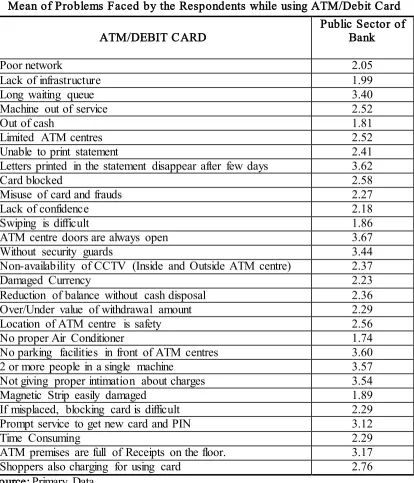
The below table shows the major problems
faced by the customers while accessing
Papers in Special Issue on Recent Research Scenario 2016 can be accessed from Table No. 1
Mean of Problems Faced by the Respondents while using ATM/Debit Card
ATM/DEBIT CARD Public Sector of Bank
Poor network 2.05
Lack of infrastructure 1.99
Long waiting queue 3.40
Machine out of service 2.52
Out of cash 1.81
Limited ATM centres 2.52
Unable to print statement 2.41
Letters printed in the statement disappear after few days 3.62
Card blocked 2.58
Misuse of card and frauds 2.27
Lack of confidence 2.18
Swiping is difficult 1.86
ATM centre doors are always open 3.67
Without security guards 3.44
Non-availability of CCTV (Inside and Outside ATM centre) 2.37
Damaged Currency 2.23
Reduction of balance without cash disposal 2.36
Over/Under value of withdrawal amount 2.29
Location of ATM centre is safety 2.56
No proper Air Conditioner 1.74
No parking facilities in front of ATM centres 3.60
2 or more people in a single machine 3.57
Not giving proper intimation about charges 3.54
Magnetic Strip easily damaged 1.89
If misplaced, blocking card is difficult 2.29
Prompt service to get new card and PIN 3.12
Time Consuming 2.29
ATM premises are full of Receipts on the floor. 3.17
Shoppers also charging for using card 2.76
Source: Primary Data
Based on the mean score, public sector
customers using ATM/Debit Card services
are facing problems like ATM outlet doors
Papers in Special Issue on Recent Research Scenario 2016 can be accessed from statement disappear after few days (3.62),
no parking facilities in front of ATM
outlets (3.60), two or more people tend to
use a machine at a time (3.57), banks are
not giving proper intimation about charges
(3.54), lack of security guards (3.44) in the
ATM outlets and long waiting in queue
(3.40).
Inference: It is inferred that, public
sector customers are facing the similar
problems i.e. lack of infrastructure
facilities and not proper maintenance of
ATM outlets. It is evidence that, urban
ATM outlets in the study area are
accurately having these types of problems
cited by the sample respondents.
SUGGESTIONS
Nowadays, there is sufficient number of ATMs but no proper facilities to access the ATM outlets like parking, shed to stay in queue, paper free ATM center, Air Conditioner, Security guards and
Papers in Special Issue on Recent Research Scenario 2016 can be accessed from
The banks should instruct the outsourcing agents to put quality paper for printing receipt. Because, the letter in the printed receipt disappear after few days.
The customers should follow the security guidelines given by the banks while accessing ATM/Debit Card.
The customers should not disclose the PIN to anybody.
The customers should avail ATM/Debit Card with utmost care. CONCLUSION
Banking sector plays a vital role in
the growth of economic development in
India. Banking is still under evolutionary
stage as it is adopting new technologies to
facilitate further the customer convenience
in the secured environment. IBS is
becoming popular amongst customers who
are familiar with the technology up
graduation but it is gradually spreading to
mass especially at metropolitan and urban
cities. Few banks have taken an early lead
by introducing technology based banking
services. The study on the customers’
attitude towards innovative banking
services (IBS) in banking sector reveals
that customers are satisfied in some
aspects and they want to continue with
their respective banks. The shift from
cutomerised service to personalized
services is highly essential to satisfy all
groups of customers. The findings of the
study stress upon the importance of the
security and safety expected by the
customers especially in the case of
innovative banking services (IBS) like
ATM/Debit Card. The future of internet
banking lies in offering personalized
internet based services that are not only
valued by their customers but are also
unique to them. This would help
distinguish themselves in the crowd. This
would also help them evolve continuously
Papers in Special Issue on Recent Research Scenario 2016 can be accessed from new technology to build stronger customer
relationship.
REFERENCES
1. Eugine, F. D. C. & Regi, S. B., “Advantages and Challenges of
E-Commerce Customers and
Businesses: In Indian Perspective” International Journal of Research– Granthaalayah, 4(3), 7-13.
2. Golden, S. A. R. (2015). Regional
Imbalance affecting quality of
e-banking services with special
reference to Tuticorin District-An
Analysis. International Journal of
Research, 2(3), 788-798.
3. Golden, S. A. R., & Regi, S. B. (2014). Attitude of Rural People Towards Technology Inclusion In Banking Services At Tirunelveli District, IGJAE – Indo Global Journal Of Applied Management Science, 2(2).
4. Golden, S. A. R., & Regi, S. B. (2014). Customer Preference Towards E- Channels Provided By State Of Bank Of India,
Kongunadu College Of Arts And Science, Special Edition 1(1). 5. Golden, S. A. R., & Regi, S. B.
(2015). Satisfaction of Customers
towards User Friendly
Technological Services offered by Public and Private Sector banks at Palayamkottai, Tirunelveli District. International Journal of Research, 2(3), 775-787.
6. http://ezinearticles.com/?A-Brief- Introduction-to-the-Automated-Teller-Machine&id=5397483
7. http://worldwidejournals.com/parip ex/file.php?val=July_2013_137404 7900_e453d_54.pdf
8. Regi, S. B., & Dr.C. Eugine
Franco, “MEASURING
CUSTOMERS’ ATTITUDE
TOWARDS INNOVATIVE
BANKING SERVICES OF
PUBLIC AND PRIVATE
SECTOR IN TIRUNELVELI
DISTRICT” International Journal of Research – Granthaalayah, Vol. 4, No. 5: SE (2016): 58-66.
9. Regi, S. B., & Golden, S. A. R.
(2014). Customer Preference
Towards Innovative Banking
Papers in Special Issue on Recent Research Scenario 2016 can be accessed from
Of India At
Palayamkottai. Sankhya
International Journal Of
Management And Technology, 3
(11 (A)), 31, 33.
10.Regi, S. B., & Golden, S. A. R.
(2014). Customer Preference
Towards E-Channels Provided By
State Of Bank Of India.
11.Regi, S. B., and Dr.C. Eugine
Franco, “MEASURING
CUSTOMERS’ ATTITUDE
TOWARDS INNOVATIVE
BANKING SERVICES OF
PUBLIC AND PRIVATE
SECTOR IN TIRUNELVELI
DISTRICT” International Journal of Research – Granthaalayah, Vol. 4, No. 5: SE (2016): 58-66.
12.Regi, S. B., Golden, S. A. R., &
Franco, C. E. (2014). ROLE OF
COMMERCIAL BANK IN THE
GROWTH OF MICRO AND
SMALL ENTERPRISES. Golden