ISSN (Print) : 2320 – 3765 ISSN (Online): 2278 – 8875
I
nternational
J
ournal of
A
dvanced
R
esearch in
E
lectrical,
E
lectronics and
I
nstrumentation
E
ngineering
(An ISO 3297: 2007 Certified Organization)
Vol. 5, Issue 11, November 2016
Study of Grid connected PV Power
Generation Inverter Control System with
MPPT Method
M. S.Thakare1, M. D. Khardenvis 2, V.M.Jape3
M Tech Scholar, Dept. of Electrical Engineering, Govt. College of Engineering, Amravati, Maharashtra, India1 Assistant Professor, Dept. of Electrical Engineering, Govt. College of Engineering, Amravati, Maharashtra, India2 Assistant Professor, Dept. of Electrical Engineering, Govt. College of Engineering, Amravati, Maharashtra, India3
ABSTRACT: this paper presents the experimental model of grid connected PV power generation inverter control system. On the basis of experimental study of power output side of photovoltaic grid connected generator system, it is seen that in photovoltaic (PV) power generation, partial shading is an unavoidable complication that significantly reduces the efficiency of the overall system. The complication can be resolved by using maximum power point tracking technique. On using the maximum power point tracking technique, the effectiveness of improved PWM inverter control method is analyzed. Considering the result of experiments, a single phase grid connected Improved PWM inverter control system is designed. The result of the simulations performed using MATLAB/SIMULINK software shows that the improved PWM inverter control system can effectively control the grid current sine waveform using the less computationally demanding harmonic suppression technique. It can achieve the maximum power point tracking. The simulations are performed for a 10 volts system and after analyzing the simulation results, the system is implemented in hardware. After the comparison of simulation model and actual hardware for 10 volts system we implemented the system for 1000 volts. The proposed hardware is able to put the arbitrary power out to the load or to the grid to maintain the stability and reliability of the power system.
KEYWORDS: PV Power generation, Improved PWM Inverter, photovoltaic cell, Maximum power point tracking
I.INTRODUCTION
Due to the increasingly burning energy issues, the world concentrates on giving importance to begin the development of new energy and related technology. At present, large-scale photovoltaic power generation and scale of renewable energy has become important parts of development strategy, meanwhile it is the way to guide the development of photovoltaic industry [1], [2]. However, because of its different characteristics from conventional power generation, grid-connected PV power station and its security, stability and reliable operation became new challenges which power grid and PV power plant need to face.
ISSN (Print) : 2320 – 3765 ISSN (Online): 2278 – 8875
I
nternational
J
ournal of
A
dvanced
R
esearch in
E
lectrical,
E
lectronics and
I
nstrumentation
E
ngineering
(An ISO 3297: 2007 Certified Organization)
Vol. 5, Issue 11, November 2016
II. GRID-CONNECTED PV GENERATION SYSTEM
A. GRID CONNECTED PV GENERATION SYSTEM
Grid-connected PV generation system is mainly composed of the PV array, the inverter device with the function of maximum power tracking and the control system. The inverter device with the function of maximum power point tracking can inverse the electric power into sinusoidal current, and connect to the grid [6]. The control system mainly
control the maximum power point tracking of photovoltaic, current waveform and power of the output of grid-connected inverter, which makes the output to the grid correspond with the export by PV array.
Fig. 1 Grid-connected PV power generation structure
B. INVERTER CONTROL THEORY
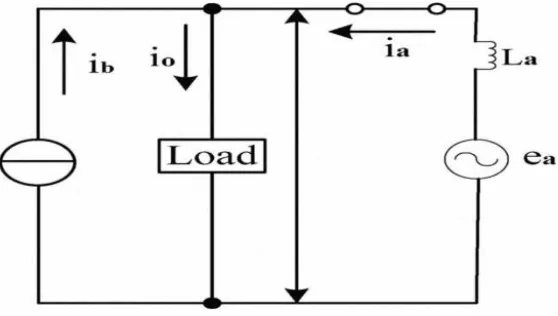
Inverter can control the switch state of shut and conduct, thus the system may form two different working ways which are parallel operation and independent operation. When the system is working in a parallel operation way, the inverter belongs to the current mode.
Fig. 2 Equivalent circuit of the inverter in parallel operating mode
C. WORKING OF PV CELL
ISSN (Print) : 2320 – 3765 ISSN (Online): 2278 – 8875
I
nternational
J
ournal of
A
dvanced
R
esearch in
E
lectrical,
E
lectronics and
I
nstrumentation
E
ngineering
(An ISO 3297: 2007 Certified Organization)
Vol. 5, Issue 11, November 2016
solar energy is absorbed in the semiconductor material. If absorbed energy is greater than the band gap energy of the semiconductor, the electrons from the valence band jumps to the conduction band. By this, pair of hole electrons are created in the illuminated region of the semiconductor. The electrons thus created in the conduction band are now free to move. These free electrons are forced to move in a particular direction by the action of electric field present in the PV cell. These flowing electrons constitutes current and can be drawn for external use by connecting a metal plate on top and bottom of PV cell. This current and voltage created because of its built in electric fields produces required power.
Fig. 3 D.C Equivalent Circuit.
The photovoltaic cell output voltage is basically functioning of the photocurrent which is mainly determined by load current depending on the solar irradiation level during the operation.
VC = (A*K*TC/e)ln[(Iph+I0-IC/I0)-RS*IC The symbols used are
VC = cell output voltage
TC = reference cell operating temperature RS = series resistance of cell
Iph = photocurrent, function of irradiation level and junction temperature I0 = reverse saturation current of the diode
IC = cell output current
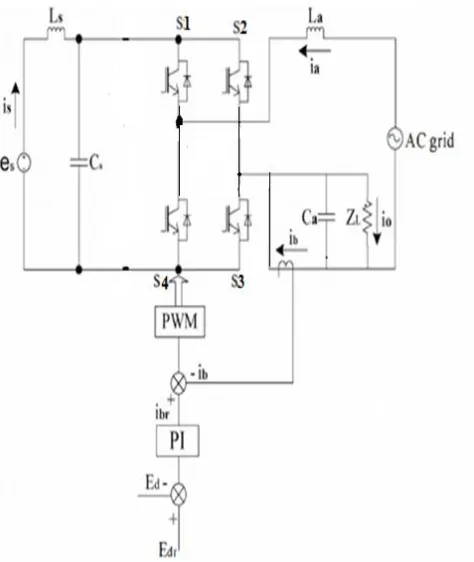
III. INTRODUCTION OF IMPROVED PWM INVERTER CONTROL METHOD
ISSN (Print) : 2320 – 3765 ISSN (Online): 2278 – 8875
I
nternational
J
ournal of
A
dvanced
R
esearch in
E
lectrical,
E
lectronics and
I
nstrumentation
E
ngineering
(An ISO 3297: 2007 Certified Organization)
Vol. 5, Issue 11, November 2016
Fig. 4 Improved type PWM Inverter Control System.
IV. HARDWARE IMPLEMENTATION OF MAXIMUM POWER POINT TRACKING
ISSN (Print) : 2320 – 3765 ISSN (Online): 2278 – 8875
I
nternational
J
ournal of
A
dvanced
R
esearch in
E
lectrical,
E
lectronics and
I
nstrumentation
E
ngineering
(An ISO 3297: 2007 Certified Organization)
Vol. 5, Issue 11, November 2016
D1 DIODE L1 400mH Q1 p55n C1
6700uf C210uf
C2(2) RA0/AN0 2 RA1/AN1 3 RA2/AN2/VREF-/CVREF 4 RA4/T0CKI/C1OUT 6 RA5/AN4/SS/C2OUT 7 RE0/AN5/RD 8 RE1/AN6/WR 9 RE2/AN7/CS 10 OSC1/CLKIN 13 OSC2/CLKOUT 14 RC1/T1OSI/CCP2 16 RC2/CCP1 17 RC3/SCK/SCL 18 RD0/PSP0 19 RD1/PSP1 20 RB7/PGD 40 RB6/PGCRB5RB4 393837 RB3/PGMRB2RB1 363534 RB0/INT 33 RD7/PSP7 30 RD6/PSP6 29 RD5/PSP5 28 RD4/PSP4 27 RD3/PSP3 22 RD2/PSP2 21 RC7/RX/DT 26 RC6/TX/CKRC5/SDO 2524 RC4/SDI/SDA 23 RA3/AN3/VREF+ 5 RC0/T1OSO/T1CKI 15 MCLR/Vpp/THV 1 U1 PIC16F877A X1 8MHz C1 33nF C3 33nF PV cell R1 2.2k R2 8.2k
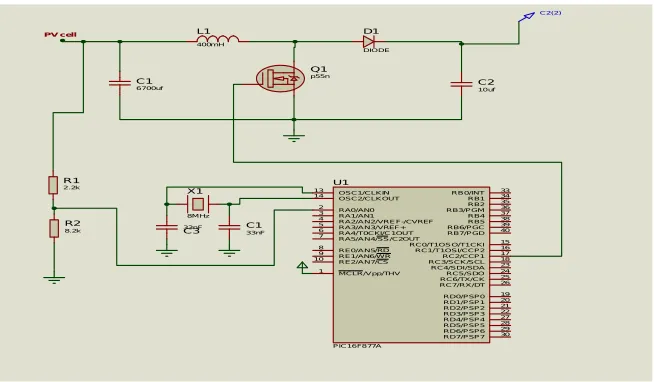
Fig 5. MPPT Hardware Circuit
Output Tables:-
Sr.No. From PV Cell
(volt)
Output(volt)
1 11 55
2 11.5 55 3 12 55.1 4 12.5 55.1 5 13 55.1 6 13.5 55.1 7 14 55.1 8 14.5 55.2 9 15 55.2 10 15.5 55.3 11 16 55.3 12 16.5 55.3 13 17 55.3 14 17.5 55.3 15 18 55.3
Hardware of single phase Inverter circuit
ISSN (Print) : 2320 – 3765 ISSN (Online): 2278 – 8875
I
nternational
J
ournal of
A
dvanced
R
esearch in
E
lectrical,
E
lectronics and
I
nstrumentation
E
ngineering
(An ISO 3297: 2007 Certified Organization)
Vol. 5, Issue 11, November 2016
RA0/AN0 2 RA1/AN1 3 RA2/AN2/VREF-/CVREF 4 RA4/T0CKI/C1OUT 6 RA5/AN4/SS/C2OUT 7 RE0/AN5/RD 8 RE1/AN6/WR 9 RE2/AN7/CS 10 OSC1/CLKIN 13 OSC2/CLKOUT 14 RC1/T1OSI/CCP2 16 RC2/CCP1 17 RC3/SCK/SCL 18 RD0/PSP0 19 RD1/PSP1 20 RB7/PGD 40 RB6/PGCRB5 39 38 RB4 37 RB3/PGM 36 RB2 35 RB1 34 RB0/INT 33 RD7/PSP7 30 RD6/PSP6 29 RD5/PSP5 28 RD4/PSP4 27 RD3/PSP3 22 RD2/PSP2 21 RC7/RX/DT 26 RC6/TX/CK 25 RC5/SDO 24 RC4/SDI/SDA 23 RA3/AN3/VREF+ 5 RC0/T1OSO/T1CKI 15 MCLR/Vpp/THV 1 U1 PIC16F877A X1 8MHz C1 33nF C3 33nF HIN 10 LIN 12 VB 6 HO 7 VS 5 LO 1 COM 2 SD 11 VC 3 U2 IR2112 HIN 10 LIN 12 VB 6 HO 7 VS 5 LO 1 COM 2 SD 11 VC 3 U3 IR2112 Q1 2N6782 Q2 2N6782 Q3 2N6782 Q4 2N6782 D2 1N4148 D3 1N4148 OUT PUT
Fig 6. single phase Inverter circuit
D. Hardware Outputs
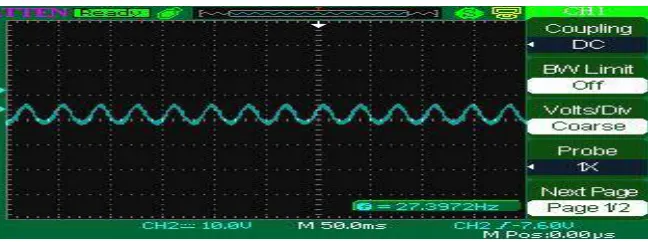
Fig. 7.Graph for power generating in MW
ISSN (Print) : 2320 – 3765 ISSN (Online): 2278 – 8875
I
nternational
J
ournal of
A
dvanced
R
esearch in
E
lectrical,
E
lectronics and
I
nstrumentation
E
ngineering
(An ISO 3297: 2007 Certified Organization)
Vol. 5, Issue 11, November 2016
V. IMPROVED PWM INVERTER CONTROL SYSTEM FOR 10 VOLT
A. SIMULATION
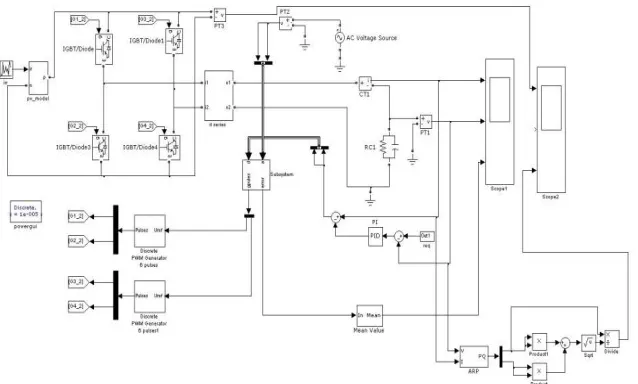
The simulation mainly use MATLAB/Simulink software to build a single-phase grid-connected PV generation system, which combines with the improved type PWM inverter control method, the structure is shown in Fig. 5. The system is mainly composed of PV array module, IGBT inverter module, LC filter module and PWM regulator module.
Fig.9 Single-phase PV grid-connected generation system
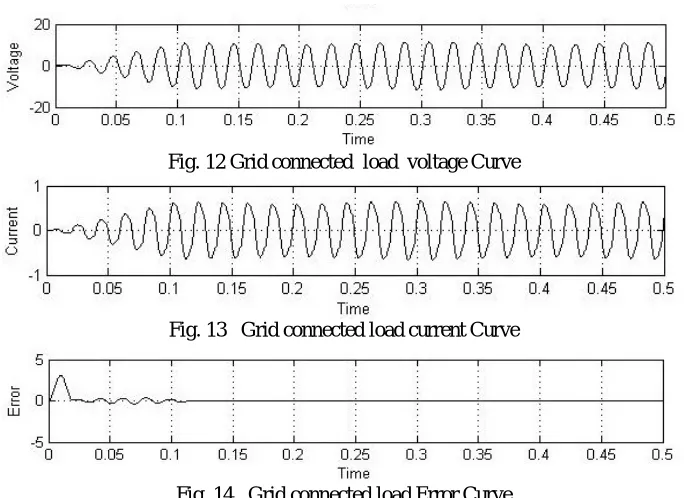
In the example, the voltage of PV cell is set to 10V, the load is in form of resistance and inductance whose resistance is set to 10 and the inductance is set to 0.5mH which is equivalent to 7W. PWM regulator controls the current of inverter through using the outer loop to control voltage and using the inner loop to control current, whose modulation index is 0.8. The load current and the output voltage of inverter can be got by calculation. The load current effective value is 0.7A, while the output voltage effective value of inverter is 0.707 V. PV array output voltage curve, Grid-connected load voltage curve and Grid-connected load current curve, load P.F, load Error are shown in Fig.10, Fig .11,Fig. 12,Fig 13 and Fig. 14 separately.
B. SYSTEM OUTPUTS
Fig. 10. Output voltage of PV Cell
ISSN (Print) : 2320 – 3765 ISSN (Online): 2278 – 8875
I
nternational
J
ournal of
A
dvanced
R
esearch in
E
lectrical,
E
lectronics and
I
nstrumentation
E
ngineering
(An ISO 3297: 2007 Certified Organization)
Vol. 5, Issue 11, November 2016
Fig. 12 Grid connected load voltage Curve
Fig. 13 Grid connected load current Curve
Fig. 14 Grid connected load Error Curve
Fig. 10 and Fig. 11 are the load voltage curve and load current curve separately. From the two curves, operating voltage and current are unstable up to 0.3 sec and then return to near-sinusoidal waveforms quickly, which shows the improved PWM inverter control method can achieve a stable output power better and faster. The power is arbitrary sent to the grid through controlling the PWM regulator, after analyzing the spectral; the power factor will reach to 0.95, which is fully satisfied with the requirement of PV grid-connected generation.
VI. IMPROVED PWM INVERTER CONTROL SYSTEM FOR 1000 VOLTS
A. SIMULATION
ISSN (Print) : 2320 – 3765 ISSN (Online): 2278 – 8875
I
nternational
J
ournal of
A
dvanced
R
esearch in
E
lectrical,
E
lectronics and
I
nstrumentation
E
ngineering
(An ISO 3297: 2007 Certified Organization)
Vol. 5, Issue 11, November 2016
Fig. 15 Single-phase PV grid-connected generation system
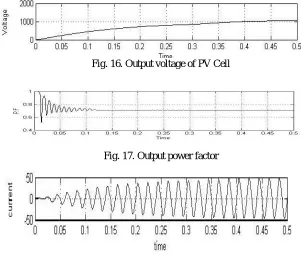
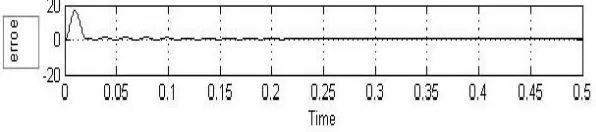
In the example, the voltage of PV cell is set to 1000V, the load is in form of resistance and inductance whose resistance is set to 100 and the inductance are set to 50mH which is equivalent to 500W. PWM regulator controls the current of inverter through using the outer loop to control voltage and using the inner loop to control current, whose modulation index is 0.8. The load current and the output voltage of inverter can be got by calculation. The load current effective value is 37A, while the output voltage effective value of inverter is 800V. PV array output voltage curve, Grid-connected load voltage curve and Grid-connected load current curve, load P.F, load Error are shown in Fig.16, Fig. 17, Fig. 18, Fig 19 and Fig. 20 separately.
B. SYSTEM OUTPUTS
Fig. 16. Output voltage of PV Cell
Fig. 17. Output power factor
ISSN (Print) : 2320 – 3765 ISSN (Online): 2278 – 8875
I
nternational
J
ournal of
A
dvanced
R
esearch in
E
lectrical,
E
lectronics and
I
nstrumentation
E
ngineering
(An ISO 3297: 2007 Certified Organization)
Vol. 5, Issue 11, November 2016
Fig. 19 Grid connected load voltage Curve
Fig. 20 Grid connected load Error Curve
The proposed hardware is able to put the arbitrary power out to the load or to the grid to maintain the stability and reliability of the power system. The system is mainly composed of PV array module, IGBT inverter module, LC filter module and PWM regulator module.
VII. CONCLUSION
Improved PWM inverter control system is based on the voltage type control method and the PWM power type control method. The result of simulation and conclusions shows that the improved PWM inverter control method can make the voltage and the current waveform of the grid tend to sine wave effectively and quickly, and the power factor will reach to one. The power can be sent to the grid or load arbitrary through controlling the PWM regulator, while the control system has a good stability. It also shows that as the increasing number of inductive load penetrate the grid, the load waveform distortion is produced, but it will not affect the reliability of power supply.
REFERENCES
[1] Amirnaser Yazdani, Prajna Paramita Dash. "A control methodology and characterization of dynamics for a photovoltaic(PV) system interfaced with a distribution network," IEEE Trans. Power Delivery, vol. 24, pp. 1538-1551, Jul. 2009.
[2] Yun Tiam Tan, Daniel S.Kirchen, Nicholas Jenkins. "A model of PV Generation Suitable for Stability Analysis". IEEE Transactions on Energy Conversion, vol. 19, pp. 748-755, Dec. 2004
[3] Hiroshi Yamashita, Keita Tamahashi, Masakazu Michihira, Akiara Tsuyoshi, Kuniyuki Amako, Minwon Park. "A novel simulation technique of the PV generation system using real weather conditions," Power Conversion Conference, pp. 839-844, 2002.
[4] M. Park, K.Matsuura, M. Michihira. "A Novel Simulation Method of PV cell using Field Data", Trans. of IEEE Japan, 121-B, No.2, pp.262-263(200 I).
[5] AKotsopoulos, J.L.Duarte, M.AM. Hendrix. "A predictive control scheme for DC voltage and AC current in grid-connected photovoltaic inverters with minimum DC link capacitance". The 27th Annual Conference of the IEEE Industrial Electronics Society, pp. 1994-1999. . [6] H.S.Bae, SJ.Lee, K.S.Cho, S.SJang. "Current control Design for a Grid Connected Photovoltaic/Fuel Cell DC-AC Inverter". IEEE Trans. On
Energy Conversion, pp. 1945-1950, 2009.
[7] O.Wasyneauk, N.AAnwah. "Modeling and Dynamic Performance of a Self-commutated Photovoltaic Inverter System". IEEE Trans. on Energy Conversion, vol. 4, NO.3, pp. 322-328, Sep. 1989.
[8] M. C. Cavalcanti, G. M. S. Azevedo, B. A. Amaral “Efficiency Evaluation in Grid Connected Photovoltaic Energy Conversion Systems”. IEEE Trans. On Energy Conversion, pp. 269-275, 2005.
[9] J.A.Gow ,C.D.Manning “Development of a photovoltaic array model for use in power- electronics simulation studies”. IEEE Proc.-Electr. Power Appl., Vol. 146, No.2, March 1999.
[10] Seul-Ki Kim, Eung-Sang Kim and Jong-Bo Ahn “Modeling and Control of a Grid-connected Wind/PV Hybrid Generation System”. IEEE Trans. On Energy Conversion, pp. 1-6, 200
ISSN (Print) : 2320 – 3765 ISSN (Online): 2278 – 8875
I
nternational
J
ournal of
A
dvanced
R
esearch in
E
lectrical,
E
lectronics and
I
nstrumentation
E
ngineering
(An ISO 3297: 2007 Certified Organization)
Vol. 5, Issue 11, November 2016
[12] R. K. Pongiannan,, S. Paramasivam, and N. Yadaiah, “Dynamically Reconfigurable PWM Controller for Three-Phase Voltage-Source Inverters” Ieee Transactions On Power Electronics, Vol. 26, No. 6, June 2011
[13] Rodrigo Padilha Vieira, Cristiane Cauduro Gastaldini, Rodrigo Zelir Azzolin,Humberto Pinheiro and Hilton Ab´ılio Gr¨undling “Simple PWM
Approach for Modulation of Three-leg Inverters Driving Two-phase Symmetrical and Asymmetrical Machines” XIX International Conference on Electrical Machines - ICEM 2010, Rome
[14] Chris S. Edrington, Saritha Balathandayuthapani, and Jianwu Cao “Analysis of Integrated Storage and Grid Interfaced Photovoltaic System via Nine-switch Three-level inverter” 978-1-4244-5226-2/10/©2010 IEEE
[15] “Nonisolated High Step-Up DC–DC Converters Adopting Switched-Capacitor Cell” Gang Wu, Xinbo Ruan and Zhihong Ye. Ieee transactions on industrial electronics, vol. 62, no. 1, january 2015
[16] Peng Li, Senior Member, IEEE, Xiaomeng Yu, Jing Zhang, and Ziheng Yin, Student Member, IEEE “The H∞ Control Method of Grid-Tied Photovoltaic Generation” IEEE Transactions on smart grid, vol. 6, no. 4, july 2015
[17] Vivek Nandan Lal, Student Member, IEEE, and S. N. Singh, Senior Member, IEEE “Control and Performance Analysis of a Single-Stage Utility-Scale Grid-Connected PV System” Manuscript received January 7, 2014; revised May 15, 2014, August 14, 2014, and October 12, 2014; accepted February 21, 2015.
[18] Erhan Demirok, Dezso Sera, Student Member, IEEE, Remus Teodorescu, Senior Member, IEEE, Pedro Rodriguez, and U. Borup, Member, IEEE .“Clustered PV Inverters in LV Networks: An Overview of Impacts and Comparison of Voltage Control Strategies”. 2009 IEEE Electrical Power & Energy Conference
[19] Gazi M.S. Islam, Student Member, IEEE, and Ahmed Al Durra, Senior Member, IEEE “LVRT Capability Improvement of a Grid-connected PV Park by Robust Sliding Mode Control”. 2015 American Control Conference Palmer House Hilton July 1-3, 2015. Chicago, IL, USA.
[20] Rosa A. Mastromauro, Student Member, IEEE, Marco Liserre, Senior Member, IEEE “A Single-Phase Voltage Controlled Grid Connected Photovoltaic System with Power Quality Conditioner Functionality” IEEE Transactions No. 6, June 207
BIOGRAPHY
Mahesh.S.Thakare received Degree in Electrical Engg. From Y.C.College of Engineering, Nagpur (M.S.), India. .Presently; he is an M Tech (EPS) student at Govt. College of Engineering, Amravati (M.S.), India.
Prof. M.D.Khardenvis received the B.E. degree in electrical engineering from R.K.N.E College of Engg Nagpur,(M.S.).,She IS Industrial experience of 9 year. From 2002 working as Assist. Prof. at Govt. College of Engineering, Amravati (M.S.), India .The research area are Transmission expansion Planning.
Prof. V.M.Jape received the B.E. degree in electrical engineering Govt. College of Engineering, Amravati (M.S.). He had also completed his M.E from VJTI Mumbai .Total teaching experience of 26 year working as Associate Professor the research area are Control system & Drives.