Traffic-Dependent and Energy-Based Time Delay
Routing Algorithms for Improving Energy
Efficiency in Mobile Ad Hoc Networks
K. Murugan
Ramanujan Computing Centre, College of Engineering, Chennai, India Email:[email protected]
S. Shanmugavel
Telematics Lab, Department of ECE, College of Engineering, Chennai, India Email:[email protected]
Received 4 July 2004; Revised 26 May 2005
Reducing power consumption and increasing battery life of nodes in an ad hoc network requires an integrated power control and routing strategy. The power control is achieved by new route selection mechanisms for MANET routing protocols, which we call energy-based time delay routing (EBTDR) and highest energy routing (HER). These algorithms try to increase the operational lifetime of an ad hoc network by implementing a couple of modifications to the basic DSR protocol and making it energy efficient in routing packets. The modification in EBTDR is enabled by introducing a delay in forwarding the packets by nodes, which is inversely proportional to the remaining energy level of the node, while in HER the route selection is based on the energy drain rate information in the route request packet to improve the fidelity in selection as it provides an optimized solution based on the link traffic in the network. It is observed from the simulation results that the proposed algorithms increase the lifetime of mobile ad hoc networks, at the expense of system complexity and realization.
Keywords and phrases:DSR, AODV, energy efficient routing protocols, ad hoc networks, GloMoSim, MANET.
1. INTRODUCTION
The mobile ad hoc networks (MANETs) [1] are instantly de-ployable without anywired base station or fixed infrastruc-ture. A node communicates directly with the nodes within radio range and indirectly with all others using a dynami-cally determined multihop route. The major motivation for studying ad hoc networks comes from military usage, sev-eral forms of tactical communication such as disaster re-coveries, law enforcements, and various forms of home and personal area networks as well as sensor networks. A criti-cal issue for MANETs is that the activity of nodes is energy-constrained. However, significant energy savings can be ob-tained at the routing level by designing minimum energy routing protocols that take into consideration the energy costs of a route when choosing the appropriate route. ad hoc routing protocols can be broadly classified as table-driven routing protocols and source-initiated on-demand
This is an open access article distributed under the Creative Commons Attribution License, which permits unrestricted use, distribution, and reproduction in any medium, provided the original work is properly cited.
routing protocols [2]. Table-driven schemes are more expen-sive in terms of energy consumption as compared to the on-demand schemes because of the large routing overhead in-curred in the former [3]. Hence, the on-demand approach is preferable for designing minimum energy routing proto-cols.
Conventional on-demand routing protocols such as ad hoc on-demand distance vector (AODV) [8] and dynamic source routing (DSR) [9] are not energy aware. Routing is done based on the shortest path in which the cost met-ric either considers number of hops or end-to-end de-lay at the time when route is established. If nodes are energy-constrained, route selection based on these metrics alone may have adverse effect on the network lifetime on the whole. For example, a node that lies on several routes will die prematurely and the network may get partitioned. Since recharging or replacing the battery is not feasible in most of the ad hoc network applications, it is imperative to study and design routing protocols which are able to conserve node en-ergy to prevent such premature death.
In this paper, work is focused on the design and imple-mentation of energy-based time delay routing (EBTDR) al-gorithm in the existing DSR protocol by introducing a delay in forwarding the packets by nodes, which is inversely pro-portional to the remaining energy level of the node. In ad-dition to our work, selection of routes based on the energy information on the route request packet was also explored based on the highest energy routing algorithm. A variation of the highest energy routing (HER) algorithm attempts to discourage nodes with small lifetime from participating in the route discovery. Thus the network partitions occur rarely and reliability of packet transfer through the path increases. The path selected is energy efficient since it deters selection of paths through nodes with higher loading, so as to avoid using node’s power to transmit the packet. Quick depletion of energy along the paths occurs if the traffic demands are long lasting and concentrated for routing protocols that are not aware of energy consumption. The destination node de-cides on the route path based on the introduction of a new metric called drain rate (DR). The drain rate is calculated with the remaining energy of a node (to predict the lifetime of nodes) according to current traffic conditions. These algo-rithms are designed and implemented using global mobile simulator (GloMoSim), a scalable simulation environment for network simulation. We evaluated the performance of all the protocols under a wide range of conditions by varying the node mobility and network load.
The rest of this paper is organized as follows. We provide a brief overview of the existing DSR protocol in Section 2. In Section 3, we explain energy-based time delay routing (EBTDR) and highest energy routing (HER) algorithms.
Section 4 analyzes the simulation methods and environ-ments. Section 5 discusses the performance of our algo-rithms.Section 6describes a review of the routing schemes related to this work. Finally, we present our conclusion in
Section 7.
2. OVERVIEW OF THE EXISTING PROTOCOL MECHANISM
In this section, we outline the existing version of on-demand routing algorithm DSR. This will provide a reference for de-signing the minimum energy routing protocol and serve as a base for our performance comparisons.
2.1. Dynamic source routing
We use the dynamic source routing (DSR) protocol [8,9] in this paper to illustrate the effects of energy efficiency in on-demand routing protocols, since DSR operates entirely on-demand. DSR is composed of two mechanisms that work together to allow the discovery and maintenance of source routes in the ad hoc network. This section describes the ba-sic operation of route discovery and route maintenance. Al-though a number of optimizations to this basic operation exist [8,9], they are not discussed here due to space limi-tations. Route discovery is the mechanism by which a node
Swishing to send a packet to a destination nodeDobtains a source route to D. Route discovery is used only when S
attempts to send a packet to Dand does not know a route to D. To initiate a new route discovery to a node D (the target of the route discovery), S transmits a route request
(RREQ) packet, which is received by other nodes located within direct wireless transmission range of S. Each node that receives the RREQ packet appends its own address to a record in the packet and rebroadcasts it to its neighbors, unless it has recently seen another copy of the RREQ for this route discovery or it finds that its address was already listed in the route record in the packet. The forwarding of the RREQ continues till the node S receives a route reply
(RREP) packet from D, giving a copy of the accumulated route record from the RREQ. The RREP contains the path that the RREQ traveled to reachD. The major objective of the route maintenance procedure is to detect a broken link and find a new route to destination. DSR is able to learn routes by overhearing packets, not addressed to it, using promis-cuous mode (DSR-PR). DSR-PR disables the “interface ad-dress filtering” and causes the network protocol to receive all packets that the interface overhears to obtain useful source routes.
3. ENERGY-EFFICIENT MANET ROUTING ALGORITHM
In the common thread of energy-aware routing protocols, routing decisions should be based on each node’s energy level. The ultimate goal of our approach is to have a good energy balance among mobile nodes, which results in long service time of the network. Considering the example in
Figure 1, usage of the same shortest path would shorten the lifetime of the system and hence should be avoided (the re-maining energy levels are given adjacent to the nodes). Thus, the basic idea behind our energy-aware routing protocols is to utilize diverse routing paths instead of continuous use of a single path.
7 9 8
A B C
S T
5 3
D E
Figure1: Example network.
3.1. Energy-based time delay routing algorithm
The energy-based time delay routing algorithm is based on the DSR protocol. The route discovery in the DSR protocol is modified so as to select the most energy-efficient route by the source node. The route maintenance is essentially the same as in DSR. Generally in an on-demand routing algorithm, when a source needs to know the route to a destination, it broad-casts an RREQ packet. The neighboring nodes on receiving the first-arrived RREQ packet relay this packet immediately to their neighbors. But in the EBTDR algorithm, the “packet forwarding” does not occur immediately. In the EBTDR al-gorithm, each node on receiving a request packet holds the packet for a period of time, which is inversely proportional to its current energy level [10]. After this delay period, the node forwards the request packet. This simple delay mechanism is motivated by the fact that the destination node accepts only the first request packet and discards other duplicate requests. With our delay mechanism [11], request packets from nodes with lower energy levels are transmitted after a larger delay whereas the request packets from nodes with higher energy levels are transmitted with a smaller delay. This route discov-ery procedure continues until the destination node receives the first request packet whose recorded routes may consti-tute nodes with high energy levels. A node holds the RREQ packet for a small duration that is inversely proportional to its own residual battery capacity.
Some nodes may receive several copies of the same RREQ packet from other neighbors. In EBTDR, the duplicate copies of the same RREQ packets would be dropped. InFigure 2, as-sume that the initial maximum battery capacity of all nodes is 10. The remaining energy levels after a finite amount of time are shown inFigure 2alongside the nodes. Owing to trans-mission range limitations, nodes AandBcan transmit the packet only to nodesCandD, respectively. The residual bat-tery capacities ofAandBnodes are the same, and therefore they flood the RREQ packets at the same time. The travel time between nodes may be ignored without loss of gener-ality. Since node Dhas more residual battery capacity than nodeC, other neighbors that can communicate with nodes
C and D receive the RREQ packet from node C (because of the inverse delay). The process repeats until the RREQ packet arrives at the destination. In this figure, the destina-tion node receives packets on many routes out of which the three routes, namely, (S-B-C-E-T), (S-A-D-F-T), and (S
-9 T2
7 T5
9
B C E
T1
T6 S
T1
A T2 D T4 6
G T7 T
9 8
9 T4 T5
B 9
F
RREQ packet Duplicate packet RREP packet
Node number
Remaining energy capacity
Figure2: Example network with energy level.
A-D-G-T), are considered for explaining route procedure. Normally the route with the least hop is selected. But with EBTDR, the route for communication from nodeSto node
T is chosen as (S-A-D-F-T) since nodes with lesser energy level delay the packet more than the others. The intuition behind this protocol is to enable those request packets that traverse nodes with high energy levels to arrive at the desti-nation early. Note that the implementation of the proposed algorithm requires minimal modification at local nodes by adding a delay mechanism [11]. However, the penalty of this protocol is introduction of delay in route discovery proce-dure. The destination sends a route reply (RRPL) packet back to this route and data packet transmission starts when the source receives the RRPL packet from the destination. The selected route (S-A-D-F-T) may not always guarantee the total minimum energy partially because it does not consider the number of hops in the route. Nevertheless, simulation re-sults showed that EBTDR prolongs the network lifetime sig-nificantly.
3.1.1. Delay mechanism
In the algorithm mentioned above, we had stated that the delay incorporated by each of the nodes is inversely propor-tional to the remaining energy level of each of the corre-sponding nodes. The delay is calculated as.
d=D−D∗e
E , (1)
wheredis a delay to be introduced,Dis a maximum delay possible,eis a remaining energy of a node, andEis a maxi-mal energy possible for a node.
3.2. Highest energy routing algorithm
a way that the destination node knows about the energy lev-els of the intermediate nodes and hence can choose the most energy-efficient route. HER differs from the conventional DSR in the route discovery only. The other aspects of DSR remain essentially the same.
In the conventional DSR protocol the RREQ packet has no energy information in it. But in this algorithm an energy field is included in the RREQ packet where the intermediate nodes insert their current energy level while forwarding the RREQ packet. The information on the remaining energy lev-els of intermediate nodes reaches the destination node. Thus this algorithm makes known the energy information on all the routes available to the destination node. The destination node chooses an energy-efficient route from a set of possi-ble routes. In the conventional DSR protocol, the destina-tion node starts to transmit the RREP packet as soon as the first RREQ packet arrives. This ensures that the data packets take the shortest path to reach the destination. But it is well known that the shortest path need not always be an energy ef-ficient path. Hence it is necessary for the destination node to wait for the other RREQ packets that have travelled a longer (and perhaps a more energy-efficient) route as compared to that travelled by the first RREQ packet.
In HER, the destination node is designed in such a way that it has to wait for a short duration of time (which is di-rectly proportional to the remaining energy level of the node) during which the destination node caches the routes that are being reported to it by different RREQ packets. For this pur-pose the destination node builds a cache during route dis-covery that is very similar to the route cache called route-request cache. The destination node then sends this route re-ply packet to the source by selecting the maximum of the minimum energy in the paths acquired from the RREQ pack-ets. The selection of the route to reply by the destination depends on the energy level of the participating nodes dur-ing route discovery. This selection of the best route is based on the following algorithm: the destination node first deter-mines the least power level in each route that is reported to it by the RREQ packets. Next it compares these least power levels and chooses the highest among them and then selects the corresponding route. Thus, by this algorithm, the desti-nation node selects the route with the highest lifetime from a set of available routes. Since the least energy level is maxi-mum, the selected route has the highest lifetime among the available routes.
3.2.1. Addition of drain rate in the cost function of HER algorithm
When the remaining power is the only metric used to estab-lish the best route between the source and the destination, we cannot guarantee that a node on the route, even with a high value of remaining battery power, will survive if used to route a heavy traffic. If a node is willing to accept all route requests only because it currently has enough residual battery capac-ity, much traffic load will be injected through that node. In this sense, the actual drain rates of power consumption of the node will tend to be high, resulting in a sharp reduction of battery power. As a consequence, it could exhaust the node’s
power supply fast causing the node to die soon. To mitigate this problem, traffic load information, besides residual bat-tery power, could be employed. To this end, techniques to accurately measure traffic load at nodes should be devised [12].
As a further enhancement to the highest energy routing that has been proposed in the previous section, we now mod-ify the cost function that was used in the HER algorithm. In the HER algorithm, we used the remaining energy level of ev-ery node in the path as the cost metric. As an improvement in HER, we also consider the energy drain rate in each node. The introduction of a new metric, the drain rate (DR), is used with the remaining energy of a node to predict the life-time of nodes, according to current traffic conditions. Energy drain rate measured in mWh can be defined as the amount of energy consumed in unit time. The inclusion of energy drain rate in the cost metric improves the fidelity of the HER algo-rithm, as it provides a more optimized solution by consider-ing the link traffic in an active network. In HER algorithm, each node, instead of adding the remaining energy level, adds a cost metric to the route request packet that it forwards. The cost metric depends on both the remaining energy level in the node and its current energy drain rate. Every node cal-culates its drain rate every six seconds. The method used by each node to calculate the drain rate is similar to running average. Let DRoldbe the drain rate calculated up to the
pre-vious six-second interval and let DRnewbe the drain rate
cal-culated in the current six-second interval. The actual drain rate DR is calculated as
DR=β×DRold+ (1−β)×DRnew. (2)
In the function given in (2), the factorβ(< 1) determines how fast the history of information (DRold) is forgotten and
DRnewconverges to a factor determined by (1−β). This drain
rate that has been calculated in this manner is used to calcu-late the cost function along with the remaining energy level as given in (3):
Cost function (σ)
=current remaining energy level/drain rate (DR).
(3) This cost function of each node is then added to the route re-quest packet that is being forwarded through that node. The cost function is an inverse measure of how much network re-source is to be spent if the data transmission is to be carried out through that node. The destination node now selects the path in which theleastcost function is highest among a set of routes through RREQ packet received by the destination.
4. PERFORMANCE EVALUATION
The routing protocols are simulated within the GloMoSim library [13]. The GloMoSim library is a scalable simulation environment for wireless network systems using the par-allel discrete-event simulation capability provided by PAR-SEC [14]. We simulated a network of mobile nodes placed randomly within a 1000×1000 square meter. Each node has been chosen to have a radio propagation range of 250 meters and a channel capacity of 2 Mb/s. We used the IEEE 802.11 distributed coordination function (DCF) as the medium ac-cess control (MAC) protocol. Each simulation was executed for 900 seconds. Multiple runs with different seeds values were simulated for each scenario and the collected data was averaged over those runs. A traffic generator was devel-oped to simulate CBR sources. The size of data payload is 512 bytes. Data sessions with randomly selected sources and destinations were simulated. We varied the traffic load by changing the number of data sessions and examined its ef-fect on routing protocols.
4.1. Energy consumption model
As for the energy consumption model used in this work, we assume that every mobile node is equipped with an IEEE network interface card (NIC) with 2 Mbps. According to the specification of the NIC, the energy consumption varies from 240 mA in receiving mode to 280 mA in transmitting mode, using a 5.0 V energy supply. Thus, when calculating the en-ergy consumed to transmit a packetp,E(p)=i∗v∗tpjoules
are needed, whereiis the current,v is the voltage, andtps
is the time taken to transmit the packet p. Besides, the en-ergy consumption values are determined based on [15]. In the simulations, the voltagevis chosen as 5 V and we assume that the packet transmission timetpis dependant on
trans-mitter for transmitting the packets. We thus calculated the energy required to transmit and receive a packet pby using
Etx(p)=280 mA∗v∗tpandErx(p)=240 mA∗v∗tp[15],
re-spectively. In our simulation, all nodes have their initial en-ergy values, which are randomly selected, but with minimal deviations. Every node has an initial energy level at the begin-ning of a simulation. For every transmission and reception of packets, the energy level is decremented by a specified value, which represents the energy usage for transmitting and re-ceiving. When the energy level goes down beyond the thresh-old level, no more packets can be received or transmitted by the host.
4.2. Performance metrics
(i)Throughputis measured as the ratio of the number of data packets delivered to the destination and the number of data packets sent by the sender.
(ii)End-to-end delayis the time between the reception of the last and first packet/total number of packets reaching the application layer.
(iii)Control overheadis measured as the total number of control packets transmitted during the simulation period.
(iv)Energy variance of the nodesis defined as the vari-ance of the remaining energy levels of the entire network. It
25 50 75 100 125 150 175 200
Figure3: Control overhead versus number of nodes.
is inversely proportional to the uniform energy distribution in a network.
(v)Average energy left is taken as the average of the re-maining energy levels of all the nodes in the network.
5. SIMULATION RESULTS AND ANALYSIS
In this section, the performance results of various algorithms with respect to mobility, control overhead, throughput, end-to-end delay, energy variance, and average energy left are pre-sented. On the whole the proposed algorithms improve the energy efficiency of the mobile ad hoc networks, which is the main objective of this paper. Given below are the effects of our algorithm on the various parameters. From the results, it can be inferred that the EBTDR is well suited for high-delay and high-density networks. HER is best suited for ad hoc net-works under normal conditions of network density and load. Also under high traffic density, HER is better compared to DSR and EBTDR since it considers both drain rate and the remaining energy level of the nodes.
5.1. Routing protocol overhead
Routing protocol overhead is an important metric for com-paring these protocols as it measures the scalability of a pro-tocol in congested or low-bandwidth environments and its efficiency in terms of consuming node battery power. Proto-cols that send large number of routing packets can also in-crease the probability of packets collision and may delay data packets in network interface transmission queues. Figure 3
1 2 3 4 5 6 7 8 9 10
Figure4: Control overhead versus speed (m/s).
5 10 15 20 25 30
No. of source-destination pairs
Figure5: Control overhead versus number of source-destination pairs.
control overhead is lesser for EBTDR and HER algorithms when compared with AODV, DSR-PR, and DSR as function of mobility. In general, at the highest mobility, more control packets are needed to acquire routes, thereby increasing the overheads.Figure 4 shows that the HER receives the route requests over a period of time and gives a single route reply while DSR gives replies for all the route requests and this is the reason why HER has lesser control overhead. DSR uses greater number of control packets since it floods the RREQ packet for every source-destination pairs, which is shown in
Figure 5. From the graph, it is evident that the overhead in-creases with increase in number of source-destination pairs for DSR but decreases for HER and EBTDR. DSR-PR has less control overhead as there is promiscuous hearing.
100 200 300 400 500 600 700 800 900 0.998
Figure6: Throughput versus pause time.
5.2. Throughput
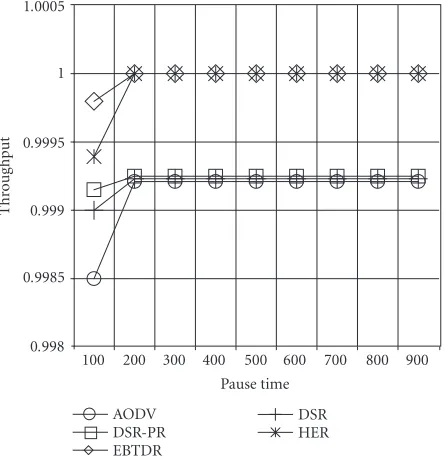
It can be inferred from Figure 6 that the throughput of EBTDR and HER is better than that of AODV and DSR-PR with respect to varying pause times, but the margin of variation is minimal. The graph also shows unity through-put for the proposed algorithms when compared to DSR and DSR-PR. This slight increase, though difficult, is attained due to lower network partitions and lower network overheads in our algorithms. Nodes in the simulation move accord-ing to a model that we call the random way point model. The movement scenario files used for each simulation are characterized by a pause time. Each node begins the simula-tion by remaining stasimula-tionary for pause time seconds. Upon reaching the destination, the node pauses again for pause time seconds, selects another destination, and proceeds. Our simulation run with movement pattern generated for diff er-ent pause times. The throughput of all protocols for ran-dom waypoint mobility with uniformly distributed speed is shown in Figure 7. In order to explore how the protocols scale as the rate of topology change varies, we changed the maximum node speed from 1 m/s to 10 m/s. This shows that all protocols deliver more than 99% of the packets at diff er-ent speeds. The performance of EBTDR and HER are com-parable to that of DSR, that is, there are no degradations in the performance of DSR by the introduction of our proposed changes in the original DSR algorithm.
5.3. End-to-end delay
1 2 3 4 5 6 7 8 9 10
Figure7: Throughput versus speed (m/s).
1 2 3 4 5 6 7 8 9 10
Figure8: End-to-end delay versus speed (m/s).
to the original DSR algorithm. This is on expected lines as in EBTDR. We have specifically added delay in forwarding route request packets. In HER we wait for a specific amount of time before replying to the route request packets. Nevertheless, the advantage gained by our modifications overweighs these shortcomings. The end-to-end delay remains constant with varying pause times for all protocols as shown inFigure 9.
5.4. Energy variance
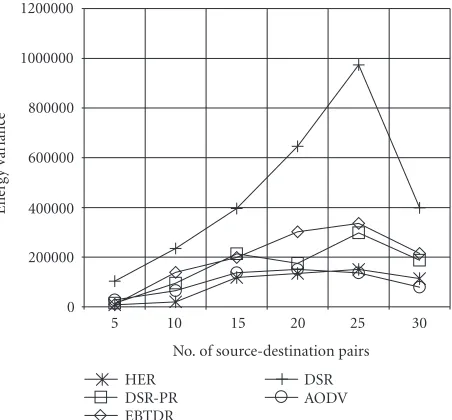
Energy variance is a factor used to identify the distribution of energy in the network.Figure 10shows that there is marginal increase in the energy variance with increase in the num-ber of source-destination pairs. The energy variance of HER protocol is lesser than that of DSR-PR and AODV.Figure 11
100 200 300 400 500 600 700 800 900 0.02
Figure9: End-to-end delay versus pause time (m/s).
5 10 15 20 25 30
No. of source-destination pairs
Figure 10: Energy variance versus number of source-destination pairs.
presents the energy variance with respect to mobility. The energy variance of EBTDR and HER are lesser than that of DSR. We vary the number of nodes from 25 to 200 with re-spect to energy variance as shown inFigure 12. All the above simulation results show that there is a uniform drain of en-ergy in the entire network. Hence, probability of a particu-lar link alone being drained completely is less, which leads to the minimization of link failure. Thus, the lifetime of the network is increased and the algorithms improve the energy efficiency of ad hoc networks.
5.5. Average energy left
1 2 3 4 5 6 7 8 9 10
Figure11: Energy variance versus speed (m/s).
25 50 75 100 125 150 175 200
Figure12: Energy variance versus number of nodes.
protocols, EBTDR and HER, increase the lifetime of the network as the network load increases.Figure 14shows the average energy left with respect to mobility for all the proto-cols. It shows that the average energy left for our algorithms (EBTDR and HER) is higher than that of DSR, AODV, and DSR-PR. HER increases the network lifetime and is also bet-ter than all the other protocols for change in number of nodes as shown inFigure 15. From all the above-mentioned results it can be concluded that HER approach can properly extend the lifetime of nodes and connections by evenly distribut-ing the energy expenditure among nodes. It avoids the over dissipation of packets through specific nodes by taking into account the current traffic profiles and drain rate of the par-ticipating nodes.
No. of source destination pairs
Figure13: Average energy left (mWh) versus number of source-destination pairs.
Figure14: Average energy left (mWh) versus speed (m/s).
6. RELATED WORK
25 50 75 100 125 150 175 200
Figure15: Average energy left (mWh) versus number of nodes.
is not being transmitted nor received. Feeney and Nilsson presented in [15] a combination of simulation and experi-mental results showing that energy and bandwidth are sub-stantively different metrics and that resource utilization in routing protocols is not fully addressed by bandwidth-centric analysis. Chang and Tassiulas [17] also proposed maximizing the life-time of a network when the message rate is known. Their main idea, namely, to avoid using low-power nodes and choose an efficient path at the beginning, has inspired the approach in this paper. In this work, we are interested in power-aware route selection mechanisms for MANET rout-ing protocols.
The MTPR (minimum total transmission power routing) [4,18] was initially developed to minimize the total “trans-mission power” consumption of nodes participating in the acquired route. According to Toh [4], the transmission power required is proportional to dα where dis the distance
be-tween two nodes andαbetween 2 and 4. This means that the MTPR prefers routes with more hops having short transmis-sion ranges to those with fewer hops but having long trans-mission ranges, with the understanding that more nodes in-volved in forwarding packets can increase the end-to-end de-lay. In addition, since the MTPR does not consider the re-maining power of nodes, it fails to prolong the lifetime of each node.
Furthermore, schemes trying to reduce only total trans-mission power do not reflect the nodes’ remaining power. Proposals, like the min-max battery cost routing (MMBCR) [5], consider the remaining power of nodes as the metrics for acquiring routes in order to prolong the lifetime of each node. Finally, Toh [4] presented the conditional max-min battery capacity routing (CMMBCR) protocol, which is a hybrid protocol that tries to arbitrate between the MTPR and MMBCR. Our approach is different from these previous works. The problems that are dealt with in this paper are to avoid: the use of nodes with weak battery supply by the use of the proposed novel routing mechanism, which selects the energy efficient route for payload transmission.
7. CONCLUSION
Various methods are proposed to improve the energy effi -ciency of mobile ad hoc networks in this paper by
realiz-ing variations from the DSR protocol. Power management in each individual node participating in the network is desir-able to increase the network lifetime. Overall lifetime of the networks has increased for the proposed algorithms by con-sidering the energy module in routing of packets. Though the algorithms HER and EBTDR involve system complexity in implementation, the advantages gained are multifold in view of energy and quality of service. The credibility of the algorithms can be judged under environments with variants in mobility and density for nodes having alarmingly low en-ergy levels. Constraints placed on the selection of route by the proposed algorithms tend to decrease the congestion in the channel, thereby enabling maximal availability of channel to nodes. Thus the delay imposed while forwarding packets by MAC layer is decreased to reduce the overlay peer-to-peer delay in HER and EBTDR. These algorithms have more man-ifold merits in various network profiles than the basic DSR protocol.
REFERENCES
[1] C. E. Perkins,Ad Hoc Networking, Addison-Wesley, Boston, Mass, USA, 2001.
[2] E. M. Royer and C.-K. Toh, “A review of current routing pro-tocols for Ad Hoc mobile wireless networks,”IEEE Pers. Com-mun., vol. 6, no. 2, pp. 46–55, 1999.
[3] T. X. Brown, S. Doshi, and Q. Zhang, “Optimal power aware routing in a wireless Ad Hoc network,” inProc. 11th IEEE Workshop on Local and Metropolitan Area Networks (LAN-MAN ’01), pp. 102–105, Boulder, Colo, USA, March 2001. [4] C.-K. Toh, “Maximum battery life routing to support
ubiqui-tous mobile computing in wireless Ad Hoc networks,”IEEE Commun. Mag., vol. 39, no. 6, pp. 138–147, 2001.
[5] S. Singh, M. Woo, and C. S. Raghavendra, “Power-aware routing in mobile Ad Hoc networks,” in Proc. 4th Annual ACM/IEEE International Conference on Mobile Computing and Networking (MOBICOM ’98), pp. 181–190, Dallas, Tex, USA, October 1998.
[6] R. Ramanathan and R. Rosales-Hain, “Topology control of multihop wireless networks using transmit power adjust-ment,” inProc. 19th Annual Joint Conference of the IEEE Com-puter and Communications Societies (INFOCOM ’00), vol. 2, pp. 404–413, Tel Aviv, Israel, March 2000.
[7] V. Rodoplu and T. H. Meng, “Minimum energy mobile wire-less networks,”IEEE J. Select. Areas Commun., vol. 17, no. 8, pp. 1333–1344, 1999.
[8] S. R. Das, C. E. Perkins, and E. M. Royer, “Performance com-parison of two on-demand routing protocols for Ad Hoc net-works ,” inProc. 19th Annual Joint Conference of the IEEE Computer and Communications Societies (INFOCOM ’00), vol. 1, pp. 3–12, Tel Aviv, Israel, March 2000.
[9] J. Broch, D. B. Johnson, and D. A. Maltz, “The Dy-namic Source Routing Protocol for Mobile Ad Hoc Net-works,” Internet-Draft, draft-ietf-manet-dsr-03.txt, October 1999. Work in progress.
[10] K. Murugan, S. Shanmugavel, S. Saravanan, C. S. Saravanan, and J. Venkatakrishnan, “Delay and energy metric based rout-ing algorithms for improvrout-ing efficiency in mobile Ad Hoc networks,” inProc. 3rd Asian International Mobile Computing Conference (AMOC ’04), Bangkok, Thailand, May 2004. [11] W. Yu and J. Lee, “DSR-based energy-aware routing
[12] D. Kim, J. J. Garcia-Luna-Aceves, K. Obraczka, J.-C. Cano, and P. Manzoni, “Routing mechanisms for mobile Ad Hoc networks based on the energy drain rate,”IEEE Transactions on Mobile Computing, vol. 2, no. 2, pp. 161–173, 2003. [13] Glomosim User Manual, http://pcl.cs.ucla.edu/projects/
glomosim.
[14] R. A. Meyer and R. Bagrodia, “PARSEC User Manual Release 1.1,” January 1999,http://pcl.cs.ucla.edu/.
[15] L. M. Feeney and M. Nilsson, “Investigating the energy con-sumption of a wireless network interface in an Ad Hoc net-working environment,” inProc. IEEE 20th Annual Joint Con-ference of the IEEE Computer and Communications Societies (INFOCOM ’01), vol. 3, pp. 1548–1557, Anchorage, Alaska, USA, April 2001.
[16] S. Singh and C. S. Raghavendra, “PAMAS: power aware multi-access protocol with signaling for Ad Hoc networks,”ACM Computer Communication Review, vol. 28, no. 3, pp. 5–26, 1998.
[17] J.-H. Chang and L. Tassiulas, “Energy conserving routing in wireless ad-hoc networks,” inProc. IEEE 19th Annual Joint Conference of the IEEE Computer and Communications Soci-eties (INFOCOM ’00), vol. 1, pp. 22–31, Tel Aviv, Israel, March 2000.
[18] K. Scott and N. Bambos, “Routing and channel assignment for low power transmission in PCS,” inProc. 5th IEEE In-ternational Conference on Universal Personal Communications (ICUPC ’96), vol. 2, pp. 498–502, Cambridge, Mass, USA, September–October 1996.
K. Murugan received his B.E. (electron-ics and communication engineering) de-gree in 1986 from Government College of Engineering, Tirunelveli, and M.E. (com-puter science) degree in 1992 from Regional College of Engineering, Tiruchirappalli. He currently works as a Selection Grade Lec-turer in Ramanujan Computing Centre, Anna University, Chennai. His current areas of research interests are routing algorithm, ad hoc networks, and mobile computing.
S. Shanmugavel received his B.S. (math-ematics) degree from Devanga Arts Col-lege, Aruppukottai, Madurai University, in 1975, and graduated from Madras Insti-tute of Technology with a major in elec-tronics and communication engineering in 1978. He obtained his Ph.D. degree in the area of coded communication and spread-spectrum techniques from India Institute of Technology, Kharagpur, India. At present he