Origin of high orbital eccentricity and inclination of asteroids
Makiko Nagasawa, Shigeru Ida, and Hidekazu Tanaka
Department of Earth and Planetary Sciences, Tokyo Institute of Technology, Meguro-ku, Tokyo 152-8551, Japan
(Received October 31, 2000; Revised April 10, 2001; Accepted May 28, 2001)
We investigate the origin of the high orbital eccentricity and inclination of present asteroids. The relative velocity between asteroids corresponding to the observed high eccentricity and inclination is ∼5 km/sec, which is much larger than their surface escape velocity. Thus collisions result in disruption rather than accretion. It is important to clarify when and how their eccentricity and inclination were pumped up, in order to know the environment of asteroidal disruption. The origin of high eccentricity and especially that of inclination have not been well understood yet. We propose sweeping secular resonances due to the gravitational potential change associated with the depletion of the protoplanetary nebula as the excitation mechanism of eccentricity and inclination. We calculated magnitudes of excited eccentricity and inclination through three-dimensional orbital integration. We found that both eccentricity and inclination are excited enough if the protoplanetary nebula is depleted from inside to outside in the region between 5 AU to 10 AU on a timescale>∼5×10⁵years. We found that the secular resonances sweep the asteroid
belt after the nebula gas is removed from there. Then the asteroidal motion is not affected by gas drag significantly. High velocity collisions between asteroids would occur in a gas-free environment.
1.
Introduction
There are two features of the present asteroid belt that cannot be accounted for by planetary perturbations in the present configuration: (1) both eccentricity (e) and inclina-tion (i) of asteroids are too high; (2) the observationally esti-mated total mass in the asteroid belt (a few×1024g) is only 0.1% of solid component mass inferred from the minimum mass solar nebula model (Weidenschilling, 1977; Hayashi, 1981).
To consider the collisional evolution of asteroids and pro-duction of meteorites, it is important to know when and how their eccentricities and inclinations are excited. In the present paper, we focus on the problem of large orbital exci-tation, though the second problem should be closely related with the first one.
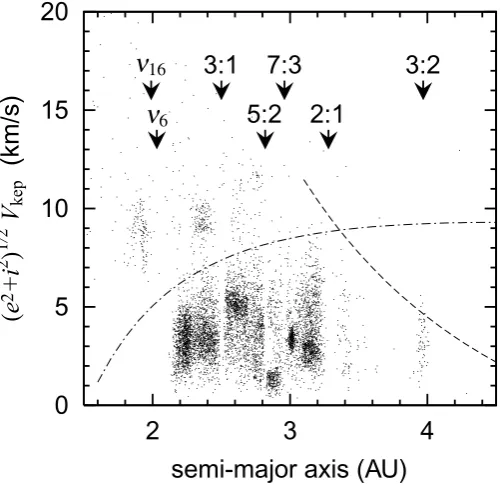
The random velocities of present asteroids defined by Vran = (e2 +i2)1/2Vkep, where Vkep is Keplerian velocity
at individual semi-major axes, are shown in the Fig. 1. In-clination (i) is given in radian in this paper. Relative ve-locities between asteroids are similar to the random veloc-ities. The root mean square of random velocities is about 4.8 km/s. Above the dotted-broken line, orbits of asteroids withi =0 cross the Martian orbit (1.52 AU) and above the dashed line they cross the Jovian orbit (5.20 AU). Aster-oids above these lines closely approach the planets and can be strongly scattered. Arrows show the locations of strong resonances. The inclinations of asteroids are excited at the location of the secular resonance calledν16, and their eccen-tricities are excited at the location of the secular resonance calledν6. These secular resonances define the inner edge of
Copy right c The Society of Geomagnetism and Earth, Planetary and Space Sciences (SGEPSS); The Seismological Society of Japan; The Volcanological Society of Japan; The Geodetic Society of Japan; The Japanese Society for Planetary Sciences.
the main asteroid belt. The locations of secular resonances shown in the Fig. 1 by arrows are those fori =0, e =0. The other arrows show the locations of mean-motion reso-nances. The orbits of asteroids can be largely affected by planetary perturbations only at the narrow regions around resonances, however,eandi (orVran) of asteroids are very
high in the entire belt.Vranand accordingly relative velocity
between asteroids are much larger than their surface escape velocities given by 1×(m/1025g)1/3km/s, wheremis mass
of asteroid with the density of 3 g/cm3. Gravity of asteroids
accelerates collision velocity up to the surface escape veloc-ity even if Vran =0. IfVran > Vesc, the collision velocities
are more than a few times Vesc, so that the collision
prod-ucts cannot be bound by their gravity (e.g., Ohtsuki et al., 1993). The collision would rather result in disruption (e.g., Greenberget al., 1978).
The high eccentricities and inclinations of asteroids can-not result from gravitational scatterings between asteroids. The random velocity acquired by mutual scattering does not exceedVesc, because collision cross section is larger than
ef-fective gravitational scattering cross section forVran >Vesc
(e.g., Safronov, 1969). Even for the largest asteroid, Ceres, its escape velocity is only∼1 km/sec. It is impossible for mutual gravity of asteroids to excite Vran up to the present
observed value∼5 km/sec. Wetherill (1989) considered a model that Earth-sized planetesimals were scattered into the asteroid belt and ejected from there after pumping upeand i of asteroids. Earth-sized planetesimals with massM can pump upVranof asteroids up to their surface escape
veloc-ity 10×(M/M⊕)1/3 km/s. Using statistical methods,
Wetherill (1992) showed that after the encounter of aster-oidal embryos, remained collisional fragments have a ve-locity distribution like that of the present asteroids. Petitet al.(2001) considered the effect of planetary embryos on the
0
kep) versus semi-major axes of the present asteroids. Above the dotted line, orbits of asteroids withi =0 cross Jovian orbit, while they cross Martian orbit above the dotted-broken line. The root mean square is about 4.8 km/s. Arrows show the locations of important mean motion resonances with Jovian orbit and secular resonances. The locations of secular resonances are shown fori=0,e=0.
asteroids starting from the stage when the runaway growth of terrestrial planets are ended (Chambers and Wetherill, 1998). They showed that the asteroids stably stay in the asteroid belt with these embryos before Jovian formation. When Jupiter is formed, the orbits of embryos are highly excited by Jovian perturbation and start to affect objects in an entire region of asteroid belt. Most of the asteroids are ejected from asteroid belt (more than 99%) by the gravita-tional stirring by the embryos. The eccentricities and incli-nations of remaining asteroids are excited to the observed level. Their model may need optimal timing of formations of terrestrial planets, asteroids, and Jupiter, although we can-not rule out these possibilities of planetary embryos.
Similarly, the high eccentricities and inclinations are not caused by collisional disruptions. Except for a small frac-tion of fragments, ejected velocities of fragments are sig-nificantly smaller than the impact velocities (e.g., Fujiwara and Tsukamoto, 1980). Because collisions are a dissipative process, they damp the eccentricities and inclinations rather than excite them, on average. Actually, members of an as-teroid family do not disperse so widely in semi-major axis, eccentricity and inclination.
As suggested in Fig. 1, the secular resonances strongly affect the orbits of asteroids. At present, the resonances are discretely located and pump upeandiin the discrete narrow regions. However, as explained below, secular resonances migrate over the entire asteroid belt when protoplanetary nebula was being depleted. The sweeping of secular reso-nances is inevitable, because the depletion of the nebula af-ter formation of Jupiaf-ter and Saturn is inevitable as explained below.
Secular resonances occur when the proper frequency sociated with the longitude of perihelion or that of the
oid belt. Ward (1981) developed techniques to calculate time evolution of secular resonances in a time-dependent axis symmetric potential. Heppenheimer (1980) and Ward (1981) concluded that characteristic timescales of nebula de-pletion must be shorter than few ×104 years, in order to
avoid excess eccentricities and inclinations of the orbit of terrestrial planets. Including the effect of gas drag, Lecar and Franklin (1997) studied the effect of the sweeping secu-lar resonances in the nebula gas through two-dimensional numerical orbital integration, using a uniform nebula de-pletion model where nebula surface density decreases with the depletion factor independent of locations in the nebula similar to Heppenheimer (1980) and Ward (1981). They also concluded that the depletion time of∼104–105 years
is preferable. If depletion timescale is longer, the asteroids (with size<∼10 km) are removed by gas drag because high eccentricities and inclinations lead to large relative veloci-ties between the particles and nebula gas and accordingly large orbital angular momentum is transferred from the par-ticle to nebula gas through gas drag (Ida and Lin, 1996). On the other hand, if the depletion timescale is shorter, the eccentricities are not pumped up to present values. How-ever, the suggested depletion time∼104–105 years would be inconsistent with lifetime of nebula∼106–107years in-ferred from observations of T-Tauri stars (Stromet al., 1993; Zuckermanet al., 1995). Nagasawaet al. (2000) showed that in the case of a non-uniform nebula depletion the re-quired timescale is consistent with 106–107years. They also
found through three-dimensional calculations that the non-uniform depletion model is needed to excite the inclinations of asteroids.
In this paper, we show how random velocities of aster-oids are excited during the depletion of the protoplanetary nebula, according to Nagasawaet al.(2000). In Section 2, we explain models we used. In Section 3 we show the re-sults. In Section 4 we give conclusions. The random ve-locities of asteroids are pumped up to observed magnitude if non-uniform nebula depletion with reasonable timescale (>∼5×10⁵years) is considered.
2.
Models and Procedures
We consider a system that consists of Jupiter, Saturn, massless asteroids, and the nebula gas, and simulate the orbital evolution of asteroids. We use the numerical tech-niques of Nagasawaet al.(2000) for orbital integration. In our simulations, we initially put 38 asteroids (10–100 km sized) on nearly circular, co-planar orbits (e,i =0.01) be-tween 2.05 AU and 3.9 AU with equal interval of 0.05 AU. Initial conditions of Jupiter and Saturn are given by veloci-ties and positions at J2000.0 with the present masses. As for the nebula model, we adopt the minimum mass solar nebula model by Hayashi (1981), in which the distribution of gas density is given by
where(r,z)are heliocentric cylindrical coordinates. We as-sume the nebula has a gap with half width 1.233 AU near the orbit of Jupiter (e.g., Lin and Papaloizou, 1993). Nagasawa et al.(2000) showed that non-uniform type of nebula deple-tion is needed to excite inclinadeple-tions. We consider the nebula is depleted from inside to outside as
ρ(r,z)=
where migration speed of the nebula edge,r˙edge, is given by
a constant parameter. When redge = 5−10 AU, secular
resonances sweep the asteroid belt. Hence the model we adopt is essentially equivalent to the model that a gap around Jupiter expands with time (Takeuchi et al., 1996). When the nebula is depleted from outside or depleted uniformly, the resonances of inclinations do not sweep in the asteroid belt region (Nagasawa et al., 2000). We also include the effect of hydrodynamic gas drag according to Adachiet al. (1976). As will be shown later, the gas drag does not damp the excited eccentricities and inclinations of asteroids, since secular resonances pass through the asteroid belt and the eccentricities and inclinations are excited after the nebula gas was cleared in the asteroid belt (afterredgebecame larger
than outer edge of the asteroid belt). In each simulation, orbits are integrated at least for 106years.
3.
Results of Numerical Simulations
Figure 2 shows an example of the orbital evolution of an asteroid with initial a = 2.35 AU. The edge of the nebula moves at a constant velocity (r˙edge = 5 ×10⁻⁶
AU/year). When the secular resonances pass though, the eccentricities and inclinations of asteroids are pumped up. The eccentricities are pumped up three times (t =6×10⁵, 1.8×10⁶, and 3.4×10⁶ years). First two passages are both due to theν5 resonance and last passage is due to the
ν6 resonance. The inclinations are pumped up four times (t = 5×10⁵, t = 6×10⁵, 1.8 ×10⁶, and 3.4 ×10⁶
years). These are due to theν16,ν15,ν15, andν16resonance, respectively. First two passages are difficult to distinguish in this figure. At the passage att =1.8×10⁶years,eand
i are excited more strongly than the other passages. After the nebula depletion, mean values of i and e attain 0.73 and 0.48, respectively. Figure 3 shows the locations of the secular resonances versus the location of the nebula edge. The lines are calculated according to the Nagasawa et al. (2000). Both eccentricity and inclination resonances sweep occur in the asteroid belt. The resonances pass where the gas was depleted. Theν5,ν15, andν16resonances migrate near Jovian orbit from inside to outside first. These resonances follow behind the nebula edge because of the local change of gravitational potential near the edge. Next, they return and pass through the asteroid belt again from outside to inside, and finally settles down to the present location. The
0
0.2
0.4
0.6
0.8
1
0
1
2
3
4
5
6
7
8
e
, i (r
ad)
time (
×
10
6years)
e
i
Fig. 2. Orbital evolution of an asteroid with initiala=2.35 AU,e,i=0. The edge velocityr˙edge=5×10⁻⁶AU/year.
0
10
20
30
0
1
2
3
0
10
20
30
time (
×
10
5
y
ear)
r
edge(A
U)
semi-major axis (AU)
ν
5ν
6ν
15ν
16nebula exists
Fig. 3. Locations of the secular resonancesν5,ν6,ν15, andν16as functions of the time. The migration speed of nebula edge isr˙edge=1×10⁻⁵AU/year. The relations between the position of nebula edge (redge) and the locations of the secular resonances do not depend on the migration speed of nebula edge. The shadowed aria shows the region where the nebula is remained.
Saturnian orbit. Theν16 resonance passa =2.35 AU when the nebula edge is at redge = 2.5 AU and redge = 16.7
AU. For the edge velocityr˙edge =5×10⁻⁶AU/year, these
passage is at 6×10⁵and 3.3×10⁶years (see Fig. 2). The
results of our simulations show good agreement with the analytical estimates.
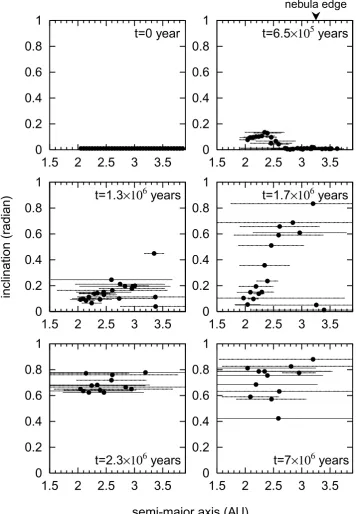
Figure 4 shows snapshots of inclination versus
semi-major axis of test particles. The edge of the nebula moves at a constant velocity (r˙edge = 5×10⁻⁶ AU/year).
0
0.2
0.4
0.6
0.8
1.5
2
2.5
3
3.5
t=0 year
0
0.2
0.4
0.6
0.8
1.5
2
2.5
3
3.5
t=6.5
×10
5years
0
0.2
0.4
0.6
0.8
1
1.5
2
2.5
3
3.5
inclination (r
adian)
t=1.3
×10
6years
0
0.2
0.4
0.6
0.8
1
1.5
2
2.5
3
3.5
t=1.7
×10
6years
0
0.2
0.4
0.6
0.8
1
1.5
2
2.5
3
3.5
t=2.3
×10
6years
0
0.2
0.4
0.6
0.8
1
1.5
2
2.5
3
3.5
semi-major axis (AU)
t=7
×10
6years
Fig. 4. The evolution of inclinations vs. semi-major axis in the cases that the velocity of nebula edge is 5×10⁻⁶AU/year. Horizontal bars show radial excursion due to eccentricities, more precisely, the distance from perihelia to aphelia.
t =6.5×10⁵years, the first secular resonances begin to pass the asteroid belt from inside to outside. Inside 2.6 AU, the inclinations and eccentricities of particles are excited by the resonance passage. In this area, random velocities (Vran = (e2+i2)1/2V
kep) are 3–5 km/s, which already exceeds
sur-face escape velocities (∼1 km/s) of 1000 km-sized particles. The collision cross sections between particles are larger than scattering cross sections with this speed. The nebula edge passes through a location ofaat 2×10⁵(a/1 AU) years. We
found that the resonances pass after the nebula edge passes through (see Fig. 3), i.e., the orbits of asteroids are exited
after the nebula is depleted around those asteroids (right up-per panel of Fig. 4). Therefore, the gas drag is not effec-tive, and the semi-major axes of particles are not damped by gas drag except at narrow regions of low-order mean motion resonances. Both secular resonances of inclination and ec-centricity pass through the asteroid belt three times as seen from Fig. 2. Att = 1.3×10⁶ years, the first resonances
0
5
10
15
20
2
3
4
(
e
2
+i
2)
1
/
2
V
ke
p
(km/s)
semi-major axis (AU)
r
edge(AU/year)=
4×10
–42×10
–55×10
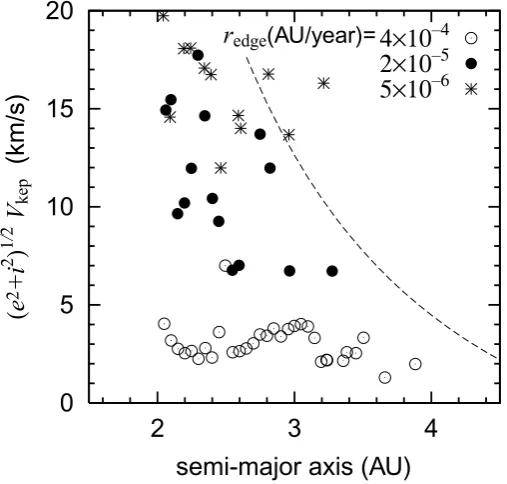
–6Fig. 5. Final random velocities versus final semi-major axes. Orbital calculations are done for three different velocities of edge (4×10⁻⁴, 2×10⁻⁵, and 5×10⁻⁶AU/year). Above the dotted line, orbits of asteroids closely approach Jovian orbit and are scattered.
Att =1.7×10⁶years, the second resonances are passing
through the asteroid belt from outside to inside. The second resonances pass over att =2.3×10⁶years. The last
res-onances pass though the asteroid belt from outside to inside at aboutt=4×10⁶years. The particles obtain large
eccen-tricities and inclinations. The random velocities are excited up to 20 km/s. Since the resonances can be either construc-tive or destrucconstruc-tive when eccentricities and inclinations are not zero, final random velocities are spread out to some de-gree. Although the random velocities of all particles stay at high levels in this simulation, they would be diffused by later mutual collisions.
We performed the simulation in the cases of r˙edge =
4×10⁻⁴, 2×10⁻⁵, and 5×10⁻⁶AU/year. The compiled
results of the final eccentricities and inclinations are shown in Fig. 5. The random velocities are excited to larger val-ues when the nebula edge migrates more slowly. Nagasawa et al.(2000) analytically showed that the excitation level is roughly proportional to(˙redge)−1/2. The observed random
velocities are explained in the cases thatr˙edgeis slower than
10−5AU/year. The excitation magnitudes of inclinations
de-pend on the discrepancies between the nebula mid-plane and the planets. In this paper, we fix the nebula mid-plane on the current ecliptic plane. If the nebula mid-plane exactly co-incides with the invariant plane of Jupiter and Saturn, the excitation effect is the minimum. In that case, the required
˙
redgeto excite the inclinations of asteroids up to the
observa-tional level is slower by a factor 10 than in the case that the nebula mid-plane coincides with the elliptic plane.
4.
Conclusions
We have investigated the evolution of eccentricities and inclinations of asteroids caused by the sweeping secular res-onances associated with depletion of the protoplanetary
neb-ula. The observed high random velocities (orbital eccentric-ities and inclinations) of asteroids cannot be explained by planetary perturbations in the present configuration. Sweep-ing secular resonances can be responsible for the high ran-dom velocity. We performed orbital calculations of a system that consists of Sun, Jupiter, Saturn, test particles (corre-sponding to asteroids), and nebula gas, according to Nagasawa et al. (2000). In order to pump up orbital in-clination, the nebula must be depleted non-uniformly, e.g., from inside to outside. We found that random velocities are pumped up high enough to be comparable to the observed magnitude in the entire asteroid belt if the nebula edge mi-grates from 5 AU to 10 AU on a timescale longer than 5×10⁵
years in the case of the inside-out depletion of nebula. In the case ofr˙edge=5×10⁻⁶AU/year, random velocities are
ex-cited up to 20 km/s mostly during when the nebula edge is moving in 5–10 AU.
We found that in this inside-out depletion model, the sec-ular resonances pass through the asteroid belt after nebula gas has already been depleted there. As a result, the particles remain in the asteroid belt without damping of eccentricities and inclinations due to gas drag even if the nebula deple-tion timescale is as long as the observadeple-tionally inferred one. Therefore, high velocity collisions between asteroids would have occurred in gas-free environment. The deficiency of total mass in the asteroid belt is still unsolved problem in our mechanism of sweeping secular resonances. Although a timing of erosion is not matter in our model, the mass de-pletion problem must be solved consistently with observed properties of taxonomic asteroidal families.
Acknowledgments. We acknowledge K. Nakazawa and H. Emori
References
Adachi, I., C. Hayashi, and K. Nakazawa, The gas drag effect on the elliptical motion of a solid body in the primordial solar nebula,Prog. Theor. Phys.,56, 1756–1771, 1976.
Bodenheimer, P. and J. B. Pollack, Calculations of the accretion and evo-lution of giant planets: The effects of solid cores,Icarus,67, 391–408, 1986.
Chambers, J. E. and G. W. Wetherill, Making the Terrestrial planets: N-body integrations of planetary embryos in three dimensions,Icarus,136, 304–327, 1998.
Fujiwara, A. and A. Tsukamoto, Experimental study on the velocity of fragments in collisional breakup,Icarus,44, 142–153, 1980.
Greenberg, R., W. K. Hartmann, C. R. Chapman, and J. F. Wacker, Plan-etesimals to planets—Numerical simulation of collisional evolution,
Icarus,35, 1–26, 1978.
Hayashi, C., Structure of the solar nebula, growth and decay of magnetic fields and effects of magnetic and turbulent viscosities on the nebula,
Prog. Theor. Phys. Suppl.,70, 35–53, 1981.
Hayashi, C., K. Nakazawa, and Y. Nakagawa, Formation of the solar sys-tem, inProtostars and Planets II, edited by D. C. Black and M. S. Math-ews, pp. 1100–1153, Univ. of Arizona Press, Tucson, 1985.
Heppenheimer, T. A., Secular resonances and the origin of eccentricities of Mars and the asteroids,Icarus,41, 76–88, 1980.
Ida, S. and D. N. C. Lin, Long Term Gas Drag Effect on the Structure of the Asteroid Belt and its Implications for the Solar Nebula,AJ,112, 1239– 1246, 1996.
Lecar, M. and F. Franklin, The Solar Nebula, Secular Resonances, Gas Drag, and the Asteroid Belt,Icarus,129, 134–146, 1997.
Lin, D. N. C. and J. C. B. Papaloizou, On the tidal interaction between protostellar disks and companions, inProtostars and Planets III, edited by E. H. Levy and J. I. Lunine, pp. 749–835, Univ. of Arizona Press, Tucson, 1993.
Mizuno, H., Formation of the Giant Planets,Prog. Theor. Phys. Suppl.,64, 544–557, 1980.
the solar gravitational field, inProtostars and Planets III, edited by E. H. Levy and J. I. Lunine, pp. 1089–1107, Univ. of Arizona Press, Tucson, 1993.
Petit, J. M., A. Morbidelli, and J. Chambers, The primordial excitation and clearing of the asteroid belt, 2001 (preprint).
Safronov, V. S., Evolution of Protoplanetary Cloud and Formation of the Earth and Planets, Nauka, Moscow, NASA Tech. Trans. F-677 1969. Strom, S. E., S. Edwards, and M. F. Skrutskie, Evolutionary timescales for
circumstellar disks associated with intermediate- and solar-type stars, inProtostars and Planets III, edited by E. H. Levy and J. I. Lunine, pp. 837–866, Univ. of Arizona Press, Tucson, 1993.
Takeuchi, T., S. M. Miyama, and D. N. C. Lin, Gap Formation in Proto-planetary Disks,ApJ,460, 832–847, 1996.
Ward, W. R., Solar nebula dispersal and the stability of the planetary system. I—Scanning secular resonance theory, Icarus,47, 234–264, 1981.
Ward, W. R., G. Colombo, and F. A. Franklin, Secular resonance, solar spin down, and the orbit of Mercury,Icarus,28, 441–452, 1976.
Weidenschilling, S. J., The distribution of mass in the planetary system and solar nebula,Astrophys. Space Sci.,51, 153–158, 1977.
Wetherill, G. W., Origin of the asteroid belt, inAsteroids II, edited by R. P. Binzel, T. Gehrels, and M. S. Matthews, pp. 661–680, Univ. of Arizona Press, Tucson, 1989.
Wetherill, G. W., An alternative model for the Formation of asteroids,
Icarus,100, 307–325, 1992.
Zuckerman, B., T. Forveille, and J. H. Kastner, Inhibition of Giant Planet Formation by Rapid Gas Depletion around Young Stars,Nature,373, 494–496, 1995.