Three-dimensional reconnection on the Sun
Eric R. Priest
Department of Mathematics and Statistics, University of St Andrews, St Andrews, Fife, KY16 9SS, U.K.
(Received May 1, 2000; Revised November 1, 2000; Accepted November 1, 2000)
A brief review is given of the theory of magnetic reconnection in three dimensions. The key elements of a three-dimensional null point are itsspineand itsfan, which consist, respectively, of a field line and a surface of field lines that pass through the null. The fans of two nulls intersect in general in a field line called aseparatorthat joins the nulls. Several different types of reconnection have been proposed, namely: spine reconnection, fan reconnection, separator reconnection and quasi-separatrix layer reconnection. In addition, a new exact solution for reconnective annihilation has been recently discovered. A summary is also given of the impressive evidence of reconnection at work on the Sun provided by a range of observations from the Yohkoh and SOHO satellites, both of solar flares and of coronal heating events.
1.
Introduction
Two-dimensional magnetohydrodynamic reconnection is now fairly well understood. The classical Sweet-Parker and Petschek regimes have been generalised to give an Almost-Uniform family (Priest and Forbes, 1986) and a NonUni-form family (Priest and Lee, 1990; Strachan and Priest, 1994) of regimes which depend partly on the boundary con-ditions and partly on whether the magnetic diffusivity is uni-form or nonuniuni-form. Recently, Terry Forbes and I have com-pleted a monograph (Priest and Forbes, 2000) that describes these models in detail, as well as models for unsteady and three-dimensional reconnection and their application to the magnetosphere, the Sun, astrophysics, the laboratory and particle acceleration.
There are also few exact solutions of the MHD equations. For magnetic annihilation (Sonnerup and Priest, 1975) the magnetic flux function is
A=A0(x)
and the stream function is
ψ=vexx y
and one can impose the values of the inflow speed (vex)
and inflow magnetic field(Bye)at an inflow point(x,y)=
(1,0). Recently, Priestet al.(2000a) have discovered much
Copy right c The Society of Geomagnetism and Earth, Planetary and Space Sciences (SGEPSS); The Seismological Society of Japan; The Volcanological Society of Japan; The Geodetic Society of Japan; The Japanese Society for Planetary Sciences.
more general reconnective annihilation solutions of the form
A= A0(x)+A1(x)y
ψ=ψ0(x)+ψ1(x)y
in which one can also imposeBxat(1,0)and there is an
ad-ditional free parameter. Also, it is currently being extended into three dimensions.
In this brief review we first of all describe some of the attempts to extend ideas about two-dimensional reconnec-tion into three dimensions and then we summarise some of the recent evidence for the presence of reconnection of work in the Sun’s corona. We consider only reconnection at null points where the magnetic field vanishes, although there are other regimes that occur in the absence of null points (Schindler et al., 1988). Also, we focus on the MHD as-pects of reconnection, which apply to collisional environ-ments such as the solar photosphere. In regions such as the solar corona where the diffusion region is collisionless, the MHD models still play an important role in providing the macroscopic environment within which the microscopic col-lisionless processes are at work. Indeed, a proper linking of the MHD and collisionless aspects is an important matter for future research.
2.
Three-Dimensional Magnetic Reconnection
When we go from two dimensions into three dimensions, there are many new features that are currently being stud-ied (Sato, 1985; Hesse and Schindler, 1988; Lau and Finn, 1990; Shibata et al., 1996; Longcope and Cowley, 1996; Priest and Titov, 1996; Ugai and Wang, 1998). For exam-ple, the definition itself is no longer obvious. The structure of the null points is different. The global topology of the field is much more complex, and there are several different types of magnetic reconnection. In particular, it was Axford (1984) who stressed that a change of magnetic connectivity is the key to a definition of three-dimensional reconnection and Schindleret al.(1988) who proposed a notion of general magnetic reconnection.
y
0.0
0.0
-1.0
-0.5
0.5
1.0
1.0
0.5
-0.5
-1.0
v
ex
B
eFig. 1. Magnetic field lines and streamlines for reconnective annihilation (Priestet al., 2000a).
x
z
y
spine
fan
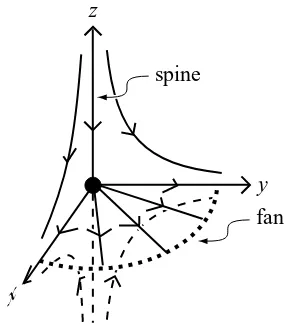
Fig. 2. Magnetic structure of a three-dimensional null point.
2.1 Structure of a null point
The simplest magnetic null in three dimensions has mag-netic field components
(Bx,By,Bz)=(x,y,−2z),
which satisfy∇ ·B=0. The resulting magnetic field lines have the structure shown in Fig. 2, in which there are two families of magnetic field lines through the null point. A
spineapproaches the origin from above and below along the
z-axis. Also, a fan of field lines leaves the origin in a surface (thex y-plane). More generally, the field near a linear null always possesses a spine and a fan, but the field lines in the null may spiral or touch an axis and the spine may be
fan
spine null
separator
Fig. 3. Separator reconnection due to the collapse of a separator.
inclined to the fan at some other angle than 12π (Parnellet al., 1996).
2.2 Types of reconnection
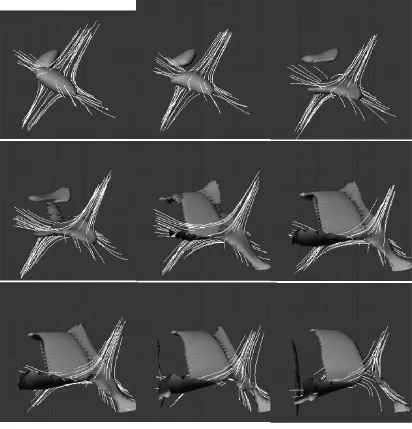
Fig. 4. Numerical experiment with an initial configuration of 8 null points, showing the local collapse of one of the nulls and the development of a strong current joining a nearby null due to separator reconnection (Galsgaard and Nordlund, 1997).
Spine
Null
Fan Separatrix
in the solar atmosphere by the TRACE satellite (Priest and Schrijver, 1999).
Inseparator reconnection(Fig. 3) the current is concen-trated along a separator, which is the intersection of the fans of two nulls and so is the magnetic field line that joins one null to another (Priest and Titov, 1996; Longcope and Silva, 1998). Reconnection may also occur in the absence of nulls at so-called quasi-separatrix layers, where the gradient of the mapping from one boundary to another is very large (Priest and Demoulin, 1995; Hornig and Rast¨atter, 1998; Titovet al., 1999). Indeed, Demoulin et al. (1996) have demon-strated that noneruptive flares are often located along quasi-separatrix layers.
These different three-dimensional mechanisms have been analysed both in the kinematic approximation and in the strong magnetic field approximation of the full MHD equa-tions and also numerically.
For example, Galsgaard and Nordlund (1997) started with a magnetic field consisting of eight null points in force-free equilibrium and then sheared the footpoints and watched what happened in a three-dimensional resistive MHD ex-periment. The nulls collapsed and reconnected by separator reconnection with strong current sheets joining nearby nulls (Fig. 4).
2.3 Complex magnetic topology
In two dimensions there areseparatrix curvesthat sep-arate the plane up into topologically distinct regions, and a pair of separatrices intersects in an X-type neutral point where the magnetic field vanishes. In three dimensions sep-aratrix surfacesdivide up the volume into topologically sep-arate regions and separatrices intersect in a special field line known as aseparator, which ends either at null points or on the boundary. In the Sun’s surface there is a multitude of flux sources, and so the topology of the overlying coronal magnetic field is extremely complex. However, it can be de-scribed in terms of itsskeleton, namely, a set of null points, a network of spine curves and a collection of separatrix fan surfaces. Its building blocks are the fields due to two, three and four sources. For two sources there is a null, with its
Separatrix surface
Separator
Null point
Fig. 6. The skeleton due to four sources showing two separatrix surfaces intersecting in a separator.
Fig. 8. Shibata’s model of a solar flare.
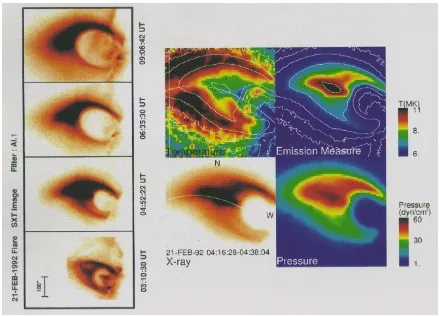
Fig. 10. The structure of the Tsuneta flare.
spine and separatrix surface that intersects the solar surface in the dashed curve shown in Fig. 5. For three sources the structure is surprisingly rich, with six different topological states when two sources are of the same sign and differ in sign from the third source. Transfer from one state to an-other is by local or global bifurcations (Priestet al., 1996).
So what is the effect on the corona of motions of magnetic
shock enhanced cooling region
flare ribbon
termination shock
chromospheric downflow
evaporation upflow
condensation downflow Mach 2 jet current sheet
Hα loops (104 K) uv loops (105 K) isothermal Petschek shock
hard X-ray region (> 108 K)
conduction front
X-r ay
loop
s(1
07K )
Fig. 11. Spikey current sheet above a flare loop system (McKenzie and Hudson, 1999).
flux sources in the solar surface? It drives three-dimensional reconnection and therefore heating. There are two main ele-ments of this process, depending on whether the fundamen-tal interaction is between a pair of sources or between three or more sources. First of all, the relative motion of a pair of sources in an ambient field (Fig. 5) produces heating by
binary reconnection(Priest and Schrijver, 1999). Just as in a gas, the binary collisions between pairs of particles domi-nates, so in the corona the effect of the interactions of pairs of photospheric magnetic flux sources may dominate the re-sulting heating that is driven in the corona. As the sources move around, the flux joining them is preserved, but indi-vidual magnetic field lines are reconnected since they may either lie below the separatrix dome or above it, depending on the orientation of the sources. The resulting heating is focussed on the separatrix surface and along the field lines that have just crossed it. The second element is an effect of the interaction of three or four sources, namely, sepa-rator reconnectionwhen their separatrix surfaces intersect (Priest and Titov, 1996; Longcope, 1998). As such sources move, there is now a change of flux in each region as flux is transferred from one to another, and the heat is concen-trated along the separatrices and especially along the sepa-rator (Fig. 6).
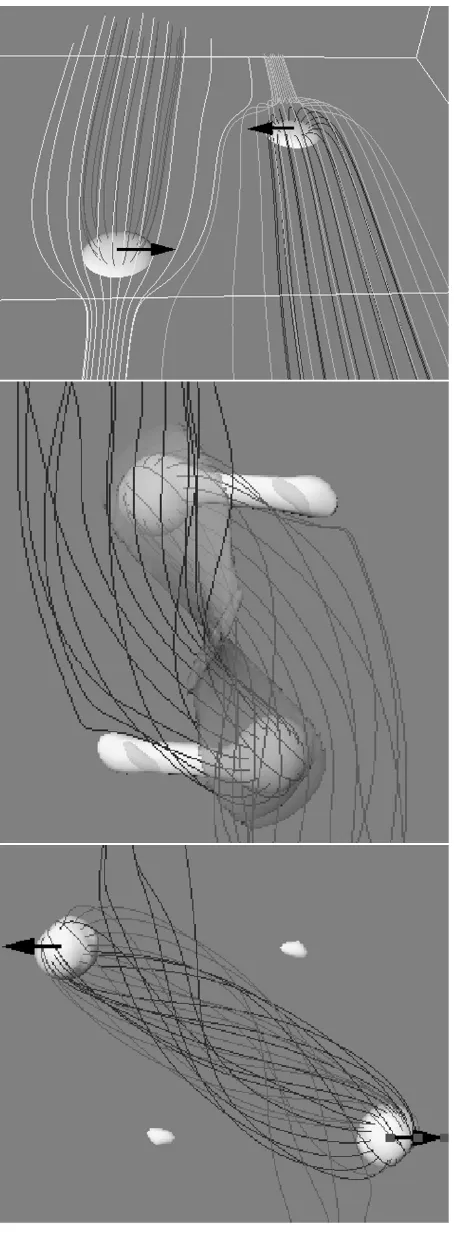
Galsgaardet al. (2000) have recently set up a numeri-cal experiment for a scenario proposed by Longcope (1998) for the interaction between two flux sources in an ambi-ent field. Initially, the sources are not connected magneti-cally (Fig. 7(a)). As they move, separator reconnection oc-curs and produces a twisted current sheet along the separator (Fig. 7(b)). After reconnection has occurred, the two sources are joined by a twisted flux tube, which has been created by the conversion of mutual magnetic helicity in the initial state to the self-helicity of the flux tube.
3.
Recent Observational Evidence for
Reconnec-tion
There is now a host of indirect evidence in favour of re-connection from the Yohkoh and SOHO satellites, espe-cially in solar flares and coronal heating events. Much of it has been produced by Tsuneta and Shibata and their co-workers (e.g., Shibataet al., 1990; Kusanoet al., 1995).
Fig. 12. Large-scale coronal loop whose heating may well be turbulent reconnection.
3.1 Solar flares
Jet
XBP
Fig. 13. Converging Flux Model.
produced by impulsive bursty reconnection (Priest, 1987). 3.2 Coronal Heating
Many examples of reconnection have been found in coro-nal heating events. The temperature profile measured along large-scale loops in Yohkoh images (Fig. 12), for instance, has been found to be consistent with heating by Parker braid-ing or turbulent reconnection (Priestet al., 1998, 2000b).
With Yohkoh too Yoshida and Tsuneta (1996) have shown that the hottest loops are either cusp-shaped or are interact-ing loops, both of which may be produced by reconnection. Furthermore, Shibataet al.(1996) has observed many x-ray jets produced by reconnection which have been simulated in a most impressive manner (Yokoyama and Shibata, 1997).
On SOHO the MDI instrument has shown that the sur-face of the Sun is covered with a magnetic carpet, in which magnetic fragments are continually emerging, fragmenting, merging and cancelling (Schrijveret al., 1997). Indeed, this is such an efficient process that the magnetic flux at the sur-face in the Quiet Sun is replaced not every 11 years, but every 40 hours.
The basic idea of the Converging Flux Model (Priestet al., 1994) is that new flux emerges in a supergranule cell, moves to the boundary and reconnects (Fig. 13), where it can in large events create an X-ray bright point and accelerate an X-ray jet. Furthermore, with the EIT instrument on SOHO, Falconer et al. (1998) have found that most bright points lie above oppositely directed magnetic fragments. With TRACE Parnell and Jupp (2000) have found that most nanoflares also lie above the supergranule boundaries.
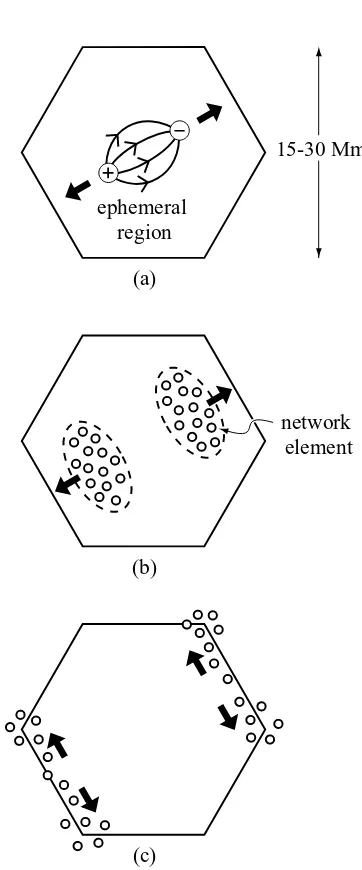
So what is the effect of the magnetic carpet on coronal heating? I would like to suggest the following scenario. The evolution of magnetic flux on the solar surface has three stages. First of all, a bipolar ephemeral region is born once every few days in a supergranule cell of typical diameter 15 Mm (Fig. 14(a)). This drives global reconnection with the overlying field which becomes visible as an X-ray bright point. Then each polarity of the ephemeral region moves to-wards the boundary over about 8 hours and fragments into typically 10 network elements (Fig. 14(b)). This drives in-ternal reconnection between the network elements and also provides a fibril magnetic structure within which MHD waves driven by granulation may dissipate efficiently. Thirdly, over the next 22 hours, the network elements move
(a)
ephemeral
region
network
element
15-30 Mm
(b)
(c)
along the boundary of the cell and undergo merging, frag-mentation and cancellation (Fig. 14(c)), which also drive re-connection within the network and in the overlying field. The elementary heating events in this model are: binary re-connection between flux pairs, separator rere-connection by the interaction of three or more sources, internal Parker braiding and dissipation of waves driven by granular buffeting.
4.
Concluding Comment
In summary, there are two main points to this review: the theory of three-dimensional reconnection is developing rapidly; and SOHO and Yohkoh have produced much evi-dence of the consequences of reconnection. However, for a detailed understanding of the connection between the sur-face of the Sun and its corona, we eagerly await the Solar-B Mission.
Acknowledgments. I am most grateful to the Symposium organis-ers and the UK Particle Physics and Astronomy Research Council for financial support and to our Japanese hosts for the care with which they have organised a most stimulating meeting.
References
Amari, T., J. F. Luciani, Z. Mikic, and J. Linker, A twisted flux rope model for CME’s and two-ribbon flares,Astrophys. J.,529, L49–L52, 2000. Axford, W. I., Magnetic field reconnection, inMagnetic Reconnection in
space and Laboratory Plasmas, edited by E. W. Hones, pp. 1–8, Amer. Geophys. Union, Washington, 1984.
Craig, I. J. D. and S. M. Henton, Exact solutions for steady-state incom-pressible magnetic reconnection,Astrophys. J.,450, 280–288, 1995. D´emoulin, P., J. C. H´enoux, E. R. Priest, and C. H. Mandrini,
Quasi-separatrix layers in solar flares. I. Method,Astron. Astrophys.,308, 643– 655, 1996.
Falconer, D. A., R. L. Moore, and J. G. Porter, Micro-coronal bright points observed in the quiet magnetic network by SOHO/EIT, Proceedings of High-Resolution Solar Atmospheric Dynamics Workshop, 1998. Galsgaard, K. and ˚A. Nordlund, Heating and activity of the solar corona.
3. Dynamics of a low-beta plasma with 3D null points,J. Geophys. Res., 102, 231–248, 1997.
Galsgaard, K., C. E. Parnell, and J. Blaizot, Elementary heating events due to magnetic interactions between two flux surfaces,Astron. and Astro-phys.,362, 395–405, 2000.
Hesse, M. and K. Schindler, A theoretical foundation of general magnetic reconnection,J. Geophys. Res.,93, 5539–5567, 1988.
Hornig, G. and L. Rast¨atter, The magnetic structure ofB=0 reconnection,
Physica Scripta,T74, 34–39, 1998.
Kusano, K., Y. Suzuki, and K. Nishikawa, A solar flare triggering mecha-nism based on the Woltjer-Taylor minimum energy principle,Astrophys. J.,441, 942–951, 1995.
Lau, Y.-T. and J. M. Finn, 3D kinematic reconnection in the presence of field nulls and closed field lines,Astrophys. J.,350, 672–691, 1990. Longcope, D. W., Current sheet formation and reconnection of separator
field lines, inObservational Plasma Physics: Five Years of Yohkoh and Beyond, edited by T. Watanabe, pp. 179–184, Kluwer Press, 1998. Longcope, D. W. and S. C. Cowley, Current sheet formation along 3D
mag-netic separatices,Phys. Plasmas,3, 2885–2897, 1996.
Longcope, D. W. and A. V. R. Silva, A current ribbon model for energy storage and release with application to the flare of 7 Jan. 1992,Solar Physics,179, 349–377, 1998.
McKenzie, D. E. and H. S. Hudson, X-ray observations of motions and structure above a solar flare arcade,Astrophys. J.,519, L93–L96, 1999. Masuda, S., T. Kosugi, H. Hara, S. Tsuneta, and Y. Ogawara, A loop-top
hard X-ray source in a compact solar flare,Nature,371, 495–497, 1994. Parnell, C. E. and P. E. Jupp, Statistical analysis of the energy distribution
of nanoflares in the quiet Sun,Astrophys. J.,529, 554–569, 2000. Parnell, C. E., J. Smith, T. Neukirch, and E. R. Priest, The structure of 3D
magnetic neutral points,Phys. Plasmas,3, 759–770, 1996.
Priest, E. R., Appearance and disappearance of magnetic flux at the solar surface, inRole of Fine-Scale Magnetic Fields on Structure of the Solar Atmosphere, edited by E. Schroter, M. Vazquez, and A. Wyller, pp. 297– 316, Camb. Univ. Press, 1987.
Priest, E. R. and P. Demoulin, 3D reconnection without null points,J. Geo-phys. Res.,100, 23,443–23,463, 1995.
Priest, E. R. and T. G. Forbes, New models for fast steady-state magnetic reconnection,J. Geophys. Res.,91, 5579–5588, 1986.
Priest, E. R. and T. G. Forbes, Magnetic field evolution during prominence eruptions and two-ribbon flares,Solar Phys.,126, 319–350, 1990. Priest, E. R. and T. G. Forbes,Magnetic Reconnection, Cambridge
Univer-sity Press, 2000.
Priest, E. R. and L. C. Lee, Nonlinear reconnection models with separatrix jets,J. Plasma Phys.,44, 337–360, 1990.
Priest, E. R. and C. J. Schrijver, Aspects of 3D magnetic reconnection,
Solar Phys.,190, 1–24, 1999.
Priest, E. R. and V. S. Titov, Magnetic reconnection at three-dimensional null points,Phil. Trans. Roy. Soc.,354, 2951–2992, 1996.
Priest, E. R., V. S. Titov, G. E. Vekstein, and G. J. Rickard, Steady linear X-point magnetic reconnection,J. Geophys. Res.,99, 21,467–21,480, 1994.
Priest, E. R., D. P. Lonie, and V. S. Titov, Bifurcations of magnetic topology by the creation or annihilation of null points,J. Plasma Phys.,56, 507– 530, 1996.
Priest, E. R., C. R. Foley, J. Heyvaerts, T. D. Arber, J. L. Culhane, and L. W. Acton, Nature of the heating mechanism for the diffuse solar corona,
Nature,393, 545–547, 1998.
Priest, E. R., V. S. Titov, R. E. Grundy, and A. W. Hood, Exact solutions for reconnective magnetic annihilation,Proc. Roy. Soc.,456, 1821–1849, 2000a.
Priest, E. R., C. R. Foley, J. Heyvaerts, T. D. Arber, J. L. Culhane, and L. W. Acton, A method to determine the heating mechanisms of the solar corona,Astrophys. J.,539, 1002–1022, 2000b.
Sato, T., 3D reconnection between two colliding magnetized plasmas,Phys. Rev. Lett.,54, 1502–1505, 1985.
Schindler, K., M. Hesse, and J. Birn, General magnetic reconnection, par-allel electric fields and helicity,J. Geophys. Res.,93, 15,477–15,485, 1988.
Schrijver, C. J., A. M. Title, K. L. Harvey, N. R. Sheeley, Y.-M. Wang, G. H. J. van den Oord, R. A. Shine, T. D. Tarbell, and N. E. Hurlburt, Large-scale coronal heating by the dynamic, small-Large-scale magnetic field of the Sun,Nature,48, 424–425, 1997.
Shibata, K., S. Nozawa, R. Matsumoto, A. C. Sterling, and T. Tajima, Emer-gence of solar magnetic flux from the convection zone into the photo-sphere and chromophoto-sphere,Astrophys. J.,351, L25–L28, 1990. Shibata, K., M. Shimojo, T. Yohoyama, and M. Ohyama, Theory and
obser-vations of x-ray jets, inMagnetic Reconnection in the Solar Atmosphere, edited by R. D. Bentley and J. T. Mariska, pp. 29–38, 1996.
Sonnerup, B. U. O. and E. R. Priest, Resistive MHD stagnation-point flows at a current sheet,J. Plasma Phys.,14, 283–294, 1975.
Strachan, N. R. and E. R. Priest, A general family of non-uniform reconnec-tion models with separatrix jets,Geophys. Astrophys. Fluid Dynamics, 74, 245–274, 1994.
Titov, V. S., P. D`emoulin, and G. Hornig, Quasi-separatrix layers: refined theory and its application to solar flares, Proc. of The 9th European Meet-ing on Solar PhysicsMagnetic Fields and Solar Processes, Florence, Italy, ESA SP-448, 715–722, 1999.
Tsuneta, S., H. Hara, T. Shimizu, L. W. Acton, K. T. Strong, H. S. Hudson, and Y. Ogawara, Observation of a solar flare at the limb with the Yohkoh Soft X-ray Telescope,Publ. Astron. Soc. Japan,44, L63–L69, 715–722, 1992.
Ugai, M. and W. B. Wang, Computer simulations on 3D plasmoid dynamics by spontaneous fast reconnection,J. Geophys. Res.,103, 4573–4585, 1998.
Yokoyama, T. and K. Shibata, Magnetic reconnection coupled with heat conduction,Astrophys. J.,474, L61–L64, 1997.
Yoshida, T. and S. Tsuneta, Temperature structure of solar active regions,
Astrophys. J.,459, 342–351, 1996.