P R O C E E D I N G S
Open Access
Genome-wide association analyses of the 15
th
QTL-MAS workshop data using mixed model
based single locus regression analysis
Wei-Xuan Fu
1†, Chong-Long Wang
1,2†, Xiang-Dong Ding
1, Zhe Zhang
1, Pei-Pei Ma
1, Zi-Qing Weng
1,
Jian-Feng Liu
1*, Qin Zhang
1*From
15th European workshop on QTL mapping and marker assisted selection (QTLMAS)
Rennes, France. 19-20 May 2011
Abstract
Background:The mixed model based single locus regression analysis (MMRA) method was used to analyse the common simulated dataset of the 15th QTL-MAS workshop to detect potential significant association between single nucleotide polymorphisms (SNPs) and the simulated trait. A Wald chi-squared statistic withdf=1 was employed as test statistic and the permutation test was performed. For adjusting multiple testing, phenotypic observations were permutated 10,000 times against the genotype and pedigree data to obtain the threshold for declaring genome-wide significant SNPs. Linkage disequilibrium (LD) in term ofD’between significant SNPs was quantified and LD blocks were defined to indicate quantitative trait loci (QTL) regions.
Results:The estimated heritability of the simulated trait is approximately 0.30. 82 genome-wide significant SNPs (P < 0.05) on chromosomes 1, 2 and 3 were detected. Through the LD blocks of the significant SNPs, we
confirmed 5 and 1 QTL regions on chromosomes 1 and 3, respectively. No block was detected on chromosome 2, and no significant SNP was detected on chromosomes 4 and 5.
Conclusion:MMRA is a suitable method for detecting additive QTL and a fast method with feasibility of performing permutation test. Using LD blocks can effectively detect QTL regions.
Background
Recently, the high-density single nucleotide polymorphism (SNP) arrays have been developed for almost all domestic animals, which offer the prerequisite of genome-wide asso-ciation study (GWAS), a more powerful approach for high-resolution mapping of loci controlling phenotypic traits in domestic animals [1]. In GWAS, two basic designs of resource population have been widely used for associa-tion analysis, one is the case-control design with unrelated individuals, and the other is the family-based design with pedigree structure. Corresponding to these two designs,
different approaches for association analysis have been proposed. However, there is no clear evidence showing general superiority of one approach over others. In farm animals, family based design is more relevant because of complex pedigree structure in almost all animal popula-tions. In our previous GWAS study [2], we employed a mixed model based single locus regression analysis (MMRA) to test the association between SNPs and milk production traits in dairy cattle. We found this method was more powerful than the TDT-based single locus regression analysis. To further verify its performance in terms of power and type I error, we applied it to the com-mon dataset provided in the 15th QTL-MAS workshop.
Methods
The simulated population consisted of 3,220 individuals in two generations. The first generation consisted of 20 sires
* Correspondence: [email protected]; [email protected] †Contributed equally
1Key Laboratory of Animal Genetics and Breeding of the Ministry of
Agriculture, College of Animal Science and Technology, China Agricultural University, Beijing, 100193, China
Full list of author information is available at the end of the article
[3] to estimate the variance components of the simu-lated trait, which would be used in the subsequent asso-ciation analysis, based on the following model
y= 1μ+Za+e
Where yis the vector of phenotypes of the 2,000 phe-notyped individuals,μis the overall mean,a is the vec-tor of the residual polygenic effect with a∼N(0,Aσa2)
(whereAis the additive genetic relationship matrix and
σ2
a is the additive genetic variance), Z is the incidence
matrix of a, and e is the vector of residual errors with
e∼N(0,Iσe2) (whereI is a unit matrix and σ2 e is the
residual error variance).
Genotype quality control
We removed the 1,000 progenies without phenotypes off the genotype data, and we calculated the minor allele frequency (MAF) for each SNP for the remained 2,220 individuals (2,000 progenies and 220 parents). We found that 2,879 SNPs were homozygous (MAF = 0) for all the tested individuals and additionally 715 SNPs had a MAF less than 0.03. These SNPs were removed and 6,396 SNPs remained for the subsequent analyses.
Association analysis
The mixed model based single locus analysis [2,4] was performed based on the following linear mixed model:
y=1μ+bx+Za+e
whereyis the vector of phenotypes of the 2000 pheno-typed individuals,μis the overall mean, × is the vector of the SNP genotype indicators which takes values 0, 1 or 2 corresponding to the three genotypes 11, 12 and 22 (assuming 2 is the allele with a minor frequency),bis the regression coefficient of phenotypes on SNP genotypes (i.e., the substitution effect of the SNP),ais the vector of the residual polygenic effect witha∼N(0,Aσa2),Zis the incidence matrix ofa, andeis the vector of residual errors with e∼N(0,Iσe2).
For each SNP, the estimate of b and the correspond-ing samplcorrespond-ing variances Var(∧b) can be obtained via
level) was obtained using the largest Wald chi-squared sta-tistic value across all SNPs from each permuted dataset. The threshold value for declaring a significant association was determined by choosing the 95th percentile of the empirical distribution, i.e., we declared a significant SNP at a 0.05 genome-wide significance level if its raw value of the Wald chi-squared statistic was larger than the empiri-cal threshold value.
For the significant SNPs, linkage disequilibrium (LD) in term ofD’between them was quantified using Haploview [5] and the LD blocks were defined by the criteria of Gabriel et al. [6] with default parameters.
Results and discussion
Association analysis results
The estimates of σa2 and σe2 are 24.82 and 58.65, respec-tively, so that the heritability estimate is 0.30 approxi-mately. The profile of the raw p values (from the chi-distribution and in terms of -log10 p) of all tested SNPs is shown in Figure 1. By using simply Bonferroni correc-tion, we detected 119 significant SNPs of 0.05 genome-wide significance level (rawpvalues < 7.82E-6). However, by using permutation test, we detected 82 significant SNPs of 0.05 genome-wide significance level (raw
pvalues < 2.31E-7) for the simulated trait. The 82 signifi-cant SNPs are distributed on chromosomes 1, 2 and 3,
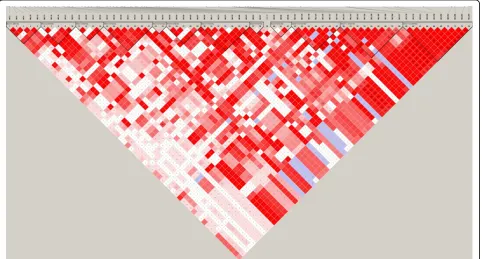
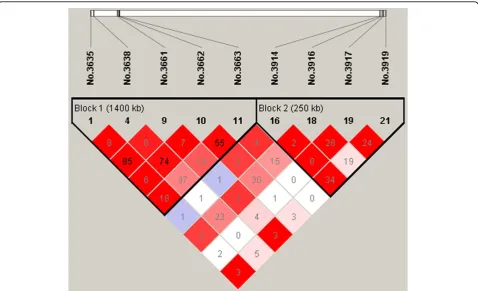
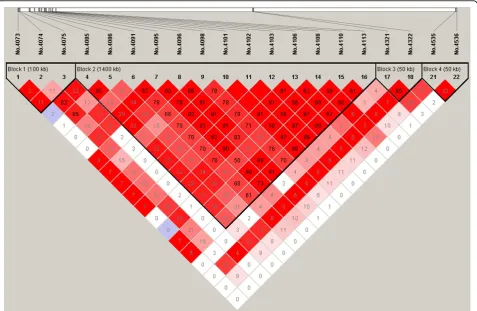
To further pinpoint the relationship among the detected SNPs, we analysed the LD levels in terms of D’ between the significant SNPs (Figures 2, 3 and 4) for chromosomes 1-3, respectively. Through the criteria of Gabriel et al. [6] with default parameters in Haploview [5], we defined 5 LD blocks on chromosome 1, which harbour 4 to 10 significant SNPs, and 1 LD block on chromosome 3, which harbour 10 significant SNPs with
6 outside. No block was detected on chromosome 2. The LD patterns show that these significant SNPs links to each other in different LD levels.
Comparison of the significant SNPs with the simulated QTN
On chromosome 1, there is one simulated QTN located at 2.85cM (No.57), which had the largest effect among all
Figure 1The Manhattan plots of GWAS for the 15th QTL-MAS Workshop Data. Chromosomes 1-5 are shown with different colours. The magenta horizontal dotted line indicates the significance threshold of Bonferroni correction (-log10(7.82E-6)), and the black one indicates that of permutation test(-log10(2.31E-7)).
simulated QTNs. We detected 63 significant SNPs on this chromosome. However, the true QTN at 2.85cM has a MAF of 0 and was discarded after quality control, and the adjacent SNP at 2.90cM (No.58), which has the lar-gest estimated effect among all significant SNPs, is accordingly considered as the putative QTN. Although a large number of pseudo significant SNPs were identified on this chromosome, the LD levels between the most effective SNP and other 62 significant SNPs (Figure 2) showed that 47 of them are in strong LD (D’>0.5) with it. This suggests that the simulated QTN may be surrogated by a suite of“ghost”QTNs nearby due to high LD level.
On chromosome 2, there are two simulated QTNs in coupling linkage phase located at 81.90cM (No.3638) and 93.75cM (No.3875), respectively. We detected 3 sig-nificant SNPs, the first is exactly at 81.90cM, and the second (No.3662, at 83.10cM) is in strong LD (D’ = 0.97) with the first one (Figure 3). But the third one No.3916 is at 95.80cM and is 2.05cM away from the second simulated QTN, while the LD level between them is strong (D’=0.69, Figure 3).
On chromosome 3, there are two simulated QTN in repulsion linkage phase located at 5cM (No.4100) and 15cM (No.4300), respectively. However, the first simu-lated SNP on this chromosome also has a MAF of 0 and was discarded after quality control. Of the 16 significant
SNPs detected, 10 are harboured in the LD block cover-ing the interval between 4.75cM and 5.65cM with an average LD level of 0.97 (D’), in which SNP No.4101 is just adjacent to the first true QTN. The second simulated QTN is 1.10cM away from the significant SNP (No.4322) and the LD level between them is strong (D’=0.93).
The one simulated imprinting QTN on chromosome 4, and 2 simulated epistatic QTNs on chromosome 5 were not detected by our analysis. This is because our method dose not account for both imprinting effect and epistatic effect. Our method needs to be further improved to account for interaction effects between SNPs and imprint-ing effects from parents.
Comparison of the significant SNPs with the those with high effects estimated via Bayesian approaches
To further validate significant SNPs identified herein, we compared the most promising SNPs detected with those with highest effects estimated via Bayesian approaches (BayesA, BayesB and BayesCπ) reported in our another analysis on prediction of genomic breeding values for the same data set [7]. Since the results from the three Bayesian approaches are similar and BayesCπ performed best, we only compare with BayesCπ here. Specifically, on chromosome 1, the most effective SNP (No.58) iden-tified by MMRA is exactly the same as that by BayesCπ.
On chromosome 2, BayesCπ revealed SNP No. 3660 with the largest effect and SNP No.3873 with the second largest effect, which are close to and in strong LD with the significant SNPs No. 3662 and No. 3916 detected by MMRA. On chromosome 3, the two promising SNPs detected by MMRA are No.4101 and No.4322, which are close to the SNP with the largest (No.4092) and the second largest (No.4331) effect estimated by BayesCπ, respectively. In all, most of findings herein are largely consistent with those with highest effect estimates via BayesCπ. This further demonstrates that the Bayesian approaches (particularly BayesCπ) could also sever as tools for QTL mapping, as suggested by Fan et al. [8].
Computing time
All analyses were implemented through Fortran pro-grams and performed on an octal-core Linux Server (Intel Xeon E5504 2.00GHz; 48.00GB RAM). The time needed was about 1.5 minutes for one permutation ana-lysis. The 10,000 permutations were performed through 8 threads, each was assigned 1,250 permutations. So, the total computing time was about 31 hours. This shows that MMRA is a fast method with feasibility of perform-ing a large number of permutations.
Conclusion
Our results herein show that the MMRA method is suita-ble for detecting additive QTL, and it is a fast method with feasibility of performing permutation test. And the LD region on chromosome 3 can effectively integrate sig-nificant SNPs for QTL region detection. However, we detects only one true additive QTN (No.3638), two SNPs (No.58 and No.4101) close to two true additive QTNs (No.57 and No.4100) with many false positives, which remains to be further investigated and the MMRA method needs to be further improved to account for other non-additive effects.
List of abbreviations used
GWAS: Genome-Wide Association Study; MMRA: Mixed Model based Single Locus Regression Analysis; SNP: Single Nucleotide Polymorphisms; QTL: Quantitative Trait Locus; QTN: Quantitative Trait Nucleotide; LD: Linkage disequilibrium; M: Morgan; MAF: Minor Allele Frequency; TDT: Transmission Disequilibrium Test.
Acknowledgements
This work was supported by the National High Technology Research and Development Program of China (863 Program 2011AA100302), the National Natural Science Foundation of China (Grant No. 30972092, 30800776), and the Modern Pig Industry Technology System Program of Anhui Province.
manuscript.
Competing interests
The authors declare that they have no competing interests.
Published: 21 May 2012
References
1. Andersson L:Genome-wide association analysis in domestic animals: a powerful approach for genetic dissection of trait loci.Genetica2009, 136(2):341-349.
2. Jiang L, Liu J, Sun D, Ma P, Ding X, Yu Y, Zhang Q:Genome wide association studies for milk production traits in Chinese Holstein population.Plos One2010,5(10):e13661.
3. Madsen P, Jensen J:DMU: A user’s Guide. A Package for Analysing Multivariate Mixed Models.University of Aarhus, Faculty of Agricultural Sciences, Department of Animal Breeding and Genetics2007.
4. Daetwyler HD, Schenkel FS, Sargolzaei M, Robinson JA:A genome scan to detect quantitative trait loci for economically important traits in Holstein cattle using two methods and a dense single nucleotide polymorphism map.J Dairy Sci2008,91(8):3225-3236.
5. Barrett JC, Fry B, Maller J, Daly MJ:Haploview: analysis and visualization of LD and haplotype maps.Bioinformatics2005,21(2):263-265.
6. Gabriel SB, Schaffner SF, Nguyen H, Moore JM, Roy J, Blumenstiel B, Higgins J, DeFelice M, Lochner A, Faggart M,et al:The structure of haplotype blocks in the human genome.Science2002, 296(5576):2225-2229.
7. Wang CL, Ma PP, Zhang Z, Ding XD, Liu JF, Fu WX, Weng ZQ, Zhang Q: Comparison of five methods for genomic breeding value estimation for the common dataset of the 15thQTL-MAS Workshop.InProceedings of the XVth QTLMAS Workshop: 19-20 May 2011; Rennes FranceDemeure O, Elsen JM, Filangi O, Le Roy P 2012.
8. Fan B, Onteru SK, Du ZQ, Garrick DJ, Stalder KJ, Rothschild MF: Genome-wide association study identifies Loci for body composition and structural soundness traits in pigs.Plos One2011,6(2):e14726.
doi:10.1186/1753-6561-6-S2-S5
Cite this article as:Fuet al.:Genome-wide association analyses of the 15thQTL-MAS workshop data using mixed model based single locus regression analysis.BMC Proceedings20126(Suppl 2):S5.
Submit your next manuscript to BioMed Central and take full advantage of:
• Convenient online submission
• Thorough peer review
• No space constraints or color figure charges
• Immediate publication on acceptance
• Inclusion in PubMed, CAS, Scopus and Google Scholar
• Research which is freely available for redistribution