Volume 2007, Article ID 64238,8pages doi:10.1155/2007/64238
Research Article
An Adaptive Time-Spread Multiple-Access Policy for
Wireless Sensor Networks
Konstantinos Oikonomou1and Ioannis Stavrakakis2
1Department of Informatics, Ionian University, Tsirigoti Square 7, 49100 Corfu, Greece
2Department of Informatics & Telecommunications, University of Athens, Panepistimiopolis, Ilissia, 15784 Athens, Greece
Received 27 October 2006; Accepted 13 March 2007
Recommended by Stavros Toumpis
Sensor networks require a simple and efficient medium access control policy achieving highsystem throughputwith no or lim-itedcontrol overheadin order to increase thenetwork lifetimeby minimizing theenergy consumedduring transmission attempts. Time-spread multiple-access (TSMA) policies that have been proposed for ad hoc network environments, can also be employed in sensor networks, since no control overhead is introduced. However, they do not take advantage of anycross-layerinformation in order to exploit the idiosyncrasies of the particular sensor network environment such as the presence of typically static nodes and a common destination for the forwarded data. Anadaptiveprobabilistic TSMA-based policy, that is proposed and analyzed in this paper, exploits these idiosyncrasies and achieves higher system throughput than the existing TSMA-based policies without any need for extra control overhead. As it is analytically shown in this paper, the proposed policy always outperforms the exist-ing TSMA-based policies, if certain parameter values are properly set; the analysis also provides for these proper values. It is also shown that the proposed policy is characterized by a certainconvergence periodand that high system throughput is achieved for long convergence periods. The claims and expectations of the provided analysis are supported by simulation results presented in this paper.
Copyright © 2007 K. Oikonomou and I. Stavrakakis. This is an open access article distributed under the Creative Commons Attribution License, which permits unrestricted use, distribution, and reproduction in any medium, provided the original work is properly cited.
1. INTRODUCTION
Sensor networks have emerged in recent years offering a wide range of possible applications by the combination of sensing, computation, and communication capabilities in a single de-vice. In most of the cases, this device is considered to be cheap and small in order to be easily deployed in large numbers in various environments of interest. Such environments can be an agricultural field in which the climatological conditions (e.g., temperature, moist) are of interest, a forest or a build-ing in which the deployed sensors allow for fire detection at early stages and numerous other applications.
Sensor networks may be seen as a special case ofad hoc
networks and share many of the principles in the design of, for example, theroutingprotocol, themedium access control
(MAC), thephysical layer, and so forth. However, there is a number of differences among the two environments: (a) in sensor networks thenetwork topologyis typically considered to be stationary while in ad hoc networks nodes’ movement is the default case; (b) in sensor networks data are forwarded
towards a certain destination in the network (thesink node), while in ad hoc networks the destination of the data can be any node. Depending on the particular ad hoc and sensor en-vironment (and on the application scenario) a more precise list of differences can be created for each particular pair of networks.
Data packets are considered to be forwarded towards the sink node along the path determined by the employed rout-ing protocol. The employed MAC policy shapes the data transmission attempts on each individual direct link. These transmission attempts should be minimized (or equivalently, the number of successful transmissions should be maxi-mized) in order to conserve energy, (e.g., [1]). In sensor net-works, nodes are not in general able to recharge their bat-teries and therefore, it is important to employ energy saving protocols in order to extend thenetwork lifetime as long as possible. Clearly, an efficient MAC policy for sensor networks should guarantee that (a) limited or no extracontrol over-headis added to maintain connectivity; (b)high throughput
Several MAC policies have been proposed in the area of ad hoc networks, that can also be applied in sensor networks. Some of them, [2–6] arecontention based in the sense that they use direct competition to access the channel.
Allocation-basedMAC protocols have also been proposed (e.g., [7]) and
it has been shown that the derivation of an optimal schedul-ing(i.e.,time slotsduring which a node is allowed to trans-mit during aframe) is anNP-complete problem, similar to then-coloring problem in graph theory, [8,9]. Consequently, these policies introduce a certain (and possibly large) control overhead for the scheduling derivation, which is not desir-able especially in sensor network environments due to the aforementioned energy limitations.
A special category of allocation-based protocols are the
time-spread multiple-access (TSMA) protocols which have
been the focus of an increased research volume in the last decade. These protocols have no coordination over-head and—provided that they are efficient enough—could be adopted for sensor networks. In addition, reduced energy consumption may be achieved as opposed to CSMA/CA-based approach [12]. Note however, that a time division sys-tem requires global synchronization which is not easily real-izable [20]. However, as in most of the cases in the area of time division MAC protocols, in this work it is assumed that nodes are synchronized (e.g., they are aware about the begin-ning of eachtime slot).
The idea that a node’s transmission is successful is as old as the ALOHA variations in 1970s [10]. Various variations have been proposed (e.g, more recently [11] or [13]) but the first TSMA protocol was proposed by Chlamtac and Farago, in 1994 [14]. The particular work has given birth to the re-search area of TSMA-based protocols, and several new ones have been proposed in the past decade among which are: [15] in 1998, [16] in 2003, [17] in 2004, [18,19] in 2005, [21–
23] in 2006, and so forth. Other researchers have studied the properties of the original TSMA protocol: Basagni and Br-uschi [24] proved the lower bound of the frame length to be logN, whereN is the number of nodes in the network and more recently in 2006, Miorandi et al. [25] proved that the throughput and the delay achieved by the TSMA protocol proposed by Chlamtac and Farago is very close to the theo-retical bounds derived by Gupta and Kumar in their seminal work regarding capacity in wireless networks, [26], or other researchers [27].
In more detail, under the original TSMA policy proposed by Chlamtac and Farago in [14], nodes are allowed to
trans-mit only at a (small) subset of the available time slots
care-fully selected so that at least one of them is collision free. The achieved throughput of this particulardeterministic pol-icy was shown that it could be further improved by allowing
probabilistictransmission attempts duringunallocatedtime
slots that were not assigned under the deterministic assign-ment [17,18]. For the rest, the deterministic policy, proposed by Chlamtac and Farago in [14], will be referred to as the D-Policy and the probabilistic policy, proposed in [17], as the P-Policy.
The main reason behind the throughput increase under the P-Policy is the use of time slots that arenot allocated
un-der the D-Policy but allow for corruption-free transmissions. Under the P-Policy, these time slots are utilized according to
anaccess probabilitypfixed for all time slots and for all nodes
in the network. Both policies are suitable for sensor networks since they do not require any control overhead to derive the scheduling of the nodes; thus energy is saved. However,
cross-layerinformation [28], such as the network topology
charac-teristics and the typically rarely changing and common des-tination of the transmitted data, are not taken into account. A new adaptiveprobabilistic policy, the A-Policy, based on the P-Policy and proposed in this paper (initially mentioned in [19]), is capable of achieving even higher throughput by exploiting the idiosyncrasies of the sensor network environ-ment. This particular policy makes better use of the unallo-cated time slots than the P-Policy (or the D-Policy that fails to utilize them at all). The new idea behind the A-Policy is to utilize the unallocated time slots with probability 1, pro-vided that the last transmission attempt was a successful one (assuming that there exist data available for transmission). The most direct result is a significant throughput increment since those unallocated time slots that allow for collision-free transmissions are better utilized under the A-Policy than un-der the P-Policy.
Due to its adaptive nature, the A-Policy requires a cer-tain time period before thesteady-statemode of operation is reached and the maximum system throughput is achieved.
Thetransient mode of operation between the beginning of
the network operation and the beginning of the steady-state mode, corresponds to theconvergence period. As it will be shown later, in order to achieve a higher throughput at steady state, a long and of low-throughput convergence period is required. Note that even though for long convergence peri-ods the system throughput at the steady-state mode of op-eration is maximized, during the convergence period it re-mains comparably low. Therefore, the larger the convergence period, the longer the system throughput remains low; this may not be a desirable effect for the efficient operation for some sensor networks. The analytical results provided in this paper derive a certain value for the access probability that al-lows for small convergence periods and comparably high sys-tem throughput. In comparison with the P-Policy, it is shown that this particular value for the access probability allows for higher system throughput under the A-Policy than that un-der the P-Policy. Simulation results support the particular claims of the analysis.
Some definitions about the network and conditions regarding successful transmissions are given in Section 2.
Section 2also includes a brief introduction to those elements
u υ
χ
ψ
u→υ Φu→υ
Sυ Θu→υ
Figure1: Example transmissionu→v, set of nodesSv, and trans-missions that belong inΦu→vorΘu→v.
inSection 4allow for a comprehensive demonstration of the
convergence period and confirm the expectation that high system throughput is achieved for long convergence periods. Finally, the conclusions are drawn inSection 5.
2. SYSTEM AND NETWORK DEFINITION
A sensor network may be viewed as a time varying multihop network and may be described in terms of a graphG(V,E), whereV denotes the set of nodes andEthe set of (bidirec-tional) links between the nodes at a given time instance. Let
|X|denote the number of elements in setXand letN= |V|
denote the number of nodes in the network. LetSu denote the set of neighbors of nodeu,u∈V. LetDdenote the max-imum number of neighbors for a node; clearly|Su| ≤D, for allu∈V. SetSuincludes any nodevto which a direct trans-mission from nodeu(transmissionu → v) is possible. As-suming the time is equally divided intime slots, letλbe the
probability that there exist data available for transmission
dur-ing a time slot for any node in the network (originatdur-ing from a memoryless source).
Suppose that nodeuwants to transmit to nodevduring a particular time sloti. Transmissionu→vmay be corrupted by any node that belongs toSv(apart from nodeu). How-ever, transmissions that corrupt transmissionu→vmay (set
Φu→v) or may not (setΘu→v) be corrupted by it, as it is
graph-ically depicted inFigure 1.
Φu→v=χ−→ψ:χ∈Sv∪ {v} − {u},
ψ∈Sχ∩Su∪ {u},
Θu→v=χ−→ψ:χ∈Sv∪ {v} − {u}, ψ∈Sχ−Sχ∩Su∪ {u}.
(1)
Under the D-Policy a frame of sizeq2 is created and each node is allowed to transmit during q (fixed) time slots in a frame. LetΩu denote the set of time slots during which nodeuis allowed to transmit in a frame. It is obvious that
|Ωu| = q. Actually, each node is assigned a polynomial of
orderkand coefficients from a Galois field of orderGF(q).
Parametersqandkare selected such thatq≥kD+ 1 is sat-isfied [14]. Even thoughoverlapping time slots (setCu→v =
Ωu∩(χ∈Sv∪{v}−{u}Ωχ)) with the neighbor nodes do exist, it is assured that at least one transmission in a frame will be collision free [14]. This is actually due to the fact that two polynomials of orderkmay have at mostkcommon roots, corresponding tokat most collisions for each pair of nodes. Given the fact thatDis the maximum number of neighbor nodes,kDis the maximum number of collisions for a node in a frame. On the other hand, each node is allowed to transmit duringqtime slots in the frame and consideringq≥kD+ 1, it is evident that there will be at least one collision-free trans-mission for each node.
However, the achievable system throughput under the D-Policy, denoted byPD, is small due tounused time slots: (a) time slots that have been allocated to nodes which do not use them due to lack of data available for transmission (small values forλ); (b)unallocatedtime slots that nodes cannot ac-cess under the D-Policy and if they were acac-cessed, sucac-cessful transmissions would have taken place. LetRu→vdenote this
set of time slots for a particular transmissionu→v. It was shown that|Ru→v| =q2− |χ∈Sv∪{v}Ωχ|, [17].
In order to utilize those unused time slots, the P-Policy allows any nodeuto transmit in time slotsi /∈Ωuaccording
to anaccess probability p. The analysis presented in [17,18] examines PP (a more tractable form of the actual system throughputPPfor which it was shown that whenPP is max-imized,PPis also close to the maximum [17,18]) and allows for its maximization. Eventually,
PP=1 +p(qq−1)λ(1−pλ)|S|,
pλ,|S|=
⎧ ⎪ ⎪ ⎪ ⎨ ⎪ ⎪ ⎪ ⎩
1 ifλ < q−1
q|S|+q−1,
q−1−λ|S|
λ(|S|+ 1)(q−1) ifλ≥
q−1
q|S|+q−1, (2)
wherepλ,|S|[18] is the value of the access probabilitypthat maximizes the (approximated) system throughput under the P-Policy.|S| =(1/N)∀u∈V|Su|corresponds to theaverage
number of neighbor nodesin the network.
3. THE A-POLICY
The key idea behind the A-Policy is to utilize more efficiently (compared to the P-Policy) the unused time slots. In partic-ular, for a given transmissionu→v, transmission attempts during a certain time sloti∈Ωutake place as soon as data are
successful future transmission. The aforementioned policy can be summarized as follows.
The A-Policy
Each nodeutransmits in slotiduring framej, ifi∈Ωuand
transmits with probability pij,u→v, ifi /∈ Ωu, provided it has
data to transmit.
Two different values, por 1, are possible forpij,u→v,
de-pending on the status of the most recent attempt of trans-missionu→vin time sloti. The initial value is set top. The remaining of this section focuses on the derivation of an ana-lytical expression regarding thesystem throughputunder the A-Policy.
LetOi,u→vbe that set of nodesχwhose transmissions
cor-rupt a particular transmission u → v and which are also allowed to transmit in time slots i /∈ Ωχ,Oi,u→v = {χ : time slotifor whichi /∈ Ωχ(therefore, these nodes belong inOic,u→v) and for which nodes the most recent attempt for
transmissionχ →ψwas successful. LetΨij,,uc→vbe that set of nodes, which belong inOic,u→vand for which the most recent attempt for transmission χ → ψ was not successful. Obvi-ously,|Ψij,u→v|+|Ψij,,uc→v| = |Oc
i,u→v|.
LetPAj,i,u→v be the probability of success for
transmis-sionu→ vin time slotiduring frame j. Ifi ∈ Cu→v, then
transmissionu→vtakes place with probabilityλ. The same applies for transmissions that belong to nodesχ ∈ Oi,u→v.
Transmissions that belong to nodes χ ∈ Oci,u→v take place
with probability λ, if these nodes belong in Ψij,u→v, while they take place with probabilitypλ, if these nodes belong in
Ψj,c
every time sloti). Eventually,
PAj,i,u→v
transmission u → v in frame j under the A-Policy (PAj,u→v = (1/q2)q2
i=1P
j
A,i,u→v). Let PAj, for which PAj =
(1/N)u∈VPAj,u→v,v ∈ Su, denote the system throughput in framej. Finally,
PAj = 1
Even though the access probability is set topat the beginning of the network operation, it is expected that after some time the access probability to be either 1 orpdepending only on the status (successful or corrupted) of the latest transmission attempt. When this is the case, the network is considered to be at thesteady-statemode of operation. Before entering the steady-state mode, there exists a certain convergence period
Since nodes are initially allowed to transmit during an un-allocated time slot with probabilitypλ, it takes 1/pλframes (on average) in order for all nodes in the network to trans-mit for the first time. Therefore, the steady-state mode of op-eration starts 1/pλframes (on average) after the beginning of the network operation. During the steady-state mode of operation, transmissions that are corrupted refrain from at-tempting to transmit and even though they try with small (on average) probability in subsequent frames, they still re-frain from transmission due to subsequent corruptions. This allows for other (successful) transmissions to continue (al-most uninterrupted) their successful transmission attempts. Consequently, there is a certain throughput improvement es-pecially for increased traffic load.
4. OBSERVATIONS AND RESULTS
Equation (4) does not provide for a tractable form of the sys-tem throughput and therefore, it is not easy to proceed fur-ther the analysis ofPAj. Some approximations are introduced in order to provide for a more tractable form ofPAj, leading to an approximate expression for PAj denoted by PAj. First, (1−λ)/(1−pλ) is approximated by 1, and second, |Sv| is approximated by|S|, for allv ∈ V. The latter approxima-tion actually corresponds to a network with all nodes having the same number of neighbor nodes. Both approximations have been used in past works in the area (e.g., [17,18]), and their effectiveness has been demonstrated. According to (4), and in view of the aforementioned approximations,
PAj =N1
u∈V
q+i /∈Ωupij,u→v
q2 λ(1−pλ)
|S|. (5)
Based on both (2) and (5) it is easy to conclude that for any value ofp, common for both the A-Policy and the P-Policy, the approximated system throughput under the A-Policy is higher than that under the P-Policy. This is easily concluded since for any transmissionu →v,pij,u→vis either equal to p
or equal to 1. Therefore,p(q−1)≤i /∈Ωupij,u→v≤q(q−1)
and eventually,PAj ≥PP . Due to the fact that these approxi-mations are well justified, [17,18], whenPAj ≥PPis satisfied,
thenPAj ≥PP, most likely, will be satisfied as well. Simulation results in the sequel demonstrate this particular argument.
For those cases that p = pλ,|S|(the system throughput under the P-Policy is maximized [18]), it is guaranteed that the system throughput under the A-Policy will always be higher than the maximum ever achieved under any settingp of the P-Policy. Smaller values ofp(<pλ,|S|) allow for higher throughput under the A-Policy during the steady-state mode of operation. Actually, when the access probability is equal to
p during the steady-state mode of operation, this is a con-sequence of a past corrupted transmission and an indication that other nodes are using the particular time slot. Conse-quently, if pis small, then theinterferencecaused to neigh-bor nodes is reduced and this is one of the reasons for the observed system throughput increase demonstrated later in the simulation results. On the other hand, for small values of
0.18 0.16 0.14 0.12 0.1 0.08 0.06 0.04 0.02 0 P
0 50 100 150 200
j PA,p=0.01
PA,p=0.5 PA,p=pλ,|s|
Pp,p=pλ,|s|
PD
Figure2: System throughput (P) simulation results for heavy traffic conditions,λ=1, for each framej.
p, the convergence period (duration of 1/pλframes on aver-age) increases. Since the system throughput during the con-vergence period is not as high as that during the steady-state mode of operation (where there is an efficient utilization of the unallocated time slots), a rather extended convergence period may not always be suitable (e.g., when some not rela-tively high system throughput is required in a small number of frames since the beginning of the network operation). This interesting case is demonstrated using simulation results in the sequel.
4.1. Simulation Results
For simulation purposes, networks of 100 nodes are consid-ered. The simulator is a program written in C that creates topologies which have the same number of neighbor nodes (however, not necessarily a grid). The events of transmission attempts are closely related to probabilities p andλ, which are implemented from random number generators assum-ing uniform distributions. The obtained results (after 10 000 time slots) have been averaged in order to provide for the figures depicted in the sequel. The algorithm presented in [15] is used to derive the sets of scheduling slots and the system throughput is calculated averaging the simulation re-sults over different number of frames. Time slot setsΩχare assigned randomly to every node χand kept the same for each scenario throughout the simulations. The purpose of the simulations presented here is to provide for a deeper un-derstanding of the A-Policy.
InFigure 2, heavy traffic conditions (λ=1) are
consid-ered. It can be seen that the system throughput under the D-Policy (PD) is a straight line remaining unchanged as j in-creases. The system throughput under the P-Policy (PP) for
0.07 0.06 0.05 0.04 0.03 0.02 0.01 0 P
0 0.2 0.4 0.6 0.8 1
λ
Pp,p=pλ,|s| PA,p=pλ,|s|
PA,p=0.001
PA,p=0.1
PA,p=1
PA,p=0.5 PD
(a)
0.08 0.07 0.06 0.05 0.04 0.03 0.02 0.01 0 P
0 0.2 0.4 0.6 0.8 1
λ Pp,p=pλ,|s|
PA,p=pλ,|s|
PA,p=0.001
PA,p=0.1
PA,p=1
PA,p=0.5 PD
(b) 0.09
0.08 0.07 0.06 0.05 0.04 0.03 0.02 0.01 0 P
0 0.2 0.4 0.6 0.8 1
λ Pp,p=pλ,|s|
PA,p=pλ,|s|
PA,p=0.001
PA,p=0.1
PA,p=1
PA,p=0.5 PD
(c)
0.09 0.08 0.07 0.06 0.05 0.04 0.03 0.02 0.01 0 P
0 0.2 0.4 0.6 0.8 1
λ Pp,p=pλ,|s|
PA,p=pλ,|s|
PA,p=0.001
PA,p=0.1
PA,p=1
PA,p=0.5 PD
(d)
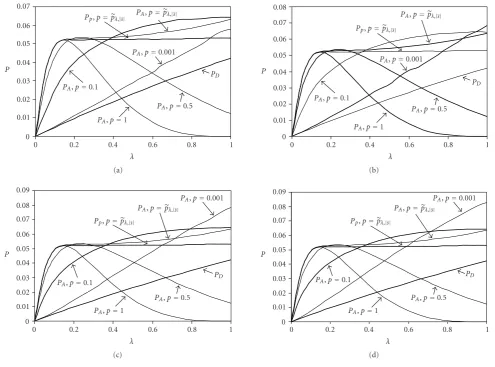
Figure3: System throughput (P) simulation results as a function ofλaveraged over different numbers of frames.
Regarding the A-Policy, for a large value ofp(p =0.5), it is easy to observe that the achieved system throughput is even lower than that achieved under the D-Policy. However, note that there is no obvious convergence period for this case (actually, there is a convergence period lasting only 1/pλ ≈
2 frames, but it is not possible to clearly identify it in this particular figure).
Whenp = pλ,|S| =0.184, under the A-Policy a conver-gence period of almost 5 frames is expected. This is identi-fiable fromFigure 2. Note that at the beginning of the con-vergence period the system throughput under the A-Policy (PA) is always higher than the maximum system throughput under the P-Policy (PP), which is in accordance with the an-alytical results presented earlier.
Even though forp= pλ,|S|the A-Policy safely overpasses the P-Policy, it is interesting to see the behavior of the A-Policy for even smaller values of p (e.g., p = 0.01). The convergence period (100 frames) for this case is easily ob-servable fromFigure 2. It is also easy to observe that during the beginning of the convergence period and until (around) frame 25, the system throughput is smaller than that under the P-Policy. On the other hand, at the end of the conver-gence period, it is significantly higher (0.16 instead of 0.1).
Figure 3presents system throughput simulation results,
averaged over different number of frames, as a function ofλ. In Figures3(a),3(b),3(c), and3(d),PDincreases withλand
PP is significantly higher than PD. The system throughput
under the A-Policy (PA) for large values ofp(e.g.,p=1.0) appears not to be a good choice for large values ofλ. For the case wherep = pλ,|S|, it is easy to observe thatPA ≥PP, ir-respectively of the value ofλ. However, for small values ofλ there is no obvious advantage of the A-Policy, as it can be also observed from Figure 3. This observation is in accordance with the analytical results. Smaller values ofp(< pλ,|S|) are possible to provide for high system throughput values un-der the A-Policy asλand/or the number of frames increases. This is also expected from the aforementioned analysis since the duration of the convergence period is (on average) 1/pλ frames.
5. CONCLUSIONS
the deterministic policy (D-Policy) [14] and the probabilis-tic policy (P-Policy) [17] that have been proposed and stud-ied in the context of general ad hoc network environments. While both policies (the D-Policy and the P-Policy) can be applied in sensor network environments, the A-Policy pro-posed here can take advantage of cross-layer information by exploiting the idiosyncrasies of the sensor network envi-ronment (e.g., nodes are not moving, all data traffic is for-warded to a certain sink node) and yield for a higher system throughput.
In particular, an analytical expression for the system throughput under the A-Policy was derived in this paper. Due to the intractability of the particular expression, cer-tain approximations were introduced that have also been em-ployed in the past for the P-Policy (e.g., [17,18]). The ap-proximated expression allowed for a number of interesting observations. For example, for any value of p, the system throughput under the A-Policy is higher than that under the P-Policy (for the same value of p). This is also the case for
p = pλ,|S|(the particular value ofpthat maximizes the sys-tem throughput under the P-Policy). Simulation results sup-port the claims and the expectations of the aforementioned approximate analytical results and observations.
Another interesting observation refers to the existence of a convergence period of 1/pλframes on average preced-ing the steady-state mode of operation. It is shown that the system throughput gradually increases during the conver-gence period and assumes the maximum at the beginning of the steady-state mode of operation. During the steady-state mode, the system throughput remains at the maximum. For
p =pλ,|S|, the A-Policy safely outperforms (as already men-tioned) the P-Policy, even during the convergence period. However, as pdecreases (assuming that the P-Policy always operates at maximum throughput obtained for p = pλ,|S|) at the beginning of the convergence period and for a com-parably small number of frames, the P-Policy performs bet-ter than the A-Policy. As time passes (a few frames labet-ter) and long before the convergence period is over, the A-Policy over-passes the P-Policy. An important difference is that for this case (p < pλ,|S|) the achievable maximum throughput un-der the A-Policy is higher than that achieved for p = pλ,|S|. Consequently, p = pλ,|S|is a good choice if the objective is to safely outperform the P-Policy. When the objective is to achieve high values for the system throughput, thenpshould take small values. The only trade offis that rather small values may result in rather long convergence periods. The selection ofpshould be based on the priorities and traffic characteris-tics of the specific environment.
In conclusion, it is shown in this paper that the A-Policy is capable of achieving high system throughput val-ues in a sensor network environment by exploiting informa-tion specific to the environment (e.g., stainforma-tionary topology, data are forwarded towards a fixed node in the network). This increased system throughput is for the benefit of the network since it minimizes the transmission attempts and thus energy is saved. In addition, the A-Policy is a simple MAC policy easy to implement in small communication de-vices like sensor nodes with limited capabilities.
ACKNOWLEDGMENTS
This work has been supported in part by (i) IST CON-TENT Program under Contract FP6-0384239; and (ii) IST BIONETS Program under Contract FP6-027748.
REFERENCES
[1] R. Hekmat and P. V. Mieghem, “Interference in wireless multi-hop ad-hoc networks and its effect on network capacity,” Wire-less Networks, vol. 10, no. 4, pp. 389–399, 2004.
[2] IEEE 802.11, “Wireless LAN Medium Access Control (MAC) and Physical Layer (PHY) specications,” November 1997, Draft Supplement to Standard IEEE 802.11, IEEE, New York, January 1999.
[3] P. Karn, “MACA - a new channel access method for packet radio,” in Proceedings of the ARRL/CRRL Amateur Radio 9th Computer Networking Conference, pp. 134–140, Ontario, Canada, September 1990.
[4] V. Bharghavan, A. Demers, S. Shenker, and L. Zhang, “MACAW: a media access protocol for wireless LAN’s,” in Pro-ceedings of the ACM Conference on Communications Architec-tures, Protocols and Applications (SIGCOMM ’94), pp. 212– 225, London, UK, August-September 1994.
[5] C. L. Fullmer and J. J. Garcia-Luna-Aceves, “Floor acquisi-tion multiple access (FAMA) for packet-radio networks,” in Proceedings of the ACM Conference on Communications Archi-tectures, Protocols and Applications (SIGCOMM ’95), pp. 262– 273, Cambridge, Mass, USA, August-September 1995. [6] J. Deng and Z. J. Haas, “Dual busy tone multiple access
(DBTMA): a new medium access controlfor packet radio net-works,” inProceedings of IEEE International Conference on Uni-versal Personal Communications (ICUPC ’98), vol. 2, pp. 973– 977, Florence, Italy, October 1998.
[7] R. Nelson and L. Kleinrock, “Spatial TDMA: a collision-free multihop channel access protocol,”IEEE Transactions on Com-munications, vol. 33, no. 9, pp. 934–944, 1985.
[8] A. Ephremides and T. V. Truong, “Scheduling broadcasts in multihop radio networks,”IEEE Transactions on Communica-tions, vol. 38, no. 4, pp. 456–460, 1990.
[9] G. Wang and N. Ansari, “Optimal broadcast scheduling in packet radio networks using meanfield annealing,”IEEE Jour-nal on Selected Areas in Communications, vol. 15, no. 2, pp. 250–260, 1997.
[10] D. Bertsekas and R. Gallager, Data Networks, Prentice-Hall, Englewood Cliffs, NJ, USA, 2nd edition, 1992.
[11] S. Nanda, D. J. Goodman, and U. Timor, “Performance of PRMA: a packet voice protocol for cellular systems,” IEEE Transactions on Vehicular Technology, vol. 40, no. 3, pp. 584– 598, 1991.
[12] Z. Tang and J. J. Garcia-Luna-Aceves, “A protocol for topology-dependent transmission scheduling inwireless net-works,” inProceedings of IEEE Wireless Communications and Networking Conference (WCNC ’99), vol. 3, pp. 1333–1337, New Orleans, La, USA, September 1999.
[13] S. Toumpis and A. J. Goldsmith, “New media access protocols for wireless ad hoc networks based on cross-layer principles,” IEEE Transactions on Wireless Communications, vol. 5, no. 8, pp. 2228–2241, 2006.
[15] J.-H. Ju and V. O. K. Li, “An optimal topology-transparent scheduling method in multihop packet radio networks,” IEEE/ACM Transactions on Networking, vol. 6, no. 3, pp. 298– 306, 1998.
[16] Z. Cai, M. Lu, and C. N. Georghiades, “Topology-transparent time division multiple access broadcast scheduling in multi-hop packet radio networks,”IEEE Transactions on Vehicular Technology, vol. 52, no. 4, pp. 970–984, 2003.
[17] K. Oikonomou and I. Stavrakakis, “Analysis of a probabilistic topology-unaware TDMA MAC policy for ad hoc networks,” IEEE Journal on Selected Areas in Communications, vol. 22, no. 7, pp. 1286–1300, 2004, special issue on Quality-of-Service Delivery in Variable Topology Networks.
[18] K. Oikonomou and I. Stavrakakis, “Analysis of topology-unaware TDMA MAC policies for ad-hoc networks under di-verse traffic loads,”ACM Mobile Computing and Communica-tions Review, vol. 9, no. 4, pp. 25–38, 2005.
[19] K. Oikonomou and I. Stavrakakis, “Throughput analysis of an aloha-based MAC policy for ad-hoc networks,” inA Poster Ses-sion During the 4th Annual Mediterranean Ad Hoc Networking Workshop (Med-Hoc-Net ’05), Ile de Porquerolles, France, June 2005.
[20] P. J. Dukes, C. J. Colbourn, and V. R. Syrotiuk, “Topology-transparent schedules for energy limited ad hoc networks,” in Proceedings of the 4th Annual IEEE International Conference on Pervasive Computing and Communications Workshops (PER-COMW ’06), pp. 85–90, Pisa, Italy, March 2006.
[21] Z. Guanghu, L. Jiandong, S. Min, and Z. Lei, “Topology-transparent schedule with reservation and carrier sense for multihop ad hoc networks,” IEEE Communications Letters, vol. 10, no. 4, pp. 314–316, 2006.
[22] Z. Guanghui, L. Jiandong, S. Min, L. Changle, and Z. Lei, “Topology-transparent reservation time division multiple ac-cess protocol with MIMO links in multihop ad hoc networks,” IEEE Communications Letters, vol. 10, no. 5, pp. 411–413, 2006.
[23] Y.-C. Deng, C.-C. Hsu, and F.-C. Lin, “An adaptive medium access control protocol for reliable broadcast and unicast in ad hoc networks,”IEICE Transactions on Information and Sys-tems, vol. E89-D, no. 2, pp. 527–535, 2006.
[24] S. Basagni and D. Bruschi, “A logarithmic lower bound for time-spread multiple-access (TSMA) protocols,”Wireless Net-works, vol. 6, no. 2, pp. 161–163, 2000.
[25] D. Miorandi, H.-P. Tan, and M. Zorzi, “Ad hoc networks with topology-transparent scheduling schemes: scaling laws and capacity/delay tradeoffs,” inProceedings of the 4th Interna-tional Symposium on Modeling and Optimization in Mobile, Ad Hoc and Wireless Networks (WiOpt ’06), pp. 213–221, Boston, Mass, USA, April 2006.
[26] P. Gupta and P. R. Kumar, “The capacity of wireless networks,” IEEE Transactions on Information Theory, vol. 46, no. 2, pp. 388–404, 2000.
[27] S. Toumpis and A. J. Goldsmith, “Capacity regions for wireless ad hoc networks,”IEEE Transactions on Wireless Communica-tions, vol. 2, no. 4, pp. 736–748, 2003.