427 | P a g e
A Comparative Survey on Traffic Analysis for Mobile Ad
Hoc Network (MANET) Routing Protocol with Soft
Computing Techniques
Niyaz Hussain A M J
1, Dr. G Maria Priscilla
21
Ph.D. Research Scholar, Department of Computer Science , Sri Ramakrishna College of Arts and
Science (Formerly SNR Sons College) Coimbatore, Tamilnadu, (India)
2
Professor & Head, Department of Computer Science, Sri Ramakrishna College of Arts and Science
(Formerly SNR Sons College) Coimbatore, Tamilnadu, (India)
ABSTRACT
Wireless free mobile devises make Network traffic as a challenging one in Mobile Ad Hoc Network
(MANET).This Paper analyses Constant Bit Rate (CBR) Traffic, Transmission Control Protocol (TCP) traffic
and User Datagram Protocol (UDP) Traffic. The characteristics of MANET namely infrastructural-less,
wireless medium, dynamic topology, distributed cooperation and dynamic network create Vulnerability to
various kinds of security attacks that includes Passive Attacks, Active Attacks, Layer Attacks, and Routing
Attacks are discused. This paper compares the performance of the MANET Routing Protocols (Dynamic Source
Routing (DSR), Ad-Hoc on Demand Distance (AODV) and Destination Sequence Distance Vector (DSDV)) with
the Softcomputing techniques (Fuzzy Logic (FL), Neural Networks (NN), Genetic Algorithms (GA), and Wireless
Mesh Network (WMN)).The Simulators (NS2, OPNET, MATLAB, GloMoSim, QualNet) used in MANET are
discussed. Packet Delivery Rate(PDR),Packet size, Node and time Parameters have also been focused. This
paper provides insight into the potential applications of Mobile Ad Hoc Network (MANET) like Tactical
Network, Emergency services, Commercial environment, Home and enterprise networking, Education,
Entertainment and so on. This Comparative study ensures the budding researchers to enrich their knowledge in
the field of Traffic Analysis of MANET, its various protocols, attacks and applications.
Keywords: MANET, UDP, PDR, Softcomputing, Tactical Network.
I.INTRODUCTION
This paper presents an analysis of MANET and Soft computing techniques in the computer Network. MANET
is a mobile equipment self-configuration on wireless communication. This paper also discusses on the
techniques of soft computing and their solutions. The security issues on the various MANET types have
428 | P a g e
1.1 COMMUNICATION IN NETWORK
A Network Communication is a sharing of information. This sharing can be either local or remote. Local
communication usually occurs face to face between the (nodes) individuals and Remote communication is used
to transfer the information between two or more points that are physically not connected. In Network
communications the data have been shared between two devices via some form of transmission medium such as
electrical cable, optical fiber, and radio waves (wireless LAN). Data in network communication represent the
information that has been translated into a form that is more convenient to move or process and to deliver the
data are travelled inside the network communication using different network topologies namely Physical and
Logical. Topology is a schematic description of the arrangement of a network, including its nodes and
connecting lines[1].
1.2. MANET (MOBILE AD HOC NETWORK)
A mobile ad hoc network (MANET) is a continuous self-configuring, infrastructure-less network of mobile
devices connected without wires. Ad hoc is Latin and means "for this purpose"[3]. Each device in a MANET is
free to move independently in any direction, and will therefore change its links to other devices frequently. Each
must forward traffic unrelated to its own use, and therefore be a router. The primary challenge in building a
MANET is equipping each device to continuously maintain the information required to properly route traffic.
Such networks may operate by themselves or may be connected to the larger Internet. They may contain one or
multiple and different transceivers between nodes. This results in a highly dynamic, autonomous topology [3].
MANETs are a kind of Wireless ad hoc network that usually has a routable networking environment on top of
a Link Layer ad hoc network. MANETs consist of a peer-to-peer, self-forming, self-healing network in contrast
to a mesh network that has a central controller (to determine, optimize, and distribute the routing table).
MANETs circa 2000-2015 typically communicate at radio frequencies (30 MHz - 5 GHz). Multi-hop relays date
back to at least 500 BC[56][57] The growth of laptops and 802.11/Wi-Fi wireless networking have made
MANETs a popular research topic since the mid-1990s. Many academic papers evaluate protocols and their
abilities, assuming varying degrees of mobility within a bounded space, usually with all nodes within a
few hops of each other. Different protocols are then evaluated based on measures such as the packet drop rate,
the overhead introduced by the routing protocol, end-to-end packet delays, network throughput, ability to scale,
etc
A MANET is collection of independent mobile nodes that communicate to each other nodes. It communication
between mobile nodes each other’s without any nodes. Each of the node is wireless interface to communicate
with each other nodes. These networks are fully distributed, and can work at any place without the help of any
fixed infrastructure as access points or base stations in MANET[58].
Fig1: shows a simple ad-hoc network with 3 nodes. Node 1 and node 3 are not within range of each other,
however the node 2 can be used to forward packets between node 1and node3. The node 2 will act as a router
and these three nodes together form an ad-hoc network. Node 2 act as a intermediate node to transferring the
429 | P a g e
Fig 1 MANET of example
MANET is movable equipments with self configuration on wireless communication. It will transferred data
from one node to another node (or) one router to another router and multiple hops. MANET have many security
issues in each and every nodes it communicates with another nodes, all nodes works as a router and maintained
a routing table in MANET.
1.3 SOFT COMPUTING
Soft computing (SC) solutions are unpredictable, uncertain and between 0 and 1. Soft Computing became a
formal area of study in Computer Science in the early 1990s[4]. Earlier computational approaches could model
and precisely analyze only relatively simple systems. More complex systems arising in biology, medicine, the
humanities, management sciences, and similar fields often remained intractable to conventional mathematical
and analytical methods. However, it should be pointed out that simplicity and complexity of systems are
relative, and many conventional mathematical models have been both challenging and very productive. Soft
computing deals with imprecision, uncertainty, partial truth, and approximation to achieve practicability,
robustness and low solution cost. As such it forms the basis of a considerable amount of machine learning
techniques. Recent trends tend to involve evolutionary and swarm intelligence based algorithms and
bio-inspired computation [5][6].
The Possibility is used when people don't have enough information to solve a problem. But soft computing is
used when it don't have enough information about the problem itself. The new automated hacking tools
emerging every day the number of intrusions for emerges to in the Computer system provides a platform. The
communication takes place between the sender and receiver without involving any intermediate nodes.
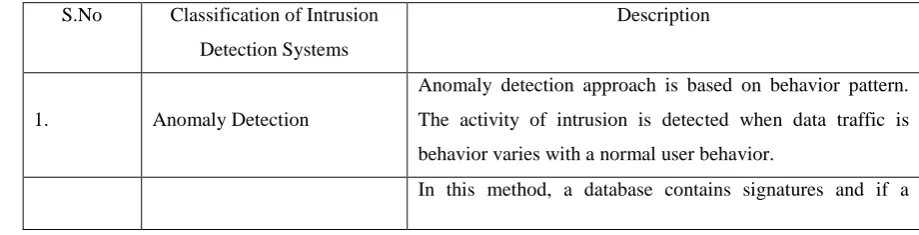
The two models of intrusion detection systems are depicted in Table 1.
S.No Classification of Intrusion
Detection Systems
Description
1. Anomaly Detection
Anomaly detection approach is based on behavior pattern.
The activity of intrusion is detected when data traffic is
behavior varies with a normal user behavior.
430 | P a g e
2. Signature or Misuse Detection particular signature does not match with pre stored signatureit is encountered as an intrusion. Thus misuse detection
approach is based on stored signature pattern.
Table 1.Intrusion detection systems in soft computing
An ideal IDS does not produce false or inappropriate alarms. The Major issues of IDSs is, it generates large no
of false positive alerts where normal traffics are mistakenly analyzed as security violations. The main objective
is to detect novel attacks by unauthorized users in network traffic. In novel attacks the vulnerability is unknown
to the target's owner or administrator, even if the attack is generally known the patches and detection tests are
available.
II.NETWORK COMMUNICATION IN COMPUTER SECURITY
The objective of computer security includes protection of information and property from theft, corruption or
natural disaster while allowing the information and property to remain accessible and productive to its intended
users. The term computer system security is the collective processes and mechanisms by which sensitive and
valuable information and services are protected from publication, tampering or collapse by unauthorized
activities or untrustworthy individuals and unplanned events respectively. The strategies and methodologies of
computer security often differ from most other computer technologies. The elusive objective of computer
security preventing unwanted computer behavior instead of enabling wanted computer behavior make it do
difference from other computer technology [1].
A network traffic monitor allows to quickly and easily to examine the network usage of the local computer. In
Network Traffic Monitor a network analysis tool examines local area network usage and provides a display of
upload and downloads statistics [1]. The Main purpose of the application is monitoring (and counting) the IP
traffic between your local area network (LAN) and Internet. Network Traffic Monitor provides real-time traffic
accounting and monitoring. It is very dynamic, every new (dial-up) connection is registered and monitored, user
can use it to count useful download and upload traffic of a computer or extend it to build the traffic accounting
system for all computers in [24] our day to day life.
2.1 MANET VULNERABILITIES
Vulnerabilities are the hardware, firmware, or software flaw that leaves an information system open for potential
exploitation. The exploitation is of various types in list 1 and list 2 [59].
S.No Classification of Vulnerabilities Description
1. Lack of centralized management MANET doesn’t have a centralized monitor server. The absence of
management makes the detection of attacks difficult because it is not
431 | P a g e
network. Lack of centralized management will impede trustmanagement for nodes.
2. Resource availability Resource availability is a major issue in MANET. Providing secure
communication in such changing environment as well as protection
against specific threats and attacks, leads to development of various
security schemes and architectures. Collaborative ad-hoc environments
also allow implementation of self - organized security mechanism
3. Cooperativeness Routing algorithm for MANETs usually assumes That nodes are
cooperative and non - malicious. As a result a malicious attacker can
easily become an important routing agent and disrupt network
operation by disobeying the protocol specifications.
List 1 – Vulnerabilities of various types
S.No Classification of Vulnerabilities Description
4. Limited power supply The nodes in mobile ad-hoc network need to consider restricted
power supply, which will cause several problems. A node in
mobile ad-hoc network may behave in a selfish manner there is
only limited power supply.
5. Adversary inside the Network The mobile nodes within the MANET can freely join and leave
the network. The nodes within the network may also behave
maliciously. This is hard to detect that the behavior of the node
is malicious. Thus this attack is more dangerous than the external
attack. These nodes are called compromised nodes
6. No predefined Boundary In mobile ad-hoc networks it is hard to define a physical
boundary of the network. The nodes work in a nomadic
environment where they are allowed to join and leave the
wireless network. As soon as an adversary comes in the radio
range of a node it will be able to communicate with that node.
The attacks include Eavesdropping impersonation; tempering,
replay and Denial of Service (DoS) attack[7].
7. Bandwidth constraint Variable low capacity links exists as compared to wireless
network which are more susceptible to external noise,
interference and signal attenuation effects
8. Scalability The mobility of nodes changes the scale of ad-hoc network all
432 | P a g e
Security mechanism should be capable of handling a largenetwork as well as small ones
List 2 – Vulnerabilities of various types
2.1.1 Summary of Vulnerability in MANET
This section discuss clearly that MANET is insecure by nature since there is no clear line of defense. Here nodes
are free to join, leave and move inside the network and perform some malicious behaviors that are hard to
detect. A centralized co-ordinator is necessary to overcome problems in lack of centralized management.
Restricted power supply also causes some problem. Continuously changing scale of the network, because of the
mobility of node in MANET, it will be hard to predict the number of nodes in the network in future.
2.2 CLASSIFICATION OF SECURITY ATTACKS
The MANET have two types of Attacks, namely 1.Internal attacks, 2.External attacks. Internal attacks are
directly leads to the attacks on nodes presents in network and links interface between them. This type of attacks
may broadcast wrong type of routing information to other nodes. Internal attacks are sometimes more difficult to
handle as compare to external attacks, because internal attacks occurs due more trusted nodes. The wrong
routing information generated by compromised nodes or malicious nodes are difficult to identify. Reason being
the compromised nodes will be able to generate the valid signature using their private keys. External Attacks
These types of attacks try to cause congestion in the network, denial of services (DoS), and advertising wrong
routing information etc [56]. External attacks prevent the network from normal communication and producing
additional overhead to the network. External attacks can classify into two categories 1. Passive Attacks, 2.Active
Attacks[8].
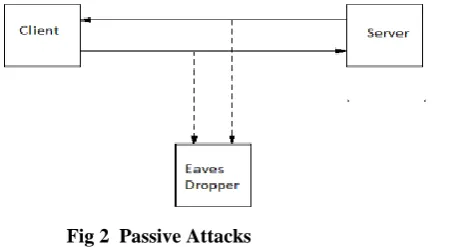
Passive Attack – classification of attacks in snooping is unauthorized access to another person’s data .It is
similar to eaves drooping but does not necessarily gain access to data. Passive attacker does not disrupt the
operation of a routing protocol but attempts to discover the important information from routed traffic[8] Fig2.
Fig 2 Passive Attacks
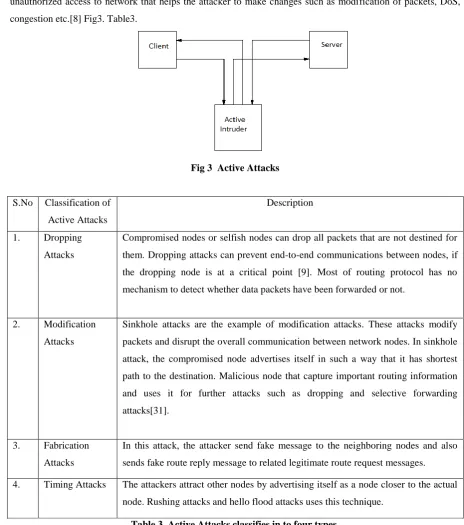
Active Attacks- Active attacks are very severe attacks on the network that prevent message flow between the
433 | P a g e
sources that do not belong to the network. Internal attacks are from malicious nodes which are part of thenetwork, internal attacks are more severe and hard to detect than external attacks. These attacks generate
unauthorized access to network that helps the attacker to make changes such as modification of packets, DoS,
congestion etc.[8] Fig3. Table3.
Fig 3 Active Attacks
S.No Classification of
Active Attacks
Description
1. Dropping
Attacks
Compromised nodes or selfish nodes can drop all packets that are not destined for
them. Dropping attacks can prevent end-to-end communications between nodes, if
the dropping node is at a critical point [9]. Most of routing protocol has no
mechanism to detect whether data packets have been forwarded or not.
2. Modification
Attacks
Sinkhole attacks are the example of modification attacks. These attacks modify
packets and disrupt the overall communication between network nodes. In sinkhole
attack, the compromised node advertises itself in such a way that it has shortest
path to the destination. Malicious node that capture important routing information
and uses it for further attacks such as dropping and selective forwarding
attacks[31].
3. Fabrication
Attacks
In this attack, the attacker send fake message to the neighboring nodes and also
sends fake route reply message to related legitimate route request messages.
4. Timing Attacks The attackers attract other nodes by advertising itself as a node closer to the actual
node. Rushing attacks and hello flood attacks uses this technique.
Table 3. Active Attacks classifies in to four types.
The characteristics of MANETs make them susceptible to many new attacks. These attacks can occur in
434 | P a g e
S.No Classification of Attacks Description1. Network Layer
Attacks
Wormhole Attacks The attackers encapsulate the packet and falsified the
route length between two wired or wireless
networks.
Black hole Attacks An attacker uses the routing protocol as the shortest
path to the node.
Byzantine Attacks A compromised set of intermediate nodes carries out
attacks like routing loops and drooping packets on
non optimal path.
Information
Disclosure
In Network communication ,to authorize nodes
,confidentiality is vital important such as network
topology, geographic location or optimal nodes.
Attackers hijack the comprised nodes and related
information of network topology.
Resource consumption
attacks
The attackers tries to consume all the resources of
nodes such as battery power ,bandwidth and
computational power.
2. Routing Attacks
Routing table overflow A node tries to prevent the creation of new node
entries by routing table overflow updating.
Routing table
poisoning
A compromised node creates traffic in the network
by changing the routing table and forward modified
route packets to other node.
packet replication Attackers causes confusion in the routing process by
replicating the old packet for additional battery
power.
Route cache
poisoning
This is similar to the route poisoning .Here AODV
protocol nodes maintain a route cache.
Rushing attack An intermediate malicious node translate the
duplicate packets which may discard the legitimate
route request packet.
List 3: Attacks on the Network Protocol Stack
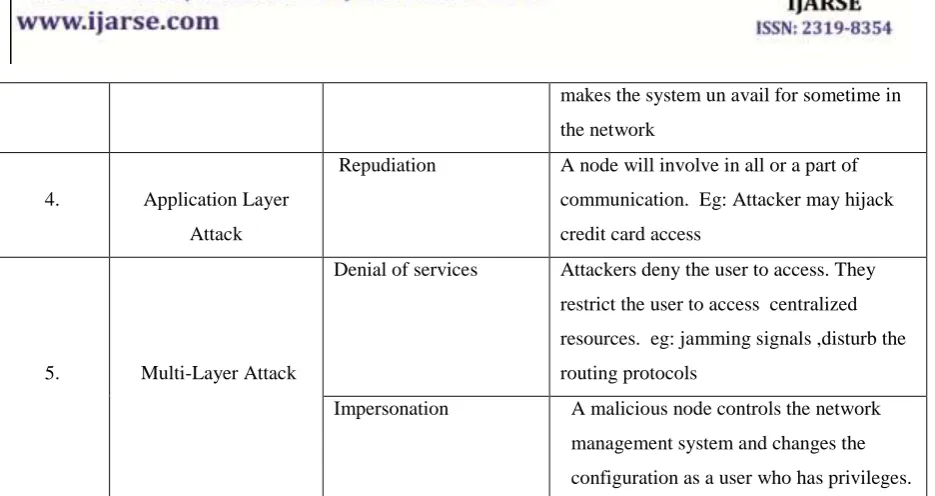
S.No Classification of Attacks Description
3. Transport Layer Attack
Session Hijacking The malicious node work as legitimate
435 | P a g e
makes the system un avail for sometime inthe network
4. Application Layer
Attack
Repudiation A node will involve in all or a part of
communication. Eg: Attacker may hijack
credit card access
5. Multi-Layer Attack
Denial of services Attackers deny the user to access. They
restrict the user to access centralized
resources. eg: jamming signals ,disturb the
routing protocols
Impersonation A malicious node controls the network
management system and changes the
configuration as a user who has privileges.
List 4: Attacks on the Network Protocol Stack
2.2.1 Summary on Security in MANET
The routing and packet forwarding in all networking functions in MANET, are performed by nodes themselves
in a self-organizing manner. For these reasons, securing a MANET is very challenging. The MANET Security
in evaluate is Availability, Confidentiality, Integrity, Authentication, Authorization, Resilience to attack and
Freshness[58].Routing in mobile ad-hoc network using various soft computing techniques have been done using
various algorithms and routing protocols. Routing in MANET using soft computing technique is the solution to
improve quality of service and route optimization in MANET. In all above techniques authors have proposed
various parameters to improve quality of service and route optimization [23].
There are several main requirements are needed to ensure the security in MANET. Some security criteria’s like
location privacy, self stabilization and byzantine Robustness has to be related to the routing protocol, Data
forwarding like layer security, Key Management and IDS in MANET.
2.3. ROUTING PROTOCOLS
Routing is a function contains much activity to connect source to destination, It plays an important role in
architecture, design and operation of network [10]. The study of Routing Protocol is important in the research
to detect Vulnerability of MANET in current year.
Ad-Hoc network routing protocols are commonly divided into three main classes namely Proactive, reactive and
hybrid protocols as shown in Fig 4.
436 | P a g e
2.3.1 Proactive Protocols (table-driven routing protocols)
In proactive routing, each network node has to maintain one or more tables to store routing information, and any
changes in network topology need to be reflected by propagating updates throughout the network in order to
maintain a consistent network view[58].It is not suitable for large topology network. Bandwidth Proactive
Protocols(table-driven routing protocols) is differ in changeable topology in all nodes in the networks. They
have some proactive routing protocols in MANETs namely DSDV(Destination-Sequenced distance
vector),OLSR(Optimized Link State Routing Protocols),TBRPF(Toplology Dissemination Based on
Reverse-Path Forwarding) and WRP(Wireless Routing Protocols).
2.3.2 Reactive Protocols(On Demand-Driven Reactive Protocols)
Reactive routing is also known as on-demand routing protocol since they do not maintain routing information or
routing activity at the network nodes if there is no communication. If a node wants to send a packet to another
node then this protocol searches for the route in an on-demand manner and establishes the connection in order to
transmit and receive the packet. The route discovery occurs by flooding the route request packets throughout the
network[58]. They have some Reactive routing protocols in MANETs they are AODV (Ad-Hoc on Demand
Distance Vector),DSR(Dynamic Source Routing),
2.3.3 Hybrid Protocols
The hybrid protocols that have advantage of both Proactive and Reactive protocols in its balance delay and
control overhead. They introduces a hybrid model that combines reactive and proactive routing protocols. The
Zone Routing Protocol (ZRP) is a hybrid routing protocol that divides the network into zones. ZRP provides a
hierarchical architecture where each node has to maintain additional topological information requiring extra
memory[57].Location Aided Routing(LAR) is another hybrid protocol.[11].The hybrid protocols is more
complex zone routing protocols in the network.
2.4 TRAFFIC ANALYSIS IN NETWORKS
It is the process of intercepting and examining messages in order to deduce information from patterns in
communication. It can be performed even when the messages are encrypted and cannot be decrypted [1]. Traffic
analysis can be performed in the context of military intelligence or counter-intelligence, and is a concern in
computer security. The size of packets being exchanged between two hosts can also be valuable information for
an attacker, even if they aren’t able to view the contents of the traffic (being encrypted or otherwise
unavailable). Seeing a short flurry of single-byte payload packets with consistent pauses between each packet
might indicate an interactive session between two hosts, where each packet indicates a single keystroke. Large
packets sustained over time tend to indicate file transfers between hosts, also indicating which host is sending
and which host is receiving the file, by itself, this information might not be terribly damaging the security of the
437 | P a g e
intended security mechanisms. Security Focus ran an article on a “Method based on traffic behavior that helps identify P2P users, and even helps to distinguish what type of P2P applications are being used”.[61] In this casefocus was on the default port numbers the tools use, though there are more sophisticated methods using
flows.[25]. Traffic analysis can also be used as a defensive technique by identifying anomalies in traffic
patterns. Using traffic analysis, administrators can baseline the traffic to and from hosts on the network over
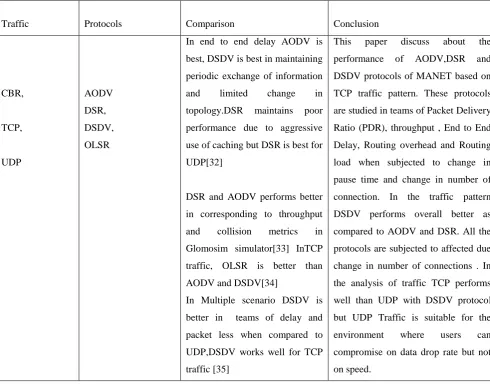
time, in a graphical format (line charts or other graphs) [1]. Table 4 .
Table 4. Traffic and protocol in MANET
2.4.2 Summary of Traffic and Protocols in MANET
This paper discusses about the performance of protocols like AODV, DSR, DSDV and OLSR based on Traffic
pattern. These protocols are studied in terms of packet delivery ratio, End-End Delay which are subjected to be
affected due to change in number of connection. In TCP traffic OLSR is better but when compared to UDP,
Traffic Protocols Comparison Conclusion
CBR, TCP, UDP AODV DSR, DSDV, OLSR
In end to end delay AODV is
best, DSDV is best in maintaining
periodic exchange of information
and limited change in
topology.DSR maintains poor
performance due to aggressive
use of caching but DSR is best for
UDP[32]
DSR and AODV performs better
in corresponding to throughput
and collision metrics in
Glomosim simulator[33] InTCP
traffic, OLSR is better than
AODV and DSDV[34]
In Multiple scenario DSDV is
better in teams of delay and
packet less when compared to
UDP,DSDV works well for TCP
traffic [35]
This paper discuss about the
performance of AODV,DSR and
DSDV protocols of MANET based on
TCP traffic pattern. These protocols
are studied in teams of Packet Delivery
Ratio (PDR), throughput , End to End
Delay, Routing overhead and Routing
load when subjected to change in
pause time and change in number of
connection. In the traffic pattern
DSDV performs overall better as
compared to AODV and DSR. All the
protocols are subjected to affected due
change in number of connections . In
the analysis of traffic TCP performs
well than UDP with DSDV protocol
but UDP Traffic is suitable for the
environment where users can
compromise on data drop rate but not
438 | P a g e
DSDV works well for TCP Traffic. In the traffic analysis TCP performs well but overall UDP traffic is betterand suitable for users in terms of speed.
III.SOFT COMPUTING TECHNIQUES (SC)
This paper provides a comprehensive view of four soft computing approaches to improve quality of service and
route optimization in MANET. Soft Computing techniques in List 5 and List 6. Soft Computing techniques in
MANET List 7, List 8 and List 9.
Artificial Neural Network
(ANN)
Fuzzy logic(FL)
An Artificial neural network is
akin toa biological network,
capable of thinking, reasoning,
decision-making and a high
degree of parallelism. It draws
inferences from a vast storehouse
of knowledge and experience
gained over a period of time in
solving problems[23]. It can
work with imprecise and
ill-defined parameters in arriving at
solutions.[31]
Zadeh explained that Fuzzy logic [12] is an extension of Boolean logic that
is often used for computer-based complex decision making in handling
imprecise and noisy data. While in classical Boolean logic an element can
be either a full member or non-member of a Boolean (sometimes called
”crisp”) set, the membership of an element to a fuzzy set can be any value
within the interval [0, 1], where 0 representing absolute falseness and 1
representing absolute truth. Fuzzy Logic also allows partial membership of
an element in a set. With fuzzy logic, the false alarm rate to determine
intrusive activities can be reduced, where a set of fuzzy rules is used to
define the normal and abnormal behavior in a computer network, and a
fuzzy inference engine can be applied over such rules to determine the
intrusions. The different stages in the fuzzy logic based intrusion detection
system are as follows:
Classifying the training data Generation of fuzzy rules Fuzzy decision
module Identifying the appropriate classification for test input As an
example for the fuzzy logic based approach, Dickerson et al. [17] report a
research based on the fuzzy logic concept. His paper reports a Fuzzy
Intrusion Recognition Engine (FIRE) for detecting malicious intrusion
activities. In the reported work, the anomaly based Intrusion Detection
System (IDS) is implemented using both the fuzzy logic and the data
mining techniques. The fuzzy logic part of the system is mainly responsible
for both handling the large number of input parameters and dealing with the
inexactness of the input data.
439 | P a g e
Genetic Algorithm (GA) Wireless Mesh Network(WMN)
Genetic Algorithm (GA) is the technique which works on
the mechanics of natural selection. It is based on the
Darwin’s theory of survival of the fittest. The main reason
behind the design of GA was to abstract and explain the
adaptive processes of natural selection and to design
artificial system that retrains two important mechanics of
natural systems [18]. This technique is used to make
effective a population of candidate result near a predefined
fitness [19].
The GA process begins with a set of potential
solutions or chromosomes (usually in the form of bit string)
which are randomly generated or selected. The entire set of
these chromosomes comprises a population. The
chromosomes evolve during several iterations or
generations. New offspring are generated using the
crossover and mutation technique. Crossover involves
splitting two chromosomes and then combining first part of
a chromosome with the second part of the other
chromosome. Mutation involves flipping one or more bits
of a chromosome. The chromosomes are then evaluated
using a certain fitness criteria. After the termination
criterion is satisfied, the chromosome having the highest
fitness is taken as the best solution of the problem [18].
Specific modifications of MANET created a
possibility to implement several new wireless
networks. One of them is a wireless mesh
network (WMN). Wireless Mesh Networks are
rapidly deployable, dynamically self organizing;
self configuring, self healing, self balancing and
self aware multi hop networks. Over the last ten
years, WMNs have gained more and more
attention and are now considered as a convincing
solution for providing better Internet access
services for end users. In these networks each
node (stationary or mobile) has the capability to
join and create a network automatically by
sensing nodes with a similar capability within its
radio range.[23].
List 6. Softcomputing techniques
S.No SC Comparison Conclusion
1 FL It is an interface system based on
expected throughput [36]. AODV
protocol that carries out NS2
simulator[37].
Due to extensive simulation, the
number of concurrent flows
significantly that affects the TCP
performance.
2 GA Genetic Algorithm detects various
types of network intrusions, it carries
out KDD9 bench mark dataset. It uses
detection rate and false positive
rate[38]
By using KDD9 bench mark dataset
is obtain reasonable detection rate
and false positive tare. It can solve
scientific equation and complex
440 | P a g e
List 7 Softcomputing techniques in MANETS.No SC Comparison Conclusion
3 ANN All the local IDS agents collaborate in
order to compose an IDS for MANET
first development towards the field of
ANN based routing solution Multi
destination routing problem single
destination routing version there
extends the range of operation of
former method finds a path with as
many as N hop [39]. Simulation with
higher and lower weighted time
influence on prediction output has to
be studied for implementation purpose
combination of conventional and
neural networks methods will be
investigated to reduce the expenditure
in real system[40]
The time influence with higher and
lower simulation, IDS for MANET
can be performances in Artificial
neural network .The Combination of
conventions and ANN methods will
reduce the expenditure in Real
system.
List 8 Softcomputing techniques in MANET
S.No SC Comparison Conclusion
4 WMN It extends network coverage with
mixture of wireless technologies
through multi-hop communication.
Routing in multi-hop wireless network
has always been a challenge in
research avenue[41]
New routing protocols specifically
adapted for WMNs are needed.
Since it has several prominent
characters it stand apart from
traditional wired or wireless network
and hence all for new resource
management techniques.
List 9 Softcomputing techniques in MANET
3.1.1 Summary of Softcomputing in MANET
In fuzzy logic, the number of concurrent flows affects the performance of TCP. GA uses KDD9 benchmark
dataset to obtain reasonable detection and false positive rate. In ANN the combination and ANN method reduces
the expenditure in real system WMNs are needed for routing protocols it is called as new resource management
441 | P a g e
List 9 Parameters in MANET.SC Parameters
Protocol
Node Times Data rate Traffic Tools
FL DSR,
AODV,
DSOV,
OLSR
10,20…
170
100Sec 1 mbps CBR NS2
MatLab,
GloMosim
Qualnet,
OPNET
ANN DSR,
AODV, DSOV, OLSR 6, 100 400Sec 6.45Sec 512 bytes 8 bits CBR CBR NS2 MatLab
GA DSR,
AODV, DSOV, OLSR 50,75, 100 100Sec 1800Sec 450sec 1000X 1000m 250m 2,4,6810,124 CBR FTP NS2 MatLab, GloMosim Qualnet, OPNET
WMN DSR,
AODV,
DSOV,
OLSR
30 200Sec 512bytes,250m CBR
FTP NS2 MatLab, GloMosim Qualnet, OPNET
SC Comparison Conclusion
FL Minimum cost and delay[42]. The bandwith
traffic factors are included in two route discovery
process [43]. Implementation of dynamic routing
algorithm based on DSR. To improve the
performance of the network, proposed algorithm
uses Fuzzy interface to dynamically vary the
parameters [44][45,46,47,48,49,50]
This discuss about the minimum and
cost delay of traffic inclusion of two
route discovery process and
implementation of DSR based routing
algorithm, uses fuzzy inter face to vary
the parameter and hopefully improve
442 | P a g e
List 10 Parameters in MANET.SC Comparison Conclusion
GA In Multihop wireless network, the integrated components
works for outcome for the end to end delay and bandwith
for unicast and multicast transmission .GOBR provides
solution for routing and connectivity based on GA[53]. In
CBR , AODV performs better than DSR. DSR performs
average in End to End delay. In FTP , AODV performs
better than DSR[54]. In UDP Traffic DSR is better and
AODV is better in drop packets. In TCP, DSR
performance is better in PDR but AODV is average.
AODV and DSR performs better in TCP pattern[55] All
over TCP performs better.
In concludes that in CBR AODV
performs better, In FTP AODV is
better again in UDP AODv is better
in TCP both DSR and AODV
performs better compared to CBR
and TCP, TCP performs well.
List 11 Parameters in MANET.
SC Comparison Conclusion
WMN DSR is more reliable and complete protocol for
mesh network when compared to AODV[56].
Routing in multi –hop wireless network is a
challenging. New routing protocols adapted for
WMNs are needed[57] DSDV and AODV routing
protocols are used in small and large network of
simulation experiment[58]
In WMN DSR is more reliable and
complete Multi-Hop wireless network is
challenging in routing new routing are
needed for WMNs, DSDV and AODV
routing protocols are used in network.
List 12 Parameters in MANET. ANN ANNs modeling for detecting DOS attack in
MANET and detecting nodes under DOS attack
effectively [51]. The input data such as throughput
, Packet delivery ratio, end to end delay and
average jitter were used for training the neural
network[52]
ANNs detect the DOS attacks in
MANET effectively the input data’s such throughput, End-End delay packet
443 | P a g e
3.1.2 Summary of Parameters in MANET
List 9 ,10,11 and 12 in this paper when the traffic parameter are analysed the node should be minimum 100
nodes, time should be minimum 100 second, data rate should be at-least 512 bytes, these parameters are used in
the CBR,TCP,FTP and UDP traffic and DSR,AODV,DOSV and OSLR protocols. From this AODV performs
better in CBR and TCP. When these parameter are used in WMNs DSR is more reliable and complete
Multi-Hop wireless network is challenging in routing and need new routing for WMNs.
IV.CONCLUSION
This paper emphasizes the overall performance, characteristics, functions and the various attacks in MANET.
Some restrictions are being faced in its excellence by network model and network parameters. Existing work
done on MANET combined with Softcomputing technique have been compared. This study help researchers to
innovate new techniques to overcome all the problems and issues effectively by taking necessary steps and
efforts in MANET.
REFERENCES
[1]Deepa.C, NiyazHussain A.M.J, “ Analysis for Traffic and Intrusion Detection”,Global Journal of
Engineering,Design& Technology,ISSN:2319 – 7293.
[2]RichaSondhiya*, Mahendraku Mishra, Manish Shrivastava. ”To Improve Efficiency of Intrusion Detection
System by Using Improved Multilayer Perceptron Algorithm” Department of IT, LNCT Bhopal, India,
Febtuary 2014.
[3]Tomas Krag and Sebastian Büettrich (2004-01-24). "Wireless Mesh Networking". O'Reilly Wireless Dev
Center. Retrieved 2009-01-20.
[4]Zadeh, Lotfi A., "Fuzzy Logic, Neural Networks, and Soft Computing," Communication of the ACM, March
1994, Vol. 37 No. 3, pages 77-84.
[5]X. S. Yang, Z. H. Cui, R. Xiao, A. Gandomi, M. Karamanoglu, Swarm Intelligence and Bio-Inspired
Computation: Theory and Applications, Elsevier, (2013).
[6]D. K. Chaturvedi,Soft Computing: Techniques and Its Applications in Electrical Engineering, Springer,
(2008).
[7] A Mishra and K.M Nadkarni, security in wireless Ad-hoc network, in Book. The Hand book of Ad Hoc
Wireless Networks (chapter 30), CRC press LLC, 2003
[8]Gagandeep, Aashima and Pawan Kumar “Analysis of Different Security Attacks in MANETs on Protocol
Stack”. International Journal of Engineering and Advanced Technology (IJEAT), Volume-1, Issue-5, June 2012
[9] PanagiotisPapadimitratos and Zygmunt J. Haas “Securing Mobile Ad Hoc Networks”.
[10]Krishna gorantala “routing protocol in Mobile adhoc networks” master thesis in computing science, UMEA
university, June 15,2006.
[11]Y.B.Ko and N.H.Vaidya”location aided routing in Mobile adhoc
444 | P a g e
[12] J. Gomez & D. Dasgupta, (2002) “Evolving Fuzzy Classifiers for Intrusion Detection”,IEEE Proceedings of the IEEE Workshop on Information Assurance, United States Military Academy,West
Point, NY
[13]J. Shum and A. HeidarMalki, "Network Intrusion Detection System Using Neural Networks", Fourth
International Conference on Natural Computation, IEEE computer society.2008.
[14]R. H. Gong, M. Zulkernine& P. Abolmaesumi, (2005) “A Software Implementation of a
Genetic Algorithm Based Approach to Network Intrusion Detection”, Proceedings of the Sixth International
Conference on Software Engineering, Artificial Intelligence, Networking and Parallel/Distributed Computing
and First ACIS International Workshop on Self-Assembling Wireless Networks.
[15]Mrutyunjaya Panda and ManasRanjanPatra, “A Novel Classification via Clustering Method
for Anomaly Based Network Intrusion Detection System”, International Journal of Recent Trends in
Engineering, Vol 2, No. 1, November 2009.
[16]ArvindMewada, PraffulGedam, Shamaila Khan and M. Udayapal Reddy (2010), “Network
Intrusion Detection Using Multiclass Support Vector Machine”, Special Issue of IJCCT for International
Conference [ACCTA-2010], Vol.1, No.2,3,4, pp.172-175.
[17] JingTao Yao, Songlun Zhao, and Lisa Fan.” An Enhanced Support Vector Machine Model
for Intrusion Detection”, Department of Computer Science, University of Regina Regina, Saskatchewan,
Canada S4S 0A2
[18]David E. Goldberg: Genetic Algorithms in Search, Optimization and Machine Learning.
Pearson Education, seventh reprint, 2004.
[19]W. Li, (2004) “A Genetic Algorithm Approach to Network Intrusion Detection”, SANS
Institute, USA.
[20] Vapnik, V.N.: The Nature of Statistical Learning Theory. Springer (1995).
[21] Burge, C.: A Tutorial on Support Vector Machines for Pattern Recognition. Datamining and
knowledge discovery journal. 2(2) (1998) 121{167.
[22] Ghanshyam Prasad Dubey, Prof. Neetesh Gupta, Rakesh K Bhujade. “A Novel Approach to
Intrusion Detection System using Rough Set Theory and Incremental SVM” , International Journal of Soft
Computing and Engineering (IJSCE), ISSN: 2231-2307, Volume-1, Issue-1,
March 2011
[23]NehaP.Bhakare,Dr. M.S.Ali2 “ Overview of Routing in MANET using Soft Computing
Approaches” International Journal of Advance Research in Computer Science and
Management Studies
[24] Original idea by Dirk Claessens; GUI, TTraffic class and text by ZarkoGajic.
[25]Identifying P2P Heavy-Hitters from Network-Flow Data, Arno Wagner¤ Thomas
D¨ubendorfer¤ Lukas H¨ammerle† Bernhard Plattner, Communication Systems Laboratory, Swiss Federal
445 | P a g e
SWITCH, PO Box, CH-8021 Zurich, Switzerland, [email protected] Contact Author: Arno Wagner,phone: +41 44 632 7004, fax: +41 44 632 10 35
[26]Jonatan Gomez and DipankarDasgupta. Evolving Fuzzy Classifiers for Intrusion Detection,
Proceedings of the 2002 IEEE Workshop on Information Assurance, United States Military Academy, West
Point, NY June 2001.
[27]Constantine Manikopoulos and SymeonPapavassiliou, New Jersey Institute of Technolog,
IEEE Communications Magazine • October 2002
[28]V. Bobor, (2006) “Efficient Intrusion Detection System Architecture Based on Neural Networks and Genetic Algorithms”, Department of Computer and Systems Sciences,
Stockholm University/Royal Institute of Technology, KTH/DSV.
[29]Zadeh L A, (1965) “Fuzzy Sets”, Information and Control, Vol.8, pp. 338-353.
[30]John E. Dickerson and Julie A. Dickerson, “Fuzzy network profiling for intrusion detection,”
in Proceedings of NAFIPS 19th International Conference of the North American Fuzzy
Information Processing Society, pp. 301–306, Atlanta, USA, July 2000.
[31]Siddesh.G.K,K.N.Muralidhara,Manjula.N.Harihar,2011. Routing in Ad Hoc Wireless
Networks using SoftComputing techniques and performanceevaluation using HypernetsimulatorInternational
Journal of Soft Computing and Engineering (IJSCE)ISSN: 2231-2307, Volume-1, Issue-3, July 2011
[32] PERFORMANCE EVALUATION OF MANET ROUTING PROTOCOLS ON THE BASIS OF TCP
TRAFFIC PATTERN- International Journal of Information Technology Convergence and Services (IJITCS)
Ajay Kumar 1 and Ashwani Kumar Singla 2
[33] Impact of CBR traffic on Routing protocols in MANET’s – Yudhvir Singh,Amit Kumar,Prabha Rani, Sunil
kumal kaushik,
[34] Traffic pattern Based perforce comparison of AODV,DSDV and OSLR MANET routing Protocols using
freeway Mobility Model – Suman Kumar,Sunil Maakar,Suresh Kumar, R.K.Rathy
[35] Performance evaluation of TCP & UDp over destination sequence distances vector for Random waypoint
mobility model - Zahid, Haleem Farman, Mushtaq Ahmad, Muhammad Najam-Ul-Islam and Huma Javed
[36] Improving TCP performance based on Fuzzy logic for MANET.
[37]http://www.isi.edu/nsnam/ns/ns-documentation.html
[38]An Implementation of Intrusion detection system using Genetic Algorithm.
[39] Overviews of routing in MANET using Softcomputing approaches – Neha P Bhakre,dr.M.S.Ali
[40] MANET location prediction by using Artificial neural network consideration and future directions – Gamel
Abdal nasir
[41] Routing protocols in Wireless Mesh Network , Challenge and design considerations – Sonia waharte,Raouf
Boutaba,Youssef Iraqi,Brent Ishibashi
[42]DSR Routing decision for Mobile Ad Hoc network using Fuzzy Inference system –Panraj Sharma,Shruti
Kohil,
446 | P a g e
[44]Fuzzy Logic Based DSr Routing Protocol design for MANET-V.Eswaramoorthy,Dr.P.Sengottuvelan-2014[45]Fuzzy Routing in AdHoc network- Gasim Alandjani and EricJonsh
[46]A Fuzzybased virtual back bone Routing for large scale MANET-Ala al-fuqaha,sehaiar guizani
[47]Implementation of modified fuzzy priority scheduler for MANET and performance analysis with
traffic-Gomathy,shanmugavel.
[48]Detection of anomaly network traffic for mobile AdHoc network using fuzzy logic-Raja lakshmi,anusha
[49]Fuzzy Improved Genetic approach for route optimization in MANET-Jaspal Jindal,Gupta
[50]Implementation of Neural network for Intrusion Detection in MANET-Moradi,Mohammed
[51]Black hole Detection in MANET using Artificial Neural Network – Ramapreet kumar,Anantdeep Kumar
[52]performance analysis of genetic algorithm based unicast and multicast routing Optimization model for
Mobile AdHoc Network-A.Vijayalakshmi,Dr.P.Ramamoorthy
[53] Performance Evaluation of Two Reactive routing protocol in MANET – Archana patidar,M.Chiranjeevi
[54]Implementation and Evaluation of Wireless Mash network on MANET Routing Protocol- Shashi
Bhishan,Anill saroliya
[55] Perfomance Evaluation of TCP & UDP over destionation sequence distans vector(DSDV) for random
waypoint mobile model.-Zahid,Farman,Alomand
[56] http://www.cs.rutgers.edu/~rmartin/teaching/fall04/cs552/papers/012.pdf
[57] http://answers.google.com/answers/threadview/id/440378.html
[58]http://www.ijarcsse.com/docs/papers/Volume_3/5_May2013/V3I5-0267.pdf
[59] http://ijcem.org/papers12011/12011_17.pdf
[60]http://www.ijeat.org/attachments/File/v1i5/E0508061512.pdf
[61] http://www.securityfocus.com/infocus/1843
Mr. NIYAZ HUSSAIN A.M.J has finished his Bachelor of Computer Applications from Sankara College of
Commence & Science, Coimbatore. He has completed his M.Sc.IT from S.N.R Sons College, Coimbatore. He
has been awarded his M.Phil in Networking from Bharathiar University during 2012. He is working as an
Assistant Professor in Sri Ramakrishana College of Arts & Science (Formerly SNR Sons College),Coimbatore
for past six years. He is currently a regular part - time Research Scholar in Department of Computer Scienceat
Sri Ramakrishana College of Arts & Science (Formerly SNR Sons College), Coimbatore, Tamil Nadu, India
447 | P a g e
Dr.J.Maria Priscilla has finished her M.Sc. degree at Bharathiar University in 1999, she has been awardedM.Phil Degree at Bharathidasan University in 2004 and she has been awarded Ph.D at Mother Teresa
University. Her area of interest is Computer Networks, She has 19 years of teaching experience in collegiate
service. She is currently working as Head & Professor, Department of Computer Science in Sri Ramakrishana
College of Arts & Science (Formerly SNR Sons College), Coimbatore. She has presented & published various