622 | P a g e
ANALYSIS OF EFFECTIVENESS FOR PLATE HEAT
EXCHANGER (PHE) USING AL
2
O
3
AND TIO
2
BASED
NANOFLUIDS
D.Bahar
1, Jakirahemed MD
2, K. Srikanth
31
Assistant Professor, Department of Mechanical Engineering,
Rajiv Gandhi University of Knowledge Technologies, Basar, Nirmal-504107 (TS).
2
Assistant Professor, Department of Mechanical Engineering,
Rajiv Gandhi University of Knowledge Technologies, Basar, Nirmal-504107 (TS)
3
Assistant Professor, Department of Chemical Engineering,
Rajiv Gandhi University of Knowledge Technologies, Basar, Nirmal-504107 (TS)
ABSTRACT
In order to reduce the environmental impact and save energy, researchers are concerned to improve the thermal
efficiency of heat exchangers. Previous work by researchers recommends that nanofluids have great potential
to improve the thermal performance of heat exchanger. Nano fluids are colloidal suspensions of nano sized
particles in the conventional base fluid such as water, engine oil and ethylene glycol etc. The nano particles
include chemically stable metals, metal oxides and non- metallic. Addition of nano sized particles in the base
fluid increases the thermal conductivity of fluid and consequently increases the heat transfer rate in heat
exchangers.The present study analyses the thermal performance of nano fluids and investigated the variety of
nano fluids as working fluids in plate heat exchanger (PHE). A model of PHE is designed in Solid Works and
this model has been analysed with nano fluids in ANSYS software. A combination of Al2O3 and
water-TiO2 as nano fluids with volume fraction of 0.2 is used in PHE and results of heat transfer rates are compared
for three cases of flowing fluids as follows.
Case-1: cold fluid as well as hot fluid is used as water
Case-II: cold fluid as water and hot fluid as a mixture of water-TiO2 (0.2 volume fraction)
Case-III: cold fluid as water and hot fluid as a mixture of water-Al2O3 (0.2 volume fraction)
After analysis it is found that thermal performance of PHE will be comparatively better in Case-III. Therefore it
is suggested to use water-Al2O3 as a nano fluid.
Key words: Plate Heat Exchanger (PHE), Nano Fluid, Nano particles, SolidWorks, ANSYS.
I INTRODUCTION
Heat exchanger is a device that promotes the transfer of heat between two fluids that are at different
623 | P a g e
up to large plants. There are many types of heat exchangers but plate type heat exchanger is one of the best
devices for the advancement and technological development in compact heat exchanger. It consists of a stack of
stamped heat exchange plates which are either bolted or brazed together in a frame with gaskets due to its high
thermal efficiency [1-2]. It has been addresses that the number of plates depends upon the flow rate, physical
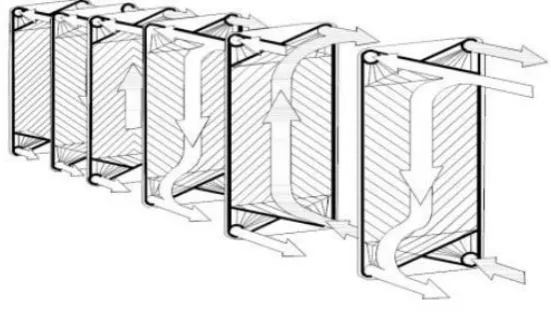
properties of the fluids, pressure drop and temperature [3]. A simple model of plate heat exchanger with
directional flow of fluid is shown in Fig 1. The cold and hot fluid flows in opposite directions on either side of
the plates. Water flow controlled by the placement of the plate gaskets and by changing the position of the
gasket, water can be channelled over a plate or past it. Gaskets are fitted in such a way that fluids cannot mixed
due a gasket failure.
Figure 1: Plate heat exchanger
One of the ways to enhance the heat transfer by convection is to increase the thermal conductivity of the fluid.
Since the publication of Maxwell’s theoretical work lot of research is carried out on suspensions containing
solid particles [4]. However owing to high density and large size, solid particles settle out of suspension. To
resolve this problem nanotechnology pave the way to produce materials with average crystallite sizes below
50nm. Nano fluids suspend nanoparticles, a term coined by Choi in the Argonne National Laboratory, U.S.A. in
1995 [5]. Nano fluids can alter the fluid flow and heat transfer characteristics of the base fluids. Keblinski et al.
[9] reviewed in a simple way to discuss the properties of nanofluids.Tiwari et al.[6] concluded experimentally
that the optimum volume concentration of Al2O3, CeO2, SiO2and TiO2 nano particles in water should be 1.25,
1.0, 0.75 and 0.75 vol.%, for effectiveness, overall heat transfer coefficient, convective heat transfer coefficient
and maximum heat transfer rate respectively. Javadi et al. [7] used SiO2, TiO2 and Al2O3 nanofluids in a plate
heat exchanger and concluded that if nano particles volume concentration increases, Prandtl number decreases.
Tiwari et al. [8] performed an experiment on a plate heat exchanger by using different nanofluids (CeO2,
Al2O3, TiO2 and SiO2) and concluded that lower volume concentrations TiO2, CeO2 and the higher volume
concentrations Al2O3, SiO2 nano particles shows better heat transfer characteristics. In the present work, plate
type heat exchanger is simulated on the basis of computational fluid dynamics (CFD) method. Water and a
624 | P a g e
different cases as afore mentioned. Figs.2 and 3 shows Transmission electron microscopy (TEM) images of
dispersed Al2O3 and TiO2 respectively. Table 1 shows the specific properties of Al2O3 and TiO2.
Figure 2: TEM photograph of dispersed Nano
Al2O3 particles in water.Tiwari et al [6]
Figure 3: TEM photograph of dispersed TiO2 Nano
particles in water. Tiwari et al [6]
Table 1: Properties of Nano fluids
Nano fluid Volume
fraction, (Φ)
Density(ρ), kg/m3
Specific Heat(Cp),
J/kg.K
Thermal
conductivity
(K), W/mK
Dynamic
Viscosity(μ),
kg/m.sec
TiO2 0.2 1650 2379.678 0.97341 1.503E-3
Al2O3 0.2 1590 2539.874214 1.041835 1.503E-3
II PROCEDURE AND ANALYSIS
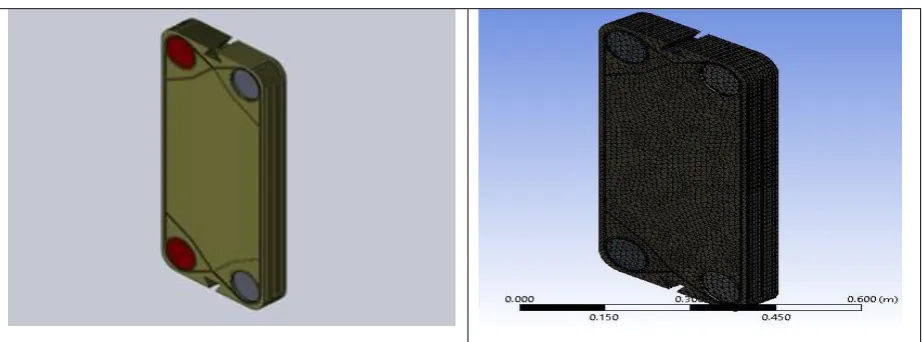
A PHE model with description given in Table 2 is designed and modelled in solid works as shown in Figure 4.
And the same model is imported in to ANSYS in which fine meshing is created as shown in Figure 5.
Table 2: Details of plate heat exchanger (PHE) Assembly
Number of plates 10
PHE length 0.853 m
Plate width 0.365 m
Plate thickness 2 mm
Spacing between two plates 5 mm
Plate material AISI-316
Thickness of Gasket 6 mm
625 | P a g e
Figure 4: Plate heat exchanger assembly Figure 5: Meshed Model of PHE assembly
Boundary condition:
Flow parameters of hot and cold fluid are tabulated in Table 3. In flow boundary conditions, direction of flow
was defined normal to boundary. The initial absolute pressure is taken as 1 MPa, the turbulent intensity was
kept 5% and turbulent viscosity ratio was 10% at inlet. Outlets of cold and hot fluids were kept as out flow.
All the walls were assumed to be smooth with zero roughness. The no slip condition was applied at all the
walls and walls were considered as stationary wall.
Table 3: Flow parameters
III
RESULTS AND DISCUSSIONS
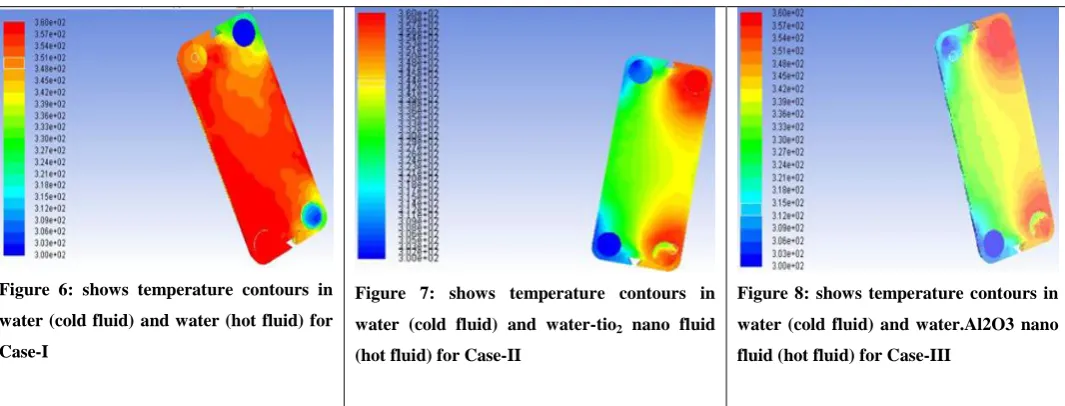
With aforementioned boundary conditions, PHE model is analysed for three cases-I,II and III as mentioned in
the following sections and the contours of temperature in cold fluid and hot fluid are shown in Figures 6,7 and 8
for respective cases.
Case-I: cold fluid as well as hot fluid is water
Case-II: Cold fluid as water and hot fluid as a mixture of water-TiO2 (volume fraction 0.2)
Case-III: cold fluid as water and hot fluid as a mixture of water-Al2O3 (Volume fraction 0.2) Cold fluid mass flow rate( 7.85 kg/s
Hot fluid mass flow rate 7.85 kg/s
Cold fluid inlet Temperature ( ) 300 K
626 | P a g e
Figure 6: shows temperature contours inwater (cold fluid) and water (hot fluid) for Case-I
Figure 7: shows temperature contours in water (cold fluid) and water-tio2 nano fluid
(hot fluid) for Case-II
Figure 8: shows temperature contours in water (cold fluid) and water.Al2O3 nano fluid (hot fluid) for Case-III
From the analysis, outlet temperatures of cold fluid and hot fluid are also found which are presented in Table 4.
Table 4: Outlet temperatures of cold and hot fluid
Case
Outlet temperature of cold fluid
( ), K
Outlet temperature of hot fluid
( ), k
I 309.0 351.0
II 310.8 341.2
III 312.2 340.5
After finding out the outlet temperatures, following equations (1,2 &3) are used to calculate the effectiveness of
PHE in different cases and the results are tabulated in Table 5.
Equations used:
Heat transfer rate in cold fluid …...(1)
Heat transfer rate in cold fluid …...(2)
Effectiveness (ϵ) =
= ……(3)
Where;
and are the specific heats of cold fluid and hot fluid respectively. Whose value is 4.182 kJ/Kg.K
627 | P a g e
Table 5: Effectiveness of PHE in different cases
Case Cold fluid Hot fluid Effectiveness
I Water Water 0.150
II Water Water-TiO2 0.316
III Water Water-Al2O3 0.335
From Table 5, it is evident that effectiveness of PHE will be higher with Al2O3 nano particles and will be lesser
without nano particles. Further effectiveness of PHE is higher by using Al2O3 nano particles as compared to
TiO2 nanoparticles.
IV CONCLUSIONS
From this work it is concluded that the performance of Plate Heat Exchanger increases if we use nano fluid as
one of the working fluids of Heat Exchanger and it changes with nanofluids. Present work also suggests that out
of considered flowing fluids in the analysis Al2O3 nanofluid should be preferred.
REFERENCES
[1]R. K. Shah, A. S. Wanniarachchi, Plate heat exchanger design theory, in: J.M. Buchlin (Ed.), Industrial Heat
Exchangers, von Karman Institute Lecture Series, (1991).
[2]W. M. Kays, A. L. London, Compact heat exchangers, 3rd ed., Krieger Publ. Co., Florida, USA, (1998)
[3]R. K. Shah, D. P. Sekuli ́ c , Fundamentals of heat exchanger design, John Wiley and Sons, Inc., Hoboken,
NJ, (2003).
[4] J.C. Maxwell, A Treatise on Electricity and Magnetism, second ed.,Clarendon Press, Oxford, UK, 1881.
[5] S.U.S. Choi, Enhancing thermal conductivity of fluids with nanoparticles,Developments and Applications of
Non-Newtonian Flows, FED-vol.231/MD-vol. 66, 1995, pp. 99–105.
[6]A. K.Tiwari , P. Ghosh , Jahar Sarkar, Particle concentration levels of various nanofluids in plate heat
exchanger for best performance” International Journal of Heat and Mass Transfer 89,2015, 1110–1118
[7] F.S. Javadi , S. Sadeghipour , R. Saidur , G. BoroumandJazi , B. Rahmati , M.M. Elias , M.R. Sohel, The
effects of nanofluid on thermophysical properties and heat transfer characteristics of a plate heat exchanger,
International Communications in Heat and Mass Transfer, 44,2013, 58–63
[8] A.K. Tiwari , P.Ghosh, J. Sarkar , Performance comparison of the plate heat exchanger using different
nanofluids,Experimental Thermal and Fluid Science,49,2013, 141–151
[9] P. Keblinski, J.A. Eastman, D.G. Cahill, Nanofluids for thermal transport, Materials Today 8 (6) (2005) 36–