445 |
P a g e
GC-MS analysis and Anti-Oxidant Activity of
Simarouba
Glauca
Leaf Extract
Ramesh. J
1, S. Gurupriya
2, Dr.L.Cathrine
31,2
Research Scholar, Department of Chemistry, Holy cross College,
Tiruchirappalli, Tamil Nadu,(India)
3
Assistant Professor, Department of Chemistry, Holy cross College,
Tiruchirappalli, Tamil Nadu, (India)
ABSTRACT
Various medicinal plants have been used for years in daily life against diseases, whole over the
world. Simarouba glauca DC., (Family. Simaroubaceae) is very important medicinal plant and it is
commonly known as Simarouba otherwise called as paradise tree or Laksmi taru, is a multi-purpose
evergreen tree receiving great interest as a promising energy crop and medicinal plant for the future.
simarouba is a medium sized evergreen tree (height 7-15 m) with tap root system and cylindrical
stem. Simarouba glauca can be cultivated in tropical regions all over the world. Simarouba
glauca has a long history in herbal medicine in many countries. Simarouba has been used for various
ailments like, anti -viral, anti -bacterial and anti-protosoval, anti-dysenteric and anti-malarial
activities. It has aroused great enthusiasm as miraculous tree of solace for cancer patients. In the
present study GC-MS analysis of Ethanolic extract of Simarouba glauca were carried out and
revealed the maximum phytocomponents with their activity. Quantitative estimation of the simarouba
glauca leaves extracts showed the presence of Vitamin-A, Vitamin-B (B1, B2, and B3) and Vitamin-C
was determined by using standard methods. Free -radical scavenging activities of simarouba glauca
were examined in the Ethanolic extract shows a good inhibitory activity against the DPPH radical.
Keywords: GC-MS analysis, quantitative estimation and Antioxidant activity
I. INTRODUCTION
446 |
P a g e
and fixed)[3]. (Amrit pal Singh, 2005). India has one of the oldest, richest and most diverse cultural traditions associated with the use of medicinal plants.
Simarouba glauca leaves and bark have a long history of medicinal use in the tropics, particularly in the treatment of malaria, fevers and dysentery; as an astringent to stop bleeding; and as a tonic. They are also used as a digestive, emmenagogue and to treat parasites both within and on the body. Research has discovered a range of medically active compounds in the plant. The main active compounds are a group of triterpenes called quassinoids. The anti-protozoal and anti-malarial properties of these chemicals have been documented for many years. Several of the quassinoids found in simarouba, such as ailanthinone, glaucarubinone, and holacanthone, are considered the plant's main therapeutic constituents and are the ones documented to be protozoal, anti-amoebic, anti-malarial, and even toxic to cancer and leukaemia cells. Studies have shown that the plant is over 90% effective against amoebic dysentery. Simarouba glauca containing large number of such compounds as alkaloids, flavonoids, carbohydrates, glycosides, phenolic compound, tannins, triterpenoids, carotenoids, saponins, fixed oils . The chemicals present in leaf, fruit pulp and seed are known to possess the medicinal properties such as amoebicide, analgesic, anthelmintic, antibacterial, anti-dysenteric, anti-leukemic, antimalarial, antimicrobial, anti-tumorous, antiviral, astringent, cytotoxic, emmenagogue, febrifuge, skin hydrator, stomachic, sudorific, tonic, vermifuge. These are mainly involved in pharmacological activities of this plant. The present study was aimed to investigate the phytochemical constituents quantitatively and anti-oxidant activity.
II. MATERIALS AND METHODS
2.1 Plant collection and preparation of extract
Simaoruba glauca trees are cultivated in Lalbagh botanical garden Bangalore and fresh leaves were collected and authenticated at Rapinet Herbarium. Healthy plant leaves were collected, washed thoroughly in tap water and dried in room temperature for 30 days. The coarse powder (50g) of the leaves of Simaruba glauca was extracted successively with Ethanol, each 250 ml in a Soxhlet apparatus for 24 h. The extracts were filtered through Whatman No.41 filters paper. The extracts were concentrated in a rotary evaporator. The ethanolic extracts were analyzed by GC-MS analysis and anti-oxidant activity.
2.2 Estimation of vitamin analysis
Determination of Thiamine by the method of Okwu (2004)
5gm of Simarouba glauca leaves was homogenized in 50 ml ethanolic sodium hydroxide. It’s 10 ml filtrate was added to 10 ml potassium dichromate and absorbance was recorded at 360 nm after development of color.
Determination of Niacin by the method of AOAC (1987)
447 |
P a g e
Determination of Riboflavin by the method of Okwu (2004)
5 gm of the Simarouba glauca leaves was extracted with 100 ml of 50% ethanol solution and shaken for 1 hr. This was filtered into a 100 ml flask; 10 ml of the extract was pipetted into 50 ml volumetric flask. 10 ml of 5% potassium permanganate and 10 ml of 30% H2O2 were added and allowed to stand over a hot water bath for
about 30 min. 2 ml of 40% Sodium sulphate was added. This was made up to 50 ml and the absorbance was measured at 510 nm in a spectrophotometer.
Determination of Ascorbic acid by the method of Barkat et al., 1973.
5gm of Simarouba glauca leaves was taken into 100 ml EDTA/ TCA (2:1) and mixed well. This mixture was centrifuge at 3000 rpm for 20 min. It was transferred to 100ml volumetric flask and volume was made up. 20ml of this mixture with 1% starch solution was titrated with 20% CuSO4 till the appearance of dark end point.
Determination of vitamin A by the method of (Bayfield and Cole, 1980).
Grind 1 to 5 gm of the Simarouba glauca leaves material to a fine paste and add 1.0ml of saponification mixture. Reflex the tubes gently for 20minutes at 600C and cool the tubes at room temperature added 20ml water and mix well. Extract vitamin with 10ml of petroleum ether in a separating funnel twice. Pool the extract and added sodium sulphate to remove the moisture for 30-60minutes evaporate 5ml aliquot of the ether extract to dryness at 600 0C dissolve the dried residue in 1.0ml of chloroform. Make up the volume in each test tube to 1.0ml with chloroform. Added 2.0ml of TCA solution from a fast delivery pipette, rapidly mixing the contents of the tube. Read at 620 nm immediately in a spectrophotometer.
2.3 Determination of anti-oxidant activity
The ability of the ethanolic extract of Simarouba glauca leaves to scavenge DPPH radicals was determined according to the method described by Shimada et al. (2001). Briefly, a 2 ml aliquot of DPPH methanol solution (25µg/ml) was added to 0.5 ml sample solution at different concentrations. The mixture was shaken vigorously and allowed to stand at room temperature in the dark for 30 min. Then the absorbance was measured at 517nm in a spectrophotometer. Lower absorbance of the reaction mixture indicated higher free-radical scavenging activity.
AC – AS
Radical scavenging activity (%) = 100 - --- X 100
A
CWhere AC= control is the absorbance and AS = sample is the absorbance of reaction mixture (in the presence of
sample).
2.4 GC-MS analysis.
448 |
P a g e
temperature was set at 275oC. The GC program was initiated by a column temperature set at 60oC for 5 min, increased to 300oC at a rate of 8 C/min, held for 10 min. Helium was used as the carrier gas (1.5 mL/min). The mass spectrometer was operated in EI mode with mass source was set at 200oC. The chromatogram and spectrum of the peaks were visualized. The particular compounds present in the ethanolic extract of the leaves were identified by matching their mass spectral fragmentation patterns of the respective peaks in the chromatogram with those stored in the National Institute of Standards and Technology Mass Spectral database (NIST-MS, 1998) library.
III. RESULTS AND DISCUSSION
3.1 Quantitative analysis of Simarouba glauca leaves
Simarouba glauca leaves showed the presence of ascorbic acid, vitamin -A, riboflavin, Niacin and Thiamine. (Table 1)shows the different Vitamin concentration contained in simarouba glauca leaves. It was observed that the Vitamin-B complex family were found to be minimum concentration with Niacin (vitamin B3) having the maximum concentration of 1.65 ± 0.08 mg/g. Thiamine (VitaminB1) also having the minimum concentration of 0.64 ± 0.05mg/g. and contains significant amounts of Riboflavin (vitamin B2) contain 0.38 ± 0.03 mg/g respectively while vitamin A content had the moderate value 4.42 ± 0.15 mg/g and Ascorbic acid (vitamin C) having the highest concentration of 22.94 ± 0.07 mg/g.
Natural ascorbic acid is very good for body performance. Lack of ascorbic acid impairs the normal formation of intercellular substances in the body viz., collagen, bone matrix and tooth dentine. The striking patho‐physiological change resulting from this defect includes the weakening of the endothelial walls of the capillaries due to reduction in the amount of intercellular substances. Therefore, the clinical manifestations of scurvy hemorrhage from mucous membrane of the mouth and gastrointestinal tract, anemia, pains in the joins can be related to the association of ascorbic acid. This function of ascorbic acid can also be accounts for its requirement in normal wound healing [8]. So it has been proved that the availability of ascorbic acid in
Simarouba glauca can be used as herbal medicine in future for the treatment of various ailments.
3.2 GC-MS analysis of Simarouba glauca
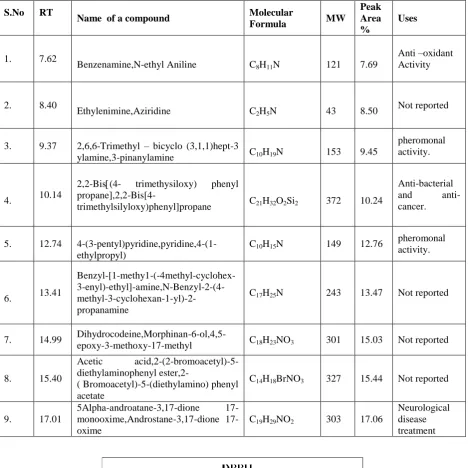
The components present in the ethanol extract of the leaf ofsimarouba glauca leaves identified by the GC-MS chromatogram are shown in Figure1. The active principles with their retention time (RT), molecular formula, molecular weight (MW) and peak area as a percentage are presented in Table 2. The major phytocompounds and their biological activities obtained through the GC-MS analysis of the leaf of simarouba glauca have been tabulated Table 2.
3.3 Anti-oxidant activity of Simarouba glauca
The ethanolic extract of simarouba glauca leaves showed potent DPPH radical scavenging activity as shown in the Figure 2.The ethanolic extract of the leaves was found to have an IC50 value of 51.50(µg/ml). The IC50 value
449 |
P a g e
activity of simarouba glauca was a very efficient free radical scavenger due to the lowest IC50 value. The
activity of the reference antioxidant (Ascorbic acid) was much higher when compare with the ethanolic extract.
Table1: Vitamin analysis of simarouba glauca leaves
S.No
Vitamins
simarouba
glauca
(leaf)(mg/100gm)
1
Riboflavin
0.38 ± 0.03
2
Niacin
1.65 ± 0.08
3
Thiamine
0.64 ± 0.05
4
Vitamin -A
4.42 ± 0.15
5
Ascorbic acid
22.94 ± 0.07
Values are expressed Mean ± SD for triplicates
RT:0.00 - 35.38 SM:15G
0 2 4 6 8 10 12 14 16 18 20 22 24 26 28 30 32 34
Time (min) 0 5 10 15 20 25 30 35 40 45 50 55 60 65 70 75 80 85 90 95 100 R e la ti ve A b u n d a n ce 12.76 15.44 16.41 17.06 13.47 17.26 15.03 10.24 9.45 11.51 8.50 8.23 7.69 18.08 6.24 6.15 18.77 19.71
21.38 22.76 24.2725.4526.9328.34 32.74 34.4735.34
4.31
NL: 1.55E5 TIC MS baby_1707 08163825
450 |
P a g e
Table: 2 Phytoconstituents present in ethanolic leaf extract of simarouba glauca
S.No RT
Name of a compound Molecular
Formula MW
Peak Area %
Uses
1. 7.62
Benzenamine,N-ethyl Aniline C8H11N 121 7.69
Anti –oxidant Activity
2. 8.40
Ethylenimine,Aziridine C2H5N 43 8.50
Not reported
3. 9.37 2,6,6-Trimethyl – bicyclo (3,1,1)hept-3
ylamine,3-pinanylamine C10H19N 153 9.45
pheromonal activity.
4. 10.14
2,2-Bis(4- trimethysiloxy) phenyl
propane],2,2-Bis[4-trimethylsilyloxy)phenyl]propane C21H32O2Si2 372 10.24
Anti-bacterial and anti-cancer.
5. 12.74 4-(3-pentyl)pyridine,pyridine,4-(1-ethylpropyl)
C10H15N 149 12.76
pheromonal activity.
6. 13.41
Benzyl-[1-methy1-(-4methyl-cyclohex- 3-enyl)-ethyl]-amine,N-Benzyl-2-(4- methyl-3-cyclohexan-1-yl)-2-propanamine
C17H25N 243 13.47 Not reported
7. 14.99
Dihydrocodeine,Morphinan-6-ol,4,5-epoxy-3-methoxy-17-methyl C18H23NO3 301 15.03 Not reported
8. 15.40
Acetic acid,2-(2-bromoacetyl)-5-diethylaminophenyl ester,2-
( Bromoacetyl)-5-(diethylamino) phenyl acetate
C14H18BrNO3 327 15.44 Not reported
9. 17.01
5Alpha-androatane-3,17-dione monooxime,Androstane-3,dione 17-oxime
C19H29NO2 303 17.06
Neurological disease treatment
451 |
P a g e
Table: 3 Percentage of DPPH Radical scavenging activity of ethanolicextract of simarouba glauca leaves. Parameters 20
(µg/ml)
40 (µg/ml)
60 (µg/ml)
80 (µg/ml)
100 (µg/ml)
IC50 (µg/ml)
simarouba
glauca leaf extract
21.37±1.49 39.55±2.76 60.91±4.26 76.82±5.37 87.28±6.10 51.50
Standard (Ascorbic acid)
25.6 ± 2.04 42.73± 61.26 ± 4.90 88.98 ± 7.11 99.34 ± 7.94 46.01
Values were expressed as Mean ± SD for triplicates
IV. CONCLUSION
In this study, the presence of various soluble bioactive compounds in simarouba glauca leaf extracts greatly contributed to antioxidant activity. In the ethanolic extract, more soluble phytocompounds were noticed. The results clearly support the use of simarouba glauca in traditional medicinal practices for the treatment of various diseases. The GC-MS analysis exhibit that the leaves contain secondary metabolites with anti-microbial, anti-viral, anti-oxidant, anti-cancer activity and thus are sources of natural bioactive molecules to control pathogens that cause diseases in humans.
REFERENCE
[1.] Nostro A, Germano MP, D'Angelo V, Marino A, (Cannatelli MA 2000).
[2.] Sofowora A (1996). Research on medicinal plants and traditional medicine in Africa. J. Altern. Complement. Med. 2 (3): 365- 372
[3.] Amrit Pal Singh. 2005. Promising Phytochemicals from Indian Medicinal plants. Ethnobotanicals Leaflets, Vol: 2005, Issue 1, Article 18.
[4.] AOAC. Vitamins and other nutrients. In Official Methods of Analysis of the Association of Official Analytical Chemists. 14th Edition (William S, ed.), AOAC, Virginia. 1984; pp. 838 – 841.
[5.] Barkat M. Z., Shehab S. K., Darwish N., Zahermy E. I., Determination of ascorbic acid from plants. Analyst Biochem 1973; 53: 225‐245.
[6.] Okwu DE. Phytochemicals and vitamin content of indigenous spices of Southeastern Nigeria. J. Sustain. Agric. Environ. 2004; 6 (1): 30- 37.
[7.] Bayfield RF and Cole ER, (1980) Colorimetric estimation of vitamin A with TCA. Methods in Enzymology 67:189-95.
452 |
P a g e
[9.] Shimada K, Fujikawa K, Yahara K and Nakamura T. (1992) Antioxidative properties of xanthum on the autoxidation of soybean oil in cyclodextrin emulsion. Journal of Agricultural and Food Chemistry, 40, 945–948.