Implementing the Concept of Relative Gain
Array for the Control of MIMO System:
Applied To Distillation Column
D.Sankaranarayanan, G.Deepakkumar
PG Student, Anna University Regional Centre, Coimbatore, India PG Student, Anna University Regional Centre, Coimbatore, India
ABSTRACT: Control of multivariable system is very complex because the system consists of many manipulated and controlled variable. It is difficult to design a controller because we don’t know which manipulated variable affect the controlled variable. The RGA provides a quantitative approach to the analysis of the interactions between the controls and the output, and thus provides a technique for pairing manipulated and controlled variables to generate a control scheme. In this paper, bottom concentration and distillate concentration of (2x2) distillation column is maintained at desired level in methanol and water separation process. Relative gain Array is applied to find the best pair of manipulated and controlled variable in the separation process. Based on the results obtained from the RGA, PI controller is designed for the best pairs of manipulated and controlled variable in the separation process in the distillation column. Controller is designed for each best pair of the input and output converting a MIMO system to multivariable SISO system. Thus the desired concentration of the bottom and distillate (top) in the distillation column is maintained.
KEYWORDS: PI controller, Relative gain array, Niederlinski index, Z-N tuning
I. INTRODUCTION
In SISO system, it consists of only one manipulated variable and one controlled variable. It is clear that, only one variable affect the output of the system. Design a controller in SISO system is simple and accurate.
Control of multivariable systems requires more complex analysis then that of single variable system. Fortunately, essentially all methods and results learned for single variable systems are applicable to multivariable systems. Thus, aspects of a single variable system that make it easy or difficult to control have generally the same effects for multivariable systems. However, in multivariable systems new characteristics due to interaction must be considered. Interaction results from process relationship that causes a manipulated variable to affect more than one controlled variable.
This is the major difference from single loop systems and has a profound effect on the steady state and dynamics behavior of a multivariable system. Thus, it is not possible to analyze each manipulated – controlled variable connection individually to determine its performance; the integrated control system must be considered simultaneously.
A closely related new issue is the disturbance source, because multivariable responds differently to different disturbances. For example, the chemical reactor responds differently to disturbances in feed composition and feed temperature, and, as we shall see, these differences must be considered in designing a multivariable control system. Another realistic issue is the number of controlled and manipulated variable, which may not be equal. In some of the cases, four manipulated variables, this can be adjusted to control three measured variables.
to calculate all manipulated variables simultaneously. The multi-loop approach, using multiple single loop controllers, was the first approach used for multivariable control in the process industries.
block diagram
Figure1. Block diagram
In MIMO system, process interaction is an important factor influencing the behaviour of the multivariable systems. A quantitative measure of interaction is needed to proceed with multiloop analysis method, and the relative gain array, which has proved useful in control system analysis, is introduced to meet this need.
The relative gain array is matrix composed of elements defined as ratios of open-loop to closed-loop gains. In this distillation process, the manipulated variables are reflux and reboiler flow rates, and the controlled variables are distillate and bottom composition. Other important variables, such as pressure and levels, are controlled tightly.
In this process, to find the best pair of manipulated and controlled variables. Relative gain array technique is employed, after some computation works RGA gives results in which best pair of the manipulated and controlled variables are found. Reflux flow rate and top distillate composition is the first best pair and reboiler flow rate and bottom composition is the second best pair found from the results of relative gain array.
Thus, controller for each pair (i.e.) refluxes flow - distillate composition and reboiler flow – bottom compositions are designed to control the composition of distillate and bottom of the distillation tower. PI controller is used to control the variables.
Plant model is derived from the fundamental rules and by various techniques. Plant model obtained is unstable one. So that, the PI controller is tuned using Ziegler-Nicholas method and initial tuning values are obtained.
PI controller produce a control signal based on the error signal feedback to it. PI controller produce a control signal proportional to error of signal, proportional to rate of change of error and proportional to integral of error in time.
Thus, PI control signal compensates the error signal and the produce a composition in desired values. Thus, two controller designed to each best pair obtained from RGA and each controller tuned to control the process output.
MATLAB tool is used to simulate the methanol-water separation process in the distillation column. Plant model and PI controller was connected in required fashion and process is simulated and outputs are measured.
II. DISTILLATION COLUMN
Heat is supplied to the reboiler to generate vapour. The source of heat input can be any suitable fluid, although in most chemical plants this is normally steam. In refineries, the heating source may be the output streams of other columns. The vapour raised in the reboiler is re-introduced into the unit at the bottom of the column. The liquid removed from the reboiler is known as the bottoms product or simply, bottoms.
The vapour moves up the column, and as it exits the top of the unit, it is cooled by a condenser. The condensed liquid is stored in a holding vessel known as the reflux drum. Some of this liquid is recycled back to the top of the column and this is called the reflux. The condensed liquid that is removed from the system is known as the distillate or top product. Thus, there are internal flows of vapour and liquid within the column as well as external flows of feeds and product streams, into and out of the column.
A schematic of a typical distillation unit with a single feed and two product streams figure 2 is shown below:
Figure2. Distillation column
The plant model of (2x2) distillation column is given below,
) ( 1 12 3 . 1 1 4 . 14 70 . 0 ) ( ) ( 1 2 . 10 1253 . 0 1 7 . 11 1173 . 0 1 15 0667 . 0 1 12 0747 . 0 ) ( ) ( 3 5 2 3 . 3 2 3 s X s e s e s F s F s e s e s e s e s X s X F s s V R s s s s B D (1)
III. RELATIVE GAIN ARRAY
Single variable Input or Single variable Output (SISO) control schemes are just one type of control scheme that engineers in industry use to control their process. They may also use MIMO, which is a Multi-Input-Multi-Output control scheme. In MIMO, one or more manipulated variables can affect the interactions of controlled variables in a specific loop or all other control loops. A MIMO control scheme is important in systems that have multiple dependencies and multiple interactions between different variables, in a distillation column, where a manipulated variable such as the reflux ratio could directly or indirectly affect the feed flow rate, the product composition, and the reboiler energy.
useful for MIMO systems that can be decoupled. A good MIMO control scheme for a system that can be decoupled is one that can control a process variable without greatly affecting the other process variables. It must also be stable with respect to dynamic situations, load changes, and random disturbances. The RGA provides a quantitative approach to the analysis of the interactions between the controls and the output, and thus provides a method of pairing manipulated and controlled variables to generate a control scheme.
Relative Gain Array is an analytical tool used to determine the optimal input-output variable pairings for a multi-input-multi-output (MIMO) system. In other words, the RGA is a normalized form of the gain matrix that describes the impact of each control variable on the output, relative to each control variable's impact on other variables. The process interactions of open-loop and closed-loop control systems are measured for all possible input-output variable pairings. A ratio of this open-loop 'gain' to this closed-loop 'gain' is determined and the results are displayed in a matrix.
nn n n nRGA
.
.
.
.
.
.
.
.
.
.
.
.
.
.
1 2 22 21 1 12 11 (2)The array will be a matrix with one column for each input variable and one row for each output variable in the MIMO system. This format allows a process engineer to easily compare the relative gains associated with each input-output variable pair, and ultimately to match the input and input-output variables that have the biggest effect on each other while also minimizing undesired side effects.
The relative gain array can be evaluated from steady state gain matrix,
09
.
6
09
.
5
09
.
5
09
.
6
RGA
(3)From the result of relative gain array best pairs of manipulated and controlled variables are found. Since only the pairing XD-FR and XB-FV has a positive relative gain value. Thus, reflux flow – distillate composition and reboiler flow – bottom composition found to be best pairs.
IV. NIEDERLINSKI INDEX
NI, the Niederlinski Index, is a calculation used to analyse the stability of the control loop pairings using the result of the RGA, evaluated at Steady State:
ni
g
iiG
NI
1 (4)
A negative NI value indicates instability in the control loop. For a 2x2 matrix, a positive NI value indicates stability in the pairings, but this is not necessarily true for larger matrices! For matrices larger than 2x2, a conclusion can only be drawn from a negative NI, which indicates instability.
A negative value for NI, when all the control loops are closed, implies the system will be integrally unstable for all possible values of controller parameters. In order to design a decentralized control system for a process, given the transfer function, the RGA is used to obtain a tentative loop pairing, and then the NI is used to ascertain the stability of the closed loop system using the recommended RGA pairing.
The Niederlinski index value for steady state gain matrix for the equation (1)
Hence, the NI value is positive and it indicates that the stability in pairs obtained from RGA. Thus, optimal pairing of control loop is obtained from Relative gain array and Niederlinski index stability analysis of pairing.
V. PI CONTROLLER TUNING
PI controller will eliminate forced oscillations and steady state error resulting in operation of on-off controller and P controller respectively. However, introducing integral mode has a negative effect on speed of the response and overall stability of the system.
Thus, PI controller will not increase the speed of response. It can be expected since PI controller does not have means to predict what will happen with the error in near future. This problem can be solved by introducing derivative mode which has ability to predict what will happen with the error in near future and thus to decrease a reaction time of the controller.
PI controllers are very often used in industry, especially when speed of the response is not an issue. A control without D mode is used when:
a) Fast response of the system is not required
b) Large disturbances and noise are present during operation of the process c) There is only one energy storage in process (capacitive or inductive) d) There are large transport delays in the system
Tuning values for process 1(G11) are P=26.86306 and I=2.386564, tuning values for process 2(G22) are P=12.60991 and I= 1.813431
VI. SIMULATION RESULTS
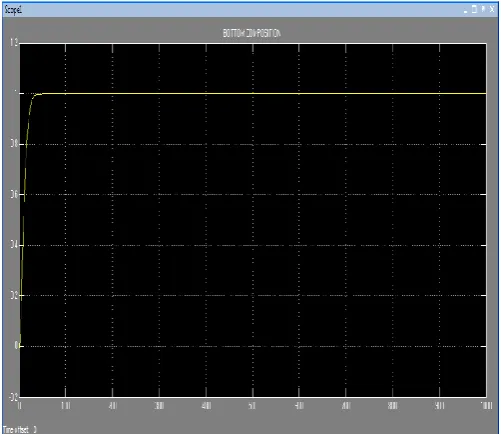
The process is simulated using MATLAB simulink tool and the results of paper are shown below in figure 3 and figure 4.
Figure 3 gives the result for the control of best pair found from RGA technique, reflux flow and distillate composition.
Figure 4 gives the result for the control of best pair found from RGA technique, reboiler flow rate and bottom composition.
Figure4.Result for the control of bottom composition
VII. CONCLUSION
The best pairs of distillation column found using Relative gain array technique and Niederlinski index. PI controller is designed for the best pair and it is properly tuned using Zeigler-Nicholas method. The process is simulated using MATLAB SIMULINK tool and results are obtained. Thus the top and bottom composition of distillation column is controlled and desired performance is achieved.
REFERENCES
[1] Ajayi T.O. and I.S.Ogboh, “Determination of Control Pairing for Higher Order Multivariable Systems by the use of Multi-Ratios” -International Journal of Scientific & Engineering Research Volume 3, Issue 3, March -2012.
[2] Z.X. Zhu and A.Jutan, “RGA as a measure of integrity for decentralized control systems” -Trans. IChemE, Vol. 74, Part A, pp. 35-38, Jan. 1996. [3] E.H. Bristol, “On a New measure of interaction for multivariable process control‖” -IEEE Trans. Automat. Control, AC-11, pp. 133-134, 1966. [4] Esmail Atashpaz garrgari, Farzad Hashemzad and Car Lucas., “Designing MIMO PID controller using colonial competitive algorithm: Applied to distillation column” -accepted to be presented in 2008 IEEE congress on Evolutionary computation (IEC 2008).
[5] Thomas Marlin, “Process control-designing processes and control systems for dynamic performance” -second edition- Tata McGraw-Hill edition 2012.
[6] Chih Min Lin and Yi-Jen Mon, “Decoupling control by Hierarchical Fuzzy Sliding mode controller”- IEEE transaction on control system technology, Vol-13, July-2005.
[7] Ogata, k., “Modern control Engineering”-prentice-Hall, Englewood liffs, NJ, 1990. [8] Shinskey, F., Distillation Control (2nd edition) McGraw-Hill, New York, 1984.
[9] C.A. Smith and A.B. Corripio, Principles and Practice of Automatic Process Control. Wiley, pp. 413-424, 2006. [10] Shinskey, F.G., Process Control Systems: Application, Design, and Tuning, Fourth Edition, McGraw-Hill, Inc., 1996.
[11] Clair, D., Controller Tuning and Control Loop Performance, Straight-line Control,Co.,USA,1993. [12] McAvoy, T., “Connection between Relative gain and control loop stability and design,” Alche J., 27, 4,613-619 (1981).
[13] Ogata, K., Discrete Time control systems, Prentice – Hall , Englewood Cliff’s NJ,1987. [14] Jeffreson, c., “Controllability of Process systems,” IEC fund, 15, 3,171-179.
[15] M.F. Witcher and T.J. McAvoy, “Interacting control systems: steady state and dynamic measurement of interaction,” ISA Trans.No. 16, pp. 83 – 90, 1977.