1658 | P a g e
Smart Campus System using IoT
Snehal K. Dixit
1, S. M. Kulkarni
21
M.E. Student, Dept. of E&TC.,MIT College of Engineering, Pune,(India)
2Assistant Professor, Dept. of E&TC.,MIT College of Engineering, Pune,(India)
ABSTRACT
Internet is a revolutionary invention, it has always been transforming itself into some or other new kind of
hardware and software which makes it irresistible for anyone. IOT can be termed as a universal global neural
network in the cloud which connects various things. IoT promises a machine-machine type of communication.
The IoT is a system comprising various devices or systems which are intelligently connected which interacts
and communicates with other machines, environments, objects and infrastructures. With the areas like business,
transportation, medicine, energy, agriculture and others, the Internet of Things also finds a major implication
in education. A university campus can be considered as the ideal place for the creation of a smart environment.
The aim of the hereby paper is to describe a new concept called Smart University by providing a comprehensive
overview of the IoT scenario and reviews its enabling technologies and the sensor networks.
Keywords : Internet of Things, Smart campus, Super sensors, Wireless sensor node
I. INTRODUCTION
The IEEE IoT Initiative provides two definitions based on the complexities of an IoT system. The definition for
low complexity systems is as follows: "An IoT is a network that connects uniquely identifiable "things" to the
Internet. The "things" have sensing/actuation and potential programmability capabilities. Through the
exploitation of unique identification and sensing, information about the "thing" can be collected and the state of
the ’thing’ can be changed from anywhere, anytime, by anything."[4]
For large complexity systems, the definition given by the IEEE IoT Initiative is the following: "Internet of
Things envisions a self-configuring, adaptive, complex network that interconnects ’things’ to the Internet
through the use of standard communication protocols. The interconnected things have physical or virtual
representation in the digital world, sensing/actuation capability, a programmability feature and are uniquely
identifiable. The representation contains information including the things identity, status, location or any other
business, social or privately relevant information. The things offer services, with or without human intervention,
through the exploitation of unique identification, data capture and communication, and actuation capability. The
service is exploited through the use of intelligent interfaces and is made available anywhere, anytime, and for
anything taking security into consideration."[4]
In this digital era, the life of human beings is getting simpler as almost everything is being automatic, replacing
the old manual systems. Nowadays internet have become an integral part of humans everyday life without
which they are helpless. Internet of things (IoT) provides a platform where devices can be connected, sensed
1659 | P a g e
electrical and the mechanical systems. Single admin controls the various devices connected to the cloud serverand also facilitates a number of sensors and control nodes. The admin can access and control all the nodes
connected to each user but a single user can control only the nodes to which are connected to that particular
user. The whole system uses IoT hence the devices connected to internet like mobile or computers can remotely
control all the functions and features of the appliances from anywhere. The system designed is economical and
scalable as it can be expanded by connecting and controlling of a number of different devices.
Generally, all universities are connected to internet, and in each there are many similar objects that can be
converted into smart objects within meaning of Internet of Things. The university campus may consist of simple
common objects like doors, windows, printers, projectors, books, poles, benches etc. or complex objects like
buildings, classrooms, laboratories and parking etc. All these objects can be converted into smart objects by
attaching sensors, QR tags (texts,links,graphics), RFID, NFC and these objects are given a significant level of
intelligence to allow operation of actuators and even decision making. The set of all these smart objects can
transform a classical campus, into a Smart Campus.
II. RELATED WORK
Kristian Hentschel et al. Here they have outlined the motivation for super sensors, based on inexpensive
Raspberry Pi devices attached to off-the-shelf sensors. System uses Python language which is well supported on
Raspberry Pi it also provides various libraries for connecting hardware interfaces [1].
Tejas Thaker et al. Here authors considered a cost of a designed Wireless network , here we use Low cost and
energy efficient ESP8266 Wi-Fi module for developing a Wireless Sensor Network. ESP8266 module provides
high performance, high integration performance [2].
Shopan Dey et al. authors focused on home automation using smart phone and computer. The IoT devices
controls and monitors the appliances that may be electronic, electrical or mechanical systems. Single admin
controls the various devices connected to the cloud server and also facilitates a number of sensors and control
nodes [3].
Marian Cata et al. In this paper, the author developed the idea that a university campus may represent the ideal
place for the creation of a smart environment. As many universities are connected through internet the
implementation of the concept is a practical idea. The concept of smart university is defined like a small world
where sensor enabled and networked devices work continuously and in collaboration to make the infrastructure
more smart [5].
Csar Cheuque et al. Here they demonstrated an university project to control the LED devices. The purpose of
the project is to give the first approximation of a system using Web technology Raspberry Pi. The system
allows inclusion of modules and can be a real alternative in the implementation of a Smart Home [6].
Sheikh Ferdoush et al. Here author described about a wireless sensor network system developed using open
source hardware platforms like Arduino and Raspberry Pi. The system is low-cost and highly scalable. The
various type and number of sensors can be connected hence it is suitable for wide variety of applications related
to environmental monitoring [13].
E. Yoneki et al. authors introduced the RasPiNET, it is a form of a Delay Tolerant Network consisting of
Raspberry Pi computers. Each Raspberry Pi is equipped with WiFi communication capability and a battery pack
1660 | P a g e
S. Banerjee et al. gave an unique design of a secure sensor node prototype. The proposed system communicatesover bluetooth using RC4 encryption algorithm between a mobile phone and their monitoring equipment [16].
R. Szabo et al. They have described generic framework for smart city applications which is built upon XMPP
ie. Extensible Messaging and Presence Protocol for mobile participatory sensing [17].
III. SYSTEM ARCHITECTURE
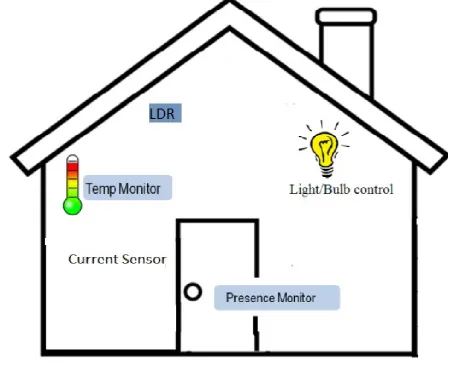
The smart campus system can be used in large campuses for the purpose of automating the electronic devices
and also to make the overall system power efficient. In large buildings, it is not always possible to search for a
vacant room like meeting room or study room and also one cannot go through all the rooms to switch off the
appliances when not in use. In such cases it is always recommended to automate the appliances. Also we know
that internet has been the basic need of human beings. So we can connect all the appliances to the internet. And
we can get the required information from anywhere on the device connected to internet. Here, temperature
sensor are used to sense the ambient temperature and according we can control the fans in the building.
Similarly, with the help of LDR we can check the light intensity in the room and accordingly we can control the
lights. Current sensor is used to determine the current through overall load and hence we can calculate the
overall power consumption.
1661 | P a g e
IV. PROPOSED SYSTEM
4.1 Block Diagram
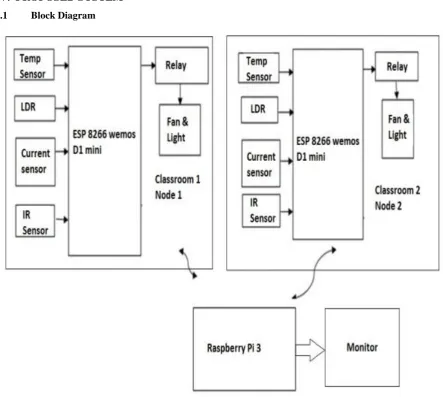
Fig. 4.1: Block Diagram of Proposed System
In this section we are proposing a low cost and power efficient smart campus system in real time using IOT
environment.The temperature sensor, light sensor and current sensor monitors the temperature, light and current
resp. The IR sensor is used for monitoring whether any person is present in that room. The data from all the
sensors is given to the ESP8266 Wemos D1 mini wi-fi enabled board. This module transmits the information
wirelessly to the Raspberry pi available within the range. Raspberry pi credit card microcontroller can store and
transfer the data of different sensor. Now the Raspberry pi transfers this data to the main server which can be
remotely located, this creates a web based GUI to display all the information. Also by comparing the values of
temperature sensor and IR sensor to the threshold value given. If both the values are above threshold system
will automatically turn on the fan. Similarly, by comparing the values of LDR and IR sensors with the
threshold, if value is greater than threshold then system should turn on the lights. If any of the criteria is not
fulfilled it will not turn on the lights or fan. We connect our own applications to proven scalable open source
software for a persistent document data store (Mysql), and a performing publish-subscribe system, cache, and
queuing system (REDIS). We make use of Protocol Buffers for serializing and parsing transmitted data using
1662 | P a g e
V. SYSTEM FLOW
5.1Hardware Flow
Fig. 5.1 : Hardware flow of Proposed System
5.2 Software Flow
1663 | P a g e
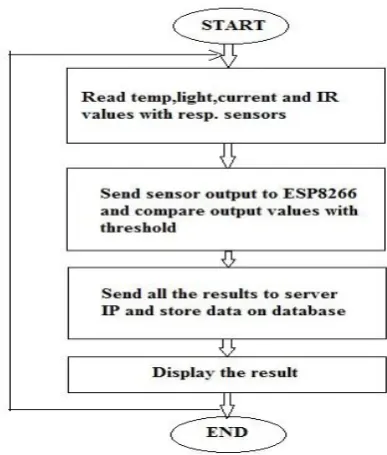
Above figure shows the software flow of the system. ESP8266 controller reads the sensor readings fromtemperature,LDR,Current and IR sensor. Now as ESP8266 is wifi based microcontroller it transmits the data to
the Raspberry pi which is available within the wifi range of the ESp8266 controller.The communication
between these two uses the TCP/IP protocol. Now Raspberry pi transmits this information to the main server
where we can create a database of the information display the information on the web based GUI.
VI. EXPERIMENTAL SETUP
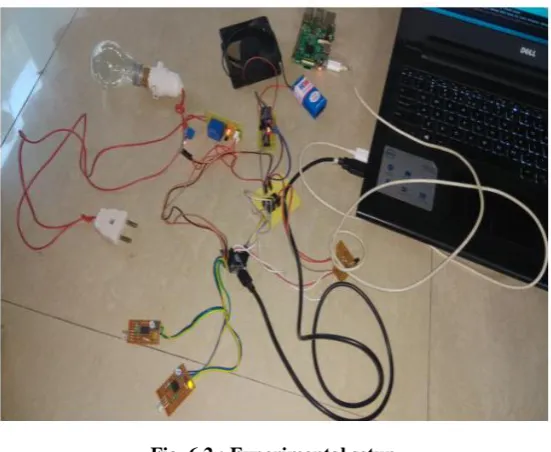
Fig. 6.2 : Experimental setup
Figure above shows the location of the sensors mounted. Temperature and IR sensors are directly connected to
ESP8266 controller whereas Current sensor and LDR is connected to the analog to digital converter
MCP3204.The output of MCP3204 is now given to the ESP8266.So in this way we have taken the readings to
perform further operations.
6.1 Monitoring Section
Figure below shows the monitoring section of system. From field site the data from microcontroller Esp8266 is
given to raspberry pi via WiFi. Raspberry pi can store and transfer the data of different sensor. Now the
Raspberry pi transfers this data to the main server. A website of Smart Campus is designed to display all the
information of sensors. We can provide facility to access data remotely with the help of IoT environment from
all over the world.
1664 | P a g e
VII. EXPERIMENTAL RESULTS
The results of this experiment can be seen by the controlling action of the devices. After receiving sensor data
controller decides the action to be taken according to the instructions given. Here from the output of
temperature sensor and IR sensor, the fans in the room can be automatically turned ON or OFF. With the help
of LDR and IR sensor output, lights in the room are controlled by the controller. Similarly the current sensor
calculates the overall current for all the devices connected in each classroom and then calculates the overall
power consumption. This power consumption in each classroom can be displayed on the web based GUI.
VIII. CONCLUSION
These kind of Systems are required in the university campus as the area is very large and number of rooms are
also large. And human can make mistakes and forget to switch off the appliances when in no use and in this
case, these systems are useful in order to increase the power efficiency. The system can be viewed as a future of
artificial intelligence. This is a powerful and dependable system. It fulfills the goal of energy saving and helps
in achieving the efficient use of energy resources. With the help of internet of things (IoT) we can monitor the
information from anywhere in the world. Hence, due to survey it became possible to make power efficient, cost
efficient, fully automated system. This system is taking a step forward towards the goal of increasing the
technological advancement and Smart City.
IX. FUTURE SCOPE
The system is flexible and can be enhanced with more sensors such as proximity sensors and fire sensors to
realize a comprehensive smart campus system. Future work could include by connecting number of stations
together to form a network and using wireless communication for different user friendly purposes. Also, the
web interface can be further developed to implement more functionality in data visualization, management, and
analysis among many others to provide better user interface and better user experience. In future, devices can be
made more smart by using machine learning algorithms. The system can be applied to not only campuses but
also other various areas using IoT.
REFERENCES
[1.] [1] Kristian Hentschel, Dejice Jacob, Jerem Singer, and Matthew Chalmers , Supersensors Raspberry Pi
Devices for Smart Campus Infrastructure (short paper), 2016 IEEE 4th International Conference on
Future Internet of Things and Cloud,Year : 2016
[2.] [2] Tejas Thaker, ESP8266 based Implementation of Wireless Sensor Network with Linux Based Web
Server, Symposium on Colossal Data Analysis and Networking (CDAN), Year : 2016
[3.] [3] Shopan Dey, Ayon Roy, Sandip Das, Home Automation Using Internet of Thing , 2016 IEEE 7th
Annual Ubiquitous Computing, Electronics Mobile Communication Conference (UEMCON), Year :
2016
[4.] [4] Xing Liu, Orlando Baiocchi, A Comparison of the Definitions for Smart Sensors, Smart Objects and
Things in IoT , IEEE 7th Annual Information Technology, Electronics and Mobile Communication
1665 | P a g e
[5.] [5] Marian Cata, Smart University, a new concept in the Internet of Things , IEEE ConferencePublications, Year : 2015
[6.] [6] CsarCheuque, Felipe Baeza, GastnMrquez, Juan Caldern, Towards to responsive Web Services for
Smart Home LED control with RaspberryPi. A first approach, 34th International Conference of the
Chilean Computer Science Society (SCCC),Year : 2015
[7.] [7]TADOJU, MAHESH J.,Bluetooth Remote Home Automation System using Android Application,
International Journal of Advance Technology and innovative Research,Year : 2015
[8.] [8] Manohar, Kumar D.M., E-mail Interactive Home Automation System, International Journal of
Computer Science and Mobile Computing,Year : 2015
[9.] [9] Mamata Khatu, Neethu Kaimal, Pratik Jadhav, Syedali Adnan Rizvi, Implementation of Internet of
Things for Home Automation, International Journal of Emerging Engineering Research and
Technology,Year:2015
[10.] [10] Vidyasagar, G. Balaji, K .N. Reddy, Android Phone Enabled Home Automation, Journal of
Academia and Industrial Research,Year : 2015
[11.] [11] Kumar A., Tiwari N., Energy Efficient Smart Home Automation System, International Journal of
Scientific Engineering and Research,Year : 2015
[12.] [12] Rao P. B., Uma S. K., Raspberry Pi Home Automation With Wireless Sensors Using Smart Phone,
International Journal of Computer Science and Mobile Computing,Year:2015,Vol.4, No. 5, pp 797-803
[13.] [13] Sheikh Ferdoush, Xinrong Li, Wireless Sensor Network System Design using Raspberry Pi and
Arduino for Environmental Monitoring Applications, The 9th International Conference on Future
Networks and Communications, Year : 2014
[14.] [14] Vishwajeet H. Bhide, A Survey on the Smart Homes using Internet of Things (IoT), International
Journal of Advance Research in Computer Science and Management Studies,Year : 2014
[15.] [15] E.Yoneki, Raspinet: Decentralised communication and sensing platform with satellite connectivity,
Proc. ACM CHANTS, 2014
[16.] [16] S. Banerjee, D. Sethia, T. Mittal, U. Arora, and A. Chauhan, Secure sensor node with Raspberry Pi,
Multimedia, Signal Processing and Communication Technologies (IMPACT),2013 International
ConferenceYear:2013, pp. 26–30
[17.] [17] R.Szabo, K.Farkas, M.Ispany, A.A.Benczur, N.Batfai, P.Jeszenszky, S.Laki, A.Vagner, L.Kollar,
Cs.Sidlo, Framework for Smart City Applications Based on Participatory Sensing, 4th IEEE International