Seonju Ko
Child Development and Learning Institute of Education
University of London
A thesis submitted for the degree of Doctor of Philosophy (PhD)
ABSTRACT
ACKNOWLEDGEMENTS
I love to remember the journey of PhD with these people and to say "Thank you":
Jaehak and Keunyoung, my husband and my daughter.
Professor Terezinha Nunes and Professor Kathy Sylva who supervised the thesis and led
me a deeper understanding of the issues involved and provided critical comments.
Anna Brett has who watched over me from the very beginning of the diploma course to
the completion of PhD here in Child Development and Learning group.
Dr. John Versey and Dr. Richard Cowan who taught me psychology.
Eeul Kim who helped with data analysis.
TABLE OF CONTENTS
LIST OF FIGURES
8
LIST OF TABLES 10
LIST OF APPENDICES
12
Chapter 1. Introduction
14
1. 1. Games 15
1.1.1. What is the role of decision-making in games? 16
1.1.2. How have outcomes of games been studied? 17
1.1.3. What are the special features of computer games? 17
1. 2. Problem solving 19
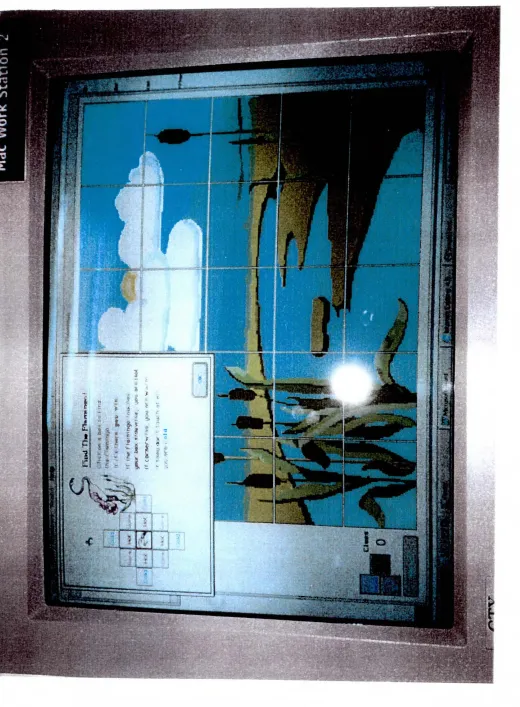
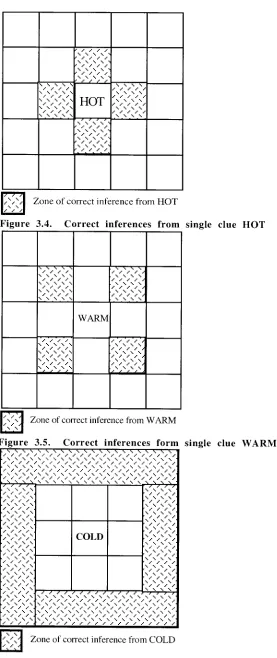
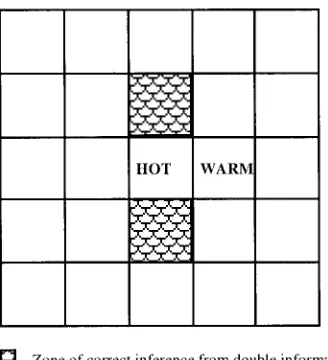
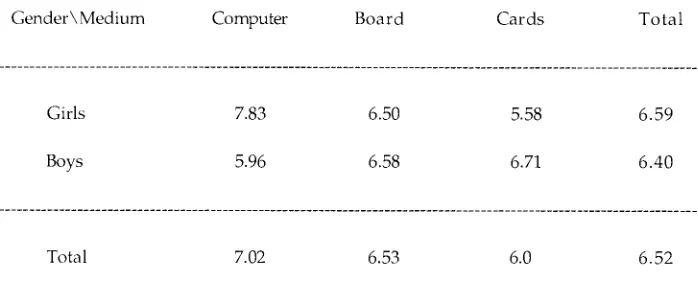
1. 3. The computer game chosen for the research 21
1. 4. Structure of the thesis 23
Chapter 2. Literature review
2 5
2.1. Social context: games vs. tasks 27
2.2. Development of the concept of a rule in games 30
2.3. Contents of rules: affirmative vs. negative 33
2.4. Choice as inference 37
2.5. Inferential goal searching 45
2.6. Possibility, impossibility & certainty 51
2.7. Gender issues in computer games 61
2.8. Methods for investigating children's game activity 65
2.9. Drawing the threads together: the study of children's thinking in the context of
2.9.1. The computer game as a window into children's thinking 69
2.9.2. Individual differences and learning 70
2.9.3. Training in planning 71
2.9.4. Prediction for inferential game play 71
Chapter 3. Study 1 7 4
3.1. Aims 74
3.2. Introduction 74
3.3. Method 77
3.3.1. Design 77
3.3.2. Participants 77
3.3.3. Apparatus 79
3.3.4. Procedure 84
3.3.5. Measures 88
3.4. Results 89
3.4.1. The game performances 89
3.4.2. Performances on the word clue tests 93
3.4.3. Reliability and validity of measurements 97
3.4.4. Summary of results 98
3.5. Discussion and conclusions 99
Chapter 4. Study 2 1 0 2
4.1. Aims 102
4.2. Introduction 102
4.3. Method 107
4.3.1. Design 107
4.3.3. Apparatus 109
4.3.4. Procedure 109
4.3.5. Outcome measures 110
4.4. Results 114
4.4.1. Analysis of number of moves 114
4.4.2. Analysis of word clue test scores 117
4.4.3. Reliability of measurements 124
4.4.4. Individual differences 125
4.4.5. Learning measured by the completion time and number of moves 127
4.4.6. Analyses of choice pattern 129
4.5. Summary of results 134
4.6. Conclusions 136
Chapter 5. Study 3 14 0
5.1. Aims 140
5.2. Introduction 140
5.3. Method 144
5.3.1. Design 144
5.3.2. Participants 145
5.3.3. Procedure 146
5.3.4. Outcome measures 149
5.4. Results 151
5.4.1. Analyses of numbers of moves 151
5.4.2. Analyses of inclusion inferences 159
5.4.3. Analyses of inferences from exclusion information 165
5.5. Summary of the results 170
Chapter 6. Study 4 175
6.1. Aims 175
6.2. Introduction 175
6.3. Method 180
6.3.1. Design 180
6.3.2. Participants 180
6.3.3. Procedure 180
6.3.4. Measures 185
6.4. Results 188
6.4.1. The Flamingo game 188
6.4.2. The Flamingo information card arrangement 188
6.4.3. The Number task 189
6.4.4. The Tunnel task 191
6.4.5. Relations between the game and the tasks 193
6.5. Summary of the results 197
6.6. Discussions and conclusions 199
Chapter 7. Conclusions and general discussion 202
7.1. The findings in relation to the research questions 202
7.2. Limitations and suggestions for further studies 212
7.3. Educational implications 213
References 217
LIST OF FIGURES
1.1. A picture of the 'Find the Flamingo game' with the rules 22
3.1. Pictures of the computer game 81
3.2. Pictures of the board game 82
3.3. Pictures of the card game 83
3.4. Correct inferences from single clue HOT 86
3.5. Correct inferences form single clue WARM 86
3.6. Correct inferences from single clue COLD 86
3.7. Correct inferences from double clues HOT-WARM 87
3.8. Correct inferences from double clues WARM-COLD 87
3.9. Mean scores across word clue tests 95
4.1. Correct inferences from HOT 111
4.2. Correct inferences from WARM 111
4.3. Correct inferences from COLD 111
4.4. Correct inferences from two HOTs 112
4.5. Correct inferences from a HOT and a WARM 112
4.6. Correct inferences from a HOT and a COLD 112
4.7. Correct inferences from two WARMs 113
4.8. Correct inferences from a WARM and a COLD 113
4.9. Correct inferences from two COLDs 113
4.11. Scores for word clue tests across age groups 123
4.12. Number of moves for the performance groups across games 126
4.13. Mean number across games for 10-year-old participants 128
4.14. Percentages of single information inference across two age groups 132
4.15. Percentages of double information inference across two age groups 133
5.1. An example of the Boat game 147
5.2. Zone of correct inference from X information 150
5.3. Zone of correct inference from 0 information 150
5.4. Interactions between age groups and blocks of games 155
6.1. Features of the network of tunnels 177
LIST OF TABLES
2.1. An overview of studies 73
3.1. Number of participants across the three media and gender 78
3.2. Mean number of moves across the three media and for each gender 92
3.3. Two-way ANOVA (medium x gender) for mean numbers of moves 92
3.4. Mean total scores for the word clue tests across the three media
and gender groups 94
4.1. Number of participants across age, gender and medium 108
4.2. Mean number of moves (SD) across age, media and gender groups 116
4.3. Mean scores (SD) across age, media and gender groups 118
4.4. Number of participants, mean number of moves and mean test scores
for each performance group 126
4.5. Percentages of moves across three areas from single information 130
5.1. Number of participants across age and treatment groups 145
5.2. Mean number of moves across treatment and age groups 153
5.3. Three-way Analysis of Variance on performance over the practice of games 154
5.4. One—way Analysis of Covariance of training performance 157
5.5. One—way Analysis of Covariance of post-training performance 158
5.6. Mean percentage of correct inclusion inferences across treatment
and age groups 160
5.7. Three-way Analysis of Variance on inclusion inference 161
5.9. One—way Analysis of Covariance of post-training performance of inclusion
inferences 164
5.10. Mean percentage of correct exclusion inferences across treatment
and age groups 167
5.11. Three-way Analysis of Variance on exclusion inferences 168
5.12. One—way Analysis of Covariance of training performance of exclusion
Inferences 169
6.1. Numbers of participants across choice categories 190
6.2. Correlation coefficients between the Flamingo game and the tasks 194
6.3. Results for three fixed order regressions with mean number of moves
LIST OF APPENDICES
1. An example of the word clue test sheets 233
2. Distribution of the mean numbers of moves in Study 1 234
3. Distribution of the word clue test total scores in Study 1 234
4. Distribution of the mean numbers of moves in Study 2 235
5. Distribution of the word clue test total scores in Study 2 235
6. Distribution of the mean time taken in the first 4 Flamingo games in Study 2 236
7. Distribution of the mean time taken in the last 4 Flamingo games in Study 2 236
8. Distribution of the mean numbers of moves of the first 4 Flamingo games
in Study 2 237
9. Distribution of the mean numbers of moves of the last 4 Flamingo games
in Study 2 237
10. Distribution of the percentages of correct inferences from HOT in Study 2 238
11. Distribution of the percentages of correct inferences from WARM in Study 2 238
12. Distribution of the percentages of correct inferences from COLD in Study 2 239
13. Distribution of the mean numbers of moves of the last 4 Flamingo games
in Study 4 239
Dedicated to
Chapter 1. Introduction
Computer games are common activities in the nineties and have become a new culture in
children's lives. Children play computer games in and out of the school curriculum. It
is a strong tendency in the education policies in many countries to encourage computer
use with every age of children (Janssen Reiner & Plomp, 1997; Pelgrum & Plomp,
1991) and home computers are used mainly for game playing (Giacquinta, Bauer &
Levin, 1993). New games are often labeled 'educational software'. Although the
games are said to be beneficial to the development of children's thinking and learning,
there is little evidence about what really happens in this respect when children play an
educational computer game. Thus, it is important to develop ways to measure and
analyze gains in children's cognitive skills through the computer game activities of the
present day.
The aim of the thesis is to develop a framework for analyzing children's thinking in
computer games. In particular, the focus is on the development of children's ability to
make and use inferences in the context of computer games and how this development
differs between individuals. Despite the recent upsurge of interest in computer games,
relatively little is known about educational games, and even less about how to examine
the development of thinking in an educational game context. To build a framework to
investigate computer game activity, two points can be made from research on games in
general and on problem solving. The first is that decisions have to be made in games
(Colman, 1982; Davis, 1970); the second is that processes of decision making and
problem solving often involve inference (Piaget & Garcia, 1991; Manktelow & Over,
1990; Thornton, 1995). Ways of analyzing children's inferences in the context of
The introduction consists of four sections. In the first section, the role of decision
making in games, and the measurements and special features of computer games are
defined and discussed. The second section describes how game playing develops into
problem solving. The role of concepts in problem solving contexts is discussed. And
there will be an introduction to the game chosen for this thesis: its criteria and purposes.
The organization of the thesis will be described at the end.
1. 1. Games
Voluntary control has been emphasized in definitions of games (e.g., Demsey,
Lucassen, Gilley & Rasmussen, 1993-4; Herron & Sutton-Smith, 1971; Pellegrini,
1995). Players decide what their goals are, plan their moves and attempt to anticipate
the other participants' intentions. Since the outcomes may depend upon the choices of
the decision-makers involved in games for two or more persons, the players may try to
assign probabilities to one another's moves. The player's moves may be aimed directly
toward the goal or to obtain more information. In this thesis, games requiring the
search for a goal according to certain rules will be studied.
Scholars have classified games according to certain family resemblances. The most
basic criterion of classification seems to concern the factors that affect the outcomes of
the game: games of skill, games of chance, games of strategy and games of
second-guessing. Games of skill, strategy and chance may be classed as games for one person
or more, while games of second-guessing must involve two or more decision-makers.
The term 'second guessing' is defined as anticipating the moves of an opposing player.
This classification is useful because the method of analyzing a specific game can be
the same general class; only relatively few games need, therefore, to be studied in order
to understand a much larger number.
1.1.1.
What is the role of decision
-making in games?
Performances in games are rich sources for the analysis of attributes of decision
making. Game players continuously ask themselves, "Which strategy/move should I
use next?" Drawing on cognitive and information processing theories, scholars have
asserted that
"Human rational behaviour is shaped by a scissors whose two
blades are the structure of task environments and the computational
capabilities of the actor." (Simon, 1990).
Consequently, the decision-making of a game player is bound to her or his
understanding of the task, in other words, the rules of the game and the types of
information encoded in the course of the game. From the perspective of mathematical
game theory (see McKinsey, 1952), randomness and hidden information make the
outcome of a game uncertain and this uncertainty is a major charicteristic which makes
the game interesting and attractive (Malone, 1980). Can young children understand the
rules of games and pay attention to information given in the course of a game? What
kind of logical inferences do children make? How do individual differences affect game
playing? Strategies or goal-directed search patterns are shown in games. A plan, a
consciously adopted strategy, means using information to determine further moves
moves in the game? Winning, losing, or reaching the goal depends on players'
strategies and planning as well as on other factors, such as luck.
1.1.2.
How have outcomes of games been studied?
Outcome measurements in game activity can be quantitative or qualitative. One
approach to measuring gains in skills from playing games is to look at the quantitative
changes in performance with practice (Mazur & Hastie, 1978; Walker, 1996). The
reduction in solution times with practice has been emphasized, by following individual
learning over a large number of trials as the player becomes increasingly competent at
executing a skill. As qualitative measurements, types of strategies and categories of
judgements are often used. However, there must be caution about the validity of
measuring types of strategies, since more- and less-advanced strategies may coexist in
an individual and it is not the case that children always apply their most advanced
strategy in a task (Siegler, 1989; Sternberg & Davidson, 1995).
1.1.3.
What are the special features of computer games?
Firstly, repetitiveness is a distinguishing characteristic of computer game activities.
Many children are highly motivated to play against the computer over and over again.
Repetition gives players the opportunity to develop cognitive skills related to the game.
In learning-from-doing, the players acquire more generalized strategies (Anderson,
aspects which the traditional pencil and paper tasks can never offer are motivational
factors of this new medium (Carter, 1984; Siegel & Misselt, 1984). In the tradition of
Marshall Mcluhan's remark that the medium is the message, Kozma (1991) argues that,
in a good instructional design, media and method are narrowly integrated and
consequently the learner constructs knowledge in interaction with medium and method.
Thirdly, proponents of computer games point to a form of preparation for, or initiation
into, the more cognitively demanding world of computer technology (Hawkridge,
1990); however, this is not the main concern of this study. Finally, due to the technical
advance in computers, it is possible to have automatic recording which tracks each
1. 2. Problem solving
Educational games embody problem solving. Deciding in which boxes to put three
crosses to make a straight line in the game of noughts and crosses, which letter will
complete a word in "Hangman", or how to find the way to the exit in a Maze all demand
problem solving. Solving a problem is a search that occurs when the means to an end
do not occur simultaneously with the establishment of the goal (James, 1890). The
journey of problem solving, in almost any instance, has different steps: recognizing that
there is a problem and identifying a new goal; planning a strategy to solve the problem;
noticing whether or not this strategy works and planning another one if it does not (see
Marshall, 1995; Newell & Simon, 1972). Do children recognize problems in a game?
Do they plan the use of information before starting a game or in the process of the
game? Inferences are a key element in problem solving in games. At each step in
problem solving, the child must make sense of the information available and use that
information to generate a new understanding of the problem or a new strategy. This
involves making inferences or deductions that take the child from what she or he
originally knew to some new piece of information or new idea (Thornton, 1995).
Some insight into the question of how children relate a new piece of information to
what they already knew has come from neo-behaviourists. In concept formation tasks,
a participant must in a first task learn to select one of two (or more) stimuli. She or he
is then required in a second task to select one of the previously incorrect choices; i.e.
she or he must reverse her or his response to a particular situation. If she or he is trying
to infer what makes certain choices positive and certain ones negative, her or his task is
to discover which of the discriminable attributes or which combination of discriminable
attributes are present in the positive instances and absent in the negative ones.
concepts and classes identified in clustering, so that instances not previously
encountered can be recognized and utilized (Langley, 1987; Mascolo & Fischer, 1999).
Individual differences in performances of concept formation tasks have been reported
(Kendler, 1995; Kendler & Kendler, 1959; Kendler, Kendler & Carrick, 1966;
Kendler, Kendler & Wells, 1960). In Kendler & Kendler (1959), kindergarten
children (5-6 years) were trained on a discrimination problem with two pairs of stimuli
which differed both in size (e.g. large v. small) and brightness (e.g. black v. white).
Only one stimulus within a specific dimension was correct (e.g. the large stimulus in
the size dimension); the stimuli in the other dimension (e.g. both brightness stimuli)
were irrelevant to the solution of the problem. After solving this problem, the children
were required to solve a second discrimination problem in which they either had to
reverse their previous choice (e.g. select small) or shift to the previously irrelevant
dimension (e.g. select black rather than either large or small). The former is termed a
reversal shift; the latter a nonreversal shift. With the kindergarten children neither shift
was favoured. However, when the children were divided into fast and slow learners,
based on their first task performance, it was found that the fast learners mastered the
reversal shift better than the nonreversal shift while the opposite was true for the slow
learners. How can these individual differences be explained? More direct observation
of the learning process itself, rather than its results, has been suggested as a more
productive way to analyze individual differences in ability to learn (Resnick & Neches,
1984). The question of how children learn search strategies will be discussed regarding
1. 3. The computer game chosen for the research
Two criteria for the choice of a computer game for the research were, first, that it can be
played by children within a broad age range and, second, the problem solving feature of
the educational software. The former criterion is in order to explore what it is that
makes younger children able to play with computer games successfully while older
children still find them challenging; a question that instantly arises is whether there are
developmental trends in understanding the game structure and inferring the target from
information. The latter criterion is in order to examine whether children use logic in
playing computer games and what they take into account when making decisions about
the next moves.
For the purpose of this research, the chosen game was an inferential problem-solving
game called "Find the Flamingo", one of the 'Safari Search' series (O'Brien, 1985). It
is advertised as educational software and one of the goals of this research is to explore
the relation of such software to children's thinking. The goal of the game is to find the
location of a Flamingo hidden among 25 cards. The instructions appear on the screen
as follows:
Turn over a card to find the Flamingo. If it's there, you win.
If the Flamingo touches your box sidewise, you are
HOT
If it touches your box cornerwise, you are
WARM
The game looks easy and friendly, since the Flamingo must be underneath one of 25
cards, which make a scene on a safari. The Flamingo can be searched for using merely
the strategy of random trial and error. However, if the players try to make an effective
search, it is cognitively challenging in that information has to be selected in the course
of the game, and spatial directions to the Flamingo should be inferred from the
information. Interesting research questions raised in this game will be explored in the
thesis. Did children understand the logical structure of the if-then sentences given as
rules of the game and use their knowledge in the course of playing the game? How
would children construct and use the new meanings of the words - Hot, Warm and
Cold - in the Flamingo game? Hot, Warm and Cold in the game are not degrees of
temperature or feelings as used in everyday life, but relations to the location of the goal.
Faced with the spatial information of Hot, Warm, and Cold in the game, would the
children construe the words as signals of exclusion of impossible locations of the goal
or inclusion of possible locations?
1. 4.
Structure of the thesis
The thesis is divided into 7 chapters. Chapter 2 provides an account and evaluation of
major approaches to explaining children's inference making. Two approaches will be
discussed: neo-behavioural and cognitive constructivists' views. Issues concerning the
process and components of strategic thinking are considered in more detail. Children's
assumptions toward a game, the development of the concept of rule, and understanding
inferential goal search will be examined.
Chapters 3 — 6 contain accounts of four experiments, each including the specifics of
Chapter 7 presents a summary of the main findings in relation to the research questions,
limitations of this project and suggestions for further research, and the educational
implications.
In brief, this thesis explores various aspects of children's making and use of inferences
in the context of computer games, and examines ways to analyze their performance. It
aims to use the computer game as a window into the everyday thinking of children. It
is hoped that findings from studies such as this will be useful in designing educational
Chapter 2. Literature review
This literature review aims to develop a technique for analyzing children's thinking in a
computer game context. I will explore various aspects of thinking in game playing:
children's representation of the game, functions of their choice behaviour, the process
by which judgements are made, individual differences and development, and the need
for adult intervention. These six aspects have been also acknowledged as fundamental
elements of a theory of thinking (Johnson-Laird, 1983; White, 1993).
Regarding the above elements of thinking, a hypothetical model of decision-making
processes is proposed in this study. The model of decision making involves the
following process. First, a child is faced with the situation. The player perceives the
situation. The product of this perception is an internal representation. In the Flamingo
game, the player is presented with many squares making a beautiful safari scene on the
first screen and the rules appear on the next. The rules of the Flamingo game say:
Turn over a card to find the Flamingo.
If It's there, you win.
If the Flamingo touches your box sidewise, you are HOT.
If it touches your box cornerwise, you are WARM.
If they don't touch at all, you are COLD.
Surely the player asks herself or himself what is this situation: is winning a chance
event or a target which can be achieved logically? It is assumed that the representation
of the situation would affect choice making, which is the next process in decision
Second, choices are made in a game situation. This situation is conceived as complex,
containing a set of choices (at least two and possibly more), each of which involves a
set of outcomes (gains or losses of various kinds and degrees). The choices, in turn,
are embedded in a context or frame. Each square contains HOT, WARM, COLD or the
Flamingo. Each word conveys a spatial relation to the goal, if the child makes a
connection between the words and the game rules. Does the player infer from the rules
when they make choices? Will all the rules be used for inference? If she or he is not
good at using the rules, will use improve as the game goes on?
The third part of the decision process is an attempt to solve the problem. The goal is
hidden among 25 squares in the game. The task of finding the Flamingo becomes a
problem to solve. How does the player represent the structure of the problem? Will
she or he plan moves ahead? The decision is made internally, but the choice leads to
actual behaviour that can be directly observed. Since the player's mind cannot be seen
directly, her or his actual choice of behaviour in a given situation constitutes a clue, and
sometimes the only clue, to what the person's decision processes might be. These three
parts of the decision making process are not mutually exclusive. In particular, choices
cannot be separated from the problem solving process if the player draws logical
inferences from information given in the form of alternative choices.
In my examination of the decision—making processes, I will review and discuss studies
of social context, the development of the concept of a rule, contents of rules, choice as
inference, inferential goal search, logical certainty and a specific additional issue: girls
and computer games. The research questions for each of the experiments of the thesis
2.1. Social context: Games vs. Tasks
The first part of the decision process concerns the player's perception of the situation.
How does the child play a game if she or he defines it as a chance event? What if the
player defines it as problem solving? There is a golden old research study on this issue.
Goodnow (1955) carried out an experiment based on a two-choice task. The participant
was to predict on each trial which of the two possible events occur when the series of
trials has been randomized and so arranged that the probability of event A occurring is
0.7, and of event B, 0.3. Two other cases used an equal probability, 0.5 of A and B
event occurring and a probability A of 0.9 with B of 0.1. One group of subjects was
instructed so as to induce a 'gambling' set, while another group was instructed so as to
induce a 'problem-solving' set. The probability of winning was programmed as the
same in the two sets. There was no difference in children's choices between gambling
and problem-solving sets for cases 50:50 and 90:10. However, there were significant
differences for case 70:30. The players came to predict A (the more frequent event) on
all trials in the 'gambling' set, but not in the 'problem' set. In the 'problem' set, the
players behaved as if there was some pattern to be found in the game and that
regularities were applicable. The 'gambling' set was more conducive to the maximizing
tendency (the predictions approximating 100%) than the problem set. Siegel and
Golstein (1959) explained the results of Goodnow's study in terms of strategy while
confirming the results of her study. They argued that circumstances in which risk or
uncertainty occurs, like in the gambling set, were most likely to induce a "maximum
gain" strategy: the maximization of the expected frequency of correct predictions. The
player came to predict the more frequent event on all trials in the 'gambling' set. These
Ceci (1990) compared a game context and a problem-solving context in computer
activities. Children were instructed to predict by placing a cross on the screen at that
location (by moving a joystick), where, on the computer screen, an object would
terminate. The object was one of three shapes (square, circle, and triangle), two
colours, and two sizes, yielding 12 combinations of features. Squares would go up,
circles would go down, and triangles would stay horizontal. Similarly, dark-coloured
objects would move to the right, and light-coloured objects would move to the left.
Large objects would move on a lower-left to upper-right diagonal, while small objects
would move along the opposite diagonal. There were no interactions in the algorithm.
Children were given 15 sessions of 50 random trial each; however, their prediction
accuracy was only 22%. Next, the same algorithm was used to drive a video game.
The three geometric shapes were converted to a butterfly, a bumble bee, and a bird.
The same colours and size were used. Instead of placing a cross on the area of the
computer screen where they predicted that the object would terminate, children were
told to place a "butterfly net" to capture the prey by moving a joystick. Children were
awarded points for each correct capture, and sound effects were added to complete the
video game context. The change of context resulted in drastically improved
performance. After 750 feedback trials altogether, the children's accuracy was near
ceiling.
In an extension of this study, a more complex curvilinear algorithm was used to drive
the objects. Again, there was a substantial enhancement of performance when the task
was embedded in the presumably more motivating video game context, although the
overall levels of performance were not as high as those found with the simple additive
algorithm.
Relatively few research studies have been conducted on the educational effectiveness of
computer games and much of the work is anecdotal, descriptive, or judgmental, rather
Nevertheless, some issues have been raised in investigating the effect of educational
software on children's learning.
Firstly, research has shown that children get better in using various cognitive skills
while they are engaged in the practice of games (Blaye, Light, Joiner, & Sheldon,
1991; Littleton & Light, 1999; Sedighian & Klawe, 1996; Sedighian & Sedighian,
1997; Subrahmanyam & Greenfield, 1994). Children in a game context learn skills that
they cannot learn if the activity is defined as a task, for motivation is created by the
situation. They behave differently, depending on their assumptions toward a game. If
they represent the Flamingo game as a chance event, they make random choices and
their behaviour will reflect reinforcement. If they represent it as a problem, their game
behaviour becomes problem solving and making inferences from information.
Secondly, observation has been widely made of marked gender differences in the ways
in which boys and girls tend to approach computer-based games (Brosnan, 1998;
2.2. Development of the concept of a rule in games
What if a child starts a game without relevant concepts about rules? Can we predict
whether she or he will be a good player? The literature on children's concept of a rule
and its relation to game play will be reviewed in this section.
Piaget investigated the question of how children come to understand the rules of games
(Piaget, 1932). In accordance with his "stage" theory of the development of children's
intelligence, he explains a child's feelings and thoughts about rules in terms of
assimilation and accommodation. In the first two stages (up to 6 years), the child
assimilates rules unconsciously along with the commands to which he is subjected,
taken as a whole. According to Piaget, the simple routine regularities of experience that
precede the rules of games imposed by a group of players give rise to the consciousness
of rules. In the case of babies, external regularity produces an awareness of "law", or
at any rate favours the appearance of motor schemas of prevision. Sources of
awareness of the regularity of the environment can be either certain physical events
(alternation of day and night, sameness of scenery during walks, etc.) or parental
discipline (meals, bed-time, cleanliness, etc.). For older children, however, certain
forms of behaviour are ritualized by the child herself or himself (e.g. not to walk on the
lines that separate the paving stones from each other on the curb of the pavement).
While these motor rules never give rise to the feeling of obligation, certain rules - it
does not matter whether they were previously invented by the child, imitated, or
received from outside - are at a given moment sanctioned by the environment, i.e.
approved of or enjoined.
Piaget (1932) distinguishes three kinds of behaviours in play: motor behaviour,
these three types of social behaviour there are three types of rules in playing games: the
motor rules due to pre-verbal motor intelligence, coercive rules due to unilateral respect,
and rational rules due to mutual respect.
The child aged between 3 and 7 knows that there are rules, the "real rules", and that
they must be obeyed because they are obligatory. But on the other hand, although the
child vaguely takes note of the general scheme of these rules (making a square, aiming
at the square, etc.), she or he is still hostile to any innovation of rules at this stage.
On the average after the age of 10, i.e. from the second half of the co-operative stage
and during the whole of the stage when the rules are codified, autonomy follows upon
heteronomy. The rule of a game appears to the child no longer as an external law,
sacred in so far as it has been laid down by adults, but as the outcome of a free decision
and worthy of respect in the measure that it has enlisted mutual consent.
Corresponding to the development of behaviour, Piaget (1951) classifies play by the
structure that characterizes it. He makes three main categories: sensori-motor play
(sometimes translated as "mastery play" or "motor practice games"), symbolic play, and
games with rules. Piaget suggests two ways to study children's games which have
rules: first, to observe the practice of rules, i.e. the way in which children of different
ages effectively apply rules: second, to study the consciousness of rules, i.e. the idea
which children of different ages form of the character of these game rules, whether it is
something obligatory or something subject to their own choice, whether they experience
heteronomy or autonomy.
The importance of Piaget's theory of game play (1932, 1951) lies in the fact that he
relates children's game play to the development of logic and conceptual thinking.
Drawing on empirical evidence, he describes the children's development of the
that rules in many strategic games are not subject to the player's choices. The rules are
already set up. Thus, the acceptance of the rules is obligatory. For example, in chess,
players are not concerned about changing rules but strategic use of the rules.
Of much interest in observing children's game behaviour is children's internalization -
understanding - of the game rules and use of it. It is important to distinguish between
pure regulation of game behaviour without awareness of following any rule and proper
rule-guided behaviour. Not only clinical discourse but also quantitative methods will be
2.3.
Contents of rules: affirmative vs. negative
This section of the literature review looks through the previous research on children's
understanding of the logical structure of the if - then sentences which are given as the
game rules, and the use of their knowledge in the course of playing the game. These
rules are stated as affirmative and as negative in the Flamingo game.
If the Flamingo touches your box sidewise, you are HOT.
If it touches your box cornerwise, you are WARM.
If they don't touch at all, you are COLD.
It could be that when she or he makes choices, a player use syllogisms* with these
rules. An example would be the player with HOT. The reasoning is as follows: "I am
HOT. The rule says If the Flamingo touches your box sidewise, you are HOT.
Therefore, the Flamingo touches my box sidewise." However, it is very unlikely for
the player to be able to recall the exact sentences of the rules at each move (Bartlett,
1932; Johnson-Laird, 1983; Markovits, Fleury, Quinne & Venet, 1998).
The rules in use are more like:
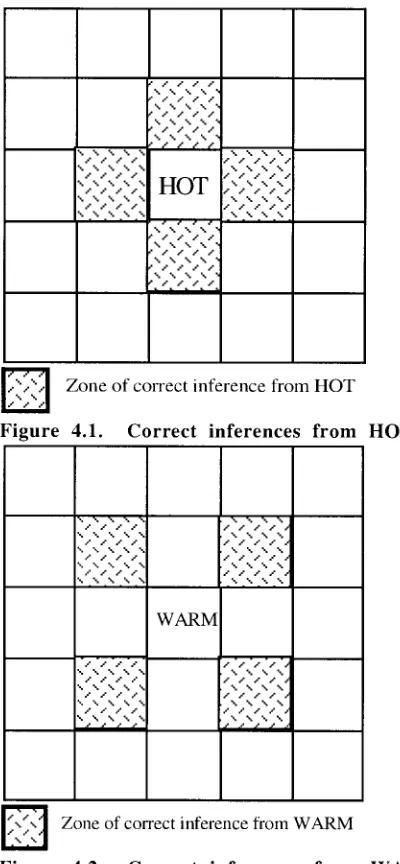
When the clue is HOT, the goal is either directly above or below, or right or left from it.
When the clue is WARM, the goal is one of diagonals from it.
When the clue is COLD, the goal is not a square touching it.
Research on reasoning has shown that there are differences in infoimation-processing
between positive and negative statements. Wason (1959) investigated the mechanism
behind the information processing of affirmative and negative propositional sentences
with college students. Participants were given four kinds of statements, generated from
two kinds of information - positive or negative - with two values: true or false. The
four kinds of statements can indicate that something either is the case or is not. An
affirmative statement that is known to be true and the complementary negative statement
which is known to be false both imply that something is the case. An affirmative
statement that is known to be false and the complementary negative statement which is
known to be true provide the same information, i.e., that something is not the case.
The time taken to judge each statement was measured and compared between each kind
of information and between values. He measured accuracy of judgements and time
taken in completing the task of processing the information. It was found that dealing
with negative statements led to more mistakes and took more time than dealing with
affirmative statements. Wason supposed that a "pre-existing" set for positive
information explained why the false affirmative condition takes longer to process than
the affirmative one. The role of a negated constituent, that is a denial of a
presupposition, would require more cognitive processes than an affirmation.
Many other explanations have been proposed for the phenomenon (see Evans, 1989).
A negated constituent does not always deny a presupposition, but it often identifies a
contrast class (Hampton, 1989). Toppino's experiment (1980) is one of the good
examples showing that a negated constituent identifies a contrast class. Toppino
investigated children's responses to positive and negative queries when two comparing
values are both present or one is absent. Kindergarten children were shown two cards -
a hypothesis card and a stimulus card - simultaneously. A hypothesis card contained
values from two attributes (e.g., blue and circle) and a stimulus card contained only one
of these values (e.g., blue). Half of the stimulus cards (proper-subset stimuli)
values on the hypothesis card. The other half of the stimulus cards (non proper-subset
stimuli) contained two values, one of which was, and one of which was not, on the
hypothesis card (e.g., blue and cross). Half of the children were asked to indicate
which value on the hypothesis card was also on the stimulus card (positive queries) and
the other half were asked to indicate which value on the hypothesis card was not on the
stimulus card (negative queries). The kindergarten children did reasonably well on
problems involving the proper-subset stimuli for both positive and negative queries, in
that 80 to 90% of the children solved all such problems. However, the results were
quite different for those problems involving the non proper-subset stimuli, which
included irrelevant features on the stimulus card. Here only 50% of the children solved
all problems with positive queries and only 25% solved all problems with negative
queries. Corroborating results were obtained in two additional experiments.
However, even though negative queries did pose difficulties for the children, research
has shown that pre-training and feedback enhance younger children's handling of them
(O'Brien & Overton,1982; Spiker, Cantor & Klouda, 1985). Spiker, et al, in one of
their experiments (Experiment 3), explored factors in producing superior performance:
feedback to the children on the correctness of their responses to queries, pre-training
with its attendant feedback, or explicit use of labels. They presented 4- and 6-year-old
children with sets of cards consisting of relevant and irrelevant information. The
unitary stimuli consisted of colour-form compounds made from combinations of one of
the colours, red, blue, or green, with one of the forms, square, circle, or triangle. The
partitioned stimuli were produced by spatially separating the two components of each
unitary compound. A positive query consisted of asking the child to indicate the value
on the hypothesis card that was also on the stimulus card. A negative query asked the
child to name the value on the hypothesis card that was not on the stimulus card. Each
pair of hypothesis and stimulus cards together with either a positive or negative query
constituted a single reasoning problem. Superior responses to the positive query than
as high as above 90% for positive queries. This was much higher than for negative
queries. In addition, this difference was found only for the three most difficult tasks.
A combination of feedback information and preliminary experience with simple forms
of the tasks produced the high performance levels, while the verbal labelling of stimulus
components had no effect.
The usage and the meaning of "If change with context (e.g., Wason & Johnson-Laird,
1972; Light, Blaye, Gilly & Girotto, 1989; Light, Girotto & Legrenzi, 1990). "If-then"
can be used to express the propositional concept of conditional implication and "If and
only if' can be used to express biconditional equivalence. It was found that
understanding the distinction between "if-then" and "if and only if' improves into
adulthood, but tends to be still problematic even for adults (Byrnes & Overton, 1988;
see Evans, Newstead & Byrne, 1993; Smith, Langston & Nisbett, 1992 for reviews).
In everyday life "if' is used for biconditional equivalence as well as conditional
implication. Young children employ "If-then" statements to express meaningful
relations such as temporal order, causality or rule-governed social interactions (French
& Nelson, 1985; Scholick & Wing, 1992, 1995).
Studies looking for competence in logical ability have demonstrated young children's
sensitivity to semantics. Processing negative queries and statements seems to pose
more difficulties than positive. The negated rule "If they don't touch at all, you are
COLD" implies that the Flamingo cannot be next to the current location when your
choice says COLD. Inference from COLD directs the player to exclude touching
squares and to hold ones NOT touching for the goal. The negative constituent in the
rule of COLD identifies an opposite class of WARM and HOT that direct the players to
infer the inclusion of touching squares. It is predicted that correct inference from
COLD will be poor due to the negative constituent in the rule. But feedback may
enhance children's performance in inferring from the rule with a negative constituent, as
2.4. Choice as inference
Following the first part of the decision-making process, that is, the representation of the
situation, the second part is choice making, which raises a research question of whether
choices are dictated by a conscious representation of the problem, or by a likelihood
gained through the past experience of reinforcement. Investigations on the issue have
been through discrimination (or concept formation) tasks in which two (or more)
stimuli are constantly rewarded. For example, choice of a 'large' object is consistently
rewarded regardless of its size in a training session. Then the job of the player in a test
session is to choose correctly which one the reward will follow. The learning of
'small' is easier than 'white' or 'black' if 'large' has been learned. Why is this the
case? It cannot be explained in behaviouristic terms. Whenever 'large' is reinforced,
'small' is not reinforced. A child is less likely to choose 'small' on the next round.
Thus, a strict stimulus-response model cannot explain the case.
How can children learn to choose a stimulus which they were not trained to choose? Of
great importance in the discrimination tasks is the aspect that participants face
successive choice problems and pick up the rules which lie behind the distribution of
feedback. Kendler and co-workers (Kendler, Kendler, & Leonard, 1962; Kendler &
Kendler, 1970; Kendler, 1995) proposed verbal links between the traditional S-R
associations. A link might serve to unite the discrete stimuli "large" and "small" under
the concept of 'size is relevant', whereas nonreversal shift or extradimensional shift,
that is, choosing white or black in the above example, can be still explained by single
unit S-R theory. Kendler and Kendler (1959) investigated the ontogeny of reversal
learning. They hypothesized that 5-6 years was the transitional point at which verbal
mediation appears; therefore, children who had not yet learned to mediate would be
learned to mediate would be fast learners and would find it easy to reverse.
Kindergarten children (5-6 years) were trained on a discrimination problem with two
pairs of stimuli, which differed both in size (e.g. large v. small), and brightness (e.g.
black v. white). Only one stimulus within a specific dimension was correct (e.g. the
large stimulus in the size dimension); the stimuli in the other dimension (e.g. both
brightness stimuli) were irrelevant to the solution of the problem. After solving this
problem, the children were required to solve a second discrimination problem in which
they either had to reverse their previous choice (e.g. select small) or shift to the
previously irrelevant dimension (e.g. select black rather than either large or small). The
former is termed a reversal shift; the latter a nonreversal shift. With the kindergarten
children neither shift was favoured. However, when the children were divided into fast
and slow learners, based on their first task performance, it was found that the fast
learners mastered the reversal shift better than the nonreversal shift, while the opposite
was true for the slow learners. However, Kendler & Kendler's assumption that fast
learners were mediators while slow learners did not make a verbal link was not proved.
Slow learners were not necessarily non-mediators. Furthermore there was no clear
demonstration that mediation occurred.
As a method of verifying these hypotheses, Kendler, Kendler and Wells (1960) tested
pre-kindergarten age children, since at this age most children should be premediational
and therefore show better nonreversal than reversal shifting. The training task involved
only a single dimension (e.g. brightness) with no irrelevant dimension present. Half of
the participants were assigned to the treatment group and instructed to tell the
experimenter which stimulus was positive and which was negative. They were helped
to express the correct word (e.g., black, white, big or little). Each child in the treatment
group named both the correct and incorrect stimuli for 10 trials. No significant effect
on reversal learning was found attributable to the instructions to verbalize. There was
training group and the control. Overall, nonreversal shift was favoured more than
reversal shift.
However, in this study (Kendler, Kendler and Wells, 1960) in contrast to Kendler and
Kendler's former study (1959), the training task involved only a single dimension (e.g.
brightness) with no irrelevant dimension present. Therefore, the two studies may not
be comparable. In the first (Kendler and Kendler, 1959), the children may have learned
to avoid the irrelevant cue (e.g. avoid size when brightness was correct) and thus found
nonreversal shifting difficult since they then had to select this previously negative
dimension. In the second study (Kendler, et. al, 1960), however, nonreversal shifting
may have been easy not because the children were younger but rather because they
could have no bias against the dimension used in the training task.
To clear up the difference between the two tasks, Kendler and Kendler (1962a) again
presented children of 4 and 7 years of age with a pair of stimuli that varied
simultaneously in size and brightness. While learning, the participants were required to
verbalize aloud the stimuli to which they were responding. One-third of the participants
was instructed to say "large" (or "small" as the case may be). The participants were
helped to express the correct label by a series of questions. Another third was
instructed to say "black" (or "white") in a corresponding way. The remaining third was
not required to say anything. After learning the discrimination, all subjects were
presented with a reversal shift. The shift was to a stimulus that was small, regardless
of the treatment group. Thus, the group that initially described the correct stimulus as
"large" had verbalized the relevant dimension. The verbal response of "black" was
irrelevant to this reversal shift. It was reported that the younger children profited by
making the kind of verbal response appropriate to a reversal shift, while learning
inappropriate verbal responses hindered them. With no verbalization the 7-year-old
children accomplished a reversal shift much more rapidly than the 4-year-olds. The
performance of the 7-year-olds in the irrelevant verbalization group was even poorer
than that of the 4-year-olds. The experimenters interpreted these results as that the
relevant labelling helped those who had not learned the concepts while those who
already had ability to form the concepts were disturbed by irrelevant labelling. Children
who are not able to represent the situation as, for instance, that big stimuli are
reinforced regardless of their colour, can be helped by repeatedly labelling, "Big",
"Big", "Big". This labelling may help children to infer that a small stimulus is the case
when "Big" is not the case, under the concept of 'size is relevant in this task'.
Later works by Kendler and co-workers focussed more on representational mediation.
Kendler and Ward (1971) presented two sets of conceptually related pictures (e.g.,
animals versus vehicles) to two groups of kindergarten children. For one group, the
reversal experimental procedure was used in that each picture was presented singly, and
immediately following the correct choice the picture was removed from view. For the
other group, the pictures were presented in a cumulative way. After being sorted
correctly, the picture remained in view so that the participant could inspect it while
responding to subsequent pictures. The experimenter reported faster reversal shifts in
cumulative stimulus presentation than in single presentation. The result was articulated
that as the number of previously sorted pictures available for inspection increases, the
probability increases that the subject will use a common representation for the instances
of each sorting category.
An alternative explanation for performance on discrimination is the attention theory
proposed by Trabasso and Bower (1968) and Zeaman and House (1963). They
diagnosed young children's difficulty as being unable to ignore irrelevant and redundant
information. Their poor performance on discrimination tasks is due to the fact that they
Can the attention theory account for the effects of overtraining? Zeaman and House
(1963) modeled an incremental attention to the relevant dimension and weakening
attention to the irrelevant dimension over trials. In contrast, according to Trabasso and
Bower's model (1968), the relative strengths of dimensions are set at the outset of a
discrimination problem and do not change over trials. It is assumed that, on a trial, the
participant only attends to a certain subset of the available dimensions, i.e. the focus of
the sample. The stronger a dimension is, relative to the other dimensions, the more
likely it is to enter the focus sample and to more of the spaces in the focus sample.
When a child makes a correct choice, all the cues that are inconsistent with that choice
drop out of the focus sample. On the next trial, there is a certain probability that the
space will not be refilled, causing the focus sample to become reduced in size. Thus,
extended overtraining should increase the probability that the focus sample will have
closed down, so that only the relevant dimension remains. Therefore, according to this
theory, as well as Zeaman and House's, overtraining should facilitate sustaining
attention on the relevant dimension and reduce attention to incidental information.
The effect of overtraining was compared to that of the one-dimension transfer of
training in Casey's study (1976). It was assumed that narrowing down attention to the
focus sample could be better achieved by training that involved only one dimension
(e.g. colour) than by over-training that involved one relevant dimension (e.g. colour)
with an irrelevant one (e.g. form). 4 and 7 year-olds were presented with
intra-discrimination tasks, in which one dimension had more than two attributes (e.g., red,
yellow and green). The number of the participants who made no errors (i.e., two-cue
learners) on the test trials was compared to the number who made one error (one-cue
learners) in each condition. The pretraining group, in which the participant had in
advance a session involving only a single dimension (e.g., colour) with no irrelevant
dimension present, had a significantly greater number of two-cue learners than the
overtraining group, in which 20 more trials were given in the initial training session.
focusing attention on the relevant dimension. No age group difference was found. The
lack of an overtraining effect was difficult to explain in terms of an incremental learning
model. Other investigations (Anderson, 1972; Lycsak & Tighe, 1975) also reported no
significant effect of overtraining with young children.
Studies with discrimination tasks have shown that even young children act as if the
accumulated experience of the previous reinforcements has an effect on solving the
current problem. Despite weakness in the design of discrimination tasks (see Blank,
1968), invaluable implications can be drawn from the studies.
First, the verbal mediation and attentional models differ in their views on the
mechanism of picking up the rules behind the disposition of feedback. Verbal (or
symbolic) mediation theory emphasizes the role of active agency in making a conscious
representation of a problem. In the view of this theory, if the child does not construct
the problem of the game by reading the game rules, for example, in the Flamingo game,
she or he will gradually build up the representation by examining the disposition of
feedback from the former choices. On the other hand, the attention theory gives credit
to the neural system in the brain. Incremental attention is given to a stimulus followed
by reinforcement, resulting in the brain becoming more sensitive to the dimension. The
child makes choices in rule-like fashion as a result of the sensitization of the neural
system. In the view of this theory, the child's performance would gradually improve as
the practice of game accumulates. But, there is no need to suggest any subjective
conscious representation.
Second, the relationship between concepts and choice-making has not been proved.
The question of how concepts related to the problem affect the processes of problem
solving is of much interest in this study. Children's games depend not only on concrete
attributes of concepts like shape, colour or size, but also on relational or abstract
ability to label different objects with a common name (e.g. pear and banana as 'fruit'),
the ability to select out the relevant physical dimension in problem solving (e.g. size,
form, colour) or the use of relational thinking (e.g. being able to compare objects as to
size - bigger, smaller). In fact, these definitions of concepts are quite restricted. The
understanding of abstract concepts like exclusion or inclusion, or defined concepts like
'diagonal', cannot be readily studied by discrimination tasks. How do abstract
concepts or higher-order concepts relate to the processes of problem solving?
Third, the verbal mediation and attention theories shed light on the importance of
encoding variables and use of strategies in problem solving. A considerable number of
studies has shown the possibility of training young children to attend to and to
remember variables in problem-solving. One of the first trainings of youngsters' verbal
rehearsal on memory tasks was implemented by Keeney, Cannizzo, and Flavell (1967).
From a large number of 6- and 7-year-olds, children who consistently rehearsed or who
consistently failed to rehearse were identified. In order to identify these two groups,
children were tested on the delayed recall test in which the experimenter recorded
children's lip movements. Rehearsers were children for whom lip movements were
detected on at least nine out of ten trials; nonrehearsers were those for whom lip
movements were absent on a similar number of trials. Half of the first group of
children and all of the latter group were trained to rehearse. Children were told to
whisper the names of the stimuli over and over until the memory test was given.
Several training trials followed in which children were prompted if they failed to
rehearse correctly. Several test trials were then given in which children tried to
remember from two to five pictures. Rehearsal training was shown to be highly
effective. Children who had not rehearsed spontaneously at all did so on more than 75
percent of the test trials. Furthermore, rehearsal had a clear facilitating effect on recall.
Before training, children who did not rehearse recalled less accurately than either group
This response pattern was backed by many later studies (i.e., Ferguson & Bray, 1976;
Kingsley & Hagen, 1969).
Fourth, adopting the neo-behavioural model, the methodology of recognizing patterns
of children's responses to reinforcements is useful for examining children's strategies
in successive decision making situations. Regularity in decision making - strategy -
gives clues about the processes involved in learning or attaining a concept. For
example, in discrimination tasks, two strategies are easily observed when a current
choice is calculated from the feedback the participant has just received. They are
lose-shift and win-stay. "Win" designates a correct response on Trial 1; "lose" an incorrect
response on Trial 1. There are two response alternatives on Trial 2; the participant may
shift her or his response, or she or he may persevere ("stay"). Levinson and Reese
(1967) reported that in young children win-stay and lose-shift strategies function
separately and that lose-shift strategies are acquired earlier than win-stay strategies.
They also reported that with increasing age the two strategies more likely occur in
combination. Kendler and Kendler (1970) reported that all the participants - children of
kindergarten, grade 2 & 6 and college students - were mostly operating on the basis of a
lose-shift strategy, which above 90 per cent of all trials used in their experiment. The
kindergarten children did not, on average, stay with the relevant stimulus after a
lose-shift response, since they continued to make errors on subsequent trials. The higher the
developmental level, the fewer the perseverative errors in the test trials. At college age,
the win-stay and lose-shift strategies merged so that there were few, if any, errors
occurring after the first correct response. The developmental trend in these strategies
supports the mediational role of concepts in problem solving. The next section will
2.5. Inferential goal searching
The previous section described how inferences are made from information. Concepts
for inferences are formed through discrimination and generalization of stimuli.
Research on the process of inference and its use in goal-search frameworks will be
reviewed here.
Earlier work on this matter was done by Maier (1936). Maier's criterion for inference
was the combination of two separate experiences in order to solve a problem. In
Experience 1, the child was allowed to explore the whole of the inside of a maze. In
Experience 2, the child was led into one of the booths from the outside and was shown
a toy which he was allowed to play with for a short while. In the test phase the child
was led into one of the other booths, from the outside, and was required to find the toy.
Each child was given a series of test trials in which different combinations of starting
and goal booths were used.
Inference, according to Maier, would be demonstrated if the incidence of direct routes
to the goal booth was significantly above the chance level of 33%. Maier's subjects
were 39 children whose ages ranged from 3 years 7 months to 7 years 11 months. He
found that very few children below 6 years performed above chance level, and
concluded that "the ability to reorganize past experience does not become marked until
about 70 months of age."
It is, however, extremely doubtful whether this experiment constitutes a valid test of
inference making. The experimental situation was based on Maier's "three tables"
experiments with rats (Maier, 1932). The children had to combine their knowledge of
Children below the age of six failed this task quite consistently, though when older than
this they were more successful. In the experiment, there was no check that young
children who failed could remember the information that they had to put together.
Thus, it was not sure whether the failure was due to children's inability to co-ordinate
separate items of information or because they forgot what they had to combine. No
conclusion, concerning the young child's capacity for inferential problem solving, may
be drawn from Maier's work.
Maier's study did, however, provide the starting point for a more thorough-going
experimental investigation of inferential problem-solving in young children by the
Kendlers (Kendler & Kendler, 1962b; Kendler, Kendler & Carrick, 1966), who
employed a Hullian paradigm that clearly separates the learning of the behaviour
segments that ultimately comprise the inferential solution to the problem.
In Kendler and Kendler (1962b), children were thoroughly familiar with the items they
later had to combine. Children were shown a box with three panels. The two side
panels had a button and pressing this button produces an object which drops into a tray
set in its own panel. In one panel this object was a marble, in the other a ball bearing.
The central panel was different. Instead of a button it had a hole, and the child must
learn that dropping the marble in the hole, but not the ball-bearing, has the effect of
producing a small toy. These then are the two items of information, that one side panel
produces a marble, the other a ball bearing, and that placing the marble in the central
hole leads to a goal (the small toy). These correspond to three behaviour segments:
A-B, X-Y, and B-G. To make sure that children remembered the items they had to
combine, subgoal training (A-B and X-Y) was given. Children learned to press a
button located in each side panel in order to obtain the marble on one side and the
ball-bearing on the other. The correct solution, the A-B-G response sequence, was to press
A that yielded B and then to insert B into the central aperture, thus obtaining G. The
grader and college students, respectively. Kendler and Kendler, thus, argued that
children younger than 7-8 years cannot solve novel problems through the inferential
combination of separately acquired behaviour segments.
The Kendlers' explanation of this improvement with age in inferential performance is in
terms of their mediational theory of human concept development. According to the
Kendlers, the difference between younger and older humans lies in the latter's tendency
to make spontaneous, implicit linguistic representations.
Kendler, Kendler and Carrick (1966) enquired whether young children's inference is
helped by verbal labelling. In one of their experiments using the same apparatus (a box
with three panels) as the previous study of Kendler and Kendler (1962b), they required
their participants to produce overt verbal labels for the subgoals during learning of the
initial segments. (In the control condition, the subgoals were never labeled.) The
incidence of A-B-G solutions among 5 - 6-year-old children was raised to 30% in this
labelling condition. Another experiment compared the effects of verbal labelling of each
segment between using the same labels and using different labels. Predictions were
made that the same-label group would make more inferential solutions than the
different-label group at both age levels, but that the effect would be more pronounced
among the kindergarten children who were supposed to be developing representational
systems, than the 3rd grade group who already did not need representational aid. As
predicted, the labelling effects, the greater effect of "same" labelling than of "different"
labelling, were obtained from kindergarten children but not third graders.
However, there is the possibility that labelling may have encouraged what may be
described as "pseudo-inferential" solutions, i.e. solutions which followed the
appropriate A-B-G pattern but which were not governed by an inference. In the
Kendlers' experiment, the children were not told how they should go about solving the