Compilation Techniques for
Efficient Encrypted Computation
Christopher Fletcher
MIT CSAIL[email protected]
Marten van Dijk
RSA Laboratories[email protected]
Srinivas Devadas
MIT CSAIL[email protected]
ABSTRACT
Fully homomorphic encryption (FHE) techniques are capable of performing encrypted computation on Boolean circuits, i.e., the user specifies encrypted inputs to the program, and the server com-putes on the encrypted inputs. Applying these techniques to gen-eral programs with recursive procedures and data-dependent loops has not been a focus of attention. In this paper, we take a first step toward building a compiler that, given programs with complex control flow, generatesefficientcode suitable for the application of FHE schemes.
We first describe how programs written in a small Turing-complete instruction set can be executed with encrypted data and point out inefficiencies in this methodology. We then provide ex-amples of transforming (a) the greatest common divisor (GCD) problem using Euclid’s algorithm and (b) the 3-Satisfiability (3SAT) problem using a recursive backtracking algorithm into a
path-levelized form to which FHE can be applied. We describe how path levelization reduces control flow ambiguity and improves encrypted computation efficiency. Using these techniques and data-dependent loops as a starting point, we then build support for hi-erarchical programs made up ofphases, where each phase corre-sponds to afixed point computationthat can be used to further im-prove the efficiency of encrypted computation.
In our setting, the adversary learns an estimate of the number of steps required to complete the computation, which we show is the least amount of leakage possible.
1.
INTRODUCTION
Fully homomorphic encryption (FHE) techniques are capable of performing encrypted computation on Boolean circuits. In en-crypted computation a program receives enen-crypted inputs and com-putes an encrypted result based on the encrypted inputs. Only the user who knows the decryption key can decrypt and interpret the result. Applying these techniques to general programs with recur-sive procedures, data-dependent loops and complex control flow has not received significant attention. In this paper, we show how to improve the efficiency of encrypted computation that uses FHE schemes by applyingpath levelizationandconditional fixed point
techniques during the compilation step of a program with complex control constructs.
Since the server deals with encrypted data it may not know what instruction to execute in the case of programs with complex control flow, and therefore it may need to execute many instructions at each time step or clock cycle. This ambiguity may make encrypted com-putation prohibitively expensive, even with efficient FHE schemes. We illustrate this by describing the execution of programs written using a small Turing-complete instruction set with encrypted data.
To decrease this control flow ambiguity, we show how a program
can be transformed to a path levelized form, even when there are complex control flow constructs such as recursion in the original program description. We then show how the decomposition of a program into hierarchicalphases, where each phase corresponds to a fixed point computation, can be used to significantly improve the efficiency of encrypted computation.
In our setting, given a program with encrypted inputs, the server performs encrypted computation for a specified number of steps, which the user or server believes is “more than enough.” When the server exceeds its budget, it sends the most current program state back to the user. The user then determines whether the program state corresponds to the final result, or an intermediate result. The program is written so it either takes a deterministic amount of time, or reaches a fixed point after the final result is computed; in the latter case, the result is not corrupted even if there is additional encrypted computation. The adversary learns an estimate of the number of clock cycles required to complete the computation. We show that revealing an estimate on the number of cycles is the least amount of leakage possible.
Organization: The rest of this paper is organized as follows. We provide background in FHE methods and discuss related work inSection 2.
InSection 3, we define the two-interactive protocol and security model that we assume. We then show how arbitrary programs writ-ten in a small Turing-complete instruction set can be executed with encrypted data and point out the inefficiency in this approach.
InSection 4, we introduce path levelization as one way of reduc-ing control flow ambiguity and fixed point computation as a way to protect program results. We demonstrate these ideas by transform-ing an algorithm that calculates the greatest common divisor (GCD) of two encrypted numbers, using Euclid’s algorithm, and showing how the transformed algorithm is more efficient under encryption.
InSection 5, we describe a programming model where a pro-gram is decomposed into phases, and each phase corresponds to a fixed point computation. We provide an example of transform-ing a program that solves the 3-Satisfiability (3SAT) problem on an encrypted SAT formula using a recursive backtracking algorithm. Both path levelization and fixpoint computation techniques are ap-plied.
We show that the two-interactive protocol results in the least amount of leakage to the server inSection 6, assuming a semi-honest server. We discuss the case of a malicious server inSection 7.Section 8concludes the paper.
2.
BACKGROUND AND RELATED WORK
decryption key, arbitrarily-complex dynamically-chosen computa-tions on that data while it remains encrypted. Until recently, subse-quent FHE schemes [7, 26, 24, 12, 6, 5] followed the same outline as in Gentry’s construction: to construct a somewhat homomorphic encryption (SWHE) scheme (which is an encryption scheme capa-ble of evaluating “low-degree” polynomials homomorphically), to squash the decryption circuit of the SWHE scheme (by adding a “decryption hint”) such that it can be evaluated under encryption by the SWHE scheme itself (using an encrypted secret key that is given as one of the components of the public key), and to use Gentry’s bootstrapping which refreshes a ciphertext (such that the ciphertext can be used in new homomorphic evaluations of low-degree polynomials).
The efficiency of FHE is measured by ciphertext/key size, en-cryption/decryption time, and the per-gate computation overhead defined as the ratio between the time it takes to compute a circuit homomorphically to the time it takes to compute it in the clear. The FHE schemes that follow the outline as in Gentry’s original construction are inefficient in that their per-gate computation over-head is a large polynomial in the security parameter (see also the implementation results in [12, 6]).
In more recent developments, Gentry and Halevi [11], and Brak-erski and Vaikuntanathan [4, 5] introduced new methods to con-struct FHE without using the squashing step, but still based on bootstrapping and an SWHE scheme. Even though their per-gate computation is still a large degree polynomial, their results have led to even more recent constructions that achieve dramatic (asymptoti-cal) efficiency improvements: In [3] Brakerski, Gentry and Vaikun-tanathan achieve asymptotically very efficient FHE schemes; their RLWE based FHE scheme that uses “bootstrapping as an opti-mization” hasO(λ˜ 2) per-gate computation and is based on the ring-LWE problem [19] with quasi-polynomial approximation fac-tor that has 2λ
security against known attacks ([4] bases secu-rity on LWE for sub-exponential approximation factors). We use this scheme throughout the paper to determine asymptotical perfor-mance when performing computation under encryption. They also present anL-leveled RWLE FHE scheme (which is able to evaluate circuits up to depthL) that does not use the bootstrapping proce-dure and which hasO(λL˜ 3)per-gate computation (quasi-linear in the security parameterλ) and is based on the ring-LWE problem with approximation factor exponential inL that has2λ security against known attacks. Both schemes apply the idea of modulus switching [4] which is used to refresh ciphertexts and manage the “noise” in the FHE scheme: Noise grows quadratically with every multiplication before refreshing. Modulus switching is used after each multiplication to reduce the noise growth to linear.
The most recent work of Brakerski [2] presents a new tensor-ing technique for LWE-based fully homomorphic encryption. This technique reduces the noise growth to linear with every multiplica-tion. The resulting FHE scheme is scale-invariant in that its prop-erties only depend on the ratio between the used modulusqand the initial noise levelN. The scheme uses the same modulus through-out the evaluation process withthrough-out the need for modulus switching and allows a modulus that is a power of 2. Finally, its security can be classically reduced to the worst-case hardness of the GapSVP problem with quasi-polynomial approximation factor (whereas pre-vious constructions only exhibit a quantum reduction to GapSVP). The scheme can be generalized to RLWE which improves the ef-ficiency even more. This has been detailed in [8], which also in-troduces optimizations and, based on [18], provides concrete pa-rameter settings: for a 128-bit security level, plaintexts are bits and ciphertexts/public key each consist of two elements inRqwhere
q= 21358
is the modulus andRis the ringZ[x]/(x2
10
+ 1).
In comparison, the SWHE scheme of [5] (without refresh proce-dures or noise reduction techniques) has been implemented in [22] for a 120-bit security level and is based on a ringRqwithq≈258
andR=Z[x]/(x2
11
+1). Plaintexts are bits and ciphertexts/public key each consist of two or three elements inRq. Key-generation runs in 250 ms, encryption takes 24 ms and decryption takes 15-26 ms. Homomorphic addition takes less than 1 ms and homomorphic multiplication takes about 41 ms. For completeness, we notice that adding or multiplying a ciphertext with a plaintext bit is almost in-stantaneous since the plaintext bit does not need to be encrypted with noise.
The most recent implementation paper [14] manages to exe-cute one AES-128 encryption homomorphically in eight days using AES-specific optimizations (and using methods based on [25, 13]). Using single-instruction multiple-data (SIMD) techniques, close to 100 blocks are processed in each evaluation, yielding an amortized rate of roughly 2 hours per block.
A domain-specific language based on Haskell for cryptographically-secure cloud computing was proposed in [1]; simple programs without data-dependent loops were compiled for FHE application. [21] shows how information flow tagging can limit leakage due to control flow constructs. In our work we transform programs with complex control flow including recursion ensuring minimum leakage.
3.
METHODOLOGY
To start, we introduce a general framework for performing com-putation under encryption for arbitrary programs. We will expand and optimize this framework in the later sections of the paper.
In this paper we use the notationFHE.Enc, FHE.Dec, FHE.Add
andFHE.Multfor FHE encryption, FHE decryption, and addition and multiplication under FHE, respectively. We assume the exis-tence of these operations and use FHE as a “black-box” module in our translation of programs into flows of instructions that can be evaluated under encryption. This translation can be viewed as a first step toward developing a compiler for computation under encryp-tion using FHE (as opposed to Fairplay [20] which is a compiler for secure function evaluation based on garbled circuits [27]). We show how the translation can be made significantly more efficient in Section 4, through techniques that reduce control flow ambigu-ity.
3.1
Two-Interactive Protocols
We model general computation with a two-interactive protocol between a user and server. Formally, a two-interactive protocolΠ
for computing a deterministic algorithmA:{0,1}∗× {
0,1}∗→
{0,1}∗
runs as follows:
1. The user wants the server to evaluate algorithmAon inputs from the user, collectively denoted byx, and inputs from the server, collectively denoted byy.
2. By usingFHE.Enc, the user encrypts its inputs to form the ciphertextM0and then chooses a number of stepsS, where
a step is some atomic unit of work (M0is notation for “the
encrypted state after zero steps”). The server then transmits to the server the pair(M0, S)together with algorithmAif Ahas not already been transmitted to the server.
3. After receiving the pair(M0, S), the server evaluatesA
un-der encryption onM0and its own inputsyby usingFHE.Add
andFHE.MultforS steps. The result is a ciphertextMS,
4. By using FHE.Dec, the user decrypts MS and checks
whetherSwas sufficient to completeA(x, y)(without loss of generality, we assume that the algorithm outputs an “I am done” message as part of its final result).
A correct execution of Π outputs to the client the evaluation
A(x, y)(ifSwas sufficient) or someintermediate result.
The disadvantage of only two interactions is that the user may receive an intermediate result (rather than the final one) indicating that the computation was not finished. The advantage is no addi-tional unnecessary privacy leakage about the final result, i.e., the server does not gain additional understanding about the output of the algorithm evaluated on the unencrypted inputs besides what the server is already able to extract from the algorithm itself, the num-ber and sizes of the encrypted inputs, and other a-priori knowledge. We will prove in Section 6 that this leakage is optimal.
3.2
Security Model
We assume the semi-honest model: the server is “honest but cu-rious.” The server is honest in that it executesAunder encryption for the required number of steps and sends back the result exactly as specified (no deviations, malicious or otherwise). In particular, the server does not send back to the user the result produced by executing a different algorithm, or evaluatingA on different in-puts, or evaluatingAon the user’s input for less thanSsteps. The server is curious in that it may try to learn as much as possible about the input of the user from its view; its view is the algorithm and encrypted inputs as given by the user (and possibly other a-priori information). This means that the server may execute other algorithms on other inputs in order to satisfy its curiosity (e.g., a small deviation of the specified algorithm, or the specified algo-rithm where some intermediate results are altered). We want the view of the server to not leak more knowledge (i.e., not compro-mise more privacy) than necessary. The interested reader can read more about malicious servers in Section 7.
3.3
A Turing Machine Approach
A first (straightforward) approach to general computation un-der encryption is to use Turing machines (TMs) to model program execution. This methodology would translate TMs to arithmetic circuits which can be evaluated under encryption through FHE schemes. A TM consists of a finite-state control unit and a tape (which we refer to asM). Communication between the two is provided by a single head, which reads symbols fromMand is also used to change the symbols onM. The program tapeMis analogous to the encrypted inputMfrom Section 3.1 and each movement of the TM head can be viewed as one step.
The control unit operates in discrete steps. At each step it per-forms one of two functions in a manner dependent on its current state and the symbol currently scanned onM: (1) Write a symbol onMat the square currently scanned, replacing the one already there; or (2) move the read/write head one square onMto the left or right. A TM is fully described by its state, the position of its head, and the content ofM. We include a detailed translation from a TM into an arithmetic circuit in Appendix A for reference.
Since state, position of the head, and the content ofMare en-crypted, any possible combination needs to be taken into account in each TM iteration. This means that each TM iteration involves a computation on the position of the head, each square onMand the state. This is costly and turns out not to be necessary. Over the next several subsections, we introduce a program structure approach in which the TM state corresponds to a global program counter and
Mcorresponds to the program’s state (memory)—both of which are encrypted. We will then present efficiency improvements to
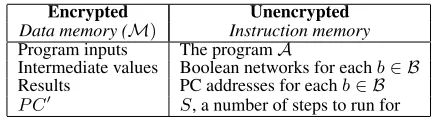
Table 1: Summary of data used by the server during an encrypted computation.
Encrypted Unencrypted
Data memory (M) Instruction memory
Program inputs The programA
Intermediate values Boolean networks for eachb∈ B
Results PC addresses for eachb∈ B
P C0 S, a number of steps to run for
this base model in Sections 4 and 5.
3.4
Program Structure
An arbitrary programAis represented as a setBof basic blocks. (We refer to thejthbasic block asBjforj= 1. . .|B|). Each basic
block is made up of an ordered sequence of instructions and has one entry and one exit point. Basic blocks are evaluatedatomically— program flow enters at the top of a basic block and all instructions within the basic block are evaluated in the specified order. Each basic block has a public, fixed address that corresponds to a unique
program counter, denoted PC.
Programs contain two types of instructions: sub(for subtract) andbranch. Thesub, a, boperation performs:
M[b] =M[b]− M[a]
whereMis the programdata memory(equivalent to the Turing machine tape from Section 3.3). Each basic block is terminated by abranch a, BBX, BBYinstruction, which performs
ifM[a]<0 :P C= PC(BBX) else :P C= PC(BBY)
wherePC(BBX)is notation for “the PC address of basic block
BBX.” Together, these instructions are Turing-complete [15]. If instructionbranch a, BBX, BBY occurs inBjfor somej, we say
thatBBXandBBY are thesuccessorbasic blocks toBj
(with-out loss of generality, each basic block can have at most two suc-cessors from its branch exit point). Likewise, we say thatBjis a
predecessor toBBXandBBY (every basic block other than the entry block to the program must have at least one predecessor). To logically terminate the program, we use a special basic block whose PC address isP Cdoneand has an unconditionalbranchinstruction
back toP C0=P Cdone.
3.5
Computation under Encryption
We now show how to map an unencrypted programAfrom the previous section to an FHE scheme. We focus on two-party com-putation between a trusted user and semi-honest server as has been described so far. A summary of the encrypted and unencrypted values used by the server is shown in Table 1.
To perform computation under encryption, the server converts each basic blockBj forj = 1. . .|B|to a Boolean network that
can be used to perform FHE-based computation on encrypted in-puts. SinceAis public, each Boolean network and its correspond-ingPC(Bj)is not encrypted and is known to the server—we say that the server stores these values in an unencrypted instruction memory. The user then augmentsMwith an encrypted PC called
P C0, which is updated under encryption after each basic block is evaluated.P C0corresponds to the program’s data-dependent con-trol flow, which is not known to the server. An important point is that the server can deduce the value ofP C0 at the beginning of the program, and also at certain points during execution (e.g., if straight-line code is being executed). The server also knows where
The user starts an algorithm by sending the server (a) an unen-crypted number ofstepsSand (b) an encrypted initial data memory
M0 as described in Section 3.1. Fors = 0. . . S−1, the server
performs the followingstate updateoperation:
Ms+1=
|B|
X
j=1
cj∗ Bj(Ms) (1)
wherecjis given by:
if PC(Bj)=? P C0:cj= 1 (2)
else :cj= 0
andBj(Ms)means “evaluate the Boolean network corresponding toBj, given the encrypted program stateMs.” All operators in the
update are mapped to the primitive FHE operations that we speci-fied at the beginning of Section 3.
Notice that at any point in the computation, PC(Bj)is equal toP C0 forexactlyoneBj; we are assuming sequential program
semantics. Thus, the server makesforward progressin A after every step. The server evaluates every basic block in parallel at each step because it does not know the true value ofP C0.
Equivalently, one can perform the state update operation per-instruction instead of per-basic block. For simplicity and efficiency reasons, we treat basic blocks as the atomic unit of work in this paper.
AfterSsteps, the server returnsMSback to the user. IfAgiven
M0 requiresS0basic blocks to complete without encryption and
S ≥S0,P C0 =? P Cdoneholds andMScorresponds to the final
program state. In a realistic setting, the user cannot always know
S for an arbitraryAgiven arbitrary inputs. If the user decrypts
P C0and sees thatP C0=? P Cdoneis false,MScorresponds to an
intermediate result.
3.6
Efficiency Under Encryption
LetSbe large enough such that when an arbitrary input is run on
A,P C0=? P Cdoneholds at some steps≤S. With the above state
update function,O(S∗ |B|)basic blocks are evaluated in order to completeA; we call this theabsolute computationperformed by the server.
Assuming an RLWE FHE scheme andN initial noise onM0,
thenoiseafter runningAwill beO(N2S). The noise comes from two flavors ofFHE.Multoperations:
1. Since the server does not know P C0, we perform an
FHE.Multoperation between eachcjandBj(Ms)as shown in Eqn. 1.
2. For thejsuch thatcj = 1, the server does not know what branch direction will be taken inBj. Letx =M[a] <0.
Then theP C0update operation can be viewed as
P C0=x∗PC(BBX) + (1−x)∗PC(BBY),
which results in an additionalFHE.Multand a corresponding increase of noise onP C0. This noise factor is not added for basic blocks with a single successor.
We do not count additive noise throughFHE.Addoperations.
4.
EFFICIENT COMPUTATION
The program transformation in Section 3 is theoretically useful for its generality, but is not an efficient transformation. Suppose thatAcan be completed inSsteps. Clearly, the server can com-pleteAon unencrypted data after evaluatingO(S) basic blocks
becauseA’s data-dependent control flow is known to the server in this situation. Thus, in addition to the overhead of performing operations under encryption, the construction from Section 3.5 per-forms a factor ofO(|B|)additional work because the server does not knowP C0.
To address this efficiency issue, we propose two compilation techniques. The first technique is calledpath levelization, which lowers theO(S∗ |B|)andO(N2S)bounds from Section 3.5 by
re-ducingPC ambiguity. The second technique is a program-level no-tion offixed pointbehavior. After explaining the transformations, we demonstrate how to transform and evaluate Euclid’s Greatest Common Divisor (GCD) algorithm under encryption.
For the rest of this section, we considerAto be an arbitrary data-dependent loop with a singleentrybasic block and a singleexit ba-sic block. Theexitblock transitions toentryto start another itera-tion, or exits the loop. (Acan be viewed as ado whileloop). We expand the scope of our transformations to larger programs (such as those with data-dependent recursive calls) in Section 5.
4.1
Program Counter Ambiguity
Our transformations are based on trying to decreaseprogram counter (PC) ambiguity. If a programAexecutes exactlyssteps for some s, P C0 points to some basic block in set Cs where
Cs ⊆ B. While evaluating under encryption for some number of
stepss, the server needs to assume that anyBj∈ Csmight satisfy PC(Bj)=? P C0.
LetBBX(Bj)andBBY(Bj)be the target basic blocks for the branch instruction inBj. Then
Cs+1={BBX(Bj) :Bj∈ Cs} ∪ {BBY(Bj) :Bj∈ Cs}
Given an arbitraryA,Cscould be as large asBat some steps < S, which means that the only way to guarantee forward progress under encryption is to perform the state update given by Eqn. 1 (cf. Section 3.5). If|Cs|= 1for some steps, we say thatP C0is
unambiguous ats.
4.2
Path Levelization
The idea behind path levelization is to evaluate the basic blocks inAby levelto shrink program counter ambiguity. Given basic blocksX andY and number of stepsL, path levelization ensures that the following property holds:
∀s:Cs={X} ⇒ Cs+L={Y}
For the remainder of this section, we assume that basic blockXis set to theentrybasic block inA, thatY is set to theexitblock, and thatLis the longest path (in terms of basic blocks) between the
entryandexit. In this context, the property is saying that ambiguity onP C0is independent of the number of data-dependent iterations inA.
To levelizeA, eachBjis assigned to a level (a set)Llforl = 1. . . L, relative to theentryblock such that
Ll={Bj: (1 + distance(entry,Bj))
?
=l,Bj∈ B}
wheredistance(entry,Bj)is the maximum path length (in terms of basic blocks) fromentrytoBj.
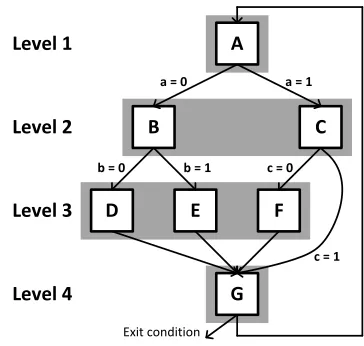
Figure 1 shows an example loopAoverlaid with levels. C1 = {A}andC2 ={B, C}correspond to level 1 and level 2. At step
3, however,C3 6=L3because the branch in blockCmay jump to
level 3 or level 4. Eventually (whens >12), this slip causesCs=
To perform computation on a levelized loop, we use the follow-ing state update function:
ifdominator(Ll,1) : Ms+1=Ll,1(Ms) (3)
else: Ms+1=
|Ll|
X
j=1
cj∗ Ll,j(Ms) +
1−
|Ll|
X
j=1
cj
∗ Ms
| {z }
identity operation
(4)
wherel= (smodL)+1,Ll,jcorresponds to thejthbasic block in
levell,Ll,1is the first basic block in levell, and eachcjis defined
in the same way as in Eqn. 2.
Eqn. 3 is an optimization: when PC ambiguity disappears, we do not have to perform a multiplication withcj.dominator(Ll,1)
returnstrueifLl,1 is adominatorbasic block—that is, if every
path from theentryto theexitblock must pass throughLl,1—and
f alseotherwise. Notice that when the server evaluatesAlevel by level,|Cs| = 1 ⇒ dominator(Ll,1) ⇒ |Ll| = 1(we refer to
this case withdominator()to aid the reader). Thus, the server can decide when to evaluate Eqn. 3 by keeping track ofCat each step.
Theidentity operationterm corresponds to the case whenCs 6=
Lland means that evaluating the current level does not necessarily
update the state. Note that whenCs =Ll(which the server can
detect), the server does not need to evaluate the identity operation (e.g., level 2 in Figure 1).
Putting these ideas together, the schedule of basic blocks that the server evaluates (per step) for Figure 1 are:
L= [{A}•,{B, C},{D, E, F},{G}•]
(read left to right). We mark eachLlwith ‘•’ ifdominator(Ll,1)
holds (meaning that multiplications were optimized away). Going back to our example, notice thatC3 = {D, E, F, G}but level 3
only has{D, E, F}. If basic blockCtransitions toH, no forward progress is made in the loop when level 3 is evaluated. This en-sures that when level 4 is evaluated:C={G}. Thus, for any loop iteration, the server knows that when it evaluates level 1:C={A}. To performSsteps of computation onA, the state update func-tion evaluates each level in order from left to right and repeats until it evaluatesI= SLloop iterations.
4.3
Fixed Point
We say thatAis in fixed point form if the following property holds:ifAcompletes inS0steps andS > S0, useful program state inMis not corrupted. We say thatusefulprogram state is that which is used by the user after the computation. SinceAis a data-dependent loop that depends onM, the server cannot generally guess when to exit and we have to protect state from getting cor-rupted. To putAin fixed point form, the programmer or compiler performs four steps:
1. AugmentMwith an encrypteddoneflag (true/f alse).
2. Remove the data-dependent loop condition and replace it with a condition that loops until I iterations are reached, whereIis public.
3. Add aheader basic block toAthat is only evaluated dur-ing the first step in the computation. This header initializes
donetof alseand then unconditionally transitions to the en-trybasic block inA. It is the programmer or compiler’s re-sponsibility to wrapA’s useful program state inif (not
done) {...}logic to prevent it from being corrupted.
A
B
C
D
E
F
G
Level 1
Level 2
Level 3
Level 4
Exit condition
a = 0 a = 1
b = 0 b = 1 c = 0
c = 1
Figure 1: Control flow diagram for an example loop, overlaid by the 4 levels of execution. Arrows indicate legal branch transitions; branch directions are given by lowercase letters for their basic block (e.g.,ais the branch direction for basic blockA). When control transitions from basic blockCtoG, level 3 does not make forward progress.
4. Evaluate atransition checkthat performs the following op-eration once, after theIthiteration ofAcompletes (say this
happens at some steps):
P Cs0+1=done∗P C(BBnext) + (1−done)∗P Cs0
Where BBnext is the basic block that A’s loop exits to.
Note that when done =? f alseholds, PC’ gets stuck at theentrybasic block ofA. This rule will be used in Sec-tion 5.1.1 to support programs with multiple and hierarchical data-dependent loops.
Thedoneflag is a program-level construct that may seem redundant because of thecjterms (which also implement fixed point-like be-havior for each basic block) from Section 3.5. We have introduced a second level of fixed point behavior to enable the optimization in Eqn. 3 from Section 4.2 where we remove certaincjterms.
4.4
Efficiency with Transformations
Consider the “worst case input”atoAwhich flows throughL
basic blocks per iteration and runs for some number of iterationsI. Path levelizingAyieldsA0; by the definition of path levelization, the longest path throughAis thesamesequence of basic blocks as that throughA0
. (We assume that fixed point logic adds a negligible number of basic blocks toA).
4.4.1
Absolute computation
LetLfollow the description from Section 4.2. Recall that ab-solute computation using the update function from Section 3.5 re-quiresO(S∗ |B|)basic blocks to be evaluated, which is equiva-lent toO(I∗L∗ |B|). Notice that per-iteration, the path-levelized scheme evaluates each basic block once, plus potentially an iden-tity operation per-level. Thus,A0
can be completed by evaluating
O(I∗(L+|B|))basic blocks.
4.4.2
Noise
after our transformations is stillO(N2S)
. The compiler in [20] uses single variable assignment for program values. We adapt this technique to computation under encryption to reduce noise on
M. GivenMsfor some steps, breakMbitwise intoMs,bfor b = 1. . . BwhereBis the encrypted bit-length ofM. We say thatMs,bonly incurs noise during stepsif some basic block in
Ll(wherel= (smodL) + 1) updatesMs,band makes forward
progress inA0
(Llis public).
With the single variable assignment technique, prior to any op-timization, we make the following observation:the noise limiting variable inMisP C0. At steps, noise is contributed to every variable modified in a basic block inLl. Since,P C0is changed in
every basic block, it accumulates the most noise between two steps
s1ands2wheres2> s1.
Whendominator(Ll,1)holds for somel, two optimizations to
the noise occur:
1. Any variable modified in basic blockLl,1 incurs one less
multiplication operation because the correspondingcj term has been eliminated. For example, ifkis the number of levels wheredominator(Ll,1)holds, the noise added toP C0in the
path levelized program isO(N2S−k∗I).
2. P C0can be reset toP C(Ll,1)—a constant value known to the server.This operation performs an implicit refresh opera-tion onP C0, eliminating any noise it has accumulated. Thus, if the RLWE FHE scheme permits at least N2L noise on
P C0,P C0will never have to be explicitly refreshed.1 This is true becausedominator(Ll,1)holds at theentrybasic block
inA0
by design.
Conceptually, the noise limiting variable (vlimit) becomes the
variable that is modified at least one time in the most levels.vlimit
can be determined by the server and is program dependent. Note that for someA0,vlimitcould still beP C0.
4.5
Alternate Approaches
Boolean network flattening.Path levelization updatesP C0 af-ter each level is evaluated. Another approach is to updateP C0
once per iteration ofA; that is, flattenAinto a single Boolean net-work and run that entire Boolean netnet-work as a single step,Itimes. Expanding the resulting Boolean network, this approach evaluates every possible path from theentrytoexitbasic block. Consider the example in Figure 1, where lowercase letters are branch direc-tions from the figure. LetMoldbe the state at the beginning of an
iteration; the equation needed to evaluate a single iteration is:
Mnew=((1−a)∗(1−b))∗G(D(B(A(Mold))))+
((1−a)∗b)∗G(E(B(A(Mold))))+
(a∗(1−c))∗G(F(C(A(Mold))))+
(a∗c)∗G(C(A(Mold)))
The number of paths fromentrytoexitcan increase exponentially with depthL. A smarter implementation can memoize common subpaths (e.g., B(A(Ms)) is used twice) to save work. If the server memoizes, it needs to copy some or all ofMfor every entry in the memoization table, which requires potentially exponential space. The advantage of this scheme is that it reduces noise due to multiplication operations by∼ 1
2—each path only needs to be
checked against theO(L)branch directions that form that path. Event-driven algorithms.It is tempting to try and decrease PC ambiguity with event-driven algorithms that maintain work queues
1Our technique is portable to other FHE schemes; the only
differ-ence is that one must respect different noise growth functions.
of basic blocks, and evaluate basic blocks that are “ready to fire.” This approach performs more work and adds more noise than path levelization because each basic blockjin the queue would be eval-uated using the update function:
Ms+1=cj∗ Bj(Ms) + (1−cj)∗ Ms
| {z }
identity operation
This adds an additional multiplication’s worth of noise and absolute computation in the identity operationper-step; the update function from Section 4.2 only adds this computationper-level.
4.6
Example: Greatest Common Divisor
We now show how to apply path levelization and program-level fixed points to Euclid’s Greatest Common Divisor (GCD) algo-rithm, as shown in Algorithm 1, and then how to run the trans-formed program under an FHE scheme.24.6.1
GCD Transformation
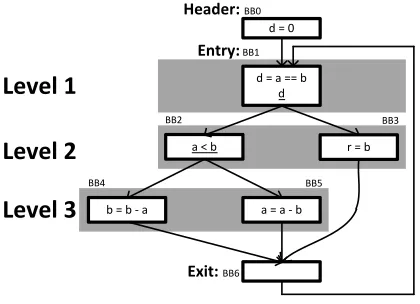
The original algorithm (GCD) has awhileloop that depends on the GCD inputs (aandb). The transformation (GCD?, shown graphically in Figure 2) runs forIiterations whereIis independent ofaandb.
Algorithm 1Original and transformed GCD algorithms. The main loop inAis shown between lines 3 and 12 in GCD?.
GCD(a, b): whiletruedo
ifa=? bthen returna 5: else ifa < bthen
b=b−a
else
a=a−b
end if 10: end while
GCD?(a, b): d = 0
fori = 0; i <I; i++do
d=a=? b
5: ifdthen
r=a
else ifa < bthen
b=b−a
else 10: a=a−b
end if end for returna, b, r
Suppose that for a givenaandb, GCD?can find the GCD after running forI0iterations. We have two cases forr, a, bafter theIth
iteration ofAcompletes:
I≥I0 :a=? bholds (distrue).r= GCD.
I < I0 :a6=b(disf alse).r= invalid.
The behavior of variabledimplements thedonefixed point flag: oncedis set,aandbare no longer modified, regardless ofS.
2Our GCD implementation assumes a subtract instead of a
mod
d = a == b d
a < b Header: BB0
Entry: BB1
BB2 BB3
Exit:BB6
d = 0
Level 1
Level 2
r = bb = b - a a = a - b
BB4 BB5
Level 3
Figure 2: The control flow graph for GCD?. Basic blocks are pre-fixed with BB.BB6is not counted as a level and is only shown to conceptually give the GCD?loop a single exit point.
4.6.2
Transformed GCD to FHE
See Figure 2. Under encryption, the user sendsM0which
con-tains encrypted values fora, band the initialP C0. The server synthesizes
LGCD= [{BB1}•,{BB2, BB3},{BB4, BB5}]
and then evaluatesBB0one time to initializedand then performs
I iterations worth of work. The server must evaluate both ba-sic blocks inL2 = {BB2, BB3}because it does not know the
value ofP C0afterBB1’s branch; inL3, the server must evaluate {BB4, BB5}as well as an identity operation in caseBB3 transi-tioned toBB6. After performingIiterations, the server performs thetransition checkfrom Section 4.3; ifd=? trueholds,P C0is set toP Cdone; otherwise it stays atP C(BB1), the entry block. After
P C0is finalized, the server returns back an updatedMcontaining
randP C0.
When the user receives a server response, it decryptsP C0and checks ifP C0=? P Cdone. If the condition holds, the user decrypts
rwhich is the GCD. Otherwise, the user has received an interme-diate result.
4.6.3
Efficiency for Transformed GCD
We analyze GCD? using the state update function from Sec-tion 3.5 (baseline) and that from Section 4.2 (levelized). To perform a single iteration’s worth of work withbaseline, we must evaluate
5 + 5 + 5 = 15basic blocks, as each iteration has a path length of 3 basic blocks (e.g., whiledoneisf alse) and the GCD?loop contains 5 basic blocks. The same computation withlevelizedonly evaluates1+2+3 = 6basic blocks (|L1|= 1,|L2|= 2,|L3|= 2
with an identity operation added).
Table 2 compares the noise between baseline and levelized.
Baselineperforms 6 multiplications per iteration onP C0while lev-elizedperforms 4. In addition, levelizedimplicitly refreshes the noise onP C0after each iteration—it almost certainly will not need to be explicitly refreshed. Note that we need two multiplications onP C0 inlevelized (l = 2)because there is PC ambiguity and
BB2can transition to oneBB4orBB5. P C0only requires one multiplication duringlevelized (l = 3)because all basic blocks in
l = 3unconditionally transition toBB6. Baseline requires3×
multiplications for variablesa,b,randdsince the server makes no
Table 2: Comparison of the number of multiplications per-step, per-variable, between a baseline state update function (Section 3.5) and a levelized state update (Section 4.2).
Levelized
Variable Baseline l= 1 l= 2 l= 3 P C0 2 refreshed, 1 2 1
d 1 1 0 0
a 1 0 0 1
b 1 0 0 1
r 1 0 1 0
assumptions about where it is in the program.
5.
PROGRAM HIERARCHY
We will now broaden the scope of our transformations and evalu-ation approach to larger programs. Section 5.1 expands our defini-tion ofAto include programs with multiple data-dependent loops and introduces the notion ofprogram phases. Section 5.2 then explains how our method can be applied to programs with data-dependent recursive calls. Using these ideas, we transform a recur-sive backtracking 3-Satisfiability algorithm in Section 5.3.
5.1
Hierarchical Data-Dependent Loops
We now show how to transform a programA, containing a set of (potentially) data-dependent loops andsimplefunction calls, to path levelized and fixed point form. We assume that each loopPkfork= 1. . .|P|takes on the form described in Section 4. Loops may be disjoint from other loops or contain other loops—we say that a loopPkis aninner-mostloop if no basic block withinPkis
part of some other loopPjforj= 1. . .|P| ∧k6=j. We define
simplefunction calls as those that (a) are made up of basic blocks and data-dependent loops (likeA) and (b) are not recursive.
To transformA, we perform a two-step process. First, all simple function calls inAare inlined.Ais now composed of basic blocks, some of which may be part of one or more loops. Second, if a loop
Pkis an inner-most loop, path levelize and apply fixed point
trans-formations toPkas described in Section 4. This process assigns a
public iteration countIktoPk. Post-transformation, we make the
following observation forPk: if (a)Pk requiresIk0 iterations to
complete without encryption, (b)Lkis the number of levels inPk,
and (c)Ik ≥Ik0: thenPkcan be thought of as a basic block that
requiresLk×Iksteps to complete (we call this a phase3).Phases can be assigned to levels in the same way as basic blocks from Section 4.2. Once all inner-most loops are turned into phases, we form a new set of inner-most loops fromP(not including existing phases) and repeat the above process until all loops are transformed into phases. Once all loops are turned into phases, we levelize the outermost scope ofA;Acan be thought of as a phase that runs for a single iteration.
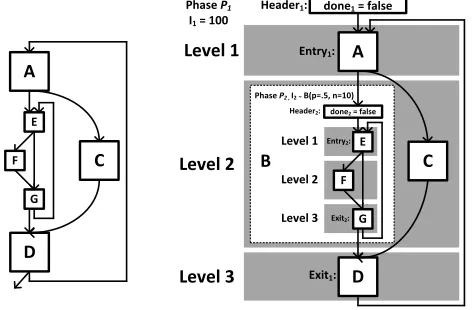
The outcome of this process is shown in Figure 3 for an example two-level loop. (We will use this example throughout the rest of Section 5.1). First, the inner-most loopP2 is path levelized and
given fixed point logic. This givesP2 the appearance of a basic
block, soP2is assigned to level 2 of the outer phaseP1. Finally, P1can be path levelized, put into fixed point form, and given an
unconditional back-edge fromD→A.
5.1.1
Computation with Program Phases
After the hierarchical transformation from Section 5.1,Ais com-posed of a hierarchy of phases and each phase is made up of basic
3
C A
D
F
Phase P2 , I2~ B(p=.5, n=10)
E Level 1
Level 2
Level 3 Phase P1
I1 = 100
Level 1
Level 2
Level 3 B
done1 = false
done2 = false
G
C A
D
F E
G
Entry1:
Header1:
Header2:
Entry2:
Exit2:
Exit1:
Figure 3: A hierarchical two-level loop that is mapped to two phases, before transformations (left) and after (right). Values for
I1andI2are explained in Section 5.1.3.
blocks and (possibly) other phases. The fundamental difference be-tween executing basic blocks within a single phase and executing across multiple phases is that with multiple phases,the server loses track ofP C0when the server breaks out of a phase prematurely.
This happens whenIk < Ik0 for some phasePkand can be
pre-vented in program-specific circumstances4. In general, however, the server cannot detect ifIk< Ik0 for somekbecauseP C
0 is en-crypted. The server only knows when it decides to transition from one phase to another.
Because of ambiguity in each phase’s iteration count, we com-pute on hierarchical programs with the following goals in mind:
1. Safety and recovery.If the server breaks out of a phasePk
too early, any useful computation performed up to that point should not be clobbered (safety). Furthermore, if some time after breaking out of Pk the server decides to run Pk for
more iterations,Pkshould be able to pick up where it left off
(recovery).
2. Efficiency.While the server is executing within a phase, the system should get the efficiency advantage described in Sec-tion 4.4.
With this in mind, a hierarchical program is evaluated using the state update function (Eqns. 3 and 4) from Section 4.2, after a change is made to each equation:
Eqn. 4: evaluating phases in levels. Suppose we start execut-ing in some phasePk. Each level inPkis now made up of basic
blocks and possibly other phases. To evaluate a basic block within a level, we evaluate the basic block’s term in Eqn. 4 as before. To evaluate a phasePjwithin a level, the server entersPj and
per-formsIjiterations worth of work inPj. Thecjterm (multiplied to
Pj) is re-defined to
if PC(Pj)=? P C0∨PCentry(Pj) ?
=P C0: cj= 1 (5)
else :cj= 0
wherePC(Pj) is the PC of the header basic block in Pj and PCentry(Pj)is the PC of theentrybasic block inPj (e.g., after
4
For example, if the server can determine an upper-bound on the size ofaandbin GCD?based on ciphertext length, it may be able to run for a conservative number of iterations.
thedoneflag is initialized tof alse). IfPC(Pj) =? P C0holds, it was time to evaluatePj. IfPCentry(Pj)
?
=P C0holds,Pjwas run
at some point in the past but the server transitioned out ofPjtoo
soon (i.e.,Ij< Ij0anddonej
?
=f alseholds). In this case,Pjcan
continue executing where it left off. Note that by “stepping into”
Pjat steps,Msmust be saved whilePj(Ms)is being evaluated.
After evaluatingPj,P C0is updated using thetransition checkas
described in Section 4.3.
Eqn. 3: dominators in multi-phase programs. Suppose we enter an arbitrary phasePj(whose levels are given byL) at some
stepsand have runs0 ≥1steps inPjso far; for simplicity, we
assume that each level inPjtakes a single step to evaluate,
regard-less of whether it has inner phases. The multiplication optimiza-tion given by Eqn. 3 can only be applied in levell =s0mod|L|
ifdominator(Ll,1)holds and nouncertaininner phase was
evalu-ated in any level from steps . . . s+s0−1. (Byuncertain, we mean a phase whose iteration count was not run for a guaranteed upper bound number of iterations by the server). We can make this op-timization whenever we enter a phase (or inner phase)Pjbecause
we evaluatecj∗ Pj—i.e., we condition oncjand can therefore
assume thatP C0points to the start ofPj. We cannot make this
op-timization inPjafter an uncertain inner phase withinPjhas been
evaluated because the server cannot assume that the inner phase completed, and therefore cannot assume any value forP C0while inPj.
Noise while evaluating phases.Suppose that we are currently evaluatingP1(from Figure 3) and will now evaluatec2∗ P2(Ms)
wheresis arbitrary. The noise onc2is proportional to the noise
onP C0after evaluating basic blockA(call thisP CA0). Thus, the
noise on variables modified withinP2will increase proportionally
to the noise onP CA0 afterc2∗ P2(Ms)completes. IfP2modifies
a large amount of state,P CA0 may need to be explicitly refreshed
before applying thec2∗ P2operation. After evaluatingc2∗ P2, the
noise onP CA0 increases in a manner proportional to the noise on done2(i.e., thedoneflag fromP2) because of thetransition check.
5.1.2
Computation Stalls
While executing within a phase Pj, efficiency is maximized
when Ij = Ij0 (I
0
j is the actual iteration count). IfIj > I
0
j,
the server performs extra work inPjthat does not make forward
progress butPj completes. IfIj < Ij0, the server stalls inPj
(e.g.,P C0gets stuck atPCentry(Pj)) and doesn’t make forward
progress untilPjis run for additional iterations (we call this a
re-covery).
The way we re-definecjfor phases, in Eqn. 5, guarantees safe execution but only limited recovery if the server stalls. For ex-ample, consider a small change to the transformed two-level loop from Figure 3 where P1 is itself an inner-loop in some phase P3. If the server underestimatesI2 during thefinal iteration of P1, P C0 gets stuck atP C(E), the PC for basic block E, and
done2 ?
= f alseholds. Since this happened in the last iteration of P1, done1
?
= f alsewill hold as well. Now, whenP3 tries
to evaluateP1again (to attempt to recover),c1inc1∗ P1(M)is
guaranteed to equal0becauseP C0=P C(E). Thus, the server is stalled and cannot recover.
5.1.3
Probabilistic Efficiency Through Recovery
The server can trade-off confidence that it has not stalled with efficiency by using probabilistic techniques and the recovery mech-anism from Section 5.1.1. In the previous section (5.1.2), the server stalled because it didn’t knowI2precisely. Suppose that the serverrandom variable with a known probability distribution. The server wants to know how many iterations ofP1(call this valueI10) it will
have to perform if it picks a fixed value forI2and wants to stall
with very small probability.
Consider the following scenario. The server knows thatI1 =
100and thatI2 ∼ Binomial (p=.5, n= 10). Thus, the upper
bound on the number of iterationsP2 has to perform overall is
100∗10 = 1000; if the server runs for this long, it is guaranteed to not stall. To decrease absolute computation, the server decides to runP2 for 5 iterations always (even though it knows thatI2is
a random variable whereP r(I2 >5) ≈.37). Because of the
re-covery mechanism, the server will finishP2after one (ifI2 ≤5)
or two (ifI2 >5) tries. The server can model how many times it
will need to try twice asF∼Binomial (p=.37, n= 100). From this, the server can calculate thatP r(F>60)≈9×10−7 =; the server has chosen 60 to make the probability very small. Thus, to finishP1 with1−probability, the server needs to to runP1
forI10 = 2×60 + (100−60) = 160iterations. Even though
the server’s view ofI2was fuzzy, the server established with high
confidence that it could finishP1while performing160∗5 = 800
iterations ofP2instead of 1000.5
5.2
Data-Dependent Recursion
IfAhas data-dependent recursion, we say that the recursive calls inAwill form acall stackF, made of up toTcall frames(for some
T), where each frame is denotedFtfort= 1. . . T. Call frames
are pushed onto (Fttransitions toFt+1) and popped off (Ft →
Ft−1) of the call stack based on data-dependent conditions.
Data-dependent recursion is problematic under encryption because (a) whether aFt→ Ft+1orFt→ Ft−1transition occurs depends on
encrypted data and (b) whenFt→ Ft−1transitions occur, control
flow may return to multiple places based on where the recursive call took place in the program.
The key idea that we use to efficiently path levelize recursive pro-grams is todecouple the call stack from the operation performed in every call frame. Formally, ifAdenotes the recursive algorithm andFsis the call frame that will be computed on at steps(assume
that each frame is evaluated in 1 step for simplicity), this transfor-mation creates the following frame update function:
Fs+1=A(Fs)
whereFs+1can be used as the call frame for the next call toAat
steps+ 1. Note that ifFscorresponds toFt(thetthcall frame),
Fs+1 will correspond toFt+t0 where(−t < t0 ≤ 1)∧(t0 6=
0)∧(t+t0 ≤ T). t0 <−1is allowed so that the program can optimize tail calls.
5.3
Example: 3-Satisfiability
With recursion and phase hierarchy in hand, we are ready to transform a recursive backtracking 3-Satisfiability (3SAT) algo-rithm and show how to run it under encryption. This algoalgo-rithm (shown in Algorithm 2) is given a 3CNF formula (a set of clauses
F) and finds the satisfying assignment if one exists or reports that no satisfying assignment exists (by returningf alse). Throughout this section,Nrepresents the number of unique variables inF.
For simplicity, we consider a simple backtracking algorithm that assigns variables in a fixed (and public) orderO. A stack data-structurest, which implicitly maintains a head-of-stack pointer de-notedst.h (st.h = 0means the stack is empty), keeps track of partial assignments to the 3CNF.Odetermines which variable is
5
Note thatI10 holds even if basic blockAtransitions to basic block
Cfor some of the iterations inP1. This is because evaluatingC
will always take one step (or “try.”)
added to/removed from the stack when a push/pop occurs. This version of 3SAT uses the following helper functions:
stackFull(N, st) : ReturnstrueifN =? st.hholds, andf alse
otherwise.
push(st, true/f alse) : Conceptually pushes true/f alse onto
st. This operation writes true/f alseontost at position
st.h;st.hthen gets incremented and the newstis returned.
canBeSAT(F, st) : ReturnstrueifFcan possibly be SAT given
st, andf alseotherwise.
For the rest of this section, we assume thatcanBeSAT()is imple-mented as a loop over the clauses inF, where each iteration can perform random accesses tost. Note that we do not need apop()
function to managest—this is done implicitly through recursive calls.
Conceptually, thecanBeSAT()routine tries to prune subtrees when possible, making the search tree that gets traversed depend onF. This makes evaluation under encryption difficult because the program call stack’s behavior depends onF; note that when 3SAT returns, control may be at line 7 or 11 in Algorithm 2 (3SAT, top). Levelizing 3SAT using only techniques from Section 4 doesn’t help, as each recursive call may take an exponential number of steps to return. In fact, using the methodology of Section 3.5 would be more efficient.
5.3.1
3SAT Transformation
To transform 3SAT, we first inline helper functions and trans-form inner loops into phases. InliningstackFull() and push()
is straightforward—both are straight-line code. canBeSAT() is a loop overF, but has a guaranteed upper bound on its iteration count—a maximum 3CNF size,F0. To properly manage the stack
stunder recursion, we also require a boundN0on the number of unique variables in the 3CNF.F0andN0are public and must be agreed upon by the user and the server. WhencanBeSAT()’s cur-rent iteration reaches|F|, thedoneflag is toggled totrue. Past that point,canBeSAT()is in fixed point mode. With this transforma-tion in hand, we will treatcanBeSAT()as a single basic block for the rest of the section.
Next, to handle the data-dependent recursive calls in 3SAT, we
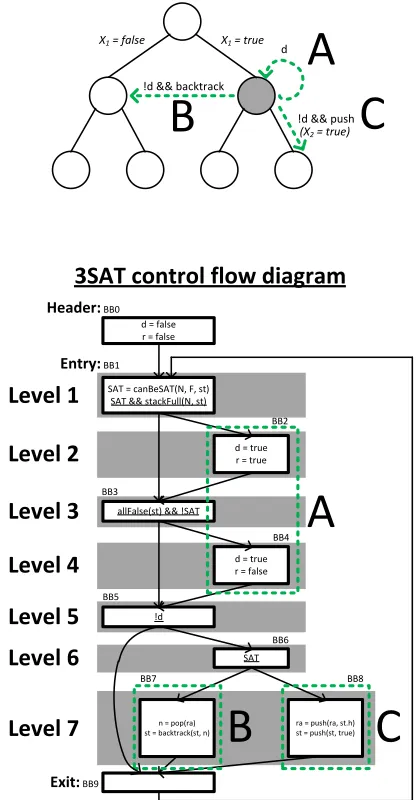
decouple the call stack from the operation performed at every node in the SAT search tree(the high-level idea is shown at the top of Figure 4). The transformed algorithm, 3SAT?, is shown in psuedo-code in Algorithm 2 and in control-flow form in Figure 4.d imple-ments thedoneflag andris a flag to indicate whether the formula is SAT or not SAT. 3SAT?uses the following helper functions, in addition to those introduced in Section 5.3:
pop(st) : Conceptually pops an element off ofst. This operation decrementsst.hand then returns the element fromstat the new positionst.h.
allFalse(st) : Returnstrueif every variable assignment instis
f alseand returnsf alseotherwise.
backtrack(st, n) : Setsst.h=nand then evaluates and returns
push(st, f alse). In Algorithm 2, this function conceptually pops off elements fromstuntil it sees atrue, and then it replaces thattruewith af alse.
performs the recursive function returns that were handled implic-itly in the original algorithm. rais used to efficiently implement thebacktrack()routine—this can be seen as a form of tail call optimization.
Algorithm 2The original (recursive) and transformed 3SAT algo-rithms. Explanations of helper functions are given in Sections 5.3 and 5.3.1. The main loop inAis shown between lines 4 and 23 in 3SAT?.
3SAT(N, F, st):
ifstackFull(N, st)∧canBeSAT(F, st)then returnst // the satisfying assignment else ifstackFull(N, st)then
5: returnf alse
end if
SAT = 3SAT(N, F,push(st, true))
if SAT6=f alse then returnSAT 10: else
return3SAT(N, F,push(st, f alse))
end if
3SAT?(N, F, st, ra): d =f alse
r =f alse
fori = 0; i <I; i++do 5: SAT =canBeSAT(F, st)
ifSAT∧stackFull(N, st)then d =true
r =true
end if
10: ifallFalse(st)∧SAT=? f alsethen d =true
r =f alse
end if
ifd=? f alsethen 15: ifSATthen
ra =push(ra, st.h)
st =push(st, true)
else
n =pop(ra)
20: st =backtrack(st, n)
end if end if end for returnd, r, st, ra
If 3SAT?is run forIiterations and we can determine ifFis SAT inI0iterations, we have the following cases:
I≥I0 : IfF was SAT:d = true,r = true, andstis the sat-isfying assignment. Otherwise: d =true,r =f alse, and
st= invalid.
I < I0 :d =f alse. r = invalid. stis the last variable assign-ment that was tested.
5.3.2
Transformed 3SAT to FHE
To evaluate 3SAT?under encryption, the user initially sends a stackst (containing a single element, initialized to true),ra
(which contains a single element that points to the first element inst),F,Nand the initialP C0as the encryptedM0. The server
d = true r = true SAT = canBeSAT(N, F, st)
SAT && stackFull(N, st)
allFalse(st) && !SAT
d = true r = false
!d
SAT
ra = push(ra, st.h) st = push(st, true) n = pop(ra)
st = backtrack(st, n)
Header:BB0
Entry:BB1
BB2
BB3
BB4
BB6
BB7 BB8
!d && backtrack d
!d && push X1 = true
X1 = false
(X2 = true)
A
B
C
A
B
C
SAT search tree and state transitions
3SAT control flow diagram
d = false r = false
BB5
Level 1
Level 2
Level 3
Level 4
Level 5
Level 6
Level 7
Exit:BB9
Figure 4: The top shows the SAT search tree overlaid with the work done by one iteration of the 3SAT?main loop. The bottom shows the control flow graph for 3SAT?. In the top part, each loop itera-tion performs work on one node of the search tree (the shaded cir-cle, or current state). Each iteration, state transitions to other nodes (dashed green arrows) are evaluated and one is taken. Each state transition is labeledA,BorCto show correspondence to the ba-sic blocks in the bottom diagram that perform the same operation.
BB9is not counted as a level and is only shown to conceptually give the 3SAT?loop a single exit point.
synthesizes
L3SAT = [{BB1}•,{BB2},{BB3}•,{BB4},{BB5}•,
{BB6},{BB7, BB8}]
where ‘•’ annotations follow the meaning from Section 4.2. To start the computation, the server evaluatesBB0to initialize
transi-tion check(Section 4.3) to finalizeP C0and then returns encrypted values for the currentst,r, andP C0.
As before, the user decryptsP C0and checksP C0 =? P Cdone.
If this condition holds, the user decryptsr. Ifristrue, the user decryptsst—which is the satisfying assignment. Ifrisf alse, the user knows thatF was not SAT. IfP C0 =? P Cdone did not hold,
the user has received an intermediate result.
Broadly speaking, the program transformations for 3SAT are non-obvious and significantly more sophisticated than the transfor-mation applied to GCD. The benefit is thatL3SAT is independent Fand that the largest level inL3SAT ({BB7, BB8}, with an
ad-ditional identity operation that is not shown) is significantly smaller than the number of basic blocks in the program.
Any program within the scope of programs we have considered can theoretically be written in path-levelized and fixed point form, though it may be quite difficult toautomaticallytransform arbitrary program descriptions into such a form. In cases when automatic transformation of a program or part of a program is difficult, one can revert to the mechanical, albeit less-efficient, form introduced in Section 3.5.
6.
PRIVACY LEAKAGE OF APPROACH
We show that the privacy leakage in our approach is optimal. We start by considering the two-interactive protocol described in Sec-tion 3.1. We prove that if the server is able to figure out when the computation is finished (such that the user always receives the final result), then the underlying FHE can be broken in that the server ob-tains a means to decrypt any message of its liking. This means that intermediate results cannot be avoided, unless the user can guaran-tee an upper bound on the number of steps required for the com-putation. Without this guarantee, to obtain the final result, the user may need to interact more than two times by asking for more com-putation and this necessarily leaks some additional privacy. At the end of this section, we discuss multi-interactive protocols.
6.1
Privacy of Two-Interactive Protocols
In the two-interactive protocolΠof Section 3.1, we assume thatAimposes a known relation on the sizes (the length of the bit rep-resentations) ofxandy, i.e.,|y|=f(|x|)for some invertible func-tionf. E.g.,|y| = 0if the server does not supply any inputs, or
yrepresents some part of a database over which the user wishes to search, or|y|indicates a number of random bits, proportional to|x|, supplied by the server. The server only receives the pair
(M, S)from the user and no other messages that depend on some intermediate computations performed by the server. This means that the only information aboutA(x, y)given to the server inΠ
comes from the pair(M, S)and its own inputy. The view of the serverviewΠserver(x, y)is defined as the triple(M, S, y).
Privacy w.r.t. semi-honest server behavior is defined as follows [16]. We say thatΠprivately computes (an intermediate result of)
Aif there exists a probabilistic polynomial time (ppt) algorithm, denotedP, such that
{P(y)}x,y∈{0,1}∗
S
≡ {viewΠserver(x, y)}x,y∈{0,1}∗ (6)
where|y|=f(|x|).
Since the used FHE scheme is assumed to be secure,Mcannot be distinguished from any other ciphertext of size|M|. Hence,P
can simulateMby encrypting a random bit string of size|x| = f−1(|y|). Only if the user inΠcomputes the number of stepsS
by using some ppt algorithmA0
(based onA) on inputsMandy,
P is able to simulateS. We conclude thatΠprivately computes
AifΠuses a ppt algorithmA0
to compute the number of steps
S← A0(M, y)based on inputsMandy. E.g.,Scan be a function of|x|=f−1(|y|).
In the GCD example the user wants to outsource the computation of the greatest common divisor ofaandbwhile keeping as much information aboutaandbhidden. If each bit ofaandbis encrypted separately, the sizes ofaandbleak. This does not mean that the computation under encryption is not private; the computation itself is private in that no extra privacy is leaked beyond the encryptions ofaand b. To limit privacy leakage through its inputs, the user may arbitrarily increase the sizes ofaandbby adding encryptions of dummy zeroes to represent extra most significant bits.
Suppose thataandbare a-priori set to say 100-bit representa-tions such that the sizes of compact bit representarepresenta-tions do not leak, and therefore no information about the ranges ofaandbleaks. The GCD is privately computed if the number of steps does not depend on the actual integer values ofaandb. E.g., the user knows that
O(logb)iterations are enough to complete the GCD algorithm. If the user’s strategy (which is known to the server) is to ask the server to compute forS =O(logb)cycles, then the server knows thatb
is in the range 2S
. Even though the encryption of the 100-bit rep-resentation ofbkeeps the range ofbprivate,Sreveals the range of
b.
Similarly, for the 3SAT problem, the user may decide on a fixed strategy, where he always asks for exactly 1 hour of computation. If the user receives an intermediate result, he concludes that the 3SAT problem is likely not satisfiable.
6.2
Teaching the Server when to Stop
We may want to improve the two-interactive protocol such that the user is always guaranteed to receive the final resultA(x, y). This is possible if there exists an upperboundu(|x|, y)on the total number of iterations required to computeA(x, y)under encryp-tion; the user chooses the number of stepsS such that the server executes at leastu(|x|, y)iterations. In order to computeu(|x|, y), the user may need to ask the server (assumed to be semi-honest) information abouty. Since the number of steps is a function of|x|
andy, no additional privacy is leaked.
For the 3SAT problem, such an upperbound is exponential in|x|. On average the 3SAT problem may be solved much sooner (much less than, e.g., the 1 hour computation the user is willing to pay for). For this reason we want to give the server some algorithm
Dto decide whether the computation under encryption reached the final state. However, we will show that an honest-but-curious server can use such an algorithmDto decrypt any ciphertext of its liking. Let I(x, y) denote the exact number of iterations needed by
A(x, y) to finish its computation under encryption. We assume thatxandyrepresent inputs for whichI(x, y)< S. I.e., the com-putation ofA(x, y)finishes in less the maximum number of steps the user is willing to pay for. In other wordsxandyrepresent an instance for whichDreduces the cost for the user.
We first consider the case which supposes that
∃k>0P robx”s.t.|x”|=|x|[I(x”, y)6=I(x, y)]>1/|x|
k . (7)
Suppose that the server executesAunder encryption on inputs
Mand y and uses the encrypted state as input to D to decide whether the computation is finished or not. Suppose that the com-putation finishes after exactlyi= I(x, y) < S iterations within the allotted number of steps. Then, the server is able to learniby usingD.
Suppose the server constructs an encryption e of 1. With a slight abuse of notation, letx = (x1, . . . , xm) ∈ {0,1}mand
inM, an encryption of some random bit stringx”is constructed:
M+ (x”−x)eis the bit by bit encryption ofx+ (x”−x)·1 =x”. See Eqn. 7—the server only needs to try a polynomial number|x|k
possible valuesx”in order to find one withI(x”, y)6=I(x, y). IfI(x”, y)6=I(x, y), then the computation based on the encryp-tion ofx”andydoes not finish after exactlyi=I(x, y)iterations. As soon as this happens, any ciphertextwcan be decrypted as fol-lows. The server addswinstead ofeto the selected positions in
M. This results inM+ (x”−x)wwhich is a bit by bit encryption ofx+ (x”−x)·0 = xifwis an encryption of0. It results in the encryption of the bit stringx+ (x”−x)·1 =x”ifwis an encryption of1. So, if the computation ofAon the encrypted input
M+ (x”−x)wtakes exactlyiiterations, thenwis an encryption of0. If this computation takes less or more iterations, thenwis an encryption of1.
We conclude that either algorithmDenables the server to de-crypt any ciphertext of its liking or Eqn. 7 is not true.
Notice that if Eqn. 7 is not true, thenI(x”, y) = I(x, y)with probability> 1−negl(|x|). This means that, except for a neg-ligible fraction of inputsx, the user knows a precise tight upper boundu(|x|, y)that can be used to choose the number of steps. This means that algorithmDdoes not help in improving the proto-col’s performance.
We conclude that either algorithmDenables the server to de-crypt any ciphertext of its liking or does not help in improving the protocol’s performance. A two-interactive protocol for computing
Acannot guarantee for generalAwithout additional privacy leak-age that the user receives the final result and not an intermediate one.
6.3
Multiple Interactions
If a user learns an intermediate result after two interactions, it may decide to ask the server to continue its computation for an-other number of steps. This allows the user to obtain the final result after multiple interactions. The disadvantage is that the decision to continue the computation or not is based on an intermediate result and therefore leaks some privacy about the final result.
In general, the server learns the number of client-interactionsj
needed for computingA(x, y). Since the server knows the pro-tocol, Aand its own input y, the server is able to simulate for arbitraryx”the number of interactions that would be needed for computingA(x”, y)under encryption in the protocol. If this is not equal toj, then the server knows thatx6=x”. This may lead to un-desired privacy leakage: The set of typical (most likely) user inputs can be partitioned into binsBjwherex∈ Bjif the computation ofA(x, y)takesjinteractions. The bin structure is revealed to the server.
In protocols with multiple interactions, besides asking the server to continue its computation, the client may ask the server to use the last state of its computation as input to a second computation. Even though this likely leads to efficiency improvements, the disadvan-tage is more privacy leakage; by simulating the protocol, the server is able to partition the user inputs not only according to the number of interactions but also according to the requested computations for each interaction.
7.
MALICIOUS SERVERS
In the semi-honest model we assume the server to be honest in executing the protocol and curious in that the server tries to learn as much about the final result as possible.
If the server is malicious, then we need to take care of additional problems:
Verification of Computation: The user needs to verify whether algorithmAwas executed by the server (and evaluated on the correct inputs). For NP-complete problems the user is able to verify a positive answer in polynomial time. If the final result cannot be verified in polynomial time, then check pointing may help: the server commits to all intermediate re-sults (by transmitting to the user the root of a Merkle tree over all intermediate results) after which the client asks for a few intermediate results, checks the commitment and verifies their consistency.
Another approach is to encrypt algorithmAand use a univer-sal Turing machine approach to evaluateAon its encrypted inputs. The user may ask the server to execute a number of encrypted algorithms, one of them beingA. If the user knows the final results for the other algorithms, then the user is able to check these. This will gain trust in the correct eval-uation ofA.
Rather than asking the server to execute multiple encrypted algorithms, the user may construct a new algorithmA00
that interleaves (in an unpredictable way based on its input) the execution ofA with some other algorithmA0, which is a way of verifying the execution ofA. If the server evaluates the encryption ofA00
by using a universal Turing machine approach, then the server does not know which iteration cor-responds to the execution ofA. Therefore, if the server tam-pers with one of the iterations, there is a significant proba-bility that an iteration ofA0
is tampered with and this can be detected by the user.
Guaranteeing Fairness: If the user pays for the outsourcing ofA, then the server needs to guarantee fairness in that the number of performed steps can be verified by the user. We need to bind an iteration counter to the state ofA. E.g., algorithmA0
(see above) can be a simple counter through which the user is able to obtain an estimate of the total number of completed steps (e.g., if the interleaving is on average 1 iteration ofA
on 1 iteration ofA0, then twice the final counter value ofA0
leads to a good estimate of the total number of completed steps).
Notice that using a universal Turing machine approach leads to circuit privacy; since algorithmAis encrypted and used as input to the universal Turing machine, the working ofAremains private. However, using a universal Turing machine to obfuscate the work-ings ofAcosts much more overhead.
Rather than encryptingAand using it as input to a universal Tur-ing machine, we may partially obfuscate and encryptA. E.g., the user may use control bits to indicate whether gates represent addi-tion or multiplicaaddi-tion. The user transmits the encrypaddi-tion of each control bit to the server. This means that the interleaving ofAwith other algorithms (used for counting steps etc.) becomes obfuscated. If obfuscated sufficiently, the computation can be verified, fairness can be checked and the algorithm itself remains partially private.
8.
CONCLUSION
In this paper we take a first step toward building a compiler for encrypted computation of general programs. This problem has not received much attention to date, with most encrypted computation examples being restricted to fixed-iteration loops or Boolean cir-cuits (e.g., AES).