An Exploratory Review of Face Recognition
Techniques and Algorithms
Ajit Kumar Tiwari1, Shrikant Lade2 1,2,
Computer Science & Engineering Department RKDF Institute of Science and Technology, Bhopal, India
Abstract—Face recognition is the most active and challenging research area in image analysis and computer vision. Human has efficient ability to recognize the faces, but has the limitation to recognize a very large number of faces. The computer has the ability to recognize a very large number of faces with high computational speed, but it is not as efficient as human. In this paper, various well known face recognition techniques and algorithms are discussed and analysed,some of the benefits and limitations of these algorithms are examined. Finally, in this review, a new approach, ideas and technique are visualized to overcome the limitations of present face recognition algorithms and technology.
Keywords—Face Recognition, Pattern Matching, Person Identification, Biometrics.
I. INTRODUCTION
A face recognition technique is a computer application for automatically identifying or verifying a person by a digital image or by a video frame from a video source. One of the possible ways to do this is by comparing certain selected facial features from the image with a facial database.
Face recognition system is an important research area spanning numerous fields and disciplines. The face recognition system have numerous practical applications such as criminal investigation, bankcard identification, access control, friend searching in social networking, security monitoring, and surveillance system. For comparing person verification in face recognition systems, there are several aspects which may differ. First, a client – an authorized user of a personal identification system – is assumed to be co-operative and makes an identity claim. Computationally it means that it is not necessary to consult the complete set of database images in order to verify a claim. An incoming image is thus compared to a small number of model images of the person whose identity is claimed and not, as in this face recognition scenario, with each and every image in a potentially large database. Second, a biometric and automatic authentication system must operate in near-real time to be acceptable to the users. Finally, in recognition analysis experiments, only images of people from the training database are presented to the system, whereas the case of a previously unseen person is outmost importance for authentication. Face recognition is a biometric approach that employs automated methods to verify or recognize the identity of a living person based on his/her physiological characteristics. In general, the biometric identification system makes use of either physiological characteristics such as a fingerprint, iris pattern, or face and behavior patterns such as handwriting, voice, or key-stroke pattern to identify a person. Because of
the human nature of protectiveness of his/her eyes, some people are naturally reluctant to use eye identification systems. Face recognition has a benefit of being a passive, non-interruptive system to test and verify personal identity in a “natural” and friendly way. In general, the biometric devices can be explained with a three step procedure: (1). A sensor takes an observation. The type of image sensor and its analysis and observations depend on the type of biometric devices used. This observation gives us a “Biometric Signature” of the individual.
(2). A computer algorithm normalizes the biometric signature so that it is in the same format such as size, resolution and view as the signatures on the database of the system. The normalization of a biometric signature gives us a “Normalized Signature” of the individual.
(3). A matcher compares the normalized signature with the set or sub-set of normalized signatures on the system's database and provides a “similarity score” that compares the individual's normalized signature with each signature in the database set or sub-set.
Face recognition begins with the detection and identification of face patterns in sometimes cluttered scenes, proceeds by normalizing the face images to account for geometrical and illumination changes, possibly using information about the location and appearance of facial landmarks, identifies the faces using appropriate classification algorithms, and post processes the results using model-based schemes and logistic feedback.
II. SYSTEM MODEL OF FACE RECOGNITION
In this review, we focus on image-based face recognition. Given a picture taken from a digital camera, we’d like to know if there is any person inside, where his/her facelocates at, and who he/she is. Towards this goal, we generally separate the face recognition procedure into three steps [3]: Face Detection, Feature Extraction, and Face Recognition as shown at figure. 1.
1. Face Detection:
Figure 1: Configuration of a general face recognition structure
2. Feature Extraction:
After the face detection step, human-face patches are extracted from images [3]. Directly using these patches for face recognition have some disadvantages, first, each patch usually contains over 1000 pixels, which are too large to build a robust recognition system1. Second, face patches may be taken from different camera alignments, with different face expressions, illuminations, and may suffer from occlusion and clutter. To overcome these drawbacks, feature extractions are performed to do information packing, dimension reduction, salience extraction, and noise cleaning. After this step, a face patch is usually transformed into a vector with fixed dimension or a set of facial points and their corresponding locations.In some literatures, feature extraction is either included in face detection or face recognition.
3. Face Recognition:
After Formulizing the representation of each face, the last step is to recognize the identities of these faces [3]. In order to achieve automatic recognition, a face database is required to build. For each person, several images are taken and their features are extracted and stored in the database. Then when an input face image comes in, we perform face detection and feature extraction, and compare its feature to each face class stored in the database. There have been many researches and algorithms pro-posed to deal with this classification problem, and we’ll discuss them in later sections. There are two general applications of face recognition, one is called identification and another one is called verification [3]. Face identification means given a face image, we want the system to tell who he / she is or the most probable identification; while in face verification, given a face image and a guess of the identification, we want the system to tell true or false about the guess.
Some facial recognition algorithms identify facial features by extracting landmarks, or features, from an image of the subject's face. For example, an algorithm may analyze the relative position, size, and/or shape of the eyes, nose, cheekbones, and jaw. [2] These features are then used to search for other images with matching features. [3] Other algorithms normalize a gallery of face images and then compress the face data, only saving the data in the image that is useful for face recognition. A probe image is then compared with the face data. [4] One of the earliest successful systems [5] is based on template matching techniques [6] applied to a set of salient facial features, providing a sort of compressed face representation.
III. LITERATURE REVIEW OF FACE RECOGNITION
In this paper we reviewed, explored and analyzed some modern face recognition methods.
A. Appearance-Based Face Recognition
Appearance-based face recognition is a traditional pattern matching method and it can be divided into linear analysis methods such as Principal Component Analysis (PCA), Independent Component Analysis (ICA) and Linear Discriminant Analysis (LDA) and non-linear analysis methods, such as Kernel Principal Component Analysis (KPCA). Classical linear appearance-based analyses are PCA, ICA and LDA where each method has its own basis vector components of a higher dimensional face image space. By using those linear analysis methods the face vectors can be projected to the basis vectors. Dimensionality of the original input image space vectors can be reduced through the projecting from a higher dimensional input image space to a lower dimensional space vector. The matching pattern score between the test face image and the training images can be estimated by calculating the differences between their projection space vectors. If the score is higher then the there is more similarity between these two face images.
(1). Principal Component Analysis
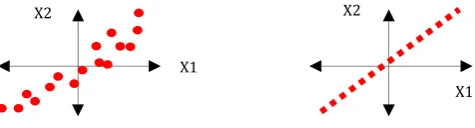
Principal component analysis (PCA) is used to calculate the vector spaces which basically represent its reduced region of image space. It is also known as Karhunen-Loève expansion, eigenvector, eigen picture and principal component. The prominent idea behind the principal component analysis is to determine the vectors which best describe the distribution of face images within the whole image space. Its concepts can be illustrated by Figure 2.
(a) PCA Basic (b) PCA reduction to 1 dimension
Figure 2: The Concept of PCA
PCA is basically performed by projection of a new image into the vector subspace called face space spanned by the eigen faces and then classification the face by comparing its position in face space with the positions of known individuals. The aim of PCA to extract a subspace where the variance is maximized.
(2). Independent Component Analysis
PCA extracts only the most expressive features which are not related to actual face recognition, and in order to improve performance additional discriminant analysis is required. However, ICA presents more powerful data representation than PCA as its aim is to provide an independent representation rather than non-correlated image decomposition and representation. ICA is the generalization of PCA [6].
Face Detection
Identification or Verification Input Image
Feature Extraction
Face Recognition
X1
X1
(3). Linear Discriminant Analysis
Similarity in images, projections of images are close together, several image projections locate far away when using PCA, but the projection from different classes of images are mixed together. LDA is also called Fisher Discriminant Analysis (FDA). LDA is able to increase the ratio of between-class distribution to that of within-class distribution [7][ 8].
(4). Nonlinear analysis
Linear discriminant analysis methods are not sensitive to the relationship among pixel vectors in the images. Some nonlinear relationship may exist in a face image, especially under the complex variations in viewpoint, illuminations and face expressions which are mathematically nonlinear. For extraction of nonlinear features of images, linear analysis methods were enhanced to nonlinear analysis, such as Kernel PCA, Kernel ICA and Kernel FLD [9][10]. With the help of nonlinear analysis approaches the original input image vector space is projected nonlinearly into a high dimensional feature vector space. In this higher dimensional vector space, the distribution of image vectors can be simplified to linear pattern.
B. Hidden Markov Models (HMMs)
The hidden markov model is a probability and statistical based model which can be used in pattern recognition techniques. The stochastic modeling of non-stationary vector time series based on hidden markov model (HMM) has been very successful for speech recognition applications. Faces were intuitively divided into regions such as the eyes, nose, mouth, jaw etc., which can be associated with the states of a hidden Markov model. Since HMMs need a one-dimensional observation sequence and images are two-dimensional, so the images should be converted into either 1D temporal sequences or 1D spatial sequences.
C. Neural Networks
The attractiveness of using neural networks could be due to its non linearity in the network [2]. So, the feature the step of extraction may be more efficient than the linear Karhunen-Loève Methods. One of the first known artificial neural networks (ANN) techniques used for face recognition is a single layera daptive network called WISARD which contains a separate network for each stored individual [11].
Figure 3: Neural Network Method
The way in constructing a neural network structure is crucial for successful pattern recognition. This is very much dependent upon the intended applications. For face detection, multilayer perception [12] and convolutional neural network [13] have been applied. Some methods were proposed that represent a hybrid neural network, which combines sampling of local images, a self-organizing map (SOM) neural network and a convolutional neural network. A self-organizing map (SOP) provides the quantization of an image samples into a topological space where inputs that are nearby in the original space are also nearby in the output space, so providing the dimensionality reduction and invariance to minor changes in the image sample. A simple neural network is described in Figure 3.
D. Geometrical Feature Matching
Geometrical features matching techniques are based on the computation of a set of geometrical features of the image of a face. The fact behind is that face recognition is possible even at coarse resolution as low as 8x6 pixels [15] when the single facial features are hardly revealed in detail implies that the overall geometrical configuration of the facial features is sufficient for recognition. The overall configuration of the image can be described by a vector representing the position and size of the main facial features, such as eyes and eyebrows, nose, angle of jaw, mouth and the shape of face outline.
E. Support Vector Machine (SVM)
Applying support vector machine (SVM) to the computer vision problem has been proposed in recent years. Training a support vector machine for face detection, where the discrimination lies is between two classes: face and non-face, each with so many examples.
For a two-class classification problem, the goal is to separate the two classes by a function which is induced from available examples. SVM is a learning technique that is considered an effective method for general purpose pattern recognition because of its high generalization performance without the need to add other knowledge [17].Intuitively, given a set of points belonging to two classes, a support vector machine (SVM) finds the hyper plane that separates the largest possible fraction of points of the same class on the same side, while increasing the distance from either class to the hyperplane. According to [17], this hyperplane is called Optimal Separating Hyperplane (OSH) which minimizes the risk of misclassifying not only the examples in the training set but also the unseen example of the test set.
F. Eigenfaces Method
Eigenfaces method basically use dimensionality reduction schemes [5][6]. Computationally the correlation methods are expensive and it require huge amount of storage apace, so dimensionality reduction methdos like eigenfaces are required. In eigenfaces method, the eigen vector as reduced dimension is extracted from higher dimensional images vectors. The principal components can be calculatuted more easily in this method.
1
Numeric al Value of color at each
pixel
For each pixel one node
Value 1 at output node means, that person was
identified
For each person in database one node
0
Let T is the matrix of preprocessed training image examples, where each column of the image vector contains one mean-subtracted image [5]. A covariance vector can be computed as
=
An eigenvector decomposition of S can be given by
= =
However is a larger vector, so the eigenvalue decomposition can be taken of this equation:
=
By multiplying with T on both sides of the equation this equation can be obtain:
=
It presents that, if ui is an eigenvector of TTT, then vi = Tui
is an eigenvector of vector S. If we have a training image set of 400 images of 100×100 pixels, then the vector TTT is a 400 × 400 vector, which is much more manageable than the 10000×10000 covariance vector. The eigenfaces methods have advantages over other techniques, such as the speed and efficiency of the system. As eigenface is mainly a dimension reduction method, the system can represent many subjects points with a relatively small set of data of images. As a face recognition system it is invariant to large reductions in image sizing.
IV. PROBLEM FORMULATION
There are limitations in various face recognition and pattern matching methods, they are not considered as problems in previous methods. Different face recognition approaches succeed and also failed at widely different viewing points and various illumination conditions. Usually one method that is highly suitable for a certain kind of imagery cannot be used under different conditions. On the other side of view, the image recognition conditions needed for a useful day-to-day recognition system cannot be constrained enough to applicable one specific recognition approach. Due to this limitations, it seems that running various individual face recognition on various applications and classifications creates a problem. The overall limitations can be considered in various face recognition methods as image size, image quality, face angles and processing speed of the algorithms. These limitations can not be completely eliminated, but can be minimized.
V. PROPOSED METHODOLOGY
The combination of profile and HMM methods through scoring presented a high recognition rate, no matter whether highly or less trained HMM models were used. Voting or ranking strategies resulted in no or only slight improvements over the individual classifiers. Profile and eigen face techniques together performed better with the scoring strategy, while voting and ranking showed the same behavior as above. The combination of HMM and eigen face classifiers, which both only rely on frontal imagery, achieved a high rate with scoring. Good results were also
received for rank summation, however, for voting strategies. Finally, the combination of profile, HMM, and eigen face classifiers can be resulted in a recognition high rate. This time good results were also achieved for the voting and ranking strategies.
The analysis presents that the different recognition criteria of different face recognition approaches can be effectively combined to enhance the identification performance that can be achieved with a given image gallery. The analysis shows that for the given images the combination of three face classifiers is superior to two classifiers. Further researches, however, have to investigate whether this is a general behavior, and how much influence the quality of the images and the choice of the face classifiers have. The combination of best features of different methods or hybrid methods will be better approach for face recognition.
VI. CONCLUSION
In this survey, we presented the exploratory and comprehensive review and theoretical analysis of different face recognition techniques and algorithms. In this survey, a general timeline based face recognition techniques along with factors affecting face recognition system in different aspects as accuracy and performance are discussed. It is observed that to capture different factors as pose variation, illumination conditions, facial aging etc. different techniques are used independently. Similarly, some integrated approaches are used to solve multiple face recognition factors in a single face recognition system. So in order to develop a universal facial recognition system which can handle all face recognition factors, the integrated hybrid approach could be the better choice.
REFERENCES
[1] R. Chellappa, C.L. Wilson, S. Sirohey, “Human and Machine Recognition of Faces: A Survey,” Proceedings of the IEEE, Volume-83, No. 5 ,May 1995, pp. 705-740.
[2] S. Ranganath and K. Arun, “Face Recognition Using Transform Features and Neural Network,” Pattern Recognition, Vol..30, Oct.1997, pp.1615-1622.
[3] Junying Gan, Peng Wang, “A novel model for face recognition”, International Conference on System Science and Engineering (ICSSE), 2011, pp. 482 - 486
[4] Matthew A. Turk, Alex P. Pentland, "Face Recognition Using Eigenfaces," Proc. IEEE Conference on Computer Vision and Pattern Recognition, pp. 586–591.
[5] M. Turk, A. Pentland, “Face recognition using eigenfaces”, Proceeding of IEEE Conference on Computer Vision and Pattern Recognition, Maui, HI, USA, June 1991, pp. 586– 591.
[6] P.N. Belhumeur, J.P. Hespanha, D.J. Kriegman, “Eigenfaces vs. fisherfaces: recognition using class specific linear projection”, IEEE Transaction on Pattern Anal. Mach. Intell. 19 (7) (1997), pp. 711–720.
[7] H.C. Kim, D. Kim, S.Y. Bang, “Face recognition using themixture-of-eigenfaces method”, Pattern Recognition Lett. 23(2002), pp. 1549–1558.
[9] K.I. Kim, K. Jung, H.J. Kim, “Face recognition using kernel principal component analysis”, IEEE Signal Processing Letters 9(2) (2002), pp. 40–42.
[10]B. Li, Y. Liu, “When eigenfaces are combined with wavelets”, Knowledge Systems 15 (2002), pp. 343–347. [11]C. Liu, H. Wechsler, Gabor “Feature based
classificationusing the enhanced fisher linear discriminant model forface recognition”, IEEE Transactions on Image Processing 11 (4) (2002), pp. 467–476.
[12]H. Yu, J. Yang, “A direct LDA algorithm for high-dimensional data-with application to face recognition”, Pattern Recognition 34 (2001), pp. 2067–2070.
[13]Z. Jin, J.Y. Yang, Z.S. Hu, Z. Lou, “Face recognition based on the uncorrelated discriminant transformation”, Pattern Recognition 34 (2001), pp. 1405–1416.
[14]D.L. Swets, J. Weng, “Using discriminant eigenfeatures forimage retrieval”, IEEE Transaction on Pattern Analysis. Mach. Intell. 18(8) (1996), pp. 831–836.
[15]M.J. Er, S. Wu, H.L. Toh, “Face recognition with radial basis function (RBF) neural networks”, IEEE Transaction on Neural Networks 13 (3) (2002), pp. 697–710.
[16]S. Lawrence, C.L. Giles, A.C. Tsoi, A.D. Back, “Face recognition: a convolutional neural-network approach”, IEEETrans. Neural Networks 8 (1) (1997), pp. 98–113. [17]V. Chatzis, A.G. Bors, L. Pitas, “Multimodal
decision-levelfusion for person authentication”, IEEE Trans. Syst. ManCybernet.-Part A 29 (6) (1999), pp. 674–680.
[18]C. Liu, H. Wechsler, “Evolutionary pursuit and its application to face recognition”, IEEE Transaction on Pattern Analysis, Mach. Intell.22 (6) (2000), pp. 570–582.
[19]J.C. Bezdek, J. Keller, R. Krishnapuram, “Fuzzy Models and Algorithms for Pattern Recognition and Image Processing”, Kluwer Academic Publishers, Dordrecht, 1999.