Public Verification of Private Effort
Giulia Alberini ∗ Tal Moran † Alon Rosen ‡
December 6, 2014
Abstract
We introduce a new framework for polling responses from a large population. Our framework allows gathering information without violating the responders’ anonymity and at the same time enables public verification of the poll’s result. In contrast to prior approaches to the problem, we do not require trusting the pollster for faithfully announcing the poll’s results, nor do we rely on strong identity verification.
We propose an “effort based” polling protocol whose results can be publicly verified by constructing a “responder certification graph” whose nodes are labeled by responders’ replies to the poll, and whose edges cross-certify that adjacent nodes correspond to honest participants. Cross-certification is achieved using a newly introduced (privately verifiable) “Private Proof of Effort” (PPE). In effect, our protocol gives a general method for con-verting privately-verifiable proofs into a publicly-verifiable protocol. The soundness of the transformation relies on expansion properties of the certification graph.
Our results are applicable to a variety of settings in which crowd-sourced information gathering is required. This includes crypto-currencies, political polling, elections, recom-mendation systems, viewer voting in TV shows, and prediction markets.
Keywords: polling, anonymity, protocols, random graphs, public verifiability, proof of work, CAPTCHA
∗
School of Computer Science, McGill University. Email: [email protected] †
Efi Arazi School of Computer Science, IDC Herzliya. Email: [email protected] ‡
1
Introduction
The Internet enables reciprocal communication on a massive scale. Thus, it has the potential to allow new forms of information gathering and “crowd-sourced” decision making. Some examples (already in widespread use) are political polling, elections (which are a mechanism for achiev-ing consensus among voters about which candidate to put in office), recommendation systems (e.g., based on users’ opinions about products and services), prediction markets (leveraging the “wisdom of the crowds” to predict future events) and “crypto-currencies” (such as Bitcoin [15]). We can think of all these cases as a generalized “opinion poll”:the outcome is the result of aggregating the opinions of a large population of Internet users. The “protocols” that implement the poll (and the methods of computing the results) are different in each case, but in all of them we can categorize the participants into three types (some parties may belong to multiple categories):
1. pollsters are responsible for collecting the information and publishing the result.
2. responders are the parties who provide inputs to the poll.
3. verifiers are interested in (should agree on) the result, but may not be active participants.
Although at first glance the examples mentioned above may not necessarily appear to be a distributed protocol problem (e.g., in elections there is a central election authority that can broadcast results to everyone), it is natural to consider the case when the central authorities are untrusted, and can potentially act maliciously. Viewed this way, verifiable polling is a generalization of the fundamental problem of achieving consensus between mutually-distrustful parties. While in the general polling setting, inputs of various parties could differ and are aggregated into the poll’s “tally”, the basic consensus problem focuses on the special case in which parties only have to agree on a specific output if all of their inputs match. Correctness of the consensus is guaranteed by the verifiability property of the polling protocol.
In their general form, verifiable opinion polls are also useful as building blocks in more complex protocols. For example, the main technical innovation of Bitcoin, a recently popular “crypto-currency”, is in achieving a distributed, decentralized consensus about the currency’s public transaction ledger (the record of all Bitcoin transactions) [15].
In the “traditional” setting for the verifiable polling problem (and its variants), the number and identities of the parties are known in advance. Using standard cryptographic techniques, solutions are known to many of them. Techniques for verifiable voting, for example, provide solutions that hide the individual responses of the participants, even after revealing the tally (see subsection 1.5 for references).
Unfortunately, adapting the traditional solutions to work in a decentralized internet envi-ronment is non-trivial. One of the major problems encountered in this setting is the lack of identity verification. Strong identity verification on a large scale is expensive, and in many cases completely impractical (e.g., when participants are spread across national boundaries, there might not be a single entity trusted by all of them to certify identities). The mechanisms for identity verification become even more complex when anonymity (or pseudonymity) of the participants is required. In the absence of identity verification, it is impossible to distinguish a fake identity from a real one; this opens the door to “Sybil attacks” (attacks based on creating multiple fake identities).
The Bitcoin protocol is an excellent example of this type: in effect, consensus is achieved by having parties constantly “vote” on which version of the transaction ledger they accept, where for each “vote” the party must also generate a “proof-of-work” to prove that the required amount of computational effort was expended.1
Proofs of work are one of the very few examples of proofs of effort that arepubliclyverifiable. However, they suffer from significant drawbacks. First of all, they are inherently wasteful in that the computation “does nothing” except prove work (indeed, this is one of the strongest arguments against the Bitcoin currency [11]). Secondly, and perhaps more importantly, a party with access to more computing power than most honest responders may gain a hugely dispro-portionate influence on the results (not to mention the wide disparities between the responders themselves).
1.1 Privately Verifiable Proofs of Effort
An alternative to publicly-verifiable proofs of work, and one that may be potentially easier to achieve, is that ofprivately-verifiable proofs of resource expenditure. One well known example is that of enforcing human involvement in each response. In voting for the “American Idol” TV show, for example, online viewers must solve a CAPTCHA [18] for each vote, but the total number of votes is effectively unlimited. (What makes the CAPTCHA solution privately verifiable is the fact that all currently known CAPTCHAs are private coin: in effect, every CAPTCHA is generated together with its solution.)
Beyond being easier to achieve (and not being “wasteful”) The “human effort” requirement may be useful when there is a “resource gap” between honest and malicious parties. For example, show producers have significantly more money and access to more computing power than most honest viewers (and there are wide disparities between the viewers themselves)—using proof-of-work in this context could give them a hugely disproportionate influence on the results.
In effect, what CAPTCHAs enable us to achieve is what we call a privately-verifiable proof of effort(PPE). Informally, this is an interactive protocol between two parties: if both parties are honest the test returns “true” to both, otherwise the test returns “false” to the honest participant.
Definition 1.1 (PPE, informal). A two-party protocol is a PPE if it satisfies:
1. EffortIf both parties honestly follow the protocol, they expend one “effort unit”.
2. σ-Completeness. If both parties honestly followed the protocol, they will both output “true” at the end of the protocol with probability at least 1−σ.
3. ε-Soundness. If one party is malicious (invests less than the required effort) and the other honestly follows the protocol, the honest party will output “false” with probability at least
1−ε.
We note that this definition is necessarily informal, since the term “effort unit” is itself not well defined. In our analysis, we sidestep the problem by reversing the definition: instead of defining a PPE as a proof of effort, we define a “proof of effort” as successful completion of PPE with at least one honest participant (formally, we follow Canetti et al.’s framework for defining CAPTCHAs [3] and define effort in terms of oracle calls; see section 2 for details).
The peer-to-peer nature of PPEs makes them potentially easier to realize than their publicly-verifiable counterparts (which require costly distributed coordination). In Appendix B, we list several potential mechanisms for PPEs, most of which do not require human involvement (making them fully automatizable, and hence scalable). These include proofs of storage, human interaction (including symmetric CAPTCHAs) and leveraging social networks.
1
1.2 Our Results
While PPEs seem easier to realize, it is not at all clear how to utilize them in order to deal with the problem of a cheating pollster. For instance, in the American Idol example, a malicious CAPTCHA generator can use the solutions to the CAPTCHAs without expending any human effort. Thus, existing CAPTCHAs cannot be publicly verified (hence cannot be used to achieve a consensus about the result of the poll when the generator is untrusted).
Our main result is a new protocol for publicly-verifiable effort-based polling, based on any
privately-verifiable proof-of-effort (PPE). The protocol uses PPEs to generate a “responder certification graph”: each responder is a node in the graph while an edge between two responders corresponds to a PPE execution. Loosely speaking, we guarantee that, as long as enough honest users participate in the protocol, a large number of cheating nodes will be publicly detected (note that, unlike most standard definitions of an “honest party”, in our case every party controlled by the adversary is considered “cheating”, even if it follows the honest protocol exactly).
If each node in the graph is published together with their response to the poll, the poll results cannot be skewed significantly by the pollster without being detected.
In its simplest variant, our protocol assumes that the responder certification graph is sampled at random. This sampling can be performed in a publicly-verifiable way, say by applying a “random-looking” function (e.g., SHA-1) to two nodes’ indices to determine if there is an edge between them in the graph. Since our protocol’s analysis relies only on expansion properties of such randomly chosen graphs, the construction can potentially be derandomized—using an explicit graph with the appropriate expansion properties, we could remove our assumption about SHA-1 and improve the protocol parameters, at the cost of making the protocol more complex. We note that while the structure of certification graph is fixed (it depends only on the number of nodes), we allow the adversary to specify the number of nodes (within bounds) and to arbitrarily control the assignment of honest nodes to vertices in the graph. We prove that security holds for every assignment.
1.3 Main Theorems
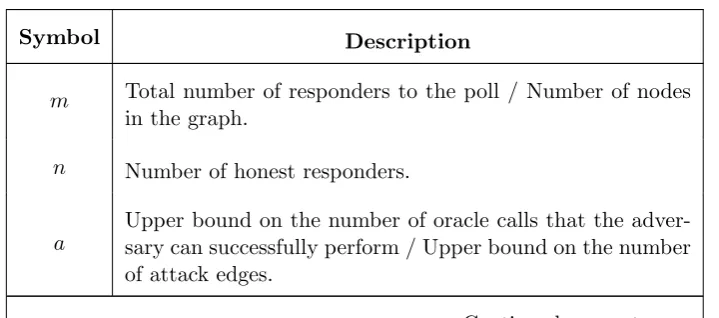
The total number of nodes in the certification graph is denotedm and corresponds to the total number of responders (some of whom may be controlled by the adversary). The number of hon-est responders is denoted byn. We denote bydthe average degree of the responder certification graph: this is the number of PPE executions each responder is expected to participate in.
We model our assumption that the pollsters have bounded resources by specifying that a cheating pollster cannot participate in too many successful PPEs with honest responders. In terms of the certification graph, this assumption implies a bound a on the number of “attack edges”—PPE executions in which the cheating pollster participates as one party and convinces an honest responder to accept. The ratioa/d gives a lower bound on the number of “cheating” nodes; an attacker can always create this many cheating nodes without detection by following the protocol honestly. Thus, our security guarantees make sense only when a/d n (we can think of a/dnas a small constant).
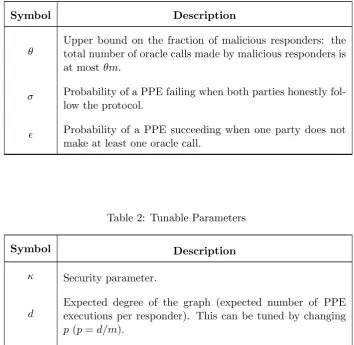
We denote by κ the security parameter. Our main theorems guarantee the soundness (a malicious pollster can’t cheat undetectably) and completeness (an honest execution will be accepted) of our protocol. For simplicity, we will consider PPEs for which ε (the soundness error of a PPE) is negligible in the security parameter and omit it. For our completeness proof, we require an additional independence property: that for a given node, the probability of failure in each PPE execution is independent (the probability can depend on the node, however).
See section 4 for the full theorem and proof. Note that our proof holds in the random oracle model, but under a very reasonable assumption about the cryptographic hash function (that the generated graph has good expansion parameters) it holds in the standard model as well.
Theorem 1.3 (Completeness—Informal). If the pollster is honest, and malicious responders are bounded byO(m) successful PPEs, the probability that verification fails is negligible in κ.
See section 5 for the full theorem and proof. The bound on successful PPEs by malicious responders is required to guarantee robustness of the protocol—when the pollster is honest the verification should succeed even if some of the responders are malicious.
1.4 Comparison to Verifiable Voting
At a high level, our polling protocol has the same form as most universally verifiable voting protocols (involving an “election authority”, “voters”, “receipts” and “verification procedure”):
1. The pollster sets up the poll and publishes public parameters on a bulletin-board (modeled as a broadcast channel). This corresponds to the role of the “election authority”.
2. Honest responders (corresponding to the “voters”) send their responses to the pollster and engage in an interactive proof protocol to ensure that they are expending the correct amount of “effort” for each response. This protocol includes interaction with the pollster and also, unlike most voting protocols, interaction with a subset of other responders.
The pollster signs the transcript of each communication with a responder and sends this signature to the responder (think of this as the “receipt” in the voting protocol).
3. The pollster publishes the empirical distribution of responses, together with a proof of correctness.
4. The verification procedure consists of both a local verification step performed by the responders (which in a voting protocol corresponds to verifying that the voter’s receipt appears on the bulletin board) and a global verification step performed by the verifiers (which corresponds to the “universal verification” step in voting protocols). Note that responders can also act as verifiers if they wish.
A significant difference between effort-based polling and verifiable voting is the issue of voter identity. In our polling protocol, parties are identified only by self-chosen pseudonyms (for our purposes, a pseudonym is a verification key of a public-key signature scheme). We do not limit the number of pseudonyms a party may generate, or require parties to link their pseudonyms to their real identities.
In contrast, most voting protocols assume each party in the protocol has been identified by a trusted authority, in order to ensure that each voter gets only a single vote. By relaxing this requirement to “one vote per effort expended”, we can dispense with the complexity, expense and privacy implications of securely identifying responders.
1.5 Related Work
Sybil Defense In a “Sybil attack”, an adversary creates multiple “fake” identities in order to manipulate a protocol. The problem of establishing trustworthy virtual identities has plagued the Internet from its inception [9]. It is particularly acute in distributed systems with no central authority—without additional assumptions, vulnerability to some forms of Sybil attacks is unavoidable in this case [8]. The paper by [9] deals with the problem of establishing identities. One of the first discussions of trust metrics based on social graphs appears in [12]. The term “Sybil Attack” (attributed to Brian Zill from MSR) was introduced in [8], where it is shown that in the absence of a central certifying authority, some attacks are always possible.
A reputation system for p2p with similar ideas to pagerank (doesn’t handle sybils) is de-veloped in [10], and the possibility of using “Turing tests” to limit Sybil nodes is mentioned in [2]. In [6] it is shown that there exists no symmetric sybil-proof reputation mechanism. Since the existing sybil-defense protocols all care about reputations (e.g., determining which nodes are “real” and which are sybils), they all strongly rely on breaking symmetry: having at least one trusted node. Our protocol is symmetric, however we can sidestep the impossibility proof because we don’t care about individual nodes’ reputations—only about the aggregate opinion of all the nodes.
The technique of random walks on a social networks to bound the effect of Sybil attack is introduced in [22] (see [21] for an expanded version with full proofs). A 2006 survey of sybil attack literature can be found in [13]. An improved version of [22] (slightly different protocol, same goal but better parameters) appears in [20], and a newer protocol to identify sybil nodes in a social graph is presented in [7]. The protocol makes very similar assumptions about the social graph, and Bayesian methods to compute the probabilities that nodes are sybils. Finally, [17] uses the social network graph to aggregate votes for online content. The “vote collector” is assumed to be honest, and votes are collected using max-flow in the social graph.
Most of these techniques implicitly or explicitly use assumptions about expansion properties of social-network graphs. We also make use of the idea that if “adding edges is hard” in an expander graph the adversary is limited in the effect bad nodes can have, but in our case the graph is artificially generated, so we can prove (in the random-oracle model, at least) that our graph has the required properties. On the other hand, the labeling of the graph is adversarial; despite this, we get results that are—in some sense—stronger than the results on social networks: we can bound the total number of “bad” nodes (rather than just their influence).
Verifiable and Private Polling. A widely used technique for privacy-preserving polling is called “randomized response” and was introduced in [19]. The first suggestion for cryptographic verifiability in voting, which also gives a mechanism for establishing anonymous channels (mix-nets) was made in [4]. More recently, the works of [5, 16] propose taking into account human
voters in End-to-End verifiability, and introduce the notion of separate verification steps for the voter and external observers. Another incarnation of this idea is verifiable (for the pollster) privacy-preserving polling using scratch-off cards [14].
2
Model and Definitions
a CAPTCHA, automatically generated challenges that should be solvable only if given a call to an effort oracle (and moreover accommodate automatic verification of the solution). Other options, (some of which may be more practical) are described in Appendix B.
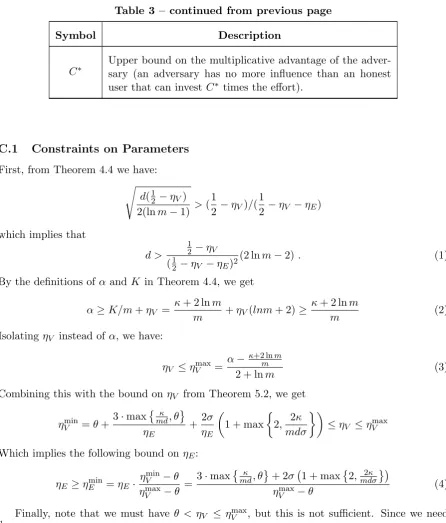
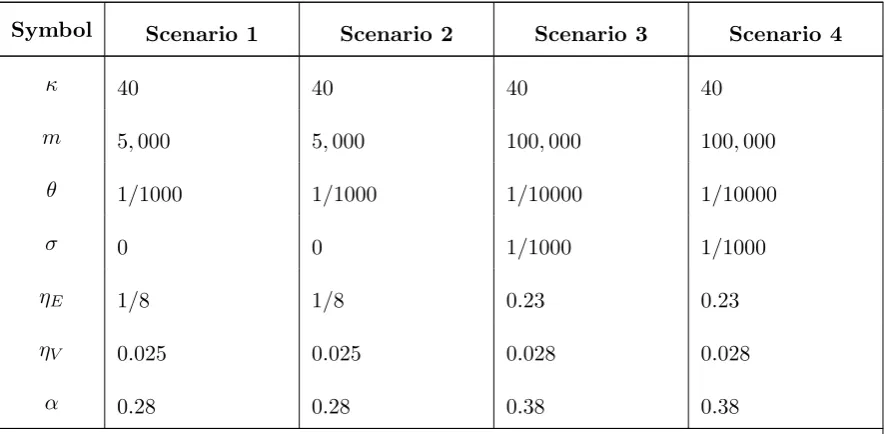
Before delving into the details, we note that for the convenience of the reader, Appendix C contains a table of the parameters and notation used in the paper.
2.1 Verifiable Effort-Based Polling
An m-responder polling scheme is a multi-party protocol between a pollster, denotedP and m
responders, denoted R1, . . . , Rm. Theith responder holds an input xi ∈D∪ {⊥}, where D is
the domain from which the responses are taken and ⊥denotes lack of participation in the poll. In practice m will be an upper bound on the number of responders; We denote by n < m the actual number of (honest) participants. The number of honest responders is known only to the adversary. Thus, the adversary can create “fake” responders by replacing some of the⊥inputs with adversarially chosen values. As the adversary knows all the inputs and controls all the outputs in our protocols, we do not need to consider corrupted responders—the adversary can just replace an honest responder’s input with a different one to simulate a corrupted responder. We give parties access to an oracle denoted E, and letREi (resp. PE) denote the execution ofRi (resp. P) with access to the oracleE. Letei denote the total number of oracle calls made
by Ri to E. Let hPE, RE1(x1), . . . , REm(xm)i be a random variable describing the output of a
protocol execution, where the probabilities are taken over the parties’ coin tosses. The output of the protocol takes the form (Y , z), where Y = (y, w) denotes the output of the pollster (y = (y1, . . . , ym) indicates the outputs of the responders as announced by the pollster, and w
contains a proof of correctness of the result) andz = (z1, . . . , zm) denotes the local outputs of
the responders, wherezicorresponds to the local output of Ri following the protocol execution.
The role of the local outputszi is to enable local verification by the parties.
To make the polling scheme publicly-verifiable we will additionally require the existence of a verifierV that takes Y and z as inputs (the verification procedure can use the output of the local verification; e.g., global verification could fail if too many responders complain).
Definition 2.1 (Verifiable Effort-Based Polling). Let κ, m, a ∈N and let α, θ ∈[0,1] and B :
N×N7→N. Anm-responder effort-based polling scheme is said to be(α, B)-soundand θ-robust
if there exists a probabilistic polynomial-time algorithmV such that for anyx1, . . . , xm ∈D∪{⊥}
with n= #{i∈[m]|xi 6=⊥}, the following properties are satisfied:
Soundness: For every PPT (Probabilistic Polynomial Time) P∗, if n≥ αm and ∆(x, y) ≥ B(a, m) then
Pr
V(Y , z) =accept<2−κ ,
where the probability is taken over (Y , z) ← (P∗E, RE1(x1), . . . , RmE(xm)), a is the total
number of oracle calls made by P∗ to E,and ∆(x, y) is the minimum Hamming distance between x and some permutation of y (i.e., this corresponds to the number of responses changed/added by the adversary).
Completeness: For every subset{i1, . . . , it} ⊆[m]of responders (corresponding to malicious
responders), if ei1 +. . .+eit < θm then
PrV(Y , z) =accept>1−2−κ,
where the probability is taken over (Y , z)←(PE, RE1(x1), . . . , REm(xm)).
expect B(a, m) to be proportional to the number of responses an honest user could add using
a calls to the effort oracle. Thus, an intuitive measure of the protocol’s soundness is a bound on the multiplicative advantage of the adversary:
C(a) =B(a, m)d
a
If the multiplicative advantage is bounded by C, then any adversary who can change C ·`
responses using an optimal cheating strategy could have altered`responses (in expectation) by honestly following the protocol and expending the same amount of effort.
The θ-robustness of the protocol guarantees that if the total effort available to malicious responders is less thanθm, then they cannot cause the verification procedure to fail except with negligible probability.
2.2 Formally Defining Proofs of Effort
In the “effort-oracle” model we can fully formalize definition 1.1. Note that while we define PPE to be a two-party protocol, we require soundness to hold even in a concurrent setting, in which a malicious party A∗ participates concurrently in multiple executions of the protocol with other parties. To achieve this, we assume each protocol execution has a unique identifier
id (e.g., in practice this could be a concatenation of the identities of the participating parties and the current time).
Definition 2.2(PPE). A protocolΠE(A, B)between two partiesAandBis a PPE if it satisfies
the following properties:
1. σ-Completeness If A and B execute an instance of ΠE(A, B) and both honestly follow the protocol, then with probability at least 1−σ both parties will output “true” at the end of the protocol.
2. ε-Soundness For every pair of PPT (Probabilistic Polynomial time) A∗ and B that ex-ecute an instance of ΠE(A∗, B) with identifier id, if B honestly follows the protocol but
A∗ does not make at least one oracle call to E with input id, then the probability that B
outputs “true” is at most ε.
3
The Protocol
The main technical innovation in this paper is the construction of the Pollster’s proof for the correctness of the published results. To do this, we borrow ideas from the literature on defense against Sybil attacks using pre-existing trust relations.
To account for the possibility that an honest responder can fail a PPE execution indepen-dently of his honesty, we denote by ηE the fraction of failing PPEs that the protocol tolerates
before discarding someone’s vote. On the other hand, we indicate by ηV the upper bound on
the fraction of responders whose vote can be discarded by the pollster (if the number of dis-carded votes is greater than ηV, the overall verification will fail). Moreover, in order to avoid
denial-of-service attacks caused by malicious responders that intentionally fail all their PPEs, our protocol will require to register for the poll by solving a single-sided PPE (i.e., a PPE that requires effort only from the voters side in order to be successful). With high probability this kind of attack will then be unsuccessful whenever the cheating responders are limited in the amount of effort they can expend. Following, is a high-level description of our protocol. For each of the steps below, the full formal protocol description appears in subsection A.3.
unique, random identifieridfor the poll and public key parameters for a digital signature scheme. We denote bySK,V K the secret and public key respectively.
The public parameters are the tuple (id, questions, p, V K), where questionsis the set of poll questions. p is a probability that determines the expected degree of the certification graph (see Appendix C for a full explanation of how it’s chosen).
2. Registration. (Protocol 2) Each responder Ri samples a private key SKi and a public
keyV Kifor their signature scheme, and sends (addri, V Ki) to the pollster (whereaddri is
the responder’s network address). Each responder then solves a single-sided PPE (verified by the pollster). If verification was successful, the pollster adds (addri, V Ki) to its list of
registered responders.
When the registration phase is over, the pollster broadcasts the list of registered public keys. Note that the network addresses are not required to appear in the broadcast list. The order of public keys in the list maps each registered responder to a unique index (i.e., theith key in the list is mapped to indexi).
For each index i, we define Ni to be “the neighborhood of i” in the certification graph.
Ni is computed fromiandm(the total number of parties) using a cryptographic hashH:
j∈Ni iffH(i, j)≤p, where the output ofH is treated as a binary fraction in [0,1] (e.g.,
H could be SHA-1). Since all of the parameters are public, every party can compute the list of its neighbors in the graph.
However, whileRimay know the verification key of every neighbor, it does not necessarily
know their network addresses. The parties can communicate via the pollster, or alterna-tively, the pollster can send each party ithe network addresses of all its neighbors in the graph.
3. Responder Certification (PPE execution). (Protocol 3) As just described, every pair of responders is paired in a PPE instance with probabilityp. Now, for eachRj ∈Ni,
responder Ri engages in a PPE withRj. The actual execution is peer-to-peer, however
the communication may be facilitated by the pollster (e.g., the pollster’s website can be used as a conduit for a VOIP chat). If the PPE execution succeeded (both parties received “true”), the parties sign each other’s public keys (concatenated with a unique “poll identifier”, to prevent the signatures being reused in other polls) and send the signed values to each other.
4. Poll Response. (Protocol 4) Every responder Ri sends to the pollster the results of
the certification phase (a signature onV Ki from each neighbor with which it successfully
completed a PPE) and xi, the actual response to the poll questions.
5. Results and Proof. (Protocol 5) We can think of the responders as nodes of a graph
Gc in which they are connected by edges if and only if they were supposed to interact
through a PPE. Let V = {1, . . . , m} denote the set of responders and E := {(i, j)|i, j ∈ V, H(i, j) < p} the set of edges. We call Gc = (V, E) the “certification graph”. Note
that anyone can compute Gc given the serial numbers associated to the responders and
p. Then, as a “proof of correctness” the pollster publishes the graph consisting of the following2:
Node labels: For each responderRi he publishes (xi, sigSKi(xi), V Ki, idi).
Edge signature: For each successful PPE he publishes (sigj(V Ki), sigi(V Kj)), where
V Ki, V Kj are the public keys of the responders involved in it.
2
List of deleted nodes: The list of all nodes whose response will not count in the result because they failed more than aηE fraction of the PPEs.
The empirical distribution of the responses can be computed by counting the votes as-sociated to the non-deleted nodes. Note that the graph published by the pollster, call it Gp, is composed of the same nodes as Gc, but it’s missing all the edges associated to
unsuccessful PPEs. So, Gp = (V, E0) is a subgraph of Gc= (V, E) where (i, j) is in E0 if
and only if Ri andRj successfully interacted through a PPE.
6. Verification. (Protocol 6) The procedure is divided in two steps:
Local verification (performed by each responder) consists of verifying that the corre-sponding node was published correctly, as were the edge signatures in which he was involved (no adjacent edge is missing, and all the adjacent edges in the graph were verified with a successful PPE). If any of these verifications fail, the responders sends a “complaint”.
Global verification (can be performed by anyone) consists of checking that all the nodes, and no others, that failed more thenηEdedges are indeed marked as deleted.
To verify if a node i is marked correctly, the verifier needs to find its neighbors in the graph (by computing the hash functionH(i, j) for everyj6=i) and checking how many of the signed edges appear in the published graph. Then, the verifiers need to check that no more than a ηV fraction of the nodes were deleted and that not “too
many” valid complaints were sent.
An adversarial pollster can attempt to manipulate results either by changing the responses associated with honest nodes or by “controlling” many nodes (they will be nodes that do not correspond to any honest participant, but appear in Gp and their “behaviour” is dictated by
the pollster), such that the overall empirical distribution differs from the empirical distribution over the honest nodes. In the former case, the local verification will detect the adversary and many valid complaints will be sent. In the latter case, we use an expansion property of the graph to prove that any large enough set of “bad” nodes (nodes that are controlled by the adversary) must have many edges to its complement in the graph. Thus, an adversary who wants to control a big enough set of nodes must succeed in many PPE executions with honest nodes; since the adversary is bounded in the number of successful PPE executions, it will be caught with high probability.
The protocol also provides a measure of robustness against malicious responders. Cheating responders cannot undetectablymodify the results for the same reason that a cheating pollster cannot. However, they can attempt to launch a denial-of-service attack by causing verification to fail. As explained above, the single-sided PPE in step 4 will prevent this form of attack, as long as the cheating responders are limited enough in the amount of effort they can expend.
4
Soundness
To prove the soundness of our protocol we need to show that the number of votes that the adversary can control is at most proportional to the amount of effort that he is willing to invest. That is, whenever the adversary is able to control a “meaningful” amount of votes that is significantly greater that the number of votes that she could have controlled by honestly following the protocol (with the same effort investment), our verification procedure will fail with overwhelming probability. The proof of such a result will rely both on the security of the signature schemes and on an expansion property of the graph Gp published by the pollster as
proof of correctness.
do this, the adversary would have to forge the honest node’s signature). Similarly, the pollster’s signature on the honest user’s registration information and the signatures of its neighboring nodes allows the honest user to verifiably complain about being omitted from the count despite successfully completing the requisite number of PPEs. The “meat” of the security proof is in the analysis of the certification graph, and that will be the focus of this section.
As described in the previous sections, in a m-responders polling scheme, each responder holds an inputxi ∈D∪ {⊥}, where D is the domain from which the responses are taken and
⊥ denotes lack of participation in the poll. We call a node honest if its corresponding party participated in the poll (its input was not ⊥). We call a node bad if it is not honest but its response in the output is not ⊥. Finally, we say a node is deleted if it failed more than ηEd
of the PPEs it was assigned (note that both honest and bad nodes may be deleted), where d
is the number of PPE executions each responder is expected to participate in. Note that for soundness to hold, we need that at least a certain portion, sayα, of the responders are actually honest. That is, we need at leastαmresponders to participate to the poll by sending an input. The adversary could in theory be the one controlling the remaining (1−α)mvotes by replacing
⊥as an actual vote in the output and by spending the effort he has available. We prove that if the number of controlled nodes is significantly greater than the number of votes he would have controlled by acting honestly, then he will be detected with high probability.
In order to prove soundness, we bound separately the number of bad nodes (corresponding to “fake” parties generated by the adversary) and the number of changes the adversary can make to the input of honest nodes (that is, responder Ri voted xi and the pollster output
yi ∈ D\ {xi} or yi =⊥ instead). To prove the first bound, we rely on an expansion property
of the graph Gp output by the pollster. In the following subsection we give a general definition
of such a property and we prove some lemmas that will be useful for our proof.
4.1 Large-Set Expanding Property
The LSE property is similar to the “jumbled” graphs of Thomason, but is weaker since we don’t care if small sets do not expand. This lets us get better LSE parameters for random graphs than are possible for the standard jumbled graphs.
Definition 4.1 (Large-Set Expanding (LSE)). A graph G = (V, E), with m = |V|, is said to be (K, ρ, q)-LSE if for every pair of disjoint sets A, B ⊂ V such that K ≤ |A| ≤ m/2,
|B| ≥ m− |A| −ρ it holds that the set of edges between A and B, denoted by e(A, B), has cardinality greater than |A||B|q.
In our analysis K will denote a bound on both the maximum number of bad nodes that we will allow and on the minimum number of good nodes that we require,ρ will be the maximum number of deleted nodes andq a function of the probability that two voters have to run a PPE.
Lemma 4.2. Let G(m, p) = (V, E) be a random graph with p =d/m, For everyρ ≥1, ρ ∈N
and every b >1, if
d > 4b
2m
m−2ρ(lnm+ 1)
thenGis (K, ρ,b−b1p)-LSE with probability at least 1−2−κ for K =κ+ (ρ+ 2) lnm+ρ (where the probability is over the choice of graph).
Proof. Consider an arbitrary pair of setsA, B⊂V such thatK ≤ |A| ≤m/2,|B|=m− |A| −r
with 1 ≤ r ≤ ρ. Define the random variable Xi,j to be the indicator variable for the event
(i, j)∈E.
|e(A, B)|=X
i∈A X
j∈B
Xi,j
E[|e(A, B)|] =|A||B|p=µ
ForA, B ⊂V such that K ≤ |A| ≤ m2 and m− |A| −ρ≤ |B| ≤m− |A|, let Bad(A, B) be the event that
|e(A, B)|< b−1 b µ
(For A, B not satisfying the size restrictions, we define Bad(A, B) to be the null event.) To prove the lemma, we must bound the probability thatP r[∃A, B ⊂V :Bad(A, B)] First, since theXi,j’s are independent, by the Chernoff bound we have for any disjoint setsA andB:
Pr[|e(A, B)|< b−1 b µ] ≤exp{− µ
2b2}= exp{−
|A||B|p
2b2 }
= exp{−|A|(m− |A| −r)p
2b2 } ≤exp{−
|A|(m/2−r)p
2b2 }
Next, we bound the probability that there exist two sets A and B of fixed sizes |A| = x,
|B|=m−x−r such that Bad(A, B) occurs. Denote
ε= Pr
[
A,B⊂V,A∩B=∅ |A|=x,|B|=m−x−r
Bad(A, B)
By the union bound, this probability is bounded by
ε≤ X
A,B⊂V,A∩B=∅ |A|=x,|B|=m−x−r
Pr
|e(A, B)|< b−1 b µ
≤ X
A,B⊂V,A∩B=∅ |A|=x,|B|=m−x−r
exp{−|A||B|p
2b2 }
= X
A,B⊂V,A∩B=∅ |A|=x,|B|=m−x−r
exp{−x(m−x−r)p
2b2 }
=
m x
m−x r
exp{−x(m−x−r)p
2b2 }
≤ m x m r
exp{−x(m−x−r)p
2b2 }
≤me x
xme
r
r
exp{−x(m−x−r)p
2b2 }
Since |A|=x≤ m2,
exp{−x(m−x−r)p
2b2 } ≤exp{−
x(m/2−r)p
Hence
ε≤expnx(lnm+ 1−lnx) +r(lnm+ 1−lnr)−xm
2 −r
p
2b2
o ≤exp −x d
4b2 −
dr
2b2m −lnm−1 + lnx
+r(lnm+ 1−lnr)
≤exp −x d
4b2 −
dr
2b2m −lnm
+r(lnm+ 1)
≤exp{−x+r(lnm+ 1)}
Where the last two inequalities hold as long as lnx >1 (which is always true assumingK >3), lnr ≥0 (which is always true forr ≥1) and d > m4b−2m2r(lnm+ 1).
Applying the union bound again, we get
Pr [∃A, B⊂V :Bad(A, B)]
≤
m/2
X
x=K ρ X r=1 P r [
A⊂V
|A|=x [
B⊂V
|B|=m−x−r
{|e(A, B)|< b−1 b µ}
≤ m 2ρe
−K+ρ(lnm+1)
≤2−κ
sinceK > κln 2 + (ρ+ 1) lnm+ lnρ+ρ.
In our analysis, we will use this lemma to prove that the certification graph Gc is indeed
expanding with specific parametersK,ρ, andq. We will then need to use the following lemma, in order to prove that our protocol is sound:
Lemma 4.3. Consider a graph G = (V, E) with m = |V| nodes. Let G0 = (V, E0) be the graph obtained from G by deleting at most s edges per node. If G is (K, ρ, q)-LSE, then G0 is
(K, ρ, q− 2s
m−2ρ)-LSE.
Proof. For simplicity let q0 = q − 2s
m−2ρ. Consider A, B ⊂ V such that K ≤ |A| ≤ m/2 and
m− |A| −ρ ≤ |B| ≤ m− |A|. We want to prove that |eG0(A, B)| > |A||B|q0, where eG(·,·)
indicates the set of edges between Aand B in the graphG.
First, by assumption the maximum number of edges that can be missing in G0 from v are exactlys. Therefore, the maximum number of edges that can be missing inG0 from the set of all edges with at least one node in A is |A|s. In the worst case, for us, all the missing edges were part of e(A, B) in G. Thus,
|eG0(A, B)| ≥ |eG(A, B)| − |A|s
Now we can use the fact that Gis (K, ρ, q)-LSE to obtain the following:
|eG0(A, B)| ≥ |eG(A, B)| −s|A|>|A||B|q−s|A|.
It remains to show that |A||B|q0 ≤ |A||B|q−s|A|. From q0=q−m2−s2ρ and|A| ≤m/2 we get
|A||B|q0=|A||B|
q− 2s m−2ρ
≤ |A||B|
q− s m− |A| −ρ
=|A||B|q− |A|s
|
B| m− |A| −ρ
≤ |A||B|q− |A|s ,
4.2 Main Theorem and Proofs
We can now apply the results obtained in the previous subsection specifically to our protocol. Let adenote the maximum number of effort oracle calls that the adversary is willing to make and letK =κ+ (ηVm+ 2) lnm+ηVm.3 Formally, we prove
Theorem 4.4 (Soundness). Let
b=
s
d(12 −ηV)
2(lnm−1) .
If b >(12 −ηV)/(12−ηV −ηE) >1, then the protocol of section 3 is an (α, B)-sound verifiable
polling protocol for
α=K/m+ηV
and
B(a, m) = max
(
K, b
(b−1)(12 −ηV)−bηE !
a d
)
+θm .
When a is sufficiently large (so we can ignore the K “free” responses), this implies the multiplicative advantage of the adversary is bounded by
C(a) = b
(b−1)(12 −ηV)−bηE !
+ θmd
a .
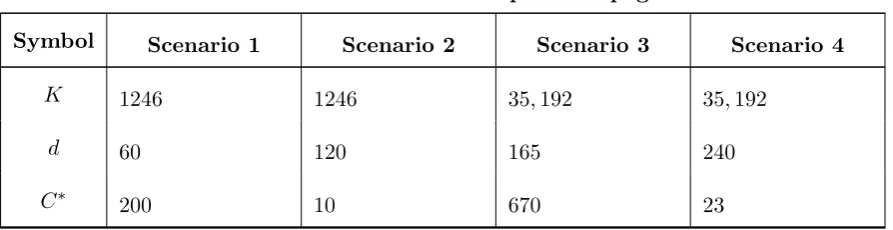
One way to interpret this is that an adversary gets resources equivalent toθmhonest users “for free”, but any more powerful adversary has multiplicative advantage bounded by
C∗= b
(b−1)(12−ηV)−bηE !
+ 1
(recall that an honest user must solve, in expectation, d PPEs during the protocol execution, so an adversary more powerful than that must havea > θmd).
Proof. As we discussed at the beginning of the section, there are two ways for the pollster to affect the vote count:
1. By possibly controlling some of the nodes.
2. By replacing or deleting the votes of honest participants.
For the latter, the bound relies on the security of the signature scheme and on the local verification of honest parties. In fact, the signature scheme ensures that the adversary cannot modify responses (with ayi6=⊥) (since that would require forging a signature compatible with
the node’s verification key). Thus, the local verification of honest nodes will catch the adversary deleting or completely replacing nodes; Global verification fails whenever more thenθmnodes complain—thus, the number of deleted/replaced nodes in a successful protocol execution can be at mostθm.
It is left to show that if the number of controlled nodes is higher than B, then global verification will fail. The proof proceeds as follow:
• Using Lemma 4.2 and Lemma 4.3 we prove thatGp is LSE with high probability.
• We will then have an lower bound on the number crossing edges between a possible set of bad nodes and the set of honest nodes.
3
• We conclude by noticing that the pollster, in order to control a set of nodes larger than
B, would have had to succeeded in more thanaPPEs involving honest participants.
LetF denote the nodes inGp corresponding to voters that have failed more thanηEdPPEs.
It must be that|F| ≤ηVm, otherwise the verification procedure would fail. LetB andH denote
the set of bad and honest nodes, respectively, that have not been labeled as “deleted”. Thus
B, H and F are disjoint sets whose union is V. That is, since we have a total of m nodes, if
|B|=x then |H|=m−x− |F|. Recall that a successful PPE corresponds to an edge in Gp.
Thus, a lower bound on the number of edges in Gp between the sets B and H translates to a
lower bound on the number of PPEs in which the adversary must have succeeded, and hence on the number of oracle calls made by the adversary.
Note that from Lemma 4.2, we know that Gc is (K, ηVm,b−b1p)-LSE with probability at
least 1−2κ. Thus, from Lemma 4.3, we can conclude that, with probability at least 1−2κ,Gp
is (K, ηVm,b−b1p−m−2η2EηVdm)-LSE. Wlog assume
|B|< m/2 and |B| ≥max
(
K, b
(b−1)(12 −ηV)−bηE !
a d
)
(the case|H|< m/2 is analogous, using|H| ≥(α−ηV)m≥K). Then, we get:
|e(B, H)|>|B||H|
b−1
b p−
2ηEd
m−2ηVm
≥ |B|(m− |B| −ηVm)
(b−1)d(1−2ηV)−2bdηE
mb(1−2ηV)
≥
2b
(b−1)(1−2ηV)−2bηE
a d
m
2 −ηVm
(b−1)d(1−2ηV)−2bdηE
mb(1−2ηV)
=
2b
(b−1)(1−2ηV)−2bηE
a d
m(1−2ηV)
2
d[(b−1)(1−2ηV)−2bηE]
mb(1−2ηV)
=a
Thus, with probability at least 1−2κ, |e(B, H)| > a which contradicts the assumption of the adversary being limited toasuccessful PPEs.
Therefore, the number of votes controlled by a pollster that investsaeffort oracle calls must be lower than max{K,
b
(b−1)(12−ηV)−bηE
a
d}+θm, as wanted.
5
Completeness
It is now left to show that in the case of an honest pollster, the verification procedure will succeed with overwhelming probability. Even when dealing with an honest pollster, we still need to take into account the possibility that malicious voters might try to force the verification to fail. This can be done by registering for the poll but aborting in all the PPE executions. Such a strategy will force the verification procedure to label the node asdeleted and all its edges asfailing. It will thus increase the number ofdeleted nodes which, for the verification to output
accept, needs to be smaller thanηVm.
the verification procedure, in case of an honest pollster, to output acceptwith probability at least (1−2κ).
To prove the main theorem of this section, we will require the following lemma (whose proof is below):
Lemma 5.1. Assuming static corruption, the probability that malicious responders with a θm
bound on effort (in total) can controlmax{3θmd,3κ}edges in the certification graph is bounded by e−κ.
Theorem 5.2 (Completeness). Let θmdenote the maximum number of effort oracle calls that can be made by malicious responders and
ηVmin=θ+3·max
κ
md, θ
ηE
+ 2σ
ηE
1 + max
2, 2κ mdσ
If the pollster follows the protocol honestly, ηE >0 and ηV ≥ηVmin then the probability that
the verification procedure outputs acceptis at least 1−2−κ.
We note that for non-trivial soundness, the values ofηE andηV are further constrained. See
Appendix C for a discussion on choosing the parameters.
Proof. Let G(m, p) = (V, E), with p = d/m, be the random graph generated by the pollster. Recall that an edge (i, j) is labeled as failing whenever the PPE between i and j fails. We denote by σ the probability that such an event occurs between honest voters. Moreover,ηE is
the highest fraction of PPEs that can fail before a node/voter gets labeled as deleted, and ηV
is the maximal fraction of deleted nodes accepted by the verification procedure.
Let Xi,j denote the indicator random variable for the event “(i, j) ∈ E is a failing edge”.
Note that, if iand j are both honest, the Xi,j’s are independent and P r[Xi,j = 1] = σp. Let
X=P i∈V
P
j∈V Xi,j. Then,E[X] =m2σp=mdσ and X denotes the number of failing edges
in the graph. Since each edge affect 2 nodes, 2X is actually the cardinality of the set containing (with repetitions) all the nodes affected by failing X edges. Note that for a node to be labeled as deleted, such a node needs to be connected to at leastdηE failing edges, which means that
such a node has been counted at leastdηE times in 2X. Thus, the expected number of deleted
nodes in case of honest responders is bounded by 2X/dηE. Now, in our analysis, we need to
take into account that, in the worst case scenario, there will beθmnodes maliciously controlled who will intentionally fail all their PPE’s. Therefore, we will have to account for the following:
1. The malicious nodes (which are θm) will be failing nodes;
2. Enough bad edges will cause an honest node to be marked deleted. However, by Lemma 5.1, with high probability the malicious responders cannot affect more than 3·max{κ, θmd}
honest edges. Which means that at most another 3·max{κ/d, θm}/ηE nodes can be
“forced” to be labeled as deleted.
To conclude, we want to prove that the probability that dη2X
E +θm+ 3θm
ηE is greater than
ηVm is negligible. Let ηV =θ+ η3θ
E + 2σ
ηE(1 +δ). (we will setδ below.) Then,
Pr
2X dηE
+θm+3θm
ηE
> ηVm
= Pr
2X dηE
> 2σ ηE
(1 +δ)m
= Pr [X >(1 +δ)mdσ]
By the Chernoff Bound,
Pr [X >(1 +δ)mdσ]≤exp
− δ
2
2 +δmdσ
Setting δ= max
We conclude by proving Lemma 5.1, as a corollary of the following claim:
Claim 5.3. Let S⊂V be an arbitrary set of vertices and denoteδ= max{2,2κ/(|S|d)}. Then
Pr [|{(i, j)∈E|i∈S}|>(1 +δ)d|S|]< e−κ
(i.e., the probability S has more than (1 +δ)d|S|edges is bounded by e−κ).
Proof. For every pair of vertices i, j∈V, letXi,j be the indicator variable for the event (i, j)∈
E. By definition,E[Xi,j] =p. DenoteX=Pi∈S
j∈V Xi,jthe number of edges adjacent toS. Then
E[X] =mp|S|=d|S|. By Chernoff,
Pr [Xi >(1 +δ)d|S|]≤exp
− δ
2/δ+ 1d|S|
≤exp
−δ
2d|S|
= exp{−κ}
Proof of Lemma 5.1. Since the pollster randomly shuffles the nodes in the certification path during the registration phase, any set of responders is assigned a random set of nodes in the certification graph. By symmetry, we can consider the probability for any specific set of size
θm. The result follows by setting|S|=θmin Claim 5.3.
6
Discussion and Open Questions
General Verifiable Computation Among Anonymous Participants While we state our main results in terms of polling, the security guarantee we give is that the final published graph does not contain too many “bad” nodes. It may be possible to leverage this technique for doing more general computations, where the edges in the graph correspond to a private computation between two parties, and the final goal is a joint, publicly-verifiable computation (in this case, the “responses” might be some intermediate public values of the computation).
Parallel and Distributed Verification The verification procedure in our protocol is highly parallelizable: each responder must verify three properties, each of which can be done by reading only a small part of the graph:
• that her own node was correctly published on the bulletin-board (requires O(m) evalua-tions of the hash function, but only O(d) communication),
• that the total number of deleted nodes was small (requires reading a small list of nodes),
• and that no edges were missed (this is a local property of each potential edge that can be computed from the node labels and the size of the graph).
The only non-local part in the verification is the aggregation of the results from all the nodes. However, by publishing a small amount of additional information, this computation can be distributed as well. Given an aggregation tree, where each node aggregates the results from its children, a verifier can check a single local neighborhood and a path from that neighborhood to the root in the tree. Thus, if we can assume that enough honest responders will participate in verification, the total amount communication for each responder can be made logarithmic in the size of the graph.
Improving Efficiency by Using Hypergraphs. Our bound on the degree of the graph may be slightly high for some uses of the protocol. However, we can extend the PPE definition to a multi-party setting, in which several parties certify each other simultaneously (e.g., using a multi-person chat, such as “Google Hangout” or “Skype”). This has the potential of significantly lowering the degree. Extending our protocol in this way may be an interesting direction for future work.
Improving Efficiency by Using Explicit Graphs. Our bound on the degree of the graph is for a randomly chosen graph. In particular, our soundness analysis includes the event that the chosen graph is not a good expander as a failure mode. Thus, we require the properties to hold for random graphswith overwhelming probability. However, it is fairly easy to prove that graphs with better parameters (e.g., lower degree for the same expansion rate)exist: if we have an explicit representation of such a graph, soundness will hold unconditionally.
References
[1] G. Ateniese, S. Kamara, and J. Katz. Proofs of storage from homomorphic identification protocols. InASIACRYPT, pages 319–333, 2009.
[2] B. Awerbuch and C. Scheideler. Group spreading: A protocol for provably secure dis-tributed name service. In J. D´ıaz, J. Karhum¨aki, A. Lepist¨o, and D. Sannella, editors,
ICALP, volume 3142 ofLecture Notes in Computer Science, pages 183–195. Springer, 2004.
[3] R. Canetti, S. Halevi, and M. Steiner. Mitigating dictionary attacks on password-protected local storage. In C. Dwork, editor,CRYPTO, volume 4117 of Lecture Notes in Computer Science, pages 160–179. Springer, 2006.
[4] D. Chaum. Untraceable electronic mail, return addresses, and digital pseudonyms. 24(2):84–88, 1981.
[5] D. Chaum. E-voting: Secret-ballot receipts: True voter-verifiable elections. 2(1):38–47, Jan./Feb. 2004.
[6] A. Cheng and E. Friedman. Sybilproof reputation mechanisms. InProceedings of the 2005 ACM SIGCOMM workshop on Economics of peer-to-peer systems, P2PECON ’05, pages 128–132, New York, NY, USA, 2005. ACM.
[7] G. Danezis and P. Mittal. Sybilinfer: Detecting sybil nodes using social networks. In
NDSS. The Internet Society, 2009.
[8] J. R. Douceur. The sybil attack. In P. Druschel, M. F. Kaashoek, and A. I. T. Row-stron, editors,IPTPS, volume 2429 of Lecture Notes in Computer Science, pages 251–260. Springer, 2002.
[9] C. M. Ellison. Establishing identity without certification authorities. In USENIX SSYM ’96, SSYM’96, page 7, Berkeley, CA, USA, 1996. USENIX Association.
[10] S. D. Kamvar, M. T. Schlosser, and H. Garcia-Molina. The eigentrust algorithm for repu-tation management in p2p networks. InWWW, pages 640–651, 2003.
[11] P. Krugman. Bits and barbarism. New York Times, Dec. 2013. http://www.nytimes. com/2013/12/23/opinion/krugman-bits-and-barbarism.html.
[12] R. Levien and A. Aiken. Attack-resistant trust metrics for public key certification. In
[13] B. N. Levine, C. Shields, and N. B. Margolin. A survey of solutions to the sybil attack. Tech Report 2006-052, University of Massachusetts Amherst, Amherst, MA, October 2006.
[14] T. Moran and M. Naor. Polling with physical envelopes: A rigorous analysis of a human-centric protocol. In S. Vaudenay, editor,Eurocrypt 2006, volume 4004 ofLecture Notes in Computer Science, pages 88–108. Springer-Verlag, May 2006.
[15] S. Nakamoto. Bitcoin: A peer-to-peer electronic cash system, May 2009.
[16] C. A. Neff. Practical high certainty intent verification for encrypted votes, October 2004.
http://www.votehere.net/vhti/documentation/vsv-2.0.3638.pdf.
[17] D. N. Tran, B. Min, J. Li, and L. Subramanian. Sybil-resilient online content voting. In J. Rexford and E. G. Sirer, editors,NSDI, pages 15–28. USENIX Association, 2009.
[18] L. Von Ahn, M. Blum, N. J. Hopper, and J. Langford. Captcha: Using hard ai problems for security. InAdvances in CryptologyEUROCRYPT 2003, pages 294–311. Springer, 2003.
[19] S. Warner. Randomized response: a survey technique for eliminating evasive answer bias.
Journal of the American Statistical Association, pages 63–69, 1965.
[20] H. Yu, P. B. Gibbons, M. Kaminsky, and F. Xiao. Sybillimit: A near-optimal social network defense against sybil attacks. IEEE/ACM Trans. Netw., 18(3):885–898, 2010.
[21] H. Yu, M. Kaminsky, P. B. Gibbons, and A. D. Flaxman. Sybilguard: defending against sybil attacks via social networks. Expanded Technical Report IRP-TR-06-01, Intel Research, Pittsburgh, Pittsburgh, PA, Jun 2006. http://www.pittsburgh. intel-research.net/people/gibbons/papers/sybilguard-tr.pdf.
A
Formal Protocol Description
A.1 Communication Model and Party Identities
Our protocol involves several different classes of participants. There is a single pollster, and multiple responders and verifiers (the same physical party may participate in the protocol in more than one role).
Since the main problem we are trying to solve with this protocol is lack of identity verifica-tion, we cannot assume that the identities of all parties are known in advance. To simplify the analysis, we will only assume that the pollster’s identity is publicly known.
Anonymous Channels and Network Addresses. To model the fact that the neither the pollster nor the honest parties know the identities of all the parties we will assume that all communication are over anonymous channels. To simplify analysis, we will only assume such channels between the pollster and every honest party (i.e., the communication graph is a star, with the pollster as the central node).
The pollster and all responders (modeled as ITMs) have one standard outgoing communi-cation tape and one standard incoming communicommuni-cation tape. Every honest party has a unique
network address in {0,1}∗ (the network address is given to the party as input). A message written to the outgoing communication tape by every party except for the pollster is copied to the pollster’s incoming communication tape. An honest party will always write messages of the form (addr, msg) to its outgoing communication tape, where addr is its network address. Every message written by the pollster to its outgoing communication tape is also parsed as an (addr, msg) tuple, and the message is copied to incoming communication tape of the honest party with network addressaddr(if one exists). Regardless of whetheraddris valid or not, the message is also copied to the adversary’s incoming communication tape.
This model allows two-way anonymous communication; Corrupt parties may write arbitrary source addresses (including using addresses allocated to the honest parties). Thus, the pollster cannot identify which party wrote the message (except by what is revealed from the contents of the message). Since a copy of every message is also sent to the adversary, sending a “fake” source address doesn’t prevent a malicious responder from two-way communication with the pollster.
When we describe communication between two responder parties (e.g., when the protocol instructs responder A to communicate with responder B), this is shorthand for their commu-nicating messages by passing them via the pollster. Although we omit this from the formal protocol description (to reduce clutter), this can be easily accomplished by adding a special header in the message that the honest pollster interprets as “forward to the specified address”; these messages are otherwise ignored by the honest pollster.
Broadcast Channel. In addition to point-to-point channels, we will assume a broadcast channel from the pollster to all the other parties. This is a special outgoing communication tape with corresponding incoming broadcast tapes for each other party; any message written by the pollster to the broadcast tape is copied to the incoming broadcast tapes of all parties. Verifiers have an incoming broadcast tape, but no standard incoming or outgoing tapes.
Complaint Channel. All parties have a special broadcast channel for “complaints”. This is used only in cases where the pollster misbehaves in a way that cannot be publicly detected by other honest parties (for example, if the pollster refuses to interact with an honest party, or omits its inputs from the final proof).
allow peer-to-peer communication (such as the Internet). Our protocol does not require any specific topology, as long as parties who need to can communicate—for example, the pollster can “introduce” every two parties who need to communicate (by giving them each other’s network addresses), and let them communicate directly. This can only improve soundness, since a malicious pollster will lose access to the communication between honest parties, so our soundness guarantees will continue to hold (and it has no effect on completeness, since the pollster doesn’t use its privileged position in the communication graph in any way except to pass messages).
A.2 Adversary and Corruption Model
We consider two types of adversaries: a malicious pollster (who attempts to violate the sound-ness guarantee) and malicious responders (who attempt to violate the completesound-ness guarantee).
Soundness. In the malicious pollster case, our adversarial model does not include corruption of responders: this is without loss of generality, since the pollster can create an arbitrary number of “fake” responders and control them completely (honest responders do not have any secret inputs, so there is no information to be gained by corrupting them). Thus, modeling “sybils” is natural in this model (the pollster just broadcasts additional identities). When we refer to “corrupt” parties, this is shorthand for identities that were created by the pollster in this way. We note that, since all communication is under the control of the pollster, the pollster can
perform message replay attacks as well as copy message contents but forge the originator (as long as the fake source of the message is a corrupt party—it can’t forge a signature for an honest party).
Completeness. In the malicious responder case, we can assume the pollster is honest (since a malicious pollster can always perform a denial-of-service attack by simply aborting). In this case, we can assume a single malicious responder, who creates an arbitrary number of fake identities (this is w.l.o.g. in the static corruption setting, since there are no secret inputs).
A.3 Full Protocol
We divide the protocol into six phases (as described in section 3). The formal protocol de-scription for each phase appears below. The phases are executed in order. In addition to the specified inputs, each party receives as input its view from the previous phases.
A.3.1 Common Elements
We make use of several elements common to all of the subprotocols.
Signature Scheme. In all of the subprotocols, we make use of a public-key signature scheme, (Gen, Sign, V er). denoting the key generation, signing algorithm and verification algorithm respectively. Gen(1κ) outputs a key pair (sk, vk). Sign(msg, sk) outputs a signature σ ∈ {0,1}∗, and V er(msg, σ, vk) outputs either 1 (ifσ is a valid signature onmsg with verification key vk) or 0 if not (if V er outputs one we say the signature isaccepted).
pollster can play man-in-the-middle between any pair of honest parties (however, the protocol will ensure that such an attack is not advantageous to the pollster).
Session identifiers, serial numbers and message validity. To prevent replay attacks, the pollster generates a unique session identifier sid as the first step of the protocol. A message between parties vksrc and vkdst is considered valid only if it begins with the tuple
(sid, vksrc, vkdst, serial, σ), where serial is the number of messages sent so far in session sid
betweenvksrc and vkdst, andσ is a valid signature under vksrc of the entire message contents,
including the initial header tuple (sid, vksrc, vkdst, serial).
Dealing with errors. At any point in the protocol, malicious parties may deviate from the honest execution. Any detected deviation is treated as if the deviating party aborted. For example, if partyAreceives an invalid message from partyB, it treats this as ifBaborted (and ignores any further messages from B).
Unless we explicitly say otherwise, the same holds for PPE verification (if parties A and B
engage in a PPE execution, and partyA did not successfully verify party B, it treats this as if
B has aborted).
Protocol 1Parameter Announcement
This protocol is executed by the pollster with inputs κ, questions, p:
1: (SK,V K)←Gen(1κ) // Generate pollster’s key pair
2: Broadcast (sid, κ, p, V K, questions) to all parties.
Protocol 2Registration
This protocol is between the pollster and every responder Ri. Every Ri receives as input addri
(its network address).
For every i∈ {1, . . . , m},Ri and the pollster execute:
1: (Responder Ri): (SKi,V Ki)←Gen(1κ) // Generate responder’s key pair
2: (Responder Ri): send (addri, V Ki) to pollster.
3: (Pollster and Ri): Engage in a one-sided PPE with identifier (sid, V Ki) (in which Ri is
the prover).
4: (Pollster): If verification was successful, add (addri, V Ki) to the responder list.
When the registration phase is completed:
1: (Pollster): Choose a random permutation π : [m] 7→ [m] and broadcast the shuffled list (V Kπ(1), . . . , V Kπm). // The shuffle is used only as defense against malicious responders;
to reduce clutter we ignore it except in the completeness proof; when we writeRi below we
actually mean Rπ(i).
2: (Responder Ri): Verify thatV Ki appears in the list. If not, broadcast a complaint.
B
Implementing PPEs, Extensions and Selective Polling
The peer-to-peer nature of PPEs seems to facilitate implementation with relatively simple mechanisms. Below we give several examples.
B.1 Bitcoin and Proofs of Storage
Protocol 3Responder Certification
This protocol is executed between every responder Ri and its neighbors in the certification
graph: Ni = {Rj|j ≤m, j 6=i, H(i, j)< p}. Note that Ni can be computed independently by
Ri given the public parameters H, pand the list (V K1, . . . , V Km). For responder Ri:
1: for allRj ∈Ni (concurrently)do
2: Engage in a PPE ΠE(Ri, Rj) with identifier (sid, V Kmin{i,j}, V Kmax{i,j}).
3: If ΠE(Ri, Rj) = 1,Ri computes σ←Sign(sid||V Kj, SKi) and sends σ toRj.
4: Let σj be corresponding the signature received fromRj
5: end for
6: LetGoodi ={σj|V er(sid||V Ki, σj, V Kj) = 1} be the set good signatures from neighbors.
Protocol 4Poll Response
This protocol is between is the pollster and every responderRi. Ri’s input in this phase is xi,
the answers to the poll questions. For every i∈ {1, . . . , m}:
1: Ri sends respi = (xi, Goodi, Sign(sid||xi||Goodi, SKi)) to the pollster.
Roughly, a PoS protocol allows the provider to prove to the client that it is still storing the file (can reconstruct the entire file), using a small amount of communication.
Since storage is a valuable resource, it is tempting to use proofs-of-storage as the “effort unit” in an effort-based polling scheme (e.g., one unit of effort could be storing 1GB of data for 1 day).
Moreover, publicly-verifiable proofs of storage have been constructed [1]—given a “public-key” generated for a specific file, anyone can verify that the PoS that the storage provider publishes for that file.
The problem here is that “backup” is a peer-to-peer concept. In particular, any solution must prevent malicious parties from sending each other “fake” data to store: e.g., they store a short seed instead of a large pseudorandom file generated by that seed.
However, the existing PoS protocols can be trivially used to construct a PPE: an honest user will send good (incompressible) files to its peers (e.g., by encrypting the file), and it can verify using the PoS that the files were stored as required. The soundness and completeness properties of this PPE are inherited directly from the PoS protocol, hence we can hope for almost perfect completeness and negligible soundness-error.
This implementation of PPEs may be most interesting in the context of Bitcoin. One of the strong arguments against the currency is the inherent waste of the Bitcoin protocol [11]; this is a direct consequence of using proof-of-work as the basis of its effort-based polling scheme. If we could replace proof-of-work with, for example, “proof-of-backup”, instead of generating heat as a side-effect, the Bitcoin network would function as a distributed backup system in addition to a currency.
Protocol 5Results and Proof
This protocol is executed by the pollster.
1: for alli∈ {1, . . . , m}do 2: Broadcast respi
Protocol 6Verification
This protocol is executed by the responders and verifiers
Local Verification. Executed by every responder. For every i∈ {1, . . . , m}:
1: verify that respi was published.
2: ifrespi was not published, broadcast a complaint.
Global Verification. Executed by every verifier. The verifiers receive θas a parameter.
1: SetbadN odes←0.
2: Setcomplaints←0.
3: Initialize an arraycount[] indexed by the poll answers.
4: for alli∈ {1, . . . , m}do
5: Verify that respi contains a valid signature from underV Ki
6: Verify that Goodi is valid (all signatures in it are valid).
7: if |Ni| − |Goodi|> ηEdthen
8: Incrementcount[xi]. // We don’t count nodes if they failed more than ηEdPPEs
9: else
10: IncrementbadN odes
11: end if
12: if Ri broadcast a complaintthen
13: Incrementcomplaints
14: end if
15: end for
16: if complaints > θmthen
17: Output ⊥ // Too many complaints
18: end if
19: if badN odes > ηVm then
20: Output ⊥ // Too many deleted nodes
21: end if
B.2 Human Interaction
The simplest type of PPE consists of human interaction: participants certify each other’s effort by simply talking with each other (e.g., using VOIP, video, or even textual chat). This is at least as hard to pass than a “real” Turing test (which consists solely of textual interaction), so its soundness properties seem to be very robust.
To prevent a proxying attack (in which Eve convinces Alice that she has expended effort by relaying Alice’s challenges to Bob and vice versa), the protocol can include Bob reading aloud his partner’s identity. Thus, to act as a person-in-the-middle, Eve would have to translate Bob saying Eve’s public key to Bob saying Alice’s public key, which seems like it would require some actual effort.
B.3 Symmetric CAPTCHAs
In this version of the PPE, each party generates a “real” CAPTCHA to be solved by the other party while simultaneously solving the CAPTCHA she received.
To prevent a proxying attack, we bind the CAPTCHA to the parties’ identities using a com-bination of cryptographic commitments and a Message Authentication Code (MAC). Define the CAPTCHA as a problem-generatorG(r) that given a random inputr generates a CAPTCHA
C along with its solution V.
1. When Bob generates a CAPTCHA for Alice, he chooses a secret MAC key and sets as the random input toGthe MAC of the pair of public keys (Alice,Bob). He sendsG(r) to Alice.
2. Alice solves C, and sends a commitment to her solution to Bob.
3. Bob then sends his secret MAC key to Alice.
4. Alice verifies that the challenge she received is correctly generated (i.e., bound to Alice and Bob’s public keys). If not, she aborts
5. Otherwise, Alice opens her commitment
6. Bob verifies that Alice correctly solved the challenge.
This protocol ensures that Eve can’t use Alice to solve Bob’s challenge to her, since Alice would refuse to open her commitment if she sees the CAPTCHA wasn’t meant for her. Note that in terms of the effort required, this is not harder than just solving a CAPTCHA—the rest of the protocol can be completely automated.
B.4 Leveraging Existing Social Networks
Instead of an online effort, a possible PPE implementation can use an existing social network (basing the “effort” on the assumption that becoming “well connected” in a social network is difficult). For example, two parties can verify that they have several short, vertex-disjoint paths between them in the social network (or use some other measure of distance for which the effort assumption seems reasonable).
In this version of the protocol, parties are not guaranteed anonymity (since they must reveal their identities in order to verify their distance in the social network), but the public transcript of the protocol does not reveal anything about their identities or their social-network neighborhood.