Efficient Padding Oracle Attacks on Cryptographic Hardware
?Romain Bardou1, Riccardo Focardi2??, Yusuke Kawamoto3? ? ?, Lorenzo Simionato2†, Graham Steel4? ? ?, and Joe-Kai Tsay5? ? ?
1 INRIA SecSI, LSV, CNRS & ENS-Cachan, France 2
DAIS, Universit`a Ca’ Foscari, Venezia, Italy 3 School of Computer Science, University of Birmingham, UK
4
INRIA Project ProSecCo, Paris, France 5 Department of Telematics, NTNU, Norway
Abstract. We show how to exploit the encrypted key import functions of a variety of different crypto-graphic devices to reveal the imported key. The attacks are padding oracle attacks, where error messages resulting from incorrectly padded plaintexts are used as a side channel. In the asymmetric encryption case, we modify and improve Bleichenbacher’s attack on RSA PKCS#1v1.5 padding, giving new cryptanalysis that allows us to carry out the ‘million message attack’ in a mean of 49 000 and median of 14 500 oracle calls in the case of cracking an unknown valid ciphertext under a 1024 bit key (the original algorithm takes a mean of 215 000 and a median of 163 000 in the same case). We show how implementation details of certain devices admit an attack that requires only 9 400 operations on average (3 800 median). For the symmetric case, we adapt Vaudenay’s CBC attack, which is already highly efficient. We demonstrate the vulnerabilities on a number of commercially available cryptographic devices, including security tokens, smartcards and the Estonian electronic ID card. The attacks are efficient enough to be practical: we give timing details for all the devices found to be vulnerable, showing how our optimisations make a qualita-tive difference to the practicality of the attack. We give mathematical analysis of the effecqualita-tiveness of the attacks, extensive empirical results, and a discussion of countermeasures and manufacturer reaction.
1
Introduction
Tamper-resistant cryptographic security devices such as smartcards, USB keys, and Hardware Security Modules (HSMs) are an increasingly common component of distributed systems deployed in insecure environments. Such a device must offer an API to the outside world that allows the keys stored on the device to be used for cryptographic functions and permits key management operations, but without compromising security. The most commonly used standard for designing cryptographic device interfaces, RSA PKCS#11 [28], is known to have vulnerabilities if the attacker is assumed to have access to the full API, and can therefore make attacks by combining commands in unexpected ways [4,5,7]. In this paper, we describe a different way to attack keys stored on the device using only decryption queries performed by a single function, usually the C UnwrapKey function for encrypted key import. These attacks are cryptanalytic rather than purely logical, and hence require multiple command calls to the interface, but the attacker only needs access to one seemingly innocuous command, subverting the typical countermeasure of introducing access control policies permitting only limited access to the interface.
We will show how theC UnwrapKeycommand from the PKCS#11 API is often implemented on commercially available devices in such a way that it offers a ‘padding oracle’, i.e. a side channel allowing him to see whether a decryption has succeeded or not. We give two varieties of the attack: the first for when the imported key is encrypted under a public key using RSA PKCS#1 v1.5 padding, which is still by far the most common and often the only available mechanism on the devices we obtained, and the second for when the key is encrypted under a symmetric key using CBC and PKCS#5 padding. The first attack is based on Bleichenbacher’s well-known attack [2]. Although commonly well-known as the ‘million message attack’, in practice Bleichenbacher’s attack requires only about 215 000 oracle calls on average against a 1024 bit modulus when the ciphertext under attack is known to be a valid PKCS#1 v1.5 block. This is however not efficient enough to be practical on low power devices such as smartcards which perform RSA operations rather slowly. We give a modified algorithm which
?Full version of a paper with the same title which appears atCRYPTO’12. ??
Work partially supported by the RAS ProjectTESLA: Techniques for Enforcing Security in Languages and Applica-tions
? ? ?
Work partially carried out while at INRIA SecSI, LSV, CNRS & ENS-Cachan, France
†
results in an attack which is 4 times faster on average than the original, with a median attack time over 10 times faster. We also show how the implementation details of some devices can be exploited to create stronger oracles, where our algorithm requires only 9400 mean (3800 median) calls to the oracle. At the heart of our techniques is a small but significant theorem that allows not just multiplication (as in the original attack) but also division to be used to manipulate a PKCS#1 v1.5 ciphertext and learn about the plaintext. In the second attack we use Vaudenay’s technique [30] which is already highly efficient. Countermeasures to such chosen ciphertext attacks are well known: one should use an encryption scheme proven to be secure against them. We discuss the availability of such modes in current cryptographic hardware and examine what other countermeasures could be used while such modes are still not available.
In summary, our contributions are the following: i) new results on PKCS#1 v1.5 cryptanalysis that, when combined with the ‘parallel threads’ technique of Klima-Pokorny-Rosa [29] (which on its own contributes a 38% improvement on mean and 52% on median) results in an improved version of Bleichenbacher’s algorithm giving a fourfold (respectively tenfold) improvement in mean (respectively median) attack time compared to the original algorithm (measured over 1000 runs with randomly generated 1024 bit RSA keys and randomly generated conforming plaintexts); ii) demonstration of the attacks on a variety of cryptographic hardware including USB security tokens, smartcards and the Estonian electronic ID card, where we found various implementations of the oracle, and adapted our algorithm to each one, resulting in attacks with as few as 9400 mean (3800 median) oracle calls on the most vulnerable devices; iii) analysis of the complexity of the attacks, empirical data, and manufacturer reaction.
In the next section, we describe the padding attacks relevant to this work and describe our modifications to Bleichenbacher’s algorithm. The results on commercial devices are described in section 3. We discuss counter-measures in section 4. Finally we conclude with a discussion of future work in section 5.
2
Padding Oracle Attacks
A padding oracle attack is a particular type of side channel attack where the attacker is assumed to have access to an oracle which returns true just when a chosen ciphertext corresponds to a correctly padded plaintext under a given scheme.
2.1 Bleichenbacher’s Attack
Bleichenbacher’s padding oracle attack, published in 1998, applies to RSA encryption with PKCS#1 v1.5 padding [2]. Letn, ebe an RSA public key anddbe the corresponding private key, i.e.n=pq anded≡1 (mod φ(n)). Let k be the byte length of n, so 28(k−1)≤n < 28k. Suppose we want to encrypt a plaintext blockP where P is l bytes long. Under PKCS#1 v1.5 we first generate a pseudorandom non-zero padding string PS which isk−3−lbytes long. We allowl to be at mostk−11, so there will be at least 8 bytes of padding. The block for encryption is now created as
0x00,0x02,PS,0x00, P
We call a correctly padded plaintext and a ciphertext that encrypts a correctly padded plaintext PKCS con-forming or justconforming. For the attack, imagine, as above, that the attacker has access to an oracle that tells him just when an encrypted block decrypts to give a conforming plaintext, and assume he is trying to obtain the messagem =cd mod n, wherec is an arbitrary integer. He is going to choose integers s, calculate c0 =c·se mod n and then send c0 to the padding oracle. If c0 is conforming then he learns that the first two bytes of m·sare 0x00,0x02. Hence, if we letB = 28(k−2), 2B ≤m·smod n <3B. The idea is to repeat the process for many values ofsuntil only a single plaintext is possible.
2.2 Improving the Bleichenbacher Attack
Let us first review in a little more detail the original attack algorithm. We are trying to obtain message m = cd mod n from ciphertext c. In step 1 (Blinding), we search for a random integer value s0 such that c(s0)emodnis conforming, by accessing the padding oracle. We let c0=c(so)emod nandm0= (c0)dmod n. Note that m0=ms0mod n. Thus, if we recoverm0 we can compute the targetmas m0(s0)−1mod n. If the target ciphertext is already conforming, we can set s0to 1 and skip this step.
we apply thesi we found to narrow the set of possible intervals Mi containing the value of the plaintext, and in step 4 we either compute the solution or jump back to step 2.
We are interested in improving step 2, i.e. the search forsi. We give step 2 of the original algorithm below, and omit the other steps (in the appendix we give our modified algorithm, of which step 1.a equals step 1 of the original algorithm, whereas steps 3 and 4 are unchanged from the original).
Step 2a Ifi = 1 (i.e. we are searching fors1), search for the smallest positive integer s1 ≥n/(3B) such that c0(s1)emod nis conforming. It can be shown that smaller values ofs1 never give a conforming ciphertext. Step 2b Ifi >1 and |Mi−1|>1, search for the smallest positive integersi > si−1 such thatc0(si)emod nis conforming.
Step 2c Ifi >1 and|Mi−1|= 1, i.e. Mi−1={[a, b]}, choose smallri, si such that
ri≥2bsi−1−2B
n and
2B+rin
b ≤si< 3B+rin
a
untilc0(si)emod nis conforming. Intuitively, the bounds forsiderive from the fact that we wantc0(si)emodn conforming, i.e. 2B ≤m0si−rin < 3B, for some ri, and from the assumptiona ≤m0 ≤ b. As explained in the original paper, the constraint on ri aims at dividing the remaining interval in half so to maximize search performance.
Some features of the algorithm’s behaviour were already known from the original paper. For example, step 2a/b will in general be executed only very few times (in roughly 90% of our trials, step 2b was executed a maximum of once, and in 32% of cases not at all). However, a lot of the expected calls are here, since each time we just search na¨ıvely for the nextsi, which takes an expected 1/Pr(P) calls wherePr(P) is the probability of a random ciphertext decrypting to give a conforming block. Step 2c, meanwhile, is highly efficient, but is only applicable if there is only one interval left. Furthermore it cannot be directly applied to the original interval
{2B,3B−1}(since the bound onri, si collapses and we end up with the same search as in step 2a). Based on this observation, we devised a new method for narrowing down the initial interval so that ‘step 2c-like’ reasoning could be applied to speed up the search fors1.
Trimming M0 First observe that as well as multiplying the value of the decrypted plaintext (mod n) by some integers, we can also divide it by an integertby multiplying the original ciphertext byt−emod n. Multiplication modulonis a group operation on (Zn)∗, so inverses are unique. If the original plaintext was divisible byt, the resultm0·t−1 mod nwill just be m0/t, otherwise it will be some other value in the group that we in general cannot predict without knowingm0. The following holds.
Proposition 1. Let u and t be two coprime positive integers such that u < 32t and t < 9B2n. If m0 and m0·
ut−1mod nare PKCS conforming, thenm0 is divisible by t.
Proof. We havem0u < m032t <3B32t < n. Thus,m0umod n=m0u. Letx=m0·ut−1modn. We knowx <3B since it is conforming. Thusxt <3Bt < nandxtmod n=xt. Now,xt=xtmod n=m0umodn=m0uwhich implies t dividesm0.
By Proposition 1, if we find coprime positive integers u and t, u < 32t and t < 9B2n such that for a PKCS conformingm0,m0·ut−1mod nis also conforming, then we know thatm0 is divisible bytandm0·ut−1mod n=m0ut. As a consequence
2B·t/u≤m0<3B·t/u.
Note that since we already know 2B≤m0<3Bwe can restrict our search totandusuch that 2/3< u/t <3/2. Given a fractionu/t in this range, and assuming m0 is uniformly distributed in the interval, we can calculate the probability that m0·u/t is also in [2B,3B−1] by first calculating the probability that t divides m0 and then the probability that it is in range: for 2/3 < u/t < 1 it is 1/t·(3−2·t/u) and for 1 < u/t < 3/2 it is 1/t·(3·t/u−2). Hence it is clear that fractions with smaller denominators are more likely to work, and that ushould be as close totas possible. We apply this by constructing a list of suitable fractionsu/t that we call ‘trimmers’. In practice, we use a few thousand trimmers and taket≤212 as the implementations typically satisfyn≥28k−1. For smallt we add all suitableu/t to the trimmer list, but fort >50 we add only (t−1)/t and (t+ 1)/t. This bound of 50 is a heuristic value found by experimentation, and is not necessarily optimal.
A large denominatortallows for a more efficient trimming. The trimming process can be thus optimised by taking successful trimming fractions u1/t1, . . . , un/tn, computing the lowest common multiplet0 oft1, . . . , tn, using this value as a denominator and then searching for the highest and lowest numerators uh, ul that imply a valid padding, giving 2B·t0/ul≤m <3B·t0/uh.
Skipping Holes In the original algorithm step 2a, the search for the firsts1starts at the valuedn/3Be. However, note that to be conforming we require in fact thatm·s≥n+ 2B. Since 3B−1≥mwe get (3B−1)s≥n+ 2B. So we can start with s = d(n+ 2B)/(3B−1)e. On its own this does not save us much: about 8000 queries depending on the exact value of the modulus. However, when we have already applied the trimming rule above to reduce the upper bound on M0 to some b, this translates immediately into a better start bound for s1 of (n+ 2B)/b.
Observe that in general for a successfuls we must have 2B ≤ms−jn <3B for some natural number j. Given that we have trimmed the first interval M0 to the range [a, b], this gives us a series of bounds
2B+jn b ≤s <
3B+jn a
Observe further that when
3B+jn a <
2B+ (j+ 1)n b
we have a ‘hole’ of values where a suitablescannot possibly be. When used in combination with the trimming rule, we found that we frequently obtain a list of many such holes. We use this list to skip out the holes during the search for the s1. Note that this is similar to the reasoning used to calculate s values in step 2c, except that here we are concerned with finding the smallest possible s1 in order to have the fewest possible intervals remaining when searching fors2. As we show in the results below, the combination of the trimming and hole skipping techniques is highly effective, in particular against more permissive oracles than a strict PKCS padding oracle.
2.3 Existing Optimisations
In addition to our original modifications, we also implemented changes proposed by Klima, Pokorny and Rosa (KPR) [29]. These are mainly aimed at improving performance in step 2b, because they were concerned with attacking a weaker oracle where most time was spent in step 2b (see below). They are therefore naturally complementary to our optimisation of step 2a.
Parallel thread method The parallel thread method consists of omitting step 2b in the case where there are several intervals in Mi−1, and instead forking a separate thread for each interval and using the method of step 2c to search forsi. As soon as one thread finds a hit, all threads are halted and the new intervals are calculated. If there is still more than one interval remaining, new threads are launched. In practice, since access to the oracle may not be parallelisable, the actions of each thread can be executed stepwise. This heuristic is quite powerful in practice, as we will see below.
Tighter bounds and Beta Method KPR were concerned with attacking the weaker ‘bad version’ oracle found in implementations of SSL patched against the original vulnerability. This meant that when the oracle succeeds, they could be sure of the length of the unpadded plaintext, since it must be the right length for the SSL ‘pre-master secret’. This allowed them to tighten the 2B and 3B−1 bounds. We also implemented this optimisation where possible, since it has no significant cost, but its effects are not significant. We implemented a further proposal of KPR, the so-called ‘Beta Method’ that we do not have space to describe here (see appendix A), but again found that it caused little improvement in practice.
2.4 Stronger and Weaker Oracles
against some specific value (e.g. 16 bytes for an encrypted AES-128 key). More precisely, we say an oracle is FFF if it returns true only on correctly padded plaintexts of a specific fixed length, like the the KPR ‘bad version’ oracle found in some old versions of SSL. An oracle is FFT if it returns true on a correctly padded plaintext of any length. This is the standard PKCS oracle used by Bleichenbacher. An oracle is FTT if it returns true on a correctly padded plaintext of any length and additionally on an otherwise correctly padded plaintext containing a zero in the eight byte padding. An oracle is TFT if if returns true on a correctly padded plaintext of any length and on plaintexts containing no 0s after the first byte. The most permissive oracle, TTT, returns true on any plaintext starting with0x00,0x02. We will see in the next section how all these oracles arise in practice. In Table 1, we show performance of the standard Bleichenbacher algorithm on these oracles, apart from FFF for which it is far too slow to obtain meaningful statistics. Attacking the strongest oracles TTT and TFT is substantially easier than the standard oracle. We can explain this by observing that for the original oracle, on a 1024 bit block, the probabilityPr(P) of a random ciphertext decrypting to give a conforming block is equal to the probability that the first two blocks are 0x00,0x02, the next 8 bytes are non-zero, and there is a zero somewhere after that. We letPr(A) be the probability that the first two bytes are0x00,0x02, i.ePr(A)≈2−16. We identify Pr(P|A), the probability of a ciphertext giving a valid plaintext provided the first two bytes are
0x00,0x02, i.e
255
256
8
. 1− 255
256
118!
≈0.358
Pr(P) is therefore 0.358·2−16. Bleichenbacher estimates that, if no blinding phase is required, the attack on a 128 byte plaintext will take
2/Pr(P) + 16·128/Pr(P|A)
oracle calls. So we have
(2·216+ 16·128)/Pr(P|A) = 371843
In the case of, say, the TTT oracle, Pr(P|A) is 1, since any block starting0x00,0x02 will be accepted. Hence we have
217+ 16·128 = 133120
oracle queries. This is higher than what we were able to achieve in practice in both cases, but the discrepancy is not surprising since the analysis Bleichenbacher uses is a heuristic approximation of the upper bound rather than the mean. However, it gives an explanation of why the powerful oracle gives such a big improvement in run times: improvements in the oracle to Pr(P|A) make a multiplicative difference to the run time. Additionally, the expected number of intervals at the end of step 2a isds1·B/ne[2, p. 7], so ifs1is less than 216, the expected number of intervals is one. For the FFT oracle, the expected value ofs1(calculated as 1/2·1/Pr(P)) is about 91 500, between 216 and 217, whereas for TTT it is 215. That means that in the TTT case we can often jump step 2b and go straight to step 2c, giving a total of
215+ 16·128 = 34816
i.e. the TTT oracle is about 10 times more powerful than the FFT oracle, which is fairly close to what we see in practice (our mean for FFT is about 5.5 times that for TTT).
In comparison, if the modulus is 2048 bit long, thenPr(P|A)≈0.599. Because the modulus is longer, the probability that 0x00 appears after the 8 non-zero bytes is higher than in the 1024 bit case. Furthermore, following the same argument as above, we obtain that the attack on a 2048 bit plaintext will take about 335 065 calls to the FFT oracle, fewer than in the 1024 bit case. Note however that RSA private key operations slow down by roughly a factor of four when key length is doubled.
2.5 Performance of the Modified Algorithm
Oracle Original algorithm Modified algorithm
Mean Median Mean Median Trimmers Mean skipped FFF - - 18 040 221 12 525 835 50 000 7 321
FFT 215 982 163 183 49 001 14 501 1 500 65 944 FTT 159 334 111 984 39 649 11 276 2 000 61 552
TFT 39 536 24 926 10 295 4 014 600 20 192
TTT 38 625 22 641 9 374 3 768 500 18 467
Table 1.Performance of the original and modified algorithms.
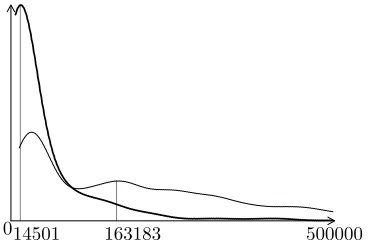
median). Note also that the trimming technique contributes more than just the oracle calls saved by the hole skipping, it also slightly improves performance on all subsequent stages of the algorithm. We know this because we can compare performance using only the parallel threads optimisation, where we obtain a mean of 113 667 and a median of 78 674 (on the FFT oracle). In Figure 1, we give the density distribution for 1000 runs of the original algorithm and our optimised algorithm on the classical FFT oracle, with medians marked. Notice the change in shape: we have a much thinner tail.
014501 163183 500000
Fig. 1.Graph comparing distribution of oracle calls for original (lower peak, thinner line) and optimised version of the algorithm on the FFT oracle. Median is marked for each.
2.6 Vaudenay’s Attack
Vaudenay’s attack on CBC mode symmetric-key encryption [30] is somewhat simpler and highly efficient. Recall first the operation of CBC mode [9]: given some block cipher with encryption, decryption functionsE(.), D(.) and a fixed block size of b bytes, suppose we want to encrypt a message P of lengthl =j·bfor some integer j, i.e.P =P1, . . . , Pj. In CBC mode, we first choose a fresh initialisation vector IV. The first encrypted block is defined as C1 = E(IV ⊕P1), and subsequent blocks as Ci = E(Ci−1⊕Pi). The need for padding arises because l is not always a multiple of b. Suppose l =j·b+r. Then we need to encrypt the lastrbytes of the message in ab bytes block in such a way that on decryption, we can recognise that only the first rbytes are to be considered part of the plaintext. One way to do this is the so-called RC5 padding, also known as PKCS padding and described in RFC 5652 [14]. The r bytes are encoded into the leftmost bytes of the final block, and then the finalb−rbytes are filled with the valueb−r. Under this padding scheme, if the plaintext length should happen to be an exact multiple of the block size, then we add a whole block of padding bytesb.
Since the original attack appeared, many variations have been found on other padding schemes and block cipher modes [1, 6, 17, 20, 23, 25]. Bond and French recently showed that the attack could be applied to the
C UnwrapKey command as implemented on a hardware security module (HSM) [3]. We will show in the next section that many cryptographic devices are indeed vulnerable to variants of the attack.
Device PKCS#11 PKCS#1 v1.5 Attack CBC-PAD Attack version Token Session Token Session
Aladdin eTokenPro 2.01 X X X X
Feitian ePass 2000 2.11 × × N/A N/A
Feitian ePass 3003 2.20 × × N/A N/A
Gemalto Cyberflex 2.01 X N/A N/A N/A
RSA Securid 800 2.20 X N/A N/A N/A
Safenet Ikey 2032 2.01 X X N/A N/A
SATA DKey 2.11 × × × ×
Siemens CardOS 2.11 X X N/A N/A
Table 2.Attack Results on Tokens
3
Attacking Real Devices
We applied the optimised versions of the attacks of Bleichenbacher and Vaudenay presented in section 2 to the unwrap functionality of PKCS#11 devices. RSA PKCS#11, which describes the ‘Cryptoki’ API for crypto-graphic hardware, was first published in 1995 (v1.0). The latest official version is v2.20 (2004) which runs to just under 400 pages [28]. Adoption of the standard is almost ubiquitous in commercial cryptographic tokens and smartcards, even if other additional interfaces are frequently offered. In a PKCS#11-based API, applications initiate asession with the cryptographic token, by supplying a PIN. Once a session is initiated, the application may access theobjects stored on the token, such as keys and certificates. Objects are referenced in the API via handles, which can be thought of as pointers to or names for the objects. In general, the value of the handle, e.g. for a secret key, does not reveal any information about the actual value of the key. Objects haveattributes, which may be bitstrings e.g. the value of a key, or Boolean flags signalling properties of the object, e.g. whether the key may be used for encryption (CKA ENCRYPT6), or for encrypting other keys, for signing, verification, and other uses. New objects can be created by calling a key generation command, or byunwrapping an encrypted key packet using the C UnwrapKey command, which takes a handle, a ciphertext and a template as input. A template is a partial description of the key to be imported, giving notably its length. The device attempts to decrypt the ciphertext using the key referred to by the handle. If it succeeds, it creates a new key on the device using the extracted plaintext and the template, and returns a new handle.
Observe that a padding check immediately following the decryption could give rise to an oracle that may be used to determine the value of the newly stored key. To test for such an oracle on a device, we create a key with the CKA UNWRAPattribute set to allow theC UnwrapKey operation, create encrypted key packets with deliberately placed padding errors, call the function on these ciphertexts and observe the return codes. For the case of asymmetric key unwrapping, constructing test ciphertexts is easy since the public key of the pair is always obtainable via a query to the PKCS#11 interface. For symmetric key unwrapping, it is not quite so trivial since the device may create unwrapping keys marked with the Boolean key attribute CKA SENSITIVE
which prevents them from being read via the PKCS#11 interface. In this case there are various tricks we can use: we can try to set the attributeCKA ENCRYPTand then use the PKCS#11 function C Encryptto construct the test packets if a suitable mode is available, or if the device does not allows this, we can explicitly try to create a key withCKA SENSITIVEset to false, assuming the same unwrap algorithm will be used as for sensitive keys. In the event, we were always able to find some way to do this with the devices under test.
6
3.1 Smartcards and Security Tokens
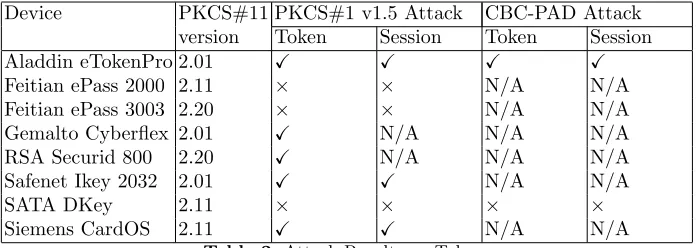
In Table 2 we give results from implementing the attacks on all the commercially available smartcards and USB tokens we were able to obtain that offer a PKCS#11 interface and support the unwrap operation. A tick means not only that we were able to construct a padding oracle, but that we were actually able to execute the attack and extract the correct encrypted key. A cross notes that the attack fails. We explain these failures below. Not applicable (N/A) means that the token did not support the cryptographic mechanisms and/or unwrap modes required for this attack. Note that relatively few devices support unwrap under symmetric key algorithms. We tested the attacks using both token keys and session keys for the unwrapping. The exact semantics of the difference between these key types is not completely clear from the standard: there is an attribute CKA TOKEN
which when set to true indicates a token key and when false indicates a session key. Session keys are destroyed when the session is ended, whereas token keys persist. However, we have noticed that devices often enforce very different policies for token keys and session keys, so it seemed pertinent to test both types.
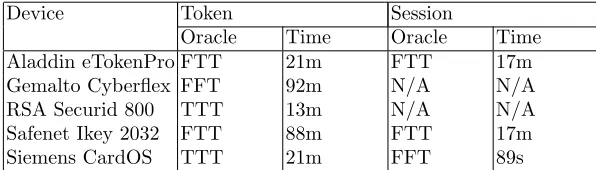
In Table 3 we give the class of padding oracle found in each device in the PKCS#1 v1.5 case. To obtain this table we construct padded plaintexts with a single padding error and observed the return code from the token (the exact return codes are in the appendix, Table 4). Note that we give separate entries for token and session keys in this table only when there is a difference in the device’s behaviour in the two cases. We report median attack time, computed from the results of table 1 and from a measure of the unwrap rate of the hardware. Notice how the tenfold improvement in median attack time of our modified algorithm makes attacks even against FFT oracles on slow devices quite practical. Unwrap calls using session keys are often many times faster than token keys though it is not clear why, unless perhaps these devices are carrying out session key operations in the driver software rather than on the card.
We will briefly discuss each line of Table 2 in turn. TheAladdin eToken Prosupports both unwrapping modes required, though the CBC PAD unwrap mode does not conform to the standard: a block containing a final byte of0x00 is accepted. According to the standard, if the final byte of the plaintext is zero and it falls at the end of a block, then an entire block of padding should be added (see section 2). This causes a small problem for the attack since it gives us an extra possibility for the last byte, but we easily adapted the attack to take account of this. The PKCS#1 v1.5 padding implementation ignores zeros in the first 8 bytes of the padding and gives a separate error when the length of the extracted key does not match the requested one (CKR TEMPLATE INCONSISTENT). Based on this we can build an FTT oracle. TheFeitiantokens do not support
CBC PAD modes. They also do not implement PKCS#1 v1.5 padding correctly as shown in Table 4: in our tests, any block with 0x02 in the second byte was accepted, except for very large values (e.g. for one key, anything between0x00and0xE2in the first byte was accepted). The result is that the attack does not succeed. TheGemalto Cyberflex smartcard does not allow unwrapping under symmetric keys. However, it seems to implement standard PKCS#1 v1.5 padding correctly, and the Bleichenbacher attack succeeds (FFT oracle, since the length is ignored). The RSA SecurIDdevice does not support unwrapping using symmetric keys, hence the Vaudenay attack is not possible. However, the Bleichenbacher attack works perfectly. In fact, the RSA token implements a perfect TTT oracle. The device also supports OAEP, but not in a way that prevents the attack (see next paragraph). TheSafenet ikey2032implements an asymmetric key unwrapping. The padding oracle derived is more accepting than the Bleichenbacher oracle since the 0s in the first 8 bytes of the padding string are ignored (FTT oracle). TheSATA DKey does not implement standard padding checks. InCBC PADmode, only the last byte is checked: it seems that as long as the last bytenis less than the number of bytes in a block, the padding is accepted and the final nbytes discarded. This means we cannot use the attack to recover the whole key, just the final byte. In PKCS#1 v1.5 mode, many incorrectly padded blocks were accepted, and we were unable to deduce the rationale. For example, any block with thefirst byte equal to0x02is accepted. The wide range of accepted blocks prevents the attack. The Siemens CardOS supports only unwrapping under asymmetric keys. The Bleichenbacher attack works perfectly: with token keys the oracle is TTT, while with session keys it is FFT.
Device Token Session
Oracle Time Oracle Time
Aladdin eTokenPro FTT 21m FTT 17m
Gemalto Cyberflex FFT 92m N/A N/A
RSA Securid 800 TTT 13m N/A N/A
Safenet Ikey 2032 FTT 88m FTT 17m
Siemens CardOS TTT 21m FFT 89s
Table 3.Oracle Details and Median Attack Times
is always set to the following mechanism list : CKM RSA PKCS, CKM RSA PKCS OAEP, and CKM RSA X 509.”. We created a key wrapped under OAEP and then performed Bleichenbacher’s attack on it using a PKCS#1 v1.5 unwrap oracle. The attack is only slightly complicated by the fact that the initial encrypted block does not yield a valid block when decrypted, requiring us to use the ‘blinding phase’ where many ciphertexts are derived form the original to obtain one that passes the padding oracle. In our tests this added only a few hundred seconds to the attack.
3.2 HSMs
Hardware Security Modules are widely used in banking and similar sectors where a large amount of cryptographic processing has to be done securely at high speed (verifying PIN numbers, signing transactions, etc.). A typical HSM retails for around 20 000 Euros hence is unfortunately too expensive for our laboratory budget. HSMs process RSA operations at considerable speed: over 1000 decryptions per second for 1024 bit keys. Even in the case of the FFF oracle, which requires 12 000 000 queries, this would result in a median attack time of 12 000 seconds, or just over three hours.
We hope to be able to give details of HSM testing soon.
3.3 Estonian ID Card
Estonia’s Citizenship and Migration Board completed the issuing of more than 1 million national electronic ID (eID) cards in 2006 [19]. The eID is the primary national identification document in Estonia and it is mandatory for all Estonian citizens and alien residents 15 years and older to have one [10]. The card contains two RSA key pairs [15]. One key pair is intended to be mainly used for authentication (e.g., for mutual authentication with TLS/SSL) but can also be used for encrypting and signing email (e.g., with S/MIME). The other key pair is attributed only to be used for digital signatures. Only this latter key pair can be used for legally binding digital signatures [19]. Since January 1, 2011, the eID cards contain 2048 bit RSA keys, therefore these cards comply with NIST’s recommendation [21]. However, cards issued before January 1, 2011 continue to use 1024 bit keys.
Attack Vector Unlike the cryptographic devices discussed above, the Estonian eID card does not allow the import of keys, so our attack here does not rely on the unwrap operation. Instead we consider attacks using the padding oracle provided by the decryption function of the DigiDoc software, part of the official ID software package developed by the Estonian Certification Center, Estonia’s only CA [11]. We note that the attack succeeds with any application that returns whether decryption with the eID card succeeds. Our experiments were conducted using the Java library of DigiDoc, calledJDigiDoc. DigiDoc encrypts data using a hybrid encryption scheme, where a 128-bit AES key is encrypted under a public key. First we tested the Estonian ID card’s decryption function using raw PKCS#11 calls and confirmed that it checks padding correctly. We then observed that with the default configuration, when attempting to decrypt, e.g., an encrypted email, JDigiDoc writes a log file of debug information that includes the padding errors for the 128-bit AES key that is encrypted under the public key. This behavior has been observed with JDigiDoc version 2.3.19, and the latest version (3.6.0.157) does not seem to change it. Any application built on JDigiDoc, that reveals whether decryption succeeds, e.g., by leaking the contents of the log file, provides an attacker with a suitable padding oracle. The information in JDigiDoc’s log file gives an attacker access to essentially an FFT oracle but with additional length information. The length information allows us to adjust the 2B and 3B−1 bounds used in the attack, though in our experiments this made little difference.
seconds, or about 27 hours to decrypt an arbitrary valid ciphertext. For ID cards using 1024 bit keys, each decryption should be four times faster, while 49 000 decryptions are required; therefore we estimate a time of about 41 700 seconds, or about 11 hours and 30 minutes to decrypt an arbitrary valid ciphertext. To forge a signature, we require, due to the extra blinding step, a mean of 109 000 oracle calls and a median of 69 000 oracle calls to get a valid signature on an arbitrary message, giving an expected time of 103 hours on a 2048 bit Estonian eID. On a card using 1024 bit keys, we require a mean of 203 000 calls and a median of 126 000 calls; therefore expect to sign an arbitrary message in around 48 hours.
4
Countermeasures
A general countermeasure to the Bleichenbacher and Vaudenay attacks has been well known for years: use authenticated encryption. There are no such modes for symmetric key encryption in the current version of PKCS#11, but version 2.30, which is still at the draft stage, includes GCM and CCM (mechanismsCKM AES GCM
and CKM AES CCM). While these modes have their critics [26], they do in theory provide secure authenticated encryption and hence could form the basis of secure symmetric key unwrap mechanisms. Unfortunately, in the current draft (v7), they are given only as modes for C Encrypt. Adoption of these modes for C UnwrapKey
would provide a great opportunity to give the option of specifying authenticated data along with the encrypted key to allow secure transfer of attributes between devices. This would greatly enhance the flexibility of secure configurations of PKCS#11. To prevent the Bleichenbacher attack one must simply switch to OAEP, which is already in the standard. PKCS#11 should follow PKCS#1’s long-held position of recommending OAEP exclusively for all new applications. Care must also be taken to remind developers not to allow the two modes to be used on the same key, as is the case in RSA’s own SecureID device. In fact, the minutes of the 2003 PKCS workshop suggest that there was a consensus to include the single mechanism recommendation in version 2.20 [24], but it does not appear in the final draft. Note that care must be taken when implementing OAEP as otherwise there may also be a padding oracle attack which is even more efficient than our modified Bleichenbacher attack [18], though we are yet to find such an oracle on a PKCS#11 device.
If unauthenticated unwrap modes need to be maintained for backwards compatibility reasons, there are various options available. For the CBC case, Black and Urtubia note that the 10∗padding, where the plaintext is followed by a single 1 bit and then only 0 bits until the end of the block, leaks no information from failed padding checks while still allowing length of the plaintext to be determined unambiguously [1]. Paterson and Watson suggest a refinement that additionally preserves a notion of indistinguishability, by ensuring that no padded blocks are invalid [22]. They also give appropriate security proofs for the two schemes. If PKCS#1 v1.5 needs to be maintained, we have seen that an implementation of the padding check that rejects anything other than a conforming plaintext containing a key of the correct length with a single error code gives the weakest possible (FFF) oracle. This may be enough for some applications, but one is well advised to remember the maxim that attacks only get better, never worse. An alternative approach would be to adopt ‘SSL style’ countermeasures, proceeding to import a randomly generated key in the case where a block contains invalid padding. However, this may not fix the hole: if an attacker is able to replay the same block and detect that two different keys have been imported, he knows there is a padding error. One could also decide to ignore padding errors completely and always import just the number of bytes corresponding to the size of the key required, but this looks dangerous: if the same block can be passed off as several different kinds of key, this might open the possibility of attacking weaker algorithms to obtain keys for stronger ones. Thus it seems clear that authenticated encryption is by far the superior solution.
We detail manufacturer responses in Appendix C. There is a broad spectrum: while some manufacturers offer mitigations and state a clear need to get authenticated encryption into the standard and adopted as soon as possible, others see their responsibility as ending as soon as they conform to the PKCS#11 standard, however vulnerable it might be.
5
Conclusions
We have demonstrated a modified version of the Bleichenbacher RSA PKCS#1 v1.5 attack that allows the ‘million message attack’ to be carried out in a few tens of thousands of messages in many cases. We have implemented and tested this and the Vaudenay CBC attack on a variety of contemporary cryptographic hard-ware, enabling us to determine the value of encrypted keys under import. We have shown that the way the
found devices for which our algorithm requires a median of only 3 800 oracle calls to determine the value of the imported key. Vulnerable devices include eID cards, smartcards and USB tokens.
Related work Most previous work on the security of PKCS#11 interfaces considers only attacks at the logical level, i.e. in the symbolic or Dolev-Yao model of cryptography [7, 8, 12, 13]. Clulow’s original assessment did discuss some cryptographic details, in particular a possible vulnerability if ‘raw’ unpadded RSA encryption is used to encrypt a symmetric key with a low public exponent (i.e. 3 [5,§3.3]). If e.g. a 128-bit symmetric key is right justified and left padded with 0s in a 1024 bit block and then raised to the power of 3, it will result in a value not greater than the modulus, hence the attacker only needs to calculate the cube root to crack the key. The tokens we tested all fix their public exponent at 65 537. Clulow notes that the private key unwrap operation includes a padding check [5,§3], but does not discuss the possibility of padding oracle attacks. Bond and French discussed a symmetric key unwrap oracle attack in a presentation at the 2010 API Analysis Workshop [3], though they did not reveal details of the hardware tested or discuss an asymmetric key version. Recently, Jager et al. showed that the Bleichenbacher attack can be used against XML encryption in many implementations [16]. Our optimisations could be applied directly to their setting to make their attacks more efficient.
While some theoreticians find the lack of a security proof sufficient grounds for rejecting a scheme, some practitioners find the absence of practical attacks sufficient grounds for continuing to use it. We hope that the new results with our modified algorithm will prompt editors to reconsider the inclusion of PKCS#1 v1.5 in contemporary standards such as PKCS#11 and XML encryption.
References
1. John Black and Hector Urtubia. Side-channel attacks on symmetric encryption schemes: The case for authenticated encryption. In Dan Boneh, editor,USENIX Security Symposium, pages 327–338. USENIX, 2002.
2. D. Bleichenbacher. Chosen ciphertext attacks against protocols based on the RSA encryption standard. InAdvances in Cryptology: Proceedings of CRYPTO ’98, volume 1462 ofLNCS, pages 1–12, 1998.
3. Mike Bond and George French. Hidden semantics: why? how? and what to do? Presentation at Fourth Analysis of Security APIs workshop (ASA-4), July 2010.
4. Matteo Bortolozzo, Matteo Centenaro, Riccardo Focardi, and Graham Steel. Attacking and fixing PKCS#11 security tokens. InProceedings of the 17th ACM Conference on Computer and Communications Security (CCS’10), Chicago, Illinois, USA, October 2010. ACM Press.
5. J. Clulow. On the security of PKCS#11. In5th International Workshop on Cryptographic Hardware and Embedded Systems (CHES 2003), pages 411–425, 2003.
6. Jean Paul Degabriele and Kenneth G. Paterson. On the (in)security of ipsec in mac-then-encrypt configurations. In Ehab Al-Shaer, Angelos D. Keromytis, and Vitaly Shmatikov, editors,ACM Conference on Computer and Commu-nications Security, pages 493–504. ACM, 2010.
7. S. Delaune, S. Kremer, and G. Steel. Formal analysis of PKCS#11. InProceedings of the 21st IEEE Computer Se-curity Foundations Symposium (CSF’08), pages 331–344, Pittsburgh, PA, USA, June 2008. IEEE Computer Society Press.
8. St´ephanie Delaune, Steve Kremer, and Graham Steel. Formal analysis of PKCS#11 and proprietary extensions.
Journal of Computer Security, 2009. To appear.
9. M. Dworkin. Recommendation for block cipher modes of operation: Modes and techniques. NIST Special Publication 800-38A, December 2001.
10. Estonian Certification Center. The estonian ID card and digital signature concept, principles and solutions. http: //www.id.ee/public/The_Estonian_ID_Card_and_Digital_Signature_Concept.pdf, March 2003.
11. Estonian Informatics Center. Estonian ID-software. https://installer.id.ee/?lang=eng.
12. Sibylle Fr¨oschle and Graham Steel. Analysing PKCS#11 key management APIs with unbounded fresh data. In Pierpaolo Degano and Luca Vigan`o, editors,Revised Selected Papers of the Joint Workshop on Automated Reasoning for Security Protocol Analysis and Issues in the Theory of Security (ARSPA-WITS’09), volume 5511 ofLecture Notes in Computer Science, pages 92–106, York, UK, August 2009. Springer.
13. Sibylle B. Fr¨oschle and Nils Sommer. Reasoning with past to prove PKCS#11 keys secure. In Pierpaolo Degano, Sandro Etalle, and Joshua D. Guttman, editors,Formal Aspects in Security and Trust, volume 6561 ofLecture Notes in Computer Science, pages 96–110. Springer, 2010.
14. R. Housley. Cryptographic Message Syntax (CMS). RFC 5652 (Standard), September 2009.
15. ID S¨usteemide AS. EstEID specification v2.01. http://www.id.ee/public/EstEID_Spetsifikatsioon_v2.01.pdf. 16. T. Jager, S. Schinzel, and J. Somorovsky. Bleichenbacher’s attack strikes again: breaking PKCS#1 v1.5 in XML
encryption. In17th European Symposium on Research in Computer Security (ESORICS), 2012. To appear. 17. T. Jager and J. Somorovsky. How to break XML encryption. In Proceedings of the 18th ACM Conference on
18. James Manger. A chosen ciphertext attack on RSA optimal asymmetric encryption padding (OAEP) as standardized in PKCS #1 v2.0. In Joe Kilian, editor,Advances in Cryptology CRYPTO 2001, volume 2139 ofLecture Notes in Computer Science, pages 230–238. Springer Berlin / Heidelberg, 2001.
19. Tarvi Martens. eID interoperability for PEGS, national profile estonia, European Commission’s IDABC programme. http://ec.europa.eu/idabc/en/document/6485/5938, November 2007.
20. Chris J. Mitchell. Error oracle attacks on CBC mode: Is there a future for CBC mode encryption? In J. et al. Zhou, editor,ISC 2005, number 3650 in LNCS, pages 244–258, 2005.
21. National Institute of Standards and Technology. NIST special publication 800-57, recommendation for key manage-ment. http://csrc.nist.gov/publications/PubsSPs.html, March 2007.
22. Kenneth G. Paterson and Gaven J. Watson. Immunising cbc mode against padding oracle attacks: A formal security treatment. In Rafail Ostrovsky, Roberto De Prisco, and Ivan Visconti, editors,SCN, volume 5229 ofLecture Notes in Computer Science, pages 340–357. Springer, 2008.
23. K.G. Paterson and A. Yau. Padding oracle attacks on the ISO CBC mode encryption standard. In T. Okamoto, editor,RSA ’04 Cryptography Track, number 2964 in LNCS, pages 305–323. Springer, 2004.
24. Minutes from the April, 2003 PKCS workshop. Available atftp://ftp.rsa.com/pub/pkcs/03workshop/minutes. txt, 2003.
25. Juliano Rizzo and Thai Duong. Practical padding oracle attacks. InProceedings of the 4th USENIX conference on Offensive technologies, WOOT’10, pages 1–8, Berkeley, CA, USA, 2010. USENIX Association.
26. Phillip Rogaway. Evaluation of some blockcipher modes of operation. http://www.cs.ucdavis.edu/~rogaway, February 2011. Evaluation carried out for the Cryptography Research and Evaluation Committees (CRYPTREC) for the Government of Japan.
27. RSA Security Inc., v2.1. PKCS #1: RSA Cryptography Standard, June 2002.
28. RSA Security Inc., v2.20. PKCS #11: Cryptographic Token Interface Standard., June 2004.
29. T. Rosa V. Klima, O. Pokorny. Attacking RSA-based sessions in SSL/TLS. In 5th International Workshop on Cryptographic Hardware and Embedded Systems (CHES 2003), pages 426 – 440. Springer-Verlag, 2003.
30. Serge Vaudenay. Security flaws induced by CBC padding - applications to SSL, IPSEC, WTLS ... In Lars R. Knudsen, editor,EUROCRYPT, volume 2332 ofLecture Notes in Computer Science, pages 534–546. Springer, 2002.
A
Modified Bleichenbacher Algorithm
We present the algorithm of the optimised Bleichenbacher attack. It incorporates existing and new optimisations as presented in section 2.2. Notation is as before.
Step 1 - Initialization
Step 1.a - Blinding For an integerc, choose different random integerss0 and check whether c·(s0)emod nis PKCS conforming, by accessing the padding oracle. (Ifcmodnis conforming then chooses0←1 instead.) For the first successful values0, set c0←c·(s0)emod n, M0← {[2B,3B−1]},i←1.
Step 1.b - TrimmingM0 Generate pairs of coprime integers and, for each pair (u, t), check whetherc0uet−emod n is PKCS conforming. For successful pairs (u1, t1),(u2, t2), . . . ,(uq, tq), compute the lowest common multiple t0 oft1, t2, . . . , tq, search for the smallest integerumin and the largest integerumax such thatc0uemint0−emod n andc0uemaxt0−emodnare PKCS conforming. Set
a←2B·t0/umin b←(3B−1)·t0/umax M0← {[a, b]}.
Step 2 - Searching for PKCS conforming message
Step 2.a - Starting the search while Skipping Holes If i = 1, then search for the smallest positive integer s1 ≥ d(n+ 2B)/besuch thatc0·se1mod nis PKCS conforming. While searching for s1, skip all values s0 such that
(3B+jn)/a≤s0<(2B+ (j+ 1)n)/b
Step 2.b.i - Parallel Threads Method If|Mi−1| ≤Pmax7, then for each intervalIj∈Mi−1, start its own thread Tjfollowing Step 2.c, forj= 1,2, . . . ,|Mi−1|. The threadsTj take rounds making each one oracle call per round. If one of the threads finds asi such thatc0·sei mod nis PKCS conforming, then go to Step 3.
Step 2.b.ii - Beta Method 8If|Mi−1|> Pmax, then search for the smallest integer 2≤β≤βmax9 such that for
si←βsi−1−(β−1)s0 c0·se
i modnis PKCS conforming. If failed to findsi, go to Step 2.b.iii.
Step 2.b.iii - No optimisation If Step 2.b.ii failed, then search for the smallest integer si > si−1 such that c0·sei modnis PKCS conforming. If such a si is found, go to Step 3.
Step 2.c - Searching with one interval left If i > 1 and |Mi−1| = 1, i.e., Mi−1 = {[a, b]}, then choose small integers ri, si such that
ri≥2bsi−1−2B n 2B+rin
b ≤si< 3B+rin
a until c0·se
i modnis PKCS conforming.
Step 3 - Narrowing the set of solutions Aftersi is found, let
Mi←
[
(a,b,r)
max a,2B+rn
si
,min b,3B−1 +rn
si
for all [a, b]∈Mi−1 and asi−n3B+1 ≤r≤bsi−n2B.
Step 4 - Computing Solution If Mi = [a, a], then set m ← a(s0)−1 mod n, and return m as solution of m≡cdmodn. Otherwise, set i←i+ 1 and continue with Step 2.b or Step 2.c.
B
Actual Padding Errors Reported by Smartcards and USB Tokens
Table 4 reports actual padding errors returned by the devices we tested.
Device First byte Second byte0x00in first No0x00from Length not0x00 not0x02 8 bytes padding byte 3 to 128 incorrect
Aladdin eToken PRO 1 1 4 1 4
Feitian epass 2000 0 5 5 5 0
Feitian epass 3003 0 3 5 5 5
Gemalto Cyberflex 2 2 2 2 0
RSA SecureID 800 1 1 0 0 0
Safenet Ikey 2032 1 1 4 1 4
SATA Dkey (session) 1 0 5 5 1
SATA Dkey (token) 1 1 5 5 1
Siemens CardOS (session) 5 5 5 5 0
Siemens CardOS (token) 5 5 0 0 5
Table 4. Variations found on PKCS#1 v1.5 Padding Tests. Error 0 = CKR OK (key is imported), Error 1 = CKR ENCYRYPTED DATA INVALID, Error 2 = CKR WRAPPED KEY INVALID, Error 3 = CKR DATA LEN RANGE, Error 4= CKR TEMPLATE INCONSISTENT, Error 5 =CKR FUNCTION FAILED,CKR GENERAL ERROR,CKR DEVICE ERRORor similar.
7
In practice we takePmax= 40. 8
We did not use beta method for most experiments. (See section 2.5.) 9 In practice we takeβ
C
Manufacturer Reaction
We have notified all manufacturers of our findings in May 2011 and we summarize their reactions so far. SafeNet released a security bulletin confirming the vulnerability on eToken Pro, eToken Pro Smartcard, eToken NG-OTP, eToken NG-FLASH, iKey 2032 using Aladdin eToken PKI Client or SafeNet Authentication Client software. As a workaround they suggest to use SafeNet Authentication Client 8.0 or later to enable PKCS#1 v2.1 padding for RSA and to avoid wrapping symmetric keys using other symmetric keys. They plan enhancements in their products for enabling symmetric keys wrapping with other symmetric keys using GCM and CCM modes of operation (discussed in section 4). They also plan to add a key wrapping policy that enforces the usage of only GCM and CCM modes of operation for symmetric encryption, and PKCS#1 v2.1 padding for RSA encryption.
RSA recognises that an attacker can obtain the corresponding plaintext through a padding oracle attack against RSA SecureID faster than would be possible with standard Bleichenbacher attack. They however claim that “this attack is unnecessary since the prerequisites to the attack are already enough to call C UnwrapKey
and C GetAttributeValue and receive the same plaintext”. Instead, they regard these flaws as incomplete compliance with the standard and they are planning to fix this in version 3.5.4 of the middleware. It is not clear if the firmware on the device will be fixed. Our perspective is that (1) full compliance with the standard would only slow down the attacks and not prevent them; (2) the attacker could have indirect attacks to the unwrapping functionality without accessing other functionalities such as C GetAttributeValue and without knowing the PIN, e.g. though a network protocol
Siemens has also recognised the flaws and we have been informally told that they have fixed the verification of the padding and added a check of the obtained plaintext with respect to the given key template in the most recent version. Additionally, CardOS is no longer a product of Siemens. Due to the merge of Atos Origin and Siemens IT Solutions, the new product owner is Atos.
Gemalto did not respond to our initial vulnerability report but at the time of writing were investigating the issue.