New Blockcipher Modes of Operation with
Beyond the Birthday Bound Security
∗Tetsu Iwata May 20, 2006
Department of Computational Science and Engineering, Nagoya University
Furo-cho, Chikusa-ku, Nagoya, 464-8603, Japan
http://www.nuee.nagoya-u.ac.jp/labs/tiwata/
Abstract
In this paper, we define and analyze a new blockcipher mode of operation for encryption, CENC, which stands for Cipher-based ENCryption. CENC has the fol-lowing advantages: (1) beyond the birthday bound security, (2) security proofs with the standard PRP assumption, (3) highly efficient, (4) single blockcipher key, (5) fully parallelizable, (6) allows precomputation of keystream, and (7) allows random access. CENC is based on the new construction of “from PRPs to PRF conver-sion,” which is of independent interest. Based on CENC and a universal hash-based MAC (Wegman-Carter MAC), we also define a new authenticated-encryption with associated-data scheme, CHM, which stands for CENC with Hash-based MAC. The security of CHM is also beyond the birthday bound.
∗An extended abstract of this paper appears inFast Software Encryption, FSE 2006 [11]. This is the
Contents
1 Introduction 3
2 Preliminaries 5
3 The Basic Tool: A New Pseudorandom Function F 6
4 A Relaxed Version F+ 8
5 CENC: Cipher-based ENCryption 9
6 Security of CENC 11
7 CHM: CENC with Hash-based MAC 13
8 Security of CHM 15
9 Security Proofs of CHM 17
10 Discussions 24
Acknowledgement 24
1
Introduction
A blockcipher mode of operation, or a mode for short, is an algorithm that provides security goals, such as privacy and/or authenticity, based on blockciphers. The mode for privacy is called an encryption mode.
Of many encryption modes, counter (CTR) mode has a number of desirable advan-tages, and it works as follows. LetEbe a blockcipher whose block length isnbits, and let ctr be an n-bit counter. For a plaintext M = (M0, . . . , Ml−1) broken into n-bit blocks,
let
Ci ←Mi⊕Si, whereSi ←EK(ctr+i) for 0≤i≤l−1,
ctr←ctr+l.
The ciphertext is C = (C0, . . . , Cl−1), andS = (S0, . . . , Sl−1) is the keystream.
Starting from [3], provable security (or reduction-based security) is the standard se-curity goal for modes. For encryption modes, we consider the strong sese-curity notion of privacy called “indistinguishability from random strings” from [23], which provably im-plies the more standard notions given in [1]. In this strong notion, the adversary is in the adaptive chosen plaintext attack scenario, and the goal is to distinguish the cipher-text from the random string of the same length (where ctris not considered part of the ciphertext).
For CTR mode, Bellare, Desai, Jokipii and Rogaway were the first who presented the proof of security [1]. The nonce-based treatment of CTR mode was presented by Rogaway [21]. It was proved that, for any adversary against CTR mode, the success probability is at most 0.5σ(σ −1)/2n under the assumption that the blockcipher is a secure pseudorandom permutation (PRP), whereσ denotes the total ciphertext length in blocks that the adversary obtains. This is the well-known birthday bound.
The above analysis is tight. There is an adversary that meets the security bound within a constant factor. The adversary simply searches for a collision in the keystream of σ blocks, and guesses the data is the true ciphertext iff there is no collision. It is easy to show that the success probability is at least 0.3σ(σ−1)/2n. This implies that, as long asEK(·) is a permutation, there is no hope that CTR mode achieves beyond the birthday
bound security.
In this paper, we design a new blockcipher mode of operation for encryption. The goals are: (1) beyond the birthday bound security, (2) security proofs with the standard PRP assumption, (3) highly efficient, (4) single blockcipher key, (5) fully parallelizable, (6) allows precomputation of keystream, and (7) allows random access. The original CTR mode achieves all the above goals except for the first one, while we improve the security of CTR mode without breaking its important advantages. As for the security assumption, we do not use the ideal blockcipher model. For efficiency, the number of blockcipher calls is close to CTR mode, and we avoid using any heavy operations, e.g., re-keying.
et. al., and they also considered the order construction [10]. Lucks [16] and Bellare and Impagriazzo [2] independently analyzed the construction GK(x) = EK(x0)⊕EK(x1), where x ∈ {0,1}n−1. Lucks also considered a more generalized construction where d
blockciphers are xor’ed to output ann-bit block, and a multiple key version,GK1,K2(x) =
EK1(x)⊕EK2(x), where x∈ {0,1}n [16].
By using these constructions in CTR mode, it is possible to construct encryption modes with beyond the birthday bound. However, there is a significant restriction in efficiency, and/or it breaks several important advantages of the original CTR mode. For example, if the construction from [4] is used, we need the ideal blockcipher model for security proofs and have the efficiency problem for re-keying. The constructions from [10] are not very efficient and the truncation construction has relatively small security im-provement. If GK(x) = EK(x0)⊕EK(x1) is used, 2l blockcipher calls are needed to
encryptlplaintext blocks. We see that the main reason for inefficiency is that the output size of these PRFs is one block (or less).
To achieve beyond the birthday bound security, we first show a new “from PRPs to PRF conversion,” where the output size of the new PRF is larger than the block size. In particular, our PRF outputs w blocks at a time by using w+ 1 blockcipher calls. The parameter, w, is called a frame width, and one frame is equivalent tonw bits. The frame width, w, can be any fixed positive integer. We prove that the adversary’s success probability is at mostwσ3/22n−3+wσ/2n, whereσ is the total number of blocks that the adversary obtains.
Based on the PRF, we show a new encryption mode with beyond the birthday bound security. The new mode is called CENC, which stands for Cipher-based ENCryption. CENC calls l+l/w blockciphers to encrypt l plaintext blocks, and the default value is
w= 28, i.e., we needl+l/256blockcipher calls to encryptlplaintext blocks. Notice that,
with the AES (n= 128), one frame corresponds tonwbits, which is 128×256 = 4KBytes, and almost all the traffic on the Internet fits in one frame [8]. This implies we need
l+ 1 blockcipher calls for these short data, i.e., the cost is one blockcipher call per data compared to CTR mode. As for the security, with w = 28 and the AES, the security bound of CENC is ˆσ3/2248+ ˆσ/2121, where ˆσ is (roughly) the total number of blocks that the adversary obtains. The security of CENC is beyond the birthday bound with the standard PRP assumption. Besides, CENC has desirable advantages of CTR mode. It uses single blockcipher key, it is fully parallelizable, allows precomputation of keystream, and random access is possible.
2
Preliminaries
Notation. Ifx is a string then |x|denotes its length in bits. Ifx and y are two equal-length strings, then x⊕y denotes the xor of x and y. Ifx and y are strings, then xy
denotes their concatenation. Let x ← y denote the assignment of y to x. If X is a set, let x←R X denote the process of uniformly selecting at random an element from X and assigning it to x. For a positive integer n, {0,1}n is the set of all strings of n bits. For positive integers n and w, ({0,1}n)w is the set of all strings of nw bits, and {0,1}∗ is the set of all strings (including the empty string). For positive integers n and m such that n ≤ 2m −1, [n]m is the m-bit binary representation of n. For a bit string x and a positive integer n such that |x| ≥ n,first(n, x) and last(n, x) denote the first n bits of
x and the last n bits of x, respectively. For a positive integer n, 0n and 1n denote the
n-times repetition of 0 and 1, respectively.
Blockciphers and function families. The blockcipher (permutation family) is a func-tion E :K × {0,1}n → {0,1}n, where, for any K ∈ K, E(K,·) =EK(·) is a permutation on{0,1}n. The positive integernis the block length and ann-bit string is called a block. If K={0,1}k, thenk is the key length.
The PRP notion for blockciphers was introduced in [18] and later made concrete in [3]. Let Perm(n) denote the set of all permutations on{0,1}n. This set can be regarded as a blockcipher by considering that each permutation is specified by a unique string.
P is a random permutation if P ←R Perm(n). An adversary is a probabilistic algorithm (a program) with access to one or more oracles. Let A be an adversary with access to an oracle, either the encryption oracle EK(·) or a random permutation oracle P(·), and
returns a bit. We say A is aPRP-adversary forE, and we define
AdvprpE (A)def= Pr(K ← KR :AEK(·)= 1)−Pr(P ←R Perm(n) : AP(·)= 1).
Similarly, the function family is a functionF :K × {0,1}m → {0,1}n, where, for any
K ∈ K, F(K,·) = FK(·) is a function from {0,1}m to {0,1}n. Let Func(m, n) denote the set of all functions from {0,1}m to {0,1}n. This set can be regarded as a function family by considering that each function in Func(m, n) is specified by a unique string.
R is a random function if R ←R Func(m, n). Let A be an adversary with access to an oracle, either FK(·) or a random function oracle R(·), and returns a bit. We say A is a
PRF-adversary forF, and we define
AdvprfF (A)def= Pr(K← KR :AFK(·)= 1)−Pr(R←R Func(m, n) :AR(·)= 1).
For an adversary A, A’s running time is denoted by time(A). The running time is its actual running time (relative to some fixed RAM model of computation) and its description size (relative to some standard encoding of algorithms). The details of the big-O notation for the running time reference depend on the RAM model and the choice of encoding.
The frame, nonce, and counter. The modes described in this paper take a positive integerwas a parameter, and it is called a frame width. For fixed positive integerw(say,
?
EK
-?
EK
?
d
?
-L
?
EK
?
d
?
-L
?
EK
?
d
?
-L x00 x01 x10 x11
y[0] y[1] y[2]
Figure 1: Example illustration of F. In this example, w = 3,ω = 1 +log2w = 2, and
F :{0,1}k× {0,1}n−2 → ({0,1}n)3 where FK(x) = (y[0], y[1], y[2]). Herex ∈ {0,1}n−2,
y[0] =L⊕EK(x01), y[1] =L⊕EK(x10), y[2] =L⊕EK(x11), where L=EK(x00).
The length of the nonce is denoted by nonce, and it is at most the block length. We also
use an n-bit string called a counter, ctr. This value is initialized based on the value of the nonce, then it is incremented after each blockcipher invocations. The function for increment is denoted byinc(·). It takes an n-bit stringx(possibly a counter) and returns the incremented x. We assume inc(x) =x+ 1 mod 2n, but other implementations also work, e.g., with LFSRs if x = 0n. For i > 0, inci(ctr) means ctr is incremented for i
times. Since the value is initialized based on the value of the nonce, there is no need to maintain this value across the massages.
3
The Basic Tool: A New Pseudorandom Function
F
In this section, we define a new function familyF. It takes two parameters, a blockcipher, and a frame width.
Fix the blockcipher E :{0,1}k× {0,1}n → {0,1}n, and the frame width w. Define
ω = 1 + log2w, i.e., we need ω bits to represent w. Now we define the function family F :{0,1}k× {0,1}n−ω →({0,1}n)w as FK(x) = (y[0], . . . , y[w−1]), where y[i] =
L⊕EK(inci+1(x[0]ω)) fori= 0, . . . , w−1 andL=EK(x[0]ω). We call L a mask. See
Figure 1 for an example.
We have the following information theoretic result onF.
Theorem 1 Let Perm(n) andw be the parameters for F. Let Abe a PRF-adversary for
F making at most q oracle queries. Then
AdvprfF (A) ≤(w+ 1)
4q3
22n+1 +
w(w+ 1)q
2n+1 .
Notice that w is a constant and the security bound of Theorem 1 is “beyond the birthday bound.” Also, if we set σ = qw (i.e., the total number of blocks that the adversary obtains) and measure the security bound in terms ofσ, we have AdvprfF (A)≤
wσ3/22n−3+wσ/2n, since 1 +w≤2w.
The following definition is useful in proving Theorem 1.
Definition 1 Let x = (x0, . . . , xq−1) ∈({0,1}n−ω)q be an arbitrary (n−ω)q-bit string.
We say that “x is distinct,” if xi = xj for 0 ≤ i < j ≤ q −1. Similarly, let Y = (Y0, . . . , Yq−1) ∈ ({0,1}nw)q be an arbitrary nqw-bit string, where Yi = (yi[0], . . . , yi[w−
Note that 0n is included in the definition for “Y is non-zero-distinct.” Suppose that
FK(xi) = (yi[0], . . . , yi[w−1]). Then we always have yi[j] = 0n, and we also see that
yi[j] = yi[j] for j = j. We allow, for example, yi[j] = yi[j] for i = i. Intuitively, Definition 1 is the set of possible input-output pairs, and for these pairs the following lemma, which will be used in the proof of Theorem 1, shows that the distribution is close to uniform. This is the crucial observation for the security improvement. There are no collisions in “one frame,” but the collision occurs across the frames.
Lemma 1 Let x= (x0, . . . , xq−1)∈({0,1}n−ω)q and Y = (Y0, . . . , Yq−1)∈({0,1}nw)q be
arbitrarily fixed bit strings, where x is distinct and Y is non-zero-distinct. Then
pF
pR ≥1−
q3(w+ 1)4
22n+1 , (1)
where pF def= Pr(P ←R Perm(n) : FP(xi) =Yi for 0≤i≤q−1) and pR def= Pr(R ←R
Func(n−ω, nw) :R(xi) =Yi for 0≤i≤q−1).
The proof is based on the counting argument.
Proof (of Lemma 1). We first count the number ofP ∈Perm(n) which satisfies FP(xi) =
Yifor 0≤i≤q−1. LetL0, . . . , Lq−1 ben-bit variables. Then the number ofL0, . . . , Lq−1
which satisfy {Li, Li⊕yi[0], . . . , Li⊕yi[w−1]} ∩ {Lj, Lj⊕yj[0], . . . , Lj ⊕yj[w−1]}=∅ for any 0 ≤ i < j ≤ q −1 is at least 0≤i≤q−1(2n −i(w+ 1)2), since there are 2n possibilities for L0, and once L0, . . . , Li−1 are fixed, we have at least 2n −i(w+ 1)2
possibilities for Li. If we set Li =P(xi[0]ω), then it is possible to setP(inc(xi[0]ω)) =
Li⊕yi[0], . . . , P(incw(xi[0]ω)) =Li⊕yi[w−1] uniquely. We have fixed q(w+ 1) input-output pairs of P, and the remaining 2n−q(w+ 1) entries can be any value. Therefore, the number of P ∈ Perm(n) which satisfies FP(xi) = Yi for 0 ≤ i ≤ q −1 is at least
(2n−q(w+ 1))!0≤i≤q−1(2n−i(w+ 1)2). Then, the left hand side of (1) is at least
(2n)qw(2n−q(w+ 1))!0≤i≤q−1(2n−i(w+ 1)2) (2n)!
≥ 0≤i≤q−1
1−i(w2+1)n 2
1−i(w2+1)n 1−i(w+1)+12n
· · ·1−i(w+1)+2n w
≥ 0≤i≤q−1
1−i(w+ 1)
2
2n 1 +
i(w+ 1)2 2n +
w(w+ 1) 2n+1
. (2)
We have used the fact that (1−α)−1 ≥1 +α for|α|<1, and the right hand side of (1)
is given by simplifying (2). 2
We present the proof of Theorem 1 using Lemma 1.
Proof (of Theorem 1). Without loss of generality, we assume that A makes exactly q
oracle queries and A does not repeat an oracle query. Also, since A is computationally unbounded, we assume that A is deterministic. Now we can regard A as a function
string, where eachYi isnwbits. The first query,x0, is determined byA. If we returnYi−1
as the answer forxi−1, the next queryxi is determined, and finally, if we return Yq−1 as
the answer for xq−1, the output of A, either 0 or 1, is determined. Therefore, the output
of A and the q queries, x0, . . . , xq−1, are all determined by fixing Y. Note that for any
Y, the corresponding sequence of queries x= (x0, . . . , xq−1) is distinct. Let vone={Y ∈
({0,1}nw)q|fA(Y) = 1}, andvdist={Y ∈({0,1}nw)q |Y is non-zero-distinct}. Observe
that |vdist|= ((2n−1)(2n−2)· · ·(2n−w))q ≥2nwq(1−qw(w+ 1)/2n+1), and therefore, we have
|vone∩vdist| ≥ |vone| −2nwqqw(w+ 1)/2n+1. (3) LetPRdef= Pr(R ←R Func(n−ω, nw) :AR(·)= 1). Then we have
PR=
Y∈vone
pR= |vone|
(2nw)q. (4)
On the other hand, let PF def= Pr(P ←R Perm(n) :AFP(·)= 1). Then
PF = Y∈vone
pF ≥
Y∈(vone∩vdist)
pF ≥
1−q
3(w+ 1)4
22n+1
Y∈(Yone∩Ydist)
1 (2nw)q
where the last inequality follows from Lemma 1. Then PF is at least
1−q
3(w+ 1)4
22n+1
|vone∩vdist|
(2nw)q ≥
1− q
3(w+ 1)4
22n+1 PR−
qw(w+ 1) 2n+1
from (3) and (4). Now, we have PF ≥PR−q3(w+ 1)4/22n+1−qw(w+ 1)/2n+1, and by
applying the same argument to 1−PF and 1−PR, we have 1−PF ≥1−PR−q3(w+
1)4/22n+1−qw(w+ 1)/2n+1. 2
4
A Relaxed Version
F
+InF, if the input is x, then the mask is always generated withx[0]ω. In this section, we present a slightly relaxed version ofF, calledF+, which removes this restriction. Similarly toF,F+ takes two parameters, a blockcipherE :{0,1}k×{0,1}n → {0,1}n, and a frame width w.
Now the function family F+ : {0,1}k× {0,1}n → ({0,1}n)w is defined as FK+(x) = (y[0], . . . , y[w−1]), wherey[i] =L⊕EK(inci+1(x)) for i= 0, . . . , w−1 and L=EK(x).
Observe thatF+ takes n-bitx as input, and the mask is generated withx. Also, it is not hard to show that F+ is a good PRF as long as there is no collision in the input to
E.
Let A be an adversary that makes at most q oracle queries and let xi ∈ {0,1}n denote A’s i-th query. Define Xi ={xi,inc(xi),inc2(xi), . . . ,incw(xi)}, i.e., Xi is the set
of input to E in the i-th query. We say that A isinput-respecting ifXi∩Xj =∅for any
0≤i < j ≤q−1, regardless of oracle responses and regardless ofA’s internal coins. We have the following information theoretic result onF+.
Corollary 1 Let Perm(n) and w be the parameters for F+. Let A be a PRF-adversary for F+ making at mostq oracle queries, where A is input-respecting. Then
AdvprfF+(A)≤
(w+ 1)4q3
22n+1 +
w(w+ 1)q
2n+1 .
AlgorithmCENC.EncK(N, M) 100 ctr←(N0n−nonce)
101 l← |M|/n
102 S←CENC.KSGenK(ctr, l) 103 C←M⊕first(|M|, S) 104 returnC
AlgorithmCENC.DecK(N, C) 200 ctr←(N0n−nonce)
201 l← |C|/n
202 S←CENC.KSGenK(ctr, l) 203 M ←C⊕first(|C|, S) 204 returnM
AlgorithmCENC.KSGenK(ctr, l) 300 for j←0 to l/w −1 do
301 L←EK(ctr) 302 ctr←inc(ctr)
303 for i←0 to w−1 do
304 Swj+i ←EK(ctr)⊕L
305 ctr←inc(ctr)
306 if wj+i=l−1 then
307 S←(S0S1 · · · Sl−1)
308 return S
Figure 2: Definition of the encryption algorithm CENC.Enc (left top), the decryption al-gorithm CENC.Dec (left bottom), and the keystream generation alal-gorithm CENC.KSGen (right), which is used in both encryption and decryption.
N0n−nonce ↓
ctr
-r inc
?
EK
--r inc
?
EK
--r inc
?
EK
--r inc
? EK ? d ? -L
-r inc
? EK ? d ? -L
-r inc
? EK ? d ? -L
-r inc
? EK ? d ? -L
-r inc
? EK ? d ? -L
-r inc
? EK ? d ? -L
-r inc
? EK ? d ? -L
S0 S1 S2 S3 S4 S5 S6
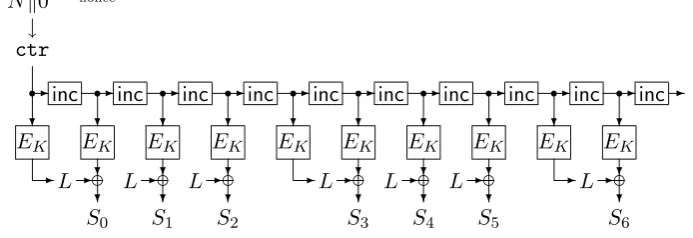
-Figure 3: Illustration of the keystream generation algorithm. This example usesw= 3 and outputsl= 7 blocks of keystreamS= (S0, . . . , S6). ThisS is used in both encryption and
decryption. The mask Lis updated after generating wblocks of keystream. The counter ctr is incremented forl+l/w= 10 times, and there are 10 blockcipher invocations.
5
CENC: Cipher-based ENCryption
In this section, we propose a new (nonce-based) encryption scheme, CENC. It takes three parameters, a blockcipher, a nonce length, and a frame width.
Fix the blockcipher E : {0,1}k × {0,1}n → {0,1}n, the nonce length nonce and the
frame width w, where 1 ≤nonce < n. CENC consists of two algorithms, the encryption
algorithm (CENC.Enc) and the decryption algorithm (CENC.Dec). Both algorithms internally use the keystream generation algorithm (CENC.KSGen). These algorithms are defined in Figure 2. A picture illustrating CENC.KSGen is given in Figure 3.
The encryption algorithm CENC.Enc has the following syntax. CENC.Enc : Key× Nonce×Plaintext → Ciphertext, whereKey is {0,1}k, Nonce is {0,1}nonce, and Plaintext
and Ciphertext are {M ∈ {0,1}∗ | |M| ≤n2max}, i.e., the set of bit strings at most max
blocks, where max is the largest integer satisfying max ≤ w(2n−nonce −1)/(w+ 1). It
write C ← CENC.EncK(N, M). The decryption algorithm CENC.Dec :Key×Nonce× Ciphertext→ Plaintext takes K,N, C to return M. We write M ← CENC.DecK(N, C). For any K,N, andM, we have M ←CENC.DecK(N,CENC.EncK(N, M)).
CENC.Enc and CENC.Dec call CENC.SKGen to generate the keystream of required length, where the length is in blocks. The encryption (resp. decryption) is just the xor of the plaintext (resp. ciphertext) and the keystream.
The keystream generation algorithm, CENC.KSGen, takesK, the initial counter value ctr, and a non-negative integer l. The output is a keystreamS, where the length of S is
l blocks. We writeS ←CENC.KSGenK(ctr, l).
In CENC.KSGen, we first generate ann-bit mask, L. l/w is the number of frames, incomplete frame counts as one frame. We see that l/w masks are generated in line 301. For each mask, w blocks of the keystream are generated in line 304 (except for the last frame, as the last frame may have fewer than w blocks). If l blocks of keystream are generated in line 306, the resulting S is returned in line 308. Observe that the blockcipher is invoked for l+l/w times, since we generate l/w masks and we have l
blocks of keystream, where each block of keystream requires one blockcipher invocation.
Discussion and default parameters. CENC takes the blockcipher E : {0,1}k × {0,1}n→ {0,1}n, the nonce lengthnonce (1≤nonce< n) and the frame widthw, as the
parameters. With these parameters, CENC can encrypt at most 2nonce plaintexts, and
the maximum length of the plaintext ismaxblocks. Note thatmaxis derived by solving
max+max/w ≤2n−nonce inmax, and in general, the bound onmaxismax≤2n−nonce−1
since max/w ≤max. As we will present in Section 6, the security bound of CENC is
(w+ 1)4σˆ3/w322n+1+ (w+ 1)ˆσ/2n+1, where ˆσ is (roughly) the total number of blocks processed by one key.
Our default parameters are,Eis any blockcipher such thatn≥128,nonce=n/2, and
w= 28 = 256. For example, if we use the AES, CENC can encrypt at most 264plaintexts, the maximum length of the plaintext is 263blocks (237GBytes), and the security bound is ˆ
σ3/2248+ ˆσ/2121 (we used (w+ 1)4/w3<261<29), thus ˆσ should be sufficiently smaller that 282 blocks (256GBytes).
The frame width, w, should be large enough so that we can implement CENC effi-ciently. On the other hand, it affects the security bound. We chose w= 28= 256, which implies 256 blocks of keystream are generated with 257 blockcipher invocations, thus the cost is about 0.4% compared to CTR mode. We see that the efficiency loss is very small in both software and hardware. Also, the security bound is low enough with this value of
w. We do not recommend w >28 (whenn= 128) because of the security loss.
64-bit blockciphers. We do not claim that CENC is generally useful for n = 64, since there are restrictions on the nonce length (thus the number of plaintexts), and the plaintext length.
For example, if we use Triple-DES and (nonce, w) = (32,256), CENC can encrypt at
most 232 plaintexts, and the maximum length of the plaintext is 231 blocks (16GBytes), which may not be enough for general applications (still, it is comparable to CTR mode). In this case, the security bound is ˆσ3/2120+ ˆσ/257, which implies ˆσ should be sufficiently smaller that 240 blocks (213GBytes).
version of CENC” is more suitable for 64-bit blockciphers.
6
Security of CENC
CENC is a symmetric encryption scheme. Before showing the security results on CENC, we first formally define what we mean by symmetric encryption schemes, and what we mean by such schemes to be secure.
Symmetric encryption schemes. A (nonce-based) symmetric encryption scheme is a pair of algorithms SE = (E,D) where E is a deterministic encryption algorithm E : Key ×Nonce×Plaintext → Ciphertext and D is a deterministic decryption algorithm D : Key×Nonce×Ciphertext → Plaintext. The key space Key is a set of keys, and is a nonempty set having a distribution (the uniform distribution when the set is finite). The nonce spaceNonce, the plaintext spacePlaintext, and the ciphertext spaceCiphertext are nonempty sets of strings. We write EK(N, M) for E(K, N, M) and DK(N, C) for D(K, N, C). We require that DK(N,EK(N, M)) = M for all K ∈ Key, N ∈ Nonce and
M ∈Plaintext.
Nonce-respecting adversary. Let A be an adversary with access to an encryption oracle EK(·,·). This oracle, on input (N, M), returns the ciphertext C ← EK(N, M).
Let (N0, M0), . . . ,(Nq−1, Mq−1) denote its oracle queries. The adversary is said to be
nonce-respecting if N0, . . . , Nq−1 are always distinct, regardless of oracle responses and
regardless of A’s internal coins.
Privacy of symmetric encryption schemes. We adopt the strong notion of privacy for nonce-based encryption schemes from [23]. This notion, which we call indistinguisha-bility from random strings, provably implies the more standard notions given in [1].
Let A be an adversary with access to an oracle, either the encryption oracle EK(·,·) orR(·,·), and returns a bit. TheR(·,·) oracle, on input (N, M), returns a random string of length |EK(N, M)|. We say that A is a PRIV-adversary for SE. We assume that any PRIV-adversary is nonce-respecting. The advantage of PRIV-adversaryAforSE = (E,D) having key space Keyis
AdvprivSE (A)def= Pr(K ←R Key:AEK(·,·)= 1)−Pr(AR(·,·) = 1).
Security results on CENC. LetAbe a nonce-respecting PRIV-adversary for CENC, and assume that A makes at most q oracle queries, and the total length of these queries is at most σ blocks, where “the total length of queries” is defined as follows: if A makes
q queries (N0, M0), . . . ,(Nq−1, Mq−1), then the total length of queries is σ=|M0|/n+ · · ·+|Mq−1|/n, i.e, the total number of blocks of plaintexts. We have the following
information theoretic result.
Theorem 2 Let Perm(n), nonce, andw be the parameters for CENC. LetAbe a
nonce-respecting PRIV-adversary for CENC making at mostqoracle queries, and the total length of these queries is at most σ blocks. Then
AdvprivCENC(A)≤ (w+ 1)
4σˆ3
w322n+1 +
(w+ 1)ˆσ
PRF-adversary B
If A makes a query (Ni, Mi):
100 ctr←(Ni0n−nonce)
101 l← |Mi|/n
102 S←CENC.KSGen.Sim(ctr, l) 103 Ci←Mi⊕first(|Mi|, S)
104 return Ci
If A returns b:
200 output b
AlgorithmCENC.KSGen.Sim(ctr, l) 300 for j←0 to l/w −1 do
301 Yj ← O(ctr) 302 ctr←incw+1(ctr) 303 Y ←(Y0, . . . , Yl/w−1)
304 Y ←first(nl, Y) 305 returnY
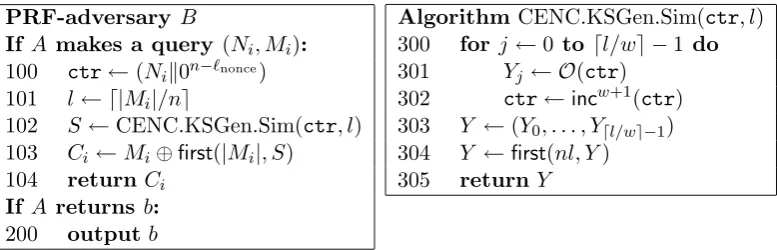
Figure 4: The PRF-adversaryB forF+ based on the PRIV-adversaryA for CENC.
where σˆ=σ+qw.
If we use the rough inequality of w + 1 ≤ 2w, then we have the simpler form,
AdvprivCENC(A)≤wσˆ3/22n−3+wσ/ˆ 2n.
The proof of Theorem 2 is based on the contradiction argument. If there exists a nonce-respecting PRIV-adversaryA such thatAdvprivCENC(A) is larger than the right hand side of (5), then we can construct an input-respecting PRF-adversary B for F+ which contradicts Corollary 1. The proof is given below.
Proof (of Theorem 2). Suppose for a contradiction that AdvprivCENC(A) is larger than the right hand side of (5). Let the oracle O be either FP+(·) or R(·) ∈ Func(n, nw). Consider the PRF-adversary B for F+ in Figure 4, where B uses the nonce-respecting PRIV-adversaryA for CENC as a subroutine.
We see that if O is FP+(·), then B gives A a perfect simulation of CENC.Enc, since
FP+(·) corresponds to “one frame” of CENC.KSGen, and this implies that the outputs of CENC.KSGen.Sim(ctr, l) and CENC.KSGenP(ctr, l) are the same. Therefore Pr(P ←R
Perm(n) :BFP+(·)= 1) = Pr(P ←R Perm(n) :ACENC.EncP(·,·)= 1). Also, it is easy to check
that B is input-respecting. On the other hand, if O is R(·), then B gives A a perfect simulation of R. That is, Pr(R←R Func(n, nw) :BR(·)= 1) = Pr(AR(·,·) = 1). Therefore, we have AdvprfF+(B) =AdvprivCENC(A).
Suppose that the queries made by A are (N0, M0), . . . ,(Nq−1, Mq−1). If we let li = |Mi|/n, then B makes l0/w+· · · +lq−1/w queries, which is at most (l0 +· · ·+
lq−1)/w+q ≤ σ/w+q = ˆσ/w queries. Note that this holds regardless of the value of
l0, . . . , lq−1. From the assumption for a contradiction, AdvprivCENC(A) is larger than the
right hand side of (5), which implies AdvprfF+(B)>(w+ 1)4σˆ3/w322n+1+ (w+ 1)ˆσ/2n+1.
This contradicts Corollary 1. 2
Given Theorem 2, we have the following complexity theoretic result.
Corollary 2 Let E : {0,1}k × {0,1}n → {0,1}n, nonce, and w be the parameters for
CENC. Let A be a nonce-respecting PRIV-adversary for CENC making at most q oracle queries, and the total length of these queries is at most σ blocks. Then there is a PRP-adversary B for E making at most (w + 1)ˆσ/w oracle queries, time(B) = time(A) +
Proof. The proof is standard, and we only check the number of queries made by B. In simulating A’s oracle by usingB’s oracle, suppose that the length of the i-th query made by Aisli blocks. ThenB makes at most (w+ 1)(l0/w+· · ·+lq−1/w) queries, which
is at most (w+ 1)(σ/w+q) = (w+ 1)ˆσ/w queries. This holds regardless the value of
l0, . . . , lq−1. 2
7
CHM: CENC with Hash-based MAC
In this section, we present a new (nonce-based) authenticated-encryption with associated-data (AEAD) scheme, CHM. It takes six parameters, a blockcipher, a nonce length, a tag length, a frame width, and two constants.
Fix the blockcipher E :{0,1}k× {0,1}n → {0,1}n, the nonce length nonce, the tag
lengthτ, the frame widthw, and twon-bit constantsconst0 andconst1. We require that 1 ≤nonce < n, 1≤τ ≤n, const0 = const1, and first(1,const0) =first(1,const1) = 1
(the most significant bits of const0 and const1 are both 1).
CHM consists of two algorithms, the encryption algorithm (CHM.Enc) and the decryp-tion algorithm (CHM.Dec). These algorithms are defined in Figure 5. Both algorithms use the keystream generation algorithm (CHM.KSGen) and a hash function (CHM.Hash). CHM.KSGen is equivalent to CENC.KSGen defined in Figure 2, and the hash function CHM.Hash is defined in Figure 6.
The syntax of the encryption algorithm is CHM.Enc : Key ×Nonce × Header × Plaintext →Ciphertext×Tag, where the key space Key is {0,1}k, the nonce space Nonce is {0,1}nonce, and the header space Header is {0,1}∗. The plaintext space Plaintext and
ciphertext space Ciphertext are {M ∈ {0,1}∗ | |M| ≤ n2max}, where
max is the largest
integer satisfying max≤w(2n−nonce−1−1)/(w+ 1)−1. The tag space Tagis {0,1}τ. It
takes the keyK, the nonceN, the headerH, and the plaintextM to return the ciphertext
C and the tag T. We write (C, T) ← CHM.EncK(N, H, M). The decryption algorithm CHM.Dec :Key×Nonce×Header×Ciphertext×Tag→Plaintext∪{reject}takes K,N,H,
C andT to returnM or a special symbolreject. We write M ←CHM.DecK(N, H, C, T) orreject←CHM.DecK(N, H, C, T).
CHM is the natural combination of CENC and a universal hash function-based MAC (Wegman-Carter MAC). As a universal hash function, we chose the standard polynomial-based hash, since it is efficient in both software and hardware, and it is well studied. The multiplication is done in the finite field GF(2n) using a canonical polynomial to represent field elements. The suggested canonical polynomial is the lexicographically first polynomial among the irreducible polynomials of degree nthat have a minimum number of nonzero coefficients. For n= 128 the indicated polynomial is x128+x7+x2+x+ 1.
Discussion and default parameters. CHM takes six parameters, the blockcipher
E : {0,1}k × {0,1}n → {0,1}n, the nonce length nonce, the tag length τ, the frame
widthw, and twon-bit constantsconst0 and const1. With these parameters, CHM can encrypt at most 2nonce plaintext-header pairs, and the maximum length of the plaintext
ismaxblocks (max is derived by solvingmax+ 1 +(max+ 1)/w ≤2n−nonce−1 inmax).
Algorithm CHM.EncK(N, H, M) 100 S0←EK(const0)
101 S1←EK(const1)
102 l← |M|/n
103 ctr←(0N0n−nonce−1)
104 S ←CHM.KSGenK(ctr, l+ 1) 105 S2←first(n, S)
106 S3←last(nl, S)
107 C←M ⊕first(|M|, S3)
108 Hash0←CHM.HashS0(C) 109 Hash1←CHM.HashS1(H) 110 T ←Hash0⊕Hash1⊕S2
111 T ←first(τ, T) 112 return (C, T)
AlgorithmCHM.DecK(N, H, C, T) 200 S0 ←EK(const0)
201 S1 ←EK(const1)
202 l← |C|/n
203 ctr←(0N0n−nonce−1)
204 S ←CHM.KSGenK(ctr, l+ 1) 205 S2 ←first(n, S)
206 Hash0 ←CHM.HashS0(C) 207 Hash1 ←CHM.HashS1(H) 208 T ←Hash0⊕Hash1⊕S2
209 T ←first(τ, T)
210 if T=T then returnreject 211 S3 ←last(nl, S)
212 M ←C⊕first(|C|, S3)
213 return M
Figure 5: Definition of the encryption algorithm CHM.Enc (left), and the decryption algorithm CHM.Dec (right). CHM.KSGen is equivalent to CENC.KSGen in Figure 2, and CHM.Hash is defined in Figure 6.
AlgorithmCHM.HashS(M) 100 M ←M10n−1−(|M|modn) 101 l← |M|/n
102 Hash←0n
103 for i←0 to l−1 do
104 Hash←(Hash⊕Mi)·S
105 returnHash
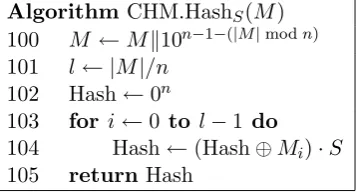
Figure 6: Definition of CHM.Hash : {0,1}n× {0,1}∗ → {0,1}n. Mi is the i-th block of
M10n−1−(|M|modn), i.e., (M0, . . . , Ml−1) =M10n−1−(|M|modn). Multiplication in line
104 is in GF(2n).
˜
σ is (roughly) the total number of blocks processed by one key, Mmax is the maximum
block length of plaintexts, andHmaxis the maximum block length of headers.
Our default parameters are,E is any blockcipher such thatn≥128,nonce=n/2−1,
τ ≥96, w= 28= 256, const0 = 1n−10 and const1 = 1n.
With these parameters, if we use the AES, CHM can encrypt at most 263 plaintexts-header pairs, and the maximum length of the plaintext is 263 blocks (237GBytes), and the security bounds are ˜σ3/2242+ ˜σ/2120 for privacy, and ˜σ3/2242+ ˜σ/2120+ (1 +Hmax+
Mmax)/2τ for authenticity. This implies ˜σ should be sufficiently smaller that 280 blocks
(254GBytes), andHmaxandMmax should be small enough so that (1 +Hmax+Mmax)/2τ
8
Security of CHM
CHM is an authenticated-encryption with associated-data (AEAD) scheme. Before show-ing the security results on CHM, we first formally define what we mean by AEAD schemes, and what we mean by such schemes to be secure.
An AEAD scheme. A (nonce-based) authenticated-encryption with associated-data (AEAD) scheme is a pair of algorithmsAE = (E,D) whereE is a deterministic encryption algorithmE :Key×Nonce×Header×Plaintext→Ciphertext×TagandDis a deterministic decryption algorithm D:Key×Nonce×Header×Ciphertext×Tag→Plaintext∪ {reject}. The key space Key is a set of keys. The nonce spaceNonce and the header space Header (also called the space of associated data), the plaintext spacePlaintextand the ciphertext spaceCiphertextare nonempty sets of strings. (We note that there is a more general treat-ment whereCiphertextand Tagare not separated. See [7]. We separate them for simplic-ity.) We writeEK(N, H, M) forE(K, N, H, M) andDK(N, H, C, T) forD(K, N, H, C, T). We require that DK(N, H,EK(N, H, M)) =M for allK ∈Key,N ∈Nonce, H∈Header and M ∈Plaintext.
Privacy of AEAD schemes. We follow the security notion from [7]. Let A be an adversary with access to an oracle, either the encryption oracle EK(·,·,·) orR(·,·,·), and returns a bit. TheR(·,·,·) oracle, on input (N, H, M), returns a random string of length |EK(N, H, M)|. We say that A is a PRIV-adversary forAE. We assume that any
PRIV-adversary is nonce-respecting (i.e., if (N0, H0, M0), . . . ,(Nq−1, Hq−1, Mq−1) is A’s oracle
queries, N0, . . . , Nq−1 are always distinct, regardless of oracle responses and regardless of
A’s internal coins). The advantage of PRIV-adversaryAfor AEAD scheme AE = (E,D) having key space Keyis
AdvprivAE (A)def= Pr(K ←R Key:AEK(·,·,·)= 1)−Pr(AR(·,·,·) = 1).
Authenticity of AEAD schemes. A notion of authenticity of ciphertext for AEAD schemes was formalized in [23, 22] following [14, 6, 5]. This time, let A be an adversary with access to an encryption oracleEK(·,·,·) and returns a tuple, (N, H, C, T). This tuple is called a forgery attempt. We say that A is an AUTH-adversary for AE. We assume that any AUTH-adversary is nonce-respecting. (The condition is understood to apply only to the adversary’s encryption oracle. Thus a nonce used in an encryption-oracle query may be used in a forgery attempt.) We sayA forges ifA returns (N, H, C, T) such that DK(N, H, C, T) = reject but A did not make a query (N, H, M) to EK(·,·,·) that resulted in a response (C, T). That is, adversaryA may never return a forgery attempt (N, H, C, T) such that the encryption oracle previously returned (C, T) in response to a query (N, H, M). Then the advantage of AUTH-adversary A for AEAD scheme AE = (E,D) having key spaceKey is
AdvauthAE (A)def= Pr(K←R Key:AEK(·,·,·) forges).
follows: if A makes queries (N0, H0, M0), . . . ,(Nq−1, Hq−1, Mq−1), then σ =|M0|/n+ · · ·+|Mq−1|/n, i.e., the total number of blocks of plaintexts. We have the following
information theoretic result.
Theorem 3 Let Perm(n),nonce,τ, w, const0 and const1 be the parameters for CHM.
Let A be a nonce-respecting PRIV-adversary making at most q oracle queries, and the total plaintext length of these queries is at most σ blocks. Then
AdvprivCHM(A)≤ (w+ 1)
3σ˜2
w222n−3 +
(w+ 1)4σ˜3
w322n+1 +
1 2n +
(w+ 1)˜σ
2n+1 , (6)
where σ˜=σ+q(w+ 1).
Note that there is no restriction on the header length. If we usew+ 1≤2w, we have the simpler form, AdvprivCHM(A)≤wσ˜2/22n−6+wσ˜3/22n−3+ 1/2n+wσ/˜ 2n.
The proof of Theorem 3 is given in Section 9. From Theorem 3, we have the following complexity theoretic result.
Corollary 3 Let E :{0,1}k× {0,1}n → {0,1}n, nonce, τ, w, const0 and const1 be the
parameters for CHM. LetAbe a nonce-respecting PRIV-adversary making at mostqoracle queries, and the total plaintext length of these queries is at most σ blocks. Then there is a PRP-adversaryB for E making at most (w+ 1)˜σ/w oracle queries, time(B) =time(A) +
O(n˜σw), andAdvprpE (B)≥AdvprivCHM(A)−wσ˜2/22n−6−wσ˜3/22n−3−1/2n−w˜σ/2n, where ˜
σ =σ+q(w+ 1).
Proof. Suppose that the plaintext length of the i-th query made by A is li blocks. Then
B makes at most (w+ 1)((l0 + 1)/w+· · ·+(lq−1+ 1)/w) queries, which is at most
(w+1)(σ/w+q/w+q) = (w+1)˜σ/wqueries. This holds regardless the value ofl0, . . . , lq−1.
The rest of the proof is standard. 2
Authenticity results on CHM. LetAbe an AUTH-adversary for CHM, and assume that A makes at most q oracle queries (including the final forgery attempt), the total plaintext length of these queries is at most σ blocks, the maximum plaintext length of these queries is at most Mmax blocks, and the maximum header length of these queries
is at most Hmax blocks. Here, ifA makes queries (N0, H0, M0), . . . ,(Nq−2, Hq−2, Mq−2),
and returns the forgery attempt (N∗, H∗, C∗, T∗), then σ,Mmax andHmaxare defined as
⎧ ⎪ ⎨ ⎪ ⎩
σdef= |M0|/n+· · ·+|Mq−2|/n+|C∗|/n,
Mmaxdef= max{|M0|/n, . . . ,|Mq−2|/n,|C∗|/n},
Hmaxdef= max{|H0|/n, . . . ,|Hq−2|/n,|H∗|/n}.
We say A’s query resource is (q, σ, Mmax, Hmax). We have the following information
theoretic result.
Theorem 4 Let Perm(n),nonce,τ, w, const0 and const1 be the parameters for CHM.
Let A be a nonce-respecting AUTH-adversary whose query resource is (q, σ, Mmax, Hmax).
Then AdvauthCHM(A) is at most
(w+ 1)3σ˜2
w222n−3 +
(w+ 1)4σ˜3
w322n+1 +
1 2n +
(w+ 1)˜σ
2n+1 +
1 +Hmax+Mmax
2τ , (7)
If we use w + 1 ≤ 2w, we have the simpler form, AdvauthCHM(A) ≤ wσ˜2/22n−6 +
wσ˜3/22n−3+ 1/2n+wσ/˜ 2n+ (1 +Hmax+Mmax)/2τ.
The proof of Theorem 4 is given in Section 9. From Theorem 4, we have the following complexity theoretic result.
Corollary 4 LetE :{0,1}k× {0,1}n → {0,1}n, nonce,τ, w,const0, and const1 be the
parameters for CHM. Let A be a nonce-respecting AUTH-adversary whose query resource is (q, σ, Mmax, Hmax). Then there is a PRP-adversary B for E making at most (w+
1)˜σ/w oracle queries, time(B) = time(A) +O(nσw˜ ), and AdvprpE (B) ≥AdvauthCHM(A)−
wσ˜2/22n−6−wσ˜3/22n−3−1/2n+wσ/˜ 2n−(1 +Hmax+Mmax)/2τ, where˜σ=σ+q(w+ 1).
The proof is almost the same as that of Corollary 3, and omitted.
9
Security Proofs of CHM
Another security result on the basic tool. To prove Theorem 3 and Theorem 4, consider the function family F+ defined in Section 4. We show a different security result on F+.
First, recall the definition of F+ from Section 4 (but we will concentrate on the
information theoretic result). Let P ←R Perm(n) be a random permutation, and fix the frame width w. Let ω = 1 +log2w. Then F+ : Perm(n)× {0,1}n → ({0,1}n)w is
FK+(x) = (y[0], . . . , y[w−1]), where y[i] = L⊕EK(inci+1(x)) for i = 0, . . . , w −1 and
L=EK(x).
Now let A be an adversary. This A is the PRF-adversary for F+, but we give A
additional information, i.e., we allowAto access the blockcipher itself. That is,Ais given either a pair of oracles (P(·), FP+(·)), or a pair of random function oracles (R0(·), R1(·)),
where R0 ∈Func(n, n) and R1 ∈Func(n, nw), with the following rules.
• If Wi ∈ {0,1}n is the i-th query for the first oracle (either P(·) or R0(·)), then
first(1, Wi) = 1 must hold.
• If xj ∈ {0,1}n is the j-th query for the second oracle (either FP+(·) or R1(·)), then
first(1, xj) = 0 must hold. That is, input/output samples from the first oracle are not used in FP+(·) oracle.
• A does not repeat the same query to its first oracle.
• A is input-respecting with respect to the second oracle (see Section 4).
We say A is msb-input-respecting if the above rules hold regardless of oracle responses and regardless of A’s internal coins. DefineAdvprfPerm(n),F+(A) as
Pr(P ←R Perm(n) :AP(·),FP+(·)= 1)
−Pr(R0 ←R Func(n, n), R1 ←R Func(n, nw) :AR0(·),R1(·)= 1)
Theorem 5 Let Perm(n) and w be the parameters for F+. Let A be an msb-input-respecting PRF-adversary for (Perm(n), F+) making at most r oracle queries to its first oracle and at most q oracle queries to its second oracle. Then
AdvprfPerm(n),F+(A)≤
r2q2(w+ 1)3 22n−1 +
q3(w+ 1)4 22n+1 +
r(r−1) 2n+1 +
qw(w+ 1) 2n+1 .
The proof of Theorem 5 is similar to the proof of Theorem 1, but it is not derived directly (and Theorem 1 is not a corollary of Theorem 5 because of the most significant bit restriction). To prove Theorem 5, we need the following lemma.
Lemma 2 Let x = (x0, . . . , xq−1) ∈ ({0,1}n)q and Y = (Y0, . . . , Yq−1) ∈ ({0,1}nw)q be
arbitrarily fixed bit strings, where x is distinct and Y is non-zero-distinct (see Definition 1). Also, let W = (W0, . . . , Wr−1) ∈ ({0,1}n)r and Z = (Z0, . . . , Zr−1) ∈ ({0,1}n)r be
arbitrarily fixed bit strings, where Wi =Wj and Zi = Zj for any 0≤i < j ≤r−1 (i.e.,
W and Z are distinct). Assume {x0, . . . , xq−1} ∩ {W0, . . . , Wr−1}=∅. Then
pF+
pR ≥1−
r2q2(w+ 1)3 22n−1 −
q3(w+ 1)4
22n+1 , (8)
where pF+ def= Pr(P ←R Perm(n) : P(Wj) =Zj for 0≤j≤r−1 and FP+(xi) = Yi for
0≤i≤q−1) and pR def= Pr(R0 ←R Func(n, n), R1 ←R Func(n, nw) : R0(Wj) = Zj for
0≤j ≤r−1 and R1(xi) =Yi for 0≤i≤q−1).
Proof. We first count the number of P ∈ Perm(n) which satisfies P(Wj) = Zj for
0≤j ≤r−1 andFP+(xi) =Yifor 0≤i≤q−1. LetYi = (yi[0], . . . , yi[w−1])∈({0,1}n)w for 0≤i≤q−1, and letL0, . . . , Lq−1 ben-bit variables. Then the number ofL0, . . . , Lq−1
which satisfy
• {Z0, . . . , Zr−1} ∩ {Li, Li⊕yi[0], . . . , Li⊕yi[w−1]}=∅ for any 0≤i≤q−1, and • {Li, Li⊕yi[0], . . . , Li⊕yi[w−1]} ∩ {Lj, Lj ⊕yj[0], . . . , Lj ⊕yj[w−1]}=∅for any
0≤i < j ≤q−1,
is at least0≤i≤q−1(2n−r(w+ 1)−i(w+ 1)2), since there are 2n−r(w+ 1) possibilities for L0, and once L0, . . . , Li−1 are fixed, we have at least 2n −r(w+ 1)−i(w + 1)2
possibilities for Li. If we set P(W0) = Z0, . . . , P(Wr−1) = Zr−1 and Li = P(xi), then
it is possible to set P(inc(xi)) = Li ⊕yi[0], P(inc2(xi)) = Li ⊕yi[1], . . . , P(incw(xi)) =
Li ⊕yi[w−1] uniquely. We have fixed r+q(w+ 1) input-output pairs of P, and the remaining 2n−r−q(w+1) entries can be any value. Therefore, the number ofP ∈Perm(n) which satisfies P(Wj) =Zj for 0≤j ≤r−1 andFP+(xi) =Yi for 0≤i≤q−1 is at least (2n−r−q(w+ 1))!0≤i≤q−1(2n−r(w+ 1)−i(w+ 1)2).
Then, the left hand side of (8) is at least
(2n)r(2n)qw(2n−r−q(w+ 1))!0≤i≤q−1(2n−r(w+ 1)−i(w+ 1)2)
(2n)! , (9)
and the right hand side of (8) is given by simplifying (9). 2
Proof (of Theorem 5). Without loss of generality, we assume thatAmakes exactlyroracle queries to its first oracle, and exactlyq oracle queries to its second oracle, andAdoes not repeat an oracle query to the same oracle. Also, since A is computationally unbounded, we assume that A is deterministic. Let Wi denote the query for the first oracle, and
xj denote the query for the second oracle. Now we can regard A as a function fA :
({0,1}n)r×({0,1}nw)q→ {0,1}. To see this, let Z = (Z0, . . . , Zr−1) be annr-bit string,
and letY = (Y0, . . . , Yq−1) be annqw-bit string, where eachZi isnbits andYiisnwbits.
Observe that if we returnZi as the answerWifor 0≤i≤r−1 and returnYjas the answer
xj for 0≤i≤q−1, the output of A, either 0 or 1, is determined. Therefore, the output
of A is determined by fixingZ and Y. Also, note that for any (Z, Y), the corresponding sequence of queries satisfies the conditions in Lemma 2, since A is msb-input-respecting (first(1, Wi)=first(1, xj)). Letvone ={(Z, Y)∈({0,1}n)r×({0,1}nw)q |fA(Z, Y) = 1},
and vdist = {(Z, Y) ∈ ({0,1}n)r× {0,1}nw)q | Z is distinct and Y is non-zero-distinct}. Observe that |vdist| = 2n(2n −1)· · ·(2n −(r −1))((2n −1)(2n −2)· · ·(2n −w))q ≥ 2n(r+qw)(1−r(r−1)/2n+1−qw(w+ 1)/2n+1), and therefore, we have
|vone∩vdist| ≥ |vone| −2n(r+wq)(r(r−1)/2n+1+qw(w+ 1)/2n+1). (10)
LetPRdef= Pr(R0 ←R Func(n, n), R1 ←R Func(n, nw) :AR0(·),R1(·)= 1). Then
PR=
(Z,Y)∈vone
pR= |vone|
(2n)r+qw. (11)
On the other hand, let PF+ def= Pr(P ←R Perm(n) : AP(·),F +
P(·) = 1). Then we have
PF+ =(Z,Y)∈v
onepF+ ≥
(Z,Y)∈(vone∩vdist)pF+ and therefore,
PF+ ≥
1−r
2q2(w+ 1)3
22n−1 −
q3(w+ 1)4 22n+1
(Z,Y)∈(vone∩vdist)
1 (2n)r+qw
from Lemma 2 and the fact that pR= 1/(2n)r+qw. By using (10) and (11),
PF+ ≥ PR−r
2q2(w+ 1)3
22n−1 −
q3(w+ 1)4 22n+1 −
r(r−1) 2n+1 −
qw(w+ 1) 2n+1 .
Finally, we have upper bound on PF+ by applying the same argument to 1−PF+ and
1−PR. This concludes the proof of Theorem 5. 2
We now present the proof of Theorem 3.
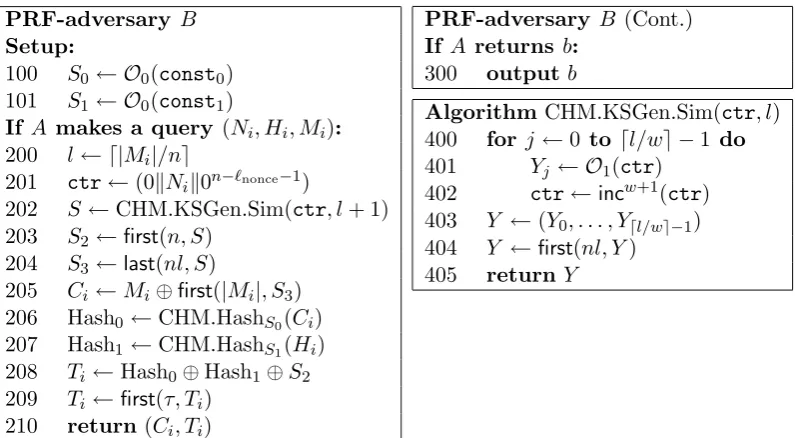
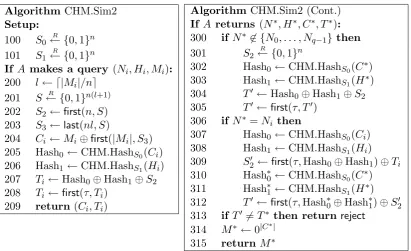
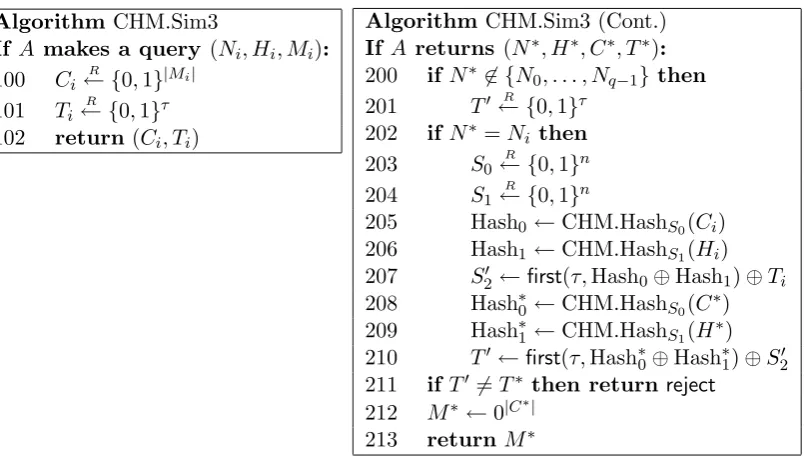
Proof (of Theorem 3). Suppose for a contradiction that AdvprivCHM(A) is larger than the right hand side of (6). Let the oracles (O0,O1) be either (P(·), FP+(·)) or (R0(·), R1(·))∈
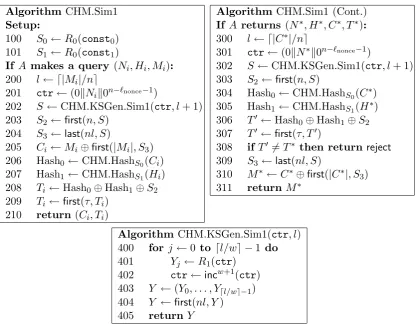
Func(n, n)×Func(n, nw). Consider the PRF-adversaryB for (Perm(n), F+) in Figure 7, where B uses A as a subroutine.
First, it is easy to see thatB is msb-input-respecting. Next, we see that if (O0,O1) is
(P(·), FP+(·)), then B gives A a perfect simulation of CHM.EncP, and therefore we have Pr(P ←R Perm(n) : BP(·),FP+(·) = 1) = Pr(P ←R Perm(n) : ACHM.EncP(·,·,·) = 1). On the
other hand, if (O0,O1) is (R0(·), R1(·)), thenB givesAa perfect simulation ofR, and we
have Pr(R0 ←R Func(n, n), R1 ←R Func(n, nw) :BR0(·),R1(·)= 1) = Pr(AR(·,·,·)= 1). From
![Figure 1: Example illustration of F. In this example, w = 3, ω = 1 + ⌊log2 w⌋ = 2, andF : {0, 1}k × {0, 1}n−2 → ({0, 1}n)3 where FK(x) = (y[0], y[1], y[2])](https://thumb-us.123doks.com/thumbv2/123dok_us/1851768.1240354/6.595.238.360.81.163/figure-example-illustration-example-w-log-andf-fk.webp)