Compression Functions Suitable for
the Multi-Property-Preserving Transform
Hidenori Kuwakado and Masakatu Morii
Graduate School of Engineering, Kobe University 1-1 Rokkodai-cho Nada-ku Kobe 657-8501, Japan
Abstract. Since Bellare and Ristenpart showed a multi-property preserving domain extension transform, the problem of the construction for multi-property hash functions has been reduced to that of the con-struction for multi-property compression functions. However, the Davies-Meyer compression function that is widely used for standard hash functions is not a multi-property compression function. That is, in the ideal cipher model, the Davies-Meyer compression function is collision resistant, but it is not indifferentiable from a random oracle. In this paper, we show that the compression function proposed by Lai and Massey is a multi-property compression function. In addition, we show that the simplified version of the Lai-Massey compression function is also a multi-property compression function. The use of these compression functions enables us to construct multi-property hash functions by the multi-property preserving domain extension transform.
1 Introduction
Cryptographic hash functions play a fundamental role in modern cryptographic protocols. Hash func-tions are used for data integrity in conjunction with digital signatures and message authentication codes. These applications require that hash functions satisfy the following properties: preimage resis-tance, second-preimage resisresis-tance, and collision resistance. Another application of hash functions is an alternative to a random oracle. For example, hash functions are used to instantiate random oracles in public-key schemes such as RSA-OAEP [2] and RSA-PSS [3]. This application requires that hash functions are indistinguishable from random oracles.
Coron, Dodis, Malinaud, and Puniya [8] have formally discussed the indifferentiability of hash functions. The notion of indifferentiability was first introduced by Maurer, Renner, and Holenstein [12], and is a stronger notion than just indistinguishability. Coron et al. have shown that the Merkle-Damg˚ard construction [9][13] is not indifferentiable from the random oracle, and have proposed hash-function constructions that are indifferentiable from the random oracle. Chang, Lee, Nandi, and Yung [7] have given the formal proof of indifferentiability to the constructions of Coron et al. In [7] and [8], the collision resistance of the indifferentiable constructions were not explicitly studied.
Bellare and Ristenpart [1] have shown that the indifferentiability from the random oracle does not guarantee the collision resistance, and have proposed a multi-property preserving domain ex-tension transform (called an MPP transform) where “multi-property” means indifferentiability and collision resistance. The MPP transform enables a constructed hash function to inherit these proper-ties of an underlying compression function. Due to their works, the problem of the construction for multi-property hash functions was reduced to that of the construction for multi-property compression functions.
However, the Davies-Meyer compression function, which is used for popular hash functions, is not a multi-property compression function in the ideal cipher model. Namely, the Davies-Meyer compression function is collision resistant [6], but it is not indifferentiable from a random oracle [7][8][10]. Therefore, it is important to construct a multi-property compression function.
In this paper, we show that the compression function proposed by Lai and Massey (called an
oracles are identically distributed when the event does not occur. However, how to define the event is not necessarily obvious. On the other hand, the game-playing proof provides how to define an event for distinguishing the two oracles, which is called identical-until-bad. Since the notion of identical-until-bad is easy to use, we quantitatively evaluate the indifferentiability using the game-playing framework. We next quantify the collision resistance of the LM compression function because Lai and Massey did not give the formal proof of collision resistance.
We also propose the simplified version of the LM compression function, called a CP compression function where “CP” is an abbreviation of “Constant Plaintext.” Although we do not think that the CP compression function is novel, the CP compression function have not been studied in terms of indifferentiability and collision resistance. We show that the CP compression function as well as the LM compression function is a multi-property compression function. Therefore, these compression functions are promising primitives for building multi-property hash functions.
Related Works Since the Merkle-Damg˚ard construction is a collision-resistant preserving domain ex-tension transform, the construction of collision-resistant compression functions have attracted interest. Since the advent of Coron et al.’s paper [8], the indifferentiability has been focused. We here sum-marize related works from the viewpoint of the construction for rate-1 and single-length compression functions.
Lai and Massey [11] proposed a compression function, which is studied in this paper because they did not provide any security observation. The LM compression function is based on the block cipher such that the key length is longer than the block length. Since the LM compression function requires one invocation of the block cipher and the output length is equal to the block length of the block cipher, the LM compression function is a rate-1 and single-length compression function. Parenthetically, they also proposed the different type of compression functions in [11], but the different type of compression functions are out of scope of this paper.
Preneel, Govaerts, and Vandewalle [15] analyzed the security of 64 compression functions (PGV compression functions) in context of attacks, but did not provide any formal proof. The PGV compres-sion functions include popular comprescompres-sion functions such as the Davies-Meyer comprescompres-sion function, the Matyas-Meyer-Oseas compression function, and the Miyaguchi-Preneel compression function. No-tice that the PGV compression functions do not include the LM compression function.
Black, Rogaway, and Shrimpton [6] provided a formal and quantitative treatment of all the PGV compression functions. Their proof is based on the ideal cipher model. They studied the collision resistance and the inversion resistance of the PGV compression functions, but did not study indiffer-entiability from a random oracle.
In [8], the Davies-Meyer compression function is not indifferentiable from a random oracle in the ideal cipher model. In [7][10], the PGV compression functions are not indifferentiable from a random oracle in the ideal cipher model. In [10], a compression function such that many block ciphers are used selectively was proposed, and it was stated that the proposed compression function was implemented by the LM compression function. However, the difference between the proposed compression function and the LM compression function was not discussed.
The above related works as well as this paper are based on the ideal-cipher model. Black [5] pointed out suspicion as to the wisdom of blindly using the ideal-cipher model in proofs of security. Black showed that, given a collision-resistant hash function in the ideal cipher model, there exists a block cipher that makes the hash function collision-easy. However, as described in [5], a pseudo-random permutation that is a weaker assumption than the ideal cipher model is insufficient for building a collision-resistant hash function. In fact, it is easy to prove that the LM compression function is not collision resistant under the pseudo-random-permutation assumption. Therefore, we employ the ideal cipher model in this paper.
resistance of the CP compression function in a similar way to Section 3. In Section 5, we summarize remarks.
2 Preliminaries
2.1 Notation and Primitives
We will writea←bto mean thatais to be set to the result of evaluating expressionb, and writea← A$ to mean that ais uniformly chosen at random from a finite setA. For algorithmsAandB,AB means thatA usesB as an oracle. We denote by Pr [A⇒a] the probability that an algorithmA outputsa. In addition, we denote by Pr [a:b] the probability that a predicate b is true aftera was performed. We denote by Pr [b|a] the probability thatbis true when aoccurred. We letkdenote the concatenation operator on strings.
Let R be a function from a finite set X to a finite set Y. The function R is said to be a random oracle1 ifR satisfies the following equation forx6∈ {x
1, x2, . . . , xq}and y∈ Y.
Pr [R(x) =y|x6=xi∧R(xi) =yi fori= 1,2, . . . , q] = 1 |Y|
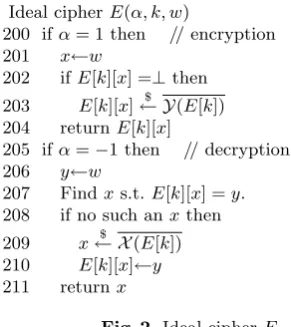
where |Y| is the number of elements in Y. Notice that R returns the same string for the same query. WhenY ={0,1}n, the random oracleR can be emulated by the algorithm of Fig. 1. In Fig. 1, the table R[x] is initialized to the special symbol⊥, and is used for storing responses to previous queries. As queries are made, each R[x] is filled with ann-bit random string.
A block cipher is a functionE0 from{0,1}`× {0,1}n to{0,1}nwhere, for eachk∈ {0,1}`,E0(k,·) is a permutation on {0,1}n. When E0 is a block cipher, E0−1 denotes its inverse, i.e.,E0−1(k, y) gives the stringxsuch thatE0(k, x) =y. LetBloc(`, n) be the set of all block ciphers from{0,1}`×{0,1}nto {0,1}n. Choosing a random element ofBloc(`, n) means that for eachk∈ {0,1}`one chooses a random permutation E0(k,·) [6]. Anideal cipheris defined as a random element ofBloc(`, n). Accordingly, the ideal cipher E0 satisfies the following equation for each k.
Pr[E0(k, x) =y|E0(k, xi) =yi fori= 1,2, . . . , q ]
= 1
|Y| −q,
where each xi is distinct, x 6∈ {x1, x2, . . . , xq}, and y 6∈ {y1, y2, . . . , yq}. Since the ideal cipher model
allows an adversary to have access to both of E0 and E0−1, combining them simplifies description of discussion. We will use E(1,·,·) and E(−1,·,·) instead of E0 and E0−1 here.
The ideal cipherE ofBloc(`, n) can be emulated by the algorithm of Fig. 2. In Fig. 2,Etakes three inputs; α ∈ {1,−1} specifies encryption or decryption, k is an `-bit key, and if α = 1 w is an n-bit plaintext, otherwise wis an n-bit ciphertext. The double dash, //, begins a comment that extends to the end of the line. The table E[k][x] is initialized with the special symbol⊥, and stores a ciphertext y obtained by encrypting the plaintext x with the key k. The symbol Y(E[k]) denotes a current set of all ciphertexts y defined with the key k, and Y(E[k]) denotes the complement of Y(E[k]) relative to {0,1}n. Similarly, X(E[k]) denotes a current set of all plaintexts x defined with the key k, and X(E[k]) denotes its complement set. As queries are made, eachE[k][x] is filled with an n-bit random string.
2.2 Definition of Compression Functions
In this paper, we first analyze security of the compression function that was proposed by Lai and Massey [11] (called an LM compression function). Although they proposed it, they did not discuss its security. Our purpose is to show that the LM compression function has good properties (exactly, indifferentiability and collision resistance). If the LM compression function has the good properties, then the MPP transform [1] allows us to construct a hash function with the good properties.
1 In [1], this is the definition of a random function, and a random oracle is defined as a public random function. In this
Random oracleR(x) 100 ifR[x] =⊥then
101 R[x]← {$ 0,1}n 102 returnR[x]
Fig. 1.Random oracleR.
Ideal cipherE(α, k, w)
200 ifα= 1 then //encryption 201 x←w
202 ifE[k][x] =⊥then
203 E[k][x]← Y$ (E[k]) 204 returnE[k][x]
205 ifα=−1 then //decryption 206 y←w
207 Findxs.t.E[k][x] =y. 208 if no such anxthen
209 x← X$ (E[k]) 210 E[k][x]←y 211 returnx
Fig. 2.Ideal cipherE.
Let E be an ideal cipher in Bloc(`, n) where ` > n. For z ∈ {0,1}`−n and x ∈ {0,1}n, the LM compression function is defined as
HLM(z, x) =E(1, xkz, x). (1)
In addition, we call the following function aCP compression functionwhere CP stands for a Constant Plaintext.
HCP(z, x) =E(1, xkz, c), (2)
wherecis an n-bit public constant string, say 0n. Although we do not think that the CP compression function is novel, the security of the CP compression function have not been studied formally. Our purpose is to show that the CP compression function has good properties.
Compression functions are usually classified asrateandlength. A compression functionH is called a rate-1/rcompression function ifr invocations of block cipherE(1,·,·) is necessary to computeH. A compression functionHis called a single-length compression function if the output length ofH is equal to the block length of E. Accordingly, the LM compression function and the CP compression function are rate-1 and single-length. Although Black et al. [6] cyclopaedically analyzed collision resistance of rate-1 and single-length compression functions, the LM compression function and the CP compression function were not included in them because Black et al. analyzed compression functions based on the block cipher such that the key length was equal to the block length.
3 The LM Compression Function
Let E be the ideal cipher of Fig. 2, i.e., a function from {1,−1} × {0,1}`× {0,1}n to {0,1}n where an element of {1,−1} stands for encryption or decryption, `is key length, andnis block length. The LM compression function is defined as
H(z, x) =E(1, xkz, x), (3)
which is a function from {0,1}`−n× {0,1}n to{0,1}n. In this section, we omit the subscription LM of Eq. (1) for simplification. In hash-function contractions such as the MPP transform,z is a message block to be compressed and x is output of the preceding compression function.
3.1 Indifferentiability
To evaluate the indifferentiability from a random oracle, we introduce the advantage of an adversary against the LM compression function, which is called apro-advantage. The pro-advantage indicates how much the LM compression function behaves like a random oracle. The pro-advantage of an adversary A is defined as
AdvproH,S(A) = Pr [
AHE,E⇒1 ]
−Pr [
AR,SR⇒1 ]
The LM compression functionH0(z, x)
100 returnE0(1, xkz, x)
Ideal cipherE0(α, k, w)
200 ifα= 1 then
201 x←w; Parsekintoakz. 202 ifE0[k][x] =⊥then
203 ifa=xthen
204 y← {$ 0,1}n 205 else
206 y← {$ 0,1}n
207 ify∈ Y(E0[k]) then
208 bad←true // bade
209 y← Y$ (E0[k])
210 E0[k][x]←y
211 returnE0[k][x]
212 ifα=−1 then
213 y←w; Parsekintoakz. 214 Findxs.t.E0[k][x] =y.
215 if no such anxthen
216 x← X$ (E0[k])
217 ifa=xthen
218 bad←true // badd
219 E0[k][x]←y
220 returnx
Fig. 3.GameG0= (H0, E0).
where H is the LM compression function, E is the ideal cipher, R is the random oracle, and S is a simulator. The random oracle R exposes the same interface as H, i.e., R is a function from {0,1}`−n× {0,1}n to{0,1}n. It is easy to implementRusing a random oracle from {0,1}` to{0,1}n. The simulatorSexposes the same interface asE, and emulatesEas possible. If the value ofAdvproH,S(A) is negligibly small, then it means that the adversaryAcannot distinguish between the LM compression function H and the random oracleR.
We quantify the indifferentiability of the LM compression function using the game-playing frame-work [4]. We assume that A is an infinitely powerful adversary andA makes no pointless query such as the same query to oracles.
We start with a game G0 as shown in Fig. 3. In Fig. 3,H0 is a function from{0,1}`−n× {0,1}n
to {0,1}n, and E0 is a function from {1,−1} × {0,1}`× {0,1}n to{0,1}n. In line 201 and line 213,
k is parsed into an (`−n)-bit string a and an n-bit string z. The flag bad in line 208 and line 218, which will be used for later discussion, does not any effect on the output of E0. It is easy to verify
thatH0andE0exactly emulate the LM compression function of Eq. (3) and the ideal cipher of Fig. 2,
respectively. Hence, we have, for any adversary A,
Pr[AHE,E⇒1]= Pr[AG0⇒1].
Note that the description ofE0 is of redundancy (e.g., line 203–206), which is helpful to compare other
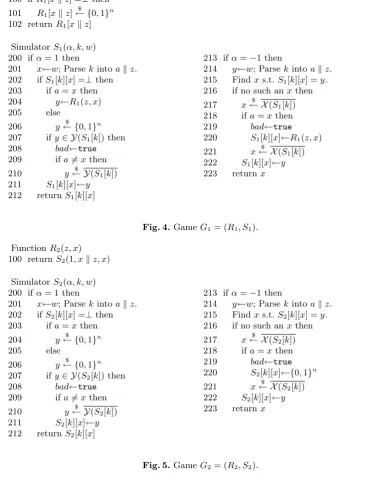
games. We next consider a gameG1as shown in Fig. 4. In Fig. 4,R1 exposes the same interface asH0,
butR1 is algorithmically equivalent to the random oracle R of Fig. 1. The functionS1 is a simulator
that we here study, and is designed to emulate the ideal cipher as possible. It follows that
Pr [
AR,SR⇒1 ]
= Pr [
AG1⇒1 ]
for any adversary A. Therefore, the pro-advantage of Eq. (4) is rewritten as
AdvproH,S(A) = Pr [
AG0⇒1 ]
−Pr [
AG1⇒1 ]
. (5)
We compare the game G1 and a game G2 of Fig. 5. The function R2 exposes the same interface
as R1, but the algorithm of R2 differs from that of R1. However, if a query is fresh, then R2 returns
an n-bit random string due to line 204, line 209, and line 220 in Fig. 5. Hence, R2 as well as R1 is
the random oracle. Comparing S1 and S2, we see that the difference is line 204 and line 220, i.e.,
y←R1(z, x) in S1 and y←{0,1}n in S2. Both of them return a random string if a query is fresh. It
follows that S1 and S2 are functionally equivalent. Hence, we have
Pr [
AG1⇒1 ]
= Pr [
AG2⇒1 ]
Random oracleR1(z, x)
100 ifR1[xkz] =⊥then
101 R1[xkz] $ ← {0,1}n 102 returnR1[xkz]
SimulatorS1(α, k, w)
200 ifα= 1 then
201 x←w; Parsekintoakz. 202 ifS1[k][x] =⊥then
203 ifa=xthen 204 y←R1(z, x)
205 else
206 y← {$ 0,1}n
207 ify∈ Y(S1[k]) then
208 bad←true 209 ifa6=xthen
210 y← Y$ (S1[k])
211 S1[k][x]←y
212 returnS1[k][x]
213 ifα=−1 then
214 y←w; Parsekintoakz. 215 Findxs.t.S1[k][x] =y.
216 if no such anxthen
217 x← X$ (S1[k])
218 ifa=xthen 219 bad←true 220 S1[k][x]←R1(z, x)
221 x← X$ (S1[k])
222 S1[k][x]←y
223 returnx
Fig. 4.GameG1= (R1, S1).
FunctionR2(z, x)
100 returnS2(1, xkz, x)
SimulatorS2(α, k, w)
200 ifα= 1 then
201 x←w; Parsekintoakz. 202 ifS2[k][x] =⊥then
203 ifa=xthen
204 y← {$ 0,1}n
205 else
206 y← {$ 0,1}n 207 ify∈ Y(S2[k]) then
208 bad←true 209 ifa6=xthen
210 y← Y$ (S2[k])
211 S2[k][x]←y
212 returnS2[k][x]
213 ifα=−1 then
214 y←w; Parsekintoakz. 215 Findxs.t.S2[k][x] =y.
216 if no such anxthen
217 x← X$ (S2[k])
218 ifa=xthen 219 bad←true 220 S2[k][x]←{0,1}n
221 x← X$ (S2[k])
222 S2[k][x]←y
223 returnx
Fig. 5.GameG2= (R2, S2).
for any adversary A. Substituting Eq. (6) into Eq. (5) yields the following equation.
AdvproH,S(A) = Pr[AG0⇒1 ]
−Pr[AG2⇒1 ]
. (7)
We compare the game G0 with the game G2. Since H0 and R2 are algorithmically the same, we
focus on the difference betweenE0andS2. We easily see that the difference appears after the statement
bad←true. Namely, E0 and S2 are identical until the flag badsets. Using the fundamental lemma [4],
we obtain
AdvproH,S(A) = Pr[AG0⇒1]−Pr[AG2⇒1] ≤Pr [G0 setsbad],
where Pr [G0 setsbad] denotes the probability that the flagbadin Fig. 3 is set totruein the execution
of Awith the gameG0. We calculate the probability Pr [G0 setsbad]. Since the query toH0 turns out
to be the query to E0, we consider only the query toE0. Since the flag bad appears in line 208 and
line 218, we have
where Pr [G0 setsbade] and Pr [G0 setsbadd] are probabilities thatbad is set totrue in line 208 and line 218, respectively. These probabilities are calculated as follows. At the i-the query to E0, the
number of defined elements in the table E0[k][x] is at mosti−1, namely, |X(E0[k])| and |Y(E0[k])|
are at most i−1. The probability that bade is set at the i-the query is not greater than (i−1)/2n, and the probability that badd is set at thei-the query is not greater than 1/(2n−(i−1)). Assuming that q queries are made in the execution ofA with the gameG0, we have
Pr [G0 setsbade]≤ 1 2n +
2
2n +. . .+ q−1
2n = q(q−1)
2n+1 ,
Pr [G0 setsbadd]≤ 1 2n +
1
2n−1+. . .+
1 2n−(q−1)
≤ q
2n−1,
where we assumed that q≤2n−1+ 1. Substituting the above inequalities into Eq. (8), we obtain
AdvproH,S(A)≤Pr [G0 setsbad]
≤ q(q+ 3)
2n+1 . (9)
3.2 Collision Resistance
In this section, we analyze the collision resistance of the LM compression function. Although Lai and Massey proposed this function, they did not evaluate its collision resistance. To quantify the difficulty of finding a collision in H, we consider the following probability, called a col-advantageof adversary B [6].
AdvcolH (B) = Pr [
BHE,E⇒((z, x),(z0, x0)) : Outputs collide. ]
, (10)
where “Outputs collide” means that one of the following events occurs.
– (z, x)6= (z0, x0)∧H(z, x) =H(z0, x0)
– For a constanty0 given in advance, H(z, x) =y0.
Since the game G0 (= (H0, E0)) in Fig. 3 exactly emulatesH andE, the col-advantage is given by
AdvcolH (B) = Pr [
BG0⇒((z, x),(z0, x0)) : Outputs collide. ]
.
Let Ci be the event that there exists j ∈ {1,2, . . . , i−1} such that (zi, xi) 6= (zj, xj)∧H0(zi, xi) = H0(zj, xj) or H0(zi, xi) =y0. In the game G0, an oracle’s answer is randomly selected from a set of
at least 2n−(i−1) because the adversary makes no pointless query. Noticing that y0 was given in
advance, we have Pr [Ci]≤i/(2n−(i−1)). Hence, we obtain
AdvcolH (B)≤Pr [C1∨C2∨. . .∨Cq] ≤
q ∑
i=1
Pr [Ci]
≤ q(q+ 1)
2n , (11)
4 The CP Compression Function
LetEbe an ideal cipher from{1,−1}×{0,1}`×{0,1}nto{0,1}nas shown in Fig. 2. Forz∈ {0,1}`−n and x∈ {0,1}n, the CP compression function is defined as
H(z, x) =E(1, xkz, c), (12) where c is a public constant string, say 0n. In this section, we omit the subscription CP of Eq. (2). In hash-function contractions, zis a message block to be compressed and xis output of the preceding compression function.
In this section, we quantify the indifferentiability and the collision resistance of the CP compression function. We will observe that these properties of the CP compression function and those of the LM compression function are the same level in terms of adversary’s advantage. In other words, the encryption of variablexin the LM compression function does not contribute to improving adversary’s advantage.
4.1 Indifferentiability
We quantify the indifferentiability of the CP compression function in a similar way to Section 3.1. We define the pro-advantage of an adversary A as
AdvproH,S(A) = Pr [
AHE,E⇒1 ]
−Pr [
AR,SR⇒1 ]
, (13)
where H is the CP compression function, E is the ideal cipher, R is the random oracle, andS is a simulator that we study here. We assume that A is an infinitely powerful adversary and A makes no pointless query.
We start with a game G3 as shown in Fig. 6. In Fig. 6, H3 and E3 exactly emulate the CP
compression function of Eq. (12) and the ideal cipher of Fig. 2, respectively. Thus, for any adversary A, we have
Pr [
AHE,E⇒1 ]
= Pr [
AG3⇒1 ]
.
Note that the redundant description of E3 is helpful to compare other games. We next consider a
game G4 as shown in Fig. 7. In Fig. 4,R4 exposes the same interface as H3, but R4 is algorithmically
equivalent to the random oracle R of Fig. 1. The function S4 is a simulator that we here study. It
follows that
Pr [
AR,SR⇒1 ]
= Pr [
AG4⇒1 ]
for any adversary A. Therefore, the pro-advantage of Eq. (13) is rewritten as
AdvproH,S(A) = Pr [
AG3⇒1 ]
−Pr [
AG4⇒1 ]
. (14)
We compare the game G4 and a game G5 of Fig. 8. The function R5 exposes the same interface as
R4, and R5 always returns an n-bit random string due to line 204, line 209, and line 220 in Fig. 7.
Hence, R4 as well as R3 is the random oracle. Comparing S4 and S5, we see that line 204 and line
220 are different, but both of them return a random string if the query is fresh. Hence, S4 and S5 are
functionally equivalent. SinceG4 and G5 are the same for the adversary, Eq. (14) is rewritten as
AdvproH,S(A) = Pr [
AG3⇒1 ]
−Pr [
AG5⇒1 ]
≤Pr [G3 setsbad].
The above inequality is based on the fact that E3 and S5 are identical until the flag badsets. We can
calculate the probability Pr [G3 setsbad] in a similar way to Section 3.1.
Pr [G3 setsbad]≤Pr [G3 setsbade] + Pr [G3 setsbadd] ≤q(q+ 3)
2n+1 .
The CP compression functionH3(z, x)
100 returnE3(1, xkz, c)
Ideal cipherE3(α, k, w)
200 ifα= 1 then 201 x←w
202 ifE3[k][x] =⊥then
203 ifx=cthen
204 y← {$ 0,1}n 205 else
206 y← {$ 0,1}n
207 ify∈ Y(E3[k]) then
208 bad←true // bade
209 y← Y$ (E3[k])
210 E3[k][x]←y
211 returnE3[k][x]
212 ifα=−1 then 213 y←w
214 Findxs.t.E3[k][x] =y.
215 if no such anxthen
216 x← X$ (E3[k])
217 ifx=cthen
218 bad←true // badd
219 E3[k][x]←y
220 returnx
Fig. 6.GameG3= (H3, E3).
Random oracleR4(z, x)
100 ifR4[xkz] =⊥then
101 R4[xkz] $ ← {0,1}n
102 returnR4[xkz]
SimulatorS4(α, k, w)
200 ifα= 1 then 201 x←w
202 ifS4[k][x] =⊥then
203 ifx=cthen 204 y←R4(z, x)
205 else
206 y← {$ 0,1}n 207 ify∈ Y(S4[k]) then
208 bad←true 209 ifx6=cthen
210 y← Y$ (S4[k])
211 S4[k][x]←y
212 returnS4[k][x]
213 ifα=−1 then 214 y←w
215 Findxs.t.S4[k][x] =y.
216 if no such anxthen
217 x← X$ (S4[k])
218 ifx=cthen 219 bad←true 220 S4[k][x]←R4(z, x)
221 x← X$ (S4[k])
222 S4[k][x]←y
223 returnx
Fig. 7.GameG4= (R4, S4).
4.2 Collision Resistance
To quantify the difficulty of finding a collision in the CP compression function H, we define the col-advantage of adversary B as
AdvcolH (B) = Pr [
BHE,E⇒((z, x),(z0, x0)) : Outputs collide. ]
. (15)
In a similar way to Section 3.2, we obtain the following bound on AdvcolH (B).
AdvcolH (B) = Pr[BG3⇒((z, x),(z0, x0)) : Outputs collide.] ≤ q(q+ 1)
2n , (16)
FunctionR5(z, x)
100 returnS5(1, xkz, c)
SimulatorS5(α, k, w)
200 ifα= 1 then 201 x←w
202 ifS5[k][x] =⊥then
203 ifx=cthen
204 y← {$ 0,1}n 205 else
206 y← {$ 0,1}n
207 ify∈ Y(S5[k]) then
208 bad←true 209 ifx6=cthen
210 y← Y$ (S5[k])
211 S5[k][x]←y
212 returnS5[k][x]
213 ifα=−1 then 214 y←w
215 Findxs.t.S5[k][x] =y.
216 if no such anxthen
217 x← X$ (S5[k])
218 ifx=cthen 219 bad←true 220 S5[k][x]←{0,1}n
221 x← X$ (S5[k])
222 S5[k][x]←y
223 returnx
Fig. 8.GameG5= (R5, S5).
5 Concluding Remarks
Due to [1], the problem of building a multi-property hash function was reduced to that of building a multi-property compression function. Hence, it is significant to build a multi-property compression function from primitives. In this paper, we employed the ideal cipher as the primitive.
We have first quantified the indifferentiability and the collision resistance of the LM compression function in the ideal cipher model. In order to distinguish between the LM compression function and the random oracle, or in order to find a collision in the LM compression function, an adversary needs about √
2nqueries to oracles wherenis output length. Next, we have analyzed the indifferentiability and the collision resistance of the CP compression function, which is a variant of the LM compression function. We have shown that the CP compression function has the same properties as the LM compression function in terms of adversary’s advantage.
References
1. M. Bellare and T. Ristenpart, “Multi-property-preserving hash domain extension and the EMD transform,” Advances in Cryptology - ASIACRYPT 2006, Lecture Notes in Computer Science, vol. 4248, pp. 299–314, 2006.
2. M. Bellare and P. Rogaway, “Optimal asymmetric encryption,” Advanced in Cryptology - EUROCRYPT ’94, Lecture Notes in Computer Science, vol. 950, pp. 92–111, 1994.
3. M. Bellare and P. Rogaway, “The exact security of digital signatures – how to sign with RSA and Rabin,” Advances in Cryptology - EUROCRYPT ’96, Lecture Notes in Computer Science, vol. 1070, pp. 399–416, 1996.
4. M. Bellare and P. Rogaway, “Code-based game-playing proofs and the security of triple encryption,” Cryptology ePrint Archive, Report 2004/331, 2004. http://eprint.iacr.org/.
5. J. Black, “The ideal-cipher model, revisited: An uninstantiable blockcipher-based hash function,” Fast Software Encryption, FSE 2006, Lecture Notes in Computer Science, vol. 4047, pp. 328–340, 2006. Cryptology ePrint Archive, Report 2005/210,http://eprint.iacr.org/.
6. J. Black, P. Rogaway, and T. Shrimpton, “Black-box analysis of the block-cipher-based hash-function constructions from PGV,” Advances in Cryptology - CRYPTO 2002, Lecture Notes in Computer Science, vol. 2442, pp. 320–335, 2002.
7. D. Chang, S. Lee, M. Nandi, and M. Yung, “Indifferentiable security analysis of popular hash functions with prefix-free padding,” Advances in Cryptology - ASIACRYPT 2006, Lecture Notes in Computer Science, vol. 4284, pp. 283– 298, 2006.
8. J. S. Coron, Y. Dodis, C. Malinaud, and P. Puniya, “Merkle-Damg˚ard revisited: How to construct a hash function,” Advances in Cryptology - CRYPTO 2005, Lecture Notes in Computer Science, vol. 3621, pp. 430–448, 2005. 9. I. B. Damg˚ard, “Collision free hash functions and public key signature schemas,” Advances in Cryptology -
EURO-CRYPT ’87, Lecture Notes in Computer Science, vol. 304, pp. 203–216, 1988.
10. H. Kuwakado and M. Morii, “Indifferentiability of single-block-length and rate-1 compression functions,” Cryptology ePrint Archive, Report 2006/485, 2006. http://eprint.iacr.org/.
11. X. Lai and J. L. Massey, “Hash functions based on block ciphers,” Advances in Cryptology - EUROCRYPT ’92, Lecture Notes in Computer Science, vol. 658, pp. 55–70, 1993.
12. U. Maurer, R. Renner, and C. Holenstein, “Indifferentiability, impossibility results on reductions, and applications to the random oracle methodology,” First Theory of Cryptography Conference, TCC 2004, Lecture Notes in Computer Science, vol. 2951, pp. 21–39, 2004.
13. R. C. Merkle, “One way hash functions and DES,” Advances in Cryptology - CRYPTO ’89, Lecture Notes in Computer Science, vol. 435, pp. 428–446, 1990.
14. National Institute of Standards and Technology, “Secure hash standard,” Federal Information Processing Standards Publication 180-2, August 2002. http://csrc.nist.gov/publications/fips/fips180-2/fips180-2.pdf.