INVESTIGATION HIGHLIGHTED ARTICLE
Inheritance Patterns and Stability of DNA
Methylation Variation in Maize Near-Isogenic Lines
Qing Li, Steven R. Eichten, Peter J. Hermanson, and Nathan M. Springer1 Microbial and Plant Genomics Institute, Department of Plant Biology, University of Minnesota, St. Paul, Minnesota 55108
ABSTRACTDNA methylation is a chromatin modification that contributes to epigenetic regulation of gene expression. The inheritance patterns andtrans-generational stability of 962 differentially methylated regions (DMRs) were assessed in a panel of 71 near-isogenic lines (NILs) derived from maize (Zea mays) inbred lines B73 and Mo17. The majority of DMRs exhibit inheritance patterns that would be expected for local (cis) inheritance of DNA methylation variation such that DNA methylation level was coupled to local genotype. There are few examples of DNA methylation that exhibittrans-acting control or paramutation-like patterns. Thecis-inherited DMRs provide an opportunity to study the stability of inheritance for DNA methylation variation. There was very little evidence for alterations of DNA methylation levels at these DMRs during the generations of the NIL population development. DNA methylation level was associated with local genotypes in nearly all of the.30,000 potential cases of inheritance. The majority of the DMRs were not associated with small RNAs. Together, our results suggest that a significant portion of DNA methylation variation in maize exhibits locally (cis) inherited patterns, is highly stable, and does not require active programming by small RNAs for maintenance. DNA methylation may contribute to heritable epigenetic information in many eukaryotic genomes. In this study, we have documented the inheritance patterns and trans-generational stability for nearly 1000 DNA methylation variants in a segregating maize population. At most loci studied, the DNA methylation differences are locally inherited and are not influenced by the other allele or other genomic regions. The inheritance of DNA methylation levels across generations is quite robust with almost no examples of unstable inheritance, suggesting that DNA methylation differences can be quite stably inherited, even in segregating populations.
M
ANY organisms exhibit abundant phenotypic diversity within a species. This observed diversity is often at-tributed to genetic variation, but there is a large part of this diversity that cannot be explained by genetic polymorphisms alone (Manolioet al.2009). It has been proposed that epi-genetic variation could be one component of this missing heritability (Petronis 2010). DNA methylation is a well-studied contributor to epigenetic information in many eukaryotes. In plants, DNA methylation occurs in three sequence contexts, CG, CHG, and CHH (where H = A, T, or C). It is widely accepted that de novo establishment of DNA methylation is often guided by small RNA (RNA-directed DNA methylation, RdDM), while maintenance of DNA methylation is performedby different methyltransferases, namely MET1 (METHYL-TRANSFERASE 1) for CG methylation, CMT3 (CHROMOME-THYLASE 3), and DRM1/2 (DOMAINS REARRANGED METHYLTRANSFERASE 1 and 2) for non-CG methylation (CHG and CHH) (Chanet al.2005). Variation in DNA methy-lation profiles has been observed in many species (Vaughn et al.2007; Eichtenet al.2011b, 2013; Regulskiet al.2013; Schmitz et al.2013a,b), and there are examples where epi-genetic variation can lead to phenotypic change (Cubaset al. 1999; Manninget al.2006).
There are multiple mechanisms that can give rise to variation in DNA methylation (Richards 2006). DNA meth-ylation variation may be the result of pure epigenetic varia-tion (Richards 2006) that is not dependent upon any sequence change. There is evidence for pure epigenetic changes in several plants (Beckeret al.2011; Eichtenet al. 2011b; Schmitzet al.2011; Haveckeret al.2012). It is un-clear how pure epigenetic variation could occur, but failure to faithfully maintain methylation patterns by methyltransferase has been proposed as one possible mechanism (Schmitzet al. 2011). Alternatively, DNA methylation variation could be
Copyright © 2014 by the Genetics Society of America doi: 10.1534/genetics.113.158980
Manuscript received October 25, 2013; accepted for publication December 18, 2013; published Early Online December 20, 2013.
Supporting information is available online athttp://www.genetics.org/lookup/suppl/ doi:10.1534/genetics.113.158980/-/DC1.
Data from this study were deposited in NCBI GEO under accession no. GSE51567.
1Corresponding author: 250 Biological Science Center, 1445 Gortner Ave., St. Paul,
dependent on genetic polymorphisms such as structural rear-rangements (Melquistet al.1999) or polymorphic transposon insertions (Martinet al.2009; Eichtenet al.2012; Yanget al. 2013) that occur near the affected region. DNA methylation variation could also be triggered by signals fromtrans-acting loci (Cao and Jacobsen 2002; Riddle and Richards 2002; Bender 2004). About 85% of the maize genome is composed of transposable elements (TEs) (Schnable et al.2009), and composition and organization of transposable elements often vary across maize inbred lines (Fu and Dooner 2002; Brunner et al.2005). Maize also has a relatively high abundance of 22-nt small RNAs (Nobutaet al.2008) and exhibits substantial variation in small RNA composition among different maize lines (Barberet al.2012). This variation in transposable ele-ments and small RNA provided ample opportunity for varia-tion in DNA methylavaria-tion of nearby sequences.
As we seek to gain a better understanding of the role of DNA methylation variation in natural phenotypic variation it is important to understand the inheritance patterns and trans-generational stability for DNA methylation. While ge-netic variation is highly heritable and exhibits well-known inheritance patterns, it is possible that DNA methylation may exhibit metastable patterns (Regulski et al. 2013). Studies in Arabidopsis comparing unselected descendants 30 generations later with their ancestors found that DNA methylation patterns are largely heritable, but examples where methylation changes at single cytosines or over larger regions were also found (Beckeret al.2011; Schmitzet al. 2011). The rate of change for DNA methylation status at a single cytosine is substantially higher than the SNP rates but the rate of DNA methylation changes for larger (100 bp) regions is relatively low. Studies using segregating recombinant inbred lines (RILs) population in maize and soybean also suggested the occurrence of unstable methyla-tion over generamethyla-tions, although with variable rates (Eichten et al.2013; Regulskiet al.2013; Schmitzet al.2013a). The goal of this study was to characterize the inheritance pat-terns of differentially methylated regions (DMRs) and esti-mate their stability in a near-isogenic population of maize plants.
Materials and Methods
Materials
B73-Mo17 near-isogenic lines (NILs) used in this study were grown from germplasm described in Eichtenet al.(2011a). The NILs were developed from two lines, B73 and Mo17. Specifically, the B73-Mo17 hybrids were backcrossed to ei-ther recurrent parent for three generations. The two sets of backcrossing populations were then self-pollinated for three to six generations to generate the NIL population. Seventy-one NILs together with the two parental inbreds, B73 and Mo17 were grown in a controlled environment with a cycle of 15 hr of light and 9 hr of dark. The samples were placed using a randomized design. Each NIL was planted in one
pot, while B73 and Mo17 were each planted in three pots. Three seeds were planted in each pot. At the 19th day after planting, the third leaf from one healthy plant was har-vested and used for DNA extraction.
Array design and data collection
A custom 123270,000 array was designed to assess methy-lation levels at 4763 DMRs identified using a 2.1 M array platform in a previous study (Eichtenet al.2013). The 123 270,000 array was designed to provide a higher resolution of the 4763 DMRs by including probes from the 2.1 M array as well as a series of newly designed probes to increase the density of assessed regions. The 12 3 270,000 array con-tains 12 subarrays, each of which has a total of 271,144 experimental probes. These included 106,800 probes from the 2.1 M array platform that are within the DMRs; 110,743 probes that are newly designed tofit in between the original probes and 5-kb surrounding regions; 32,024 probes that are selected from the 2.1-M platform and can be used as control; 13,504 probes that show differential hybridization signal between B73 and Mo17 inbreds, which can be used to validate NIL genotypes; and 8073 replicated probes found on chromosome 7 to validate array quality. Array data were collected using the method described in Eichten et al. (2013).
Analysis of array data
The raw array image was aligned and quantified using NimbleScan software (Roche). Pair files with quantification data for each probe were then exported from NimbleScan and imported into an R environment. Two CGH ratios were then calculated to check genotypes of each NIL using the genotyp-ing probes on the array that showed big hybridization difference between B73 and Mo17: the ratio of the Cy3 signal from each NIL to that from B73, and the ratio of the Cy5 signal from each NIL to that from B73. The NILs with confirmed genotypes were used for following analysis. The signals for those NILs were normalized using a two-step array normal-ization method. Signal wasfirst normalized within each array to minimize space effect and then normalized across arrays to minimize batch effect. Array raw data as well as normalized data were deposited in National Center for Biotechnology Information GEO under accession no. GSE51567.
Classification of DMR inheritance
trans, and complex inheritance patterns, while the DMRs that did not show significant difference were used to differentiate paramutation from unclassified patterns. The DNA methyla-tion levels for each DMR were also assessed using whole-genome bisulfite sequencing data from B73 and Mo17 as previously reported (Eichtenet al.2013). To be classified as a paramutation-like DMR, we require the methylation level of the NIL population to be similar to one parent (P$0.05) but significantly different from the other parent (P,0.05).
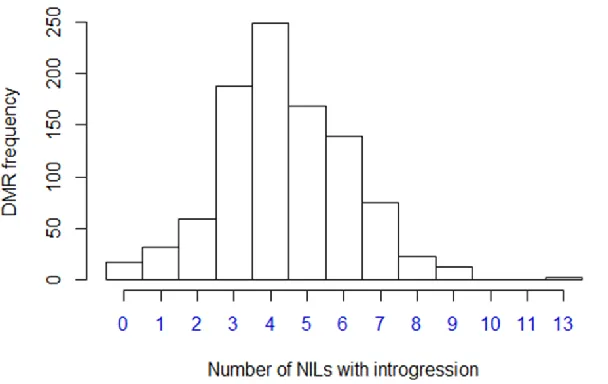
To differentiate DMR with cis, trans, or complex inheri-tance pattern, we used the informative NILs, which were
de-fined as NILs that had an introgression at the genomic location of the DMR. Only DMRs that had at least three informative NILs were used for inheritance classification. For those DMRs, the genotype of each NIL was predicted based on the methyl-ation level using the linear discriminant analysis (LDA) func-tion from R and were compared to the inferred genotypes based on another prior study (Eichtenet al.2011a). A prob-ability parameter was then calculated for each DMR based on the observed pattern of prediction using the function
n!
k!ðn2kÞ!pk(12p)n2k, where nis the number of informative NILs,kis the number of NILs with methylation matching local genotypes,pis the probability of methylation matching local genotype and was considered to be 0.5. DMRs with a proba-bility .0.13 were classified as complex DMRs. DMRs with a probability ,0.13 were classified intocisDMR if all/most of NILs were matching local genotype, andtransDMRs if all/ most of NILs were matching background genotype.
Methylation level and genotype in the intermated B73-Mo17 (IBM) RIL population (Leeet al.2002) was from pre-vious studies (Eichtenet al.2013; Liet al.2013). The study of Eichten et al. (2013) measured methylation level using the original probes on the 2.1-M array platform, while both original and newly synthesized probes were used to calcul-ate methylation level in this study. The classification criteria for inheritance patterns in the RILs were as described in Eichtenet al.(2013).
Identification of cis DMR with instability of DNA methylation levels
To identify cisDMRs with instability for DNA methylation levels, all the NILs including the NILs with or without in-trogression at the interested DMR were used. The genotypes of those NILs were predicted based on the methylation level of the DMR using the LDA function in R. A probability that the predicted genotype is different from the observed geno-type based on other genotyping technology was obtained. If this probability was ,0.8, no instability occurred; if .0.8, a putative instability was defined. This analysis was then replicated for each individual probe within the DMR. If the percentage of probes showing instability is .60%, in-stability was defined for that NIL at the DMR.
To identify unstable DMRs with high confidence, we applied the following criteria: (1) the probability of instability was raised to 0.95 instead of 0.8; (2) parental value was required to span 0 for better separation of B73- or Mo17-like genotypes;
(3) the number of NILs with instability at an interested DMR was required to be no more than three since methylation levels for DMRs with more than three unstable cases generally show a large overlap between B73-like and Mo17-like NILs; (4) after removing NILs with putative instability, Fisher’s linear discrim-inant (FLD) was calculated for the remaining NILs, and the best FLD was used to separate them into two groups. This value was required to be at least 12 for better separation of the two groups and the genotype within one group is B73 and the other group is Mo17. Application of these criteria resulted in 22 cases of instability from 19 DMRs.
Analysis of small RNA data
Small RNA data from a previous study (Regulski et al.2013, GEO accession no. GSE39232) was processed using the FASTX toolkit to remove 39adapters, control sequencing quality and select small RNA size between 21 nt and 24 nt. Small RNA mapped to tRNA, rRNA, and miRNA was removed from the analysis. The remaining small RNA was mapped to maize ge-nome, allowing up to 1000 mapping locations. For small RNA that was mapped to multiple locations, the abundance of that small RNA was normalized to the number of mapping loca-tions. Small RNA was then clustered based on the DMR unit. The small RNA levels for 21/22-nt and 23/24-nt class were summarized separately for each DMR. DMRs with at leastfive reads were regarded to be covered by small RNA. Small RNA read counts were then normalized using DESeq (Anders and Huber 2010), which was also used to identify DMRs with differentially expressed small RNA between B73 and Mo17.
Quantitative PCR validation of unstable DMRs
The exact same DNA used for microarray analysis was used in methylation-sensitive quantitative PCR (qPCR) assays to validate the instability of DMRs observed in the microarray analysis. Genomic DNA (1mg) was digested using the meth-ylation-dependent restriction enzyme FspEI (New England Biolabs) following the manuals. A mock digestion using 50% glycerol substituting the enzyme was performed in parallel as the control. The digests were performed at 37°for 8 hr fol-lowed by enzyme inactivation at 65°for 20 min. After diges-tion, 240ml water was added to the 30-ml digest, and 8.8ml was used for qPCR in a 20-ml reaction system using the Sso-Fast EvaGreen Supermix (Bio-Rad, no. 172-5201). qPCR was performed on a CFX384 Real-Time PCR system using the fol-lowing condition: 98°for 4 min to activate enzyme, followed by 40 cycles of 98°for 10 sec and 58°for 10 sec. All primers used in qPCR are listed in supporting information,Table S1.
Results
DNA methylation analyses in a B73-Mo17 near-isogenic line population using a custom array
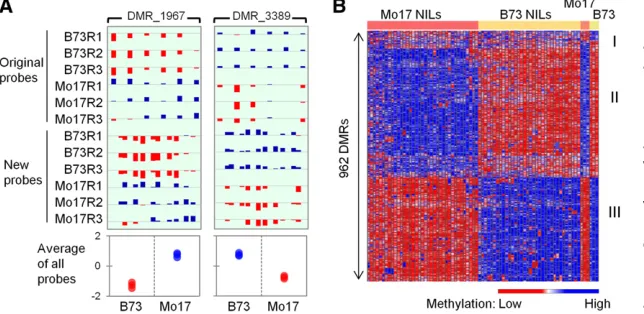
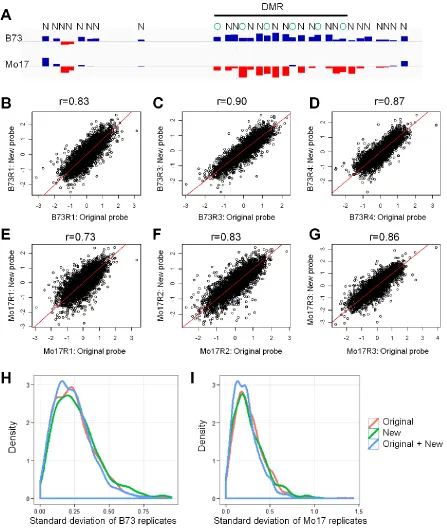
documenting the inheritance patterns and stability of these DMRs in biparental populations of maize lines. A custom multiplex microarray format that included the same probes originally used to discover the DMRs as well as additional probes within these regions and various control probes was designed and synthesized (Materials and Methods, Figure 1A, andFigure S1). The custom array was used to measure DNA methylation level in B73 and Mo17 in three biological replicates, along with a panel of 71 B73-Mo17 NILs (Eichten et al.2011a), each of which was measured in a single sam-ple (Figure 1B). The NILs included 34 lines using B73 as recurrent parent and 37 lines using Mo17 as recurrent par-ent. The NILs were developed by three rounds of back-crosses to the recurrent parent followed by three to six generations of self-pollination (Eichten et al. 2011a). This is expected to result in NILs that have93% of the genome inherited from the recurrent parent and 7% from the do-nor parent with relatively low levels of residual heterozy-gosity. The 4763 DMRs surveyed by this array platform were discovered through comparisons of DNA methylation levels in20 different maize inbred lines (Eichtenet al.2013). As the NILs are derived from B73 and Mo17, we filtered the DMRs to those displaying differences between the three bi-ological replicates of those two genotypes. There were 962 DMRs that exhibit significant differences (P , 0.05) be-tween B73 and Mo17 and subsequent analyses focus on this set of 962 DMRs (Table S2).
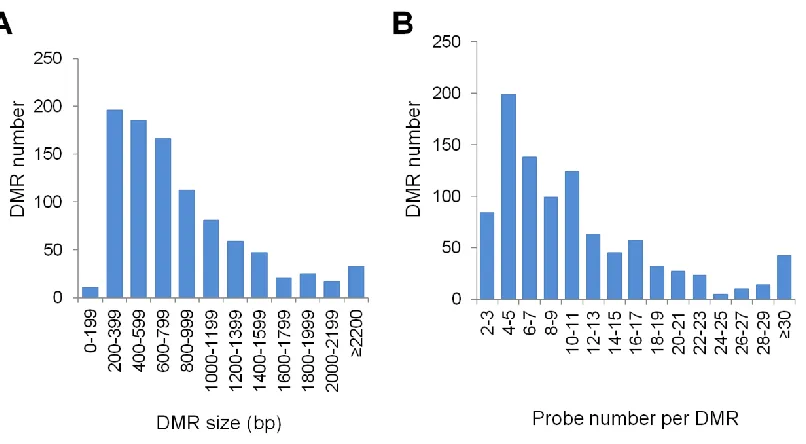
The majority of the 962 DMRs are 200–1000 bp in length and contain at least three probes (Figure S2, A and B). These DMRs are evenly distributed across the maize genome. In total, the DMRs represent797 kb (0.034%) of the 2.3-Gb maize genome, and 25% of them overlap an annotated gene (Table S2). Hierarchical clustering of DNA methylation levels for the 962 DMRs in all samples suggested that the DMRs could be roughly divided into three groups (Figure 1B). Group I (77 DMRs) showed significant difference between inbred lines B73 and Mo17, but no difference between B73-NILs and Mo17-B73-NILs. Groups II and III (885 DMRs) showed significant difference between B73 and Mo17, and also be-tween B73-NILs and Mo17-NILs. They differed in which ge-notype had a higher DNA methylation level. The high level of consistency between B73vs. Mo17 and B73-NILsvs. Mo17-NILs (885/962,92%) suggested that most of the DMRs are heritable in the NIL population. We thus proceed to classify the inheritance patterns of those DMRs.
Inheritance patterns for DMRs in NIL population
A series of criteria were employed to classify the inheritance patterns in the NIL population for the 962 significant DMRs between B73 and Mo17 (Figure 2 andTable S2). Although the classification of inheritance patterns was based solely upon the analysis of DNA methylation levels in NILs we also used information from whole-genome bisulfite sequencing of B73 and Mo17 (Eichtenet al.2013; Figure 2A andTable S2) and microarray-based DNA methylation analysis in a set of 17 intermated B73-Mo17 RILs (Eichtenet al.2013; Figure
2B and Table S3) to further characterize and validate the DMRs and their inheritance patterns.
There are 77 DMRs that do not exhibit significant differences between B73-like NILs and Mo17-like NILs. These 77 DMRs were further classified based on whether the NILs exhibit consistent DNA methylation levels similar to one parent (n = 13, paramutation like) or whether they exhibit “unclassified”patterns (n = 64). Paramutation-like DMRs were those where the methylation of the entire NIL population was similar to the methylation state of one par-ent, but significantly different from that of the other parent (Figure 2, A and C). There were only 13 DMRs that exhibited evidence for paramutation-like behavior in the NIL population. The evidence to support these DMRs from bisulfite sequencing is relatively weak as only 3/13 exhibit similar parental differences in bisulfite analyses (Table S2). The analysis of DNA methylation levels for these 13 DMRs in the RIL population does not support the classification of paramutation-like behavior (Figure 2B,Table S2andTable S3). Instead, many of these DMRs exhibit complex inheri-tance patterns in the RILs. The combined results of the NIL and RIL analysesfind little evidence for significant numbers of DMRs that exhibit strong paramutation-like inheritance. It is possible that some of these loci exhibit paramutation that is transient or has incomplete penetrance. The other 64 DMRs that do not exhibit significant differences between B73-like and Mo17-like NILs were described as unclassified. These may be the result of highly stochastic behavior or differences in the DNA methylation level between the B73 and Mo17 used for this study and the exact B73 and Mo17 used as parents for the NIL population.
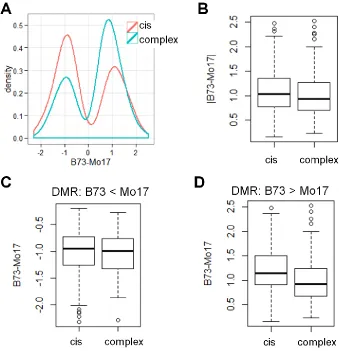
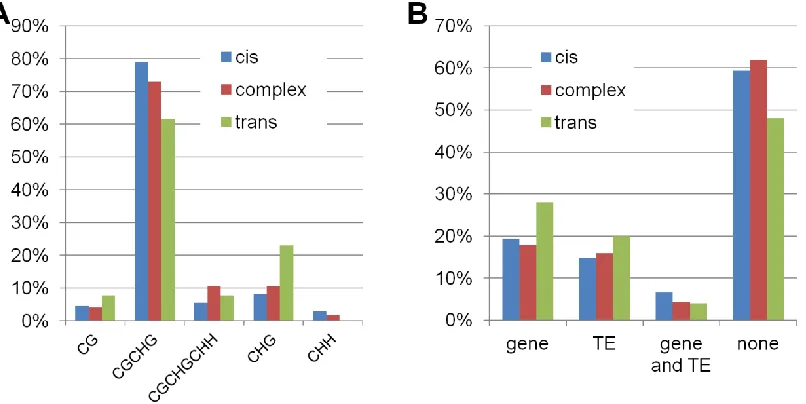
The most prevalent class of mapped DMRs (460 of 787; 58%) exhibit DNA methylation states that agree with the local genotype suggestingcis-acting control or inheritance of DNA methylation (Figure 2D). Methylation difference in 73% of these DMRs was confirmed by bisulfite sequencing (Figure 2A andTable S2). We also found that86% of the DMRs that were classified as having cisinheritance in the NIL population were also classified as havingcisinheritance in the RIL population (Figure 2B,Table S2andTable S3). A relatively small portion of the mapped DMRs (25 of 787; 3.2%) exhibit DNA methylation states that appear to be controlled by the genetic background rather than the local genotype and are classified astrans-regulated DMRs (Figure 2, A, B, and E). Bisulfite sequencing data confirmed parental differences for 59% of thosetransDMRs (Table S2). Nearly one-third (8 of 25) of thetransDMRs were also classified as havingtrans-acting control in the RIL population (Figure 2B, Table S2, andTable S3). There were a substantial number of complex DMRs that exhibit significant differences in DNA methylation, which was further confirmed by bisulfite data (69%), but they could not be unambiguously classified ascis or trans inheritance patterns (Figure 2F). These complex DMRs generally showed less parental difference than cis DMRs (Figure S4), which makes it more difficult to correlate methylation with local/background genotype, leading to some misassignment ofcisortransDMRs into this category. Indeed we found that the majority of DMRs classified as complex based on the NIL population are actually classified as cisortransin the RIL population (Figure 2B,Table S2, and Table S3). There was little evidence for major differ-ences in the context of DNA methylation differdiffer-ences or in the location of the DMRs relative to genes and transposons for DMRs that exhibited cis,trans, or complex inheritance patterns (Figure S5).
The relatively small number of trans-controlled DMRs suggests that most DMRs are inherited through mainte-nance of DNA methylation patterns as opposed to active targeting through RNA-directed DNA methylation pathway
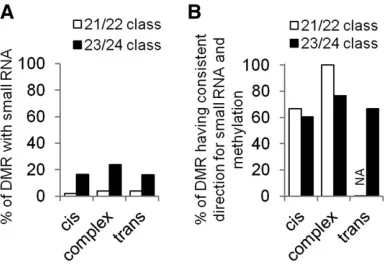
or other means. Recent studies have described small RNAs in shoot tissue of B73 and Mo17 (Regulskiet al.2013). The overlap of these small RNAs with the DMRs monitored in this study was analyzed (Figure 3). A relatively small por-tion of the DMRs are covered by small RNAs:5% by 21/ 22-nt and 20% by 23/24-nt small RNA (Figure 3A and Table S2). The DMRs with complex inheritance patterns exhibit slightly higher small RNA coverage than DMRs with cisortransinheritance patterns. It was somewhat surprising that only a small proportion (1/25 by 21/22 nt; 4/25 by 23/ 24 nt) of thetransDMRs had small RNA coverage. The lack of small RNA coverage in transDMRs could be due to the existence of other trans-acting factors or potential that the important small RNAs are not expressed in the tissues sur-veyed for small RNA abundance. The concordance of DNA methylation and small RNA coverage was assessed to de-termine if the genotype with higher DNA methylation also had higher small RNA coverage. An agreement in direction between DNA methylation levels and small RNA coverage was observed for both 21/22-nt and 23/24-nt small RNA classes and for all DMR inheritance patterns (Figure 3B). Together, these results suggested a role of small RNA in establishing/maintaining the methylation difference at a subset of the DMRs, but reveals that the majority of dif-ferential DNA methylation is not associated with small RNA presence.
Stability of DMRs across generations
A major focus of this study was to better understand the stability of inheritance for DNA methylation variation. Here, we were able to study the stability of DNA methylation variation in a segregating population that has gone through four to seven generations of self-crossing (the exact number of generations for a particular DMR cannot be determined since any particular allele may have been present in the F1 or introduced in any of the three backcrosses) (Eichtenet al. 2011a). For this purpose, only thecisDMRs were included since it is difficult to differentiate between instability and
presence of trans-acting factors for the other DMRs. We hypothesized that if the transmission process is stable, the methylation level atcisDMR would be coupled to the local genotype for all of the NILs studied; otherwise, rare exam-ples of NILs where methylation levels do not match local genotype would be observed. Thus, a comparison of the DNA methylation level and the genotype for all NILs would allow the discovery of NILs with potential instability.
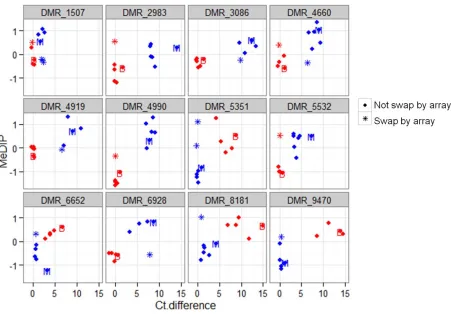
It is possible that false-positive examples of unstable DNA methylation could result from a miscalled genotype due to residual heterozygosity in the NILs or technical error in genotyping measurement. We sought to exclude unstable DMRs resulting from genotyping error by checking the genotypes of the NILs showing instability using the genotyping probe on this array platform. In addition, we assessed DNA methylation levels for every single probe within the DMR and required.60% of probes within a DMR to support an instability to minimize possible technical artifacts in array measurement. This resulted in a total of 368 unstable cases out of a total of 30,671 tests (1.2%). Seventeen examples of unstable inheritance (from 12 DMRs) were independently tested using qPCR-based analysis of DNA methylation ( Fig-ure S6; Materials and Methods). While the methyl-sensitive qPCR was able to validate the parental difference and cis inheritance pattern of these DMRs, it did not support the unstable DNA methylation for a particular NIL genotype that was suggested by the microarray profiling. In each case, the DNA methylation level found using methyl-sensitive qPCR matches the local genotype (Figure S6). To determine
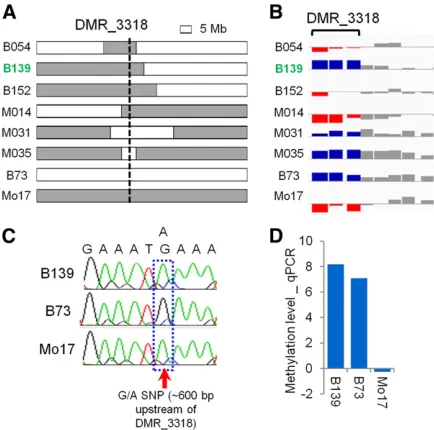
whether there are any examples of instability for cisDMRs a more stringent set of criteria (Materials and Methods) were implemented to identify the most robust examples of unsta-ble DNA methylation inheritance. This led to an identifi ca-tion of 19 DMRs with 22 cases of instability (some DMRs showed instability in more than one NIL). Methylation levels at 15 DMRs involving 18 unstable cases were assessed using methyl-sensitive qPCR (Figure S7). Only 1 of these putative 18 cases was confirmed (Figure 4 and Figure S7). It oc-curred at DMR_3318 in a B73-NIL with Mo17 introgression at the DMR, B139 (Figure 4A). B139 showed similar meth-ylation level as B73 based on both the array and qPCR mea-surement (Figure 4, B and D), but it had a Mo17 genotype based on both the genotyping probes on the array and Sanger sequencing (Figure 4, A and C). The mismatch be-tween methylation level and genotype indicated that a switch of methylation level happened after the hybridiza-tion of B73 and Mo17.
Discussion
There is a substantial interest in understanding the contri-bution of DNA methylation variation toward heritable natural variation, response to environmental conditions, as well as development. This study is focusing on studying the inheritance patterns and stability for DNA methylation variation that occurs between two parental inbreds. Nearly 1000 DMRs between the B73 and Mo17 inbreds were assessed in 71 NILs. This provided an opportunity to study
the frequency of different types of inheritance patterns as well as the stability of inheritance of locally (cis) controlled DMRs. Understanding these two issues would provide insights into frequency changes of (epi)alleles over time within a population, as well as the contribution of DNA methylation to less stable inheritance of information.
Inheritance patterns for DNA methylation variation
One of the particularly intriguing aspects of DNA methyla-tion is the potential for unexpected segregamethyla-tion behaviors. For example, there are instances in which there can be communication of epigenetic state between alleles at a single locus as in paramutation (Chandler 2007) or communica-tion between homologous loci located in distinct genomic positions as in PAI silencing (Melquist and Bender 2003). We were interested in determining the frequency at which DMRs would exhibit inheritance patterns that resemble par-amutation or trans-acting control as opposed to cis(local) inheritance. NILs provide advantages as the successive rounds of backcrossing result in maintained heterozygosity within introgression regions, providing ample opportunity for allelic interactions to occur. Second, the ability to test the effect of the genetic background (essentially all potential trans-factors) is relatively easy in a NIL population.
In our analysis of 962 DMRs, only a very small subset (13) exhibit strong evidence for paramutation-like patterns. While we have referred to these as“paramutation-like”it is also possible that these patterns could be observed due to a rare DNA methylation loss/gain in the parental plants and this would not represent a paramutation-like event. It is worth noting that our definition of paramutation-like inher-itance was relatively strict. We required that the paramuta-tion would occur at high frequency and then be highly
stable. There are some examples of paramutation, such as theB-Ilocus that exhibit full penetrant and stable behaviors (Chandler and Stam 2004). However, there are other exam-ples of paramutation, such as the p1and R-r:stdlocus, for which less stable behavior is observed (Chandler and Stam 2004; Chandler and Alleman 2008; Hollick 2010). It is quite possible that the relatively strict criteria that we used have failed to identify some examples of paramutation-like pat-terns of inheritance for DMRs. Regulskiet al.(2013) noted a slightly higher rate of paramutation-like behavior. They did not require the same level of penetrance or stability to be classified as paramutation-like and found that up to 10% of DMRs exhibit potential paramutation-like inheritance (Regulski et al.2013). The analysis of inheritance of DNA methylation patterns in epiRILs suggests that allelic commu-nication of DNA methylation states may occur for some loci but not others (Johanneset al.2009; Reinderset al.2009; Schmitz and Ecker 2012). While some loci that have re-duced DNA methylation inddm1mutant plants can regain DNA methylation, when functional DDM1 is reintroduced there are many other loci that fail to become remethylated (Johannes et al.2009). The behavior of the DMRs in these epiRILs indicated that many DMRs are not influenced by paramutation-like behavior, reinforcing the view that not all DNA methylation variation can be communicated be-tween alleles.
Among the 787 total DMRs that could be assessed forcis/ trans inheritance patterns for DNA methylation, we found that 58% exhibit cisinheritance and 3.2% exhibittrans in-heritance patterns. The remaining DMRs could not be con-clusively classified ascisortransand are classified as having complex patterns of inheritance. These complex DMRs may reflect a number of distinct biological processes. In some cases these may be examples ofcisortransinheritance that did not meet our statistical criteria for these classifications. Another potential explanation for the complex inheritance patterns of some of these DMRs could be multilocus control of DNA methylation levels. It is possible that atrans-acting factor and the local genotype interact to influence DNA methylation. A recent study (Schmitz et al. 2013b) using genome-wide association scan mapping of DNA methylation inArabidopsisdocumented a number of examples in which multiple loci influenced a particular DMR. Finally, it is worth noting that some of the complex patterns of inheritance could be the result of unstable inheritance of DNA methyl-ation patterns.
The relative paucity of DMRs that exhibit inheritance patterns reflectingtrans-acting control has been observed in other analyses of DMR inheritance. Previous studies of maize DMRs in a RIL population (Eichtenet al.2013) found relatively few trans inheritance patterns. The mapping of methyl-QTL in a soybean RIL population found that only 2.5% of the methyl-QTL mapped to trans-acting genomic regions while the other 97.5% mapped near the DMR (Schmitz et al. 2013a). However, association mapping of DNA methylation variation in Arabidopsis found more
examples oftranscontrol thanciscontrol. It is worth noting that the expected nature of many examples of trans inheri-tance patterns may inhibit the ability to accurately document them using many molecular approaches. One mechanism for trans-acting control of DNA methylation is that a homo-logous sequence located in another genomic position can generate a siRNA that can trigger RNA-directed DNA methy-lation as observed at the PAI locus (Melquist and Bender 2003). Note that in this case, there are multiple closely re-lated sequences in a genome. In our analyses, the DMRs were discovered through meDIP-array analysis and the microarray probes were required to be single copy (no other sequence with.90% identity found in the maize B73 refer-ence genome). This may have removed many of the exam-ples of potential trans-acting control from the survey. The trans-acting control that we are most likely to identify in our dataset are cases in which Mo17 contains a homologous sequence that is lacking from the B73 reference genome or examples in which the extra copy of a sequence is missing from the reference genome assembly. We did attempt to map the genetic position of the trans-acting factor in the NILs and were able to find a putative genomic region for 17 of the 25transDMRs. Six of these 17 DMRs also exhibit transinheritance patterns in RILs and map to the same ge-nomic locations. However, our attempts to validate these examples of trans-acting control were confounded by re-lated sequences. Methyl-sensitive qPCR assays for many of the trans DMRs revealed amplification of multiple related
sequences in at least one of the genotypes. The difficulties in identifying and validatingtrans-acting control of DNA methy-lation will not only be limited to the approaches used in this work, but also apply to other approaches using sequencing technology. Whole-genome bisulfite sequencing studies often require unique alignments of reads to a single genomic po-sition. If the locus that generates thetrans-acting signal is highly similar it may prevent the ability to quantify DNA methylation and detect variation using whole genome bi-sulfite sequencing.
Many studies of inheritance patterns for natural variation in DNA methylation have found a large number of examples of DMRs withcisor local inheritance (Vaughnet al.2007; Eichten et al. 2013; Regulski et al. 2013; Schmitz et al. 2013a,b). In addition, the analysis of inheritance of altered DNA methylation patterns in epiRILs has found relatively stable inheritance of allelic DNA methylation patterns that are induced by ddm1 or met1 loss of function (Johannes et al. 2009; Reinders et al. 2009). The cis inheritance of DNA methylation can reflect two different potential pro-cesses. In some cases thecisinheritance pattern could actu-ally reflectcis-acting genetic variation that directs the DNA methylation. For example, the insertion of a transposon in one allele could result in DNA methylation of neighboring sequences. Schmitz et al. (2013b) noted that a number of the methyl-QTL that map inciscontain structural variation or TE insertions in Arabidopsis. This type ofcisinheritance reflects the genetic influences on DNA methylation and has been described as obligatory epialleles (Richards 2006). Al-ternatively,cisinheritance could reflect highly stable inher-itance of DNA methylation information in the absence of any causative genetic changes,i.e., pure epiallele (Richards 2006; Eichtenet al.2011b).
Stability of inheritance for cis-controlled DNA methylation variation
Our dataset provided an opportunity to study the stability for the inheritance of DNA methylation over four to seven generations in a biparental population. The DMRs that generally exhibit cis inheritance pattern were analyzed to determine if there were any NILs that exhibit an unexpected association between genotype and methylation status for a particular DMR. A small number of unstable DNA methyl-ation states relative to genotype were identified (1.2% of all potential cases). However, attempts to validate these exam-ples of unstable behavior were not successful (Figure S6). A further attempt to validate only the most robust examples only found evidence to support 1 of the 18 examples (Figure S7). This suggests that DMRs that show local inheritance are quite stably inherited. Given that we could only validate one example of instability the estimated“mutation”rate for DNA methylation level of a DMR would be approximated as 1/ (30,671 tests 37 generations) [4.631026]. Due to the small numerator, this rate might be a quite unreliable esti-mate of the true rate. The analysis of DNA methylation in Arabidopsisaccessions that have been grown for 30 generations
without selection revealed that the estimated mutation rate permCG per generation is 4.531024(Schmitzet al. 2011). However, in this study the rate of DMR changes (regional changes in DNA methylation level rather than single base changes) was much lower, consistent with the idea that methylation mutation rate over a large region is smaller than single sites (Beckeret al.2011; Schmitzet al. 2011).
Although we do observe quite stable inheritance for some DMRs, we cannot conclude that all DMRs will exhibit stable behavior. DMRs that exhibit unstable inheritance would not be classified as havingcisinheritance patterns. Instead, these examples would be classified as complex patterns. Alternatively, highly unstable DMRs may not even be discovered in many experiment designs. The 962 DMRs used for this study were selected because they exhibit sig-nificant differences in three biological replicates of B73 compared to three biological replicates of Mo17. If a DMR is highly unstable, then it may not exhibit consistent behavior within the inbred parents and may not even be selected for analysis within the population. Many of the other studies on inheritance of DMRs find that at least a subset of the DMRs exhibit stable behavior that can be mapped to cis or trans genomic regions (Schmitz et al. 2013a,b) but in each case there are also a number of the DMRs that cannot be attributed to particular causes. These may be analogous to the DMRs that we classified as com-plex and may reflect a subset of DMRs with high levels of instability. Future work is important to more clearly docu-ment the range of stabilities exhibited by natural variants for DNA methylation.
Acknowledgments
Evan Starr assisted with the DNA isolations and microarray hybridizations for this study. Computational support was provided by the Minnesota Supercomputing Institute and the Texas Advanced Computing Center. This work was supported by a grant from the National Science Foundation to N.M.S. (DBI-1237931).
Literature Cited
Anders, S., and W. Huber, 2010 Differential expression analysis for sequence count data. Genome Biol. 11: R106.
Barber, W. T., W. Zhang, H. Win, K. K. Varala, J. E. Dorweileret al., 2012 Repeat associated small RNAs vary among parents and following hybridization in maize. Proc. Natl. Acad. Sci. USA 109 (26): 10444–10449.
Becker, C., J. Hagmann, J. Müller, D. Koenig, O. Stegle et al., 2011 Spontaneous epigenetic variation in the Arabidopsis thaliana methylome. Nature 480: 245–249.
Bender, J., 2004 DNA methylation of the endogenous PAI genes in Arabidopsis. Cold Spring Harb. Symp. Quant. Biol. 69: 145– 153.
Brunner, S., K. Fengler, M. Morgante, S. Tingey, and A. Rafalski, 2005 Evolution of DNA sequence nonhomologies among maize inbreds. Plant Cell 17(2): 343–360.
Cao, X., and S. E. Jacobsen, 2002 Role of the Arabidopsis DRM methyltransferases in de novo DNA methylation and gene si-lencing. Curr. Biol. 12(13): 1138–1144.
Chan, S. W.-L., I. R. Henderson, and S. E. Jacobsen, 2005 Gardening the genome: DNA methylation in Arabidopsis thaliana. Nat. Rev. Genet. 6: 351–360.
Chandler, V. L., and M. Stam, 2004 Chromatin conversations: mechanisms and implications of paramutation. Nat. Rev. Genet. 5: 532–544.
Chandler, V., 2007 Paramutation: from maize to mice. Cell 128 (4): 641–645.
Chandler, V., and M. Alleman, 2008 Paramutation: epigenetic in-structions passed across generations. Genetics 178(4): 1839– 1844.
Cubas, P., C. Vincent, and E. Coen, 1999 An epigenetic mutation responsible for natural variation infloral symmetry. Nature 401: 157–161.
Eichten, S. R., J. M. Foerster, N. de Leon, K. Ying, C.-T. Yehet al., 2011a B73-Mo17 near-isogenic lines demonstrate dispersed structural variation in maize. Plant Physiol. 156(4): 1679–1690. Eichten, S. R., R. A. Swanson-Wagner, J. C. Schnable, A. J. Waters, P. J. Hermanson et al., 2011b Heritable epigenetic variation among maize inbreds. PLoS Genet. 7(11): e1002372.
Eichten, S. R., N. A. Ellis, I. Makarevitch, C.-T. Yeh, J. I. Gentet al., 2012 Spreading of heterochromatin is limited to specific fam-ilies of maize retrotransposons. PLoS Genet. 8(12): e1003127. Eichten, S. R., R. Briskine, J. Song, Q. Li, R. Swanson-Wagneret al.,
2013 Epigenetic and genetic influences on DNA methylation variation in maize populations. Plant Cell 25(8): 2783–2797. Fu, H., and H. K. Dooner, 2002 Intraspecific violation of genetic
colinearity and its implications in maize. Proc. Natl. Acad. Sci. USA 99(14): 9573–9578.
Havecker, E. R., L. M. Wallbridge, P. Fedito, T. J. Hardcastle, and D. C. Baulcombe, 2012 Metastable differentially methylated regions within Arabidopsis inbred populations are associated with modified expression of non-coding transcripts. PLoS ONE 7(9): e45242.
Hollick, J. B., 2010 Paramutation and development. Annu. Rev. Cell Dev. Biol. 26: 557–579.
Johannes, F., E. Porcher, F. K. Teixeira, V. Saliba-Colombani, M. Simonet al., 2009 Assessing the impact of transgenerational epigenetic variation on complex traits. PLoS Genet. 5(6): e1000530.
Li, L., K. Petsch, R. Shimizu, S. Liu, W. W. Xu et al., 2013 Mendelian and non-Mendelian regulation of gene ex-pression in maize. PLoS Genet. 9(1): e1003202.
Lee, M., N. Sharopova, W. D. Beavis, D. Grant, M. Katt et al., 2002 Expanding the genetic map of maize with the intermated B73 x Mo17 (IBM) population. Plant Mol. Biol. 48(5–6): 453– 461.
Manning, K., M. Tör, M. Poole, Y. Hong, A. J. Thompson et al., 2006 A naturally occurring epigenetic mutation in a gene en-coding an SBP-box transcription factor inhibits tomato fruit rip-ening. Nat. Genet. 38: 948–952.
Manolio, T. A., F. S. Collins, N. J. Cox, D. B. Goldstein, L. A. Hin-dorffet al., 2009 Finding the missing heritability of complex diseases. Nature 461: 747–753.
Martin, A., C. Troadec, A. Boualem, M. Rajab, R. Fernandezet al., 2009 A transposon-induced epigenetic change leads to sex de-termination in melon. Nature 461: 1135–1138.
Melquist, S., B. Luff, and J. Bender, 1999 Arabidopsis PAI gene arrangements, cytosine methylation and expression. Genetics 153(1): 401–403.
Nobuta, K., C. Lu, R. Shrivastava, M. Pillay, E. De Paoli et al., 2008 Distinct size distribution of endogenous siRNAs in maize: evidence from deep sequencing in the mop1–1 mutant. Proc. Natl. Acad. Sci. USA 105(39): 14958–14963.
Petronis, A., 2010 Epigenetics as a unifying principle in the aeti-ology of complex traits and diseases. Nature 465: 721–727. Reinders, J., B. B. H. Wulff, M. Mirouze, A. Marí-Ordóñez, M. Dapp
et al., 2009 Compromised stability of DNA methylation and transposon immobilization in mosaic Arabidopsis epigenomes. Genes Dev. 23: 939–950.
Regulski, M., Z. Lu, J. Kendall, M. T. A. Donoghue, J. Reinders et al., 2013 The maize methylome influences mRNA splice sites and reveals widespread paramutation-like switches guided by small RNA. Genome Res. 23: 1651–1662.
Richards, E. J., 2006 Inherited epigenetic variation—revisiting soft inheritance. Nat. Rev. Genet. 7: 395–401.
Riddle, N. C., and E. J. Richards, 2002 The control of natural variation in cytosine methylation in Arabidopsis. Genetics 162 (1): 355–363.
Schmitz, R. J., M. D. Schultz, M. G. Lewsey, R. C. O’Malley, M. A. Urich et al., 2011 Transgenerational epigenetic instability is a source of novel methylation variants. Science 334(6054): 369–373.
Schmitz, R. J., and J. R. Ecker, 2012 Epigenetic and epigenomic variation in Arabidopsis thaliana. Trends Plant Sci. 17(3): 149– 154.
Schmitz, R. J., Y. He, O. Valdés-López, S. M. Khan, T. Joshiet al., 2013a Epigenome-wide inheritance of cytosine methylation variants in a recombinant inbred population. Genome Res. 23: 1663–1674.
Schmitz, R. J., M. D. Schultz, M. A. Urich, J. R. Nery, M. Pelizzola et al., 2013b Patterns of population epigenomic diversity. Na-ture 495: 193–198.
Schnable, P. S., D. Ware, R. S. Fulton, J. C. Stein, F. Weiet al., 2009 The B73 maize genome: complexity, diversity, and dy-namics. Science 326(5956): 1112–1115.
Vaughn, M. W., M. Tanurdži´c, Z. Lippman, H. Jiang, R. Carrasquillo et al., 2007 Epigenetic natural variation in Arabidopsis thaliana. PLoS Biol. 5(7): e174.
Yang, Q., Z. Li, W. Li, L. Ku, C. Wang et al., 2013 CACTA-like transposable element in ZmCCT attenuated photoperiod sensi-tivity and accelerated the postdomestication spread of maize. Proc. Natl. Acad. Sci. USA 110(42): 16969–16974.
GENETICS
Supporting Information http://www.genetics.org/lookup/suppl/doi:10.1534/genetics.113.158980/-/DC1
Inheritance Patterns and Stability of DNA
Methylation Variation in Maize Near-Isogenic Lines
Qing Li, Steven R. Eichten, Peter J. Hermanson, and Nathan M. Springer
Table S1 Primers used in this study
Name Forward sequence Reverse sequence
Tables S2-S3 are available for download as Excel files at
http://www.genetics.org/lookup/suppl/doi:10.1534/genetics.113.158980/-/DC1
Table S2 DMR inheritance pattern in NIL population