A New Provably Secure Authentication and Key Agreement
Protocol for SIP Using ECC
∗
Liufei Wu
1,
2, Yuqing Zhang
1, Fengjiao Wang
11(National Computer Network Intrusion Protection Center, GUCAS, Beijing, China 100049) 2(Communication Engineering Institute, Xidian University, Xi’an, China 710071)
Abstract
SIP is playing a key role in the IP based services and has been chosen as the protocol for multimedia application in 3G mobile
networks by the Third-Generation Partnership Project. The authentication mechanism proposed in SIP specification is HTTP
digest based authentication, which allows malicious parties to impersonate other parties or to charge calls to other parties,
furthermore, other security problems, such as off-line password guessing attacks and server spoofing, are also needed to be
solved. This paper proposes a new authenticated key exchange protocol NAKE, which can solve the existed problems in the
original proposal. The NAKE protocol is provably secure in CK security model, thus it inherits the corresponding security
attributes in CK security model.
Key words: SIP; NAKE protocol; CK security model; Provable security
1 Introduction
The Internet Engineering Task Force (IETF) proposed the Session Initiation Protocol (SIP) as the IP-based telephony protocol [1]. SIP is a text based protocol with similar formatting to HTTP capable of operating on TCP or UDP and handles all the signaling requirements of a Voice over IP (VoIP) session, which is analogous to the SS7
protocol in traditional telephony [2]. It is an application-layer signaling protocol for creating, modifying, and terminating multimedia sessions with one or more participants [1]. Currently, the security of SIP is becoming more
and more important. SIP specification does not include any specific security mechanisms. SIP authentication is inherited from HTTP Digest authentication, which is a challenge-response based authentication protocol.
1.1 History and Related Work
Security and privacy requirements in a VoIP environment are expected to be equivalent to those in Public switched telephone network (PSTN), even though the provision of secure Internet services is much more
complicated. Salsano et al pointed out that the HTTP digest authentication in SIP suffers from two major weaknesses when it is applied in SIP [3]. One is the lack of securing all headers and parameters in SIP which
would possibly need protection. The other is the requirement of pre-existing user configuration on servers. Furthermore, a methodology for the evaluation of the processing cost of SIP authentication procedure is also given in their work, which is of great meaning. HTTP Digest authentication scheme in SIP can offer one-way message
∗
This work is supported by National Natural Science Foundation of China (grant Nos. 60573048, 60373040). 1
Corresponding author: Tel: +86-010-68860988, Fax: +86-010-68860988.
authentication and replay protection but not the support message integrity and confidentiality. According to RFC
3261 [1], it is very possible for a malicious user to place spam calls and send a manipulated message to cause a Dos. Moreover, this method is vulnerable to well known plaintext, replay attack, off-line password guessing attack, man-in-the-middle attacks and server spoofing [4, 5].
Since the current authentication mechanism is not providing security at an acceptable level, several new schemes are proposed to improve it. An identity-based authentication and key agreement protocol without formal
analysis was presented in [6], and the off-line password guessing attack and server spoofing attack to original authentication mechanism have been found. A SIP authentication scheme by using a public key exchange mechanism using Elliptic Curve Cryptography (ECC) was proposed in [7]. It has significant advantages like
smaller key sizes, faster computations on behalf of other Public Key Cryptography systems that obtain data transmission more secure and efficient. However, it is vulnerable to man-in-the-middle attack, and does not reflect
the good characteristics of Elliptic Curve Diffie-Hellman (ECDH) protocol.
1.2 Our Solution
This paper proposes the use of ECC cryptography as a solution to the authentication and key agreement problems that exist in SIP. This new SIP authentication mechanism and key agreement protocol provides mutual authentication and provable security in Canetti-Krawczyk (CK) security model. This solution fits neatly in the SIP
protocols as described in RFC 3261 [1].
1.3 Outline of Paper
Section 2 presents some background information about SIP authentication scheme, RFC3310. In section 3, the new SIP key agreement protocol is shown. The security proof is given in section 4. This is followed by a discussion of the proposed solution and observed limitations in Section 5. Finally, Section 6 concludes the paper.
2
SIP Authentication Procedure
SIP authentication [2] security is based on the challenge-response mechanism, in which a nonce value is used in
challenging the target. Before the scheme starts, the client pre-shares a password with the server. SIP applies the digest mechanism for authenticating users to users or users to proxies, not proxies to proxies. The security between
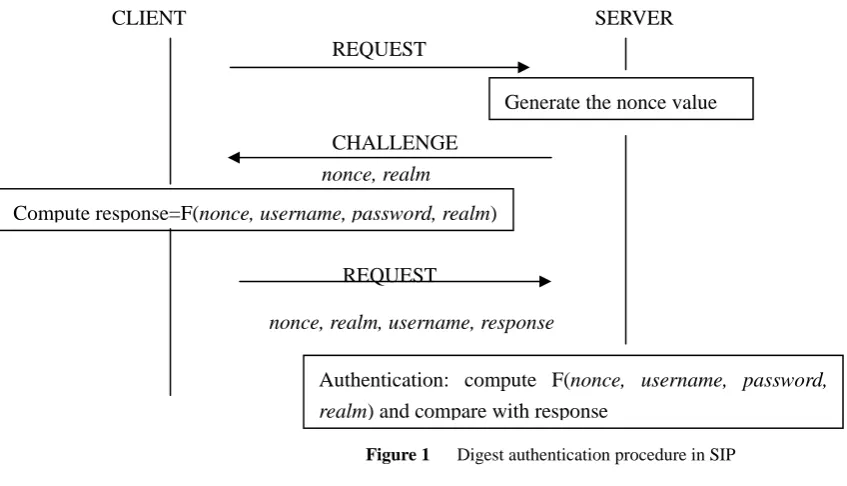
proxies relies on other mechanisms, for example TLS or IPsec. Figure 1 is an example flow of authentication mechanism in SIP.
Step 1. client→server: REQUEST
The client sends a REQUEST to the server.
Step 2. server→client: CHALLENGLE(nonce, realm)
The server sends an response message containing a nonce value and a realm to the client. The response is actually an error message requesting authentication. The realm in the message is the digest algorithm used in this challenge. Step 3. client→server: RESPONSE(nonce, realm, username, response)
The client computes the response, which is computed with nonce value received in challenge, a username and a secret password. Then the client sends back the original request message with the computed response value,
username, nonce value and realm.
nonce is correct. If it is correct, the server computes F (nonce, username, password, realm) and compare it with the
response. If they match, the server authenticates the identity of the client.
CLIENT SERVER
REQUEST
CHALLENGE
nonce, realm
REQUEST
nonce, realm, username, response
Figure 1 Digest authentication procedure in SIP
3
A New Authentication and Key Exchange Protocol for SIP
This new authentication and key exchange protocol for SIP uses the provably secure implementation of ECDH protocol and provides authentication of both parties at the end of the handshake, while ensuring that the operation
remains consistent with the requirements of RFC3261. Figure 2 is a message flow describing a Digest AKE process of authenticating a SIP REGISTER request.
Client→Server: REGISTER
Server→Client: 401: Unauthorized
{
server realm oopaque fnonce, , ,}
Client→Server: Authorization
{
'(
')
}
, , , , , , , , , ,
client realm opaque fnonce f k realm client opaque nonce nonce server
Server→Client: 200 OK
{
(
')
}
, , , , , , , , ,
client realm opaque f k realm server opaque nonce nonce client
Authentication: compute F(
nonce, username, password,
realm
) and compare with response
Compute response=F(
nonce, username, password, realm
)
Generate the nonce value
Figure 2 NAKE protocol
3.1 Initial Information
The correct and secure operation of this protocol depends upon a number of realistic assumptions. It is assumed
that all parties have globally agreed upon a nonsingular high elliptic curve,E F
( )
q , whereP∈E F
( )
q , and be of ordern, such as would be defined by an appropriate standards body. PS, PCdenotes the identities of client and server respectively, opaque string is used as a session identifier, denotes bys.f is a hash function. Furthermore it is assumed that all private keys remain private and secure, and that nonce will not be reused.3.2 Description
The proposed authentication and key agreement operation is similar to the HTTP Digest using AKA Mechanism, and as stated can operate without changing the semantics of RFC3310. The handshake is described here:
kis stored in the ISIM, which resides on a smart card like, tamper resistant device. 2. Client makes request of a SIP service requiring authentication (REGISTER).
3. Server chooses ephemeral private keyx, x∈R
[
1,n−1]
and calculates nonceα=x Pi , fnonce . Then, it prepares 401 Unauthorized Authentication Required as appropriate. This response is a challenge consisting of: a realm string, fnonce, opaque string, and identity of the Server. An opaque string is used as a session identifier,noted( )
k fα⊕
s.
4. Client verifies the server response using the shared secret . Client then chooses an ephemeral private key , and calculates nonce
k y
y P
β = i , fnonceβ⊕ f
( )
k and produces an authentication responsef k P s(
, C, , , ,β α PS)
. Then, client derives session keysk=yiα.5. Client sends the response along with their username, realm, nonce and opaque string in clear text to the entity requesting authentication.
6. Server verifies the response with
k
respectively, and prepares an authentication responsef k P s(
, s, , , ,α β PC)
. Thus, server derives session keysk
=
xiβ.7. Server responds with appropriate error message or grants access. If grants access, the responds consist of the realm, opaque string and the hash value based onk.
3.3 CK Security Model
CK security model [8] presents definition of SK-security, allows for modular design and analysis of key
exchange protocol, which simplifies the difficulty of design and analysis of security protocol. The security definition is based on the concept of indistinguishability
The attacker model follows the unauthenticated-links model (UM) that the attacker is a (probabilistic) polynomial-time machine with full control of the communication lines between parties. In addition, the attacker can have access to secret information via session exposure attacks of three types: session-state reveal, session-key
queries, and party corruption. The first type of attack is directed at a single session which is incomplete and the result is that the attacker learns the session state of that particular session. A session-key query can be performed
against an individual session after completion and the result is that the attacker learns the corresponding session-key. Finally, party corruption means that the attacker learns all information in the memory of that party; in addition, from the moment a party is corrupted all its actions are totally controlled by the attacker.
Sessions can be expired in the model of CK. From the time a session is expired the attacker is not allowed to perform a session-key query or a state-reveal attack against the session, but is allowed to corrupt the party that
holds the session. Protocols that ensure that expired sessions are protected even in case of party corruption are said to enjoy “perfect forward secrecy”.
For defining the security of a KE protocol, CK follows the indistinguishability style of definitions that the
“success” of an attacker is measured via its ability to distinguish the real values of session keys from independent random values. When the attacker chooses the test session it is provided with a value
υ
which is chosen as follows: a random bitbis tossed, ifb=0thenυis the real value of the output session-key, otherwiseυis a random valuechosen under the same distribution of session-keys produced by the protocol, but independent of the value of the real session key. After receivingυ, the attacker may proceed with the regular actions against the protocol; at the
end of its run the attacker outputs a bit . The attacker succeeds in its attack if (1) the test session is not exposed,
and (2) the probability that is significantly larger than1 . Note that the attacker is allowed to corrupt a party
to the test session once the test expires at that party (this captures perfect forward secrecy). '
b
'
b=b / 2
one fundamental difference: the attacker is restricted to only deliver messages truly generated by the parties
without any change or addition to them. Then the notion of “emulation” is introduced in order to capture the equivalence of functionality between protocols in different adversarial models, in particular between the UM and AM.
The resultant security notion for KE protocols is called SK-security and is stated as follows:
Definition 1. (SK-security) An attacker with the above capabilities is called an SK-attacker. A key-exchange protocolπ is called SK-secure if for all SK-attackerArunning againstπit holds:
1. If two uncorrupted parties complete matching sessions in a run of protocolπ under attacker then, except
for a negligible probability, the session key output in these sessions is the same.
A
2. succeeds in its test-session distinguishing attack with probability not more than 1 plus a negligible fraction.
A / 2
3.4 Security Proof of NAKE Protocol
We first demonstrate that under the Elliptic Curve Decisional Diffie-Hellman (ECDDH) assumption the classic two-move Elliptic Curve Diffie-Hellman key-exchange protocol designed to work against an eavesdropper only is
SK-secure in the AM. We denote this protocol by ECDH and describe it in Figure 2. Using Theorem 1 we can apply an appropriate authenticator to this protocol to obtain a secure Elliptic Curve Diffie-Hellman exchange against realistic UM attackers.
common information:prime P∈E Fq
( )
of ordern。goal:server and client share a session key: sk=xiβ=yiα
1. server→client:s P, S,α ⊕f k
( )
,α=x Pi2. client→server:s P, C,β⊕f k
( )
, β=y PiFigure 3 ECDH protocol
The Elliptic Curve Decisional Diffie-Hellman (ECDDH) assumption is as follows:
ECDDH Assumption Let
E
be a nonsingular high Elliptic Curve on finite fieldFq, LetP∈E F( )
q be of order n , x y z, , ∈R[
1,n−1]
. Then the probability D distributes quintuples0 , , ,
Q = P x P y P x y Pi i i i andQ1= P x P y P z P, i , i , i is computationally indistinguishable.
Theorem 2 If ECDDH assumption holds, protocol ECDH is SK-secure in the AM.
Proof: To see that the first requirement of Definition 1 is satisfied, note that if both parties are uncorrupted during the exchange of the key and both complete the protocol then they both establish the same key (which is
sk
). Note that the session identifier suniquely binds the values of α⊕f( )
k and β⊕f( )
k to these particular matching sessions and differentiates them from other exponentials that the parties may exchange in other sessions.We show that the second requirement of Definition 1 is also satisfied by protocol ECDH. Assume to the contrary that there is a KE-adversaryΑin the AM against protocol ECDH that has a non-negligible advantageεin guessing correctly whether the response to a test-query is real or random. Out of this attacker , we construct an algorithmDthat distinguishes between the distributions and with non-negligible probability, thus reaching a
contradiction with Assumption 1. AlgorithmDuses adversary as a subroutine and is described in Figure 4. Α
0 Q Q1
Α
Proceed as follows, on input q P, ,α β γ*, *, * :
2. .Invoke on a simulated interaction in the AM with parties running ECDH. Hand the values, ,
Α Α
q Pas the public parameters for the protocol execution.
3. Whenever activates a party to establish a new session (except for the r-th session) or to receive a message, follow the instructions of ECDH on behalf of that party. When a session is expired at a player erase the corresponding session key from that player’s memory. When a party is corrupted or a session (other than the r-th session) is exposed, hand all the information corresponding to that party or session as in a real interaction.
Α
Α
4. When the r-th session, say
(
P P sS, C,)
, is invoked with PS to exchange a key withPC, letPSsend themessage
(
P sS, ,α*)
toPC.5. When PC is invoked to receive
(
)
*
, ,
S
P sα , let PCsend the message
(
)
*, , C
P s β toPS.
6. If session
(
P P sS, C,)
is chosen byΑas the test-session, then provideΑwithγ*as the answer to this query.7. If the r-th session is ever exposed, or if a session different than the r-th session is chosen as
the test-session, or if halts without choosing a test-session thenDoutput and halts.
(
P P sS, C,)
Α '
{ }
0,1
R
b ←
8. IfΑhalts and outputs a bit ', thenDhalts and output too.
b b'
Figure 4 Distinguisher D
First note that the run ofΑbyDis identical to a normal run ofΑagainst protocol ECDH.
Consider the case in which the test session coincides with the r-th session, and then the response to the test-query byΑis
γ
*. In addition, input toDwas chosen with probability that 1 from and , and the advantage that guesses correctly whether the test value was “real” or “random” is/ 2
Q
0 Q1Α ε . Thus the
distinguisherDguesses correctly the input distributionQ0or
Q
1with the same probability 1/ 2+εasΑdid. Now consider the case in which the r-th session is not chosen as a test-session. In this case always ends outputting a random bit, and thus its probability to guess correctly the input distribution is 1 .D
/ 2
Since the first case happens with probability 1 while the other case happens with probability we get that the overall probability ofDsucceeds in distinguishing from with non-negligible advantage.
/l 1 1/− l
0 Q Q1
1. server→client:m 2. client→server:m N, C
3. server→client:m f k m N,
(
, , C⊕f k( )
,PC)
Figure 5 Pre-shared key based MT-authenticator
Applying the signature-based authenticator in figure 5 to each of the flows in ECDH protocol and joining
(piggy-baking) the common flows,then we can get protocol NAKE in UM. Follows from Theorems 1 and 2, NAKE is a SK-secure protocol under UM.
4
Discussion
The new SIP authentication mechanism and key agreement protocol proposed here meets the goal and requirements stated above. The cryptographic primitive used to provide the assurances are provably secure in CK
security model. Non-repudiation, protection against replay and session hijacking attacks, and mutual authentication are by-products from the use of ECC cryptography and hash value. We analyze the security of our scheme as
follows. Replay attack
Replay attacks cannot work in this scheme can be provided by the freshness of session ids.
Off-line password guessing attack
( )
(
( )
)
(
)
(
( )
(
( )
)
)
(
, C, , , , S)
f k P s f k ⊕ f k ⊕β f k ⊕ f k ⊕α P and f k P s f k
(
, , ,s(
( )
⊕(
f k( )
⊕α)
)
,(
f k( )
⊕(
f k( )
⊕β)
)
,PC)
. Obviously, the attacker cannot compute the value to match the RESPONSE, because it faces the difficulty of discrete logarithms. Therefore, the protocol is immune to the off-line password guessing attack.k
Server spoofing
The server computes shared key
sk
=
xiβand sendsf k P s(
, , , , ,s α βPC)
to the client. The client can verify theidentity of the server by computingf k P s
(
, , , , ,s α βPC)
. Thus, the attacker cannot impersonate the server to deceivethe client. Meanwhile, the client derives shared key by computingsk=yiα and sends f k P s
(
, C, , , ,β αPS)
to theserver. Then, the server can verify the identity of client. Mutual authentication
Both parties produce a hash value based on pre-shared key for mutual authentication, and meet the security
objectives of mutual authentication. Mutual key agreement and control
Protocol AKE based on Diffie-Hellman key exchange, freshness of session key to ensure appropriate selection of random numbers. Two sides enjoy a separate key based on hash value produced by pre-shared key. Security parametersαandβwere each randomly selected by the server and client. Thus, server and client are beyond the
control of key generation. Mutual key confirm
After the end of the protocol by the hash value f k P s
(
, , , , ,s α βPC)
and f k P s(
, C, , , ,β αPS)
of server and clientrespectively, moreover the two sides can ensure that they have a specific key.
Perfect forward secrecy
Session key is established by Diffie-Hellman key exchange, thus, AKE protocol have the attractive property of
PFS.
Furthermore, its total execution times and memory requirements of proposed scheme have been improved in comparison with non-elliptic approaches by adopting elliptic-based key exchange mechanism. It is more efficient
and preferable in the applications which require low memory and rapid transactions. However, this new scheme has its limitations. It requires a pre-arranged trusted environment for password distribution as Digest authentication
does. But it is fortunate that this new protocol could easily be extended to PKI circumstances, which would have the same security attributes.
5
Conclusion
This paper proposes a new authentication scheme for SIP, which overcomes the inherent weaknesses of AKA scheme, achieves the authentication and a shared secret at the same time and provides provable security in CK
security model. This solution fits neatly in the SIP protocols as described in RFC3261 .The new protocol has security attributes required by SIP standard and requires only minimal changes to the standard. The scheme is designed to provide data confidentiality, data integrity, authentication, access control, and perfect forward secrecy,
Acknowledgments
The authors would like to thank the anonymous reviewers for their constructive comments. This research was partially supported by National Natural Science Foundation of China (grant Nos. 60573048, 60373040).
References
[1] Rosenberg, J, Schulzrinne, H, Camarillo, G, et al, SIP: Session Initiation Protocol, RFC 3261, June 2002.
[2] Niemi, A, Nokia, Arkko, et al, Hypertext Transfer Protocol (HTTP) Digest Authentication Using Authentication and Key Agreement (AKA).
RFC 3310, September 2002.
[3] Salsano Stefano, Veltri Luca and Papalilo Donald, SIP security issues: the SIP authentication procedure and its processing load, IEEE
Network, Volume 16 (Issue 6, Nov-Dec 2002) 38-44.
[4] Yang C C, Wang R C, Liu W T. Secure authentication scheme for session initiation protocol, Computer &Security, 2005, vol.24: 381-386.
[5] Chia-Chen Chang, Yung-Feng Lu, Ai-Chun Pang etc.Design and Implementation of SIP Security. C.Kim (Ed.): ICOIN 2005,LNC 3391,
( Springer, Berlin, 2005) 669-678.
[6] Jared Ring, Kim-Kwang Raymond Choo, Ernest Foo, et a, A New Authentication Mechanism and Key Agreement Protocol for SIP Using
Identity-based Cryptography, AusCERT2006 R&D Stream. Gold Coast, Australia, 2006.
[7] Aytunc Dulanik, Ibrahim Sogukpinar, SIP Authentication Scheme using ECDH, In: ENFORMATIKA, 2005, Vol (V8 2005 ISSN 1305-5313)
350-353.
[8] Canetti R, Krawczyk H, Analysis of Key-Exchange Protocols and Their Use for Building Secure Channels, In: Pfitzmann ed.Proceedings of