Research
Web exclusive Research
Nipissing District Developmental Screen
Patterns of use by physicians in Ontario
Marjolaine M. Limbos
PhD CPsychDavid P. Joyce
MD CCFPG. Jane Roberts
MScABSTRACT
OBJECTIVE
To determine if providing the Nipissing District Developmental Screen (NDDS) free of charge is associated with increased use of this measure and to investigate regional variations in the use of the NDDS in Ontario.DESIGN
Retrospective analysis of purchasing data from before the NDDS was available at no costcompared with analysis of the results of a brief questionnaire completed by those downloading the NDDS for free.
SETTING
Ontario.PARTICIPANTS
Users of the NDDS.INTERVENTION
Provision of free on-line access to the NDDS.MAIN OUTCOME MEASURES
Patterns of purchasing or downloading of the NDDS by FPs and health care professionals (HCPs) before and after implementation of the program.RESULTS
Before the program, 91 FPs (0.9% of FPs in Ontario) purchased the NDDS, and an additional 129 FPs (1.3% of FPs in Ontario) downloaded the NDDS in the year after the start of the program. Including all other HCPs increased the estimated number of users to 504 (representing an estimated 5.0% of all FPs in Ontario). Adjusting for group practice increasedthe estimate to 16.5% of all FPs in Ontario who had access to the NDDS. There were no significant differences in NDDS usage by FPs between central, southwestern, and northern Ontario (P > .05). Significantly fewer FPs in eastern Ontario accessed the NDDS than FPs in other areas of the province did (P < .001).
CONCLUSION
Despite measures to increase usage, only a small number of FPs access the NDDS in Ontario. However, free access to the NDDS does seem to contribute to removing barriers to screening, as indicated by a 3-fold increase in the number of FPs accessing the NDDS. Further research is required to investigate the reasons for these trends so that effective methods to increase the use of developmental screening measures in clinical practice can be implemented.EDITOR’S KEY POINTS
•
Recent recommendations have emphasized the
importance of screening for developmental disabili
-ties. However, many physicians do not perform rou
-tine screening with the assistance of objective mea
-sures. Several barriers to screening exist, including
insufficient time or reimbursement and a lack of
access to inexpensive measures.
•
The Nipissing District Developmental Screen (NDDS)
is a brief screening tool for children between
1 and 72 months of age to assess vision, hearing,
speech, language, communication, gross and fine
motor function, self-help, and cognitive, social, and
emotional function. This study examined whether
making the NDDS available free of charge would
increase its use.
•
Although making the NDDS available free of charge
did increase the number of FPs who accessed the
tool, the authors found that few physicians in
Ontario accessed the NDDS. Less than 1% of FPs
purchased the NDDS before it was free, and approx
-imately 1% downloaded the measure after it was
available for free. Even with liberal assumptions
about other health care professionals representing
physicians and about sharing the NDDS in group
practices, the estimate of those accessing the NDDS
represented only 16.5% of FPs in Ontario at most.
Vol 56: february • féVrier 2010 Canadian Family Physician • Le Médecin de famille canadien
e67
Recherche
Exclusivement sur le web
Le Nipissing District Developmental Screen
Son utilisation par les médecins ontariens
Marjolaine M. Limbos
PhD CPsychDavid P. Joyce
MD CCFPG. Jane Roberts
MScRéSUMé
OBJECTIF
Déterminer si le fait d’offrir gratuitement le Nipissing District Developmental Screen (NDDS) entraîne une augmentation de l’utilisation de cet outil de mesure et examiner les variations régionales de l’utilisation de cet outil en Ontario.TYPE D’éTUDE
Analyse des données sur l’achat du NDDS avant qu’il soit offert gratuitement, par rapport à l’analyse des résultats d’un court questionnaire auprès de ceux qui l’ont téléchargé gratuitement.CONTEXTE
L’Ontario.PARTICIPANTS
Les utilisateurs du NDDS.INTERVENTIONS
Le fait de rendre le NDDS accessible en ligne sans frais.PRINCIPAUX PARAMÈTRES éTUDIéS
Modes d’achat ou de téléchargement du NDDS par des MF et des professionnels de la santé (PS), avant et après l’instauration du programme.RéSULTATS
Avant le programme, 91 MF (0,9 % des MF ontariens) ont acheté le NDDS et 129 autres MF (1,3 % des MF ontariens) l’ont téléchargé durant l’année suivant le début du programme. L’inclusion de tous les autres PS faisait grimper le nombre d’utilisateurs à 504 (ce qui correspond en gros à 5 % de tous les MF ontariens). Cette estimation s’élèvaità 16,5 % de l’ensemble des MF ontariens ayant accès au NDDS si l’on tient compte d’une utilisation partagée dans les polycliniques. Il n’y avait pas de différence significative entre les régions du centre, du sud-ouest ou du nord de l’Ontario en termes d’utilisation du NDDS par les MF (P > ,05). Par rapport à ceux des autres régions de la province, un nombre significativement plus faible de MF de l’est l’Ontario ont eu accès au NDDS (P > ,001).
CONCLUSION
Malgré des mesures pour promouvoir l’utilisation du NDDS, seuls un petit nombre de MF ontariens l’utilisent. L’accès gratuit au NDDS semble toutefois contribuer à faire disparaître certains obstacles au dépistage, tel qu’indiqué par le triplement du nombre de MF ayant eu accès au NDDS. Il faudra d’autres études pour comprendre les raisons de ces tendances afin de pouvoir mettre en place des mesures efficaces pour accroître l’utilisation du dépistage des troubles de la croissance en pratique clinique.POINTS DE REPÈRE DU RéDACTEUR
•
Des directives récentes soulignaient l’importance
de dépister les problèmes de croissance. Toutefois,
plusieurs médecins négligent d’en faire un dépis
-tage systématique à l’aide de mesures objectives.
Plusieurs obstacles entravent ce dépistage, incluant
le manque de temps, la rémunération insuffisante et
la difficulté d’accéder à des mesures peu onéreuses.
•Le Nipissing District Developmental Screen (NDDS)
est un outil de dépistage simple qui permet d’éva
-luer chez les enfants de 1 à 72 mois la vision, l’audi
-tion, l’élocu-tion, le langage, la communica-tion, la
motricité fine et globale, l’autonomie, et les fonc
-tions cognitives, sociales et émotives. Cette étude
cherchait à savoir si le fait d’offrir le NDDS gratuite
-ment aug-menterait son utilisation.
•
Même si le fait d’offrir gratuitement le MDDS a
augmenté le nombre de MF qui y ont eu accès, les
auteurs ont constaté que peu de médecins ont uti
-lisé cet outil en Ontario. Moins de 1 % des MF ont
acheté le NDDS avant qu’il soit gratuit, et environ
1% l’ont téléchargé après qu’il le soit devenu. Même
en supposant de façon libérale que d’autres profes
-sionnels de la santé ont agi au nom de médecins et
que des membres de polycliniques ont partagé le
NDDS, le nombre de ceux qui y ont eu accès repré
-sente tout au plus 16,5 % des MF ontariens.
Research
Nipissing District Developmental Screen
GO
CFPlus
C
urrently in Canada a considerable portion ofpediatric primary care is provided by FPs.1 While most physicians assess child develop-ment in some manner during routine well-child vis-its, their specific assessment practices and the extent to which they include standardized developmental
screening tests is unknown.2
The importance of this issue cannot be underesti-mated. The burden of developmental disabilities is substantial, affecting between 4% and 16% of chil-dren.3,4 Developmental delay is the leading cause of disability among children younger than 4 years of age in Canada. Most children’s developmental problems are mild, and there is mounting evidence that provid-ing early intervention improves outcomes for children and their families.5-8 Despite this, only 30% of children with disabilities are identified before beginning school, and up to one-quarter of children who enter the first grade have learning, health, and behavioural prob-lems that will interfere with their academic and social performance.3,9-11
Family physicians are an invaluable resource for screening for developmental disabilities, as they see children routinely for health care and immuniza-tions. Although the Canadian Task Force on Preventive Health Care has suggested excluding the use of stan-dardized screening tests, this decision was based largely on studies of screening using the Denver Developmental Screening Test, which is now known to have poor sensitivity and specificity.3,12-14 In contrast, new recommendations in Canada by the Best Start Expert Panel on Early Learning and the Expert Panel on the 18 Month Well Baby Visit (sponsored by the Ontario College of Family Physicians) recommended routine developmental review and evaluation by primary care providers using the Nipissing District Developmental
Screen (NDDS).8,15 These recommendations come in
light of the mounting evidence of the importance of early brain development in the preschool years, as well as findings showing that providing early intervention through education, anticipatory guidance, and referral for specialized services improves outcomes for chil-dren and their families.2,5-8,16 While the NDDS requires further study as an effective screening instrument, it is being endorsed in Canada because of its face validity, its ease of use, its provision of educational informa-tion to parents, and preliminary findings of reasonable sensitivity and specificity.8,15,17-20
In order to increase awareness and monitoring of development, the Ontario government recently pur-chased the rights to the NDDS and made the test available free of charge to all residents of the prov-ince. Despite the rich potential for benefit from screen-ing programs, there is limited information on actual patterns of developmental screening in family prac-tice. The objective of this study was to determine if
making the NDDS available for free was associated with increased physician use in Ontario.
METHODS
The NDDS is a brief screening tool for children between 1 and 72 months of age that can be administered by parents or health care profes-sionals (HCPs).19,20 It explores development in the domains of vision, hearing, speech, language, com-munication, gross and fine motor function, self-help, and cognitive, social, and emotional function. Responding no to 1 or more questions is considered to be a positive screening result, implying potential developmental disability. The NDDS was developed by a multidisciplinary team with expertise in child development and has been validated on a small sample of children.19,20
The NDDS is protected by copyright, and users were required to purchase copies of the test between 2001 and 2006. In October of 2006, the Ontario government acquired rights to make the NDDS broadly available by
free download (www.ndds.ca).*
In October 2007, we approached the managers at the NDDS who were responsible for distribution to partici-pate in this study.
Use before October 2006
Staff at the NDDS reviewed the Canadian customer records of purchases between January 2001 and September 2006 to determine whether purchasers were physicians. These purchasers were assumed to be FPs for the purposes of this study. Purchasers whose titles included medical clinics, medical groups, hospitals, health centres, health services, or health teams were counted as HCPs. Information on geo-graphic location of customers, aside from the prov-ince of purchase, was not made available.
Use after October 2006
Following the implementation of the program to make the NDDS available for free on-line, the web-site collected information on users through a brief questionnaire. The purpose of data collection was to understand how widely the NDDS was being used. Type of user was among the items collected, which included physician and health care professional as options. The specialty of the physician was not col-lected, but all physicians were assumed to be FPs for the purposes of calculating proportions. Staff
Vol 56: february • féVrier 2010 Canadian Family Physician • Le Médecin de famille canadien
e69
at the NDDS determined the geographic location of individuals using a database of Internet protocol addresses.
Estimates of the number of physicians accessing the NDDS after October 2006 were added to the number of purchasers before that date to give a final estimate of all the physicians who had access to the NDDS.
Geographic distribution
Geographic distribution of physicians was determined using the map and summary tables for the Local Health Integration Network (LHIN) in Ontario (Figure 1).21 Clients were grouped according to their LHINs, then into 4 larger regions: southwestern Ontario (LHINs 1 to 4); central Ontario (LHINs 5 to 9 and 12); east-ern Ontario (LHINs 10 and 11); and northeast-ern Ontario (LHINs 13 and 14).
The proportion of physicians working in group prac-tice was available for each specific LHIN region in Ontario.21 The average number of physicians in group practice was determined using data from the National Physician Survey.22
Data analysis
Use of the NDDS before October 2006 is expressed as the number of customers identified as FPs, other HCPs, or a combination of the 2 (all HCPs). Total use of the NDDS after October 2006 is expressed as the num-ber of users (FPs, HCPs, or all HCPs) who downloaded the NDDS, added to the number of purchasers before October 2006. In some analyses, health care profession-als were assumed to represent FPs, and the calculations of proportions were therefore performed based on the total number of FPs in Ontario.21
To account for shared access to the NDDS, the num-ber of purchases or downloads was multiplied by the proportion of physicians in group practice; that number was multiplied by 4.83, the average size of a group prac-tice in Ontario, to obtain the total number of physicians who would have group access. This number was added to the number of those with individual access in order to estimate the total number of FPs or HCPs who would have access to the NDDS.
Comparison of proportions among groups was done using χ2 tests. Differences between geographic regions were examined using serial 2 × 2 contingency tables between each region, as well as using a 4 × 2 table for comparison among all regions. Results were considered significant at P < .05.
RESULTS
Use before October 2006
A total of 91 physicians (0.91% of FPs in Ontario) pur-chased the NDDS between January 2001 and September 2006. During this period, there were 65 purchasers who
were identified as nonphysician HCPs. As seen in Table
1,21,22 when we controlled for group practice, we esti-mated that 299 FPs (2.98% of all FPs in Ontario) would have had access to the NDDS.
The estimate of all HCPs who had purchased the NDDS was 156 (1.6% of all FPs in Ontario); after controlling for group practice, this represented 513 physicians (5.1% of all FPs in Ontario) who had access to the NDDS (Table 121,22).
Use after October 2006
The number of physicians who downloaded the NDDS was 129 (1.3% of all FPs in Ontario). Thus, the total number of physicians who ever purchased or down-loaded the NDDS was 220 physicians (2.2% of all FPs in Ontario). Controlling for group practice, 723 FPs (7.2% of all FPs in Ontario) would have accessed the NDDS.
An additional 284 individuals identified as HCPs accessed the NDDS. Thus, 504 HCPs either downloaded or purchased the NDDS. Controlling for group practice, 1658 HCPs (16.5% of all FPs in Ontario) would have access to the NDDS. This represented a 320% increase in access after the NDDS became available free of charge.
Figure 1.
Geographic distribution of LHINs in Ontario
REGION OF ONTARIO LHIN
Southwestern Ontario 1. Erie St Clair
2. South West 3. Waterloo Wellington
4. Hamilton Niagara Haldman Brant
Central Ontario 5. Central West
6. Mississauga Halton 7. Toronto Central 8. Central 9. Central East 12. North Simcoe Muskoka
Eastern Ontario 10. South East
11. Champlain
Northern Ontario 13. North East
14. North West
Research
Nipissing District Developmental Screen
Geographic variations
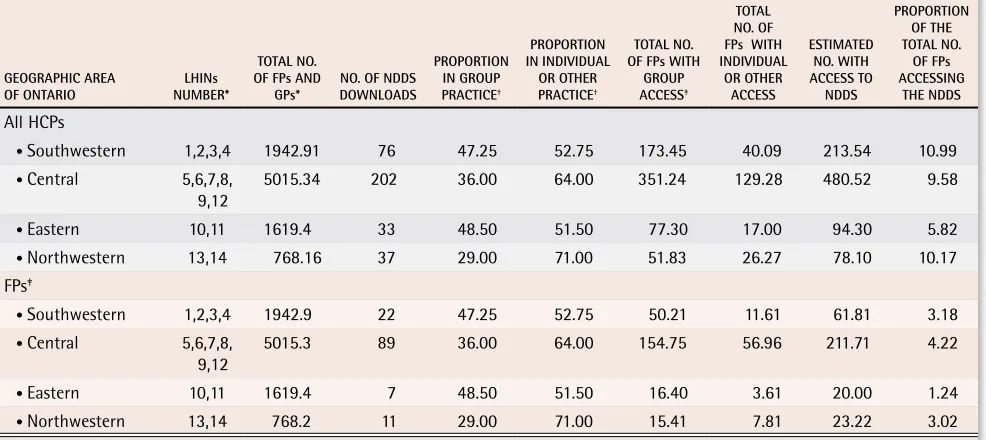
As seen in Table 2,21,22 significantly fewer FPs in east-ern Ontario (1.2%) used the NDDS than in northeast-ern
(3.0%), southwestern (3.2%), or central (4.2%) Ontario (χ2
3 = 34.3, P < .0001). A significant difference also existed between the proportion of FPs accessing the
Table 1.
Patterns of use of the NDDS by FPs and all HCPs in Ontario before and after October 2006
PROVIDERS NDDS REQUESTS GROUP PRACTICE*PROPORTION IN
PROPORTION IN INDIVIDUAL OR OTHER PRACTICE*
TOTAL NO. OF FPs WITH GROUP
ACCESS
TOTAL NO. WITH INDIVIDUAL OR OTHER ACCESS
TOTAL NO. WITH ACCESS TO NDDS (GROUP AND INDIVIDUAL)
PROPORTION OF FPs IN ONTARIO USING THE NDDS†
All HCPs‡
• Purchases before 2006
156 59.8 40.2 450.58 62.71 513.29 5.11
• Downloads
after 2006 348 57.0 43.0 958.08 149.64 1107.72 11.02
• All HCP
access 504 59.8 40.2 1455.72 202.61 1658.33 16.50
FPs§
• Purchase before 2006
91 59.8 40.2 262.84 36.58 299.42 2.98
• Downloads
after 2006 129 57.0 43.0 352.94 55.47 408.41 4.06
• All FP access||
220 59.8 40.2 635.43 88.44 723.87 7.20
HCP—health care professionals, NDDS—Nipissing District Developmental Screen. *Data from the Local Health Integration Network21 and the National Physician Survey.22
†The estimated number of FPs in Ontario was 10 053.21
‡All HCPs are those individuals who purchased or downloaded the NDDS and identified themselves as HCPs, added to those identified as physicians. §FPs are those individuals who purchased or downloaded the NDDS and identified themselves as physicians.
||All FP access represents the sum of purchases (before October 2006) and downloads (after 2006) of the NDDS by those identified as physicians.
Table 2.
Geographic distribution within Ontario of FPs and all HCPs who downloaded the NDDS after October 2006
GEOGRAPHIC AREA
OF ONTARIO NUMBER*LHINs
TOTAL NO. OF FPs AND
GPs* NO. OF NDDS DOWNLOADS
PROPORTION IN GROUP PRACTICE†
PROPORTION IN INDIVIDUAL
OR OTHER PRACTICE†
TOTAL NO. OF FPs WITH
GROUP ACCESS‡
TOTAL NO. OF FPs WITH INDIVIDUAL
OR OTHER ACCESS
ESTIMATED NO. WITH ACCESS TO NDDS
PROPORTION OF THE TOTAL NO.
OF FPs ACCESSING
THE NDDS
All HCPs
• Southwestern 1,2,3,4 1942.91 76 47.25 52.75 173.45 40.09 213.54 10.99
• Central 5,6,7,8,
9,12 5015.34 202 36.00 64.00 351.24 129.28 480.52 9.58
• Eastern 10,11 1619.4 33 48.50 51.50 77.30 17.00 94.30 5.82
• Northwestern 13,14 768.16 37 29.00 71.00 51.83 26.27 78.10 10.17
FPs‡
• Southwestern 1,2,3,4 1942.9 22 47.25 52.75 50.21 11.61 61.81 3.18
• Central 5,6,7,8,
9,12 5015.3 89 36.00 64.00 154.75 56.96 211.71 4.22
• Eastern 10,11 1619.4 7 48.50 51.50 16.40 3.61 20.00 1.24
• Northwestern 13,14 768.2 11 29.00 71.00 15.41 7.81 23.22 3.02
HCP—health care providers, LHIN—Local Health Integration Network, NDDS—Nipissing District Developmental Screen.
*See Figure 1 for a diagram of LHIN locations and geographic distribution; LHINs were used to provide estimates of the number of physicians in each geographic area.21
†Data from the Local Health Integration Network.21
‡The average size of group practice was estimated to be 4.83 physicians per group.22
Vol 56: february • féVrier 2010 Canadian Family Physician • Le Médecin de famille canadien
e71
NDDS in southwestern and central Ontario (χ1 =3.98, P = .046).
Similarly, the proportion of all HCPs with access to the NDDS was significantly lower in eastern Ontario than in all other regions (P < .0001).
DISCUSSION
The findings of this study demonstrate that a minor-ity of physicians in Ontario access the NDDS. Fewer than 1% of FPs purchased the NDDS and approximately 1% downloaded the tool when it was made available free of charge. Even with our liberal assumptions about other HCPs representing physicians and about the NDDS being shared in group practices, the estimate of those accessing the NDDS at most represented only 16.5% of physicians in Ontario. The trend of low rates of access-ing the NDDS was seen across the province, but was significantly lower in eastern Ontario. These findings point to a need for enhanced dissemination of guide-lines as well as further investigation into the reasons for low rates of use of developmental screening measures in family practice.
Although the NDDS is only one of several tools avail-able for developmental screening, it is particularly attractive for use in routine practice because it is easy to administer, available free of charge, and endorsed by experts in the field. Although there are few data on the validity of the NDDS, it has several advantages over other tools, including written educational information on child development provided to parents.19,20 Many physicians continue to rely on the developmental sec-tion of the Rourke Baby Record for developmental sur-veillance, but that instrument has a limited number of test items and has never been validated as a screen-ing measure.17,18 Our finding that few HCPs in Ontario access the NDDS is likely reflective of a low frequency of use of any objective developmental screening measures by FPs across Canada.
Such low frequency of use has been identified by research on primary care physicians in the United States. Through mailed surveys, Sand and colleagues demon-strated that only 23% of pediatricians used standardized developmental instruments.23 Similarly, Sices and col-leagues found that up to half of primary care physicians
used a formal developmental screening instrument.24
Although our study did not assess actual physician practices, it raises the possibility that use of develop-mental screening measures might be substantially lower among physicians in Ontario than among those in the United States. These findings raise concerns about the adequacy of screening in family practice, particularly because the ability of physicians to detect develop-mental delays without the aid of objective measures is limited.12,25,26 These problems cannot be underestimated,
particularly in Canada, where a large proportion of pedi-atric care is provided by FPs, who might have less train-ing in developmental assessment than pediatricians do.
The usefulness of routine developmental screening has been debated, which might explain the low rates of use of the NDDS in this study. Indeed, the Canadian Task Force on Preventive Health Care recommended excluding screening with the Denver Developmental Screening Test, citing evidence of a lack of benefit from using this measure in routine practice.13,14,27 In recent years, however, many authorities have endorsed the use of developmental surveillance and screening, includ-ing the NDDS, by FPs.8,15,28 These changes come in light of new research demonstrating the consequences of undetected developmental problems and the potential for improvements with early intervention.5,16 This evi-dence, coupled with our findings of low rates of use of one standardized screening measure, suggest that an opportunity for improving child health in Canada is truly being missed. The need to increase dissemination of recommendations on developmental screening, as well as to investigate ways to remove other barriers to screening, cannot be overstated.
Our finding of a 3-fold increase in use of the NDDS with the introduction of the program making it available for free, however, is encouraging. Barriers to the use of developmental screening measures include the com-plexity of administering tests, the expense of materi-als, and the lack of adequate remuneration.29 It appears that providing free and easy-to-use measures could be a first step in increasing compliance with recent guide-lines. However, there is considerable room for improve-ment, and research on physician, test, and social-policy factors associated with improved screening should be a priority.
Limitations
Research
Nipissing District Developmental Screen
Conclusion
Our study begins to explore the patterns of develop-mental screening, particularly as they pertain to the recent guidelines and incentives for using the NDDS in family practice. Although the overall frequency of accessing the NDDS by physicians was extremely low in Ontario, it appears that making the measure free and accessible might be somewhat effective in increas-ing the use of standardized developmental measures. Future research should examine actual screening prac-tices in family medicine settings in Canada so that inter-ventions to improve developmental screening can be developed and implemented.
Dr Limbos is a clinical child psychologist at Sunny Hill Centre for Children
in Vancouver, BC. Dr Joyce is a family physician at the Pender Community
Health Centre in Vancouver. Ms Roberts is a third-year medical student at the
Northern Ontario School of Medicine in Sudbury, Ont.
Contributors
Drs Limbos and Joyce conducted the background research, developed the
research question, and wrote the manuscript. Ms Roberts assisted from the
start of the project with data collection and analyses, background research, and connecting with Nipissing District Developmental Screen staff, and contributed to writing the manuscript. All authors reviewed and made suggestions on the final draft of the manuscript.
Competing interests
None declared
Correspondence
Dr Marjolaine Limbos, Department of Psychology, Sunny Hill Centre for Children, 3644 Slocan Dr, Vancouver BC V5M 3E8;
e-mail [email protected]
references
1. Levitt C, Doyle-MacIsaac M, Grava-Gubins I, Ramsay G, Rosser W; CFPC Task Force on Child Health. Our strength for tomorrow: valuing our children.
Part 6: educating family physicians to care for children. Can Fam Physician
1998;44:119-23 (Eng), 124-8 (Fr).
2. Healy A. Early intervention services for infants with disabilities. Am Fam
Physician 1991;43(1):102-3.
3. Glascoe FP, Shapiro HL. Introduction to developmental and behavioral
screening. Dev Behav Pediatr Online. Epub 2004 May 27. Available from:
www.dbpeds.org/articles/detail.cfm?TextID=%205. Accessed 2010 Jan13.
4. Statistics Canada. PALS 2001: a profile of disability in Canada,2001. Catalogue
no. 89-577-XIE. Ottawa, ON: Ministry of Industry; 2002. Available from: www.
statcan.ca/english/freepub/89-577-XIE/info.htm. Accessed 2010 Jan 13.
5. McCain M, Mustard F. Early years study. Toronto, ON: Government of Ontario;
1999.
6. Greenspan S, Shanker S. The first idea: how symbols, language and
intelli-gence evolved from our primate ancestors to modern humans. Cambridge, MA: Da Capo Press; 2004.
7. Shonkoff J, Phillips D. Neurons to neighborhoods: the science of early childhood
development. Washington, DC: National Academic Press; 2000.
8. Report of the Expert Panel on the 18 Month Well Baby Visit. Getting it right
at 18 months … making it right for a lifetime. Toronto, ON: Children’s Health Network, Ontario College of Family Physicians; 2005.
9. Janus M. Measuring community early child development. CAP J
2006;14(3):14-6.
10. Kershaw P, Irwin L, Trafford K, Hertzman C. The British Columbia atlas of
child development. Vancouver, BC: Human Early Learning Partnership; 2006.
11. Glascoe FP. Early detection of developmental and behavioral problems. Pediatr Rev 2000;21(8):272-9.
12. Wilms D. Vulnerable children. Edmonton, AB: University of Alberta Press;
2002.
13. Feightner JW. Preschool screening for developmental problems. In:
Canadian Task Force on the Periodic Health Examination. The Canadian guide
to clinical preventive health care. Ottawa, ON: Ministry of Supply and Services;
2006. Available from: www.phac-aspc.gc.ca/publicat/clinic-clinique/pdf/
s2c26e.pdf. Accessed 2010 Jan 13.
14. Glascoe FP, Byrne KE, Ashford LG, Johnson KL, Chang B, Strickland B.
Accuracy of the Denver-II in developmental screening. Pediatrics 1992;89(6
Part 2):1221-5.
15. Best Start Expert Panel on Early Learning. Early learning for every child
today: a framework for Ontario early childhood settings. Toronto, ON; Government of Ontario, Ministry of Children and Youth Services; 2006. 16. Schweinhart LJ, Montie J, Xizng Z, Barnett WS, Belfield CR, Nores M.
Lifetime effects: the HighScope Perry Preschool study through age 40. Ypsilanti,
MI: HighScope Educational Research Foundation; 2005. Available from: www.
highscope.org/Content.asp?ContentId=219. Accessed 2010 Jan 13. 17. Rourke LL, Leduc DG, Rourke JT. Rourke Baby Record 2000. Collaboration
in action. Can Fam Physician 2001;47:333-4. Erratum in: Can Fam Physician
2001;47:703.
18. Rourke L, Leduc D, Rourke J. Rourke Baby Record: evidence-based infant/
child health maintenance guide. Mississauga, ON; Canadian Family Physician;
2006. Available from: www.cps.ca/english/statements/cp/rourke/
rbrnational.pdf. Accessed 2010 Jan 13.
19. Dahinten SV, Ford L. Validation of the Nipissing District Developmental Screen
for use with children and toddlers—working paper. Vancouver, BC: Consortium for Health, Intervention, Learning and Development; 2004. Available from:
www.ndds.ca/pdf2/Validation%20of%20NDDS%20Screen%20for%20 use%20with%20infants%20and%20toddlers.pdf. Accessed 2010 Jan 13.
20. Early Childhood Developmental Screening Work Group. Field test of the
Nipissing District Developmental Screen in the NWT. Yellowknife, NWT: Early Childhood Developmental Screening Work Group, Department of Health and Social Services, Yellowknife Association for Community Living; 2001.
Available from: www.ndds.ca/pdf2/Evaluation%20-%20Field%20Test%20
of%20NDDS%20Screen%20in%20NWT.pdf. Accessed 2010 Jan 13.
21. Local Health Integration Network. Ontario LHINs map. Toronto, ON; Local
Health Integration Network; 2006. Available from: www.lhins.on.ca/
FindYourLHIN.aspx?ekmensel=e2f22c9a_72_254_btnlink. Accessed 2009 Dec 23.
22. National Physician Survey. 2004 National Physician Survey. Mississauga, ON:
College of Family Physicians of Canada, Canadian Medical Association, Royal
College of Physicians and Surgeons of Canada; 2004. Available from: www.
nationalphysiciansurvey.ca/nps/2004_Survey/2004nps-e.asp. Accessed 2010 Jan 13.
23. Sand N, Silverstein M, Glascoe FP, Gupta VB, Tonniges TP, O’Connor KG. Pediatricians’ reported practices regarding developmental screening: do
guidelines work? Do they help? Pediatrics 2005;116(1):174-9.
24. Sices L, Feudtner C, McLaughlin J, Drotar D, Williams M. How do primary care physicians manage children with possible developmental delays? A
national survey with an experimental design. Pediatrics 2004;113(2):274-82.
25. Bierman JM, Conor A, Vaage M, Honzik MP. Pediatrician’s
assess-ments of the intelligence of 2-year-olds and their mental scores. Pediatrics
1964;34(5):680-90.
26. Starfield B, Borkowf S. Physicians’ recognition of complaints made by
par-ents about their children’s health. Pediatrics 1969;43(2):168-72.
27. Cadman D, Chambers LW, Walter SD, Ferguson R, Johnston N, McNamee J. Evaluation of public health preschool child development screening: the process
and outcome of a community program. Am J Public Health 1987;77(1):45-51.
28. American Academy of Pediatrics. Developmental surveillance and
screen-ing of infants and young children. Pediatrics 2001;108(1):192-6.
29. Rydz D, Shevell MI, Majnemer A, Oskoui M. Developmental screening. J
Child Neurol 2005;20(1):4-21.