a/a-Specific
Repression
by
MATa2
Jeffrey Strathern,* Brenda Shafer,* James
Hickst and Carolyn McGill*
*Laboratory of Eukaryotic Gene Expression, BRI-Basic Research Program, Natwnal Cancer Institute-Frederick Cancer Research Facility, Frederick, Maryland 21 701, and
t
Research Institute of Scripps Clinic, La Jolla, California 92037Manuscript received February 29, 1988 Revised copy accepted May 2 1, 1988
ABSTRACT
The product of the MATa2 gene is a DNA-binding protein that acts as a repressor of two different sets of cell type-specific genes. In a cells, the a2 protein represses the transcription of several a-specific genes. In a/a cells, the a2 protein acts together with the product of the MATal gene, the a1 protein,
to repress several genes used by haploids in the mating process. In addition to the mata2 mutations
that result in defects in both types of regulation, other mata2 alleles have been described that result
in defects in the repression of a-specific genes but that do not affect the ability of the a2 and a1 proteins to interact to repress the haploid-specific genes. We report here the isolation of a new class of mata2 mutations that do not affect the ability of the a2 protein to repress a-specific genes, but that
interfere with the ability of the a2 protein to interact with the a1 protein to repress the haploid- specific genes and establish the a/a cell type. These mutations may help determine the means by which the a1 protein interacts with a2 to expand the set of genes under its control.
T
HE a2 protein, encoded by MATa2, is a negative regulator of the expression of genes of the sexual cycle in the yeast Saccharomyces cerevisiae(STRATHERN, HICKS and HERSKOWITZ 198 1). The a2
protein is particularly interesting because it is involved in the repression of two different sets of cell type- specific genes. In a cells, a2 has the role of a repressor of a-specific genes such as MFal and MFa2 [genes encoding a pheromone involved in coordinating mat- ing (BRAKE et al. 1985)], STE2 [the gene encoding the receptor for the pheromone produced by a cells, a- factor (JENNESS et al. 1983)], BAR1 [the gene encoding a protease that degrades a-factor (SPRAGUE and HER- SKOWITZ 1981 ; CIEJEK and THORNER 1979)], and STE6 [an a-specific gene involved in a-factor bio- genesis (WILSON and HERSKOWITZ 1984; CHAN et al.
1983)l. A consensus DNA sequence required for reg- ulation by a2 has been identified in the 5’ noncoding region of these genes (MILLER, MACKAY and NAS- MYTH 1985). Specific DNA-protein interaction be- tween a2 protein and the consensus sequence at the STE6 gene has been demonstrated (JOHNSON and
HERSKOWITZ 1985). Although such DNA-protein
binding can even be demonstrated for a2 protein made in Escherichia coli, it remains possible that proper regulation of these a-specific genes requires a second yeast protein in vivo.
In its second role, as a repressor of “haploid-spe- cific” genes, a2 protein requires the a1 protein, the product of the MATal gene. These haploid-specific genes include HO [the gene for an endonuclease that initiates homothallic switching (JENSEN, SPRAGUE and HERSKOWITZ 1983; KOSTRIKEN and HEFFRON 1984)],
Genetics 120: 75-81 (September, 1988)
MATal [encodes a positive regulator of a-specific genes (KLAR et al. 198 1 ; NASMYTH et al. 198 1 ; JARVIS, HAGEN and SPRAGUE 1988)], STE4, STE5 and STEl2 [genes required for mating in both a and a cells (unpublished observations cited in HALL andJoHNsoN 1987)] and SST2 [a gene involved in pheromone re- sponse (DIETZEL and KURJAN 1987)l. The repression of these genes in ala cells is also mediated through a consensus sequence found upstream of their tran-
scribed regions (MILLER, MACKAY and NASMYTH
1985; SILICIANO and TATCHELL 1986; DIETZEL and KURJAN 1987). This sequence is related to, but differ- ent from, the sequence required for the repression of a-specific genes by a2 protein. The mechanism by which a1 protein modifies or cooperates with a2
protein to broaden the spectrum of genes that it represses has not been determined.
Most mata2 mutations have effects on the pheno- types of both a and a/a cells. For example, the mata2- 1 allele results in sterility in a haploid a cell and cannot support sporulation in a mata2-1IMATa diploid (MACKAY and MANNEY 1974a, b; STRATHERN, HICKS and HERSKOWITZ 198 1). This is the phenotype of the mata2 null mutation.
One approach to determining the features of a2
TABLE 1
Yeast strains
Strain Genotype Source
DC14 MA Ta his 1 G . FINK
DC17 MATa his1 G . FINK
DC122 matA leu2 lrpl his5 ura3 ade6 This study
JSS3-2A MATa leu2 trpl ura3 This study
JSS3-3A MATa leu2 ura3 This study
JSS56-11 B MATa his3 leu2 trpl ura3 This study
JSS82-22B MATa his3 leu2 ura3 canl‘ cyh2‘ This study
294 MATa his3 leu2 trpl ura3 J. BROACH
JH727 MATa HMLa HMRa mar2-1 leu2 lys2 his4 This study
JH807 mata2d-807 HMLa HMRa mar2-1 leu2 lys2 his4 This study
Hence, the a2 protein encoded by the mata2-4 mu- tation is still capable of interacting with the a1 protein to repress haploid-specific genes. We will refer to such mutations as mata2h to reflect the defect in the a
haploid phenotype. Similar mata2h mutations, capable of conferring the a/a phenotype but not of giving the a phenotype, have been isolated by linker insertion mutagenesis (TATCHELL et al. 1981) and by site-di- rected mutagenesis (PORTER and SMITH 1986).
We report here the isolation of mata2 mutants that retain the ability to regulate a-specific genes but that cannot support the a/a phenotype. As haploids these mata2 mutants have no apparent defect and mate like
a cells. However, as mata2/MATa diploids they fail to sporulate, and rather than being nonmaters, they mate as if they are a cells. Thus, they have separated the roles of the a2 protein in the opposite sense of the mata2h mutations. This novel class of mutations is designated mata2d to denote their defect in the a/
a diploid phenotype. One such recessive mutation is near the “homeobox-DNA binding domain.” Such mata2d mutations may be useful in determining the mechanism of interaction of the a2 and a1 proteins.
MATERIALS AND METHODS
Yeast strains: The genotypes of the yeast strains em- ployed in this study are listed in Table 1.
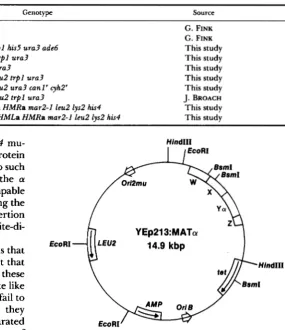
Plasmids: The high copy number yeast vector YEp213 (HICKS et al. 1982) carries the LEU2 gene and the 2-micron origin of replication. It was derived from YEpl3 (BROACH, STRATHERN and HICKS 1979) by inverting the 2.2 kbp Sal1 to XhoI fragment containing LEU2 (HICKS et al. 1982). The plasmid YEp213:MATa has the 4.3-kbp genomic HindIII fragment carrying the M A T a allele inserted into YEp213 (Figure 1). GRMATl is similar to YEp213:MATa but has a deletion of the MAT W, X , Y, and Z1 sequences (HICKS et al. 1982). A unique XhoI site separates the remaining por- tions of the MAT HindIII fragment.
Plasmid mutagenesis: The YEp213:MATa plasmid was mutagenized by propagating the plasmid in the mutD E. coli
bacterial strain, LE30 (COX 1976). Plasmid DNA was pre- pared from a pool of about 1000 primary LE30 transform- ants. One reflection of the level of mutagenesis is that the pool of plasmids included about 1% that were defective in
LEU2 as judged by their inability to complement the E. coli
A m 1
HindIII
EcoRI
Ori2mu
\
EcoRI
tot
/
IT
14.9 kbpYEp213:Mi
Hind111
EcoRI
xsv
FIGURE 1.-The MATa locus cloned as a HindIII fragment into the cloning vector YEp213. The 480-base BsmI fragment that includes the mata2d-807 mutation is indicated.
mutation leuB. A second indication of successful mutagen- esis was that when this pool was transformed into a yeast strain lacking MAT (DC122), 6 of the 480 Leu+ strains tested had plasmid-borne mutations resulting in sterility. These mutants were not further classified as matal or
mata2.
drugs is a sensitive assay for sporulation. After growth on sporulation medium, the diploids to be tested were replica- plated to plates containing cycloheximide and canavanine.
Transformations: Transformations were performed by the glusulase-spheroplast technique (HINNEN, HICKS and FINK 1978; BROACH, STRATHERN and HICKS 1979). To
screen the transformants containing the mutagenized MATa plasmid the primary transformation plates were homoge- nized and the resulting cell suspension diluted and replated again selecting Leu+. The resulting colonies were then
tested for mating phenotype. To place the mata mutations into the genome at the normal MAT position on chromo-
some ZZZ, a yeast strain in which the MAT locus has been deleted (DC122) was transformed with the Hind111 frag- ment carrying the mutation. To facilitate the screen for MAT substitutions, the cells were co-transformed with the TRPl containing replicating plasmid YRp7 (STRUHL et al.
1979). Trp+ transformants were screened for loss of the matA phenotype.
Bacterial transformations were done using competent
DH5 cells from Bethesda Research Laboratories, Gaithers- burg, Maryland.
Sequencing: DNA sequencing was done using a chain- termination protocol (SANCER, NICKLEN and COULSON
1977) modified to allow the use of double stranded DNA
(P. SUTRAVE, personal communication). The oligonucleo- tide primers corresponding to about 200 base intervals on both strands of MATaZ were used in the sequencing reac- tions.
RESULTS
Previously described mata2 mutations cause defects only in the repression of the a-specific genes in haploid
a cells (mata2h), or cause defects in both the repres- sion of a-specific genes and the repression of haploid- specific genes found in a/a diploids (mata2 null). As a step toward understanding how the a1 protein inter- acts with the a 2 protein to establish the a / a state of repression, we isolated mata2 mutants that were de- fective in a / a diploid regulation (mata2d) but retained the ability to repress the a-specific genes in haploid a
cells.
Mutagenesis of MATa: The 4.3-kbp HindIII frag- ment carrying the M A T a locus is sufficient to confer the a phenotype on cells that have had the MAT locus deleted (matA). For example, when that fragment is carried on a high copy number plasmid such as YEp213:MATa (Figure 1) in a yeast strain that has
matA, the yeast strain will mate efficiently as an a.
Thus, it will complement both the m a t a l and mata2
defects of the matA deletion. Similarly, this M A T a
plasmid confers the a/a phenotype on cells that also have a good MATa allele. Thus, an a/a diploid carry- ing one of these plasmids does not mate as an a or as an a but it can be induced to undergo meiosis and sporulation.
The basis of the screen for mutations of the desired
mata2d type was to transform a pool of mutagenized YEp213:MATa plasmids into a MATa yeast strain (JSS56-11B) and then screen for cells that were able to mate like a cells. Plasmid mutagenesis was by pas-
sage through a bacterial mutator strain as described in MATERIALS AND METHODS. About 5000 transform- ants were screened, of which
5
(D50-D54) showed the a mating phenotype. This phenotype was shown to be dependent on the plasmid by demonstrating that Leu- segregants that had lost the plasmid regained the a mating phenotype. This level of analysis left the possibility that the defect was in the MATa chromo- somal locus. That is, if for some reason the transform- ants had a mata mutation (KASSIR and SIMCHEN 1976), they would have had the a phenotype when the plas- mid was present, and the a-like phenotype character- istic of mata mutants when the plasmid was lost. Therefore, the five plasmids were recovered from the mutants into E. coli and reintroduced into MATa cells. All five again conferred the a phenotype. When these plasmids were transformed into an a / a diploid (294 mated to JSS56-1 lB), the strains had the nonmating phenotype of an a / a strain, indicating that the malamutations on the plasmid were recessive to M A T a on the chromosome. Given that a / a diploids do not ex- press M A T a l (KLAR et al. 1981; SILICIANO and
TATCHELL 1984), the difference between the pheno- type of the plasmid in an a strain and the phenotype in an a/a strain should be due to the presence of the functional M A T a 2 gene product. This strongly sug- gests that the mutations are in the M A T a 2 gene.
T o test the phenotype of these mutations in single copy, they were placed in the yeast genome at the normal position of MAT on chromosome
ZZZ.
For this purpose, a strain with the MAT locus deleted was used (DC122). This strain has the a-like phenotype(STRATHERN, HICKS and HERSKOWITZ 1981) caused by the inability to turn on a-specific genes ( m a t a l ) ,
and the inability to turn off a-specific genes (mata2).
This strain was transformed with the MAT HindIII fragment and screened for cells that did not have the a-like phenotype (see MATERIALS AND METHODS). The presence of the intact Hind111 fragment at MAT was confirmed by restriction endonuclease digestion and blotting analysis (data not shown).
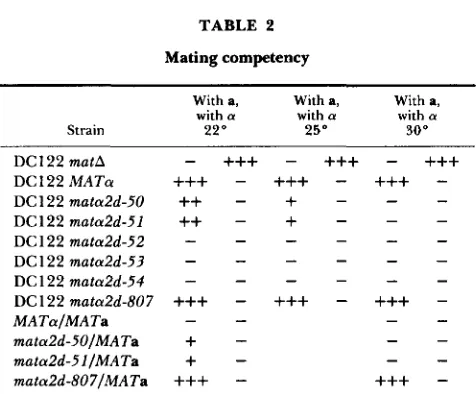
All five mutants (DC122 mata2d-50, DCl22
mata2d-51, DC 122 mata2d-52, DC 122 mata2d-53 and DCl22 mata2d-54) analyzed by this protocol were sterile when tested at 30" (Table 2). Therefore, the mating competency of the original mutants (D50- D54) required both a mata mutation and its presence on a high copy number vector. However, DC122
mata2d-50 and DC122 mata2d-51 were able to mate as a cells at 22" (Table 2). This allowed the construc- tion of isogenic MATalMATa, mata2d-SO/MATa and
mata2d-5l/MATa diploids by mating to strain JSS82- 22B. The mutant diploids had a weak a phenotype at 22" (Table 2) but could not sporulate at any temper- ature.
TABLE 2
Mating competency
With a, With a, With a,
with u with u with u 30"
Strain 22" 25"
DC 122 matA
-
+++
-+++
-
+++
DC 122 MATa
+++
-+++
-
+++
-
DC122 mata2d-50
++
-
+
-
-
-
DC122 mata2d-51
++
-+
-
- -DC122 mata2d-52
-
DC122 mata2d-53
-
-
DC122 mata2d-54
-
-
-
-
-
DC122 mat(u2d-807
+++
-
+++
-
+++
-MATaIMATa -
-
--
mataPd-SO/MATa
+
-
mata2d-ZlIMATa+
-
mata2d-807fMATa+++
-
-
-
-
-
-
-
-
-
--
-
--
-
+++
-
tained by screening a MATa HMLa HMRa mar2 strain (JH727) for cells capable of mating like an a. Because of the mar2 (also known as sir3) mutation, this strain expresses the a1 protein from HMLa and HMRa as well as a 2 from MATa and hence, has the a/a phe- notype. A similar screen was used in the isolation of suppressors of the mar mutation (KLAR et al. 1985). T h e screen of JH727 for cells that could mate like an
a yielded one mutant (JH807) that was unique in that, when mated to a MATa haploid, it gave a diploid that mated like an a cell and that could not sporulate.
T h e phenotype of strain JH807 was consistent with either a mutation in MATa or a dominant mutation elsewhere that kept a1 from functioning. Analysis of the DNA in JH807 had confirmed that the HMLa and HMRa alleles were intact (data not shown). T o deter- mine if the mutation was in MATa, the MAT locus was cloned from strain 807 by the gapped plasmid tech- nique (HICKS et al. 1982). Strain 807 was transformed with the GRMATl plasmid cut with XhoI to create a gapped plasmid spanning the MAT locus. About 100 Leu+ transformants were pooled and DNA isolated. Plasmid DNA was recovered by transformation into
E . coli (see MATERIALS AND METHODS) and confirmed
to be YEp2 13 with a complete MAT HindIII fragment, designated YEp213:MATa807.
YEp213:MATa807 was shown to carry a mata2d mutation by transforming the plasmid into a MATa strain JSS56-1 1B. T h e resulting transformant had the
a mating phenotype in contrast to the control JSS56-
1 1B strain with YEp213:MATa, which has the non- mating a/a phenotype. As shown below, this mutation is in the MATa2 gene and is designated mata2d-807. A MATa/MATa strain (294 mated to JSS56-11B)
was transformed with YEp213:MATa or
YEp213:MATa807. Both transformed diploids had the a/a nonmating phenotype. Therefore, even when the mata2d-807 mutation is present on a high copy number plasmid, it is recessive to a MATa allele.
T h e mata2d-807 mutation was placed into the ge-
160 Helix 2 170
AAG GGC CTA GAG AAT CTA ATG AAG AAT ACC AGT TTA TCT L Y S GLY LEU GLU ASN LEU MET LYS ASN THR SER LEU SER
Bsml Helix 3 180
CGC A T T CAA ATC AAA AAC TGG GTT TCG AAT AGA AGA AGA ARG
I L E ~ I E I L Y S
A S N ~ V A L S E RARG ~ ARG ARG190 EcoRl
AAA GAA AAA ACA ATA ACA ATC GCT CCA GAA TTA GCG GAC
I-" ( C )
(SER)
,_LUSIGLU;EESITHR
ILE THR ILE ALA PRO GLU LEU ALA ASP200
CTC TTG AGC GGT GAG CCT CTG GCA AAG AAG AAA GAA TGA LEU LEU SER GLY GLU PRO L E U ALA LYS LYS LYS GLU *
FIGURE 2.-The C-terminal end of the MATa2 open reading frame. The postulated helices of the homeobox (LAUGHON and SCOTT 1984), and the base change and corresponding amino acid substitution in the mata2d-807 mutation at codon 196 are indicated in parentheses below the nucleotide and amino acid sequences. Changesat codons 175, 176, 179 and 182 aremata2null mutations (solid boxes) and changes at codons 186 and 188 are mata2h mutations (dashed boxes) (PORTER and SMITH 1986).
nome of DC122 at MAT by the technique described above and shown to be sufficient in single copy to confer the mata2d phenotype. That is, DC122 mata2d-807 could mate efficiently as an a (Table
2),
but the resulting MATa/MATa diploids could not sporulate and mated like a cells.Sequencing of the mata2d-807 coding region iden- tified only one base change between the published sequence of the wild-type gene (ASTELL et al. 1981) and mata2d-807 (Figure 2). T h e prediction from the sequencing that the mutation destroys an EcoRI* site was confirmed (data not shown). T o confirm that this mutation was responsible for the defect, the BsmI fragment (480 bp) containing just the last 1 10 bases of the 3' end of the coding region of the MATa2 gene was exchanged between the wild-type and mutant clones. For this experiment, a YEp2 13:MATa plasmid with the MAT HindIII fragment in the opposite ori- entation was used. T h e different orientation of the HindIII fragment had no effect on the phenotype but made unambiguous the demonstration that the BsmI fragments had been exchanged. T h e transferred mu- tant BsmI fragment was sufficient to alter the pheno- type from wild-type to mutant, and the wild-type BsmI fragment was sufficient to alter he mutant to wild
t Y Pee
T h e mata2d-807 mutation results in a substitution
DISCUSSION
We have isolated and characterized mutant alleles of the MATa2 gene that are defective in the regulation of the a/a diploid phenotype while retaining the abil- ity to support the a haploid mating phenotype. These have been designated mata2d alleles to reflect their defect in the diploid functions and to distinguish them from previously reported alleles defective only in the
a haploid phenotype (designated here mata2h) or mata2 null alleles defective in both aspects of cell type regulation by the a 2 protein.
Mutations in the MATal gene have no effect on the mating ability of a cells (KASSIR and SIMCHEN 1976). This led to the conclusion that the a1 protein had no role in the repression of a-specific genes in a cells. Similarly, the failure of a/a cells to mate has been attributed to the repression of the haploid specific genes by the combined action of the a1 and a 2 pro- teins. It has been demonstrated that the STE3 gene is expressed in MATalmata2 diploids and thus that a1 is
not sufficient to repress that gene (SPRAGUE, JENSEN and HERSKOWITZ 1983). The ability of the MATa/ mata2d-807 diploids to mate suggests that the MATal gene product has no direct role in the repression of any gene required for mating by a cells.
The properties of the mata2d mutants described here support the view that the a2 protein has separa- ble functions involved in repression of a-specific genes in a haploids (defective in mata2h mutants) and a/a- specific repression in diploids (defective in mata2d mutants). The mata2h point mutations made by site- directed mutagenesis have been interpreted as iden- tifying a region of a 2 required for repression of a- specific genes but not for ala-specific repression (POR- TER and SMITH 1986). The mata2d-807 mutation in amino acid 196 may identify a region of a2 protein required specifically for a/a repression.
Genes such as STES, HO, and MATal are transcrip- tionally repressed in a/a diploids but can be expressed in haploids. Both the a1 and the a2 proteins are required for this repression. The mechanism by which a1 and a 2 together turn off these genes is as yet unknown. It would seem reasonable that the role of a2 in this regulation is that of a repressor, directly binding to DNA as it does in a cells to repress a- specific genes (JOHNSON and HERSKOWITZ 1985). The recognition site for a 2 protein was deduced from a consensus sequence in the 5’-regulatory region of several a-specific genes (MILLER, MACKAY and NAS- MYTH 1985). A single copy of this sequence is suffi- cient to make expression of a promoter sensitive to repression by the a2 protein (JOHNSON and HERSKOW- ITZ 1985). Specific binding to this sequence has been demonstrated for a2-/3-galactosidase-fusion proteins (JOHNSON and HERSKOWITZ 1985). A consensus se- quence for genes repressed by a2-al has also been
determined (MILLER, MACKAY and NASMYTH 1985;
SILICIANO and TATCHELL 1986; ERREDE et al. 1985) and short fragments carrying this sequence were shown to be sufficient to confer a/&-specific repression on a heterologous gene (MILLER, MACKAY and NAS- MYTH 1985). The observation that the a2 and a l / a 2 recognition sequences are related, although different, supports the view that the a2 protein has a sequence- specific binding role in a/a regulation. However, the a2 protein alone does not bind to the a l / a 2 operator
(JOHNSON cited in MILLER, MACKAY and NASMYTH
1985). These observations argue that the role of the a1 protein is to alter the sequence specificity of the a2 protein, not merely to bind independently to the
DNA (MILLER, MACKAY and NASMYTH 1985).
A priori, several different models for the interaction of the a1 and a2 proteins can be imagined. Broadly, they can be classified as models invoking (1) a catalytic modification of a 2 by a1 that alters the DNA recog- nition specificity of a2, (2) the stoichiometric binding of a1 to a 2 to again alter the sequence recognition of a2, (3) the binding of a1 to a2 to form a heteromul- timer in which both the a1 and a2 components have DNA sequence recognition roles, and (4) the inde- pendent binding of a2 and a1 proteins to sequences upstream of the haploid-specific genes, and that their combined effects result in repression. The observation that a1 protein, like a2 protein, has homology to the “homeobox” sequence of the DNA-binding domains of several regulatory proteins (LAUGHON and SCOTT
1984) would seem to support the latter two models that invoke direct DNA interaction by a1 protein.
A 68 amino acid domain corresponding to residues 136-204 of the 2 10 amino acid a2 protein has been demonstrated to be sufficient for sequence-specific DNA binding to the a2 consensus operator (HALL and JOHNSON 1987). This region has similarity to proteins encoded by several Drosophila homeotic genes (GEHRING 1987), and includes the helix-turn- helix motif involved in DNA binding by prokaryotic repressors (LAUGHON and SCOTT 1984). PORTER and SMITH (1 986) made specific codon alterations in this interval of MATa2 and obtained both complete null mutations and mutations that cause defects only in repression of the a-specific genes (mata2h mutations). It is interesting to note that they obtained mata2h alleles at codons 186 and 188, very near the mata2d- 807 mutation at codon 196. Further, they were able to make substitutions in codons 189, 190 and 19 1 without affecting either regulatory role of a 2 protein. HALL and JOHNSON (1 987) have defined a region of a2 protein involved in binding to a1 protein. This conclusion was based on mata2 mutations that were dominant to MATa for a defect in regulation of an
strain. This was interpreted as a reflection of a com- petition between the mutant and functional
a2
pro- teins for binding to a l protein. Mutations that did not affect the ability of the a2 protein to bind the a 2 operator DNA in vitro but lost the dominant pheno- type were interpreted as having lost sequences re- quired to interact with al. The region defined in that approach included amino acids 20 to 62. These results contrast with the recessive nature of the mata2d-807 mutation in amino acid 196 on a similar high copy number vector when tested for mating. If the model that a heterodimer between a 2 and a1 protein is formed is correct, mata2d-807 may define another region of a2 important for that interaction. Alterna- tively, the mata2d-807 mutation could define an ex- tended region of a2 involved in sequence-specific recognition required for a/a-specific repression but not for repression in a cells. A third view is that the a 2 proteins in a/a cells are in equilibrium between an a 2 homomultimer (functional in repression of a-spe- cific genes) and a heteromultimer formed with a1 protein (involved in ala-specific repression). The a2- 807 proteins might have higher affinity for each other than for a1 proteins so that little of the a l / a 2 repres- sor is formed and the mata2d phenotype would result. Based on mata2 mutations with dominant defects in the repression of MFa2, HALL and JOHNSON (1987)have concluded that the region of the protein near the homeobox (amino acids 140-1 89) is involved in a2-a2 interaction. The mata2-807 mutation in codon 196 could increase the affinity of that interaction. Biochemical characterization of the a2-807 protein may allow tests of the predictions of these different views and help elucidate mechanism by which the a2 and a1 proteins combine to regulate the a/a cell type in yeast.
Research sponsored by the National Cancer Institute, Depart- ment of Health and Human Services, under contract NOl-CO- 74101 with Bionetics Research, Inc. The contents of this publica- tion do not necessarily reflect the views or policies of the Depart- ment of Health and Human Services, nor does mention of trade names, commercial products, or organizations imply endorsement by the U.S. Government.
We would like to thank STUART AUSTIN, DAVE GARFINKEL, STEVE HUGHES and KEITH WEINSTOCK for their helpful review of this paper, PRAMOD SUTRAVE and CHRIS PETROPOULOS for advice on the sequencing protocols, and SYLVIA LUCM for preparation of the manuscript.
LITERATURE CITED
ASTELL, C. R., L. AHLSTROM-JONASSON, M. SMITH, K. TATCHELL, K. A. NASMYTH and B. D. HALL, 1981 The sequence of the DNAs coding for the mating-type loci of Saccharomyces cereuis- iae. Cell 27: 15-23.
BRAKE, A. J., C. BRENNER, R. NAJARIAN, P. LAYBOURN and J.
MERRYWEATHER, 1985 Structure of genes encoding precur- sors of the yeast peptide mating pheromone a factor. pp. 103- 108. In: Protein Transport and Secretion, Edited by M. J. GE-
THING. Cold Spring Harbor Laboratory, Cold Spring Harbor, N.Y.
BROACH, J. R., J. N. STRATHERN and J. B. HICKS, 1979 Transformation in yeast: development of a hybrid cloning vector and isolation of the CAN1 gene. Gene 8: 121-133. CHAN, R. K., L. M. MELNICK, L. C. BLAIR and J. THORNER,
1983 Extracellular suppression allows mating by pheromone- deficient sterile mutants of Saccharomyces cereuisiae. J. Bacteriol.
CIEJEK, E., and J. THORNER, 1979 Recovery of S. cerevisiae a cells from G1 arrest by a factor pheromone required endopeptidase action. Cell 18: 623-635.
Cox, E. C., 1976 Bacterial mutator genes and the control of spontaneous mutation. Annu. Rev. Genet. 1 0 135-156. DIETZEL, C., and J. KURJAN, 1987 Pheromonal regulation and
sequence of the Saccharomyces cereuisiae SST2 gene: a model for desensitization to pheromone. Mol. Cell. Biol. 7: 4169-4177. ERREDE, B., M. COMPANY, J. D. FERCHAK, C. A. HUTCHISON and
W. S. YARNELL, 1985 Activation regions in a yeast transposon have homology to mating type control sequences and to mam- malian enhancers. Proc. Natl. Acad. Sci. USA 82: 5423-5427. GEHRING, W. J., 1987 Homeo boxes in the study of development.
Science 236 1245-1252.
HALL, M. N., and A. D. JOHNSON, 1987 Homeo domain of the yeast repressor a 2 is a sequence-specific DNA-binding domain but is not sufficient for repression. Science 237: 1007-1012. HICKS, J. B., J. N. STRATHERN, A. J. S. KLAR and S. L. DELLAPORTA,
1982 Cloning by complementation in yeast: the mating type genes. pp. 219-248. In: GeneticEngineering, Vol IV, Edited by J. SETLOW and A. HOLLANDER. Plenum, New York.
HINNEN, A., J. B. HICKS and G. R. FINK, 1978 Transformation of yeast. Proc. Natl. Acad. Sci. USA 75: 1929-1933.
JARVIS, E. E., D. C. HAGEN and G. F. SPRAGUE, JR., 1988 Identification of a DNA segment that is necessary and sufficient for a-specific gene control in Saccharomyces cereuisiae: implica- tions for regulation of a-specific and a-specific genes. Mol. Cell. Biol. 8: 309-320.
JENNESS, D. D., A. C. BURKHOLDER and L. H. HARTWELL, 1983 Binding of a-factor pheromone to yeast a cells: chemical and genetic evidence for an a-factor receptor. Cell 3 5 521-529. JENSEN, R. E., G. F. SPRAGUE, JR. and I. HERSKOWITZ, 1983
Regulation of yeast mating type interconversion: feedback control of HO gene expression by the mating type locus. Proc. Natl. Acad. Sci. USA 8 0 3035-3039.
JOHNSON, A. D., and I. HERSKOWITZ, 1985 A repressor (MATa2 product) and its operator control expression of a set of cell type specific genes in yeast. Cell 42: 237-247.
KASSIR, Y., and G. SIMCHEN, 1976 Regulation of mating and meiosis in yeast by the mating-type region. Genetics 82: 187- 206.
KLAR, A. J. S., J. N. STRATHERN, J. R. BROACH and J. B. HICKS, 1981 Regulation of transcription in expressed and unex- pressed mating type cassettes of yeast. Nature 2 8 9 239-244. KLAR, A. J. S., S. N. KAKAR, J. M. IVY, J. B. HICKS, G. P. LIVI and
L. M. MIGLIO, 1985 SUMl, an apparent positive regulator of the cryptic mating-type loci in Saccharomyces cerevisiae. Genetics
111: 745-758.
KOSTRIKEN, R., and F. HEFFRON, 1984 The product of the HO gene is a nuclease: purification and characterization of the enzyme. Cold Spring Harbor Symp. Quant. Biol. 4 9 89-104. LAUGHON, A,, and M. P. SCOTT, 1984 Sequence of a DrosoPhila
segmentation gene: protein structure homology with DNA- binding proteins. Nature 3 1 0 25-3 1 .
MACKAY, V., and T. R. MANNEY, 1974a Mutations affecting sex- ual conjugation and related processes in Saccharomyces cereuis- iae. I. Isolation and phenotypic characterization of nonmating mutants. Genetics 7 6 255-27 1 .
MACKAY, V., and T. R. MANNEY, 197413 Mutations affecting
uisiae. 11. Genetic analysis of nonmating mutants. Genetics 7 6
MILLER, A. M., V. L. MACKAY and K. A. NASMYTH, 1985 Identification and comparison of two sequence elements that confer cell-type specific transcription in yeast. Nature 314:
NASMYTH, K. A,, 1985 At least 1400 base pairs of 5”flanking DNA is required for the correct expression of the HO gene in yeast. Cell 42: 213-223.
NASMYTH, K. A,, K . TATCHELL, B. D. HALL, C. ASTELL and M. SMITH, 198 1 A position effect in the control of transcription at yeast mating type loci. Nature 289: 244-250.
PORTER, S. D., and M. SMITH, 1986 Homeo-domain homology in yeast MATaZ is essential for repressor activity. Nature 3 2 0
766-768.
SANCER, F., S. NICKLEN and A. R. COULSON, 1977 DNA sequenc- ing with chain terminating inhibitors. Proc. Natl. Acad. Sci. USA 7 4 5463-5467.
SHERMAN, F., G. R. FINK and J. B. HICKS, 1986 Laboratory Course
Manual for Methods in Yeast Genetics. Cold Spring Harbor Laboratory, Cold Spring Harbor, N.Y.
SILICIANO, P. G., and K . TATCHELL, 1984 Transcription and regulatory signals at the mating type locus in yeast. Cell 37:
SILICIANO, P. G., and K . TATCHELL, 1986 Identification of the 273-288.
598-603.
969-978.
of yeast. Proc. Natl. Acad. Sci. USA 83: 2320-2324. SPRACUE, G. F., JR., and I. HERSKOWITZ, 1981 Control of yeast
cell type by the mating type locus. I. Identification and control
of expression of the a-specific gene B A R l . J. Mol. Biol. 153:
305-32 1 .
SPRAGUE, G. F., JR., J. RINE and I. HERSKOWITZ, 1981 Homology and nonhomology at the yeast mating type locus. Nature 2 8 9
250-252.
SPRACUE, G. F., JR., R. JENSEN and I. HERSKOWITZ, 1983 Control of yeast cell type by the mating type locus: positive regulation of the a-specific STE3 gene by the M A T a l product. Cell 32:
STRATHERN, J., J. HICKS and I. HERSKOWITZ, 1981 Control of cell type in yeast by the mating type locus. The a l - a 2 hypothesis.
J. Mol. Biol. 147: 357-372.
STRUHL, K., D. T. STINCHCOMB, S. SCHERER and R. W. DAVIS, 1979 High-frequency transformation of yeast: autonomous replication of hybrid DNA molecules. Proc. Natl. Acad. Sci.
TATCHELL, K., K. A. NASMYTH, B. D. HALL, C. ASTELL and M.
SMITH, 1981 In vitro mutation analysis of the mating-type locus in yeast. Cell 27: 25-35.
WILSON, K. L., and I. HERSKOWITZ, 1984 Negative regulation of STE6 gene expression by the a 2 product of Saccharomyces cerevisiae. Mol. Cell. Biol. 4: 2420-2427.
409-415.
USA 7 6 1035-1039.