ISSN(Online): 2319-8753
ISSN (Print): 2347-6710
I
nternational
J
ournal of
I
nnovative
R
esearch in
S
cience,
E
ngineering and
T
echnology
(An ISO 3297: 2007 Certified Organization)Vol. 4, Issue 8, August 2015
Optimization of Machining Parameters in dry
Turning of IS 2062 with Taguchi Technique
Saadat Ali Rizvia, Wajahat Alib
Research Scholar, Department of Mechanical Engineering, IIT (BHU), Varanasi (U.P) and faculty member in U.P,
JMI, New Delhi, Indiaa
Department of Mechanical Engineering, SCRIET, (CCS University, Meerut), Uttar Pradesh, India b
ABSTRACT: In this experimental work, an attempt has to be explore of various cutting parameters on tool wear was studied.Taguchi orthogonal array was employed to minimize the number of experiments.Poor surface quality and rapid tool wear are the common major problems encountered during the machining process. This paper presents an optimization method of the cutting parameters (cutting speed, feed and depth of cut) in dry turning of IS2062 steel to achieve minimum tool wear. To optimization process parameters Taguchi technique is used. An orthogonal array L9 and Analysis of Variance (ANOVA) are employed to investigate the turning conditions and machining was done using coated tool and results showed that cutting speed and feed are the most important parameter influencing the tool wear followed by depth of cut. The minimum tool wear was found at cutting speed of 43.01 m/min, feed of 0.381 mm/rev depth of cut of 0.5 mm and finally, the results are further confirmed by validation experiments or confirmation run.
KEYWORDS: CNC turning, Taguchi method, Machining, Machinability, Tool wear.
I. INTRODUCTION
In today’s global setting, advanced manufacturing process demands high quality of product with minimum
cost.Machining operation is one of the major cost centres to manufacturing of a product. The production cost can also be minimized by reduction of machining cost through optimization of proper setting of various parameters during machining. Surface finish obtained in manufacturing processesmainly depends on the combination of two aspects: theideal surface finish provided by marks that manufacturingprocess produces on the surface and the actual surface finish which is generated taking into account irregularities and/or deficiencies that may appear in the process, changing
manufacturing initial conditions. Ramón Quiza et al [1] investigate the tool wear in hard machining D2 AISI steel by
generating the two mathematical model and they mentioned in their result that the neural network model has shown better capability to make accurate predictions of tool wear under the conditions studied.
Tool wear is a very important aspect for designing mechanical elementsand is also presented as a quality and precision indicator of manufacturing processes, being necessary a proper knowledge of part geometry taking into account both its macro geometry and micro geometry. For turning process it is very important to know the cutting tool wear function. Tool wear which leads to tool failure is an integral part in all machining processes. High speed machining uses high cutting speed and feed rate and ultimately generates high cutting temperature which not only reduces tool life but also impairs the product quality. The most important surface quality requirement in turning is surface roughness. Therefore, it is important to address the factors affecting surface quality and tool wear mechanism in turning [2].Various cutting parameters which affect the tool wear is given in fig 1.
ISSN(Online): 2319-8753
ISSN (Print): 2347-6710
I
nternational
J
ournal of
I
nnovative
R
esearch in
S
cience,
E
ngineering and
T
echnology
(An ISO 3297: 2007 Certified Organization)Vol. 4, Issue 8, August 2015
Figure 1.Effects of different parameters in tool wear [12].
Figure 2. A schematic diagram of the measurement of tool wear.
The need for measurement of all cutting force component arises from many factors, but probably the most important is the need for correlation with the progress of tool wear [3]. In this study, an alternative approach based on the Taguchi method [4–6] is used to determine the desired cutting
Parameters more efficiency.
A.N.M Khalil et al [13] studied the Effect of Al2O3 nano lubricant with SDBS on tool wear during turning process of
ISSN(Online): 2319-8753
ISSN (Print): 2347-6710
I
nternational
J
ournal of
I
nnovative
R
esearch in
S
cience,
E
ngineering and
T
echnology
(An ISO 3297: 2007 Certified Organization)Vol. 4, Issue 8, August 2015
alleviate and flush away the heat generated during turning. Alireza Dehghani et al [14] investigate the Effects of magnetic assistance on improving tool wear resistance during steel turning by application of ANOVA technique and they mentioned in their result that maximum reduction of 94% in flank wear after applying magnetic field at spindle
speed of 115 rpm, feed rate, of 0.052 mm/rev and depth of cut of 1mm. Sudhansu Ranjan Das et al [15] Experimental
investigation of flank wear during machining of hardened AISI 4340 steel with coated carbide insert by Taguchi
technique and authors indicate that Cutting speed exhibits the highest physical as well as statistical influence on the tool
flank wear (81.93%) followed by feed (15.23%), whilst the depth of cut has a less effect (1.81%).José C. Camargo et al [16] produced a tool wear model in turning of hardened steel with PCBN tool and they informed that the wear model combined with the Statistica® software used to calculate the optimum cutting conditions permitted the establishment of a new approach for modelling the wear of the cutting tool in hard turning operation.S.Y. Luo et al [17] studied the wear behaviour in the turning of AISI 4340 hardened alloy steels by CBN and ceramic tools and it was observed that the main wear mechanism for the CBN tools was the abrasion of the binder material by the hard carbide particles of the work piece. S.R Das et al [18] optimized the cutting parameters by application Taguchi technique on tool wear in turning of AISI D2 steel and authors mentioned in their result that Depth of t cutting speed are the most important parameters influencing the tool wear.M. Kaladhar et al [19] used Taguchi technique to optimize cutting parameters effect on tool wear and surface roughness in turning of AISI 304 steel by CVD coated tool and results revealed from ANOVA that the cutting speed most significantly, influences both surface roughness and flank wear. In addition to this the optimal setting of process parameters and optimal ranges of performance measures are predicted.
II. MATERIAL AND METHOD
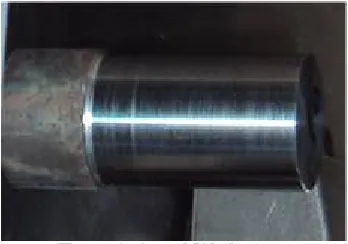
In the present study IS 2062 steel rods are used for turning on CNC Lathe Trainer. The diameter of steel rods was taken 35 mm and length was 100 mm during experiments. Actual work piece is shown in fig 3.The work piece material is chosen because of its wide use in automotive industry for ring gears, pinions, helical gears, bearing races, Arbors, bushes, camshafts, kingpins, ratchets, gears, spindle shafts etc.
Figure 3.Actual Work piece
Table 1 Chemical composition of IS2062 Table 2 Mechanical properties of IS2062
Max Stress 400-560 n/mm2
Yield Stress 300-440 n/mm2 Min
0.2% Proof Stress 280-420 n/mm2 Min
Elongation 10-14% Min
Chemical composition & Mechanical properties of the material is shown in Table 1 & Table 2 respectively. The cutting tool selected for machining the IS 2062 steel is CVD coated carbide inserts designed as TNMG 160408 GS CA5515.
Carbon 0.16-0.18%
Silicon 0.40% max
Manganese 0.70-0.90%
Sulphur 0.040% Max
ISSN(Online): 2319-8753
ISSN (Print): 2347-6710
I
nternational
J
ournal of
I
nnovative
R
esearch in
S
cience,
E
ngineering and
T
echnology
(An ISO 3297: 2007 Certified Organization)Vol. 4, Issue 8, August 2015
2.1 CNC Lathe Machine
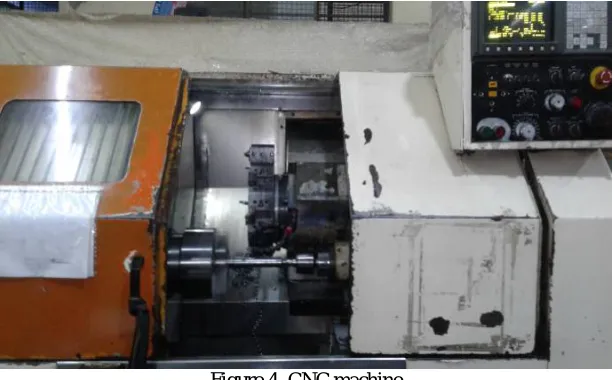
CNC machine used in turning operation was universal turning machine MIDAS 8i by GALAXY MACHINARY PVT. LTD Rajkot. Turning operation is carried out on this machine, a dry environment was chosen because of environment safety. Fig 4 shows CNC machine used in turning process.
Figure 4. CNC machine
2.2. Design and analysis of experiments
The experimental design for three turning parameters (cutting speed, feed rate and Depth of cut) with three levels L9 (33) and three factors are organized by the Taguchi’s L 9 orthogonal array as shown in Table 4.
Design of experiment is a powerful statistical method to determining the unknown properties of the machining parameters in the experiment process and for analyzing and modeling the interaction among the factors [7].Taguchi method is used in the industry to decrease the product development period for the design and production which also decrease the costs and increase the profit of the industries. Taguchi method also allows controlling the variations caused by the uncontrollable factors which are not taken into consideration at conventional design of experiment [8-9]. Taguchi converts the objective function valuesto signal-to-noise (S/N) ratio for measure the performance characteristics of the levels of control factors against these factors. S/N ratio is defined as the desired signal ratio for the undesired random noise value and shows the quality characteristics of the experimental data [10-11]. As the first step in Taguchi, the orthogonal array of L9 is identified to optimize machining parameters for minimum tool wear (flank) and best surface quality. The standard orthogonal array consists of twenty seven experiments with three control factors and three different experimental condition levels for each factor. Process parameters and levels have been selected as listed in Table 3.
Table 3 Process parameters and levels Parameters levels
1 2 3 Cutting speed
(Vs) (mm/min)
29.05 43.1 67.19
Feed rate (Fs)
(mm/rev)
0.25 0.376 0.381
ISSN(Online): 2319-8753
ISSN (Print): 2347-6710
I
nternational
J
ournal of
I
nnovative
R
esearch in
S
cience,
E
ngineering and
T
echnology
(An ISO 3297: 2007 Certified Organization)Vol. 4, Issue 8, August 2015
2.3. Confirmation tests
Once the optimal level of the design parameters hasbeen selected, the final step is to predict and verify the improvement of the quality characteristic using the optimal level of the design parameters after the optimal level has been selected, one could predict the optimum tool wear (flank) using the following equation:
Where µm is the mean response or mean S/N ratio, µi is the mean response or mean S/N ratio at optimal level, and n is the number of
main design parameters that affect the quality characteristics. It is very essential to perform a confirmation experiment for the parameter design, particularly when less numbers of data are utilized for optimization. The purpose of this confirmation experiment is to verify the improvement in the quality characteristics.
III. RESULT AND DISCUSSION
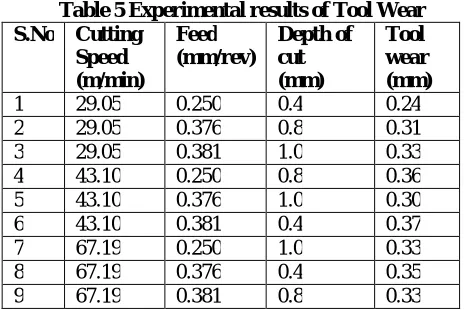
Experiments conducted to determine the effect of different cutting parameters on tool wear.experiemntal result are shown in Table 5. 3.1 ANOVA
ANOVA is a power full tool, used to determine the optimum combination of parameters with efficiently by investigating the relative importance of process parameters Table 4 shows ANOVA result for tool wear (flank) and from Table 4 it is observed that cutting speed (36.78%) having more significant effect on tool wear followed by feed (14.61) where as feed having very less significant effect on tool wear.
Table 4.Analysis of Variance for flank wear (mean)
ource DF Adj SS Adj MS F P % contribution
Cutting speed 2 0.004422 0.002211 0.81 0.554 36.78
Feed 2 0.001756 0.000878 0.32 0.758 14.61
Depth of cut 2 0.000356 0.000178 0.06 0.939 2.96
Residual Error 2 0.005489 0.002744 45.67
Total 8 0.012022
3.2 Description of the Taguchi method
Table 5shows the experimental results for Tool wear and the corresponding S/N ratio. Since the experimental design is orthogonal, it is then possible to separate out the effect of each cutting parameter at different levels. Sunil Kumar Sharma et al [20] coupled Taguchi technique with grey relation and they conclude that Cutting speed and depth of cut is found to be insignificant from the ANOVA study
Table 5 Experimental results of Tool Wear S.No Cutting
Speed (m/min)
Feed (mm/rev)
Depth of cut (mm)
Tool wear (mm)
1 29.05 0.250 0.4 0.24
2 29.05 0.376 0.8 0.31
3 29.05 0.381 1.0 0.33
4 43.10 0.250 0.8 0.36
5 43.10 0.376 1.0 0.30
6 43.10 0.381 0.4 0.37
7 67.19 0.250 1.0 0.33
8 67.19 0.376 0.4 0.35
ISSN(Online): 2319-8753
ISSN (Print): 2347-6710
I
nternational
J
ournal of
I
nnovative
R
esearch in
S
cience,
E
ngineering and
T
echnology
(An ISO 3297: 2007 Certified Organization)Vol. 4, Issue 8, August 2015
3.3 optimum tool wear prediction
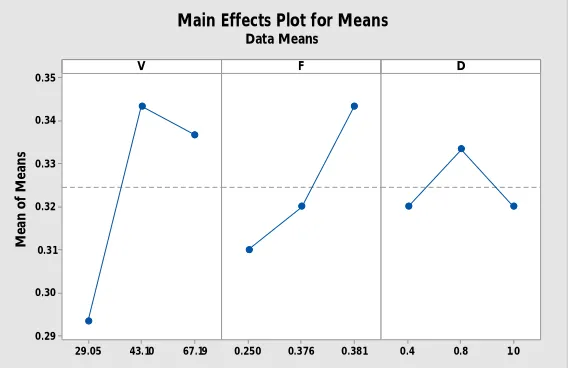
In Figs. 5 show the tool wear values of the S/N means response. The optimized values for the tool wear were calculated V2F3D2. Eq. (6) was used for calcula-
67.19 43.10 29.05 0.35 0.34 0.33 0.32 0.31 0.30 0.29 0.381 0.376
0.250 0.4 0.8 1.0
V M e a n o f M e a n s F D
Main Effects Plot for Means Data Means
Figure 5. Main effects plot for mean
IV. CONCLUSIONS
This paper has presented an application of the parameter design of the Taguchi method in the optimization of turning operations. The following conclusions can be drawn based on the experimental results of this study:
1. The experimental results showed that the Taguchi parameter design is an effective way of determining the optimal cutting parameters for achieving low tool wear.
2. According to results of ANOVA analysis, the main contributing factors affecting the tool wear were cutting speed with a contribution of 36.78% followed by feed (14.61). Whereas depth of cut having least significant affect on tool wear (flank).
3. The optimum level of cutting parameters for tool wear V2F3D2 (i.e., cutting speed = 43.01 m/min, Feed rate = 0.381 mm/rev, and depth of cut 0.8 mm)
4. It is found that the parameter design of the Taguchi method provides a simple, systematic, and efficient methodology for the optimization of the cutting parameters.
REFERENCES
[1]Ramón Quiza & Luis Figueira & J. Paulo Davim, Comparing statistical models and artificial neural networks on predicting the tool wear in hard machining D2 AISI steel, Int J Adv Manuf Technol (2008) 37:641–648.
[2] Barry, J. and Byrne, G., 2001 “Cutting tool wear in the machining of hardened steels, Part II: CBN cutting tool wear”, Wear, 247, 152-160 [3] S.E. Oraby,”Mathematical modeling and in-process monitoring techniques for cutting tools”, University of Sheffield, Ph.D. Thesis, 1989. [4] Abuelnaga AM, El-Dardiry MA.”Optimization methods for metal cutting”. Int J Mach Tool Design Res 1984; 24(1):11–8.
[5] Chryssolouris G, Guillot M. A.” Comparison of statistical and AI approaches to the selection of process parameters in intelligent machining”.ASME,J Eng Ind 1990; 112:122–31.
[6] Chua MS, Rahman M, Wong YS, Loh HT.”Determination of optimal cutting conditions using design of experiments and optimization techniques”. Int J Mach Tools Manuf 1993; 33(2): 297–305.
[7] Murat Sarıkaya ,Abdulkadir Güllü “Taguchi design and response surface methodology based analysis of machining parameters in CNC turning under MQL” Journal of Cleaner Production 65 (2014) 604e616
[8] G. Taguchi, S. Chowdhury, Y. Wu,”Taguchi’s Quality Engineering Handbook”, John Wiley & Sons Inc., New Jersey, 2005.
[9] J.Z. Zhang, J.C. Chen, E.D. Kirby, “Surface roughness optimization in an end-milling operation using the Taguchi design method”, J. Mater.Process. Technol. 184 (2007) 233–239.
ISSN(Online): 2319-8753
ISSN (Print): 2347-6710
I
nternational
J
ournal of
I
nnovative
R
esearch in
S
cience,
E
ngineering and
T
echnology
(An ISO 3297: 2007 Certified Organization)Vol. 4, Issue 8, August 2015
[11] M. Kurt, E. Bagci,Y. Kaynak,”Application of Taguchi methods in the optimization of cutting parameters for surface finish and hole diameter accuracy in dry drilling progress”,Int. J. Adv. Manuf.Technol. 40 (2009) 458–469.
[12] Calado V, Montgomery DC. Planejamento de Experimentos usando o Statistica®. Rio de Janeiro: E-papers Serviços Editoriais; 2003
[13] A.N.M Khalil, M.A.M Ali, A.I. Azmi, Effect of Al2O3 nanolubricant with SDBS on tool wear during turning process of AISI 1050 with minimal quantity lubricant, Procedia Manufacturing 2 ( 2015 ) 130 – 134
[14] Alireza Dehghani, Sasan Khalaj Amnieh⁎, Alireza Fadaei Tehrani, Aminollah Mohammadi, Effects of magnetic assistance on improving tool wear resistance and cutting mechanisms during steel turning, Wear 384–385 (2017) 1–7
[15] Sudhansu Ranjan Das, Asutosh Panda and Debabrata Dhupal, Experimental investigation of surface roughness, flank wear, chip morphology and cost estimation during machining of hardened AISI 4340 steel with coated carbide insert, Mechanics of Advanced Materials and Modern Processes (2017) 3:9, 1-14
[16] José C. Camargo, Dany Sanchez Dominguez, Emmanuel O. Ezugwu, Álisson R. Machado, Wear model in turning of hardened steel with PCBN tool, Int. Journal of Refractory Metals and Hard Materials 47 (2014) 61–70
[17] S.Y. Luo , Y.S. Liao , Y.Y. Tsai, Wear characteristics in turning high hardness alloy steel by ceramic and CBN tools, Journal of Materials Processing Technology 88 (1999) 114–121
[18] S.R Das, R.P Nayak, D. Dhupal, Optimization of cutting parameters on tool wear and work piece surface temperature in turning of AISI D2 steel, Int. Journal of lean thinking Vol.3 Issue 2,2012,140-156
[19] M. Kaladhar, K. Venkata Subbaiah, CH. Srinivasa Rao, Optimization of Surface Roughness and Tool Flank Wear in Turning of AISI 304 Austenitic Stainless Steel With CVD Coated Tool, Journal of Engineering Science and Technology,Vol. 8, No. 2 (2013) 165 – 176
[20] Sunil Kumar Sharma, Saadat Ali Rizvi, R. P Kori, Optimization of Process Parameters in Turning of AISI 8620 Steel Using Taguchi and Grey Taguchi Analysis, Int. Journal of Engineering Research and Applications, Vol. 4, Issue 3, 2014,51-57
![Figure 1.Effects of different parameters in tool wear [12].](https://thumb-us.123doks.com/thumbv2/123dok_us/1667183.1209558/2.595.104.539.187.490/figure-effects-different-parameters-tool-wear.webp)