KUNZE, ANDREA JORDAN. Students’ Discipline-Specific Perceptions of Learning Practices: A Mixed-Methods Approach. (Under the direction of Dr. Teomara A. Rutherford).
Students’ learning experiences help shape their perceptions of what effective learning
practices are, and these perceptions affect the effort and approaches students engage in when in a learning environment. The type of learning environment students engage with may vary across disciplines, therefore students’ perceptions may be domain-specific. Data for this study were students’ discipline-specific perceptions of effective course structures and activities for
chemistry and humanities and their general epistemic beliefs. Individual responses from students (N = 329) across three courses were grouped as either constructivist or instructivist learning approaches and then reported as a ratio of the two views. A step-wise regression was used to determine domain-specific differences in the students’ responses, and the association between their epistemic beliefs and perceptions of learning. Results revealed disciplinary differences in students’ perceptions of learning, as well as potential influential factors due to differences in each course’s models of learning. Understanding students’ perceptions of learning have implications for students’ future enrollment in, effort invested in, and approaches to learning
by
Andrea Jordan Kunze
A thesis submitted to the Graduate Faculty of North Carolina State University
in partial fulfillment of the requirements for the degree of
Master of Science
Curriculum & Instruction
Raleigh, North Carolina 2018
APPROVED BY:
_______________________________ _______________________________ Teomara Rutherford Roger Azevedo
Committee Chair
BIOGRAPHY
Andrea Kunze earned her B.I.S. in Human Learning and Development from Georgia State University in 2016. She is currently a student in the department of Curriculum and Instruction pursuing her Master of Science in Educational Psychology.
Throughout her undergraduate studies, Andrea worked as a research assistant for multiple departments. During her time in the Educational Psychology department, she worked on projects about how students learn science within collaborative and informal learning settings and
presented her work at local conferences. Additionally, her time in the Neuropsychology
department furthered her interest in individual differences in cognition using fMRI. These early research experiences sparked her interest to continue researching students’ learning and
cognition by pursuing a master’s degree in Educational Psychology.
AKNOWLEDGEMENTS
I would first like to thank the faculty and staff at NC State University that allowed me the opportunity to administer my survey to their students. Without this collaboration, this paper would not have been possible.
Next, I want to thank my advisor, Dr. Rutherford. The flexibility, freedom, and support you have given me throughout this process has really helped me develop into a better researcher. Without your invaluable feedback and patience, this thesis would not have even been possible.
To Dr. Greene, thank you for the research idea for this project. Our conversations over the past two years have been so useful, and has helped me expand on my prior work. Dr. Azevedo, I appreciate the guidance and opportunities to develop my research skills you have offered me. These are skills I will always carry with me moving forward.
To my NCSU family, I cannot thank you enough. Know that the love, support, successes, failures, and frustrations we have all shared over these past two years do not go unnoticed or underappreciated.
Of course, I cannot forget my family back home–Mom, Steve, Deirdre, and Patrick. I know you guys do not always understand what I am doing and I have little time, but the journey to pursue my degree would not have been possible without your endless love and support.
Lastly, I want to thank myself for seeing this through. Remember the late nights,
TABLE OF CONTENTS
LIST OF TABLES ... vi
LIST OF FIGURES ... vii
CHAPTER 1: INTRODUCTION 1 1.2. Personal Factors—Student beliefs of Learning & Knowledge 2 1.2.1. Perceptions of Learning. ... 2
1.2.2. Epistemic Beliefs. ... 5
1.3. Behavior & Approaches—Epistemic Practices 6 1.3.1. Communities of Practice. ... 7
1.4. Learning Environment—Epistemic Orientation & Climate 8 1.4.1. Instructivism. ... 9
1.4.2. Constructivism. ... 10
1.5. Purpose of the Study 11 CHAPTER 2: METHODOLOGY 12 2.1. Research Design 12 2.2. Procedures 12 2.3. Participants 13 2.3.1. Chemistry. ... 14
2.3.2. HSS. ... 14
2.4. Measures 15 2.4.1. Open-ended Questions. ... 15
2.4.2. Epistemic Belief Inventory. ... 15
2.5. Analysis 15 2.5.1. Phase 1: Qualitative ... 15
2.5.1.1. Open-ended. ... 15
2.5.2. Phase 2: Quantitative ... 16
2.5.2.1. Open-ended Transformation. ... 16
2.5.2.2. Epistemic Beliefs. ... 16
CHAPTER 3: RESULTS 18 3.1. Student Perceptions of Courses Structures and Activities 18 3.2. Domain-specific Differences in Perceptions 23 3.3. Learning Perceptions & Epistemic Beliefs 25 3.4. Emerging Results: Course Climate 28 3.4.1. Phase 3: Qualitative Analysis. ... 29
CHAPTER 4: DISCUSSION 33
4.1. Research Question 1: Student Perceptions as Models of Learning 33 4.2. Research Question 2: Discipline-specific Perceptions 34 4.3. Research Question 3: Student Perceptions and Epistemic Beliefs 34 4.4. Emerging Results: Students Perceptions and Course Climate 35
4.5. Limitations 36
4.6. Implications 37
4.7. Conclusion 37
REFERENCES 39
Appendix A 55
Appendix B 56
LIST OF TABLES
Table 1 Descriptive Student Characteristics by Course ... 14
Table 2a Portion of Student Perceptions of Learning for Course Structure Themes ... 21
Table 2b Portion of Student Perceptions of Learning for Activities Themes ... 22
Table 3 Descriptive Statistics for Students’ Views of Learning ... 24
Table 4 Multiple Regression of Construct: Instruct Preferences by Course Subject ... 25
Table 5 Descriptive Statistics of Epistemic Beliefs Subscales ... 25
Table 6 Descriptive Statistics for Epistemic Beliefs Dimensions by Course ... 26
Table 7 Pairwise-Correlations of Course Perceptions and Epistemic Beliefs ... 27
Table 8 Step-wise Regression of Students’ Views of Learning on their Epistemic Beliefs . 28 Table 9 Undergraduate Courses Model of Learning by Learning Factors ... 30
Table 10 Student Responses Reflective of Syllabus Structures ... 31
LIST OF FIGURES
CHAPTER 1: INTRODUCTION
University students do not come to college with blank slates, but rather come with a combination of experiences with a variety of instructional practices that shape their perceptions of successful learning. Many of them may identify with a particular preference or belief about how they best process information (Willingham & Dobolyi, 2015). Although their views of learning do not reflect their actual capabilities or dictate which approaches are best for learning performance (Alghasham, 2012; Cuevas, 2015), these beliefs about learning are important because students’ perceptions of learning environments are related to their approaches to learning and how they engage with their environment (Bandura, 1989; Ramsden, 1992). The approaches to learning students choose to engage in are important, because deep learning approaches, such as thinking critically about material and making connections to prior knowledge, are associated with better learning outcomes than more surface approaches, such as memorization (Felder & Brent, 2005). Both surface and deep learning approaches are often associated with different types learning environments (Entwistle & Tait, 1990). Deeper learning approaches are most consistent with constructivist learning environments (Freeman et al., 2014; Von Glasersfeld, 1996); however, in higher education, instructivist learning approaches, which promote surface learning approaches, continue to dominate courses (Eagen et al., 2014). Within this study, a mixed-method approach is taken to explore students’ perceptions of effective learning activities and course structures across
three courses in two domains. These perceptions are matched with constructivist and instructivist learning approaches and are related to a potential undergirding factor, students’ beliefs about the
1.1.Theoretical Framework
I frame my study within Bandura’s (1989) Social Cognitive Theory (SCT), where students’
personal factors, such as their beliefs and perceptions, have a reciprocal and dynamic relationship with how they engage with learning environments and approach learning (Biggs, 1993, 1999; Myer, 1998). In addition, a self-regulated learning framework is used to explain the dynamic relationship between students perceptions of effective strategies and practices, and the learning environment. Because students play an active role in their learning, their perceptions and experiences are also brought to the classroom, where they interact with their teacher and peers’ beliefs during the learning process, indirectly shaping the learning environment. In line with SCT, Experiential Learning Theory (ELT) states, “learning is best facilitated by a process that draws out the students' beliefs and ideas” (Kolb & Kolb, 2005, p.194). This idea of drawing on students’
beliefs about learning is consistent with constructivist views of learning, where knowledge is a socially constructed process that accounts for students’ prior knowledge and learning experiences (Vygotsky, 1978). Consistently, these theories of learning suggest that students’ epistemologies,
beliefs, learning environments, and approaches to learning are a complex and bi-directional system; however, studies showing contradicting relationships between perceptions, environment, and approaches, suggest they are still not fully understood (Baeten, Kyndt, Struyven, & Dochy, 2010; McParland, Noble, & Livingston, 2004; Tetik, Gurpinar, & Bat, 2009).
1.2. Personal Factors—Student beliefs of Learning & Knowledge
1.2.1. Perceptions of Learning. Within Bandura’s (1989) Social Cognitive Theory, students’ beliefs about learning and knowledge are considered personal factors that contribute to
underlying assumptions about learning styles; they are generalizable and consistent across different subjects, and are a reflection of an individual’s cognitive abilities; however, scientific
literature notes the lack of support for those assumptions (Massa & Mayer, 2006; Pashler, McDaniel, Rohrer, Bjork, 2008). To move further away from learning styles as part of a student’s personal learning factors, it is encouraged to view students’ perceptions of learning as learning preferences (Dunn, Beaudry, & Klavas, 1989; Willingham, Huges, & Dobolyi, 2015). Learning preferences can be broadly defined as one’s predisposition for perceiving and processing
information in a particular way or combination of ways; they are the learner’s perspective, or beliefs, of what strategies are most effective for their learning (Sarasin, 1998).
In Higher Education courses where students have more autonomy and control over their approaches to learning, accounting for their perceptions of effective learning strategies can provide insight into who the learner is, how they approach learning, and the learning environment itself. A recent study has shown that course structures that account for individual learning preferences have been shown to increase student-perceived autonomy, which contributes to deeper conceptual learning (Jang, Reeve, & Halusic, 2016). Increasing student autonomy is crucial in developing deeper conceptual understandings in the more adult audience found in Higher Education courses; however, to achieve an autonomy-supportive environment, students’ perspectives must be taken into account (Ryan & Deci, 2000). This is not to say that courses should be completely structured to fit students’ desires as often touted by advocates of learning styles. Instructors and educators
This relationship between student beliefs and actions is also expressed in motivation literature, and has found to be associated with approaches to challenges, and actions taken to achieve their learning goals (Dweck, 1986; Dweck & Leggett, 1988); however, this relationship between beliefs and action is not unidirectional. Students’ perceptions of their learning
environment, including beliefs about assessment, are also associated with their approaches to learning and perceptions of the courses goal structure (Lizzio, Wilson, & Simons, 2002; Parpala, Lindblom-Ylänne, Komulainen, Litmanen, & Hirsto, 2010). In particular, students adapt their own learning strategies to align with their beliefs about effective strategies to meet assessment requirements (Biggs, 2003; Birenbaum, 2007; Hativa & Birenbaum, 2000). This means that students will adopt differing learning strategies to fit their beliefs and understandings of a courses structure and goal orientation, in order to be successful.
1.2.2. Epistemic Beliefs. In addition to the importance of learning perceptions and beliefs, domain-general beliefs about the nature of knowledge and learning, or epistemic beliefs, are additional personal factors that contribute to academic achievement (Hofer, 2000; Muis & Franco, 2009; Phan, 2008). Students’ epistemic beliefs are a reflection of a collection of independent
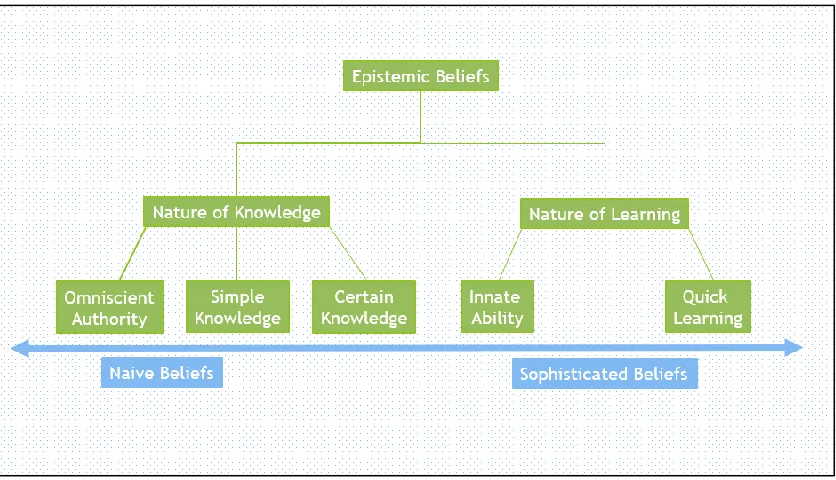
beliefs about the nature of knowledge, and the nature of learning (Olafson, Schraw, & Vander Veldt, 2010). These beliefs are considered on a spectrum of naïve to sophisticated perceptions of the process of learning (Quick learning), ability to learn (Innate ability), source (Omniscient Authority), organization (Simple Knowledge), and certainty of knowledge (Certain Knowledge) (Schommer, 1990) (See Figure 1). The concept of knowing and learning as a continuum from simple to complex is not new (see Kuhn, 1991; Perry, 1970); however, more contemporary models view epistemology as multi-dimensional rather than unidimensional (e.g., Schommer, 1990).
Figure 1. A model for understanding epistemic beliefs
have conducted cluster-analyses on epistemic beliefs have revealed a higher achieving and motivated profile for students with more sophisticated beliefs, meaning students understanding of learning and knowledge contribute to their drive and performance in the classroom (Buehl & Alexander, 2005; Chen, 2012). Other studies have found that sophisticated beliefs are associated with greater use of self-regulatory strategies and deeper learning approaches (Greene, Muis, & Pieschl, 2010; Hofer & Pintrich, 1997; Schreiber & Shinn, 2003; Vermetten, Vermunt, & Lodewijks, 1999). For example, Schommer (1990) found epistemic beliefs were related to how students connected new information to prior knowledge and how they monitored their comprehension of material. This means that the methods students use for creating new knowledge are related to their epistemic cognition.
1.3. Behavior & Approaches—Epistemic Practices
Schommer’s earlier work suggests that students’ epistemologies can be seen in the actions
they take to learn. In line with this, Phan (2008) found that students’ learning approaches mediate students’ epistemic beliefs association to their learning outcomes, further supporting the
bi-directional relationship in SCT between students’ personal beliefs and learning approaches. Learning approaches can be explained as surface-level or deep. Surface learning strategies are based on rote memorization, and actions often seen with this type of learning are flash cards, mnemonics, and reading textbooks (Eagen et al., 2014). These more shallow strategies have shown to be associated with more naïve epistemic beliefs (Ravindran, Greene, DeBacker, 2005), further supporting the concept that students’ beliefs plays a role in their approaches to learning. In contrast,
sophisticated beliefs (Greene, Muis, Pieschl, 2010). This means that the actions students engage in when trying to learn new material are underpinning their beliefs about the nature of knowledge and learning, supporting the concept of epistemic practices.
1.3.1. Communities of Practice. When considering epistemic practices within a learning environment or students, we need to be consider potential disciplinary differences in how knowledge is communicated to students in the classroom, or what the practice of their learning environment is. According to Biglan (1973), academic disciplines can be categorized as Pure (e.g., biology) or Applied (e.g., engineering) domains, nested as either a life (e.g., psychology) or non-life subjects (e.g., chemistry). Within these different domains, often there is a collective understanding or perspective of how to process and seek information, problem solve, and communicate the knowledge (Eitenne Wegner, 2004). There is evidence that students tend to study in disciplines that align with their views of learning and learner characteristics (Entwistle & Tait, 1990; Malaney, 1986). This suggests different disciplines may require different skills and attract different students, and provides the impetus to further explore how these differences may manifest in student preferences for different instruction.
(Ellis, Cox, & Hall, 1993); however, studies support the concept that approaches to problem solving and critical thinking are domain-specific (e.g., Chi, Feltovich, & Glaser, 1981; Glaser & Chi, 1988). This suggests that across fields there are some similarities in CoP, but variation can still be found.
1.4. Learning Environment—Epistemic Orientation & Climate
In addition to the relationship between epistemic beliefs and learning practices, epistemic beliefs are also associated, or even embedded in, learning environments. There is growing evidence that epistemologies are represented in a learning environment through course materials and structure, and has an influence on students’ own beliefs (Bendixen & Rule, 2004; Feucht, 2008; Haerle & Bendixen, 2008; Muis & Duffy, 2013). For example, Muis and Duffy (2013) showed that students’ epistemological beliefs shifted when within a constructivist learning
environment, and this shift, or epistemic change, was associated with an increase in critical thinking and academic performance. Bendixen and Rule (2004) also found students’ epistemic
beliefs to be influenced by the beliefs and actions of their teachers and peers. Both studies support the concept of epistemic orientations, or individual’s epistemological alignments based on learning
practices and structures at hand, as adaptive processes that are contextually-driven.
A classroom’s epistemic orientation is present in the structure and types of assessment and
epistemological orientation. Contrary to this, the theory of constructivism emerged as a learning theory supporting more student-centered approaches based upon the notion that knowledge is socially constructed and builds on prior knowledge and experiences (Vygotsky, 1978). The orientation of a course is a reflection of the teachers understanding of the material, and their epistemological beliefs. A study by Chan & Elliot (2002) revealed that teachers’ epistemic beliefs affect their understanding of course material, and the strategies and practices they provide to their students. Furthermore, other studies found teaching and learning structures are related to students' beliefs about learning and approaches to learning (Gow and Kember, 1993; Kember & Gow, 1994; Kember, Leung, & McNaught, 2008). A study by Entwistle and Tait (1990) found students with preferences for deep learning approaches preferred active learning structures, in contrast with students with preferences for surface approaches who preferred rote learning structures. This does not mean students who prefer surface learning benefit best from that approach, but that their perceptions may influence student motivation for and perception of the course, which in turn has implications for effort and engagement (Cano, 2007; Floyd, Harrington, & Santiago, 2009). This indicates that in a learning environment the orientation of the learning structure, and the teacher and students’ epistemic beliefs, contribute to the epistemic climate of an environment. For this
study, I particularly look at the orientation of instructivist and constructivist courses.
of knowledge as controlled and certain (Fetherston, 2001). Common activities found in these types of classrooms are reliant on textbooks, repetition, individual work, and summative assessments. A course reflecting this type of structure limits student autonomy and interaction by relegating the student to a passive role in their learning (Jonassen, 1991). There have been multiple national calls to increase student-centered strategies in the classroom (e.g., NRC, 1999, 2003; NSF, 1996), because these more interactive learning approaches have shown to positively change students’
perceptions and success in fields with high attrition, such as STEM (Freeman et al., 2014; Singer, Nielson, & Schweingruber, 2012). Despite this, more than 60% of chemistry courses are still presenting information in a instructivist style, and the majority of all STEM courses consist of more than 100 students making a less instructivist approach complicated (Stains et al., 2018).
collaborative and student-driven nature of those environments (Ertmer & Newby, 1993; Tom, 2015). Constructivist environments, because of the interactive nature, reflects a more sophisticated epistemic orientation, which could be beneficial for students across all disciplines.
1.5. Purpose of the Study
There have been multiple studies that have shown students’ beliefs about learning, and
choice in strategy affect their academic performance (Alghasham, 2012). We also know that these beliefs and perceptions about learning affect how students interact in the classroom and differ across domains. What is still not fully understood is how these beliefs play a role in the “big picture,” or epistemic climate, as they have a reciprocal relationship to the environment and
CHAPTER 2: METHODOLOGY 2.1. Research Design
I used a mixed-methods approach with quantitative methods embedded within a qualitatively-driven research design to address my research questions. Data collection was limited to a single phase via an online survey. The qualitative data sources came from two places: the individual course syllabi for all three courses, and two open-ended questions within the 18-question 18-questionnaire.
2.2. Procedures
Data were collected in the fall of 2017. To recruit participants, a PowerPoint outlining the purpose, compensation, requirements, and format of the study was presented to four sections of an Introduction to Humanities and Social Sciences (HSS) course for major-declared students taught by a single instructor, a single section of a Preparatory Chemistry course taught by one instructor (Chemistry 1), and a single section of an Introduction to Chemistry course taught by another instructor (Chemistry 2). Students were provided extra credit for the course in which they were enrolled as compensation for their time. Two surveys were created; the surveys were largely the same, but the chemistry survey asked how students perceived chemistry, and the HSS survey asked how students perceived humanities and social sciences. Each course’s instructor provided their course syllabus.
After initial recruitment, participants were sent an email containing a unique link to the survey. Students were given two weeks to complete the survey after receiving the initial email, with reminder emails sent twice over the two weeks to those who had yet to complete the survey. Each student’s link directed them to a page with information regarding the study and informed
to the survey. By initiating the survey, students provided consent to participate and permission for the research team to access to their private academic records. Once the deadline for the survey passed, the unique survey identifiers were sent to the Office of Institutional Researching and Planning (OIRP) to match student academic records to de-identified responses.
2.3. Participants
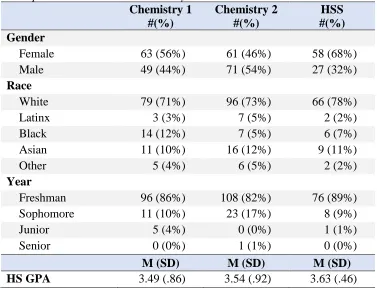
A total of 879 surveys were initially completed from 1376 surveys sent out; however, 217 (25%) of the completed surveys were duplicate responses leaving a total of 662 unique responses for a total response rate of 48%. In these cases, the first survey responses were preserved. From the 662 surveys, an additional 142 students were excluded for being in courses outside those examined in this study. Of the 520, an additional 31 surveys were excluded for being incomplete, and 160 for missing academic records.
Table 1
Descriptive Student Characteristics by Course Chemistry 1
#(%)
Chemistry 2 #(%)
HSS #(%) Gender
Female 63 (56%) 61 (46%) 58 (68%)
Male 49 (44%) 71 (54%) 27 (32%)
Race
White 79 (71%) 96 (73%) 66 (78%)
Latinx 3 (3%) 7 (5%) 2 (2%)
Black 14 (12%) 7 (5%) 6 (7%)
Asian 11 (10%) 16 (12%) 9 (11%)
Other 5 (4%) 6 (5%) 2 (2%)
Year
Freshman 96 (86%) 108 (82%) 76 (89%)
Sophomore 11 (10%) 23 (17%) 8 (9%)
Junior 5 (4%) 0 (0%) 1 (1%)
Senior 0 (0%) 1 (1%) 0 (0%)
M (SD) M (SD) M (SD)
HS GPA 3.49 (.86) 3.54 (.92) 3.63 (.46)
Note. The total number of students is N = 329; Chem 1 (N= 112), Chem 2 (N = 132), & HSS (N= 85). Number in parentheses represents the percentage of students within the course. Other, under Race, represents students who were either unspecified, multiracial, or not one of the races listed. HS GPA = High school GPA.
2.3.1. Chemistry. Of 588 chemistry students, 396 completed the survey. An additional 151 participants were eliminated for missing academic records, and lastly an additional student was eliminated for being a graduate student. The final number of chemistry participants used for analyses were 244, divided 112 for Chemistry 1, and 132 for Chemistry 2.
2.4. Measures
2.4.1. Open-ended Questions. The development of the researcher-created open-ended questionnaire was based on previous pilot-testing that used a sample of introductory chemistry students from a university on the west coast (Kunze & Rutherford, 2017, August). The questionnaire consisted of three open-ended questions, but for the purpose of this study we focus on the first two:
1. How are good [chemistry/humanities & social sciences] courses structured?
2. What are activities that help you learn about [chemistry/humanities & social sciences]?
2.4.2. Epistemic Belief Inventory. The Epistemic Belief Inventory (EBI) developed by Schraw, Bendixen, & Dunkle (2002) was used in this study to assess students’ general views of
knowledge. Building off of the Schommer-Aikens model (2002), the measures span five dimensions of epistemology: Quick Learning (learning speed), Certain Knowledge (knowledge ambiguity), Simple Knowledge (knowledge structure), Innate Ability (learning control), and Omniscient Authority (source of knowledge). Each dimension consisted of three, five-point Likert-scale questions, for a total of 15 questions (See Appendix A).
2.5. Analysis
2.5.1. Phase 1: Qualitative
2.5.1.1. Open-ended. The open-ended course structure and course activities questions were analyzed using a grounded theory approach (Strauss & Corbin, 1990, 1998). Because of the limited prior research on differences in students’ perceptions of domain-specific classroom practices, and
robustness of the codes. For each students’ response, an initial sentence-by-sentence open-coding
scheme was used, allowing each student to have multiple codes per response. An axial coding process was then used to group the open codes based on common characteristics. These common characteristics revealed themes differing in active versus passive learning preferences aligning with Vygotsky’s (1978) Social Development Theory. Lastly using this framework, a selective
coding process was used to relate both the course structure and course activities themes to either instructivist (Harrington & Standen, 1999) or constructivist (Jonassen, 1991) models of learning.
2.5.2. Phase 2: Quantitative
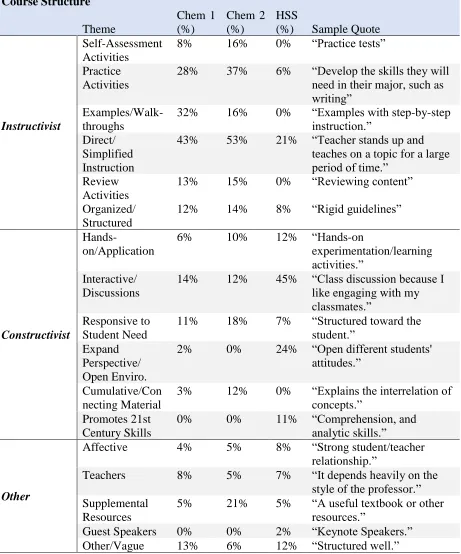
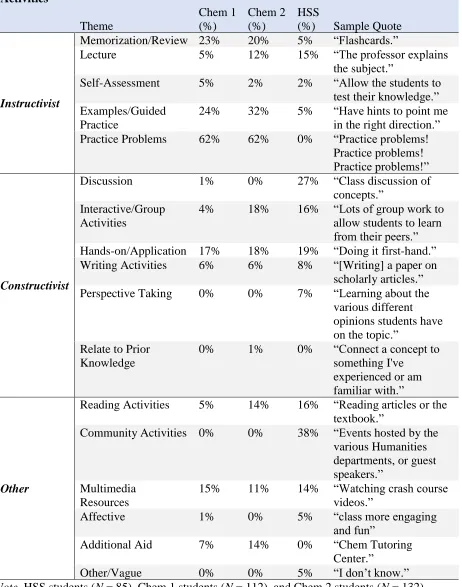
2.5.2.1. Open-ended Transformation. To integrate the qualitative and quantitative analyses, the codes that were created during the axial coding phase of the qualitative analyses were transformed; each axial code was coded as either 0 (not present) or 1 (present) for each student response. It is worth noting that students who responded in more detail to the questions tended to have more codes present. Once transformed, the percentage of students reporting each theme was calculated (see Table 2a and 2b). A second coder, an undergraduate researcher who coded the prior pilot-study themes, was used to ensure interrater reliability and quality of the codes created. Cohen’s Kappa statistic was calculated to determine consistency among raters (See Appendix B
for details). The interrater agreement between the two coders was greater than 80% for all course structure themes, and greater than 86% for all activities themes. For codes with discrepancies between coders, a final decision was made by the lead researcher. These 0/1 axial codes were then totaled within each selective code (constructivist/instructivist). A ratio score was calculated representing each student’s ration of constructivist views to instructivist views of learning.
degree of naivety (or sophistication) for each dimension. The Cronbach alphas for each subscale are as follows: certain knowledge (α = .50), innate ability (α = .71), omniscient authority (α = .61), quick learning (α = .65), and simple knowledge (α = .69). These alphas are consistent with those
CHAPTER 3: RESULTS 3.1. Student Perceptions of Courses Structures and Activities
To answer my first research question, What do students perceive as effective chemistry and humanities course structures and practices?, students’ open-ended responses revealed codes that aligned with constructivist and instructivist approaches to instruction. First, an initial number open codes from the course structure question for the three courses were found: HSS (N= 93), Chem 1 (N = 102), Chem 2 (N =1 83). Examples of different codes across the three courses include, “Stories of other’s experiences,” “Step-by-step instructions,” and “Efficient lecture.” The open
codes for the activities question were then determined: HSS (N = 56), Chem 1 (N = 62), Chem 2 (N = 96). Examples of open-codes from the activities question include “Mnemonics,” “Outlines of important material,” and “Interviewing experts in different fields.”
Axial coding was then used across both questions to synthesize the open-codes that were characteristically the same, but only differ in phrasing. An example of chemistry student responses that differ in phrasing, but are still elementally the same are, “Homework” and “Practice problems,” as both express the desire for repetition and practice of learned material. Another example includes HSS students who desired courses that “Promote student participation” and were “Interactive,” because both expressed students’ desire for interaction and active engagement with
the course and others. The number of themes synthesized across course structure were: HSS (N = 16), Chem 1 (N = 17), and Chem 2 (N = 18). Theme numbers for activities were: HSS (N = 17), Chem 1 (N = 11), and Chem 2 (N = 15).
courses. Examples of common themes for all three courses included the use of “lectures,” “discussion,” and “hands-on application”; however, some themes remained exclusive to only one
or two courses (e.g., guest speakers and practice problems). Below are examples of comments that are representative of the three courses.
“I think good humanities and social sciences courses are structured around a free learning environment. In other words, I think it necessarily needs to be an interactive class. There needs to be active discussion between professor and students. This allows students to learn through their own processes, and the professor simply guides them to this learning, rather than just telling them what to learn.”
[HSS, student 1]
“Quality HSS classes have a loose structure that allows for individual passions and interest to seep through the structure. It allows for creativity and expression through the material. It does not have a heavy reliance on reading a textbook or pure lecture form. It involves activities and projects that have real-life applications.” [HSS, student 2]
“Good chemistry courses have a lecture with notes that are easy to follow as well as practice example problems done by the teacher in class. They also have enough resources for those that need help, and always have extra problems to do outside of class for practice.”
[Chem 1, student 1]
“Good chemistry courses are structured by having lectures with PowerPoints to follow and a teacher who thoroughly explains the content. Then having homework assignments and books to read that instill those same lessons a second time so you can remember it better and practice.” [Chem 1, student 2]
“I think good chemistry courses are structured in a way that every student can learn all the material they need to know for tests by attending lectures. I think a textbook should only be used as supplementary material, and should not be the first source a student relies on to learn chemistry.” [Chem 2, student 1]
“The teacher should provide explicit instruction on material that is or is not required to know for the course. The teacher should provide plentiful examples of practice problems similar to exam/quizzes inside and out of the lecture period.” [Chem 2, student 2]
structures and learning activities as compared to humanities students. In particular, repetitious activities, such as practice problems, were almost exclusively noted by the chemistry students, as discussion activities were by the HSS students. This differences in the HSS responses compared to chemistry responses may suggest domain-specific perceptions of learning. Worth noting, is the 21% of HSS students that reported a preference for direct instruction in their course structure, and 15% of HSS prefer lecture for learning activities. Despite this high percent, the open-ended responses from these students revealed they desire this type of instruction in conjunction, or balance, with other more constructivist aspects. This raises question as to whether there are statistically significant differences in students’ perceptions of instructivist and constructivist
learning environments by discipline, or if they have more in common than it appears:
“They are constructed with a balance of lecture and discussion. Lecture, so that the teacher can teach the topic and discussion, as to open different students' attitudes towards the topic.” [HSS, Student 3]
“Good humanities and social science courses are structured with meaningful lectures and some type of engagement with the information presented.” [HSS, Student 4]
Table 2a
Portion of Student Perceptions of Learning for Course Structure Themes Course Structure
Theme
Chem 1 (%)
Chem 2 (%)
HSS
(%) Sample Quote
Instructivist
Self-Assessment Activities
8% 16% 0% “Practice tests” Practice
Activities
28% 37% 6% “Develop the skills they will need in their major, such as writing”
Examples/Walk-throughs
32% 16% 0% “Examples with step-by-step instruction.”
Direct/ Simplified Instruction
43% 53% 21% “Teacher stands up and teaches on a topic for a large period of time.”
Review Activities
13% 15% 0% “Reviewing content” Organized/
Structured
12% 14% 8% “Rigid guidelines”
Constructivist
Hands-on/Application
6% 10% 12% “Hands-on
experimentation/learning activities.”
Interactive/ Discussions
14% 12% 45% “Class discussion because I like engaging with my classmates.”
Responsive to Student Need
11% 18% 7% “Structured toward the student.”
Expand Perspective/ Open Enviro.
2% 0% 24% “Open different students' attitudes.”
Cumulative/Con necting Material
3% 12% 0% “Explains the interrelation of concepts.”
Promotes 21st Century Skills
0% 0% 11% “Comprehension, and analytic skills.”
Other
Affective 4% 5% 8% “Strong student/teacher relationship.”
Teachers 8% 5% 7% “It depends heavily on the style of the professor.” Supplemental
Resources
5% 21% 5% “A useful textbook or other resources.”
Table 2b
Portion of Student Perceptions of Learning for Activities Themes Activities Theme Chem 1 (%) Chem 2 (%) HSS
(%) Sample Quote
Instructivist
Memorization/Review 23% 20% 5% “Flashcards.”
Lecture 5% 12% 15% “The professor explains
the subject.”
Self-Assessment 5% 2% 2% “Allow the students to test their knowledge.” Examples/Guided
Practice
24% 32% 5% “Have hints to point me in the right direction.” Practice Problems 62% 62% 0% “Practice problems!
Practice problems! Practice problems!”
Constructivist
Discussion 1% 0% 27% “Class discussion of concepts.”
Interactive/Group Activities
4% 18% 16% “Lots of group work to allow students to learn from their peers.” Hands-on/Application 17% 18% 19% “Doing it first-hand.” Writing Activities 6% 6% 8% “[Writing] a paper on
scholarly articles.” Perspective Taking 0% 0% 7% “Learning about the
various different opinions students have on the topic.”
Relate to Prior Knowledge
0% 1% 0% “Connect a concept to something I've
experienced or am familiar with.”
Other
Reading Activities 5% 14% 16% “Reading articles or the textbook.”
Community Activities 0% 0% 38% “Events hosted by the various Humanities departments, or guest speakers.”
Multimedia Resources
15% 11% 14% “Watching crash course videos.”
Affective 1% 0% 5% “class more engaging
and fun”
Additional Aid 7% 14% 0% “Chem Tutoring Center.”
Other/Vague 0% 0% 5% “I don’t know.”
3.2. Domain-specific Differences in Perceptions
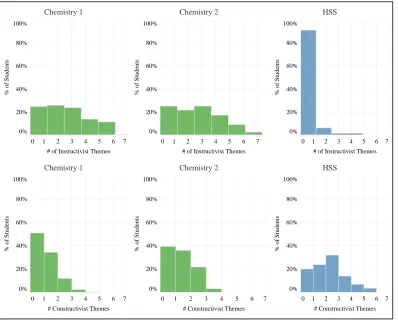
To answer research question two, Do these perceptions differ across course subject?, I first visually explored the percentage of students reporting each number of constructivist and instructivist preferences reported by course (See Figure 2). Figure 1 displays six histograms of the students’ responses by course and model of learning. Visually, most HSS students reported little
to no instructivist responses, and chemistry students reported a wider range of instructivist responses. This relationship appears inverse for constructivist responses, with a large percentage of HSS students’ reporting at least one theme and the chemistry student responses clustering more
at the left.
Figure 2. Visual Comparisons of Student Responses by View of Learning and Course
This figure represents the spread of instructivist and constructivist responses and the percentage of students by course. Chemistry courses are displayed in green, and the humanities course is displayed in blue.
0 1 2 3 4 5 6 7
# of Instructivist Themes 0% 20% 40% 60% 80% 100% % o f S tu d en ts Chemistry 1
0 1 2 3 4 5 6 7
# of Instructivist Themes 0% 20% 40% 60% 80% 100% % o f S tu d en ts Chemistry 2
0 1 2 3 4 5 6 7
# of Instructivist Themes 0% 20% 40% 60% 80% 100% % o f S tu d en ts HSS
0 1 2 3 4 5 6 7
# Constructivist Themes 0% 20% 40% 60% 80% 100% % o f S tu d en ts Chemistry 1
0 1 2 3 4 5 6 7
# Constructivist Themes 0% 20% 40% 60% 80% 100% % o f S tu d en ts Chemistry 2
0 1 2 3 4 5 6 7
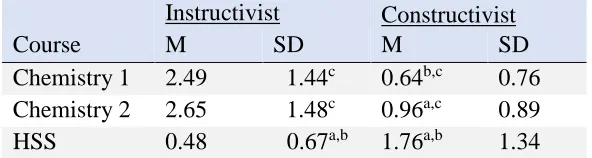
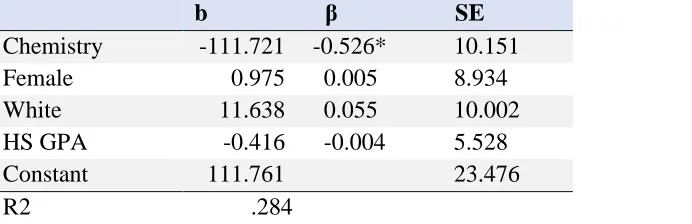
As these distributions do not take the number of responses given by students into account (see Table 3), the ratio of constructivist to instructivist themes was calculated for each student to represent their views of learning. A oneway ANOVA with posthoc mean comparisons was conducted to reveal any statistically significant differences in the courses. Analyses revealed all three courses differed statistically significantly in the average number of constructivist preferences reported, compared to instructivist preferences differing only in the HSS students. I then regressed this ratio on the subject of study (chemistry or HSS), controlling for gender, race, and high school GPA. The results of the multiple regression explained 28% of the variance in students’ views of learning (R2 = .284, F(4,324) = 32.06, p < .001). Looking individually at the predictors, course subject was the only variable that statistically significantly predicted students views of learning (β = -.526, p < .001) (See Table 4). In this case, students within the chemistry courses had a constructivist to instructivist ratio over half a standard deviation lower than those in the HSS course, indicating their views were substantially more aligned with instructivist approaches. Table 3
Descriptive Statistics for Students’ Views of Learning Instructivist Constructivist
Course M SD M SD
Chemistry 1 2.49 1.44c 0.64b,c 0.76 Chemistry 2 2.65 1.48c 0.96a,c 0.89 HSS 0.48 0.67a,b 1.76a,b 1.34
Note. HSS students (N = 85), Chem 1 students (N = 112), and Chem 2 students (N = 132). M =mean, SD = standard deviation.
Table 4
Multiple Regression of Construct: Instruct Preferences by Course Subject
b β SE
Chemistry -111.721 -0.526* 10.151
Female 0.975 0.005 8.934
White 11.638 0.055 10.002
HS GPA -0.416 -0.004 5.528
Constant 111.761 23.476
R2 .284
Note. HSS students (N = 85), Chem 1 students (N = 112), and Chem 2 students (N = 132). * p < .001. Dependent variable scale is such that larger numbers equal more constructivist. Reference group for this model is nonwhite, male, HSS students.
3.3. Learning Perceptions & Epistemic Beliefs
To answer the last research question, How do these perceptions associate with student views on the nature of knowledge?, I first visually explored differences in the students’ epistemic beliefs by course (See Appendix C). I then tested for the skew and kurtosis of each of the dimensions (See Table 5). All variables were within the acceptable ranges for skewness (+/- 1) and kurtosis (normal distribution is 3), suggesting a normal distribution across students’ epistemic
beliefs (Ho & Yu, 2014). Table 5
Descriptive Statistics of Epistemic Beliefs Subscales
Epistemic Belief M (SD) Skew Kurtosis
Innate Ability 2.43 (.83) 0.34 2.85 Omniscient Authority 2.93 (.71) 0.06 2.83 Quick Learning 1.66 (.52) 0.52 3.39 Simple Knowledge 2.40 (.70) -0.12 2.59 Certain Knowledge 2.55 (.66) 0.27 3.05
Note. N = 329. The Cronbach alphas for each dimension was also calculated: Simple knowledge (.67), Quick learning (.70), Omniscient Authority (.63), Innate Ability (.71), and Certain knowledge (.52).
= 9.74, p < .001) beliefs statistically significantly differed by course. Pairwise post-hoc means comparisons were conducted to compare which courses differed at the p < .05 level and are represented in Table 6. Chemistry 1 students’ views of omniscient authority were statistically significantly higher than both Chemistry 2 (t(3) = -3.45, p = .002), and HSS students (t(3) = -3.40, p = .002), meaning Chemistry 1 students had more naïve views about the source of knowledge, or who relays information (i.e., experts or teachers). These students are more likely to believe learning is a not a co-constructed process, and rely on the instructor for information and learning (Schommer, 1990).
Table 6
Descriptive Statistics for Epistemic Beliefs Dimensions by Course
Epistemic Beliefs M SD Min Max
Chemistry 1
Certain Knowledge 2.63 0.69 1.00 4.33
Innate Ability 2.40 0.84 1.00 5.00
Omniscient Authorityb,c 3.13 0.73 1.33 5.00 Quick Learningb 1.77 0.56 1.00 4.00 Simple Knowledgeb,c 2.62 0.64 1.00 4.00
Chemistry 2
Certain Knowledge 2.46 0.66 1.00 4.67
Innate Ability 2.51 0.83 1.00 5.00
Omniscient Authoritya 2.83 0.70 1.00 4.33 Quick Learninga 1.60 0.50 1.00 3.00 Simple Knowledgea 2.29 0.70 1.00 4.00
Humanities & Social Sciences
Certain Knowledge 2.46 0.66 1.00 4.67
Innate Ability 2.51 0.83 1.00 5.00
Omniscient Authoritya 2.83 0.70 1.00 4.33
Quick Learning 1.60 0.50 1.00 3.00
Simple Knowledgea 2.29 0.70 1.00 4.00
Note. HSS students (N = 85), Chem 1 students (N = 112), and Chem 2 students (N = 132). Lower scores for epistemic beliefs are associated with a more sophisticated view of knowledge.
Statistically significant differences in the means for each dimension by course was calculated at the p < .05, a = different from Chemistry 1, b = different from Chemistry 2, c = different from humanities.
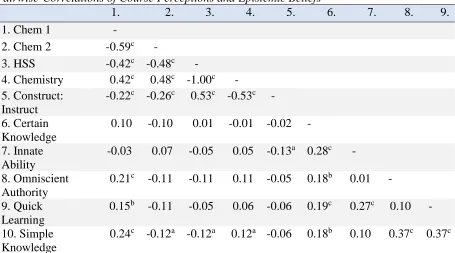
subject chemistry was weakly but statistically significantly associated with simplicity of knowledge. Worth noting, each of the three courses had differing associations with the five dimensions of the epistemic beliefs. Students within the chemistry 1 course showed a statistically significant negative association to omniscient authority, quick learning, and simple knowledge. Simple knowledge was the only dimension all three courses had a statistically significant association.
Table 7
Pairwise-Correlations of Course Perceptions and Epistemic Beliefs
1. 2. 3. 4. 5. 6. 7. 8. 9.
1. Chem 1 -
2. Chem 2 -0.59c -
3. HSS -0.42c -0.48c -
4. Chemistry 0.42c 0.48c -1.00c - 5. Construct:
Instruct
-0.22c -0.26c 0.53c -0.53c - 6. Certain
Knowledge
0.10 -0.10 0.01 -0.01 -0.02 - 7. Innate
Ability
-0.03 0.07 -0.05 0.05 -0.13a 0.28c - 8. Omniscient
Authority
0.21c -0.11 -0.11 0.11 -0.05 0.18b 0.01 - 9. Quick
Learning
0.15b -0.11 -0.05 0.06 -0.06 0.19c 0.27c 0.10 - 10. Simple
Knowledge
0.24c -0.12a -0.12a 0.12a -0.06 0.18b 0.10 0.37c 0.37c Note. N= 329. Chemistry represents domain-specificity. Construct:Instruct is the ratio of students’ reported views of learning.
a p < .05; b p < .01; c p < .001.
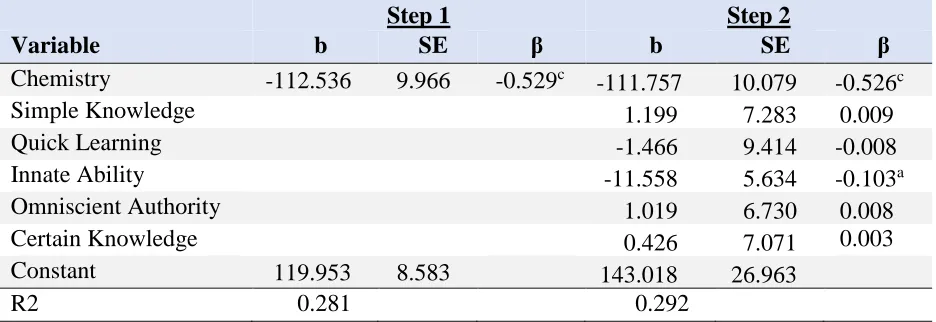
Building off of the multiple regression in Table 4, I then used a step-wise regression predicting students’ ratio of constructivist to instructivist preferences by the five dimensions of
beliefs subscales. The results of the regressions revealed course subject as more predictive of students’ views of learning than any dimension of epistemic beliefs. In the second model, including
the epistemic beliefs accounted for an additional 0.9% of the variance explaining students views of learning, (ΔR2 = .011, F(5,322) = 1.00, p = .419). Of the five dimensions, belief in innate ability was the only one that statistically significantly predicted students’ perceptions of learning, (β =
-.103, p = .041). The results from these analyses revealed students’ epistemic beliefs explain a small percentage of the variance in their views of learning after accounting for course of study.
Table 8
Step-wise Regression of Students’ Views of Learning on their Epistemic Beliefs
Step 1 Step 2
Variable b SE β b SE β
Chemistry -112.536 9.966 -0.529c -111.757 10.079 -0.526c
Simple Knowledge 1.199 7.283 0.009
Quick Learning -1.466 9.414 -0.008
Innate Ability -11.558 5.634 -0.103a
Omniscient Authority 1.019 6.730 0.008
Certain Knowledge 0.426 7.071 0.003
Constant 119.953 8.583 143.018 26.963
R2 0.281 0.292
Note. N = 329. Variables found nonsignificant variables in the first model were left out of the second part of the analyses. Lower scores for epistemic beliefs are associated with a more sophisticated view of knowledge.
a p < .05; b p < .01; c p < .001.
3.4. Emerging Results: Course Climate
In addition to domain-specific differences, including two chemistry courses allowed me to examine within domain differences in students’ responses that may be due to effects of the
emergence of themes that did not fit the instructivist or constructivist model of learning, as seen in Table 2, sparked an exploration of differences in the course climate.
3.4.1. Phase 3: Qualitative Analysis. Each instructor from the three courses provided their course syllabus, which included the order, assessments, and expectations for the semester. The syllabus for each course was qualitatively analyzed to understand which model of learning the courses were adopting by using a conventional content analysis approach for factors that shape the format and structure of a course (Rosengren, 1981). For the purpose of this study, I focused on the structure, activities, and grading practices of the courses.
Table 9
Undergraduate Courses Model of Learning by Learning Factors
Course Factors | Chemistry 1 | | Chemistry 2 |
| Hum. & Soc. Sci. |
Structure
Lecture √ √ √
Lab X √ X
Seminar X X √
Activities
Readings √ √ √
Practice Problems √ √ X
Guest Speakers X X √
Hands-on Activities X √ √
Class Discussions X X √
Grading
Exams 75% 75% X
Quizzes 15% 15% X
Homework 10% 10% X
Writing Reflection X X 70%
Analysis X X 16%
Group work X X 14%
Model of Learning
Teacher-centered
Student & Teacher-centered
Student & Community-centered
Instructivist Constructivist
Note. Each course provided the syllabus, or semester outline, that contained course structure, activities, and grading assessments. These three factors were noted, and the table above reflects the differences found across the three courses. X = Not present, √ = present.
3.4.1.1. Results. In addition to the courses’ structure differences, the students’ open-ended responses evoked some of the structures and activities listed within the course syllabus. Examples of students’ direct reflection of the courses syllabus include additional aid, homework, and guest
speakers (See Table 10). In particular, 38% of the students in the HSS course listed “community activities” as an effective learning approach, which did not fit into either instructivist or
constructivist models of learning. These findings are in line with a longitudinal study conducted by Zeeger (2001) that found students’ approaches to learning are changeable and dynamic as a
supports the idea that a student’s learning environment is associated with their beliefs and behaviors.
Table 10
Student Responses Reflective of Syllabus Structures
Syllabus Student Response
Chem 1
"Graded homework will be
administered online through Sapling"
"Sapling homework."
"Example problems" "Going over example problems that are similar to what we will see in homework."
Chem 2
"Problem Session" "…chemistry recitation (problem session)."
"Supplemental Instruction" I used supplemental instruction."
HSS
"Talks given by outside speakers" "Hearing guest professors talk about not only their area of study, but [the department] as a whole has been useful."
"Vocational Enrichment Events" "Going to sponsored events from the department."
Note. N = 329. 38% of students in HSS reported community events.
The Chemistry 1 course’s syllabus expressed no constructivist structures, in contrast to those of Chemistry 2 and HSS, which both included differing degrees of constructivist elements (See Table 9). These differences are particularly interesting, because 92% of students within all three of these courses were first semester Freshman, meaning the courses in this study were among their first exposures to undergraduate learning environments and their chosen discipline. Because of the emerging model of learning spectrum for the three courses, I went back to look at the percentage of students reporting one or more instructivist or constructivist themes for both the course structure and activities questions. Unlike the ratio, the percentage allowed me to see what portion of the Chemistry 1 students identified no vs. any constructivist features.
constructivist theme were those in HSS (80%), Chem 1 (47%), and Chem 2 (64%). Two oneway ANOVA’s were conducted to reveal any statistically significant differences within the three
courses for any instructivist preferences reported, F(2, 326) = 94.64, p < .001, and any constructivist preferences reported, F(2, 326) = 11.76, p < .001. Posthoc Tukey mean comparisons revealed that both Chem 1 (t(3) = -12.00, p < .001) and Chem 2 (t(3) = -12.62, p < .001), differed significantly statistically from HSS in the portion of students reporting any instructivist learning preferences. This means there were no differences in the portion of students that reported instructivist learning preferences between Chemistry courses, but more students in both Chemistry courses reported at least one instructivist theme as compared to the students in the HSS course. For constructivist preferences, the posthoc tests revealed all three courses differed statistically significantly from each other in the portion of students who reported any constructivist themes (See Table 11). These are similar findings to the analyses conducted in Table 3. These results support the aligned view of student preferences and environments, reflecting the SCT model of interaction between person and environment.
Table 11
Results from Constructivist Themes— Tukey PostHoc Test
Course M SD
Chemistry 1 0.47b,c 0.50 Chemistry 2 0.64a,c 0.48
HSS 0.80a,b 0.40
Note. N = 329.
CHAPTER 4: DISCUSSION
With this study, I aimed to answer three questions: (1) What do students perceive as effective chemistry and humanities course structures and practices? (2) Do these perceptions differ across course subject? and (3) How do these perceptions associate with student views on the nature of knowledge?
4.1. Research Question 1: Student Perceptions as Models of Learning
The first goal of this study was to expand on prior work related to students’ perceptions of
learning. First, the use of qualitative open-ended questions allowed for students to freely choose what activities and structures came to mind when thinking about effective learning approaches, which can allow for more flexibility and authenticity than is true of closed-response questions used by many studies (e.g., PALS, 1985; PISA, 2012). The approach in the study allowed for richer responses from students and did not make any a priori assumptions about the types of activities students may prefer, experiential differences in the students, or differences across disciplines.
This qualitatively-driven approach revealed that students’ learning preferences largely fell into categories that aligned with instructivist or constructivist models of learning. Interestingly, across the three courses, students had a wide variety of types of structures and activities they noted would help them to learn a subject, but the HSS students reported more constructivst views, as opposed to the chemistry students’ mostly instructivist preferences. Many of these
4.2. Research Question 2: Discipline-specific Perceptions
The findings from the first research question enabled me to further explore the apparent discipline-specific perceptions, and the extent to which course subject might affect students’ preferences. Prior research has shown that knowledge and learning is domain specific (Glaser & Chi, 1988), therefore we might expect students’ perceptions of learning in each domain to also reflect these differences. Findings from the analyses revealed that students within chemistry perceived chemistry learning to be most effective in a traditional setting with direct instruction and memorization-based techniques. Students learning humanities and social sciences perceived that domain to be one that is most effectively learned using interactive discussion and participation from students, teachers, and community-members. Although the students were not asked to directly compare the subjects, the stark differences between the fields lends some support for differences across soft and hard science fields as found in studies such as Nelson Laird, Shoup, Kuh, and Schwarz (2008).
4.3. Research Question 3: Student Perceptions and Epistemic Beliefs
Considering how students’ personal factors, such as their epistemic beliefs, are associated
with their approaches to learning (Greene et al., 2010; Phan, 2008;), I also explored how students’ epistemic beliefs related to their constructivist to instructivist learning preferences ratio. The results showed that students’ belief in innate ability was the only dimension of epistemology that
approaches over deeper constructivist learning approaches. In addition to these findings, the statistically significant differences found across all courses, rather than just domain, sparked the need to further explore individual differences in the courses climate rather than the communities of practice.
4.4. Emerging Results: Students Perceptions and Course Climate
To address the differences across all three courses the qualitative analyses revealed student perceptions of effective learning environments may be a reflection of practices and orientations of the course itself. These results also showed that across disciplines and courses there are similarities and differences in how instructors communicate information, and how students seek information. The overlap in the three courses suggest classrooms or learning environments may have models of learning that are dynamic and changing rather than constant, as suggested by many students desiring a balance of instructivist and constructivist activities. Also, the results showing students within chemistry 1 versus chemistry 2 and HSS have more naive beliefs across multiple dimensions of the epistemic beliefs measure suggest that, in addition to a differences in models of learning, the classroom may be oriented in a less sophisticated way.
In addition to both of models of learning, there has been a recent push in education for a school learning community, where schools, families, and community partnerships come together to increase student learning and experiences while meeting the school goals (Epstein & Salinas, 2004). Epstein's Framework of Six Types of Involvement (2002) with school-community partnerships addresses different types of school-community collaborative involvement practices, such as school program events, and community activities. These characteristics that describe this type of skill to practice are similar to some of themes found within the HSS students’ responses
Speakers” or “Community Events.” Although this school-community learning is a framework and
not a model of learning in the same as instructivist and constructivist practices are, it reflects an expansion on constructivist views of learning by providing opportunities for apprenticeship and co-construction of knowledge with field experts (Porcaro, 2011). These emerging findings support the concept of views of learning as falling on a spectrum; however, further exploration is needed as to how students and teachers epistemic beliefs play a role in the learning environments epistemic climate.
4.5. Limitations
My study was limited in three main ways. First, the open-ended nature of the survey questions allowed students to choose to list as many, or as few, activities and structures they perceived effective. This means some responses may have been inflated due to students responding in more detail, allowing for greater deviation in students’ constructivist:instructivist ratio. The second limitation of this study is the loss in sample size due to a number of students’ academic
DeBacker et al., 2008; Ravindran et al., 2005), it could be limiting the conclusions that can be drawn.
4.6. Implications
By further exploring students’ perceptions of effective learning across courses and disciplines, instructors and researchers can better understand how students’ personal factors and
beliefs engage with learning environments. For example, in this study, those with innate views of learning also preferred more instructivist methods of instruction, such as lectures and practice problems. Future researchers can use longitudinal or experimental research to test the directionality of these relations—with the push to move students toward a growth mindset (e.g., Snipes & Loan, 2017) it may be important to know which instructional practices hinder or foster such transformations. For university instructors who wish to foster more sophisticated beliefs, this study provides some evidence that these beliefs are associated with constructivist course practices, even within subjects, like chemistry, that may be dominated by instructivist practices and students with more instructivist preferences.
4.7. Conclusion
environment create an epistemic climate. This is important in beginning to understand how students, and instructors, epistemologies are presented in their actions and beliefs, and how those factors cultivate an environment that can be supportive (or not) of more sophisticated views of learning and knowledge. Lastly, this study built upon previous research by revealing an emerging model of learning linking instructivist, constructivist, and community-based practices with students’ perceptions of effective learning. The finding of emerging model in higher education
REFERENCES
Alghasham A. A. (2012). Effect of students’ learning styles on classroom performance in
problem-based learning. Medical Teacher, 34(1). doi: 10.3109/0142159X.2012.656744 Ames, C. (1992). Classrooms: Goals, structures, and student motivation. Journal of Educational
Psychology, 84(3), 261-271. doi: http://dx.doi.org/10.1037/0022-0663.84.3.261
Ames, C., & Archer, J. (1988). Achievement goals in the classroom: Students' learning strategies and motivation processes. Journal of Educational Psychology, 80(3), 260-267. doi: http://dx.doi.org/10.1037/0022-0663.80.3.260
Archee, R. (2012). Reflections on personal learning environments: Theory and practice. Social and Behavioral Sciences, 55, 419-428. doi:10.1016/j.sbspro.2012.09.520
Asikainen, H., Parpala, A., Lindblom-Ylänne, S., Vanthournout, G., & Coertjens, L. (2014). The development of approaches to learning and perceptions of the teaching-learning
environment during bachelor level studies and their relation to study success. Higher Education Studies, 4(4). doi:10.5539/hes.v4n4p24
Baeten, M., Kyndt, E., Struyven, K., & Dochy, F. (2010). Using student-centered learning environments to stimulate deep approaches to learning: Factors encouraging or discouraging their effectiveness. Educational Research Review, 5(3), 243-260. doi:10.1016/j.edurev.2010.06.001
Bednar, A.K., Cunningham, D., Duffy, T.M., & Perry, J.D. (1991). Theory into practice: How do we link? In G.J. Anglin (Ed.), Instructional technology: Past, present, and future.
Englewood, CO: Libraries Unlimited.
Bendixen, L. D., & Rule, D. C. (2004). An Integrative Approach to Personal Epistemology: A Guiding Model. Educational Psychologist, 39(1), 69-80.
doi:10.1207/s15326985ep3901_7
Bennett, J., & Holman, J. (2002). Context-Based Approaches to the Teaching of Chemistry: What are They and What Are Their Effects? In J. Gilbert (Ed.), Chemical education: Towards research-based practice (pp. 165-184). Dordrecht: Kluwer Academic Publishers. doi: 10.1007/0-306-47977-X_8
Biggs, J. (1993). What do inventories of students learning processes really measure? A
theoretical review and clarification. British Journal of Educational Psychology, 63(1), 3-19. doi:10.1111/j.2044-8279.1993.tb01038.x
Biggs, J. (1999). What the Student Does: teaching for enhanced learning. Higher Education Research & Development, 18(1), 57-75. doi:10.1080/0729436990180105
Biggs, J. B. (2003). Teaching for quality learning at university (2nd ed.). Maidenhead: Open University Press.
Biglan, A. (1973). The characteristics of subject matter in different academic areas. Journal of Applied Psychology, 57(3), 195-203. doi: http://dx.doi.org/10.1037/h0034701
Boekaerts, M. (1996). Self-regulated learning at the junction of cognition and motivation. European Psychologist, 1(2), 100-112. doi:10.1027/1016-9040.1.2.100
Boekaerts, M., & Corno, L. (2005). Self-Regulation in the Classroom: A Perspective on
Assessment and Intervention. Applied Psychology: An International Review, 54(2), 199-231. doi: 10.1111/j.1464-0597.2005.00205.x
Buehl, M. M., & Alexander, P. A. (2005). Motivation and Performance Differences in Students’
Domain-Specific Epistemological Belief Profiles. American Educational Research Journal, 42(4), 697-726. doi:10.3102/00028312042004697
Campbell, J., Smith, D., Boulton-Lewis, G., Brownlee, J., Burnett, P. C., Carrington, S., & Purdie, N. (2001). Students perceptions of teaching and learning: The influence of students approaches to learning and teachers approaches to teaching. Teachers and Teaching, 7(2), 173-187. doi:10.1080/13540600120054964
Cano, F. (2007). Approaches to learning and study orchestrations in high school students. European Journal of Psychology of Education, 22(2), 131-151. doi:10.1007/bf03173518 Chan, K.W. & Elliott, R.G. (2002). Exploratory study of Hong Kong teacher education students’
epistemological beliefs: Cultural perspectives and implications on beliefs research. Contemporary Educational Psychology, 27, 392-414. doi: 10.1006/ceps.2001.1102 Chen, J. A. (2012). Implicit theories, epistemic beliefs, and science motivation: A
person-centered approach. Learning and Individual Differences, 22(6), 724-735. doi:10.1016/j.lindif.2012.07.013
Chi, M. T., Feltovich, P. J., & Glaser, R. (1981). Categorization and Representation of Physics Problems by Experts and Novices. Cognitive Science, 5(2), 121-152.