General
The HK94 semi-automatic rifle, cal. 9 mm x 19 is a modern small arm produced in accordance with the most advance manufacturing methods. It permits semi-automatic fire from all positions with the bolt closed.
The HK94 is a recoil operated rifle with stationary barrel and delayed roller locked bolt system. The cartridges are fed either from a 15-round or from a 30-round magazine.
Note:
For reliable function only fully jacketed ammo should be used. Existing models:
1. Rifle with fixed butt stock (Fig. 1) 2. Rifle with telescopic sight (Fig. 2) 3. Rifle from the right
Fig. 1
Fig. 4
Assemblies
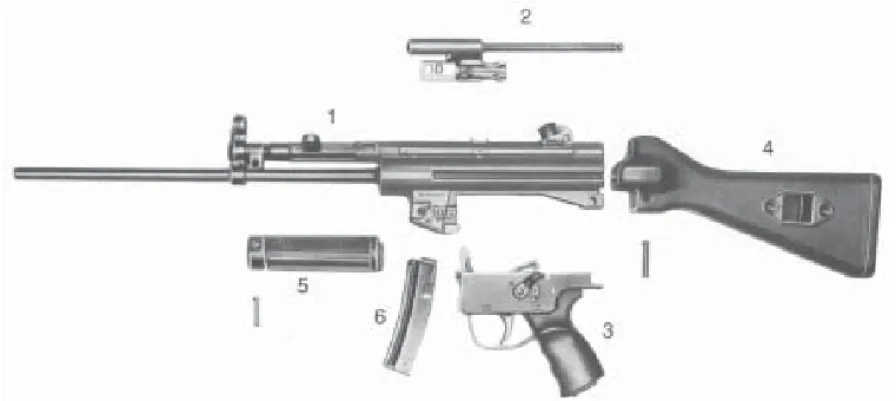
1 Receiver and barrel, cocking mechanism and sights 2 Bolt assembly
3 Grip assembly and trigger mechanism 4 Butt stock
5 Handguard 6 Magazine
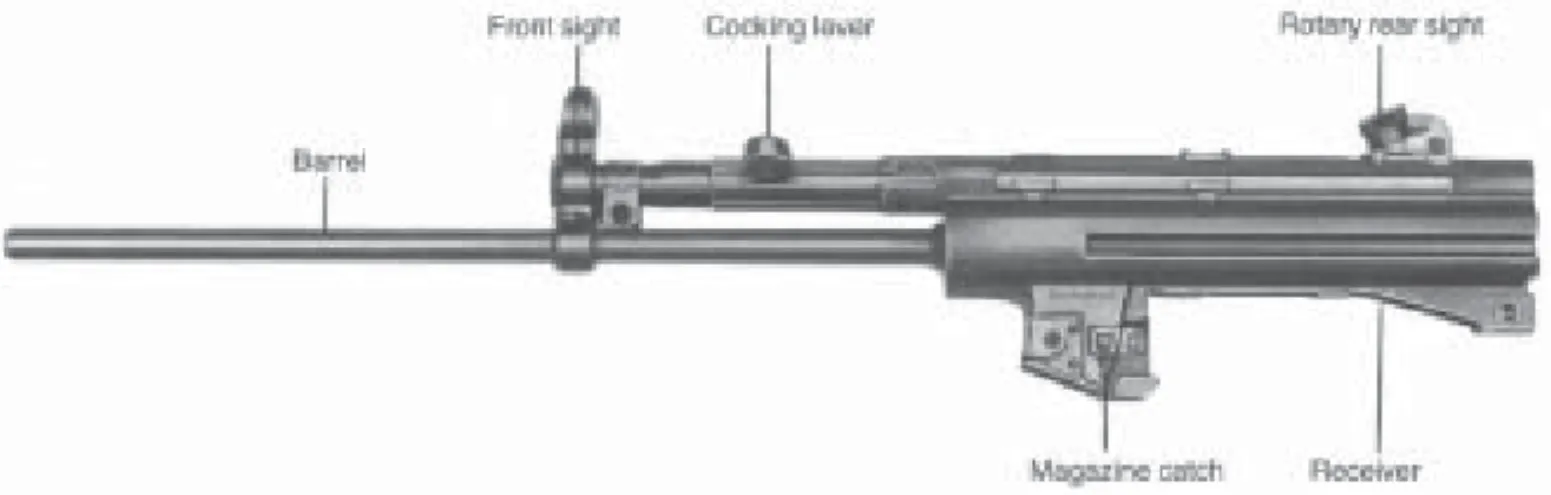
Assembly 1 Receiver with barrel, cocking mechanism and sights The receiver connects the barrel, cocking mechanism and sights. In addition, all assemblies are either contained in the receiver or attached to it (Fig. 7).
The barrel is press-fitted into the barrel extension and fixed in place by means of pins. The cocking mechanism is located above the barrel and is employed for manually cocking and loading the weapon and for securing the bolt in its rearmost position.
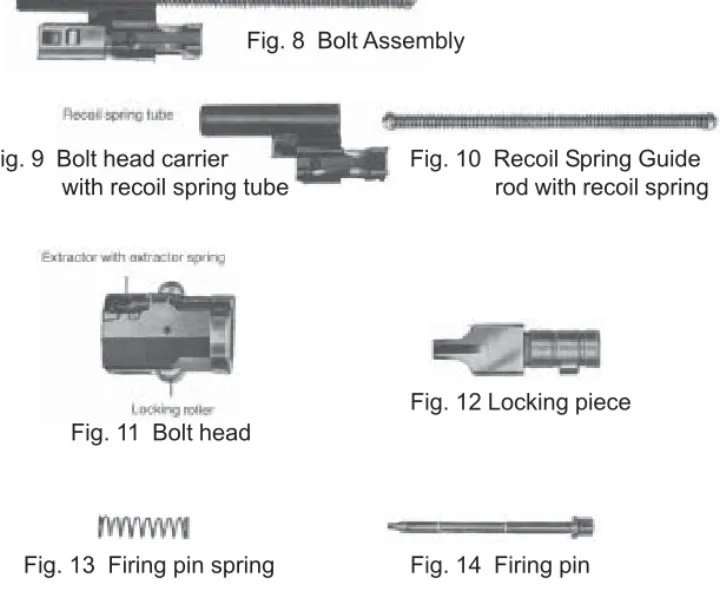
The bolt assembly (Fig. 8) consists of the following elements: Bolt head carrier with recoil spring tube (Fig. 9) Recoil spring guide rod and recoil spring (Fig. 10) Bolt head with locking rollers, extractor
and extractor spring (Fig. 11)
Locking piece (Fig. 12)
Firing pin spring (Fig. 13)
Firing pin (Fig. 14)
Fig. 12 Locking piece Fig. 11 Bolt head
Assembly 3 Grip assembly and trigger mechanism
Fig. 15 Fig. 16
Assembly 4 Butt stock Fixed butt stock
The fixed butt stock (Fig. 17) closes the rear of the receiver. It is con-nected to the receiver by a locking pin.
The sling holder is attached to the butt stock by means of tubular rivets, which are also employed for safekeeping of the locking pins when the weapon is field stripped.
Retractable butt stock
The fixed but stock can be replaced by a retractable butt stock (Fig. 18) when required.
The two guide rails on either side of the butt stock are guided in grooves on the receiver. They are secured by a locking catch in both the retracted and extended position.
Fig. 17 Fixed butt stock
Assembly 5 Handguard
Assembly 6 Magazine
The magazine holds 15 or 30 rounds and is employed for feeding the cartridges to the Rifle.
The magazine consists of:
Magazine housing (Fig. 20)
Floor plate (Fig. 21)
Fig. 20 Magazine Housing
ACCESSORIES
Multi-purpose carrying sling
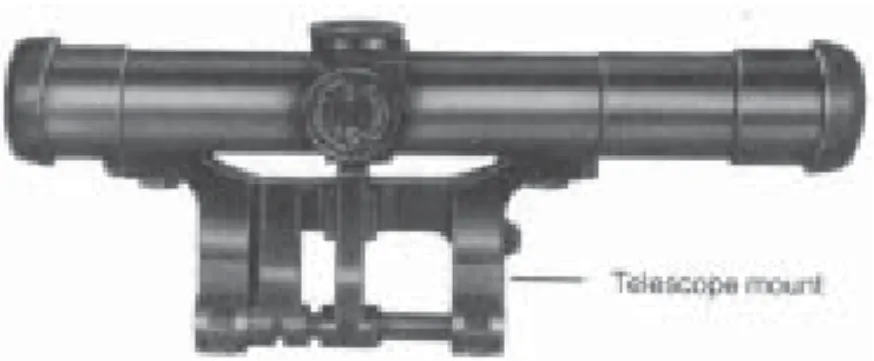
Telescoping sight
HANDLING AND OPERATION
Filling the magazine
Hold the magazine in one hand (Fig. 25); with your other hand, place the cartridge in the magazine opening, pressing hte uppermost cartridge under the lip with your thumb.
Emptying the magazine
SAFETY FEATURES
The safety lever is located on the left side of the grip assembly and can bet set at:
“O” = Safe and “1” = Fire (Fig. 27 and 28)
The position selected is indicated also on the right side of the grip assembly.
How to put at safe
Set safety lever at “O”. The trigger cannot be squeezed. However, the rifle can be loaded while in “safe” position.
Firing
Inserting and removing of magazine
Put at “safe”!
Insert magazine into the magazine well (Fig. 29) until the magazine catch engages audibly.
Put at “safe”!
Pull cocking lever rearward with the left hand, engaging it in the recess of the cocking lever housing (Fig. 31).
Insert the filled magazine into the magazine well so that the magazine catch locks magazine audibly into position.
OPERATING PRINCIPLE
The weapon is loaded and cocked, with the safety off.
Pulling the trigger releases the hammer, which strikes the firing pin. The cartridge is ignited. The powder gases thus generated drive the bullet out of the barrel. At the same time, these gases also exert pressure on the cartridge case.
After the locking rollers have been fully cammed into the bold head, the bolt can continue its recoil movement. In the course of this movement, the empty cartridge case is ejected and the hammer recocked.
STRIPPING THE RIFLE FOR CLEANING
Engage the safety! Remove magazine.
Unload chamber; retract cocking lever and make sure that the chamber is clear. Let the cocking lever snap forward.
Unhook carrying sling from front sight holder.
Remove butt stock locking pin and put it in the tubular rivets in the fixed butt stock.
Slide off butt stock and back plate (Fig. 35). Remove grip assembly. Retract bolt assembly by means of the cocking lever and remove it from the receiver (Fig. 36).
Fig. 35 Removing the butt stock
Remove recoil spring from recoil spring tube by edging it off in the rearmost position.
Rotate bolt head 90° toward your body and detach it from the locking piece. Remove locking piece, firing pin and firing pin spring from the bolt head carrier (Figs. 37 and 38).
To assemble the bolt assembly, insert firing pin, firing pin spring and locking piece into the bolt head. Insert all parts in the bolt head carrier in such a manner that the lug on the locking piece is guiding through the recess in the bore of the bold head carrier.
Rotate bolt head until you hear it engage. Press recoil spring into the recoil spring tube. Stripping the pistol grip with trigger mechanism Uncock hammer (spring).
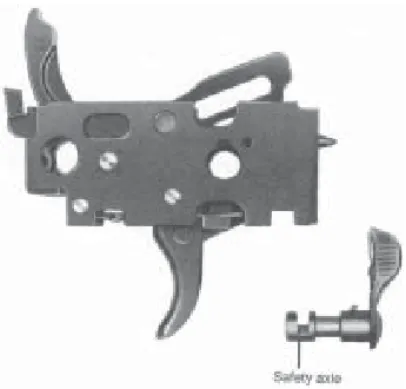
rotate selective fire lever until it is in a verticle position, then pull out. Remove trigger assembly housing.
REASSEMBLING THE RIFLE
Attach handguard.
Insert the assmbled bolt with recoil spring into the receiver (locking rollers must rest inside the bolt head).
Attach grip assembly (Fig. 39).
(Set safety lever on grip assembly on “O”.)
Slide fixed or retractable butt stock onto receiver and insert locking pin. Hook carrying sling into the eye on the front sight holder.
Check the proper reassembly of the rifle by performing several cocking motions.
Failure to function
ADJUSTING THE ROTARY REAR SIGHT
Any corrections which may be required when sighting-in the weapon may only be performed by adjusting the rear sight for elevation or windage. Elevation adjustmnet:
Insert elevation adjustment tool into the rear sight cylinder (Fig. 40) in such a manner that the wedges of the tool engage the two splines in the cylinder, which contain the catch bolts. Press Phillips-head screwdriver downward into the adjustment tool and hold firmly.
Rotate rear sight sylinder manually in the desired direction (rotating clock-wise lowers the strike 1.4 cm (0.55 in.) per click at a range of 25 m, rotating counterclockwise raises it correspondingly).
After performing the correction, withdraw Phillips-head screwdriver and remove elevation adjustment tool. The catch bolts will then reengage in the splines.
Windage adjustment:
Correction of left-hand deviation: Loosen clamping screw (Fig. 41). Turn adjusting screw (Fig. 42) counterclockwise, in accordance with the required correction. Then retighten clamping screw.
Correction of right-hand deviation: Loosen clamping screw (Fig. 41). Turn adjusting screw (Fig. 42) clockwise until the required correction is obtained. Then retighten clamping screw.
Fig. 41 Fig. 42
WITH TELESCOPIC SIGHT
The telescopic sight is mounted as follows:
To remove the telescopic sight with mount, push clamping lever down-ward.
Press catch downward with thumb and raise clamping lever again. Tip telescopic sight with mount to the right and remove.
Correct point of aim Even circle of light
ference of the front sight holder.
In this sight picture, the front sight is centered precisely in the diopter hole.
- Correct point of
Calibre 9mm x 19
Sighting shot 25 and 100m
Weights
Rifle with fixed butt stock
without magazine 6.43 lbs. (2.92 kg)
Rifle with retractabel butt stock
without magazine 7.18 lbs. (3.26 kg)
Steel magazine for 30 rounds empty 6.00 oz. (0.17 kg) Steel magazine for 15 rounds empty 4.23 oz. (0.12 kg)
Cartridge 185 gr. (12 gr.)
Lengths
Rifle with fixed butt stock 34.59 in. (878 mm) Rifle with retractable buttstock 34.05 in. (865 mm) Rifle with butt stock retracted 27.58 in. (700 mm)
Line of sight 13.39 in. (340 mm)
Barrel 16.54 in. (420 mm)
Operating principle 32
Stripping the rifle for cleaning 36
Reassembling the rifle 40
Adjusting the rotary rear sight 42
Using the HK94 semi automatic rifle with telescopic sight 46
Aiming 49
Technical Data 52