Sitespecific Recombination Determined
by
I-SceI,
a
Mitochondrial Group
I
Intron-Encoded Endonuclease Expressed in the Yeast Nucleus
Anne Plessis,* Arnaud Perrin,* James E. Habert and Bernard Dujon*
*Uniti de ginitique moliculaire des levures, URAl149 du CNRS, Dipartement de Biologie moliculaire, Institut Pasteur, 75724 Paris Cedex 15, France, and TRosenstiel Basic Medical Sciences Research Center and Department of Biology, Brandeis University,
Waltham, Massachusetts 02254 Manuscript received September 20, 199 1 Accepted for publication November 22, 1991
ABSTRACT
The Saccharomyces cerevisiae mitochondrial endonuclease I-SceI creates a double-strand break as the initiating step in the gene conversional transfer of the omega+ intron to omega- DNA. We have expressed a galactose-inducible synthetic I-SceI gene in the nucleus of yeast that also carries the I-SceI recognition site on a plasmid substrate. We find that the galactose-induced I-SceI protein can be active in the nucleus and efficiently catalyze recombination. With a target plasmid containing direct repeats of the Escherichia coli lac2 gene, one copy of which is interrupted by a 24-bp cutting site, galactose induction produces both deletions and gene conversions. Both the kinetics and the proportion of deletions and gene conversions are very similar to analogous events initiated by a galactose-inducible HO endonuclease gene. We also find that, in a rad52 mutant strain, the repair of double-strand breaks initiated by I-SceI and by HO are similarly affected: the formation of deletions is reduced, but not eliminated. Altogether, these results suggest either that the two endonucleases act in the same way after double-strand break formation or that the two endonucleases are not involved in subsequent steps.
0
NE of the key issues in understanding genetic recombination is the nature of the initiation step. Studies of homologous recombination in bacteria and fungi have led to the proposal of two types of initiation mechanisms. In the first model, a single- strand nick initiates strand assimilation and branch migration (MESELSON and RADDINC 1975). Alterna- tively, a double-strand break may occur, followed by a repair mechanism that uses an uncleaved homolo- gous sequence as a template (RESNICK and MARTIN1976). This latter model has gained support from the fact that integrative transformation in yeast is dra- matically increased when the transforming plasmid is linearized in the region of chromosomal homology (ORR-WEAVER, SZOSTAK and ROTHSTEIN 1981) and from the direct observation of a double-strand break during mating type interconversion of yeast (STRATH-
ERN et al. 1982). Recently, double-strand breaks have also been characterized during normal yeast meiotic recombination (SUN et al. 1989; SUN, TRECO and SZOSTAK 1991 ; ALANI, PADMORE and KLECKNER
Several double-strand endonuclease activities have been characterized in yeast: HO and the intron-en- coded endonucleases (see below) are associated with homologous recombination functions, while others still have unknown genetic functions (Endo-SceI, Endo-SceII) (SHIBATA et al. 1984; MORISHIMA et al.
1990).The HO site-specific endonuclease initiates mating-type interconversion by making a double-
1990).
Genetics 1 3 0 451-460 (March, 1992)
strand break near the YZ junction of MAT (KOSTRIKEN et al. 1983). T h e break is subsequently repaired using the intact HML or H M R sequences, resulting in ec- topic gene conversion. T h e HO recognition site is a degenerate 24-bp nonsymmetrical sequence (NICKO-
LOFF, CHEN and HEFFRON 1986; NICKOLOFF, SINGER
and HEFFRON 1990). This sequence has been used as a “recombinator” in artificial constructs to promote intra- and intermolecular mitotic and meiotic recom- bination (NICKOLOFF, CHEN and HEFFRON 1986; Ko- LODKIN, KLAR and STAHL 1986; RAY et al. 1988; RUDIN and HABER 1988; RUDIN, SUCARMAN and HA-
T h e two site-specific endonucleases, I-SceI
UAC-
QUIER and DUJON 1985) and I-SceII (DELAHODDE et
al. 1989; WENZLAU et al. 1989), that are responsible for intron mobility in mitochondria of yeast, initiate a gene conversion that resembles HO-induced conver- sion [see DUJON (1989) for review]. I-SceI, which is encoded by the optional intron Sc LSU. 1 of the 2 1 S
rRNA gene, initiates a double-strand break at the intron insertion site (MACREADIE et al. 1985; DUJON et al. 1985; COLLEAUX et al. 1986). The recognition site of I-SceI extends over an 18 bp nonsymmetrical sequence (COLLEAUX et al. 1988). Although the two proteins are not obviously related by their structure
(HO is 586 amino acids long while I-SceI is 235 amino acids long), they both generate 4-bp staggered cuts with 3”OH overhangs within their respective recog- nition sites.
452 A. Plessis et al.
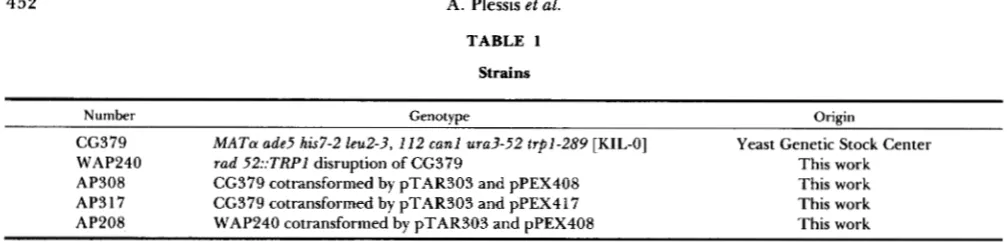
TABLE 1
Strains
Number Genotype Origin
CG379 MATa ade5 his7-2 l e d - 3 , 112 can1 ura3-52 trpl-289 [KIL-0]
WAP240 rad 52::TRPI disruption of CG379 This work
AP308 CG379 cotransformed by pTAR303 and pPEX408 This work
AP3 17 CG379 cotransformed by pTAR303 and pPEX417 This work AP208 WAP240 cotransformed by pTAR303 and pPEX408 This work
Yeast Genetic Stock Center
Thus far all the results on the repair of double- strand breaks initiated in vivo have been obtained with HO. The issue of the precise role of HO seems rele- vant: Does it act only as an endonuclease at the initi- ation step or is it also involved in the subsequent steps of the repair process? To answer this question, we decided to test whether the mitochondrial I-SceI en- donuclease exerts a recombinogenic activity on nu- clear sequences similar to that described for HO. To allow direct comparison with HO, we have used the same system as the one developed by RUDIN, SUGAR-
MAN a n d HABER ( 1 989). O u r results demonstrate, for t h e first time, that a mitochondrial intron-encoded endonuclease, transcribed in the nucleus and trans- lated in the cytoplasm, generates a double-strand break at a nuclear site. The repair events induced by I-SceI are identical to those initiated by HO.
MATERIALS AND METHODS
Strains and media: Saccharomyces cerevisiae strains are listed in Table 1. Strain WAP240 was constructed by gene disruption of the wild type RAD52 gene (SCHILD et al. 1983) in CG379. The disruption was performed by insertion at the RAD52 locus of a RAD52 BamHI fragment disrupted with a BglII-BamHI TRPZ fragment at the BglII site. The fragment used was derived from the R535 plasmid (a gift from S. ROEDER).
Complete medium (YP) is 1% w/v yeast extract Difco, 1% w/v Bacto-peptone Difco supplemented with glucose (2% w/v, YPglu) or glycerol and lactate (2% w/v each, YPgly+lac) or glycerol, lactate and galactose (2% w/v each, YPgal). Synthetic complete minimal medium (SC) is 6.7 g/ liter Yeast Nitrogen Base w/o amino acids from Difco sup- plemented with either glucose 2% (SCglu) or glycerol 2%, lactate 2% and galactose 2% (SCgal) and all the 20 amino acids plus uracil and adenine. Selective media lack one or several additions [e.g., SCglu-U (uracil), -LWU (leucine, tryptophan, uracil)]. Bacto-Agar (DIFCO) was added (2% w/v) for solid media.
Galactose induction was done in t w o different ways. First, a glucose grown colony was inoculated into SCgal (see Tables 2 and 4, and Figure 3). For the kinetics experiments cells were first grown in SCglu-UL for 24 hr, then the culture was diluted at 1/500 in SCgly+lac and incubated. At OD = 0.6-0.8 galactose was added to 2% w/v final concentration (see Table 3, and Figures 5 and 6).
@-Galactosidase activity in yeast colonies was scored by an X-Gal assay. Colonies were replica plated on 3 MM What- man filters, the filters were frozen flat in liquid nitrogen and laid o n 0.1 M Na-phosphate buffer, pH 7.0, containing 0.7% agar, 0.001 M MgS04, 120 pg X-Gal (MILLER 1972). (MgS04 and X-Gal (Appligene) were added to the melted
agar just before pouring the plates). Lac+ colonies turned blue overnight.
Escherichia coli and yeast transformation: E. coli was transformed either by the method described by HANAHAN (1985) or by electroporation according to the manufactur- er’s instructions (Bio-Rad). Yeast transformations were per- formed by either of the three following methods: sphero- plast transformation (HINNEN, HICKS and FINK 1978), lith- ium acetate (IT0 et al. 1983) or electroporation (SIMON and MCENTEE 1989), with minor modifications. For electropor- ation, strains were grown in YPglu until OD600 = 1, washed with 25 mM dithiothreitol (DTT) and incubated for 10 min at 30°, then centrifuged and resuspended in 270 mM su-
crose, 10 mM Tris-C1, pH 7.5, 1 mM MgCI2, at IO9 ceh/ml. Plasmid DNA (20-50 ng) was added to aliquots of 100 111 of the cell suspension. Electroporation conditions were: 2250 V/cm, 250 pF capacitance, and a derivation of 200R using the Bio-Rad gene pulser. Cells were plated directly on selective media.
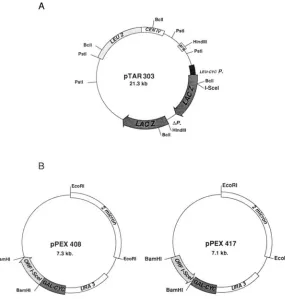
Plasmid constructions: Two plasmids were built: a target plasmid and an expression vector (Figure 1). The target plasmid contained the ISceI recognition site introduced from a pair of 24-bp synthetic oligonucleotides (G13: 5’-
GTATTACCCTGTTATCCCTAGCGT-3’ and G15: 5’-
ACGCTAGGGATAACAGGGTAATAC-3’). The expres- sion vector carried a synthetic gene encoding the I-SceI
endonuclease (A. THIERRY and B. DUJON, unpublished data) placed under the control of a galactose inducible GALl- CYCl promoter (see Figure 1).
Plasmid pTAR303 (Figure 1A) is similar to pNR18 of RUDIN (RUDIN SUCARMAN and HABER 1989) except for the presence of the I-SceI site instead of the HO site and for the deletion of the URA3 sequence. pTAR303, was built from pJH262 and pJH271 (described, but not named, in MATE- RIALS AND METHODS of RUDIN, SUGARMAN and HABER 1989) as described below. Reannealed G13-Gl5 was inserted at the BclI site of the lacZ gene (KALNINS et al. 1983) in pJH262. This insertion did not destroy the BclI site. The resulting plasmid was deleted for the 0.7-kb EcoRV-Smal fragment of URA3. The 5.9-kb Hind111 fragment including the disrupted lacZ gene under the LEU2-CYCl promotor was cloned into the Hind111 site of pJH271 in the same orientation as the other lacZ copy. The expression plasmid, pPEX408, was built by cloning a 750-bp BamHI synthetic DNA fragment encoding the I-SceI endonuclease under GALl-CYCl control at the BamHI site of the 2 pm, URA3
plasmid, pLGSD5 (without ATG) (GUARENTE, YOKUM and GIFFORD 1982). This plamid was also deleted for most of the lacZ gene (a 2.9-kb PvuII deletion). The construction with the I-SceI gene in the opposite orientation is called pPEX4 17.
A
FIGURE 1.-Vectors used in these experiments. A.
Target plasmid pTAR303 is a centromeric plasmid carrying the LEU2 marker and containing a direct du- plication of lacZ (see MATERIALS AND METHODS). The I- Scel recognition site is cloned, from a synthetic oligo- nucleotide, at the BclI site (the insertion restores the
BclI site) of the lacZ copy which is under the control of a CYCIuAsLEU2 hybrid promoter. The other lacZ gene is promoterless (AP). B. Expression vector pPEX408 is
ENTE, YOCUM and GIFFORD 1982) deleted for its lacZ
sequence. It contains a synthetic open reading frame coding for the IScel endonuclease (A. THIERRY and B.
DUJON, unpublished data) placed under a galactose in- ducible promoter. The control vector pPEX4 17 has the open reading frame in the opposite orientation.
B a 2-pm based plasmid derived from pLGBD5 (GUAR-
EWRl BamHl EcoRl
endonuclease target sequence is present in one copy in pJF6 instead of two repeated copies in pNRI8.
Minipreparation of total yeast DNA and Southern analysis: Minipreparations of total yeast DNA were pre- pared following the protocol in SHERMAN, FINK and LAW-
RENCE ( 1 979) with minor modifications. Samples were di- gested and electrophoresed on 0.7% agarose gels, trans- ferred to Hybond-N membrane (Amersham) by vacuum blottin ex osed to UV (0.16 kJ at 254 nm) and hybridized
to a [a-
!?
*P]ATP-labeled probe (CHURCH and GILBERT 1984). Radioactive probes were prepared by random priming (HODGSON and FISK 1987) from the 2.5-kb PvuII fragment containing l a d .RESULTS
The mitochondrial I-SceI site-specific endonucle- ase expressed from a nuclear plasmid can act on a nuclear target site and induce genetic recombina- tion: We have expressed the intronic endonuclease I- SceI in yeast from a nuclear expression plasmid and asked the following questions. (i) Does the endonucle- ase synthesized in the cytoplasm promote double- strand breaks and site-specific recombination between nuclear target sequences? (ii) If so, is this induced recombination similar to that observed in the same conditions with HO? T o answer these questions, we have used the experimental system previously devel- oped by RUDIN, SUCARMAN and HABER (1 989) except that we have replaced the HO gene and its target site by the ISceI gene and its target site, respectively. Yeast cells were cotransformed with two plasmids: a target plasmid, pTAR303, containing the site of the endonuclease and an expression plasmid, pPEX408,
producing the I-SceI endonuclease under the control of a galactose inducible promoter. The target plasmid contains two inactive copies of lac2 in tandem: one placed under a yeast promoter but interrupted by the I-SceI recognition site, the second, intact but promot- erless.
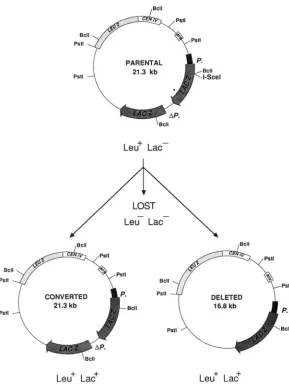
Double-strand cleavage at the ISceI site of the tar- get plasmid by the endonuclease may result in two different outcomes (Figure
2).
Either the linearized plasmid can be lost, or the break can be repaired by using the uncleaved homologous gene as a template. Repair can yield either a simple gene conversion or a deletion between the two lac2 direct repeats. Plasmidloss is easily monitored by the appearance of a Leu- phenotype. Repair by gene conversion or by deletion both result in a Leu+ Lac+ phenotype but these can be distinguished from each other at the molecular level.
In the first set of experiments, we have compared the frequency of Lac+ cells, with or without induction of the I-SceI endonuclease, in medium selective for both plasmids. We can see in Table
2
that the fraction of blue clones (Lac+) strikingly increases from about 4.7% to about 78% when the endonuclease I-SceI expression is induced. Thus, we conclude that expres- sion of the endonuclease I-SceI from cytoplasmic ri- bosomes induces homologous recombination between two direct repeats on a nuclear plasmid, indicating that the endonuclease, although of mitochondrial or- igin, can enter the nucleus.454
,Bell
A. Plessis et al.
Leu+ Lac-
CONVERTED
Psn Bell
Psn
P.
Bell
have estimated the efficiency of repair by measuring both plasmid loss and the formation of Lac+. After 420-min induction (about two cell generations) in nonselective medium, the percentage of loss of the target plasmid (Leu-) increased from 6.6 to 2 1 % while the percentage of Lac+ among Leu+ colonies increased in the same proportion as before (from cu. 13 to cu. 97%) (Table 3A). Hence repair is more frequent than plasmid loss.
Both plasmid loss and the formation of Lac+ colo- nies during induction show similar kinetics (Table 3B). The percentages of plasmid loss and of Lac+ clones were again low in the absence of induction. Plasmid
loss increased from about 7% to a maximum of 24% in less than 4 hr. During the same time, the percentage of Lac+ clones among the colonies which have kept both plasmids increased from 5.6 to 80%, again in agreement with the previous experiments. Similar proportions of plasmid loss were also observed by RUDIN, SUCARMAN and HABER (1 989) using HO.
Since the strain used in these experiments is omega+ type 1 [SeeJACQUIER and DUJON (1 985) for definition; data not shown] we examined the possibility that the mitochondrially synthesized endonuclease leaking to
FIGURE 2.-Products expected after double strand break repair of pTAR303 induced by the ISceI endo- nuclease. After cleavage by ISceI, the plasmid pTAR303 can be lost (giving rise to a Leu- Lac- cell)
or repaired (giving rise to a Leu+ Lac+ cell). If the repair occurs by gene conversion without exchange the result- ing plasmid remains identical in size to the parental plasmid (except for the 24-bp ISceI recognition site). I f the repair induces crossing over between the two lacZ repeats, the resulting plasmid will be deleted by 4.5 kb. The different products can be easily distinguished by PstI restriction analysis and hybridization using a lacZ specific probe: the PstI fragment spanning the lac2 sequence is 11.1 kb long in the parental plasmid pTAR303 and in the converted product and is 6.6 kb long in the deleted plasmid.
the nucleus may account for the relatively high back- ground of Lac+ recombinants observed in the pres- ence of glucose or prior to galactose induction. The frequency of Lac+ recombinants in the same strain (CG379) transformed only with the target plasmid pTAR303 (ISceI site) is shown in Table 4. The fre- quency of Lac+ cells (about 0.1%) is much lower than the 5.6-1 2.9% found in glucose grown cells harboring the galactose-inducible plasmid pPEX408 (Table 3). This suggests that the high level of Lac+ colonies when strain AP308 is grown on glucose results from a low level of expression of ISceI enconuclease gene carried by the pPEX408 plasmid rather from the mitochon- drially ecoded ISceI enzyme. As a further control, the same experiment was performed with strain CG379 transformed with pJF6 (containing the HO site, see
Sitespecific recombination between lac2 repeats induced by
ISceI endonuclease expression
No. of colonies tested Growth
medium Exmriment No. Blue Sectored White 5% Lac*‘
SCglu-UL 1 1 0 28 4.8
2 1 1 31
3 6 18 472
SCpI-UL 1 637 N.D. 189 78
2 54 0 28
3 191 0 27
Cells of strain AP308 were cultivated for 24 hr in either SCglu- UL or SCgal-UL media ( i e . , selective for both plasmids). The cultures were then plated on SCglu-UL to form colonies that were subsequently tested for their Lac’ phenotype using the X-gal color test (see MATERIAL AND METHODS).
The Lac+ frequency is an overestimate, because sectored colo- nies are counted as entirely Lac+. Although some of these sectored colonies may have arisen by the segregation of a Lac+ plasmid to only one of the two mitotic cells following the first cell division after plating, it is equally likely that they represent two independent cells (or a mother and daughter chromosome in G2, prior to mitosis) plated as a single colony forming unit. In this case, the total number of cells plated, including colonies that were entirely Lac-, is under- estimated and the frequency of Lac+ events is overestimated.
TABLE 3
Plasmid loss and sitespecific recombination induced by ISceI
endonuclease expression
Induction
time (min) colonies tested pTARS03 loss % Lac* No. of Percent
Spontaneous recombination between lac2 repeats containing the ISceI or HO target site in the absence of any endonuclease
expression vectors
Target Growth No. of colonies tested
site medium Blue Sectored White ?6 Lac+”
ISceI SCglu-UL 0 1 922 0.1
SCgal-UL 0 0 921 <0.1
HO SCglu-UL 0 3 705 0.4
SCgal-UL 0 1 646 0.15
~~~ ~
Cells of strain CG379 transformed by either pTAR303 or pJF6 were cultivated either in SCglu-UL or in SCgal-UL for 9-1 1 gen- erations. The cultures were then plated on SCglu-L to form colonies that were tested for their Lac+ phenotype as in Table 2. The results are pooled from five experiments.
As noted in Table 2, the frequency of Lac+ cells is overesti- mated.
1 2 3 4
1 1 . 1 kb
6.6 kb
p a r e n t a l o r c o n v e r t e d
d e l e t e d
A. -24 150 6.6 12.9
420 200 21 97.4
B. -15 96 7.3 5.6
45 48 12.5 33.3
95 93 16.1 60.2
145 87 18.4 84.5
225 95 23.1 68.4
600 78 24.3 69.5
1440 174 24.1 80.3
AP308 cells were induced in YPgal media for the time shown. Uninduced cells were taken prior to induction (-1 5 or -24 min) as control. The culture was diluted and plated on YPglu (A) or SCglu- U (B) to obtain individual colonies which were picked at random and tested on SCglu-U, SCglu-L and X-Gal. pTAR303 loss is expressed as the percentage of Ura+ Leu- colonies over the total number of colonies tested. Frequency of Lac+ is expressed as the percentage of blue clones over the total number of Ura+ Leu+ colonies.
endonuclease expressed from a nuclear plasmid.
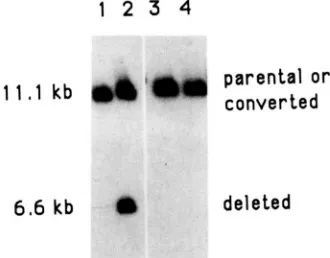
The ISceI endonuclease induces gene conversion as well as deletions: The results reported above show that the action of the site-specific endonuclease ISceI promotes homologous recombination in the yeast nu- cleus. T o distinguish between gene conversion and crossing over, we have examined the molecular struc- ture of the Lac+ plasmids by Southern blot. Gene conversion alone would lead to a “parental size” prod- uct while crossing over would produce a plasmid deleted of 4.5 kb between the lac2 repeats (see Figure 2).
FIGURE 3.--Southern blot analysis of IScel induced double strand break repair products. Total DNAs were extracted from strain AP308 (lanes 1 and 2) or from AP317 (lanes 3 and 4). Cells were grown either on SCglu-UL (lanes 1, 3) or on SCgal-UL (lanes
2 and 4) as described in Table 2. DNAs were digested by Psfl, run on 0.7% agarose gel and probed with the 2.5-kb PvuIl lac2 frag- ment.
It can be seen in Figure 3 that when the cells were grown on glucose medium (lanes 1 and 3), only the 11.1-kb band of parental size is visible. On the con- trary, an additional band is clearly visible in the strain
AP308 grown on galactose to induce ISceI expression (lane
2).
This band corresponds to a size of 6.6 kb as expected of a deletion between the two lac2 tandem repeats. This band is not visible in the control strainAP3
17
grown in the same galactose medium (lane 4)(confirming that only the endonuclease produced from the nuclear vector is active). We conclude there- fore that expression of the ISceI endonuclease induces crossing over between the repeated lac2 sequences.
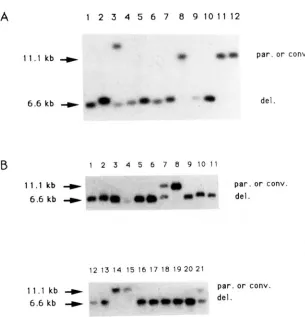
T o estimate the relative frequency of crossing over (deletion) vs. gene conversion we analyzed individual clones obtained after ISceI induction. In a first exper- iment, 12 clones (3 white and 9 blue) from the induc- tion experiment of Table
2
were analyzed (Figure4A): the 3 white clones show, as expected, only a parental size band (lanes 8, 1 1 and 12), while 8 of the
456 A. Plessis et at.
A
B
1 2 3 4 5 6 7 8 9 1 0 1 1 1 2
rn p a r . o r conv 1 1 . 1 kb
+
6.6 kb
+
I1 2 3 4 5 6 7 8 9 1 0 1 1
1 1 . 1 k b
+
6.6 kbdel. clones isolated after FIGURE 4.”Southern blot analysis lacel expression. Total DNAs of individual were extracted from blue or white individual sub- clones derived from individual colonies in the in- duction experiment described on Table 2 (4A) or from G1 micromanipulated cells in the induction experiment described in Table 3A (4B). DNAs were digested and analyzed as in Figure 3. Part A: lanes 8, 1 1 and 12: white clones (Lac-); lanes 1-7, p a r . or conv. 9 and 10: blue clones (Lac’). Lane 3 may reflect del. partial digestion by Pstl of a deletion event. Part
B: all clones analyzed are blue. Par. is the parental configuration, conv. is the gene conversion without crossing over configuration and del. is the deletion product configuration.
1 1 . 1 kb
+
6.6 kb
+
12 13 14 15 16 17 18 1 9 2 0 2 1
p a r . o r conv.
del.
to 7, and 9, 10). T h e last one (lane 3) shows the 6.6- kb band and an additional band representing a partial digest.
In addition, 21 blue clones from the induction experiment in Table 3A were analyzed (Figure 4B). Sixteen of these colonies have plasmids resulting from crossing over (6.6-kb band), 3 have plasmids resulting from gene conversion alone (1 1.1-kb band) and 2 show a pattern indicating the simultaneous presence of the deleted and parental size plasmids. However these latter two cannot represent mixed colonies is- sued from budding cells since in this experiment G1 cells were isolated by micromanipulation; they prob- ably represent instances in which the strain initially carried two copies of pTAR303. In summary, 27 out of 30 blue clones tested (90%) contain the crossover product. In similar experiments using H O endonucle- ase, RUDIN, SUCARMAN and HABER (1 989) found that a similar proportion (83%) of Lac+ plasmids contained deletions.
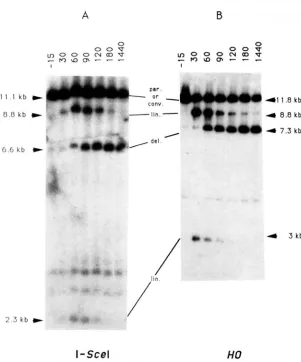
Physical analysis of the double-strand break for- mation and its repair: T h e recombination events induced by ISceI expression can be accounted for by the action of this site-specific endonuclease on the target site inserted into one of the lac2 copies. We have looked for the appearance and processing of the expected double-strand break intermediate during in- duction and compared it to the results obtained with induction of HO. Figure 5A shows that, prior to the start of induction, most of the plasmids pTAR303 are
in the parental configuration (as indicated by the 1 1.1
-
kb PstI restriction fragment). A faint band of 6.6 kb probably resulted from a low background of recom- bination in the noninduced cells (see Table 4). Within 30 min after galactose addition, two extra bands, of 8.8 and 2.3 kb, appear; these are the sizes expected for the plasmid linearized at the inserted I-SceI site by a double-strand break. After 60-90 min of induction one observes the appearance of the 6.6-kb band indi- cating the formation of a deleted product (the product of gene conversion cannot be distinguished here from the parental plasmid). After 180-min induction, the bands corresponding to the cut plasmid start to dis- appear while the 6.6-kb band remains constant. This confirms that the 8.8-kb and the 2.3-kb band are, as expected, intermediates of the recombination reac- tion.
We have compared the effects of the endonuclease ISceI to that of HO by repeating the experiment of RUDIN, SUCARMAN and HABER (1989) in our strain CG379 (carrying pSE27 1 ::GAL1 0-HO and pJF6) (Figure 5B). Comparison of Figure 5, A and B, shows similar kinetics, both for the appearance and disap pearance of the intermediates and for the appearance of the final recombined product. We conclude, there- fore, that ISceI and H O induced site-specific double- strand breaks are similarly processed.
A
B
O O P
0
~ O O O ( V W - r - m m m - - -
I
O O 0 P ~ O O O ( Y a 3 P
"\Dm-."
I
1 1 . 1 kb + 4 11.8 kb
0 . 8 kb
-
Iln.-
4 8.8 kbconv.
G.G k b
*
/ 4 7.3 kb
,
del.lin.
/
/
2.3 kb
*
I
-
Scel
HOray-damaged DNA (RESNICK 1969; GAME and MOR-
TIMER 1974) is also necessary for mitotic and meiotic
homologous recombination (GAME et al. 1980), ho- mologous integration of linear plasmids (ORR- WEAVER, SZOSTAK and ROTHSTEIN 1981), mating-
type
switching (MALONE and ESPOSITO 1980; WEIF-FENBACH and HABER 1981) and other recombination
events initiated by HO (RUDIN and HABER 1988). More recently, OZENBERGER and ROEDER (1 99 1) have shown that HO-induced recombination in direct re- peats of rDNA or CUP1 genes is reduced but not eliminated in rad52 strains.
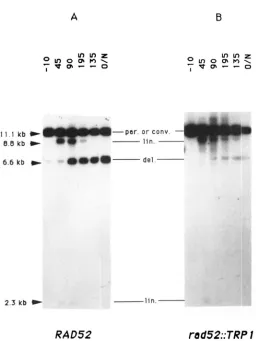
We have tested the effect of a rad52 disrupted allele on the I-SceI induced recombination. Figure 6 shows the results of an induction experiment in the two isogenic strains AP308 and AP208 (respectively RAD52 and rad52::TRPl). In both strains, double- strand breaks are formed. T h e wild-type strain shows the same kinetics of appearance of the 6.6-kb PstI deletion fragment as in Figure 5A. In contrast, recom- bination is very inefficient in the rad52::TRPl strain, as indicated by the low intensity of the deleted prod- uct. In addition, we have observed a very high rate of pTAR303 plasmid loss when ISceI is induced in the rad52::TRPl strain: 67% of 43 Ura+ plated colonies became Leu- (compared to about 20% for the RAD52 strain). Nevertheless, we have recovered Leu+ rad52
FIGURE 5.-Comparison of 1Scd- and HO-in- duced events after galactose induction. Total DNA was extracted from AP308 cells (A) or from CG379 cells transformed with pJF6 and pSE271::GALlO- HO (B) prior to and during induction in YPgal media. DNAs were digested and analyzed as indi- cated in figure 3. Notice that the fragments from the pJF6 plasmid are 0.7 kb larger than those from the pTAR303 plasmid since the LIRA3 gene of pTAR303
is partially deleted.
4 3 kb
colonies that became Lac+. Out of 14 Leu+ colonies,
5 were Lac+. Thus, about 13% of the galactose-in- duced rad52::TRPI cells that were still Ura+ became Lac+; this proportion is consistent with the intensity of the 6.6-kb band on the Southern blot. We conclude that the product of the RAD52 gene is important, but not completely necessary for the repair of double- strand breaks initiated by I-SceI, as with HO-mediated events (see DISCUSSION).
DISCUSSION
T h e results presented here demonstrate that the mitochondrial intron-encoded I-SceI endonuclease, when expressed in the cytoplasm from a nuclear expression vector, is active on a nuclear target. Its action promotes high levels of intramolecular homol- ogous recombination. From those results, we can con- clude the following. First, although I-SceI has no known specific nuclear targeting sequence its small size (325 amino acids) and its basic nature are likely suffkient for nuclear import by diffusion. Second, the 24-bp sequence introduced in the target gene in suf- ficient for recognition and cutting by I-SceI in the yeast nucleus. This was also the case in vivo in E. coli and in in vitro assays (COLLEAUX et al. 1986; MON-
TEILHET et al. 1990). Finally, no toxic effect of ISceI
458 A. Plessis et al.
A B
1 1 . 1 k b +--par, o r conv.
-
l i n .-
8.8 k b t
2.3 k b -1in.-
R A D 5 2
radS2::TRP 1
shown). This is consistent with the recent observation of the absence of natural I-SceI site in the yeast ge- nome (THIERRY et aZ. 199 l).
We demonstrated the recombinogenic effect of I- SceI on intramolecular recombination between two direct ZacZ sequences. After induction, the level of Lac+ clones rose from ca. 5-10% to ca. 80-95%. In the RAD52 background, the repair is very efficient compared to the 20-24% of cells that lose the ZacZ
cleaved plasmid. Moreover, the repair is precise, since
a functional ZacZ gene is restored. These results are very similar to those obtained by RUDIN, SUCARMAN and HABER (1989) for HO-induced events using nearly identical substrates.
After ISceI induction, 60-80% of the cells are repaired within about half a generation time, arguing against the hypothesis that repair of ISceI induced double-strand breaks would take place only during a short period of the cell cycle. This is in agreement with the results of CONNOLY, WHITE and HABER (1 988) and RUDIN, SUCARMAN and HABER (1 989) who have shown that double-strand breaks induced by H O under galactose control can efficiently be repaired throughout the cell cycle, and with similar kinetics to those reported here.
T h e double-strand break repair model postulates that crossing over occurs associated with gene conver- sion (ORR-WEAVER and SZOSTAK 1983). We have ob-
FIGURE 6.-Southern blot analysis o f total DNA from wild-type and rad52 double transformants during an induction. Total DNAs were extracted from strain AP308 (A) or AP208 (B) during an 1-
Scel induction experiment. DNA was digested and analyzed as indicated in Figure 3.
served here simple gene conversion and a deletion between direct repeats. Although the deletion corre- sponds to one of the products expected from a recip rocal crossing over, the other expected product-a 4.5- kb circular molecule-has not been detected in our experiments. This reciprocal product is also not ob- served with
HO.
It now appears likely that the dele- tions do not result not from "gap-filling" and crossing- over, but from reannealing of single-stranded ends after extensive single-strand degradation (FISHMAN- LOBELL, RUDIN and HABER 1992; SUCAWARE and HABER, 1992). Analogous single-stranded degrada- tion and annealing events (first proposed by LIN, SPERLE and STERNBERC 1984, 1990) have also been recently observed in Xenopus Zaevis oocytes (MARYON and CARROLL 1989, 1991a,b). We believe that there are two different pathways in double-strand break repair between direct repeats: one leading to a gene conversion by repair of the cut and the other leading to a "nonreciprocal crossing over," via extensive sin- gle-strand degradation. Both pathways appear to be initiated by I-SceI as well as HO.formed in a rad52 strain. Some or all of the deletion visible in Figure 6 must represent completely repaired and ligated product, as ca. 10% of the galactose- induced rad52 colonies contained a Lac’ plasmid.
Recently, OZENBERCER and ROEDER (1991) have also found that HO-induced events can be repaired by deletions in rad52 strains, when the cutting site is in the midst of multiple tandemly repeated rDNA or CUP1 chromosomal genes. We have also observed RAD52-independent double-strand break repair by studying HO-induced recombination in pJF6, the plas- mid analogous to the I-SceI substrate, pTAR303. We have found essentially identical results with pJF6 as those for pTAR303 reported here (FISHMAN-LOBELL, RUDIN and HABER 1992). We note that when a similar experiment was performed using a direct repeat of URA3 genes integrated into a chromosome, RUDIN and HABER (1 988) did not find such a high proportion of induced rad52 cells that yielded viable recombi- nants. We do not know if this reflects an inherent difference between plasmid and chromosomal events o r a difference in the size of the homologous regions that were available to undergo recombination by sin- gle-strand annealing or some other mode of recom- bination.
T h e only differences between I-SceI- and HO-in- duced events appear to be quantitative ones: (i) a slightly lower frequency of recombinant clones is ob- served after induction by I-SceI, and (ii) the back- ground frequency of recombinants is higher with I- SceI. The first difference can be linked to the slightly lower abundance of the plasmid linearized by I-SceI than by HO. This could result from: (i) a smaller proportion of cells containing the I-SceI expression plasmid (caused, for example, by the lower stability of
the multicopy I-SceI vector vs. the centromere-con- taining single-copy HO plasmid in nonselective me- dium), (ii) a lower level of expression of I-SceI, (iii) a lower protein stability, (iv) a lower nuclear targeting efficiency, or (v) a lower cutting efficiency. Since I- SceI is normally a mitochondrial protein, the last three points are not unexpected. T h e high background frequency of Lac+ clones could again be due to differ- ences between the H O and I-SceI expression vectors. We eliminated the possibility of a leakage of the genuine mitochondrial I-SceI protein to the nucleus.
In conclusion, the striking resemblance between
HO- and I-SceI-induced events suggests either that the two endonucleases act in the same way after the dou- ble-strand break formation or that the two endonucle- ases are not involved in the subsequent steps. Since the two proteins are not obviously related, we favor the second possibility.
We thank our colleagues from the Unite de Ginitique m&cu- laire des Levures and in the Haber laboratory for helpful discussions and suggestions. B.D. is Professor of Molecular Genetics at Univer- sity P. M. Curie, Paris. A.P. is supported by a fellowship from DRET (90 16 14/A000). This work was supported in parts by grants
from University P. M. Curie to B.D., by grant GM20056 from the National Institutes of Health to J.E.H. and by National Science Foundation-Centre National de la Research Scientifique coopera- tive science grant to J.E.H. and B.D.
LITERATURE CITED
ALANI, E., R. PADMORE and N. KLECKNER, 1990 Analysis of wild- type and rad50 mutants of yeast suggest an intimate relation- ship between meiotic chromosome synapsis and recombination. Cell 61: 419-436.
CHURCH, G., and W. GILBERT, 1984 Genomic sequencing. Proc. Natl. Acad. Sci. USA 81: 1919-1995.
COLLEAUX, L., L. D’AURIOL, M. BETERMIER, G . COTTAREL, A. JACQUIER, F. GALIBERT and B. DUJON, 1986 Universal code equivalent of a yeast mitochondrial intron reading frame is expressed into E. coli as a specific double strand endonuclease. Cell 44: 521-533.
COLLEAUX, L., L. D’AURIOL, F. GALIBERT and B. DUJON, 1988 Recognition and cleavage site of the intron-encoded omega transposase. Proc. Natl. Acad. Sci. USA 85: 6022-6026. CONNOLY, B., C. I. WHITE and J. E. HABER, 1988 Physical moni-
toring of mating-type switching in Saccharomyces cerevisiae. Mol. Cell. Biol. 8: 2342-2349.
DELAHODDE, A., V. GOGUEL, A. M. BECAM, F. CREUSOT, J. PEREA, J. BANROQUES and C. JACQ, 1989 Site-specific DNA endonu-
clease and RNA maturase activities of two homologous intron- encoded proteins of yeast mitochondria. Cell 56: 43 1-441. DUJON, B., 1989 Group I introns as mobile genetic elements: facts
and mechanistic speculations-a review. Gene 82: 91-1 14. DUJON, B. G. COTTAREL, L. COLLEAUX, M. BETERMIER, A. JAC-
QUIER, L. D’AURIOL and F. GALIBERT, 1985 Mechanism of integration of an intron within a mitochondrial gene: a double- strand break and the transposase function of an intron encoded protein as revealed by in vivo and in vitro assays, pp. 2 15-225 in Achievements and Perspectives of Miotchondrial Research, Vol. 11, edited by F. PALMIERI. Elsevier, Amsterdam.
FISHMAN-LOBELL, J., N. RUDIN and J. E. HABER, 1992 Two alter- native pathways of double-strand break repair that are kinet- ically separable and independently moduled. Mol. Cel. Biol. 12: (in press).
GAME, J. G., and R. K. MORTIMER, 1974 A genetic study of X-
ray sensitive mutants in yeast. Mutat. Res. 24: 281-292. GAME, J. G., T. J. ZAMB, R. J. BRAUN, M. RIBNICK and R. M. ROTH,
1980 The role of radiation (rad) genes in meiotic recombi- nation in yeast. Genetics 94: 51-68.
GUARENTE, L., R. R. YOCUM and P. GIFFORD, 1982 A GALIO- CYCl hybrid yeast promotor identifies the GAL4 regulatory region as an upstream site. Proc. Natl. Acad. Sci. USA 79:
HANNAHAN, D., 1985 Techniques for transformation of E . coli, pp. 109-135 in D N A Cloning, Vol. 1, edited by D. M. GLOVER. IRL Press, Oxford.
HINNEN, A., J. B. HICKS and G . F. FINK, 1978 Transformation of yeast. Proc. Natl. Acad. Sci. USA 75: 1929-1933.
HODGSON, C. P., and R. Z. FISK, 1987 Hybridization probe size control: optimized “oligolabelling.” Nucleic Acids Res. 15:
ITO, H . , Y. FUKUDA, K. MURATA and A. KIMURA, 1983 Transformation of intact yeast cells treated with alkali cations. J. Bacteriol. 153: 163-168.
JACQUIER, A., and B. DUJON, 1985 An intron encoded protein is active in a gene conversion process that spreads an intron into a mitochondrial gene. Cell 41: 383-394.
KALNINS, A., K. OTTO, U. RUTHER and B. MULLER-HILL, 1983 Sequence of the IacZ gene of Escherichia coli. EMBO J.
2: 593-597.
KOLODKIN, A. L., A. J. S. KLAR and F. W. STAHL, 1986 Double- 7410-7414.
460 A . Plessis et al.
strand breaks can initiate meiotic recombination in S. cerevisiae. Cell 4 6 733-740.
KOSTRIKEN, R., J. N. STRATHERN, A. J. S. KLAR, J. B. HICKS and F. HEFFRON, 1983 A site-specific endonuclease essential for mat- ing-type switching in Saccharomyces cerevisiae. Cell 35: 167-174.
LIN, F.-L., K. SPERLE and N. STERNBERG , 1984 Model for ho- mologous recombination during transfer of DNA into mouse L cells: role for DNA ends in the recombination process. Mol. Cell. Biol. 4: 1020-1034.
LIN, F.-L. M., K. SPERLE and N. STERNBERG, 1990 Intermolecular recombination between DNAs introduced into mouse L cells is mediated by a non conservative pathway that leads to CrOsSOver products. Mol. Cell. Biol. 1 0 103-1 12.
MACREADIE, I. G . , R. M. SCorr, A . R. ZINN and R. A . BUTOW,
1985 Transposition of an intron in yeast mitochondria re- quires a protein encoded by that intron. Cell 41: 395-402.
MALONE, R. E., and R. E. ESPOSITO, 1980 The RAD52 gene is required for homothallic interconversion of mating types and spontaneous mitotic recombination in yeast. Proc. Natl. Acad. Sci. USA 77: 503-507.
MARYON, E., and D. CARROLL, 1989 Degradation of linear DNA by a strand-specific exonuclease activity in Xenopus laevis oo-
cytes. Mol. Cell. Biol. 9 4862-4871.
MARYON, E., and D. CARROLL, 1991a Involvement of single- stranded tails in homologous recombination of DNA injected into Xenopus laeuis oocyte nuclei. Mol. Cell. Biol. 11: 3268- 3277.
MARYON, E., and D. CARROLL, 1991 b Characterization of recom- bination intermediates from DNA injected into Xenopus laevis oocytes: evidence for a non conservative mechanism of homol- ogous recombination. Mol. Cell. Biol. 11: 3278-3287.
MESELSON, M. S., and C. M. RADDING, 1975 A general model for genetic recombination. Proc. Natl. Acad. Sci. USA 72: 358- 361.
MILLER, J. H., 1972 Experiments in Molecular Genetics. Cold Spring Harbor Laboratory, Cold Spring Harbor, N.Y.
MONTEILHET, C., A. PERRIN, A. THIERRY, L. COLLEAUX and B. DUJON, B., 1990 Purification and characterization of the in vitro activity of I-Sce I, a novel and highly specific endonuclease encoded by a group I intron. Nucleic Acids Res. 18: 1407-
1413.
MORISHIMA, N., K. NAKAGAWA, E. YAMAMOTO and T. SHIBATA,
1990 A subunit of yeast site-specific endonuclease SceI is a mitochondrial version of the 70-kDa heat shock protein. J. Biol. Chem. 265: 15189-15197
NICKOLOFF, J. A , , E. Y. CHEN and F. HEFFRON, 1986 A 24-base- pair DNA sequence from the MAT locus stimulates intergenic recombination in yeast. Proc. Natl. Acad. Sci. USA 83: 7831- 7835.
NICKOLOFF, J . A , , J. D. SINGER and F. HEFFRON, 1990 In vivo
analysis of the Saccharomyces cerevisiae HO nuclease recognition site-directed mutagenesis. Mol. Cell. Biol. 1 0 11 74-1 179.
ORR-WEAVER, T. L., and J. W. SZOSTAK, 1983 Yeast recombina- tion: the association between double-strand gap repair and crossing-over Proc. Natl. Acad. Sci. USA 8 0 44 17-442 1.
ORR-WEAVER, T . L., J. W. SZOSTAK and R. J. ROTHSTEIN,
198 1 Yeast transformation: a model system for the study of recombination. Proc. Natl. Acad. Sci. USA 78: 6354-6358.
OZENBERG, B. A , , and S. ROEDER, 1991 A unique pathway of
double-strand break repair operates in tandemly repeated genes. Mol. Cell. Biol. 11: 1222-1231.
RAY, A., I. SIDDIQI, A. L. KOLODKIN and F. W. STAHL, 1988 Intra- chromosomal gene conversion induced by a DNA double- strand break in Saccharomyces cereuisiae. J. Mol. Biol. 201: 247- 260.
RESNICK, M. A., 1969 Genetic control of radiation sensitivity in Saccharomyces cerevisiae. Genetics 62: 51 9-53 1.
RESNICK, M., and P. MARTIN, 1976 The repair of double-strand breaks in the nuclear DNA of Saccharomyces cerevisiae and its genetic control. Mol. Gen. Genet. 143: 119-129.
RUDIN, N . , and J. E. HABER, 1988 Efficient repair of HO-induced chromosomal breaks in Saccharomyces cerevisiae by recombina- tion between flanking homologous sequences. Mol. Cell. Biol.
RUDIN, N., E. SUGARMAN and J. E. HABER, 1989 Genetic and physical analysis of double-strand break repair and recombi- nation in Saccharomyces cerevisiae. Genetics 122: 5 1 9-534.
SHERMAN, F., G . F. FINK and C. LAWRENCE, 1979 Methods in Yeast
Genetics. Cold Spring Harbor Laboratory, Cold Spring Harbor, N.Y.
SCHILD, D., B. KONFORTI, C. PEREZ, W. GISH and R. K . MORTIMER,
1983 Isolation and characterization of yeast DNA repair genes. Curr. Genet. 7: 85-92.
SHIBATA, T . , H. WATABE, T . KANEKO, T . IINO and A. TADAHIKO,
1984 On the nucleotide sequence recognized by a eukaryotic site-specific endonuclease, Endo.Sce1 from yeast. J. Biol. Chem. 2 5 9 10499-10506.
SIMON, J. R., and K. MCENTEE, 1989 A rapid and efficient pro-
cedure for the transformation of intact Saccharomyces cerevisiae by electroporation. Biochem. Biophys. Res. Commun. 164:
1157-1 164.
STRATHERN, J. N., A. J. S. KLAR, J. B. HICKS, J. A. ABRAHAM, J. M. IVY, K. A. NASMYTH and C. MCGILL, 1982 Homothallic switching of yeast mating-type cassettes is initiated by a double- stranded cut in the MAT locus. Cell 31: 183-192.
SUGAWARA, N., and J. E. HABER, 1992 Characterization of double strand break induced recombination: homology requirements and single-stranded DNA formation. Mol. Cell. Biol. 11: (in press).
SUN, H., D. TRECO and J. W. SZOSTAK, 1991 Extensive 3'-over- hanging, single-stranded DNA associated with the meiosis- specific double-strand breaks at the A R G l recombination ini- tiation site. Cell 64: 1 155-1 16 1.
SUN, H., D. TRECO, N. P. SCHULTW and J. W. SZOSTAK,
1989 Double-strand breaks at an initiation site for meiotic gene conversion. Nature 338: 87-90.
THIERRY, A,, A. PERRIN, J. BOYER, C. FAIRHEAD, B. DUJON, B. FREY and G . Scmm", 1991 Cleavage of yeast and bacterio- phage T7 genomes at a single site using the rare cutter endo- nuclease I-Sce 1. Nucleic Acids. Res. (in press).
WEIFFENBACH, B., and J. E. HABER, 1981 Homothallic mating- type switching generates lethal chromosome breaks in rad52 strains of Saccharomyces cereuisiae. Mol. Cell. Biol. 1: 522-534.
WENZLAU, J. M., R. J. SALDANHA, R. A. BUTOW and P. S. PERLMAN,
1989 A latent intron-encoded maturase is also an endonucle- ase needed for intron mobility. Cell 56: 421-430.
WHITE, C. I . , and J . E. HABER, 1990 Intermediates of recombi- nation during mating-type switching in Saccharomyces cereuisiae. 8: 3918-3928.
EMBO J. 9 663-673.