ISSN: 2319-8753
I
nternational
J
ournal of
I
nnovative
R
esearch in
S
cience,
E
ngineering and
T
echnology
(An ISO 3297: 2007 Certified Organization) Vol. 3, Issue 4, April 2014
Design and Implementation of Runtime
Reconfigurable High Resolution Digital Pulse
Width Modulator on FPGA
Rajini K. R.1, Shubha G. N.2P.G. Student, Dept. of E&C, Don Bosco Institute of Technology, Kumbalagodu, Bangalore, Karnataka, India1
Assistant Professor, Dept. of E&C, Don Bosco Institute of Technology, Kumbalagodu, Bangalore, Karnataka, India2
Abstract: Digitally controlled pulse width modulator have gained increased attention because of a number of potential advantages including lower sensitivity to parameter variations, programmability, reduction or elimination of external passive components, as well as possibilities to implement more advanced control, calibration, or protection algorithms. This paper describes a design and implementation of runtime reconfigurable high-resolution digital pulse width modulator on low-cost general-purpose field-programmable gate arrays (FPGAs) without any manual placement and routing effort. This implementation does not depending on specialized phase locked loop (PLL) or high performance digital clock managers (DCM) which are presents exclusively in high-end vertex-6 FPGA. This implementation based on internal carry chains and logic resources, which are presents in most FPGA families. The proposed DPWM combines a counter based approach with a tapped delay line scheme for increased resolution without unnecessarily increasing the clock frequency. The experimental results show an implementation in a low-cost FPGA (Xilinx Spartan-3) that uses a 1 MHz clock frequency for a final time resolution under 1ps.
Keywords- pulse width modulation, tapped delay line, field programmable gate arrays, hybrid circuits, carry chains.
I. INTRODUCTION
Digital pulse width modulator (DPWM) is an important part of digital switching power controller. It converts the digital duty ratio into PWM wave. High resolution DPWM is required to avoid limit-cycle oscillation in digital SMPS. Many architectures are proposed since 1997, such as delay line, sigma-delta and hysteretic modules, etc. Sigma-delta type can achieve high resolution without high bits of DPWM, but suffers from the problem of poor transient response. Hysteretic module is easy to implement and can reach high resolution, however its switching frequency is not constant. Delay line types are popular for its simplicity. Hybrid DPWM can achieve high resolution without taking very large die size. The high performance tapped delay line based Pulse width modulators are required by the field programmable gate array based digitally controlled power converters to achieve the high efficiency at low voltage [1]. In order to optimize circuit resources in terms of occupied area and power consumption, a general architecture based on tapped delay lines is proposed, which includes segmentation of the input digital code to drive binary weighted delay cells and thermometer-decoded unary delay cells [2]. While most of the features required from the DPWM can be obtained with conventional digital design procedures, achieving fine time resolution to meet the required voltage regulation accuracy and to avoid undesired limit cycling [3], [4] is still a challenge.
ISSN: 2319-8753
I
nternational
J
ournal of
I
nnovative
R
esearch in
S
cience,
E
ngineering and
T
echnology
(An ISO 3297: 2007 Certified Organization) Vol. 3, Issue 4, April 2014
The second family of solutions makes use of standard internal logic elements/blocks of the FPGA to construct the delay line [8], [9]. This approach removes the need for specialized PLL or DCM resources, but requires more complex implementations that depend on manual placement and routing, and the resolution is limited by propagation delays of FPGA logic elements/ blocks. Carry-chain logic paths are often used to implement the delay-line functionality due to their low latency and presence in most FPGAs [10]–[13]. This approach was used to construct a DPWM with 70–80 ps resolution in [14] without the need for a multiplexer. However, such an approach still requires significant manual placement effort, which, if not done properly, may lead to nonmonotonic operation or other timing errors.
II. CLASSIFICATION OF DIGITAL PULSE WIDTH MODULATORS
In digital world for the implementation of pulse width modulator, it uses two methods to generate the PWM signals one is “Tapped delay-line scheme” another one is “Counter-comparator method”. Both have some disadvantages like requires more area and consumes more power respectively. To overcome those disadvantages this paper proposing a new model called hybrid delay- line /counter architecture, this combines both the properties of the tapped delay line approach and counter comparator method.
A. Counter Comparator Scheme
When using analog circuits, a PWM signal is typically created by comparing a ramp signal to a reference Value with a static comparator (a static comparator is one, which requires DC current draw). Digital PWM circuits can avoid the problem of static power dissipation. A previously reported method of creating a PWM signal from a digital command is to use fast-clocked counters, but the pourer of the reported controller alone is approximately milli watts. A clock frequency fclk is chosen to be 2N times the switching frequency, fsw, where N is the number of bits in the digital
command word. The clock is used to divide the switching period into 2N increments. This method requires the use of very fast clocks for large values of N,and the need to run an Nbit counter at fclk precludes the use of low supply voltages, which would otherwise save power. Fig.1 shows the fast-counter digital PWM generation scheme.
Fig.1 Counter comparator based digital PWM signal generator
B. Tapped Delay Line Scheme
ISSN: 2319-8753
I
nternational
J
ournal of
I
nnovative
R
esearch in
S
cience,
E
ngineering and
T
echnology
(An ISO 3297: 2007 Certified Organization) Vol. 3, Issue 4, April 2014
input clock. Multiple PWM signals can be generated by adding multiplexers to a single delay line, a feature that might be used to create a timing signal to turn off a synchronous rectifier.
Fig.2 Tapped delay line based PWM generator
C. Hybrid DPWM Architecture
Fig.3 is one of the most widely used architectures. It combines reliable, synchronous modulation techniques to achieve coarse (clock frequency) resolution, with a delay-line-based approach that provides high resolution without the need for a very high frequency clock. The delay-line section usually contains tapped delay elements and a multiplexer to control the amount of delay applied to the input signal.
ISSN: 2319-8753
I
nternational
J
ournal of
I
nnovative
R
esearch in
S
cience,
E
ngineering and
T
echnology
(An ISO 3297: 2007 Certified Organization) Vol. 3, Issue 4, April 2014
In the N-bit hybrid DPWM shown in Fig.3, the output signal d is set high by the counter at the beginning of the switching period, and is reset by the delay-line output within the desired clock period selected by the most significant bits (MSB) of the duty cycle, dMSB = duty(N −1 : M). The system clock is usually taken as the input signal to the delay line, and delayed by an amount controlled through a multiplexer, using the least significant bits (LSB) of the duty cycle command, dLSB = duty(M −1 : 0). Therefore, synchronous logic handles the MSB part of the duty cycle command, whereas an asynchronous section (tapped delay line and multiplexer) resets the duty cycle signal and determines the resolution. Careful routing and placement are required to match the delay of the critical signal paths; the 2M tapped delay-line outputs that go through the multiplexer must be delay-matched within at least one unit delay. Failure to do so causes nonmonotonicity a malfunctioning of the DPWM.
III. HYBRID DPWM ARCHITECTURE
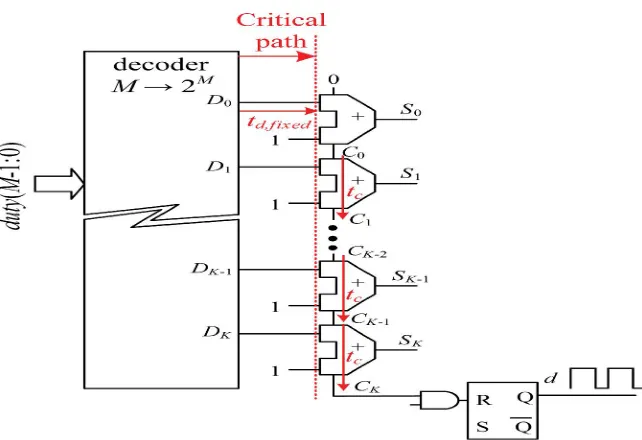
Fig. 4 shows a simplified delay line based on carry-chain logic as proposed in [14]. The carry chain is a low latency path, which is used to propagate the carry bit through consecutive 2-bit adders to implement high-speed arithmetic operations. When Di goes high, logic 1 propagates through the carry chain. Rather than tapping and multiplexing each delay element output, the control word D is used to select the position of the chain where the carry begins to propagate. The propagation delay tcof the carry bit through each adder is fixed and predictable, and usually lays in the range of 10–100 ps, depending
on the FPGA. This propagation delay sets the minimum achievable time resolution of the DPWM. The digital word duty (M −1 : 0) = dM−1dM−2 . . . d0 ∈ [0, 2M −1 = K] determines the total delay, tdelay , of the carry chain, in the following
manner:
tdelay = td,fixed + duty ・ tc (1)
with td,fixed being the propagation delay from the output of the decoder to the actual input of the carry-chain element
where the propagation begins. From (1) and Fig. 2, it can be seen that 2M delay elements are required to implement a M
-bit delay line. Furthermore, note that an ideal hybrid DPWM should fulfil
Tclk = td,fixed + K ・ tc (2)
ISSN: 2319-8753
I
nternational
J
ournal of
I
nnovative
R
esearch in
S
cience,
E
ngineering and
T
echnology
(An ISO 3297: 2007 Certified Organization) Vol. 3, Issue 4, April 2014
with Tclk being the system clock period. Table I shows the value of the digital word D and the desired delay as a function
of the duty cycle command. Note that tc remains approximately constant among different elements and thus, according to
(1), linearity and monotonicity are mainly determined by the delay through the critical path, td,fixed. Given the low value
of tc that the carry-chain logic provides, an almost perfect match between the routing delay from each output of the
decoder Di to the input of each corresponding adder is required to achieve a monotonic, repeatable, and reliable
behaviour. This means that, although the carry chain is automatically placed by the FPGA programming tools, the decoding logic still requires very careful manual placement and routing, significantly increasing complexity, and development time. The next section presents the main contribution of this letter, two simple implementation approaches that guarantee the required delay matching without the need for manual placement and/or routing.
TABLE I
IDEAL DELAY AND CONTROL WORD D AS FUNCTIONS OF THE DUTY CYCLE
IV. DPWM IMPLEMENTATION
According to Fig.4, there are at least 2M signals in the critical path that need to be matched within a few picoseconds.
This section describes two different implementations that target the most widely used FPGA families, which achieve high-timing resolution and maintain simplicity of implementation without manual placement or routing effort by leveraging the inherent, default routing optimization routines of associated development tools.
A. Implementation in Xilinx FPGAs
ISSN: 2319-8753
I
nternational
J
ournal of
I
nnovative
R
esearch in
S
cience,
E
ngineering and
T
echnology
(An ISO 3297: 2007 Certified Organization) Vol. 3, Issue 4, April 2014
Fig.5 Routing of signals in Xilinx Spartan-3 FPGA. (a) Path between a single RAM block and 8 carry-chain units is routed automatically, with severe mismatch. (b) Gating signal trig is used to provide well-matched low-skew routing to all delay cells.
Default routing routines inherent to the Xilinx development tools for the Spartan-3 natively maintain the structure of the carry chain for optimal timing, so no manual placement or routing is necessary. Furthermore, directly from primitives, instantiating carry-chain multiplexers and NAND gates (LUT2) automatically combine the LUT elements into the same CLB as the carry chain they control.
Fig.6 Spartan-3 implementation of a high-resolution delay line. NAND gates are used to gate the decoder output to alleviate the requirement on match routing delays from the decoder to a carry chain.
V. EXPERIMENTS
The architecture was implemented in Xilinx Spartan-3 FPGA and version 13.2 of the Xilinx ISE design suite.
ISSN: 2319-8753
I
nternational
J
ournal of
I
nnovative
R
esearch in
S
cience,
E
ngineering and
T
echnology
(An ISO 3297: 2007 Certified Organization) Vol. 3, Issue 4, April 2014
(b)
Fig.7 Simulation results of the hybrid DPWM architecture. (a) Duty cycle=00110011 (b) Duty cycle=01000100. As per the duty cycle value increases on period of the PWM signal also increases.
Duty cycle is the main input in DPWM and it is stored in terms of binary numbers (N-1:0). LSB (M-1:0) are used to implement the duty cycle and MSB(N-1:M) are used for synchronous modulator. Figure 7 (a) and (b) show the PWM signal for 8 bits duty cycle and 8 bits are equally divided in to 4 bits LSB and 4 bit MSB. S-R flip flop is used to set and reset the output value depending on input duty cycle here we can control the ON time and OFF time of the PWM signal.
VI. CONCLUSION
This paper has demonstrated a very simple, design and implementation of runtime reconfigurable high resolution digital pulse width modulator architecture using general purpose low cost field programmable gate array(FPGA) without any manual placement and routing efforts.. The proposed architecture achieves very high resolution using the propagation delay through internal carry chains normally used to perform high-speed arithmetic operations. This approach provides a excellent linearity, reliability, low latency, low variability delay line that is automatically instantiated by the compiling tools. This fact, in conjunction with further use of specific internal FPGA resources that provide matched routing delay to the input of the delay chains.The proposed approach has been demonstrated through a 1-MHz switching frequency, 8-bit, 1 ps time resolution DPWM without manual placement and routing.
REFERENCES
[1] A. Dancy and A. Chandrakasan, “Ultra low power control circuits for PWM converters,” in Proc. IEEE Power Electron. Spec. Conf., Jun. 1997, vol. 1, pp. 21–27.
[2] A. Syed, E. Ahmed, D. Maksimovic, and E. Alarc´on, “Digital pulse width modulator architectures,” in Proc. IEEE Power Electron. Spec. Conf., Jun. 2004, vol. 6, pp. 4689–4695.
[3] A. Peterchev and S. Sanders, “Quantization resolution and limit cycling in digitally controlled PWM converters,” IEEE Trans. Power Electron., vol. 18, no. 1, pp. 301–308, Jan. 2003.
[4] H. Peng, A. Prodic, E. Alarc´on, and D.Maksimovic, “Modeling of quantization effects in digitally controlled dc–dc converters,” IEEE Trans.
PowerElectron., vol. 22, no. 1, pp. 208–215, Jan. 2007.
[5] S. Huerta, A. de Castro, O. Garc´ıa, and J. Cobos, “Fpga-based digital pulse width modulator with time resolution under 2 ns,” IEEE Trans. Power
Electron., vol. 23, no. 6, pp. 3135–3141, Nov. 2008.
[6] A. D. Castro and E. Todorovich, “High resolution FPGA DPWM based on variable clock phase shifting,” IEEE Trans. Power Electron., vol. 25, no. 5, pp. 1115–1119, May 2010.
[7] D. Navarro, O. Luc´ıa, L. Barrag´an, J. Artigas, I. Urriza, and O. Jim´enez, “Synchronous FPGA-based high-resolution implementations of digital pulse-width modulators,” IEEE Trans. Power Electron., vol. 27,
no. 5, pp. 2515–2525, May 2012.
[8] V. Yousefzadeh, T. Takayama, and D. Maksimovic, “Hybrid dpwm with digital delay-locked loop,” in Proc. IEEE Worksh. Comput. Power
Electron., Jul. 2006, pp. 142–148.
[9] R. Foley, R. Kavanagh, W. Marnane, and M. Egan, “A versatile digital pulse width modulation architecture with area-efficient FPGA implementation,” in Proc. IEEE Power Electron. Spec. Conf., Jun. 2005, pp. 2609–2615.
[10] J. Wu and Z. Shi, “The 10-ps wave union tdc: Improving FPGA tdc resolution beyond its cell delay,” in Proc. IEEE Nucl. Sci. Symp. Conf.Rec., Oct. 2008, pp. 3440–3446.
[11] R. Cicalese, A. Aloisio, P. Branchini, R. Giordano,V. Izzo, and S. Loffredo, “Implementation of high-resolution time-to-digital converters on two different FPGA devices,” in Proc. Astropart. Particle Space Phys. Detect.Med. Phys. Appl., Jun. 2008, pp. 50–54.
[12] C. Favi and E. Charbon, “A 17 ps time-to-digital converter implemented in 65nm FPGA technology,” in Proc. Int. Symp. Field Program. Gate
Arrays, 2009.
ISSN: 2319-8753
I
nternational
J
ournal of
I
nnovative
R
esearch in
S
cience,
E
ngineering and
T
echnology
(An ISO 3297: 2007 Certified Organization) Vol. 3, Issue 4, April 2014
[14] L. S. Ge, Z. X. Chen, Z. J. Chen, and Y. F. Liu, “Design and implementation of a high resolution dpwm based on a low-cost FPGA,” in Proc.
IEEE Energ. Conv. Cong. Exp., Sep. 2010, pp. 2306–2311.
[15] “Diagram of slice-l,” Xilinx Virtex-4 FPGA User Guide, UG070(v2.6), San Jose, CA, Dec. 2008.
BIOGRAPHY
Rajini K. R.: is currently doing M. Tech (VLSI Design and Embedded System) with the department of Electronics and communication engineering, Don Bosco Institute of Technology, Bangalore, V. T. U., belgam, she holds B.E in electronics and communication Engineering in Adichunchanagiri Institute of Technology, Chikmagaluru, V. T. U. Belgaum