Copyight 0 1996 by the Genetics Society of America
Interallelic Complementation at the mf@ressor offorlied
Locus of Drosophila
Reveals Complementation Between Suppressor of forked Proteins
Mutated
in
Different Regions
Martine Simonelig," Kate
Elli~tt,~
Andrew Mitchelsont
and
Kevin O'Haret
*Dynamique du Ginome et Evolution, Znstitut Jacques Monod, Universiti Paris 7, 75005 Paris, France and tDepartment of
Biochemistry, Imperial College of Science Technology and Medicine, London SW7 ZAZ, United Kingdom
Manuscript received September 22, 1995
Accepted for publication January 15, 1996
ABSTRACT
The Su(f) protein of Drosophila melanogaster shares extensive homologies with proteins from yeast
(RNA14) and man (77 kD subunit of cleavage stimulation factor) that are required for 3' end processing
of mRNA. These homologies suggest that s u ( f ) is involved in mRNA 3' end formation and that some
aspects of this process are conserved throughout eukaryotes. We have investigated the genetic and
molecular complexity of the s u ( f ) locus. The s u ( f ) gene is transcribed to produce three RNAs and could
encode two proteins. Using constructs that contain different parts of the locus, we show that only the
larger predicted gene product of 84 kD is required for the wild-type function of s u ( f ) . Some lethal
alleles of s u ( f ) complement to produce viable combinations. The structures of complementing and
noncomplementing s u ( f ) alleles indicate that 84kD Su(f) proteins mutated in different domains can
act in combination for partial s u ( f ) function. Our results suggest protein-protein interaction between
or within wild-type Su(f) molecules.
D
IFFERENTIAL RNA processing mechanisms havebeen shown, in many cases, to be responsible for the regulation of developmental processes. For exam-
ple, the entire sex determination pathway of Drosophila
is regulated at the level of sex specific splicing (for
reviews, see BAKER 1989; HODGIUN 1989; STEINMANN-
ZWICKY et al. 1990). In Drosophila, genes involved in mRNA metabolism have been identified by their effect upon mutations caused by insertion of transposable ele-
ments within noncoding sequences of genes (RUT-
LEDGE et al. 1988). In this type of mutation, the insertion
results in an abnormal transcription pattern of the
gene, and this transcription pattern as well as the phe- notype of the mutant can be further altered by muta- tions in other unlinked genes (reviewed by SMITH and
CORCES 1991). These genetic interactions have been
very useful in identifying genes involved in critical steps
of RNA processing such as suppressor of white-apicot
[su(w")] and suppressor of sable [su(s)]
.
Mutations atsu(w") suppress the phenotype of the white'+cot allele of
white where a copia retrotransposon is inserted in the
second intron of the white gene (LEVIS et al. 1984). The
su(w") gene encodes one of the few genetically charac- terized splicing regulators. It regulates its own expres- sion by repressing accumulation of the fully spliced
su(w') mRNAs (ZACHAR et al. 1987, 1994). Mutations at su(s) suppress the phenotype of mutations due to
Corresponding author: Martine Simonelig, Dynamique du Gknome
e t Evolution, InstitutJacques Monod, Tour 42,4eme ktage, Universitk Paris 7, 2 , Place Jussieu, 75005 Pans, France.
E-mail: [email protected]
Genetics 1 4 2 1225-1235 (April, 1996)
insertion of transposable elements within 5' untrans-
lated regions of uermillon and yellow (FRIDELL et al. 1990;
GEYER et al. 1991). Su(s) protein is also believed to have
a role in splicing and has been suggested to act by preventing splicing complexes from forming on poor
5' splice sites (FRIDELL and SEARLES 1994).
The suppressor of forked [ s u ( f ) ] locus was identified
from its interaction with the forked' ( f ') mutation where
a gypsy retrotransposon is inserted in an intron of the
forked ( f ) gene (HOOVER et al. 1993; ISHIMARU and SAIGO 1993). The su(f)' mutation suppresses the forked
bristle phenotype off
',
so the bristles appear wild typein the stock f ' s u ( f ) ' (WHITTINCHILL 193'7). ISHIMARU
and SAIGO (1993) have shown that in f
',
very few wild-type f transcripts are made and that truncated tran-
scripts terminating within the 5' LTR of gypsy accumu-
late. In the double mutant f ' s u ( f ) ' , the abundance of
the wild-type f transcripts is strongly increased, which
correlates with the suppression of the forked bristle
phenotype. This shows that the Su(f) protein is involved
in some step of mRNA metabolism.
The Su(f) protein is homologous to the RNA14 pro-
tein of Saccharomyces cerevisiae (MITCHELSON et al. 1993).
The homology extends over the entire length of the
RNA14 protein with 26% of residues being identical
and 47% similar between the two proteins. RNA14 has recently been shown to be involved in polyadenylation
of mRNA (MINVIELLE-SEBASTIA et al. 1994). Another re-
cent study has described the high homology (56% iden-
tity, 69% similarity) between the Su(f) protein and a
1226 M. Simonelig et al.
2.9kb
2.6kb
1.3kb
-
5' 3'
WG8
I cDNA
d
Z q T
wG G -
d
WlO
b
U
1 kb
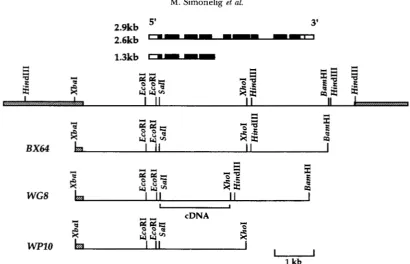
FIGURE 1.-Constructs with different parts of the s u ( f ) locus. A map of the locus is depicted. Below are indicated the restriction fragments cloned into pW8 to produce the different constructs. For WG8, the genomic fragment exchanged for the corresponding cDNA fragment is noted. Thin line corresponds to unique DNA, grey boxes are repeated DNA. At the top are shown polyadenyl- ated transcripts produced by s u ( f ) . Thin lines are introns, black boxes are coding sequences, open boxes are untranslated parts of exons.
adenylation (TAKAGAKI and MANLEY 1994). These ho-
mologies suggest that su(f) is also involved in mRNA
3' end formation and that some aspects of 3' end pro- cessing are conserved from yeast, through Drosophila to man.
The su(f) gene is complex at both the molecular
and genetic levels. It produces three
RNAs
(Figure 1)resulting from utilization of alternative polyadenylation
sites (MITCHELSON et al. 1993). The 1.3-kb mRNA has
its 3' end within intron
4
and could encode a proteinof -39 kD. The
2.6-
and 2.9-kb su(f) mRNAs encodean 84kD protein. While su(f)' is a viable allele, null
alleles of su(f) are lethal at the end of first instar larvae
(PERRIMON et al. 1989; LINDSLEY and ZIMM 1992). How-
ever, it has long been known that some lethal alleles of su(f) complement and produce viable heteroallelic combinations (see below).
To investigate the basis for the genetic complexity of su(f), we tested the requirement for each putative Su(f)
protein in the wild-type function of su(f) and showed
that only the 84kD protein is required. We have also mapped the molecular lesions of complementing and
noncomplementing su(f) alleles. Their structures sug-
gest that alleles that complement encode close to wild- type proteins, whereas alleles unable to complement
any other su(f) allele encode no, or very small, polypep-
tides. We propose that complementation between lethal
alleles of su(f) results from interaction between mole-
cules of 84kD Su(f) protein mutated in different do- mains.
MATERIALS AND METHODS
Drosophila stocks and genetics: All s u ( f ) alleles used in this study are described by LINDSLEY and ZIMM (1992) ex- cept S U ( ~ ) ~ ~ ' * ~ (SCHALET and LEFEWZE 1973). The original names of s u ( f ) alleles have been used throughout and alleles called l(1)x have been changed to su(f)". For example, l(1)R- 9-18 is su(f)R-'18. Drosophila stocks containin s u ( f ) alleles that we have used are: s ~ ( f ) ' , ~ ~ / F M 6 , su(f)'"''/FM6, w m J
~ u ( f ) ~ ~ ~ ' ~ / F M 6 , w m f s ~ ( f ) ~ ' ~ ? / F M 6 , In(1) sc41. sc'", y sc4 sc' w"
Tu su(f)"/FM6, S U ( ~ ) ~ ' ~ / F M G , su(f)"/FMG, In(1) sc4'. sc'", y sc4 sc' w" f x ~ u ( f ) ~ ' / F M 6 , y ct6 u f ~ u ( f ) ~ ' / F M 6 , y2 v f S U ( ~ ) ~ ' " ~ ~ /
FM6, y ct6 u f carsu(f)""'/FMb, y u f S U ( ~ ) " ~ ' ~ , y2 ru" f S U ( ~ ) ~ " ~ ~ / FM7b, y w f su(f)"d': f ' su(f)mndr' and f ' su(f)'. Details of balancers, other special chromosomes and other genes are given by LINDSLEY and ZIMM (1992). To test the complementa- tion between s u ( f ) alleles, we used the B'Y chromosome, which contains a translocation of chromosome Xcovering the
s u ( f ) region (LINDSLEY and ZIMM 1992). Females su(f)lel'm"/ balancer were crossed with males su(f)'fl'h"L2/BYY and resulting
s u ( f ) ~ f ~ ~ N / s u ( f ) l c r h n ~ z females were scored. The stock w'"' was used for transformation. Transformant stocks were estab- lished by crossing to balancer strains in the w'"' background. Unless specified otherwise, the rescue of s u ( f ) alleles by trans- genes was determined with a single copy of the construct. Each primary transformant line and each secondary insertion line made by mobilization with A2-3(99B) (ROBERTSON et al. 1988) were analyzed by DNA blotting. We found a single nonrearranged insertion in every line except for WG8.2, which contains three inserts at least one of which is not re- arranged, and for W 1 0 . 1 3 , W10.17, W I 0 . 2 9 a n d W 1 0 . 4 4 .
These four last lines result from mobilization of W l O . I and contain the primary insertion W I U . 1 as well as another non- rearranged insertion on chromosome III.
Complementation at the s u ( f ) Locus
TABLE 1
Complementation pattern between
sum
lethal alleles at 25"L26 16-185 MS252 MS97 S1 D l 3 S2 X1 3DES X 2 R-9-18
L26 1 6 1 85 MS252 MS97 s1 D l 3
s 2
+
x 1
+
3DES
+
X2
+
R-9-18 -
- ND - - - - ND - - - -
- - - ND - - ND ND ND -
- - - ND - ND - - -
- - - -
- - ND ND - - -
- - - -
- - - -
- - -
- -
-
-, lethal combination;
+,
viable combination; ND, not determined.1227
constructs were in the pW8 vector (KLEMENZ et al. 1987). Construct DNA (500 pg/ml) with 250 pg/ml of the helper plasmid pUChsnA2-3 were injected into w1'18 embryos.
Molecular biology: Plasmid construction and other rou- tine molecular biology techniques were carried out as de- scribed by SAMBROOK et al. (1989). RNA blots were as re- ported by MITCHELSON et al. (1993) except that total RNA was extracted using RNAzol (Bioprobe Systems). PCR am- plifications were carried out as recommended by the manu- facturer (Perkin Elmer-Cetus). Oligonucleotides used for PCR were: 5'CCGCATACTGGTACTGAATTAATATC (-539
266), 5'CCATCCAAATAAAGCCAATG (509 to 490), 5'GTG AGTGTTATACGCAGAGTTTGC (1304 to 1327), 5'CTG
GTTTTAAGTTGGAATTTAGAAAGAAC(l361 to1333),
5'GTAGGAACACACATATTGAATATG (2158 to 2181),
5'CTGGAGTATTAAATTTCGATGGTATC (2222 to 2197),
5'GTCTTACTTTAATCACCTCGTTCTGC (3222 to 3247),
5'CCCACCTTGTTCAGTATAATGCCC (3278 to 3255),
S'GTGAGTGTCCCTGATTGAAATTCTC (3551 to 3575),
5'CGTACTTGTATCCACGATCCAGTG (3696 to 3673),
5'GCATGAAGGCAAATTCCCAAGCAGC (3988 to 3963),
5'CTGAGGTAATGGAGGAGTGCTTC (4341 to 4319); coor- dinates indicated within brackets are from MITCHEISON et al.
(1993). PCR products were purified from low melting gel and either cloned into M13 vectors or directly sequenced. DNA sequencing was by the dideoxy chain-termination method
(SANGER et al. 1977) using sequenase (U.S. Biochemical). to -513), 5'CGATGACACTATCGCAGTCATCC (242 to
RESULTS
Genetic interactions between su(f) alleles: A com- plex pattern of complementation has been described
for a particular allele of su(f), su(fy-""'* (SCHALET
1972). At 25", su(f pp'' homozygotes die at pupariation,
but at 18", a very small proportion of them eclose show- ing thread-like, pale yellow bristles and hairs and wrin-
kled wings. su(f )H-p18 suppresses the phenotype off at
18", and it is allelic to su(f)' since in females of the
genotype f I s u ( f
y-p18/
f s u ( f )" the f phenotype is sup-pressed. Nevertheless, at 25" s u ( f y-9'8complements for
viability some s u ( f ) alleles that are lethal as homozy-
gotes at all temperatures. The complementation pat- tern for viability at 25" in a large number of combina-
tions of 11 alleles of s u ( f ) has been studied (SCHALET
1972; SCHALET and LEFEVRE 1973; A. SCHALET, unpub-
lished results and this study) and is summarized in Ta-
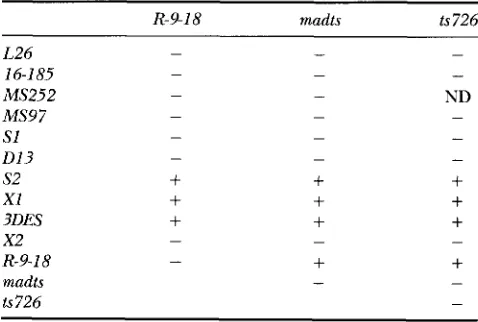
ble l. This shows that the allele su(f)R-P1' complements
four lethal alleles of s u ( f ) for viability but not six others
and except for s u ( f )K-9-'', all other alleles fail to comple-
ment one another at 25".
To determine if su(fF-"' is the only s u ( f ) allele able
to complement other s u ( f ) lethal alleles, we carried out
complementation analysis with two other temperature- sensitive lethal alleles, su(f and S U ( ~ ) " " " ~ . Four tem-
perature-sensitive lethal alleles of s u ( f ) with similar mu-
tant phenotypes have been described, su(f)m'd's
UUR-
GENS and GATEFF 1979), su( f )'s67g (DUDICK et al. 1974),
Homozygotes of these alleles are phenotypically wild
type at 18", they survive and suppress the f I phenotype
at intermediate temperatures and are lethal at 29". We
studied the complementation pattern for viability at
30" of the 10 lethal alleles of s u ( f ) used in earlier stud-
ies with su(fp9"*, su(f)mndl" and S U ( ~ ) ' ' ~ ~ ~ (Table 2).
TABLE 2
Complementation pattern between lethal alleles and
temperature-sensitive lethal alleles of
sum
at 30"su( f )ts76n (WILSON 1980) and S U ( ~ ) " ~ ' ~ (RUSSEL 1974).
R-918 madts ts 726
L26 - -
MS252
MS97 - - -
SI D l 3
s2
+
+
x 1
+
+
+
3DES
+
+
+
X 2 - -
R-9-18
madts -
ts 726 16-1 85
-
- - -
- - ND
- - -
- -
+
--
-
+
+
- -
1228 M. Simol
, m ( f ) " - y - 1 8 shows identical complementation patterns at
25" and at 30" except with the lethal allele su(f)x2,
which complements su(f )rr-9-'x for viability at 25" but not
at 30". This result has already been described (SCHALET 1972). S U ( ~ ) ~ " " " and su(J)1c726 both present the same
complementation pattern as su(f)'i-y"8. They both com-
plement three lethal alleles of s u ( f ) [su(f)", su(f)"' and S U ( ~ ) ~ ~ " ~ ~ ' ] among the 10 alleles tested. In addition,
S U ( ~ ) ~ - ' - ' ' complements both S U ( ~ ) ~ " ~ ~ ' ~ ~ ' and su(f)'si2h at
30". Finally, .vu(f)mdL" and s ~ ( f ) " ~ ~ ~ do not complement
one another. From these patterns of complementation,
five different groups can be defined: (I) su(f)','',
. ~ u ( f ) ' ~ - ~ " ~ , S U ( ~ ) " " ~ ' , su(f)"", su(f)" and . ~ u ( f ) ' " ~ ,
which do not complement any su(f) alleles; (11) , ~ u ( f ) ~ ~ ,
su(f)"' and su(/)3r"'"s, which complement S U ( ~ ) ~ - ' - ' ' ,
ments su(fjRP'' at 25" only; (IV) su(f)mn'L" and S U ( ~ ) " ~ ~ ~ ;
and (V) su( f )""P18.
Complementation at the s u ( f ) locus is independent of the allelic state of the zeste gene: Interallelic comple- mentation has been described at other loci in Drosoph-
ila, including white (BABU and BHAT 1980), decapen-
taplegic (GELBART and WU 1982) and yellow (GEYER et al. 1990). In all these cases, complementation is depen- dent upon alignment of the two alleles resulting from
pairing of the two homologous chromosomes. The phe-
notypes of certain allelic combinations are affected by rearrangements that disrupt chromosome pairing and
by mutations of the zeste (z)locus. Hypomorphic alleles
of z have a similar effect to that of chromosomal rear-
rangements and eliminate complementation between
alleles of the same gene. To determine whether interal-
lelic complementation at the su(f) locus depends upon
z, we studied the effect of two different z alleles, z" and
z'on the viable combination su(f )3"is/,~u(f)"~y"x. z" is a
hypomorphic allele of z and z1 is a neomorphic allele,
but both can affect interallelic complementation (GELB-
ART and Wu 1982). Various z su(f) recombinants were
made and used to show that z" su(f)""'~y/zlL . s ~ ( f ) ~ ' ~ ~ ~ ' ~
. Thus, the allelic state of the
z
gene hasno effect on complementation at the su(f) locus. This
suggests that this complementation could be indepen- dent of chromosome pairing.
Transformation experiments prove that the 84-kD
Su(f ) protein is sufficient for the wild-type s u ( f ) func- tion: The s u ( f ) gene (Figure 1) is transcribed to pro- duce three polyadenylated RNAs that have different 3'
ends (MITCHELSON et al. 1993). Both the 2.9- and 2.6-
kb RNAs encode an 84-kD protein. The 3' end of the
1.3-kb su(f) RNA is within intron 4 of the gene. This
RNA has no in frame stop codon and would encode a
protein with the same 313 N-terminal amino acids as
the 84-kD protein, then 37 amino acids encoded by
intron 4 followed by a C-terminal poly-lysine tract en- coded by poly(A).
Part of the complex complementation pattern de-
su (f) lnodls and su(f)"7z2"; (111) su(f)", which comple-
and z1 su(f)3/)/<.s/z' su(f)/<-Y-/8 are as viable as zt su( f ) 3')""/ z+ su (f) 1'- Y- 18
d i g et al.
scribed at the s u ( f ) locus (Tables 1 and
2)
could resultfrom a requirement for both proteins in su(f) function.
A su(f) lethal allele altered in the coding sequence specific to the 84-kD protein might complement an-
other su(f) lethal allele altered in the region specific
to a protein encoded by the 1.3-kb RNA. We therefore
made s u ( f ) transgenes to test the requirement for these
two putative proteins in the wild-type function of su(f)
(Figure 1). BX64 contains a 6.4-kb XbuI-BamHI genomic
fragment covering the whole su(f) locus, and we have
already reported that this construct rescues all su(f)
mutant phenotypes (MITCHELSON et ul. 1993). WG8 also
contains the whole locus, but a fragment from exon 1 to
exon 6 has been replaced by the corresponding cDNA fragment. This construct lacks the first five introns of the gene and is thus unable to produce the 1.3-kb RNA
that includes part of intron 4. It can encode the 84-
kD Su(f) protein. WPlOcontains an XbaI-XhoI genomic
restriction fragment from the 5' region of s u ( f ) up to
exon 6. W 1 0 cannot encode the 84-kD protein, but
should produce the protein encoded by the 1.3-kb
RNA. The three constructs were introduced into flies by P-element mediated transformation. Additional in- sertions were generated by transposing primary inser-
tions using a stable source of P transposase (ROBERTSON
et al. 1988). In this way, we recovered two primary and
two secondary insertions of BX64, four primary and
three secondary insertions of WG8 and two primary and
four secondary W I O insertions (Figure 2). We have
confirmed by RNA blotting that WG8 does not, and that
W P 1 O does, produce the 1.3-kb mRNA (Figure 3).
The primary insertions were tested for rescue of two
s u ( f ) mutant phenotypes: lethality and the suppression
of the f 1 bristle phenotype. Transformants with the
transgene on an autosome were crossed with seven
su(f) alleles representing all five groups defined earlier
and with the stock
f '
su(f)' (Table 3). Both BX64 pri-mary transformants rescued all lethal su(f) alleles as
well as the su(f)' allele since f' su(f)';BX64 flies had
forked bristles. The secondary insertions of BX64 were
shown to rescue su(f)1'26, a deletion of s u m . These
results indicate that in the four insertion sites tested, the BX64 transgene provides fully wild-type function of
su(f). One primary WG8 transformant (WG8.4) was
able to rescue all lethal alleles for viability and the
suppression of the bristle phenotype of
j"
by su(f)'.The other two primary autosomal WG8 transformants showed only a very small effect in combination with the SU(~)~'-'"' allele at 18". The survival of SU(~)"-~-~"/ Y; WG8.2/
+
and su( f )"-'"x/ Y; WG8.3/+
males at 18" wasbetter than that of s~(f)"'~~~/u/Yrnales (Table 3). Two of
the three secondary WG8 insertions rescued the lethal
alleles, S U ( ~ ) ~ " " ~ ' and S U ( ~ ) ' , ' ~ , and the remaining pri-
mary insertion on the X chromosome (WG8.1) was via-
ble when recombined with ~ u ( f ) " ' ~ (Figure
2).
In onecase, an insertion that rescued (WG8.4.15) was recov-
Complementation at the sucf) Locus 1229
BX64
WG8
WP10
:ransfomant and Rescue of
sum
mobilized lines mutant phenotypes
BX64.2
+
BX64.1
+
BX64.11
+
BX64.12
+
k
t:
WG8.1
+
WG8.2
WG8.3
-
WG8.4
+
WG8.4.38
+
WG8.4.14
-
L
WG8.4.15+
WP10.2
-
WP10.1
-
WP10.13
-
WP10.17
-
WP10.29
-
WP10.44
-
Number of lines vhich rescud Total
number of lines
414
016
did not rescue ( WG8.4.14). This shows that the WG8
transgene is able to provide wild-type su(f) function,
but only in some chromosomal locations.
Neither primary W P I O transformants rescued any
m ( f ) phenotype (Table 3), and all four secondary W l O
insertions did not rescue the lethality of su(f)"",~',
su(f)'"6 or su(f)R-y-'x (Figure 2). Furthermore, the fail-
ure of WG8.3, W l O . 1 and WPI0.2 to rescue su(f) mu-
tants is not dose dependent. Even when homozygous For these autosomal insertions, s ~ ( f ) " ' ~ or
were not rescued at 25".
Taken together, these data indicate several conclu-
sions. WG8 encodes the 84kD Su(f) protein only, and
this protein is sufficient for the wild-type function of su(f). It is able to rescue the lethality of a complete deletion of the s u ( f ) locus, s ~ ( f ) ' ~ ' ~ , and it also rescues
the suppression of the f ' phenotype. The failure of
some WG8 insertions to rescue s u ( f ) mutants appears
to be due to a strong position effect when the first five
introns of s u ( f ) are missing. This position effect is not
seen in RX64 transformants, suggesting that an en-
hancer necessary for the proper expression of su(f) may
be located in the first five introns of the gene. W l O
insertions show no indication of providing any s u ( f )
function. They do not rescue any su(f) allele, and they
do not complement WG8 transformants that fail to res-
cue s u ( f ) phenotypes. Males of the genotypes su(f)',26/
FICUKE 2.-Rescue of su(J3 lethality with
three constructs containing various parts of the
su(f) locus, located at different places in the ge- nome. Arrows indicate insertions obtained from mobilization of another insertion.
+,
rescue; -, no rescue.Y;WG8.3/+;WPIO.I/+, s u ( f ) ' ~ 2 6 / Y ; W G 8 . ~ / + ; W 1 0 . 2 /
+,
S ~ ( ~ ) " " " ~ / Y ; W G ~ . ~ / + + ; W I O . I / + or .SU(~)"~~-'*/ ~WG8.?/++;WPI0.2/+ do not survive. Our results strongly suggest that a putative protein encoded by the1.3-kb RNA is dispensable for the su(f) function. Given
the unusual structure of this RNA in lacking a stop
codon, it is possible that there is no such protein. These results also clearly demonstrate that the complementa-
tion pattern obtained with the various su(f) alleles does
not result from a requirement for two different Su(f) proteins.
Molecular mapping of m(f) mutants: The structures
of the 11 lethal m ( f ) alleles described in Table 1 and
the temperature-sensitive su(f) alleles, .su(f)"L""f',
gated by DNA blotting (data not shown). The results
of this analysis are summarized in Figure
4
.
Eight ofthe 11 lethal alleles showed differences from wild-type
DNA. s ~ ( f ) " " " ~ ' " and su(f)A's4i have P-element inser-
tions within exon 2 of s u ( f ) at positions 615 and 682,
respectively, (MITCHELSON et al. 1993) while in .su(f)s2,
there is a Doc element insertion in the last exon of the
gene at position 3659 (DRIVER et al. 1989; MITCHELSON
et al. 1993). Nucleotide positions are from the DNA
sequence of MITCHEISON et nl. (1993). In ,su(f)"",
there is a deletion of 8.5 kb including the whole s u ( j )
locus and 1.5 kb of repeated DNA flanking the gene
1230 M. Simonelig et al.
A
B C D
" pp-"
kb:
-
1.3
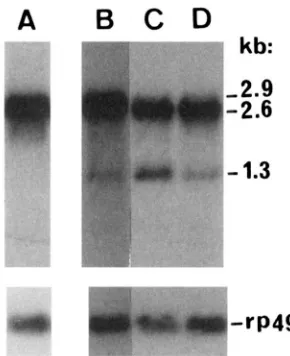
FIGURE 3.-Production of s u ( f ) mRNAs from WG8 and
W P I O constructs. 5 yg of poly(A)' RNA from adult females
were loaded per lane. The Northern blot was hybridized to a
singlestranded DNA probe corresponding to a cDNA of the
1.3-kb su(f) RNA (MITCHEISON et al. 1993). The filter was
then reprobed with the 949 clone (VASLET et al. 1980) as a
loading control. (A) 711"'~' .su(f~"';WGS.4, (B) w"" su(f)',26;
WC8.4;WP10.1, (C) u1'"~;WPl0.2, (D)
w"'~.
In lanes Aand B,su(f) mRNAs are produced exclusively by WG8.4 and WP10.1
insertions, since the allele su(f)',2" is a complete deletion of
the su(f)locus (see text). Note that WG8.4, as expected, does
not produce the 1.3-kb mRNA (lane A) and that, in contrast,
W P l O . 1 does (lane B). In lanes C and D, su(f) mRNAs are
produced by the su(f) locus and by the WP10.2insertion. Note
the increase in the level of the 1.3-kb mRNA when WP10.2 is
present in the genome (lane C ) .
(M. TUDOR and K. O'HARE, unpublished data). In
S U ( / ) ' ~ - ' ~ ~ , there is either a large insertion or an inver- sion with one breakpoint within su(/); it was not char- acterized further. The last three alleles, s~(/)"', su( f )" and su(/)" showed small differences from wild type.
Mutant specific fragments were amplified by the PCR
and their DNA sequences were determined. In
there is an insertion of the most 3' 222 bp of the I
factor (FAWCETT d al. 1986) terminated by one TAA
triplet followed by four repetitions of the sequence
TAAA. The complete insertion is 241 bp and it is lo-
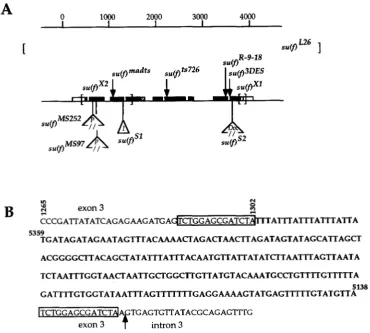
cated at the end of exon 3 (position 1302) (Figure
4A). Figure 4B shows that the I element has inserted
in inverse orientation with respect to s u ( / ) transcrip-
tion and that this insertion has duplicated a 14-bp
target sequence. In su(/)", 149 bp of the last exon
(from position 3822 to 3970) are deleted (Figures 4A
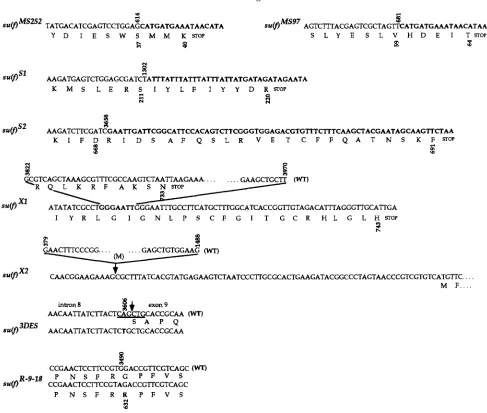
and 5 ) . In addition, Figure 5 shows that in su(/)"', 7
bp located at the 3' break point of this small deletion
are duplicated. Finally, su(/)"' corresponds to a 11 10-
bp deletion (from position 379 to 1488, Figure 5) that
starts within exon 1 and includes exon 2, exon 3 and
the 5' half of exon 4 (Figure 4A).
DNA from SU(/)"'~, SU(/)""~~, SU(/)""*'~ and from the
four temperature-sensitive su(/) alleles showed no dif-
ference from wild-type DNA in DNA blots. We have
determined the nucleotide changes for the mutations
of the genotype WG8.1 SU(/)'.~~/S"/)"'''~' and used to
amplify a fragment specific to su(/)'""', from intron 5
to downstream of the 3' untranslated region of su(/).
We sequenced 0.8 kb of this fragment (from position
3350 to 4150) and found 1-bp difference from the wild-
type sequence, at the end of intron 8 (Figure
4A).
Thisdifference is at position 3606 and changes the AG con-
sensus dinucleotide (MOUNT 1982) at the 3' splice site
of intron 8 to TG (Figure 5 ) . To determine whether
this difference is responsible for the su(f~''' mutant
phenotype, we checked the presence of the wild-type A
at position 3606 in six different wild-type stocks since
the parental stock for SU(/)~')''' has not been described
in the literature. The difference found in su(/)"'" dis-
rupts a PuuII restriction site (Figure 5). We therefore
amplified the corresponding region from the six wild-
type stocks and digested the amplified DNA with PuuII.
In contrast to .~(f)""", all six stocks have the wild-type PuuII site. Moreover, in an independent analysis, LANG LEY d dl. (1993) showed that this PvuII site is present in su(/)31"" and S U ( / ) " ~ ~ - ' ~ ~ . DNA was made from flies
TABLE
3Rescue of
sum
alleles with three constructs containing various parts of thesum
locusL26 s2 XI 3DES x2 X-918 madts 1
18" 25" 18" 25" 18" 25" 18" 25" 18" 25" 18" 25" 25" 30" 18" 25"
BX64.1 ND
+
ND+
ND+
ND+
ND+
ND+
ND+
ND+
BX64.2 ND
+
ND+
ND+
ND+
ND+
ND+
ND+
ND+
WG8.2 -
-
-
ND -WG8.3
-
- ND - --
+" -WG8.4
+
+
+
+
+
+
+
+
+
+
+
+
+
+
ND+
WP10.1 - - ND - ND
-
ND-
-
- --
- - -WP10.2 - - ND
-
ND-
ND -- -
-
-
-+"
- ND ND - -- -
-
- --
- --
-
-
- --
-
- --, lethal for su(f)'.26, su(f,"', su(f)", S U ( ~ ) ~ ' ' ~ '
,
su(f)", su(fy-""", and lethal for su(f)"""" at 30", f' phenotype for su(f)'"''''" at25" and for su(f)'; +,viable for su(ffZ6and su(ff2and viable with a fphenotype for su(f)"', SU(~)~'"''', su(f)", su(f)"*", s~~(f)""""
and su(f)' (see MATERIALS AND METHODS for details of the s u ( f ) stocks); ND, not determined.
Complementation at the s u ( f ) Locus 1231
A
0 lo00 2000 3000 4000In
W
N
0
B
r
exon 31
C C C G A T T A T A T C A G A G A A G A T G A G ~ ~ C T G G A G C G A T C T ~ L A
5359
TGATAGATAGAATAGTTTACAAAACTAGACTAACTTAGATAGTATAGCATTAGCT
A C G G G C C T T A C A G C T A T A T T T A T T T A C A A T G T T A T T A T A T T A
TCTAATTTGGTAACTAATTGCTGGCTTGTTATGTACAAATGCCTGTTlTGTlTTTA
G A T T T T G T G G T A T A A T T T A G T T l T T T T G A G G A A A A G T A T A T G T T A 5138
ITCTGGAGCGATCT~
TGAGTGTTATACGCAGAGTITGexon 3
@f
intron3FIGURE 4.-Map of sucf) mutants. (A) The s u ( / ) locus is depicted. Black boxes are coding sequences, open boxes are
noncoding parts of exons, stippled box is the part of intron 4 incorporated within the 1.3-kb su(f) mRNA, and thin lines between
exons are introns. Brackets represent the location of break points of deficiencies. Arrows indicate location of point mutations.
Insertions are represented by small triangles. (B) The sequence of the su(f)"' mutant in the region of the Zelement insertion
point is shown. Nucleotides from the Z factor are in bold. The Z element is inserted in inverse orientation with regard to s u ( f ) ;
coordinates for the insertion (written horizontally) are those of the Ifactor (FAWCETT et al. 1986). The 14bp target sequence
is boxed. Arrow indicates the 5' splice site of s u ( f ) intron 3. Coordinates for the s u ( f ) locus are from MITCHEISON et al. (1993).
in 64 lines generated from natural populations. These
data indicate that the difference found in the allele
su(f)'""" at position 3606 is the cause for the su(f)"""
mutant phenotype. ~u(f)~-'-'' individuals die as pupae
at 25" and survive very poorly at 18". DNA from selected
male su(f)R-91'/ Y larvae was prepared and used to am-
plify fragments to cover the whole s u ( f ) locus. A total
of 3.4 kb was sequenced (from positions -540 to
2223
and 3221 to 3988) and only 1-bp difference from the
wild-type sequence was found in exon 8 (Figure 4).
Figure 5 indicates that in the su(f)R-PIR mutant, nucleo-
tide 3490 is changed from G to A, which results in a
change in the protein sequence from glycine to argi-
nine. To check that this difference is the cause for the su(f)R-p" mutant phenotype, we also amplified and se-
quenced the corresponding region from three different
wild-type strains and from the stock l(l)R-9-28/FM6
(LIFSCHITZ and FALK 1969). The mutant l(1)R-9-28 was
obtained in the same screen as su(f)R-p'' and on the
same parental chromosome, which is no longer avail-
able. Thus, the l(l)R-9-28 mutant chromosome can be
considered as having a parental version of the s u ( f )
locus for SU(~)~-'-~'. All four stocks have the wild-type G
at position 3490. This shows that the single difference
found in the allele su(f)R-P'' is indeed responsible for
the mutant phenotype. The DNA sequences of the en-
tire m ( f ) locus from the four temperature-sensitive al-
leles have also been determined and in each case, there
was a single base pair difference from the wild-type
sequence (K. ELLIOTT, K. 0'- and M. SIMONELIG,
unpublished observations). The fact that the level of
DNA sequence polymorphism at the s u ( f ) locus is ex-
tremely low has already been reported and results from
the hitchhicking effect in a region of very low recombi-
nation (LANGLEY et al. 1993). In su(f)mndt,', the substitu-
tion is within exon 3, while in S U ( ~ ) " ~ ~ ~ , it is within exon
6 (Figure 4A). For both mutants, the single base pair
difference results in a change of one amino acid in the 84kD protein sequence.
su(f) alleles that complement one another encode an
almost complete 84kD protein: The interallelic com-
plementation pattern described in Tables 1 and 2 de-
fines five groups of ~ ( f ) alleles. Group I contains the
1232 M. Simonelig et al.
d
M
3
TATGACATCGAGTCCTGGA&ATGATGAAATAACATA SUflMSg7 AGTCITTACGAGTCGCTAGTATGATGAAATAACATAAGG
Y D I E S W S M M K S O P S L Y E S L V H D E I T n O P
h
CI 8 % * W
K M S L E R S n I Y L FI Y Y D R X O P
*
H
w
f
Sufis2 A A G A T C T T C G A T C G A A ~ G A T T C G G C A ~ C C A C A G T C A A
K I F D R I D S A F Q S L R V E T C F F Q A T N S K F n o p
J
Ms
CGTCAGCTAAAGCGTITCGCCGTCTAATTAAGAAA. . . . . . . . GAAGCTGCTT
P
(WT)G R Q L K R F A
s u p A T A T A T C G C C T G G G A A T T G G G A A ~ G C C ~ C A T G C ~ G G ~ T ~ C C G G T T G T A G A C A ~ A G G G T T G ~ T T G A
\
I Y R L G I G N L P S C F G I T G C R H L G L H S T O P
3
+
CAACGGAAGAAAGCGCmATCACGTATGAG~GTCTAATCCCTTGCGCACTGAAGATACGGCCCTAGTAACCCGTCGTGTCATGTTC. .
M F . . .
intron 8
3
A
exon9AACAATTATCTTAC~CGCACCGCAA (WT)
S A P Q
AACAATTATCTTACTCTGCTGCACCGCAA
f
CCGAACTCCTTCCGTGGACCGTTCGTCAGC (WT)
s49R-9-18
P N S F R G P F V S
CCGAACTCCTTCCGTAGACCGTTCGTCAGC
P N S F R R P F V S
N
m
W
FIGURE 5.-Coding capacity for the su(f) mutants. For each mutant, the nucleotide and deduced amino acid mutant sequences
are indicated. For mutations due to deletion and for point mutations, the wild-type sequences (WT) are written above the
mutant sequences. Nucleotides from the insertions, from the duplication [in ~ u ( f ) ~ ' ] and mutant nucleotides in point mutations
are in bold. For ~ u ( f ) ' ~ ~ ' , the arrow indicates the end of intron 8 and the PUuII site is underlined. Coordinates are from
MITCHELSON et al. (1993).
su(f)" and S U ( ~ ) ~ " , which do not complement any
other s u ( f ) allele. Group I1 contains the lethal alleles
su(f)", su(f)"' and su(f)jlDES, which complement the
lethality of su(f)R-p18 and of the temperature-sensitive
alleles, su(f)madts and S U ( ~ ) & ~ ' ~ at 30". Group I11 corre-
sponds to the lethal allele su(f)x2, which complements
su(f)R-p18 at 25" only. su(f)R-p18 and the alleles su(f)madt'
and S U ( ~ ) ' ~ ~ ~ ~ , represent respectively the two last groups
that complement one another, in addition to comple- menting group 11.
Three alleles from group I, S U ( ~ ) ~ ~ ' ~ ' , S U ( ~ ) ~ ' ~ ~ and
su(f)" have insertions into the very 5' part of the gene
(Figure 4A). The putative proteins encoded by these
mutants would be very small (40 amino acids, 64 amino
acids and 220 amino acids, respectively, Figure 5). A
fourth member of this group, su(f)L26, is a complete
deletion of the gene. In contrast, all group I1 alleles,
su(f)", su(f)xl and su(f)" have alterations in the very
3' end of the gene. Assuming that transcription and
translation in su(f)" continued into the insertion, only
the C-terminal 65 residues of the 84kD Su(f) protein
would be substituted by
23
residues encoded by the Doctransposon (Figure 5). The small deletion in suCf)"'
includes the stop codon of the 84kD Su(f) protein and
the 3' end of the 2.6-kb mRNA. However, the 3' end
for the 2.9-kb s u ( f ) mRNA remains and the deleted
mRNA would encode a protein where the 10 C-terminal
residues of the 84kD Su(f) protein would be substi-
tuted by 20 amino acids encoded by the 3' untranslated
region (Figure 5). In the s ~ ( f ) ~ ~ ~ ' a l l e l e , the point muta-
tion in the 3' splice site of intron 8 should prevent wild-
type splicing of this intron. We do not know whether
this intron remains unspliced in the su(f)'""" mutant
Complementation at the s u ( f ) Locus 1233
case, the protein encoded by s ~ ( f ) ~ ~ ~ ~ w o u l d lack a max-
imum of
82
C-terminal residues of the wild-type Su(f)protein, encoded by the last exon. The lethality of these three alleles indicates that the C-terminal part of the Su(f) protein is important. These mutants do comple- ment su(f)R-p18, su(f)""" and ~u(f)'"~where 84kD pro- teins altered at a single site should be produced. These results strongly suggest that interallelic complementa- tion results from complementation between complete
and/or close-to-complete 84kD Su(f) proteins that are
altered in different regions.
su(f)" is interesting since it complements su(f)R-p18
at 25" but not at 30". This temperature sensitivity indi- cates that this transheterozygote combination is less via-
ble than the others. In contrast to su(f)", su(f)" and
su(f)'""", Figure 5 shows that su(f)" cannot encode a nearly complete Su(f) protein. This allele has a 1110-
bp deletion from exon 1 to exon 4 that includes the
initiation codon of the Su(f) protein, but not the trzn-
scription start site. As we hypothesize that for comple-
mentation both alleles produce proteins altered in dif- ferent ways, we suggest that a protein is produced in
su(f)" that is able to act with a protein encoded by
su(f)R-p18 and so permit the trans-heterozygote to sur-
vive. Assuming that transcription occurs in su{f)" to
produce an RNA where exon 1 has been fused to exon
4 and the remaining introns are spliced as in wild type,
the first in frame methionine corresponds to residue
278 within exon 4 (Figure 5). This putative Su(f)X2
protein would correspond to the 456 C-terminal amino acids of the 733 amino acids Su(f) protein.
DISCUSSION
The 84kD Su(f) protein is sufficient for the wild- type function of su(f): The su(f) locus is complex and
is transcribed to produce three RNAs that could encode
two different proteins. The three RNAs (2.9,2.6 and 1.3
kb) arise from utilization of alternative polyadenylation sites and from alternative splicing of intron 4. Polyade- nylation within intron 4 generates the 1.3-kb mRNA.
We have shown that the 84kD Su(f) protein is suffi-
cient for the su(f) function as assayed by two pheno-
types: viability and restoration of the f' bristle pheno-
type. Transformants containing a construct encoding only the 84kD Su(f) protein can rescue a complete
deficiency of the su(f) locus. Flies of the genotype
s ~ ( f ) ~ ' ~ ; W G 8 . 4 are perfectly viable at all temperatures. Such transformants also rescue the suppressed bristle
phenotype o f f ' su(f)' flies, i,e., f ' su(f)';WG8.4 flies
have mutant forked bristles. Our results show that the 1.3-kb mRNA is dispensable for the wild-type function of su{f). We do not know if this RNA is translated. Although it has the features necessary for translation, it is possible that a regulatory process prevents its trans-
lation. This is the case for su(wa) where RNAs that are
not fully spliced are retained in the nucleus (ZACHAR
et al. 1994).
Genetic complementation between
s u ( f )
alleles can be explained by complementation at the protein level: We have examined a role for the Zeste protein in theinterallelic complementation at the su(f) locus. For
some loci in Drosophila, interallelic complementation is supposed to result from interaction between an intact regulatory sequence on one chromosome and an intact
transcription unit on the other paired chromosome.
This interaction can be altered by disruption of chro-
mosome pairing or by mutations at the z locus (JACK
and JUDD 1979; GELBART and WU 1982; GEYER et al.
1990; LEISERSON et al. 1994). We have shown that inter-
allelic complementation at the su(f) locus is indepen-
dent of mutations in the z gene. This suggests that this
complementation would not result from interaction be- tween regulatory sequences on one chromosome and a transcription unit on the homologous chromosome.
This has been confirmed by the mapping of su(f)
mutants. We have determined the molecular lesions of
su{f) alleles that show interallelic complementation and have no evidence that any of these mutations affect regulatory sequences. All our results suggest that the
interallelic complementation at su{f) results from com-
plementation at the protein level. Three lethal alleles,
ment any other su{f) allele, have insertions in the 5'
end of the gene and could only encode small polypep-
tides (40-220 residues). In contrast, all su{f) alleles
that fall into groups that do exhibit some degree of
complementation are potentially able to encode pro- teins close to the wild-type 84kD Su(f) protein. Three of them, su(f)madts, S U ( ~ ) " " ~ and su{f)R-P'8, are point mu-
tants that encode Su(f) proteins altered at only one
amino acid. su(f)", su{f)"' and su(f)'""" complement
these three su{f) point mutants and have lesions that
affect the last exon of the gene. Proteins encoded by these alleles would lack only the C-terminal 65 amino acids [in S U ( ~ ) ~ ' ~ ] , 10 amino acids [in su{f)"] and 82
amino acids [in S U ( ~ ) ' ~ ~ ' ] of the 84kD Su(f) protein.
Finally, it is possible that in su{f)x2, which is able to
complement su{f)R-P'R at 25" only, the deletion might
result in production of a protein corresponding to the
C-terminal two-thirds of the 8 4 k D Su(f) protein. Com-
plementation for viability occurs between lethal su{f)
alleles able to encode mutant Su(f) proteins altered in different regions.
Several models can be proposed for complementa- tion between Su(f) protein molecules. In a first model,
su(f) would encode a single polypeptide with several independent functions. Complementation would occur between alleles that affect different functions. Such complementation has been described for two genes in
Drosophila, the rudimentmy (FREUND et al. 1986) and
the Gurt loci (HENIKOFF 1986; HENIKOFF et al. 1986), which encode several enzyme activities involved in py- rimidine and in purine biosynthesis respectively. In a second model, interallelic complementation supposes
1234 M. Simonelig et al.
protein-protein interaction between several monomers of the same protein. Complementation may result from the production of a partly functional hybrid complex formed from different mutant derivatives of the same protein (CRICK and ORGEL 1964). This phenomenon
has been demonstrated for some loci in Drosophila
(GELBART et al. 1976; PELLICIA and COUPER 1984).
Although the first model cannot be ruled out, we favor the second one. When interallelic complementa- tion results from different mutant proteins altered in different independent functions, a fully wild-type func-
tion can be restored. In contrast, when interallelic com-
plementation results from protein-protein interaction, the hybrid complex formed from different mutant
monomers is usually less than fully active (PELLICIA and
COUPER 1984). This is precisely what occurs at su(f).
For each complementing combination of lethal alleles of su(f), there is sufficient activity for viability, but flies
of such combinations that are homozygous for f
'
alwayspresent a suppressed bristle phenotype, diagnostic of
reduced su(f) activity. Moreover, the hypothesis of an
interaction between mutant Su(f) proteins is rein-
forced by the fact that complementing combinations involve temperature-sensitive mutants that may encode
Su(f) proteins with altered conformations. In these
combinations, heterodimeric Su(f) complexes could be partly functional because their conformation would be
more compatible with activity than that of homodimeric
temperature-sensitive mutant complexes.
In this hypothesis, the allele su(f)x2 is informative
since it is potentially able to encode a protein corre- sponding to the C-terminal two-thirds of the wild-type Su(f) 84kD protein. As it complements the point mu-
tant su(fy-""'8 at 25" to produce a viable combination,
this suggests that the most N-terminal region of the
protein (residues 1-277) is dispensable, at least for one molecule, in the interaction between Su(f) proteins.
Role of Su(f) protein: The Su(f) protein has been shown to be homologous to a human protein involved
in mRNA 3' end formation. In higher eukaryotes, this
process requires several complexes, one of which has been called cleavage stimulation factor (CstF) (for re-
views, see WAHLE and KELLER 1992; KELLER 1995; MAN
LEY 1995). CstF has a role in the cleavage of pre-mRNA,
but is dispensable in vitro for the addition of poly(A)
to the newly generated 3' end. In HeLa cells, CstF has
subunits of
77,
64 and 50 kD (TAKAGAKI et al. 1990).The 64kD (TAKAGAKI et al. 1991) and 50-kD ( T M G M
and MANLEY 1992) proteins have been shown to con-
tain, respectively, a RNP-type RNA binding domain,
which binds pre-mRNA, and transducin repeats, which could be involved in protein-protein or in protein-nu-
cleic acid interactions (DURONIO et al. 1992). The 77-
kD subunit of CstF makes contact with the 6 4 and 50-
kD subunits (TAKAGAKI and MANLEY 1994). The
77-
andthe 84kD Su(f) proteins are homologous over their
entire length and the degree of homology, 56.2% iden-
tity and 69.4% similarity (TAKAGAKI and MANLEY 1994),
suggests functional conservation. Su(f) could thus be part of a complex homologous to human CstF and in-
deed, a homologue of the 64kD subunit of human
CstF has been cloned from Drosophila (TAKAGAKI and
MANLEY 1994).
In addition, a role for su( f ) in mRNA 3' end forma-
tion is in good agreement with the phenotypes of viable
su(f) alleles. The suppression of the
f'
phenotype in f'su(f)' individuals is correlated with an increase in the
level of wild-type spliced f transcripts that could result
from reduced polyadenylation within gypsy (ISHIMARU
and SAIGO 1993). A similar effect of su(f) on the bal-
ance between truncated mRNA polyadenylated within
gypsy and read-through RNA has been reported in an-
other study where gypsy is inserted in an intron of the
hsp82 gene (DORSEIT et al. 1989).
Our study indicates that mutant Su(f) proteins can
act in combination to provide partly functional Su(f) activity. They may do this by interacting with each other, which would suggest an interaction between wild-type Su(f) proteins. It is possible that for some aspect of
wild-type su(f) function, at least two Su(f) molecules
must interact. CstF purifies as a heterotrimeric complex
containing a single
77-kD
polypeptide (TAKAGAKI et al.1990). However, formation of higher forms i n v i v o , per-
haps for assembly in the cytoplasm or translocation into the nucleus, cannot be excluded.
We are grateful to ~ R A H A M SCHAI.ET for stocks and unpublished
results and to CAROL WILI.IAMS for criticisms of the manuscript. K.E.
held a Student Training Award from the SERC. M S . started this work
as a Long Term EMBO Fellow. This work was supported by project
grants from the Medical Research Council (G8710879CB) and the Wellcome Trust (040633), by the Centre National de la Recherche
Scientifique (UMR 9922) and by the Universities P. and M. Curie
and D. Diderot.
LITERATURE CITED
BABU, P., and S. G. BHAT, 1980 Effect of zesteon whitecomplementa-
tion, pp. 35-44 in Deuelopment and Neurobiology of Drosophila, ed-
ited by 0. SIDDIQI, P. BABU, L. M. HALL and J. C. HAIL. Plenum
Press, New York.
BAKER, B. S., 1989 Sex in flies: the splice of life. Nature 340: 521-
524.
CRICK, F. H. C., and L. E. ORGEL, 1964 The theory on inter-allelic
DORSETT, D., G. A. VIGLIANTI, B. J. RUTLEDGE and M. MESEISON, 1989
complementation. J. Mol. Biol. 8: 161-165.
Alteration of the hsp8.2 gene expression by the gypsy transposon
and suppressor genes in Drosophila melanogaster. Genes Dev. 3:
DRIVER, A,, S. F. LACEY, T. E. CULLINGFORD, A. MITCHELSON and K.
O'HARE, 1989 Structural analysis of Doc transposable elements
inserted in white and suppressor of forked loci of Drosophila melano-
DUDICK, M. E., T. R. F. WRIGHT and L.-L. BROTHERS, 1974 The
gaster. Mol. Gen. Genet. 2 2 0 49-52.
developmental genetics of the temperature-sensitive lethal allele of the suwessor-ojforked, l ( l ) ~ u ( f ) " " ~ , in Drosophila melanogaster.
Genetics 76: 487-510.
DURONIO, R. J., J. I. GORDON and M. S. BocusK~, 1992 Comparative
analysis of the p Transducin family with identification of several
new members including PWPI, a nonessential gene of Saccharo-
myces cerevzsiae that is divergently transcribed from NM7'1. Pro- teins 13: 41-56.
Complementation at the su(f) Locus 1235
FAWCETT, D. H., C. K. LISTER, E. KELLET and D. J. FINNEGAN, 1986 Transposable elements controlling I-R hybrid dysgenesis in D.
melanogusterare similar to mammulianLINEs. Cell 47: 1007-1015.
FREUND, J. N., W. VERCIS, P. SCHEDL and B. P. JARRY, 1986 Molecular organization of the rudimentaly gene of Drosophila melanogaster. J. Mol. Biol. 1 8 9 25-36.
FRIDELL., R. A., and L. L. SEARLES, 1994 Evidence for a role of the Drosophila melanogaster suppressor of sable gene in the pre-mRNA splicing pathway. Mol. Cell. Biol. 14: 859-867.
FRIDELL, R. A,, A,”. PRET and L. L. SEARLES, 1990 A retrotranspc- son 412 insertion within an exon of the Drosophila melanogaster v m i l i o n gene is spliced from the precursor RNA. Genes Dev. 4:
559-565.
GELBART, W. M., and C.-T. WU, 1982 Interactions of zeste mutations with loci exhibiting transvection effects in Drosophila melanogaster. Genetics 102: 179-189.
GELBART, W. M., M. MCCARRON and A. CHOVNICK, 1976 Extension of the limits of the XDH structural element in Drosophila melane gaster. Genetics 8 4 211-232.
GEYER, P. K., M. M. GREEN and V. G. CORCES, 1990 Tissue-specific transcriptional enhancers may act in trans on the gene located in the homologous chromosome: the molecular basis of transvec- tion in Drosophila. EMBO J. 9: 2247-2256.
GEYER, P. K., A. J. CHIEN, V. G. CORCES and M. M. GREEN, 1991 Mutations in the su(s) gene affect RNA processing in Drosophila melanogaster. Proc. Natl. Acad. Sci. USA 88: 7116-7120. HENIKOFF, S., 1986 The Saccharomyces cereuisiae ADE5,7 protein is
homologous to overlapping Drosophila melanogaster Gart polypep tides. J. Mol. Biol. 190: 519-528.
HENIKOFF, S., M. A. KEENE, J. S. S m m , J. BLESKAN, R. H m s et al., 1986 Multiple purine pathway enzyme activities are encoded at a single genetic locus in Drosophila. Proc. Natl. Acad. Sci. USA
HODGKIN, J., 1989 Drosophila sex determination: A cascade of regu- lated splicing. Cell 56: 905-906.
HOOVER, K. H., A. J. CHIEN and V. G. CORCES, 1993 Effects of trans- posable elements on the expression of the forked gene of Drosoph- ila melanogaster. Genetics 135: 507-526.
ISHIMARU, S., and K. SAIGO, 1993 The Drosophila forkedgene encodes two major RNAs, which, in gypsy or spn‘nger insertion mutants, are partially or completely truncated within the 5’-LTR of the inserted retrotransposon. Mol. Gen. Genet. 241: 647-656. JACK, J. W., and B. H. JUDD, 1979 Allelic pairing and gene regulation:
a model for the zeste-white interaction in Drosophila melanogaster. Proc. Natl. Acad. Sci. USA 76: 1368-1372.
JURGENS, G., and E. GATEFF, 1979 Pattern specification in imaginal discs of Drosophila melanogaster. Wilhem Roux’s Arch. Dev. Biol.
JSELLER, W., 1995 No end yet to messenger RNA 3’ processing! Cell
81: 829-832.
KLEMENZ, R., U. WEBER and W. J. GEHRING, 1987 The whitegene as a marker in a new P-element vector for gene transfer in Drosophila. Nucleic Acids Res. 15: 3947-3959.
LANGLEY, C. H., J. MACDONALD, N. MWASHITA and M. AcumE, 1993 Lack of correlation between interspecific divergence and intra- specific polymorphism at the suppressor of forked region in D r e sophila melanogaster and Drosophila simulans. Proc.Nat1. Acad. Sci.
LEISERSON, W. M., N. M. BONlNl and S. BENZER, 1994 Transvection at the eyes absent gene of Drosophila. Genetics 138: 1171-1 179. LEVIS, R., K. O’HARE and G. M. RUBIN, 1984 Effects of transposable element insertions on RNA encoded by the whitegene of Drosoph- ila. Cell 38: 471-481.
LIFSCHWZ, E., and R. FALK, 1969 Fine structure analysis of a chromo- some segment in Drosophila melanogaster. Analysis of ethyl meth- anesulphonateinduced lethals. Mutat. Res. 8: 147-155. LINDSLEY, D. L., and G. G. ZIMM, 1992 Thegenome ofDrosophila mela-
nogastm. Academic Press, San Diego, CA.
MANLEY, J. L., 1995 A complex protein assembly catalyzes polyad- enylation of mRNA precursors. Curr. Opin. Genet. Dev. 5:
MINWELLE-SEBASTIA, L., P. J. PREKER and W. KELLER, 1994 RNA14
8 3 720-724.
186: 1-25.
USA 9 0 1800-1803.
222-228.
and RNA15 proteins as components of a yeast pre-mRNA 3’-end processing factor. Science 266: 1702-1705.
MITCHEISON, A., M. SIMONELIG, C. WILLIAMS and K. O’HARE, 1993 Homology with S. cereuisiae RNA 14 suggests that phenotypic suppression in Drosophila by suppressor of forked occurs at the level of RNA stability. Genes Dev. 7: 241-249.
MOUNT, S. M., 1982 A catalogue of splice junction sequences. Nu- cleic Acids Res. 10: 459-472.
PELLICIA, J. G., and D. G. COUPER, 1984 Intra-genic complementa- tion at the Adh locus. Dros. Inf. Ser. 60: 160-162.
PERRIMON, N., D. SMOUSE and G. L. G. MIKLOS, 1989 Developmental genetics of loci at the base of the X chromosome of Drosophila melanogaster. Genetics 121: 313-331.
ROBERTSON, H. M., C. R. PRESTON, R. W. PHILLIS, D. M. JOHNSON- SCHLITZ, W. K BENZ et ab, 1988 A stable genomic source of P
element transposase in Drosophila melanogaster. Genetics 1 1 8
461 -470.
RUBIN, G. M., and A. C. SPRADLING, 1982 Genetic transformation of Drosophila with transposable element vectors. Science 218:
RUSSEL, M. A,, 1974 Pattern formation in the imaginal discs of a temperature-sensitive cell-lethal mutant of Drosophila melanogas-
ter. Dev. Biol. 40: 24-39.
RUTLEDGE, B. J., M. A. MORTIN, E. S C W ~ , D. THIERRY-MIEG and M. MESELSON, 1988 Genetic interactions of modifier genes and modifiable alleles in D. melanogaster. Genetics 119: 391-397. SAMBROOK, J., E. F. FRITSCH and T. MANIATIS, 1989 Molecular Clon-
ing: A Laboratoly Manual. Cold Spring Harbor Laboratory Press, Cold Spring Harbor, NY.
SANGER, F., S. NICKLER and A. R. COULSON, 1977 DNA sequencing with chain terminating inhibitors. Proc. Natl. Acad. Sci. USA 74:
5463-5476. 348-353.
SCHALET, A., 1972 Report of A. Schalet. Dros. Inf. Ser. 49: 37. SCHALET, A,, and G. J. LEFEVRE, 1973 The localisation 0f“ordinary”
sex-linked genes in Section 20 of the polytene X chromosome of Drosophila melanogaster. Chromosoma 4 4 183-202.
SMITH, P. A,, and V. G. CORCES, 1991 Drosophila transposable ele- ments: mechanisms of mutagenesis and interactions with the host genome. Adv. Genet. 29: 229-301.
STEINMANN-ZWICKY, M., H. AMREIN and R. NOTHIGER, 1990 Ge- netic control of sex determination in Drosophila. Adv. Genet.
TAKAGAKI, Y., and J. L. MANLEY, 1992 A human polyadenylation factor is a Gprotein p subunit homologue. J. Biol. Chem. 267:
TAKAGAKI, Y., and J. L. MANLEY, 1994 A polyadenylation factor s u b unit is the human homologue of the Drosophila suppressor of forked protein. Nature 372: 471-474.
TAKAGAKI, Y., J. L. MANLEY, C. C. MACDONAI.D, J. WII.LSZ and T. SHENK 1990 A multisubunit factor, CstF, is required for polyad- enylation of mammalian pre-mRNAs. Genes Dev. 4 2112-2120. TAKAGAKI, Y., C. C. MACDONALD, T. SHENK and J. L. MANI.EY, 1991
The 64kD polyadenylation factor contains an RNP-type RNA
binding domain and unusual auxilliary motifs. Proc. Natl. Acad. Sci. USA 89: 1403-1407.
VASLET, C. A., P. O’CONNEL, M. IZQUIERDO and M. ROSBACH, 1980 Isolation and mapping of a cloned ribosomal protein gene of Drosophila melanogaster. Nature 285: 674-676.
WAHLE, E., and W. KELLER, 1992 The biochemistry of 3’ end cleav- age and polyadenylation of mRNA precursors. Annu. Rev. Bio- chem. 61: 419-440.
WHITTINGHII-I., M., 1937 Report of M. Whittinghill. Dros. Inf. Ser.
8: 11-13.
WILSON, T. G., 1980 Studies on the female-sterile phenotype of 1(l)su(f)ts76a, a temperature-sensitive allele of the suppressor-of-
forked mutation in Drosophila melanogaster. J. Embryol. Exp. Mor- phol. 55: 247-256.
ZACHAR, Z., T.-B. CHOU and P. M. BINGHAM, 1987 Evidence that a regulatory gene autoregulates its own splicing. EMBO J. 6: 4105- 4111.
%CHAR, Z., T.-B. CHOU, J. KRAMER, I. P. MIMS and P. M. BINGHAM, 1994 Analysis of autoregulation at the level of pre-mRNA splic- ing of the suppressor-of-white-apricot gene in Drosophila. Genetics
137: 139-150.
27: 189-230.
23471-23474.