by Richa Budhiraja
A thesis submitted to the Graduate Faculty of North Carolina State University
in partial fulfillment of the requirements for the degree of
Master of Science
Computer Science
Raleigh, North Carolina 2016
APPROVED BY:
_______________________________ _______________________________
Dr. Xipeng Shen Dr. Guoliang Jin
Committee Chair
DEDICATION
BIOGRAPHY
ACKNOWLEDGMENTS
I am highly grateful to my thesis advisor Dr. Xipeng Shen, for giving me the opportunity to work in his research group, and for guiding me throughout the course of my thesis work. I learnt a lot about compilers and systems, and about research in general through this experience. I am also thankful to Dr. Youfeng Wu for his insightful reviews and guidance throughout this thesis work.
I am thankful to my thesis committee members, Dr. Guoliang Jin and Dr. Huiyang Zhou, for their support in my research work.
TABLE OF CONTENTS
LIST OF TABLES ... viii
LIST OF FIGURES ... ix
Chapter 1 Introduction ... 1
1.1 Background ... 1
1.2 Problem of Position Independence ... 5
1.3 Previous Work ... 6
1.3.1 Serialization-Deserialization ... 6
1.3.2 Based Pointer ... 7
1.3.3 Fat Pointer ... 8
1.4 Overview of New Methods ... 8
1.5 Related Work ... 9
1.5.1 Mnemosyne library ... 9
1.5.2 NV-heaps library ... 10
Chapter 2 Support for Position Independence on NVM ... 12
2.1 Introduction to NVML library... 12
2.1.1 Terminology... 12
2.1.2 Allocation of Objects... 13
2.1.3 Consistent Writes ... 14
2.1.4 The Typed Persistent Pointer ... 14
2.2 Implementation of the Methods ... 17
2.2.1 Off-holder ... 17
2.2.2 Region ID in Value or RIV ... 18
2.2.3 Based Pointer ... 25
2.3 Support for Run-time type checks ... 26
Chapter 3 Porting New and Legacy Code to NVM ... 28
3.1 Introduction to CLANG libtooling ... 28
3.2 The basic Idea of Transformation Methods ... 31
3.4 Implementation... 37
3.4.1 Changes to CLANG to support transformations ... 37
3.4.2 Transformation Tools ... 39
3.4.2.1 NVM converter ... 39
3.4.2.1.1 Design ... 40
3.4.2.1.2 Issues ... 41
3.4.2.2 NVM Mini-converter ... 42
3.4.2.2.1 Design ... 43
3.4.2.2.2 Issues ... 44
3.4.2.3 NVM object converter ... 45
3.4.2.3.1 Typed Persistent Pointer... 46
3.4.2.3.1.1 Design ... 46
3.4.2.3.1.2 Issues ... 48
3.4.2.3.2 Value based Persistent Pointer ... 51
3.4.2.3.2.1 Design ... 53
3.4.2.3.2.2 Issues ... 54
3.4.2.4 NVM Incremental converter ... 55
3.4.2.3.1 RIV/Based Pointers ... 59
3.4.2.3.1.1 Design ... 59
3.4.2.3.2 Off-holder Pointer ... 59
3.4.2.3.2.1 Design ... 60
3.4.2.3.3 Fat Pointers ... 62
3.4.2.3.3.1 Design ... 62
3.4.2.3.4 Issues ... 64
3.5 Conclusion ... 66
Chapter 4 Experiments and Results... 68
4.1 Introduction about the PMEP machine ... 68
4.2 SQLite and its Architecture ... 68
4.3 SQLite Transformed Version ... 70
LIST OF TABLES
Table 2.1 Run-time support for different types of pointers ... 26
Table 3.1Macros for translating relative pointer values to absolute address values ... 34
Table 3.2 Mapping C library specific allocation functions to libpmemobj library specific allocation functions ... 34
Table 3.3 Transformation rules for the Typed Persistent Pointer (libpmemobj specific fat pointers) ... 35
Table 3.4 Mapping SQLite allocation functions to libpmemobj specific allocation functions ... 57
Table 4.1 SQLite data structures that were transformed, along with their description. ... 71
Table 4.2 Read and Write counts for B-Tree Benchmark’s Insert operation. ... 72
Table 4.3 Read and Write counts for B-Tree Benchmark’s Find operation. ... 73
Table 4.4 Read and Write counts for List Benchmark’s Add operation. ... 76
Table 4.5 Read and Write counts for List Benchmark’s Traverse operation. ... 76
LIST OF FIGURES
Figure 1.1 A general view of memory hierarchy ... 1
Figure 1.2 The New Memory Hierarchy ... 3
Figure 1.3 Problem of using absolute address references on NVM ... 6
Figure 2.1 Canonical Address Space in x86_64 processors ... 22
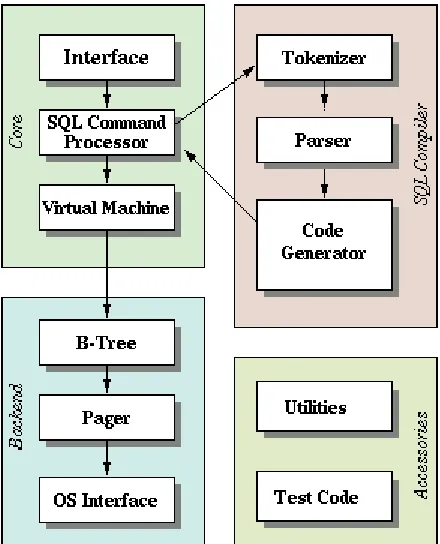
Figure 4.1 Architecture of SQLite ... 70
Figure 4.2 Box plot of time measurements recorded for Insert operation (B-Tree Benchmark). ... 74
Figure 4.3 Box plot of time measurements recorded for Find operation (B-Tree Benchmark). ... 74
Figure 4.4 Box plot of time measurements recorded for Insert operation (B-Tree Benchmark), on PMEP system. ... 75
Figure 4.5 Box plot of time measurements recorded for Find operation (B-Tree Benchmark), on PMEP system. ... 75
Figure 4.6 Box plot of time measurements recorded for Add operation (List Benchmark). . 77
Figure 4.7 Box plot of time measurements recorded for Traverse operation (List Benchmark). ... 77
Figure 4.8 Box plot of time measurements recorded for Add operation (List Benchmark), on PMEP system. ... 78
Figure 4.9 Box plot of time measurements recorded for Traverse operation (List Benchmark), on PMEP system. ... 78
Chapter 1
Introduction
1.1 Background
A computer’s memory hierarchy consists of many layers, and each layer has its own distinct set of features from the layer above or below it. The difference can be in terms of the memory capacity, the process technology and the material used for making the memory cells, the latency of reads and writes by the processor from and to the memory layer, the bandwidth provided by the bus interconnects, the duration of time it is expected to hold on to the values stored on the memory, and the wear and tear associated with that memory technology.
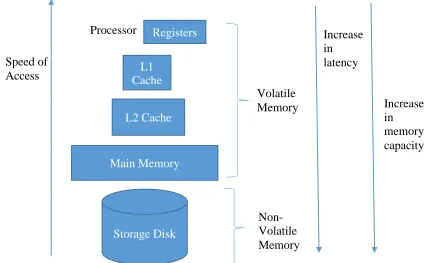
The memory hierarchy, for many years, in almost all of the systems, has more or less looked like as shown in Figure 1.1.
Processor
Figure 1.1A general view of memory hierarchy
L1 Cache
L2 Cache
Main Memory
Storage Disk Registers
Speed of Access
Increase in memory capacity Increase
in latency Volatile
Memory
As, can be seen from the above figure, the last level of memory hierarchy consists of the storage devices which are non-volatile and have a considerably larger size as compared to the volatile memory layers. However, the drawback here is the time taken to fetch data from the storage devices to the processor for processing is also quite large.
The volatile memory layers on the other hand, have much lower latencies for read and write as compared to the storage devices, but are volatile in nature. That is all the information stored on the volatile memory is lost, as soon as the power supplied to such memory devices is switched off.
For a long time, the storage devices had mainly consisted of the hard disk drives. The time taken while reading from or writing to such devices depends on three factors:
1. Seek Time, which is the time it takes the head to reach the requested track.
2. Rotational delay, which is the time it takes for the head to reach the sector from which the data has to be read.
3. Transfer Time, which is the allowed bandwidth for data transfers from/to the disk. Hence, being an electromechanical device, it is prone to a lot of delays for performing read and write operations.
Recently, solid state drives which consist of integrated circuits for storing the data persistently, and which also offer a very low read/write latency as compared to the hard disk drives, have been employed in computers as storage devices.
However, more recently technologies such as PCM [1], STT RAM [2], and RRAM [3] are being developed, which in future will be able to support very high memory capacities. These new storage devices have the combined benefits of the two types of memory earlier seen in the memory hierarchy:
1. They are non-volatile, and
the programming models based on how NVM is used in the system are discussed in [4]. Two of the ways in which NVM can be used in devices are:
1. Use the non-volatile memory as a storage device just like how they have traditionally been used. This use will require the usual block device driver to read from or write data to the memory device in chunks of blocks. This also makes it easy for the existing applications to port from using the existing storage devices to using the upcoming NVM technology based storage devices.
2. Another very interesting use of such devices would be to have these non-volatile memory devices shown as main memory to the processor, as shown in Figure 1.2. The processor would be able to access such devices through load/store instructions, without going through a number of interface layers, as is done when accessing data on a traditional non-volatile memory device.
Processor
Figure 1.2 The New Memory Hierarchy
DRAM (volatile)
PCM/ STT RAM (non-volatile)
L1 Cache
L2 Cache
Increase in latency Volatile
Memory
Non-Volatile Memory
Main Memory
Registers
When a non-volatile memory will be used as a main memory to the processor, some changes will be required in the system software such as Operating Systems to incorporate this new memory hierarchy, because how the processor interacts with such a non-volatile memory will be different than how it used to previously interact with the non-volatile devices or the main memory for that matter as discussed in [5] [6]. The programming paradigm will also need to be changed to take into consideration the new memory hierarchy. For example, the new programming paradigm will have to provide support for:
1. Allocation, Re-allocation and De-allocation of objects on persistent memory. 2. Access to data on persistent memory.
3. Position Independence for object reuse.
4. Atomicity, Consistency, Isolation and Durability (ACID) properties which are required in a traditional transactional system.
5. Concurrency for making sure that the data can be accessed by multiple threads concurrently without making the data inconsistent.
6. Legacy code, i.e., the new programming paradigm should make it easy for the existing applications and programs to be transformed such that they can utilize the new memory hierarchy for better performance.
This list is only a small subset of issues that will need to be considered while programming on top of such a memory hierarchy. This thesis work addresses the 3rd and the 6th point in the list mentioned above. This thesis work will explore the various techniques for supporting position independence in the new non-volatile memory technologies and will also discuss the compiler tools which can be used for porting C programs to NVM, by introducing position independence in them.
independence is done on NVML library, and hence it will be discussed in detail throughout this document. The thesis will also briefly discuss the other two libraries mentioned above.
1.2 Problem of Position Independence
The paradigm used by the libraries which provide programming support on NVM, for exposing NVM to the application process, is to mmap(2) the files existing on NVM devices into the address space of a process. So, we can think of non-volatile memory as consisting of a number of NV Regions [10] as seen in the virtual address space of a process. These NV Regions will have a base address which will serve as the starting address of the NV Region, and also a unique identification number to identify the NV Region across different runs and processes. The NV Region can also have a name associated with it. Each NV Region will have a root object through which all other objects existing in the NV Region, can be reached.
Now, since in order to protect a system from buffer overflow attacks, a technique called the Address Space Layout Randomization (ASLR) is employed in many systems, which maps various sections such as stack and heap, of a user’s address space randomly at different virtual addresses at the time of a process’s execution. Hence, there will be no guarantee that the NV Regions are always mapped at the same virtual address space of a process, i.e. the starting address of an NV Region will always be different for different processes that will map it, and also this mapping will differ across different executions of the same programs.
Hence the problem of position independence arises when objects created in an NV Region, contain references to other objects also on same/some other NV Region, are later reused across different runs and/or different processes.
to a different address, say address 0x2000, the program might crash due to the presence of incorrect pointer values. As can be seen from the diagram, in the second run, the first node’s next field still points to address 0x1200, but the second node is actually at 0x2200.
Figure 1.3 Problem of using absolute address references on NVM
Hence, supporting position independence in non-volatile memory, basically means to ensure that the pointers in any object point to correct locations even when they are loaded at different virtual addresses in the memory.
The above example only states the problem in terms of intra-region pointers. However, we can also have cross region pointers, in which the pointer and the object lie in different NV Regions. Hence, there is a need to support position independence in this scenario also.
1.3 Previous Work
1.3.1 Serialization-Deserialization
In order to store objects to a file on disk, a technique called serialization-deserialization of objects is employed. Serialization of objects is performed when the objects have to be written to a storage device, in which case the objects are converted into stream of bits. While reading back from the storage and into main memory, these streams of bits are converted back into the object by a process called the Deserialization of objects.
next = 0x1200
next =
NULL
next = NULL next
=0x1200
0x1000 0x1100 0x1200 0x2000 0x2100 0x2200
During the serialization of objects, all pointer references containing absolute addresses are first converted to a position independent value and then the object is stored to the file. This can be done by either,
1. Storing the offset from the start of the file to the object.
2. Assigning unique identifiers to the objects and then referring to these objects using the identifiers instead of using the addresses.
This transformation, from an absolute address to a position independent value, is called pointer unswizzling. The opposite of unswizzling is called swizzling [11] of pointers, which is performed during the deserialization of object, i.e. when the objects are read from the storage and into the memory. In this step, the offsets or the unique identifiers are converted back to absolute virtual addresses.
Serialization-Deserialization has an overhead on the performance of an application which reads objects from and writes objects to the non-volatile memory quite often. Such an overhead, though may easily be hidden during the fetch operation from slow storage devices due to their access latency, it might lead to inefficient performance in the emerging non-volatile memory systems.
1.3.2 Based Pointer
The Microsoft’s C/C++ compiler provides a __based keyword [12], which is used to declare pointers that are at a certain offset from some other pointer. Example usage as provided by Microsoft:
void *vpBuffer; struct llist_t {
void __based( vpBuffer ) *vpData; struct llist_t __based( vpBuffer ) *llNext; };
vpBuffer. As can be seen from the above example, the base address of the list objects is part of the type of the objects.
1.3.3 Fat Pointer
The fat pointer is basically a data structure which has two fields; one for carrying the base
address of the NV Region and another for carrying the offset from the base of the NV Region.
In this case, there cannot be any cross-region pointers. A slightly modified form of the fat
pointer, which supports cross region pointers, was being used until recently in the libpmemobj
library of the NVML libraries, in which the structure consists of the Region ID of the NV
Region and the offset from the base of the NV Region to the address of the object. Now, the
library is using a smart pointer to support position independence.
1.4 Overview of New Methods
Given below are the two new methods for supporting position independence that are described in [10], and will be discussed in greater details in the later chapters of this thesis.
a. Off-holder Method: In this method, the pointer carries the offset from the address of the pointer to the address of the target object. This method can only support intra-region pointers, as during different runs of the program, the NV Regions will be mapped at different addresses and hence the absolute address calculation from the offset values may fail.
b. Region ID in Value or the RIV method: In this method, the Region ID of the NV Region as well as the offset from the base of the NV Region to the target object is stored within the 64-bit value of the pointer. This method involves a table look up at run time to fetch the base address of the NV Region, given the RID of the Region. The base address is then added to the offset value contained in the pointer to form the absolute address. This method will support both inter as well as intra-region pointers.
This thesis will evaluate the performance of the four different methods of supporting position independence mentioned so far, i.e.
ii. Fat Pointer iii. Off-holder iv. RIV
1.5 Related Work
As mentioned in section 1.1, there are two other libraries that provide APIs for programming with persistent memory. In this section, we will briefly mention how these two libraries deal with the problem of position independence.
1.5.1 Mnemosyne library
Mnemosysne library [9] introduces the semantic to declare global persistent variable with the keyword “pstatic” and also provides a way to dynamically allocate persistent data. However, their work does not support position independence of the pointer references and makes sure that the persistent memory regions are mapped to the same virtual address ranges in subsequent runs also.
The library provides a keyword “persistent” to annotate that a pointer is pointing to a persistent target. The paper mentions that this keyword has similar use as that of “const” keyword. Their annotation however does not follow the rule of orthogonality [13] in that, annotating a target as persistent does not mean that all its members will be persistent. The keyword is provided so that there will not be any assignment operations between volatile pointers and non-volatile pointers as these kind of assignments are considered as error prone by the authors.
The paper also mentions the shortcomings of having a non-volatile pointer pointing to a volatile object or a variable, as the volatile objects will be meaningful only during the first execution of the program and will contain inconsistent or incorrect values during the subsequent execution of the program. Their keyword hence, also helps in removing these kind of errors.
1.5.2 NV-heaps library
The NV-heaps [8] enumerates the four types of pointers that will exist in a program written to execute on the new memory hierarchy. These are:
1. Volatile Pointers to Non-Volatile Targets 2. Non-Volatile Pointers to Volatile Targets
3. Non-Volatile Pointers to Non-Volatile Targets in the same NV Region 4. Non-Volatile Pointers to Non-Volatile Targets in different NV Regions,
And of-course there will also be volatile pointers to volatile objects. The authors claim that both the second and fourth kinds of pointers are error prone and should be avoided. They also claim that the pointers from non-volatile region to volatile region will be rendered meaningless and useless after the first run of the program.
In summary, the reasons provided by [8] for avoiding the fourth kind of pointer, which is the inter-region or the cross region pointer are:
1. Program can crash if there is a pointer from one NV Region to another NV Region, say NV Region A to NV Region B. Then, if NV Region B is closed or deleted then there will be a stray pointer in NV Region A which will be pointing to a non-existent object now. And this might lead to run time errors.
2. The cross region pointers will lead to a much complicated garbage collection process, because at any point of time, we will not be able to discern whether there is a pointer variable in some other region that is pointing to a particular object in, say, NV Region A.
for allocating more objects, if an earlier NV Region reached its full capacity. The overflowed NV Region will need to have access to all the other NV Regions which were created to handle this overflow. Hence, we will need to have cross-region pointers in this case also.
And there will be a need to have Non-volatile to volatile pointers because for some of the calculations, we might need some dummy objects whose life time will need to be only for a loop or for a function. In such cases, assuming that the writes to persistent memory take longer time and that there will be some wearing costs associated with the non-volatile memory, it is better for the performance of the application to have pointers from Non-volatile to volatile memory. Also, there will be some structures which should be ephemeral and new objects of which are required to be created on each instantiation of the application, such as the database connection objects, the locks that are needed to be acquired on in memory data structures such as Btree for DBMS applications, etc.
Hence, we will need cross-region pointers, as well as NV Region to volatile target pointers as well, however we will need to make sure that before or while closing the NV Region, the pointer from NV to volatile regions are all equated to NULL, so that the future execution of the program will not lead to run time errors. And as mentioned above, we will need sophisticated methods for handling garbage collection when we have inter-NV Region pointers.
Chapter 2
Support for Position Independence on
NVM
2.1 Introduction to NVML library
NVML library [7] [14] consists of six different libraries which provide an interface to the programmers for programming on persistent memory. These library provides support for memory management, transactions, logging, etc., for programs that will run on persistent memory. These six libraries are libpmemobj, libpmemblk, libpmemlog, libpmem, libvmem and, libvmmalloc.
This thesis work has used libpmemobj library to implement the various methods of supporting position independence. While using libpmemobj library for executing a program, it is not necessary for the persistent memory to be present in the machine. The library can discern at the initialization of the library about whether the file being mapped to the user space belongs to a persistent memory aware file system or to a traditional disk file system. If the file belongs to a persistent memory aware file system, writes to the persistent memory are made consistent by issuing ‘clflush’ instruction calls whereas for a normal file system ‘msync’ instruction calls are issued.
2.1.1 Terminology
The SQLite [15] source code is also transformed based on how this library is used for programming with persistent memory. Hence, it is necessary to go through some of the common terms which are specific to this library and will be used frequently in the subsequent sections. This section enumerates some of these terms.
a 128 bits long value, which is then XORed (in a first byte with last byte manner) to produce a 64-bit value, which they use for identifying the pool.
They can also be thought of as NV Regions, which were mentioned in section 1.2. The terms pool and NV Regions and hence pool ID and Region ID may be used interchangeably throughout the document.
This library provides an API for creating, opening and closing a pool. The pool handle returned by the pool creation/open functions is used while allocating objects in that pool. b. Layout: All programs which use this library should define a layout, which will store the
information about various types that are being used in the program, which is needed to generate typed persistent pointer types that will be used in the program. Section 2.1.3 discusses the typed persistent pointers in detail. Given below is an example of how the layout is declared in a program:
POBJ_LAYOUT_BEGIN(example_store);
POBJ_LAYOUT_ROOT(example_store, struct my_root);
POBJ_LAYOUT_TOID(example_store, struct Index); // for fat pointer method POBJ_LAYOUT_END(example_store);
Here, the “example_store” is the name of the pool layout, and ‘struct Index’ is a type that is used in the program, and objects of this type are allocated on heap, during the program’s execution.
c. Root: The object through will all the other objects stored in a pool can be reached.
2.1.2 Allocation of Objects
The libpmemobj library can be used to either perform transactional allocations and reads and writes need to be part of a transactional block, or there can be atomic or non-transactional allocations. In this work, only atomic allocations are used and transaction blocks are not used for the read and write operations, as the main goal of this thesis is to evaluate the performance of the methods for supporting position independence.
constructor function for the object. If the allocation and the initialization are both successful, the object is moved to a user list, which actually is the list that contains all the objects of a particular type and the objects of a particular type can be reached using those lists. Each type used in a program will have a corresponding list in the persistent memory pool.
2.1.3 Consistent Writes
There are two ways in which the programmer can make consistent writes to the persistent memory:
i. By flushing the cache contents after every write
ii. By using libpmemobj’s transaction API, which manages the flushing for the programmers.
Which flush statement should be used, is discerned at the initialization of the pools, and it depends on whether the memory on which the libpmemobj library is working, is really persistent memory or not.
2.1.4 The Typed Persistent Pointer
The libpmemobj library provides fat pointer as a way to support position independence in their library. Fat pointer is basically a structure defined as:
typedef struct pmemoid{ uint64_t pool_uuid_lo; uint64_t off;
}PMEMoid;
Here, the pool_uuid_lo is the unique identifier of a pool in which the objects will reside. The field named ‘off’ is the offset from the base of the pool to the location where a particular object resides in a particular pool, identified by pool_uuid_lo.
However, only using this structure to support position independence would not work, as there is no information about the type of object to which this fat pointer will be pointing to. For example,
PMEMoid index = pmemobj_alloc(pop, struct Index, sizeof(struct Index), NULL, NULL); Then, there will be no compilation error, if the pointers are assigned to each other like this:
btree = index;
The above assignment however will lead to run time errors, if the code tries to access fields of Btree object. Also after translating a fat pointer to an absolute address pointer, the programmer will explicitly have to associate the type with the address, so that the object’s fields can be accessed. For example:
PMEMoid index = pmemobj_alloc(pop, struct Index, sizeof(struct Index), NULL, NULL);
Struct Table *tab = ((struct Index *)pmemobj_direct(index))->pTab;
Here, the pmemobj_direct is a function that converts the fat pointer to an absolute address at which the object is situated.
To summarize, we need to associate a type with the fat pointer: 1) To generate compile time errors for incompatible types
2) To facilitate easy conversion from fat pointer to a particular type pointer carrying the absolute address.
In order to meet these two requirements, the library uses named unions, in which the fat pointer, as well as the type of the pointer is embedded. These named unions however need to be declared first before they can be used in the program to declare typed persistent pointers.
The macro TOID_DECLARE is used for declaring the named union which is used as a typed persistent pointer. The macro TOID is used in code while declaring a variable which is of the typed persistent pointer type.
That is to say the TOID_DECLARE macro will create a type which will be of type union _toid_##type##_toid. Now variables of this type can be declared in user’s program that will point to the persistent objects of the type mentioned in the macro. The library also associates a unique type number for each type used in the library, which is used when storing objects of a particular type in their specific lists. The TOID_DECLARE macro is defined as:
#defineTOID_DECLARE(type, type_num)\
TOID(type)\ {\
PMEMoid oid;\ type *_type;\
_toid_##type##_toid_id *_id;\ }
The declaration of such typed persistent pointer looks like this: TOID_DECLARE(struct Btree, 1);
TOID_DECLARE(struct Index, 2);
Here, the numbers ‘1’ and ‘2’ are the type numbers that are assigned to type ‘struct Btree’ and to type ‘struct Index’, respectively. Another way to declare all the named union types that will be used in a program is to declare these types while defining the layout of a program, as described in section 2.1.1. For example:
POBJ_LAYOUT_BEGIN(my_layout);
POBJ_LAYOUT_TOID(my_layout, struct Btree); POBJ_LAYOUT_TOID(my_layout, struct Index); POBJ_LAYOUT_END(my_layout);
In this case, there is no need to explicitly specify the type number for the named union type that will be used in the program. The library will assign type numbers to these declared types in a consecutive manner.
There are two macros provided by the library that are used for translating a fat pointer to an absolute pointer. These are: D_RO and D_RW, which are used while reading an object and when writing to an object respectively. The library uses cuckoo hash tables for storing the pool ID and pool’s base address entries. These entries are looked up while translating the fat pointer to an absolute address. The library using two hash tables for this, and hence, the translation of the fat pointer to an absolute address requires computation of two hash functions for deciding which table entry to fetch.
Advantages:
2. Since, the typed persistent pointer carries with it the pool ID information, we can have cross region pointers, which may be useful in applications which require inter-pool object references.
Drawbacks:
1. The size of the typed persistent pointer is twice the size of a normal pointer, because it is essentially a struct variable. It occupies 128 bits or 16 bytes.
2. This type of pointer is not compatible with the 64-bits volatile pointers and hence a conversion is required.
3. There is a need to put a named union wrapper around the fat pointer and this named union should be declared before the typed persistent pointer can be used, which adds to the complexity of writing a program.
2.2 Implementation of the Methods
This section mentions describes two new methods which can be used for supporting position independence while programming on non-volatile memory. All the methods mentioned in this section do not need to be wrapped in named unions for using them as persistent pointers, since these are just 64 bit values, they can be easily assigned to pointer variables, which already have a particular type associated with them. As long as the programmer knows which variable is carrying which kind of value and remembers to translate the value to absolute address, the program will compile and execute correctly.
2.2.1 Off-holder
Translating an off-holder value: BtShared *pBt = p->pBt;
If p->pBt contains an off-holder value, then while converting it to an absolute address, we will have to perform,
p->pBt = &p->pBt + p->pBt; Writing to an off-holder pointer:
While assigning a persistent object’s address to an off-holder pointer variable: p->pBt = pBt;
If pBt contains absolute address of a non-volatile object in the same pool as member variable p->pBt lies, then we will have to perform the following operations:
p->pBt = pBt - &p->pBt; Advantages:
1. There is no need for the table lookup to find the base address of the NV pool or NV Region.
2. The size of the off-holder pointer is the same as the size of a normal pointer, i.e. 64 bits on a 64-bit machine.
Disadvantages:
1. While assigning the off-holder pointer value to a different off-holder pointer, the value first needs to be converted to an absolute form and then the new off-holder value is calculated by subtracting the L.H.S pointer address from the absolute object address before assigning the value to the L.H.S pointer variable. Hence, this conversion while writing the off-holder value will have an extra overhead.
2. Cannot point to objects belonging to different pools.
2.2.2 Region ID in Value or RIV
address of the object and it also holds the Region ID or the pool ID, but it does that in a single 64-bit value, and hence, is called the Region ID in value pointer.
The 64-bit address of an object might be segregated according to this idea: 11…1 XXX…X 00000…0
l1 l2 l3
As can be seen in the text above, the value of the 64-bit pointer is divided into three parts. The first l1 bits are all ones and signify that the pointer is pointing to a non-volatile memory region. The next l2 bits signify the base address of the pool in which the object is located. The last l3 number of bits will contain the information about the offset of the object from the base of the NV Region/pool, and hence basically gives the information about the size of a NV Region.
If the absolute address of an object is in the form described above, then the RIV pointer can have the value in this form,
00…..0 XXX…X YYY…Y (64-l4-l3) l4 l3
Here the last l3 bits contain the offset value from the base address of the pool to the object’s address, the next l4 bits carry the pool ID and the next (64-l4-l3) bits may consist of all zeroes.
Just like in the fat pointer method adopted by the libpmemobj library, this method also depends on the lookup of base address by using the Region/pool ID value obtained from the pointer value. However, instead of using a cuckoo hash table, two directly mapped tables are maintained, one is for looking up the RID given the base address, and hence called the RID lookup table, the other one is used for looking up the base address of a NV Region/pool given the RID of the NV Region/pool, and hence is called the Base lookup table.
11…1 xx…x 00…0 l1 l2 l3
The virtual address at which the RID value is stored can be calculated like this, getRID(base):
l1 l2 l3 nvbase = base & 00…0 11….1 00….0;
ridAddr = 11…1 00…0 00….0 00…0 | (nvbase >> (l3 – l4)); RID = *(ridAddr);
The RID look up table will look like:
Virtual address RID
11…1 00…0 xx…x 00…0 RID5
………. 11…1 00…0 xx…x 00…0 RID2
……….... 11…1 00…0 xx…x 00…0 RID7
l1 l3-l4 l2 l4
Similarly, for the Base look up table, given the RID in the form of, RID = xx..x
l4
the base address can be calculated as, nvbase = getBase(RID):
baseAddr = (RID << l2) | 11…1 00…1 00…0 00…0; l1 l3-l4 l4 l2 nvbase = (*baseAddr);
The Base lookup table will look like:
Virtual address NVBase
11…1 00…1 xx…x 00…0 000101
………. 11…1 00…1 xx…x 00…0 000001
11…1 00…1 xx…x 00…0 000111 l1 l3-l4 l4 l2
Whenever there is a need to translate the RIV value to an absolute address, the following is done:
1. The RID value is extracted from the RIV value and then a base address lookup is done. 2. The offset value is extracted from the RIV value and is added to the base address
fetched in the first step.
Now, the NV Regions cannot be placed at any address that can be formed using nvbase bits. If the nvbase is smaller than 00…...0 1….,
(l3-l4-2)
then there will be a collision with the NV Region address range and the placement of translation tables.
The various combinations for the l1, l2, l3, and l4 bits will give various ways in which the NV space can be organized. For example, the bits in the virtual address are segregated like this: l1 = 2, l2 = 28, l3 = 34, l4 = 30 means that there can be 2^30 NV regions, which can each be 2GB in size.
The adoption of RIV method has several constraints on the virtual address space of a process, where NV Regions can be mapped. For this approach to work, we need starting few (l1) bits of the NV region addresses to be one. So that we can distinguish whether the pointer is pointing to a volatile or a non-volatile object or variable.
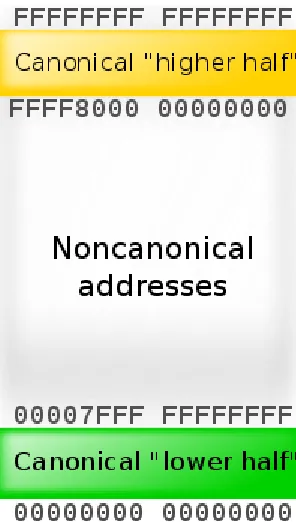
Figure 2.1 Canonical Address Space in x86_64 processors
As can be seen in the above figure, in a canonical address space organization, the 47th bit from right determines whether the address belongs to the user space or the kernel space. Also, the bits from 47th position onwards have the same value as the 47th position bit. If the 47th bit is set then all the other bits from 48th position till 63rd bit position are also set. If the 47th bit is 0 then all the rest of the bits from 48th position till the 63rd bit position are also 0.
Given such an organization, the RIV method implementation had to be changed, without making changes to the OS and/or hardware. Hence, the higher addresses in the user space were considered from 0x0000400000000000 address for mapping NV Regions. For the existing address space organization, the following values were taken for the various bits, which did not take into consideration the type information of the pointer values:
1. l1 = 18, but would consist of 17 zeros and one 1 2. l2 = 12
4. l4 = 30
The implementation of the libpmemobj library is changed slightly to incorporate all these factors:
1. The pool ID is shortened to a 32-bit value, by once again XORing (first byte with last byte manner) the bytes in the previously obtained 64-bit value, and later this value is masked with the l4 bits all set to one, to extract l4 bits for the pool ID.
2. libpmemobj library provides a function ‘util_map_hint’ which is used to calculate a hint address that serves as the starting address for the NV Region/pool and also is given as an address to the mmap(2) function call.
In order to support RIV method, the util function definition is slightly changed to introduce the concept of l1 bits and nvbase starting values.
The function ‘util_map_hint’ uses /proc to determine a hint address for mmap(). It opens up /proc/self/maps and looks for the first unused address in the process address space that is greater or equal to the address value calculated by:
(NVMBASE|1ULL <<(64-l1-(l3_l4()-2)-1));
Where the macro NVMBASE is set to ((uintptr_t)1 << 46) to factor in the fact that only addresses greater than or equal to 0x0000400000000000 will be used for mapping non-volatile regions. Since this is just a prototype, in future uses the l1 bits can have more than one set bit, and in that case this macro will need to be modified to incorporate that. However, for the purpose of this thesis, only one configuration was used as mentioned above.
And we need another bit to be set at location (l1 + (l3-l4-2) +1)th position from the left, which is done by the above instruction. Hence, this ensures that the starting address of the NV Region is consistent with the implementation of the RIV method.
creation, at the hint address in user space. Hence, the hint function makes sure that the starting range of the NV Region address follows the RIV implementation.
3. Another aspect of the RIV implementation is that at the time of pool creation, the Region ID Lookup table and the Base Lookup table should be populated so that either values can be looked up for translation of RIV value into absolute addresses and from absolute address to RIV value, during execution.
The addresses at which the table entries should be placed is determined by performing some bitwise operations to the base or the RID value. After performing these operations, the addresses that are generated are provided to the mmap function with the MAP_ANONYMOUS and MAP_FIXED flag so that these entries can be placed at the designated positions without any file backing up this mapping. When the pool is closed the entries from the two directly mapped tables are removed.
The RID lookup table is looked up when there is a translation from the absolute address to the RIV form, in which case the following steps are followed:
1. Extract the base address of the NV Region from the absolute address, where the object/target lies.
2. Use getRID macro to fetch the RID value from the RID lookup table. 3. Extract the offset from the absolute address.
4. Concatenate the left shifted RID value with the offset extracted in step 3 to form the RIV value.
Advantages:
1. RIV pointers occupy less space than the fat pointers.
2. Intra and well as Inter-Region pointers can be supported through RIV pointers.
3. Efficient look up mechanism by using directly mapped tables, which also conserve space that they occupy, i.e.,
Space for RID look-up table = (2^l2) * l4 bits, where l2 is the number of bits representing the nvbase and l4 is the number of bits used for representing RID, and hence the space that will be occupied by one RID entry.
Similarly, space occupied by the base look up table = (2^l4) * l2 bits, where l4 is the number of bits representing RID and l2 is the number of bits required for a single nvbase value entry into the table.
Hence, total amount of space occupied by the two look up tables: (2^l2 * l4) + (2^l4 * l2) bits.
However, this is the upper bound on the space occupied by the two tables. In reality, the space occupied by the tables would be dependent on the number of NV Regions that are opened by a process at a time. Hence, if there are ‘N’ NV Regions opened by a process at one point of time then the space occupied by these two tables would be: N * (l4 + l2) bits. For example, in our example it will be N * 58.
2.2.3 Based Pointer
The based pointer approach has been implemented on libpmemobj library in order to evaluate the performance of different methods that support position independence. The based pointers have already been implemented in the Microsoft C/C++ compilers [12] as mentioned in section 1.3.2.
The based pointer for the purpose of this experiment is implemented as a global variable which holds the address of a pool or the address of the root of a pool. All the other pointers in a pool, will hold an offset value from the address held by the based pointer to the address where the object really lies.
2.3 Support for Run-time type checks
While transforming the SQLite code, it was realized that there is a need to provide a run time type checking mechanism to deal with situations in which we cannot discern at compile time whether the pointer is pointing to a volatile object or a non-volatile object. And maybe in future we might also want to distinguish different types of non-volatile pointers from each other at run time as well. Depending on the number of types of pointers used in a system, the first few bits can be reserved to identify the type of a pointers. In this thesis work, four different types of pointers are used in the programs. Hence, we may reserve two bits for type checking during run time.
However, since off-holder value can be both positive as well as negative, errors may arise while translating pointer values due to the ambiguity in deciding the type of the pointer, because the first few bits in off holder will all be one, if a negative offset value was being stored. However, in order to mitigate this, we might have to do some extra work. Instead of keeping the first bit as signed bit, the translation mechanism can keep and check the (length of the offset +1) th bit to discern whether the offset value is negative or not, while the rest of the higher bits are cleared and ORed with the type number (first 2 bits) of the off-holder pointer, after evaluating the offset value.
In another approach, we can reserve the first 3 bits to hold the pointer type and sign of the offset value in case of the off-holder pointer. In this approach the signed bit is left as is, and the pointer type is resolved by checking the two bits adjacent to the signed bit. Hence, off-holder pointer will map to two types: signed and unsigned.
In the implementation of this method on libpmemobj library, the following bit values are used for the pointers.
Table 2.1 Run-time support for different types of pointers
Pointer Method
Pointer Type 64-bit Pointer value with type
Sign of the value
Off-holder 3 011xxx...x +
Table 2.1 (continued)
RIV 1 001xxx……..x +
Based 2 010xxx……..x +
Volatile 0 000xxx……..x +
Chapter 3
Porting New and Legacy Code to NVM
In order to evaluate the performance of various position independence methods, SQLite was selected as a benchmark application. For transforming the SQLite source code to four different forms, each with a different method for supporting position independence, CLANG [17] libtooling was used to build a transformation tool.
The main requirement was that the tool should be able to put all or some objects on persistent pools/NV-Regions/Heaps, and then use the persistent pointers which support position independence for accessing those objects.
Over the course of this thesis, six such tools were developed. This chapter will describe each of the design decisions used for the transformation tools, what were the challenges faced during transformation of SQLite source code and in general, any C program to a form which can support position independent references, for the programs to run on persistent memory. This chapter will highlight the problems that might be faced while transforming legacy C programs, and how they were dealt with.
3.1 Introduction to CLANG libtooling
For all the tools mentioned henceforth, CLANG’s libtooling API was used to statically analyze the source code and perform transformations by using the Rewriter class of the CLANG’s libtooling API. The version of CLANG used in these transformation tools is 3.4. A little background about CLANG and its libtooling API is necessary to understand how the transformation tools were built using CLANG.
The API provided by CLANG can recursively traverse the AST and all its nodes. The CLANG’s AST consists of Declarations and Statements as nodes. The top level nodes are all Declarations, and Statements are part of function declarations that have body.
The statements are further broken down into different expressions, and even these expressions can be traversed through the AST. All expressions and variable declarations have a type from source associated with them, which can also be accessed through expression objects and variable declaration objects.
CLANG also provides a class called the Rewriter class through which source code can be easily transformed. For example, by selecting the range of source code that needs to be replaced by a string containing the transformed code. The Rewriter class provides many API calls, but the tools mentioned in the upcoming sections mainly use these five types of calls to write to the source files:
1. InsertTextBefore 2. InsertTextAfter 3. ReplaceText 4. ConvertToString 5. overwriteChangedFiles
The expressions that are used in the statements or as subexpressions in other expressions can belong to many different classes. The classes which our tool mainly deals with are:
1. MemberExpr:
This is a class for representing expressions which are structure or union members. These are of the form: X->Y or X.Y, where X is the base expression and Y is the member field of X.
2. ArraySubscriptExpr:
3. DeclRefExpr:
This is a class for representing the expressions which are references to a declared variable.
For example:
Line 1: int X = 1; …
Line 6: X = Y; …..
In this example, line 6 is a BinaryOperator expression with opcode “=”, and L.H.S and R.H.S. expressions of this binary expression belong to DeclRefExpr class.
Given below is a brief overview of how tools can be created by using the libtooling API provided by CLANG.
1. Instantiate an object of ClangTool which provides the utility to run a front end action over a set of files. Information about how the files are compiled and the list of files that need to be compiled is needed to instantiate this object.
2. The information about the list of compilation commands and the list of files on which the compilation or tool actions need to be performed is provided by CommonOptionsParser object, which is basically a parser for options common to all command-line Clang tools.
3. On this compiler tool instance, a custom FrontendAction is run, which will perform the front end action we want to be performed.
4. After the tool is run, an ASTConsumer is created which consumes the AST as it is being parsed or when it is done being parsed. We can override the functions, HandleTranslationUnit to traverse or consume the entire parsed AST and/or override the function HandleTopLevelDecl to consume the AST as it is being parsed.
6. The Rewriter writes all the changes that are being made to the source code in a string buffer and a call to overwriteChangedFiles dumps all these changes to file. Although the changes are flushed to the file, the AST that has already been formed is not changed and it remains immutable for the entire run of the tool. The files need to be loaded again into the compiler tool instance and the AST has to be parsed again so that the changes made in the source file are visible in a new formed AST in the second run of the tool.
3.2 The basic Idea of Transformation Methods
This thesis work has explored the following methods for transforming C programs such that they will support relative pointers and use an NVM library for allocating objects on persistent memory:
1. For the typed persistent pointers, which are described in section, let the user decide whether:
a. All the objects in the program needs to be put on the persistent heap
b. Objects having a particular type need to be put on persistent heap. In this case the question of whether the orthogonal persistence should be applied for persisting the objects or not should be answered by the user. In case of orthogonal persistence all objects reachable from a persistent object are made persistent. Hence there are two cases:
i. Automatically promote all objects reachable from the persistent objects.
ii. Let the user define only one type, for example a data structure named struct Btree at a time, all objects of which should be transformed.
2. For value based persistent pointers, in which the only difference between a persistent pointer and a volatile pointer, is the way in which they hold address values, then there are two ways to carry out transformations:
However, in this case also there is a decision that needs to be taken by the user as to whether:
i. Automatically promote all member pointer fields in the object that is made persistent to point to persistent object.
ii. Let the user decide which member fields he/she needs to be similarly transformed. b. Let the user define only one type, for example a data structure named struct Btree at a
time, all objects of which should be transformed.
Also, in these cases, let the run time decide whether the pointer is pointing to volatile memory or to the non-volatile memory, and also which type of pointer value is contained in it, i.e. whether the pointer is an off-holder, a based or an RIV pointer.
3.3 Transformation Rules
This sections provides an overview of the transformation rules that should be applied to the program for it to be able to run on the NVML library using relative pointers. These rule are: 1. Include the library specific header files in the source files:
a. ‘libpmemobj.h’
b. ‘riv.h’ if the pointers are being transformed to Region ID in Value pointer types c. ‘offholder.h’ if the pointers are being transformed to Off-holder pointer types d. ‘based.h’ if the pointers are being transformed to Based pointer types
2. Define the layout as mentioned in section 2.1.1, after the ‘include’ preprocessor directives in the file in which main function is defined.
3. Declare the root object type for the pool.
4. Declare the type and type numbers in other source files 5. Create a pool in main function.
6. Depending on the tool, find which all instances to change to persistent type and gather all the information needed to do a successful transformation. For example, in the first three tools:
b. Keep track of which functions are calling which all functions, like a call graph. Because we will need to change the function declaration of all those functions in which we are changing the malloc function to pmemobj_alloc function and we need to pass the pool object to those functions, and to any functions which call those functions.
For example:
void enqueue (int iNode, int iDist, int iPrev){ #pragma pmem_riv
QITEM *qNew = (QITEM *) malloc(sizeof(QITEM)); ....
In this example, for malloc to be changed to ‘POBJ_ALLOC_TRIV(pop,...)’, where pop is the pool handle, which is being passed from the main function, the definition of this function should be changed to,
void enqueue (PMEMObjpool *pop, int iNode, int iDist, int iPrev),
and the call expression of this function in any other function should also be changed. For example, in the below code the call to enqueue function should be changed to, ‘enqueue(pop, chStart, 0, NONE);’:
int dijkstra(int chStart, int chEnd) { ...
enqueue (chStart, 0, NONE); ....
}
This also means that the dijkstra function declaration should be changed to: dijkstra(PMEMObjpool *pop, int chStart, int chEnd).
And likewise its call expression in other functions should be changed.
Table 3.1Macros for translating relative pointer values to absolute address values
Macro Use
D_RO Translates a fat pointer to absolute address value
readoh Translates an off-holder value to an absolute address value
writeoh Stores the offset value from the pointer’s address to object’s address into the pointer variable
R_RIV Translates the RIV value to absolute address value
translate_address Determines at run time, the type of persistent pointer (off-holder, RIV or based) being dereferenced and then translates the address from the persistent pointer value to an absolute address, by using pointer type specific translation method.
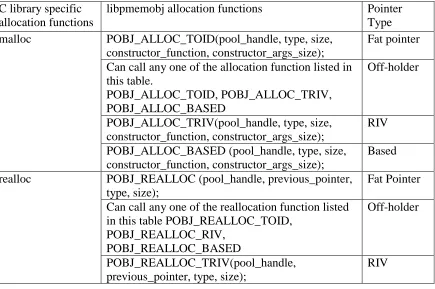
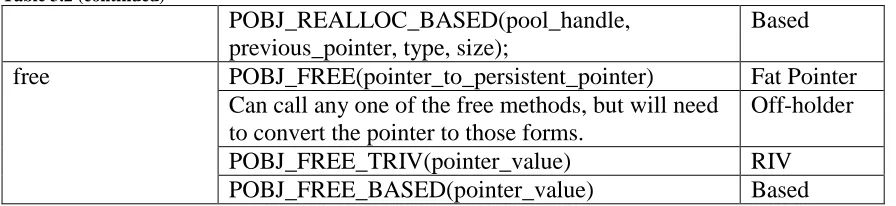
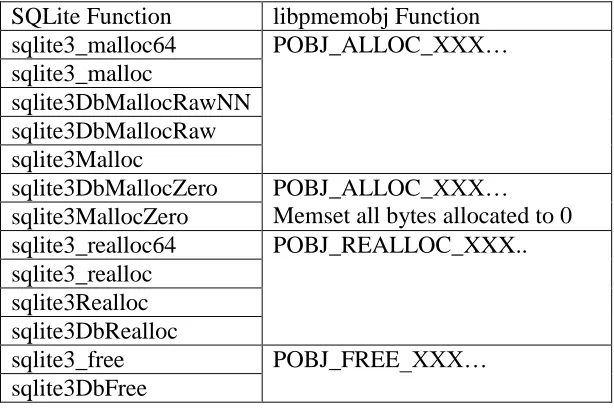
8. Change the function calls used for managing allocation on volatile heap to libpmemobj library specific calls. The following table maps the changes made in a program that uses the normal C allocation functions to libpmemobj library specific function:
Table 3.2 Mapping C library specific allocation functions to libpmemobj library specific allocation functions
C library specific allocation functions
libpmemobj allocation functions Pointer
Type malloc POBJ_ALLOC_TOID(pool_handle, type, size,
constructor_function, constructor_args_size);
Fat pointer Can call any one of the allocation function listed in
this table.
POBJ_ALLOC_TOID, POBJ_ALLOC_TRIV, POBJ_ALLOC_BASED
Off-holder
POBJ_ALLOC_TRIV(pool_handle, type, size, constructor_function, constructor_args_size);
RIV POBJ_ALLOC_BASED (pool_handle, type, size,
constructor_function, constructor_args_size);
Based realloc POBJ_REALLOC (pool_handle, previous_pointer,
type, size);
Fat Pointer Can call any one of the reallocation function listed
in this table POBJ_REALLOC_TOID, POBJ_REALLOC_RIV,
POBJ_REALLOC_BASED
Off-holder
POBJ_REALLOC_TRIV(pool_handle, previous_pointer, type, size);
Table 3.2 (continued)
POBJ_REALLOC_BASED(pool_handle, previous_pointer, type, size);
Based free POBJ_FREE(pointer_to_persistent_pointer) Fat Pointer
Can call any one of the free methods, but will need to convert the pointer to those forms.
Off-holder
POBJ_FREE_TRIV(pointer_value) RIV
POBJ_FREE_BASED(pointer_value) Based
9. Append the code to close the pool in the main function. Transformations specific to fat pointer method:
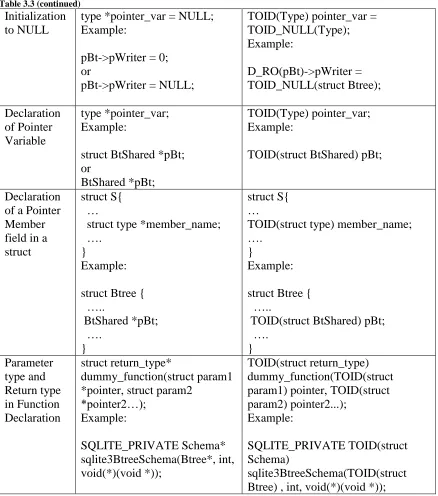
Table 3.3 Transformation rules for the Typed Persistent Pointer (libpmemobj specific fat pointers)
Operations Original Form and Example Transformed Form and Example Pointer Assignments lhs_pointer_variable = rhs_pointer_variable Example: pNext = pSub->pNext TOID_ASSIGN(lhs_pointer_variable , rhs_pointer_variable.oid) Example: TOID_ASSIGN(pNext, D_RO(pSub)->pNext.oid) Pointer Equality checker
If(x->y == a) … Example:
If(pBt->pWriter == p) …
If(TOID_EQUALS(D_RO(x)->y, a)) …
Example:
If(TOID_EQUALS(D_RO(pBt)->pWriter, p)) …
Null pointer check
If (pointer_var) … Example:
if(pBt ){ ….
!TOID_IS_NULL(pointer_var) Example:
if( !TOID_IS_NULL(pBt) ){ ….
If (!pointer_var) … Example:
if( ! pBt ){ ….
If(TOID_IS_NULL(pointer_var)) … Example:
Table 3.3 (continued) Initialization to NULL
type *pointer_var = NULL; Example:
pBt->pWriter = 0; or
pBt->pWriter = NULL;
TOID(Type) pointer_var = TOID_NULL(Type); Example: D_RO(pBt)->pWriter = TOID_NULL(struct Btree); Declaration of Pointer Variable type *pointer_var; Example:
struct BtShared *pBt; or
BtShared *pBt;
TOID(Type) pointer_var; Example:
TOID(struct BtShared) pBt;
Declaration of a Pointer Member field in a struct
struct S{ …
struct type *member_name; ….
}
Example: struct Btree { ….. BtShared *pBt; …. } struct S{ …
TOID(struct type) member_name; ….
}
Example: struct Btree { …..
TOID(struct BtShared) pBt; …. } Parameter type and Return type in Function Declaration struct return_type* dummy_function(struct param1 *pointer, struct param2
*pointer2…); Example: SQLITE_PRIVATE Schema* sqlite3BtreeSchema(Btree*, int, void(*)(void *)); TOID(struct return_type) dummy_function(TOID(struct param1) pointer, TOID(struct param2) pointer2...);
Example:
SQLITE_PRIVATE TOID(struct Schema)
sqlite3BtreeSchema(TOID(struct Btree) , int, void(*)(void *));
Example, if the original line of code is: Btree *p = NULL;
And if underlying type of Btree is struct Btree, then the transformed code would be written as: TOID (struct Btree) p = TOID_NULL(struct Btree);
This was done to make it easy for the tool to correctly append the type declarations either directly or through layout declaration.
3.4 Implementation
3.4.1 Changes to CLANG to support transformations
Although the tools are written by extending the API provided by CLANG 3.4, certain changes were made to CLANG source code for features that were required by the tool but not provided by CLANG.
However, when CLANG reads this JSON file and stores the information about the compilation, it makes them visible to other functions of the JSONCompilationDatabase class, but makes those functions that are used for accessing this information as ‘const,’ so that these objects are immutable. Hence, once the compilation database is loaded it cannot be changed.
However, in our tools especially the ones which required the change from a normal pointer to a typed persistent pointer, this can lead to a problem, because while transforming the source files we have to consider that, a translation unit consisting of some source files will have some included header files. In our tools we make sure that nothing happens to the system header files and that only header files belonging to the directory of source being transformed are considered for transformation.
Now the source header files can be shared among different Translation Units. So, if during the traversal of one of the ASTs a certain function declaration is changed in a header file, the formation of another AST that uses this function through a header inclusion will be jeopardized. Since, the declaration in the header will not match the function call used in the source file. In order to remove such an error while transforming, the following rule was applied:
1. Transform only the .c source files in all of the translation units
2. Reload the compilation database but this time having only the source header files 3. Transform the header files using the data collected in the previous passes, with the
constraint that if header file A is included in header file B, but header file B is not included in any other header files, then B should be transformed first and then A. This is done to make sure the compilation process is not broken due to incompatible type errors.
Hence, for reloading the compilation database object, we had to changes CLANG source code such that we can modify the list containing the compilation files for the last pass where only the header files are translated to form the AST.
If a single file is being compiled then use CommonParserOption to populate the compilation commands list and compilation file list, else use JSONDatabaseCompilation object, and reload this object while transforming the header files.
3.4.2 Transformation Tools
This section gives a brief overview of the design idea of the tools, how to run the tools, what were the challenges faced during transformation using each tool and also what are the short comings of each tool. These tools follow the designs and transformation rules as mentioned in section 3.1 and section 3.2 respectively of this document.
3.4.2.1 NVM converter
The NVM converter was designed with the goal that any pointer pointing to an object should be converted to a relative pointer. Also, a global array of primitive or non-primitive type was changed such that those arrays were allocated on persistent memory pool.
The type of position independence method that should be introduced in the source code should be provided at the compile time of the tool. The following command is given during compilation of the tool:
make CPPFLAGS+=-Dtype
where ‘type’ can have one of the following four values: i) TOID for fat pointer
ii) TPI for off-holder iii) TRIV for RIV
iv) BASE for Based pointer.
3.4.2.1.1 Design
The tool consists of three passes, and a pass in this tool refers to the process of traversing an AST. There are two passes per .c source file and one pass per header file.
1. Pass 0
This pass occurs when the AST is being parsed and is basically used for collecting information about the source code. After each declaration is parsed, the HandleTopLevelDecl function is invoked, and we collect information such as
a. The various types being used in the source files, and the number of times a pointer pointing to an object of a particular type is being referenced. This was mainly done to generate a root object that will point to an object of a type which has the highest number of occurrences in the main file. This was a simple algorithm that was followed so that the root object can be written automatically by the transformation in the main file, but it doesn’t need to work like this. A user can declare the root depending on his/her design decisions.
b. The information about which data structure is declared in which file, because we will need this information during transformation of those structures. This pass also collects the information about which function calls which all functions.
2. Pass 1
The information collected from Pass 0 can be used to make the transformations as mentioned in section 3.3 of this document.
There is a small difference in transforming the code when a pointer value is being read, in case of this tool than all the other tools for fat pointer method. Instead of using one macro for translating the fat pointer to an absolute address pointer, two macros are provided by the libpmemobj library:
b. D_RO macro is used when the target objects are just being read. This macro basically returns the ‘const’ pointer to the object, hence the object is read only. Hence, in this first tool, if a pointer variable that is being transformed belongs to L.H.S of a binary expression, then the transformation tool appends D_RW instead of D_RO.
For example
pBt = D_RO(p)->pBt; // here object pointed to by p is read only, hence D_RO is used for dereferencing the pointer.
D_RW(p)->pBt = pBt; // here a member of p is being written to, hence D_RW macro is being used.
This feature was later removed so as to make transformations easier and only the macro D_RO was used for both read and modify operations to the object.
The above two passes are applied to all source .c files, before starting Pass 2. 3. Pass 2
The tool is reloaded with only the header files for transformation. The function declarations and struct declarations are transformed according to the transformation rules mentioned in section 3.3 of this document.
3.4.2.1.2 Issues
The transformation using this tool, when done to simple one source file based code was correct for both compiling and for executing the program. However, when this tool was used for transforming the SQLite code, an overwhelming number of compilation errors were received because:
1. Only a single level of MemberExpr was transformed, whereas the source code contained a lot of inner MemberExpr embedded in them.
2. Many of the rewrites were not proper.
3. Only malloc was checked as the allocation function.
5. The rewriting of expressions that involved expanded macros was not correct in most of the cases, due to the failure of the tool to compute the correct source location where the expression needs to be replaced.
6. A lot of rewriting involved replacing the source code, rather than inserting the source code, which might have led to multiple replacements for a single expression that would have been visited more than once as two different nodes in an AST, resulting in an overwrite of a previous change with the latest changes within a pass.
3.4.2.2 NVM Mini-converter
This tool was built to reduce the scope of the transformations from all objects to a set of objects that belong to a particular type. In this tool, the rule of orthogonality is followed, such that all member pointer fields (pointing to some struct variable/object) of the selected structure type will also be considered as the types, whose objects need to be allocated on the persistent heap. For example:
If we select struct Btree as the data structure whose objects need to be put on to heap, then all the pointer member variables declared in its type definition needs to be considered for transformation like it itself is being considered. The struct Btree is defined in SQLite source code as:
struct Btree {
sqlite3 *db; /* The database connection holding this btree */ BtShared *pBt; /* Sharable content of this btree */
u8 inTrans; ……. };