MATERNAL EFFECT TRANSFERRED BY INJECTION AND FURTHER ANALYSIS OF TEMPERATURE EFFECTIVE PERIOD FOR
TUMOROUS HEAD IN DROSOPHILA MELANOGASTER’
ELDON J. GARDNER, J. HOWARD TURNER, AND WILLIAM D. BERSETH
Utah State University, Logan, Utah
Received February 1, 1960
NITIAL experiments ( GARDNER 1948) on the tumorous head phenotype Idemonstrated a difference in the results of reciprocal crosses. A maternal effect dependent on a substance elaborated in the presence of a homozygous sex-linked gene ( t u - I ) was postulated (GARDNER and WOOLF 1949) to account for this observation. Changes in temperature during the early stages of development were found to alter the effect (GARDNER and WOOLF 1950).
Extensive reciprocal crosses between tumorous head (tu-h) and “wild” labora- tory stocks (GARDNER and STOTT 1951)
,
laboratory stocks carrying mutants (GARDNER, STOTT and DEARDEN 1952),
and flies collected from natural popula-. tions (GARDNER and GARDNER 1953) further demonstrated the maternal effect. From most crosses between tu-h females and males from other stocks about 30 percent of the first generation progeny showed the tumorous head phenotype compared with about one percent or less from the reciprocal cross between females from most other stocks and tu-h males. Variations from this pattern were observed in some crosses. Modifiers and different genetic backgrounds were postulated to account for the differences. Penetrance, expressivity, and relative viability were described in the inbred tu-h stock following three years of selection and inbreeding ( GARDNER and RATTY 1952). Experiments involving two series of backcrosses ( GARDNER 1959) indicated that no persistent cytoplasmic sub- stance is involved and that a single, recessive, sex-linked gene ( t u - I ) controls the maternal effect. An autosomal semidominant gene (tu-3) is necessary for any expression of the trait. There is a resemblance between the behavior of tumorous head and that of CO, sensitivity for which a genoid was described by L‘HERITIER(1951). There are also conspicuous differences. The genoid is a n independent virus or plasmagene while two major nuclear genes are involved i n the tumorous head complex. No cytoplasmic particle comparable with the genoid of L’HERITIER has been detected in tumorous head flies.
The present experiments were designed to test the hypothesis that a substance elaborated by tu-h females carrying the gene tu-I in homozygous condition is responsible for the maternal effect. Further analyses of the temperature effective period which is associated with the maternal effect are also included in this report.
906 E. J. GARDNER, et al.
MATERIALS A N D METHODS
For the injection experiments, tu-h females were etherized and washed in two baths of distilled water to remove adhering food particles, salts, and other sub- stances from the body surface. The flies were then crushed and homogenized with ten times their weight of insect Ringer's solution (1000 ml H,O, 7.5 gm NaC1, 0.35 gm KC1, 0.21 gm CaC1,). Crude extracts were lightly centrifuged at 2,800 rpm to remove solid particles and cellular debris. The supernatant was injected into the lateral thorax of wild (Lausanne) virgin females with a Dutky Fest microinjector. Injected females were mated with tu:h males, and the progeny were classified and compared with controls.
The standard corn meal, molasses, agar medium with live yeast added was used for all experiments. Flies were maintained at 25°C unless otherwise noted. Percentages are given in the tables with accuracy to the nearest whole number. When reciprocal crosses are symbolized, the female parent is always written first. The first experiment, carried out to define the temperature effective period more narrowly, was prepared by mass mating 50 tu-h females with 50 wild males in dacron laying cages (SIMMONS and GARDNER 1958) and collecting eggs laid during two-hour intervals. Seven successive batches of eggs were deposited on separate petri dishes. Cultures were maintained at 21 "C and 45 percent relative humidity except during the four-hour intervals at 30°C. Controls were similar to the experimental cultures but were not subjected to heat treatment. The first petri dish was placed in the 30°C incubator during the first four hours after the eggs were laid, the second was subjected to the higher temperature during the interval from four to eight hours after egg deposition, and so on at four-hour intervals for 24 hours. After eclosion, the adult flies were killed by freezing and classified for abnormal cephalic growths.
For the next experiment, designed to determine whether longer periods at higher temperature are more effective than four-hour intervals, another series of cultures was obtained as described above for the first experiment. Six experi- mental cultures were treated in the same way but all six were placed in the 30°C incubator immediately after egg deposition and left for different periods of time. The first was left four hours, the second, eight, and so on at increases of four hours until the last group which remained for 24 hours. Controls were maintained at 21 "C and 45 percent relative humidity.
When it was shown that the abnormal growths being investigated could be altered by temperature changes during four-hour intervals in the early develop- mental period, a comparative study was made of the metabolic rates of developing larvae from different cultures during the first 24 hours after'egg deposition. One hundred eggs were collected from each of the following: tu-h stock, wild stock,
tu-h X wild, and wild x tu-h (female parent is always written first). Oxygen uptake during the first 24 hours after egg deposition was determined with a Warburg apparatus. Readings were taken at 30-minute intervals.
MATERNAL EFFECTS 90 7 than in dry air. Since humidity effects are closely allied with temperature effects, these two environmental factors were controlled as well as possible during the first 24 hours of development. Tests were made at 20°C with 20, 45, 52, and 66 percent relative humidity and at 30°C with 21, 45, 53, and 68 percent relative humidity. Eggs were laid at the temperature and relative humidity indicated, parent flies were removed, and cultures were allowed to remain under the same environmental conditions for 24 hours. Cultures were then removed to another incubator maintained at 24°C and 40 percent relative humidity. After eclosion the adults were classified for abnormal growths.
The atmospheric relative humidity which was recorded did not represent the effective relative humidity during the larval stage. Eggs were laid on the surface of the medium where the relative humidity of the air could have an influence, but when the larvae emerged from the eggs they went immediately into the medium which was saturated with moisture. The larvae were probably not influenced by the air above the medium under the conditions of this experiment. All cultures were as nearly alike as possible, with respect to the water content of the medium.
EXPERIMENTAL RESULTS
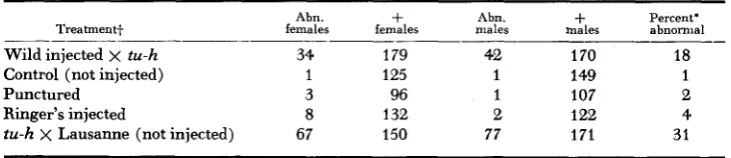
The results of the first injection experiment are summarized in Table 1. Four wild (Lausanne) females, injected with extract from adult tu-h females and mated with tu-h males, produced a total of 425 progeny with 76 or 18 percent abnormal. From two control matings, which were similar except that the wild females were not injected, 276 progeny were produced with two (one female and one male) abnormal. Another control experiment was carried out in which Lausanne females were punctured with the injection needle, but no extract was released. Four (three females and one male) of the 207 progeny were abnormal. When insect Ringer’s solution was injected into Lausanne females, ten (eight females and two males) of the 264 progeny were abnormal. Results from controls were within the range obtained from previous matings between Lausanne females and tu-h males. Lausanne apparently has a genetic background which may in- crease the percentage of abnormal flies from this type of mating to as much as
TABLE 1
F , progeny from crosses between wild (Lausanne) females, injected with extract from tu-h
females and crossed with tu-h males, Results from controls and reciprocal crosses are included
Abn.
+
Abn,+
Percent’Treatment+ females females males males abnormal
Wild injected x tu-h 34 179 42 170 18
Control (not injected) 1 125 1 149 1
Punctured 3 96 1 107 2
Ringer’s injected 8 132 2 122 4
tu-h
x
Lausanne (not injected) 67 150 77 171 31~ ~
* Percentages given with accuracy to .learest whole number.
908 E. J. GARDNER, et al.
three or four percent of abnormal flies compared with less than one percent for most wild stocks. The small percentages (less than one percent) of abnormal flies from wild females and tu-h males were explained (GARDNER and WOOLF 1949) on the basis of independent action of gene tu13. From the reciprocal cross between tu-h females and wild (Lausanne) males, 144 of the 465 flies were abnormal. This result is comparable with previous large-scale matings between tu-h females and Lausanne males.
The extract injection experiments on Lausanne females were repeated under carefully controlled conditions. Results of the second experiment are summarized in Table 2. Nineteen percent of the progeny of the injected females were abnormal compared with three and four percent from the two controls.
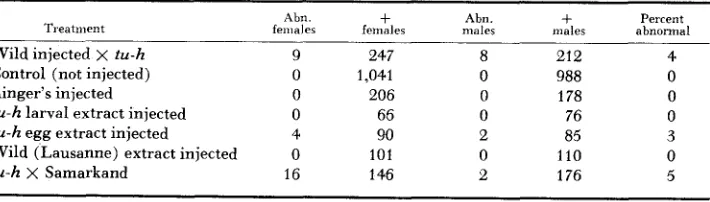
Injection experiments similar to those with Lausanne were conducted with the Samarkand wild stock. Among the numerous stocks with which tu-h has been outcrossed, Samarkand crosses have shown the lowest expression of tumorous head. Apparently the genetic background in this stock reacts in a different way than that of Lausanne. Results of the experiments involving Samarkand are summarized in Table 3. Extract from tu-h females was injected into Samarkand females which were later mated with tu-h males. Four percent of the progeny were abnormal. No abnormal flies were obtained from the control cross between uninjected Samarkand females and tu-h males. Samarkand females injected with Ringer’s solution produced no abnormal flies. Extract from larval tu-h flies in- jected into Samarkand females did not alter the results, but females injected with extract from tu-h eggs and mated with tu-h males produced three percent of
TABLE 2
Results from second experiment similar to that reported in Table I in which extract from tu-h females was iniected into wild (Lausanne) females which were crossed with tu-h males
Treatment females Abn. females
+
males Abn. males+
abnormal PercentWild injected x tu-h Control (not injected) Ringer’s injected
41 122 17 127 19
1 55 3 72 3
8 132 2 122 4
TABLE 3
F , progeny from crosses between wild (Samarkand) females, injected with extract from tu-h females and crossed with tu-h males. Results from controls and reciprocal crosses are included
Treatment females Abn. females
+
males Abn.~ ~
+
Percentmales abnormal
Wild injected X tu-h Control (not injected) Ringer’s injected
tu-h larval extract injected tu-h egg extract injected
Wild (Lausanne) extract injected tu-h x Samarkand
9
0 0
0 4 0 16
247 1,041 206 66 90 101 146
21 2 4
988 0
178 0
76 0
85 3
110 0
M A T E R N A L EFFECTS 909 abnormal flies. Extract from Lausanne wild females was injected into Samarkand Females which were mated with tu-h males. No abnormal flies were produced. Five percent of abnormal flies came from the reciprocal cross between tu-h females and Samarkand males.
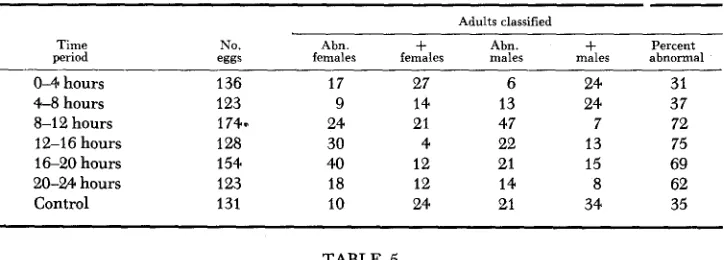
Results from the first experiment designed to test the temperature effective period are summarized in Table
4.
The maternal effect could be greatly increased by changing the temperature from 21 "C to 30°C at any of the four-hour intervals between the 8-12 and the 20-24-hour periods after the eggs were deposited. Cultures subjected to increased temperature during the first two intervals (0-4and 4-8 hours after egg deposition) were not significantly different from the control maintained constantly at 21°C. Results of the next experiment in which the cultures were left at 30°C for different time periods are summarized in Table 5 . These results were not significantly different from those of the first experiment (Table 4), indicating that a four-hour interval was sufficient for the full effect.
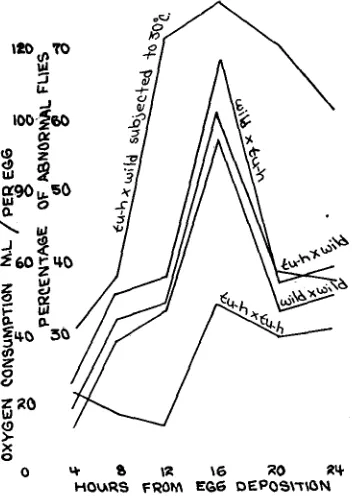
Results of the oxygen consumption experiment are summarized in Table 6 and shown graphically in Figure 1. Progeny of the two reciprocal crosses (tu-h
x
wild and wild x tu-h) show no significant difference in oxygen consumption. NeitherTABLE 4
F , progeny from crosses between tu-h females and Lausanne males subjected to 30°C at four-hour intervals during first 24 hours after egg deposition
Time period
~ ~~
Adults classified
Abn.
+
Abn.+
Percentfemales females males males abnomial
0 4 hours 4-8 hours 8-12 hours 12-16 hours 16-20 hours 20-24 hours Control 136 123 174. 128 154 1W 131
17 27 6 24 31
9 14 13 24 37
24 21 47 7 72
30 4 22 13 75
40 12 21 15 69
18 12 14 8 62
10 24 21 34 35
TABLE 5
I;, progeny from crosses between tu-h females and Lausanne males subjected to different time periods at 30°C, each interual beginning with time of mating
Time period 0 4 hours 8 hours 12 hours 1 G hours 20 hours 24 hours Control Adults classified No. eggs 366 286 421 309 241 263 578 Abn. females 79 64 119 145 100 1 23 118
+
Abn.females males
215 37
159 39
68 161
55 85
31 87
24 64
156 128
+
Percent males abnormal35 32
24 36
73 67
24 74
23 78
52 71
910 E. J. GARDNER, et al.
TABLE 6
Measurements of oxygen consumed b y eggs and laruae of different stocks and crosses given in microliters per egg during four-hour intervals
Source of samples
~
Time peilod ( 1 ) tu-h X tu-h
_________________ (a) 0-4 hours 22.824*
(b) 4-8 hours 18.512
(c) 8-12 hours 12.960
(d) 12-16 hours 46.656
(e) 26-20 hours 30.880
(f) 20-24 hours 31.720
( 2 )
+
x+
12.896 39.496 45.312 96.712 45.168 49.208_ _ _ _ _ _ _ _ ( 3 ) tu-hX ~
+
19.432 43.432 45.812 102.872 56.288 55.144
(4)
+
X t u - h__ 25.976 47.952 53.944 115.872 53.952 58.984
* Oxygen cons.imption in microliters/per egg/four-hour period.
is there a significant difference between the results of the two reciprocal crosses and those of the wild stock. Analysis of variance showed the time period 12-16 hours (d at the left of 'Table 6) to be significantly different (one percent level) from c, e, and f. The differences c us. e, f, and e us. f were not significant. The cross 1 (tu-h x tu-h) sample was significantly different (one percent level) from 2, 3, and 4.
FIGURE 1.-Oxygen consumption of samples of 100 eggs during first 24 hours after eggs were laid (data from Table 6 ) . Upper curve represents the effect of increased temperature during first
M A T E R N A L EFFECTS 91 1
The graph at the top of Figure 1 represents the percentage of abnormal flies produced when cultures from the tu-h x wild cross were subjected to 30°C at four-hour intervals (from Table
4).
There is a rough parallel between the rate of respiration and the temperature effective period for the tumorous head trait. Under the conditions of these experiments, no significant differences in head abnormalities were related to humidity, but the relationships previously reported for temperature ( GARDNER and WOOLF 1950) were confirmed. The results showed the present level of expression in the tumorous head stock after some 12 years of selection and inbreeding in our laboratory to be about 80 percent at 20°C and 90 percent at 30°C. They also confirmed the difference in reciprocal crosses, upon which the maternal effect hypothesis was based, with two wild stocks(Lausanne and Canton).
DISCUSSION
Transfer of the maternal effect from tumorous head females to wild females by injection of a crude extract supports the hypothesis (GARDNER and WOOLF 1949) that a tangible substance is involved. Previous experiments ( GARDNER 1959) have shown that no persistent cytoplasmic factor is carried from generation to generation, but the possibility of a virus or a genoid
( ~ H E R I T I E R
1951) acting under the control of a gene is not excluded.The substance injected into the body cavity must be capable of penetrating the developing eggs in the ovary or tubes. KING and BURNETT (1959) have shown from autoradiographic studies that certain chemicals may be taken into the ovary of fruit flies. The tu-h substance depends on the sex-linked gene ( t u - I ) , and its action is related to the action of the autosomal gene (tu-3) which must be present
if any expression of the trait occurs in the adult flies. The substance may act by altering the dominance of the autosomal gene ( t u - 3 ) . CAVALCANTI, LAGDEN,
FALCAO, and CASTRO (1958) have described the interaction of a nuclear and cyto- plasmic component in sex-ratio factor in Drosophila prosattans, and MALOGOLOW- KIN, POULSON, and WRIGHT (1959) have succeeded in transferring a maternally inherited sex-ratio in D . willistoni.
912 E. J. GARDNER, et al.
Stephenville females mated with tu-h males produced the highest proportion (89 percent) of abnormal flies ( GARDNER and STOTT 195 1 )
.
From the reciprocal cross between Stephenville males and tu-h females, 20 percent of abnormal flies were obtained. No abnormal flies have been obtained from the cross: Samarkand females x tu-h males, and only five percent of abnormal flies was obtained from the reciprocal cross. The genetic background in Samarkand is evidently better buffered against these abnormal expressions or more favorable for normal expres- sion as compared with the genotypes of other stocks. Samarkand females injected with extract from tu-h females and mated with tu-h males produced four percent of abnormal flies. When an extract was prepared from eggs of tu-h females and injected into Samarkand females which were subsequently mated with tu-hmales, three percent of the progeny was abnormal. Injection with tu-h larval extract had no effect; the results were similar to the uninjected controls in which no abnormal flies appeared.
Two approaches are being made to obtain data concerning the nature of the substance and the mechanics of the maternal effect. (1) Extracts are being refined and separated into their chemical components. Each component is being tested for transmission of the maternal effect. (2) The temperature effective period is being investigated more critically to see if some aspect of metabolic activity might sug- gest how the maternal effect operates.
To define the temperature effective period more narrowly than the 24-hour period detected in the previous study (GARDNER and WOOLF 1950), it was neces- sary to collect eggs rather than to transfer whole cultures to different temperature incubators. Laying cages were used to obtain large numbers of eggs from the same parents within a short time period. The results showed that any four-hour interval between 8-12 and 20-24 hours after the eggs were deposited was as effective as the full 24 hours at the higher temperature. The temperature effective period indicates that some chemical activity associated with the abnormality is in prog- ress during this early period of development.
The over-all pattern of oxygen consumption conformed to that obtained by VAVALA (1954). In our experiments there was no significant difference between the results of the reciprocal crosses (tu-h x wild and wild x tu-h), and these results did not differ from those of the wild stock. The sample from tu-h consumed considerably less oxygen than the other three samples. This is probably because of the decreased viability of tu-h flies, particularly in the egg and larval stages (GARDNER and RATTY 1952). If there were fewer living larvae in the tu-h sample after the initial stage of the experiment compared with other samples, the amount of oxygen consumed would be considerably less than that of the other samples. Comparison between the graphs for the heat sensitive period of the tu-h x wild cross and the high oxygen consumption indicates that the heat sensitive period begins earlier andextends longer than the period of highest oxygen consumption.
SUMMARY
M A T E R N A L E F F E C T S 913 experiments expressed the tumorous head phenotype compared with one to four percent for the controls. This result supports the hypothesis that a tangible, trans- missible substance is associated with the maternal effect. Similar injection experi- ments were conducted with the wild Samarkand stock. Four percent of the prog- eny from tu-h injected Samarkand females crossed with tumorous head males were abnormal compared with none for the uninjected controls. The temperature effective period during the first 24 hours of development was defined more narrowly. Four-hour intervals at 30°C between the 8-12 and 20-24-hour inter- vals after egg deposition were found to be as effective as longer periods at the higher temperature. Measurement of oxygen consumption during the first 24 hours of development showed a peak for the period 12-20 hours after egg deposition.
L I T E R A T U R E C I T E D
CAVALCANTI, A.. G. LAGDEN, D. N. F A L C ~ O , and L. E. CASTRO, 1958 The interaction of nuclear and cytoplasmic factors in the inheritance of “sex-ratio” character in Drosophila prosaltans.
(Abstr.) Proc. 10th Intern. Conqr. Genet. 2: 47.
7
GARDNER, E. J., 1948 Head tumors in Drosophila melanogaster. Utah Acad Sci., Proc. 25: 164. Gmetic mechanism of maternal effect for tumorous head in Drosophila melanogaster. 1959
Genetics 44: 471481.
GARDNER, E. J., and M. D. GARDNER, 1953 Further evidence for maternal effect and modifiers of tumorous head genes in natural populations of Drosophila melanogaster. Cancer Research 13: 689-693.
Penetrance and expressivity of tumorous head in Dro- sophila melanogaster and relative viability of flies carrying tumorous head genes. Genetics
37: 49-61.
Modifiers of tumorous head genes in natural populations and laboratory stocks of Drosophila melanogaster. Genetics 37 : 4-51-456.
Genes producing a maternal effect and modifiers of tumorous head in “wild” and tumor-bearing stocks of Drosophila melanogaster. Genetics 36: 72-83,
GARDNER, E. J.. and F. J. RATTY, 1952
GARDNER, E. J., G. H. STOTT, and D. M. DE4RDEN, 1952
GARDNER, E. J., and G. H. STOTT, 1951
GARDNER, E. J., and C. M. W o o ~ a , 1949 Maternal effect involved in the inheritance of abnormal
The influence of high and low temperatures on the expression of tumorous head i n growths in the head region of Drosophila melanogaster. Genetics 34: 573-585.
Drosophila melanogaster. Genetics 35 : 44-55.
Autoradiographic study of uptakct of tritiated glycine, thymidine, and uridine by fruit fly ovaries. Science 129: 1674-1675.
The CO, sensitivity problem in Drosophila. Cold Spring Harbor Symposia Quant. Biol. 16: 99-112.
Experimental transfer of matern- ally inherited abnormal sex-ratio in Drosophila uillistoni. Genetics 44 : 59-74.
The effect of tryptophan on the penetrance of tumorous head in crosses among selected stocks of Drosophila melanogaster, Genetics 43: 164-171.
Respiratory metabolism. pp. 119-120. Insect Physi- ology. Edited by K. D. ROWER. John Wiley and Sons, Inc. New York.
A comparative study of the respiration of normal and tumor strains of Drosophila melanogaster. Texas J. Sci. 6 : 194-200.
1950
KING, R. C., and R. G. BURNETT, 1959
L‘HERITIER, PH., 1951
MALOGOLOWKIN, C., D. F. POULSON, and E. Y. WRIGHT, 1959
SIMMONS, J. R., and E. J. GARDNPR, 1958
THOMPSON, W. R., and R. TENNANT, 1953