ABSTRACT
SEALE, ELIZABETH KELLEY. Serving the Poor: A Comparative Case Study of an Urban and a Rural County in North Carolina. (Under the direction of Michael Schulman and L. Richard Della Fave).
In this dissertation I find that changes associated with welfare policy, federal devolution, and the global economy constrain service providers and communities, but that local factors in the two counties mediate how organizational actors adapt to these challenges. I use global political economic theory, organizational theory, and theories of inequality to investigate how local actors address poverty in their communities. Specifically, I examine through a comparative case study how government and nonprofit service providers in two North Carolina counties cope with challenges that derive from global and national levels as well as local factors to serve the poor. I rely on extensive interviews, observations, and secondary data. I find that officials in the rural county are severely constrained in their ability to address poverty, due to lower organizational capacity and very limited financial and social resources. The implications of poverty policy for rural and urban areas differ. Not only has inequality within place been exacerbated by recent national and global trends, but inequality
Serving the Poor: A Comparative Case Study of an Urban and a Rural County in North Carolina
by
Elizabeth Kelley Seale
A dissertation submitted to the Graduate Faculty of North Carolina State University
in partial fulfillment of the requirements for the degree of
Doctor of Philosophy
Sociology
Raleigh, North Carolina 2010
APPROVED BY:
_______________________________ ______________________________
Michael D. Schulman L. Richard Della Fave
Committee Co-chair Committee Co-chair
________________________________ _______________________________
ii DEDICATION
iii BIOGRAPHY
iv ACKNOWLEDGMENTS
I thank several people and institutions for their contributions to this project and their extensive support. My chairs and committee members, including Sarah Bowen and Ed Kick, have contributed in important ways to the scholarship of this project. I would like to thank my co-chairs in particular, Rick Della Fave and Michael Schulman, for their support, advice, and mentorship. I will not name them all, but many friends, colleagues, departmental staff, and family members have supported me throughout my graduate and undergraduate school years and throughout the dissertation process. I thank the Rural Sociological Society for providing much-needed financial support for this project with a Dissertation Research Award.
v TABLE OF CONTENTS
LIST OF TABLES ... viii
LIST OF FIGURES ... ix
CHAPTER ONE INTRODUCTION ... 1
1.1 Purpose of Research ... 1
1.2 Development of Research Project ... 3
1.3 Findings and Contributions ... 5
CHAPTER TWO LITERATURE REVIEW ... 9
2.1 Globalization and Neo-liberal Policies ... 10
2.1.1 Global Economic Changes ... 10
2.1.2 Neoliberalism and Welfare ... 14
2.1.3 Studies of Aggregate Effects of Welfare Reform: Class, Gender, and Race ... 20
2.1.4 Local Autonomy ... 24
2.2 Local Areas: Rural and Urban Issues ... 26
2.2.1 Urban Locales ... 27
2.2.2 Rural Locales ... 29
2.2.3 Comparing Urban and Rural Places ... 31
2.3 Organizations ... 34
2.3.1 Organizational Capacities ... 36
2.3.2 Strategies ... 38
2.3.3 Inter-organizational Arrangements ... 43
2.4 Conclusion ... 47
CHAPTER THREE METHODS ... 49
3.1 A Comparative Case Study ... 49
3.2 Sources of Data ... 52
3.2.1 Interview... 49
3.2.2 Observations ... 58
3.2.3 Other Sources ... 61
3.3 Analysis and Coding ... 70
3.4 Strengths and Limitations ... 71
CHAPTER FOUR THE LOCAL CONTEXTS ... 74
vi
4.2 Economic and Historical Factors ... 80
4.2.1 Marian County ... 80
4.2.2 Woods County ... 83
4.2.3 Effects of Economic Recession ... 86
4.3 Additional Local Factors ... 88
4.3.1 Social Capital ... 88
4.3.1.1 Marian County ... 88
4.3.1.2 Woods County ... 91
4.3.2 Cultural Capital ... 94
4.3.2.1 Marian County ... 94
4.3.2.2 Woods County ... 97
4.3.3 Race Relations ... 98
4.3.3.1 Marian County ... 99
4.3.3.2 Woods County ... 103
4.4 Discussion ... 105
CHAPTER FIVE ORGANIZATIONAL CAPACITIES AND LIMITS ... 108
5.1 Defining and Measuring Capacity ... 109
5.1.1 Local Government: Department of Social Services ... 112
5.1.1.1 Marian County DSS (Urban) ... 112
5.1.1.2 Woods County DSS (Rural) ... 114
5.1.2 Nonprofit Organizations... 116
5.1.2.1 Marian County (Urban) ... 116
5.1.2.2 Woods County (Rural) ... 123
5.2 Comparing Capacity across Organizations and Counties ... 127
5.3 Impacts of the Economic Recession in Relation to Capacity ... 130
5.4 Effects of Devolution and Welfare Reforms ... 132
5.5 Discussion ... 143
CHAPTER SIX ORGANIZATIONAL STRATEGIES AND SERVICE PROVISION 148 6.1 Organizational Strategies ... 150
6.1.1 Verification, Monitoring and Surveillance ... 150
6.1.1.1 City Ministry (Urban) ... 150
6.1.1.2 Marian County DSS (Urban) ... 158
6.1.2 Enforcement of Low-Wage Work ... 159
6.1.2.1 Marian County DSS (Urban) ... 160
6.1.2.2 City Ministry (Urban) ... 164
6.1.2.3 Woods County DSS (Rural) ... 165
6.1.2.4 Woods County JobLink (Rural) ... 166
6.1.3 Restricting Services ... 169
vii
6.1.3.2 Woods County Parish (Rural) ... 171
6.1.3.3 Family Services/Shelter (Rural) ... 175
6.1.4 Alternative Strategies ... 179
6.1.4.1 Work Solutions (Urban) ... 179
6.1.4.2 NCV (Urban) ... 182
6.2 Strategies, Environmental Factors, and Regulation of the Poor ... 186
6.3 Discussion ... 195
CHAPTER SEVEN CONCLUSION ... 198
7.1 Contributions ... 198
7.1.1 Impact of Federal Policy ... 200
7.1.2 Rural-Urban Differences ... 205
7.1.3 Global Political Economy and Local Autonomy ... 210
7.2 Limitations and Further Research ... 216
7.3 Policy Implications ... 217
7.4 In Closing ... 221
REFERENCES ... 223
APPENDICES ... 249
9.1 Appendix A: Interview Guides ... 250
9.2 Appendix B: Details for Primary Organizations ... 260
9.2.1 Table B.1a Woods County Organizations ... 260
9.2.2 Table B.1b Marian County Organizations ... 262
viii LIST OF TABLES
Table 3.1 Demographics of Respondents in Low-Income Households ... 57
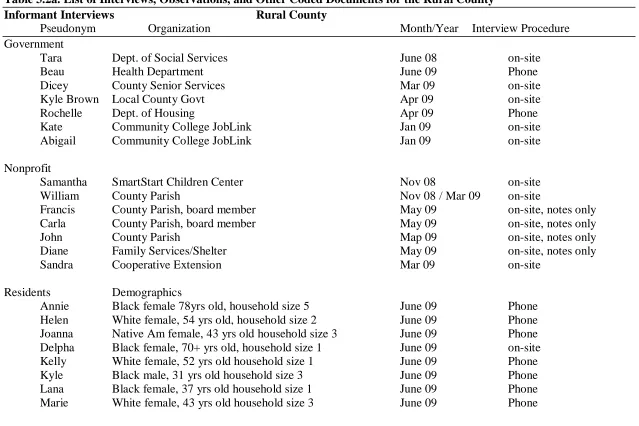
Table 3.2a List of Interviews, Observations, and Other Coded Documents for the Rural County ... 63
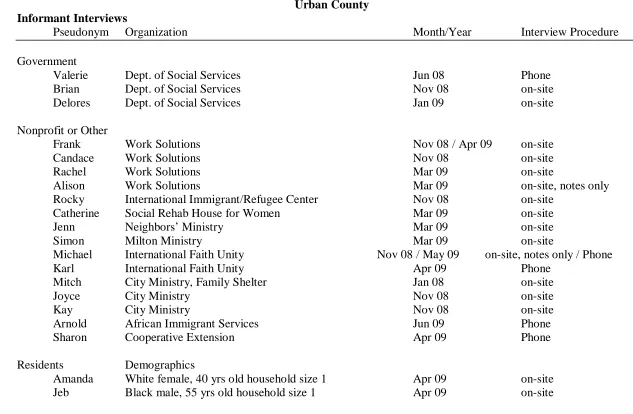
Table 3.2b List of Interviews, Observations, and Other Coded Documents for the Urban County ... 65
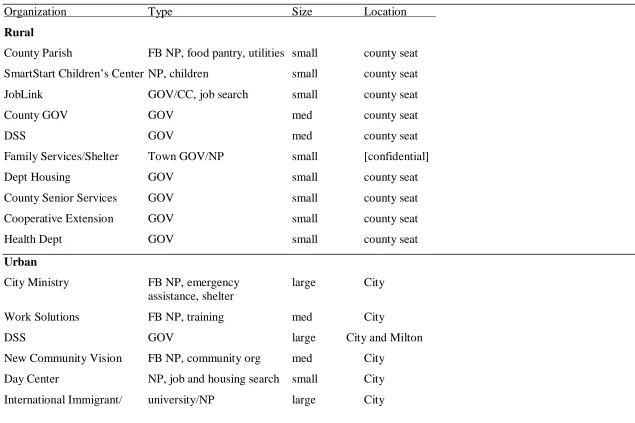
Table 3.3 List of Organizations Included in the Study ... 68
Table 4.1 Demographic and Socioeconomic Indicators ... 78
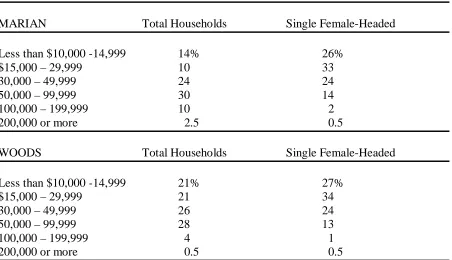
Table 4.2 Household Income Distribution, 2000 ... 79
Table B.1a Woods County Organizations ... 260
ix LIST OF FIGURES
1 CHAPTER 1
INTRODUCTION
[This] is not a great community...with social services and trying to get help and assistance. I’ve never been in trouble before but I got in trouble in ’06 and went to prison and got out in ’08. And now social services won’t help me at all. [Patricia at the parish] helps me out if she can. She is willing to help. But there is nothing else around here (Loretta, Woods Co.).
I appreciate all the help in the world, but right now I just—I would like to find me a full-time job. Find me a full-time job so I can take care of myself, then I don’t have to worry about asking anyone to help me (Douglas, Marian Co.).
PURPOSE OF RESEARCH
Local activists and service providers find themselves in a “catch-22” situation. Locals who wish to address poverty must rely on either outside funding and the strings attached, or upon community support. However, the withdrawal of federal support, government fiscal crises, global competition for cheap labor, and deindustrialization have undermined the resources and institutions that have traditionally fostered local empowerment (Theodore and Peck 1999; Schmidt 2002; Szreter 2002; DeFilippis 2004; Agnitsch, Flora and Ryan 2006). As a result, local well-being may be diverging according to place-based
advantages or disadvantages.
2 private market rather than government or public approaches (Peck 2001b; McDonald and Marston 2005; Blau 2006; Jurik 2006; Resich 2006; Schram 2006). My contention is that welfare reform, state devolution, and global economic changes have strained the capacity of local organizations to address poverty and inequality. Organizations in rural and urban locales, however, are strained in different ways and cope with this strain in different ways. This leads to important, varying impacts for the economically disadvantaged and important implications for public policy. My research suggests that the communities that require the most change are the most incapable of producing it on their own.
I use a comparative case study of a rural county and of an urban county in North Carolina to examine the differential impacts of policy on the poor. I concentrate in this dissertation on service provision organizations, specifically local government and nonprofit organizations, and how they cope with economic processes and government restructuring policies that affect their operations. As a reflection of neoliberal policy, the 1996 welfare reform replaced entitled benefits for anyone who is eligible under federal standards with employment requirements and limited federal funding. Agencies also cope with the
consequences that global economic restructuring has had on the livelihoods and opportunities of clients in their local labor markets. But how do service providers respond similarly and differently in the urban and rural locations? I emphasize two main issues: the variance of organizational capacity among the organizations and sites, and the different strategies
3 the concentration and centralization of power with monolithic and global institutions (e.g., Logan and Molotch 1987; McMichael 1996; Strange 2003; Glatzer and Rueschemeyer 2005; Stephens 2005); and 2) the trend towards community-based problem-solving and local control (e.g., Reid 2005; Emery and Flora 2006).
This study contributes to our understanding of how government localization and the increasing reliance on non-governmental organizations exacerbate inequality within and across locales. It addresses the relative power and control that local communities can maintain in the face of global social and economic restructuring (see Dewees, Lobao, and Swanson 2003; DeFilippis 2004; Sandel 1996). While many decisions that affect the well-being of local areas are made by external actors, federal and state government policy also emphasize local autonomy and community self-help. But despite national policymakers’ rhetoric of community empowerment and localism, recent policies intentionally withdraw federal investment from communities and leave localities in open competition with one another for resources and private investments. I explore these paradoxes of devolution/local autonomy and community vulnerability. The implications of where we place the
responsibility for local well-being, be it at the national, county, or individual level, are important to explore.
DEVELOPMENT OF RESEARCH PROJECT
4 noticed that personnel in both rural and urban counties mentioned many of the same issues, such as challenges in meeting bureaucratic requirements, lack of mental health services for clients, and housing and transportation problems. Yet, the character of their concerns differed. The rural county personnel tended to have fewer resources at their disposal and seemed close to despair. As I considered conducting case studies of county service providers, this urban-rural puzzle preoccupied me. The intricacies and complexities of untangling service provision in a local area warranted the use of an in-depth comparative case study.
The urban and rural counties selected for this study are drastically different in terms of resource availability and organizational capacity. But it was not immediately clear whether one set of county organizations is more effective at serving their clientele. In examining local capacity and organizational strategies, I find that although external factors are very important, there is also a mediating role for local factors such as social capital, race relations, the local labor market, and the local tax/resource base. Many of these factors differ for the rural and urban cases. I also began to consider how organizational decisions about coordinating with other agencies are part of wider survival strategies employed by agency personnel. I explore two main sets of research questions in this dissertation:
1) How have recent welfare reforms affected the capacity of human service organizations to respond to poverty? In turn, how does organizational capacity impact the ability of people in the two counties to respond to recent challenges and opportunities?
5 inter-sectoral arrangements exist in these counties, and how do these
arrangements help organizations cope with the challenges of welfare reform? How do the coping strategies affect their services?
I use a multi-method approach in the dissertation research. I conducted interviews with organizational and government informants to uncover the problems they perceive and how they address these issues. I rely on observational data to detail the daily procedures and challenges of service providers. And I use archival and second-hand data to supplement my knowledge of how local and extralocal factors are important for organizations in these counties. All research protocols were approved by the North Carolina State University Institutional Review Board, and all county and informant names are fictionalized.
FINDINGS AND CONTRIBUTIONS
6 strategies reflect these challenges in ways that are related to the level of organizational
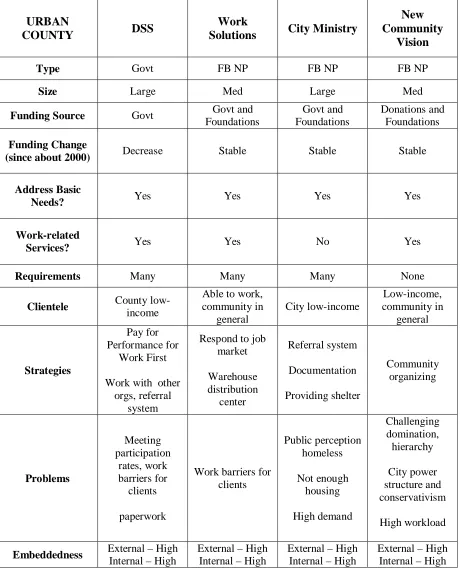
capacity, including number of staff and presence of ties within and outside the county. Overall, agencies in both counties concentrate on two methods for serving the poor: providing some basic services to ease hunger and homelessness, and reintegrating the poor into the low-wage workforce. Some agencies respond by adopting punitive and/or exclusive policies to inhibit over-usage of services and suppress the level of redistribution. As
7 However, there are more resources and inventive efforts to ease poverty in the urban county than in the rural county. As Loretta explains in the introductory quote above, there are few places to which the rural county residents can turn in crisis, and these organizations are restricted in their ability to help clients. A few high-capacity organizations in the urban county—none of which are present in the rural county—are able to create empowerment programs and policies for serving the poor. Further, basic needs provision is more extensive in the urban county than in the rural county.
In addition, levels of social capital in the counties differ, with important implications for community organizing around poverty. As Szreter (2002) argues, bridging and
democratic linking forms of social capital are realistic only in the context of an engaged and politically-supported state and local participatory government involvement. In the urban county, grassroots organizations foster vertical and horizontal ties between elements of the community. In the rural county, these vertical ties or bridging forms of social capital are notably absent. Although the urban organizers have limited influence, they are able to demand some concessions from governing sectors on the behalf of poorer segments of the county. In the rural county, the poor are largely powerless to make demands on the local government or other organizations, and locals concerned about poverty are limited in their use of networks. Consequently, inequality is reinforced between places as well.
9 CHAPTER 2
LITERATURE REVIEW
In examining the issue of how local organizations address poverty, there are several unresolved problems to address. Primarily, how do macro-level factors impact organizations in rural and urban areas differently? In this chapter I incorporate theoretical and empirical work to discuss what we know about the context in which service provision organizations operate. I begin by examining the wider context in which service provision to the poor occurs, taking a global political economy approach and drawing on theories by David Harvey and other political economists who discuss class and neoliberalism. Then I turn to examine the research on welfare reform and its impact upon different populations in the U.S. I
10 scope? In examining these questions, this dissertation contributes to the literature by
comparing rural and urban service provision organizations and the factors that impact them.
GLOBALIZATION AND NEOLIBERAL POLICIES
Global Economic Changes
As places and people become more integrated into the global capitalist economy, several processes of economic restructuring related to the heightened mobility of capital and labor hinder the eradication of poverty. One is the changing nature of work, arising from technological development and fragmented production styles, making employment a less likely route out of poverty, even in wealthier countries. As styles of production continue to serve flexible accumulation, income inequality has increased, along with job insecurity and the proliferation of low-wage jobs. De-unionization and erosion of workers’ rights in some advanced capitalist countries have exacerbated these trends. Thus, employment per se is less likely to provide a sustainable route out of poverty or upward mobility, particularly for single mothers (O’Connor 2000; Goldsmith and Blakely 1992; Albelda and Withorn 2002).
11 competition and America could afford generous social spending. Since then, changes in the world economy increased competition among producers tremendously (Della Fave 2008). For instance, Europe and Japan recovered from World War II and fostered production innovation. Increased competition drove down rates of profit, leading employers to exert downward pressure on wages (among other tactics) in order to improve profit rates, remain competitive, and attract investment (Della Fave 2008). Harvey (2003) argues that when U.S. dominance was threatened in production activities, the U.S. asserted itself in finance through trade liberalization (see also Useem 1996). Therefore the U.S. actually undermined its competitiveness in production activities, although benefiting from cheaper goods and relatively high levels of consumerism. After all, low profits could be supplemented by higher profits abroad (Harvey 2003; Portes and Walton 1981). The continuous expansion for profit-seeking has implications for different localities.
For one, the effects of these global economic changes are not spread out evenly— uneven development is a natural part of capitalism (see Harvey 1987). As capitalists seek a “spatial fix” to the problem of over-accumulation, they seek evermore mobility or flexibility for capital (Molotch 1976; Logan and Molotch 1987; Harvey 1987, 2005). They seek out new markets for investment to lower costs, which results in a strange landscape of
12 in more remote areas as of late, transforming these spaces and creating more low-wage service work. With corporate and sector differentiation, important financial and technical administrative functions are located in more privileged centers of global economic activity, like New York City or Los Angeles (Goldsmith and Blakely 1992; Sassen 1998; Sassen 2009). Thus, highly-paid jobs in the financial and information industries are more likely to be created in larger “global cities,” with fewer such jobs filled by local workers in smaller cities and rural areas (Sassen 1998). Across places, however, the creation of low-wage service work provides less desirable employment (Tickamyer and Duncan 1990; Blinder 2006; Morgen et al. 2006). Economically marginal people and places who are unable to compete internationally suffer the most from negative effects of globalization as they are left to fend for themselves (Kodras 1997a).
13 population (Richmond and Shields 2005). In sum, global-level processes such as the changes in production and employment that increase poverty; heightened capital mobility in response to international competition; and international immigration, all strain societies’ abilities to procure widespread social welfare, while making it more important to do so.
It is important to note before I go much further, however, that globalization is not synonymous with neoliberalization. Although I focus in this chapter mostly on economic globalization, and even more specifically those forms of economic globalization that have developed in tandem with neoliberal policies and practices, globalization per se is a broader construct. The proper definition of globalization no doubt involves reference to the
14
Neoliberalism and Welfare
Actually, as these changes have contributed to poverty in advanced capitalist nations, U.S. policy and welfare state restructuring have eroded protections from the market for the poor and their communities (Zhong, Clark and Sassen 2007; Johnson, Burthey, and Ghorm 2008; Massey 2008). Organizations that serve the poor contend with neoliberal policies as well as economic changes. Since the 1960s, embedded liberalism, the reduction of risks associated with a free market through government means, has no longer sufficed to prevent lower classes from threatening the power of elites, according to Harvey (2005). With heightened global market competition, free market ideology has been enthusiastically supported by industries and capitalists attempting to respond to these conditions.
15 1987). Hayek and Friedman had very direct impacts on the policies instituted by Margaret Thatcher and Ronald Reagan, respectively (Feser 2006; Rayack 1987). Their principles have not always been attended to consistently; Harvey (2005) argues they were ignored when they conflicted with the interests of certain elites (see also Rayack 1987).1 But the basic idea that there is no better way to organize the social economy than through a competitive market system with limited government interference (and few government-provided services) has become a guiding centrist principle for those on both the left and right political continuum (Bourdieu 1998; Maskovsky 2001b). Indeed, during the Clinton Presidential years, before massive debt and stock-market deregulation caught up to us, neoliberal policies appeared to be working (see Brenner 2002). In its hegemony, neoliberalism impacts the expectations for and legitimacy of a range of organizations, including nonprofit agencies (Domhoff 2009).
In the mid-1970s, the idea that a mixed economy and the welfare state best promoted economic growth came under increased fire. Multinational financial institutions, notably the World Bank and International Monetary Fund (IMF), increased in influence with the debt restructuring of third world countries during the debt crisis (Harvey 2005). These institutions then imposed structural adjustment strategies on recipient countries, forcing them to institute more flexible labor markets, privatize and cut social spending (Harvey 2005). The IMF was more or less purged of Keynesian influence in 1982, and thereafter the IMF and World Bank were neoliberal in practice, instituting structural adjustments in return for debt rescheduling, more flexible labor markets, and privatization (Harvey 2005; see also Ruckert 2007 for an
1
16 analysis of the World Bank’s poverty reduction efforts). Across the globe, governments have “adjusted” their social policies as they adapt national economy regimes to promote
investment, “flexibility,” and competitiveness (Pierson 2006).
Thus, welfare reforms under U.S. Presidents Reagan, Clinton, and Bush, Jr. are part of a package of neoliberal restructuring of government activities. These reforms emphasize participation in the market as a route out of poverty for former and current welfare
participants, the eradication of dependence on government aid, and turning to civil society for addressing local needs. The moves toward decreased federal responsibility and increased local responsibility for public services fall in this camp as well, and this devolution has occurred in the areas of public services and local economic development in particular (Flora and Flora 2008). Across many advanced capitalist nations neoliberal rhetoric and practices have gained political currency. Some scholars link these reactions to the forces of production in the global economy (Howard and King 2004). Others insist that global economic changes do not impel these policies, but rather policymakers believe or are able to convince others that globalization impels these policies (Piven 2002; Schram 2006).
Whether or not such policies are “impelled”, we can examine their manifestations and actual impacts. Workfare policies focused on making work pay for former welfare recipients have been constructed in recent decades throughout Western capitalist nations, but
17 1996 Personal Responsibility and Work Opportunity Reconciliation Act transformed aid to poor families (formerly AFDC) into the “workfare” program Temporary Aid to Needy Families (TANF). This program is geared toward regulating poor mothers’ behavior in its emphasis on sanctions, time limits, community service, eliminating dependency, and work programs. Other nations such as the United Kingdom, Australia, and New Zealand have created similar programs involving devolution and “workfare” – requiring clients to engage in certain work activities. Market-based models of poverty alleviation aim to integrate the poor into the market (Goode and Maskovsky 2001; DeVault 2008; see also Kirby 2002 on the World Bank model). Under this ideology, the “deserving” poor are those who embrace entrepreneurship, volunteerism, consumerism, and self-help (Goode and Maskovsky 2001). This ideology is a softer justification for the reluctance of primarily white working class and middle class Americans to pay higher taxes—taxes that supposedly support the nonworking poor or lower class blacks who already have an advantage in anti-discrimination policies (see Edsall and Edsall 1992 on how these racially-influenced sentiments influenced elections, leading to the rise of the GOP and anti-government agendas).
18 increasing reliance on nonprofit organizations, advocating for local control, and removing disincentives to employment, policymakers supposedly increase national competitiveness in the labor market while “empowering” communities (Rose 2000).
19 strengthening civil society. Wolpert (1997), for instance, demonstrates that federal cutbacks weaken the civic sector, questioning the ability of the sector to absorb added responsibility in the context of rising inequality and place-based differences in capacity. Thus, government
and nonprofit service providers are hit doubly by devolution and welfare reform.
Some scholars describe the demise of the state under globalizing forces (Strange 2003; Bonanno 2008), whereas others suggest globalization has shifted, not eliminated, the role of the state (O’Riain 2000; Hirst and Thompson 2003). For example, researchers question the inevitable downward pressure on transfer payments and social services
presented by global forces, suggesting that there is no ‘race to the bottom’ in terms of welfare state generosity (Pierson 2000; Randeria 2003). Peck (2001) argues that contrary to what neoliberals assert, the state is not powerless under globalization, as it steps up its role in many areas, such as workfare programs, immigration controls, incarceration and crime control, labor market flexibility initiatives, and major multibillion dollar financial bail-outs, while retrenching in other areas, like collective service delivery. According to this view, “globalization” acts as a justification for policy makers to defer to more powerful special interests.
Indeed, policymakers in many advanced capitalist countries have come to favor the privatization of social services, reduced transfer payments, and work incentives (Dumont 1996; Korpi and Palme 2003) at a time when the security of employment has been
20 accumulation (Habermas 1975; Lake 1997) by making welfare policy more consistent with capitalists’ interests (e.g., a trained, docile labor force). The details of the reforms neatly dovetail with neoliberal economic policy at the global and national levels that require less government, a flexible labor force, and the individual absorption of risk (see Cope 1997). In fact, empirical research reveals that welfare reform has only partially benefited the poor, more often than not serving the interests of employers. 2 The increased availability of low-wage workers is clearly a bigger boon for employers, consumers, and the state than it is for the poor.
Studies of Aggregate Effects of Welfare Reform: Class, Gender, and Race
Overall, empirical research suggests that welfare reform is severely limited in its ability to help the poor (Piven et al. 2002; Hays 2003; Pearson 2007; Tickamyer et al. 2007). Moreover, certain groups of people are additionally disadvantaged—primarily women of color. Single mothers and non-white women face additional barriers in the workforce, which are often exacerbated in slack labor markets. Thus, the focus on employment is problematic for several reasons, and reinforces traditional forms of inequality. Service providers and community organizations must deal with class, gender, and race inequalities in addressing poverty.
2
21 Generally speaking, economic growth has not created enough living-wage jobs, even with the Earned Income Tax Credit (Grogger and Karoly 2005). The poor who find
employment are able at times to piece together enough to make it out of poverty, but in the low-wage workforce, solid middle-class status is difficult to attain, particularly for single-parent households and for those with other barriers (Blank 1997; Hays 2003; Morgen et al. 2006; Tickamyer et al. 2007; Solomon 2008; Scott and London 2008). As Theodore and Peck (1999) point out, the success of local workfare programs is contingent upon local labor markets. The quantity and quality of jobs in an area are critical factors for the variance in poverty rates (Bluestone and Harrison 1982; Tomaskovic-Devey 1987). Instead of providing higher education as a route out of poverty, federal and state welfare policies force
caseworkers and recipients to rely upon employment in low-skill sectors.3 Although barriers to gaining employment such as child care, transportation, and domestic violence may be addressed even for those not receiving cash assistance, the difficulty of supporting a family on minimum wage is almost never addressed in legislation or policies (Cope 1997; Albelda and Withorn 2002). On the other hand, research suggests that workers are generally better off than non-workers in this post-reform era (Tickamyer et al. 2007). Low-income workers continue to rely upon various strategies, and may obtain intangible benefits from
participation in the workforce, but nonetheless remain poor and highly vulnerable
3
22 (Tickamyer et al. 2007). Not incidentally, some argue, welfare retrenchment undermines workers’ ability to ask for better working conditions and contributes to worker vulnerability (Ehrenreich 2002; Albelda and Withorn 2002; Morgen and Maskovsky 2003). Many survival strategies used in lieu of state support, including reliance on debt, the private safety net of family and friends, and frequent changing of jobs and residences, are not sustainable in the long term for individuals or society (Seefeldt 2008).
Indeed, capitalism is driven by growth and accumulation, not by uplifting the poor. Neoliberalism, as unregulated capitalism, by definition entails economic marginalization of fairly large numbers of people with limited assistance and few alternatives to market participation. Research suggests that in the U.S., primarily women and people of color fill those slots.
23 Impacts also differ by racial/ethnic background. Historically, U.S. welfare policy has been deeply racist, initially excluding non-white women, with later reforms based on the stigmatizing and stereotyping of black recipients in the media after the civil rights movement helped extend coverage to black women (Quadagno 1994). Today, ground level
administration tends to reinforce racial inequality (Brush 2003; Pickering et al. 2006; Morgen and Maskovsky 2003; Zylan and Soule 2000; Soss et al. 2001). Schram et al. (2009) found that caseworkers judge black and Latina clients more harshly than white clients in
24
Local Autonomy
Economic restructuring combined with policies of devolution, welfare retrenchment, and privatization therefore has clear, negative impacts on low-income communities, and particularly for certain demographic groups (i.e., immigrants, racial minorities, and working class women). What challenges do local service providers and activists face, and how do organizations in different places cope with these realities? In other words, while it is clear that global economic restructuring and neoliberalism have profound implications, are local actors willing and able to counter these forces? This question has additional import because of the policy trend of devolving community responsibility to the local level.
Part of the rationale for PRWORA was the idea that more localized forms of control of welfare would be more effective and democratic (Blank 1997). Consequently, the issue of how to address poverty is left more or less up to the states and local communities to deal with as they can. States are given block grants and the mandate to create their own system of administering services and funds within certain limits to low-income families, and many states (including North Carolina) pass much of this responsibility onto counties. However, reduced social spending in the U.S. has also put state and local governments in financial straits.
25 Flora and Flora 2008). Local places have distinct institutional contexts involving different economic trajectories, political practices, and social relations, which shape capacity of local government and nonprofit organizations (Kodras 1997b). Policy at different levels has shifted from addressing inequality (including regional inequality) to creating an attractive environment for capital, which involves deregulation and cuts in social spending. Further, the national government no longer makes itself responsible for place-based prosperity, which exacerbates location differences in fiscal capacity and hence vulnerability to market forces (Rural Sociological Society 1993; Staeheli et al. 1997). Therefore, community autonomy or control may be threatened, at least for some communities. Federal restructuring that,
according to its supporters, was supposed to enhance local autonomy may provide opportunities for some while disadvantaging others.
The development of community social capital is a recently popularized solution proposed among scholars, foundations, and multinational organizations like the World Bank (Warner 1999). Lang and Hornburg of the Fannie Mae Foundation define social capital as “the stocks of social trust, norms, and networks that people can draw upon in order to solve common problems” (1998:4). They propose that strengthening social capital in distressed communities can help them deal with the burdens of devolution. Other scholars, notably Putnam (1993, 2000), argue that strong and/or broad social relationships can aid a
26 resource for non-elites. The forms of capital he identifies include obligations and
expectations, information potential, norms and effective sanctions, authority relations, appropriable social organization, and intentional organization.
However, as I discuss below, social capital, like other resources, is certainly not equally distributed (or practiced) across space (Flora and Flora 2008). Furthermore, some scholars argue that although social capital can be effective, it depends on other factors for social change (Skocpol 1996; Warner 1999; Lopez and Stack 2001; Szreter 2002). What difference can social capital make in different contexts, including rural and urban areas? I turn next to discuss the different contexts of rural and urban areas, and propose that we examine how, under a neoliberal regime, the ability to address local problems differ across place.
LOCAL AREAS: RURAL AND URBAN ISSUES
27 fact argues that place serves as a basis for inequality (see also Lichter and Jayakody 2002; Parisi et al. 2003) and advocates for comparative research between urban and rural areas. By comparing the effects of welfare state restructuring on a rural and an urban county, this dissertation contributes to our understanding of how place is implicated in stratification.
Urban Locales
Urban poverty understandably takes center stage in much poverty research and debate, as we are increasingly urbanized and most of the poor (about two-thirds) do reside in cities. Urban poverty in the United States is concentrated in the largest cities, particularly those with the highest proportion of minorities. Researchers of urban poverty describe very poor conditions that involve the concentration of poverty, lack of access to jobs, higher cost of living, deindustrialization, concentration of minorities, racial segregation, and urban disinvestment (Wilson 1987; Massey, Gross, and Shibuya 1994; Venkatesh 2000). William Julius Wilson’s work in The Truly Disadvantaged (1987) was very influential, stressing changes in economic structure and social composition of the inner city, especially for urban blacks. He saw the removal of manufacturing jobs and lack of formal education and
credentials as detrimental to inner city residents. Primarily, he drew attention to the
importance of social isolation and concentration effects for sustaining poor conditions in the black ghetto.4
4
Wilson and others viewed the concentration of poverty as particularly devastating, especially as residents became increasingly isolated from job networks, role models, mainstream institutions, and mainstream
28 Suburbanization is seen as a major historical contributor to urban problems. It
certainly intensified racial and class inequality. Suburbanization was directly endorsed by federal policy, including mortgage policy, interstate highway acts, the GI Bill, etc., for white men and their families (as discussed by Wilson 1996; O’Connor 2000; Goode and
Maskovsky 2001; see also Kleniewski 2006 for an overview of urban issues). Supermarkets, shopping malls, and manufacturing industries followed, and throughout the 1970s and 1980s, suburbs became the main source of employment for the majority of metropolises (Goldsmith and Blakely 1992; Goode and Maskovsky 2001). In the 1960’s, with suburbanization and the disinvestment in cities, urban renewal projects (i.e., gentrification) began, just as influential culture of poverty theories and “underclass” debates took shape (Goode and Maskovsky 2001). Now, Goode and Maskovsky (2001) argue, the new local development model is based on trickle-down strategies like privatization, marketization, and consumerism.
Polarization between the urban poor and the urban and suburban elite has been exacerbated by cities’ efforts to compete over position in the international division of labor, as centers of consumption, for control and command functions especially in finance and administration, and over government redistributions (Harvey 1987; Eisinger 2000; Weber 2001). Local officials and developers redesign the city and/or the downtown to appeal to visitors and tourists, suburbanites and corporations in an effort to draw in consumer dollars and stimulate economic growth (Eisinger 2000; Harvey 1987). Some scholars refer to the
29 growth machine phenomenon, in which the interests of different elite sectors in the city, including rentiers, local politicians, commercial capitalists, and so on, merge to favor
continual urban growth at all costs (Molotch 1976). Cities compete to attract businesses that also must remain competitive, partly through relocation to favorable locations (Harvey 1987). This intensified competition results in, not only more competition, but socially
wasteful economic development that does not benefit the poor (Harvey 1987; Eisinger 2000). For example, Maskovsky (2001a) and Fraser et al. (2003) use case studies to demonstrate how improving urban neighborhoods now entails creating zones for business investment and other neoliberal practices that tend to sidestep the issue of improving the lives of
impoverished residents. For instance, when neighborhoods are improved through creation of better housing, poor residents can be priced out of the neighborhood, essentially moving them elsewhere (Fraser et al. 2003; Fraser and Kick 2007).
Rural Locales
Rural areas have a disproportionate share of the poor (Tickamyer and Duncan 1990). The rural poor are more likely to be white, elderly, and in two-parent households than the urban poor. Yet, those who make up much of the poor in the city, including racial minorities, single mothers, and children, are even more likely to be poor if they live in a rural area
30 as transportation, weak labor markets, land inequality, dependency, poor education and low skills, and dependence on social capital (Pickering et al 2006; Tickamyer and Duncan 1990; Fitchen 1981). These problems are related to the lack of proper infrastructure and narrow economic structure that characterize remote rural areas in particular. Rural residents have adapted to insecure work conditions (e.g., seasonal work, plant relocation, agricultural decline) by combining different kinds of work and sometimes migrating to urban areas (Fitchen 1981; RSS 1993). Research also shows that race and class segregation and access to mainstream institutions play important roles in the persistence of poverty in rural areas (Duncan 1990). There may be particular challenges for women living in rural areas, where services may be limited and the sex differences in earnings even higher (Pickering et al. 2006).
31 (Lobao 2004: 24-5). All this considered, devolution in social services can have disturbing consequences for residents of rural counties that are left to their own devices (Weber et al. 2001; Lichter and Jayakody 2002; Pickering et al. 2006; Agnitsch, Flora, and Ryan 2006).
Comparing Urban and Rural Places
A large amount of literature documents the problems that cities and rural areas each face in addressing poverty. Here I cover three main issues: 1) contextual differences in terms of job availability and opportunity structures; 2) differences in demand for and accessibility of social services; and 3) differences in government, organization and community capacities to respond to poverty.
32 rural areas—increasing the competition for businesses and tourists in urban areas, and
increasing exploitation of natural resources in rural areas. In both cases class inequality is increased. Moreover, the downward pressure on wages and the mobility of production increases worker vulnerability across place. However, although a volatile global economy may harm both urban and rural economies, urban and suburban areas with diverse economic structures may be more resilient than rural areas (Flora and Flora 2008).
Both urban and rural nonprofit agencies are strained with demand (Curtis 1997; Kissane 2003; Pickering et al. 2006), but accessibility tends to be a greater issue in less densely populated locations with poor transportation infrastructure. Nonmetropolitan counties also provide fewer public services than metropolitan counties, particularly social services (Warner and Hefetz 2002; Lobao and Kraybill 2005). Metropolitan county officials are more likely to report increased work loads for social services and funding shortages, whereas nonmetropolitan county officials report greater fiscal stress and more difficulty with job placement of welfare recipients (Lobao and Kraybill 2005). Research demonstrates that Work First programs do not function well in rural areas. The working poor
33 Demand for social services is high in many urban areas, but in rural areas, social services are much harder to provide.
Both poor urban and poor rural areas lack stable employment, opportunities for mobility, and investment (internal and external) in the community (Tickamyer and Duncan 1990). Dewees et al. (2003) find that counties marked by economic disadvantage in general are less likely to engage in economic development strategies, regardless of whether they are rural or urban, and may continue to be disadvantaged in the face of increasing global
competition. However, even though inner cities include some of the highest poverty rates, at the county level, rural areas are much more likely to experience lower levels of education and higher poverty rates. These factors are associated with lack of sophisticated economic
development strategies by county governments (Dewees, Lobao, and Swanson 2003). The difference between two disadvantaged locales with similar demographic compositions, one urban and one rural, may therefore be capacity. Despite their acute problems, urban areas are often also rich in community and religious organizations that in some cases can successfully defend and empower local interests (Goldsmith and Blakely 1992; Harvey 1987; Small 2006). While any community may feasibly be able to form resourceful ties, improve social and economic investment, and exercise social capital, such exercises in agency may be far more unlikely for the rural community under the realities of capital mobility.
34 community agency be restricted differently in urban and rural areas? Empirically, we do not have many urban-rural comparisons that are not large-N quantitative studies. It is difficult using the separate case studies and the large-N studies available to determine how
organizations and groups in urban and rural communities address poverty on the ground level. When we compare governmental and nongovernmental organizations in rural and urban locations, there appear to be significant differences in capacity. And when looking at poverty in particular, we do not know how global and national processes such as economic changes and welfare state restructuring affect the poor differently across locations. Lobao observes that:
Rural sociologists’ attention to analyzing urban and rural regions jointly and comparatively provides the only comprehensive sociological lense on spatial inequality, a lense capable of providing powerful insights. In taking a
comparative approach, one is confronted with considerable inertia in regional processes, particularly evident in persistent regional differences in economic well-being (2004:7).
I consider the rural-urban one significant axis of difference on which to examine effects of welfare state restructuring for service provision to the poor. With the devolution of
economic development and social services to local governmental and private organizations, the implications of agency for rural and urban areas are even more salient.
ORGANIZATIONS
35 individuals formally organized to pursue some goal(s). Not all social action occurs through organizations, but in modern societies, more social functions have become the purview of the organization. We depend highly on organizations, including government agencies and churches, to provide services to the poor. Organizations provide individuals with tools to pursue goals such as ameliorating poverty or some effect of poverty, but they can also be constraining (as Weber discussed concerning bureaucracies). Theory suggests that the effectiveness of organizations depends heavily on environmental factors and ways in which organizational actors respond to environmental challenges (e.g., Lawrence and Lorsch 1967; Meyer and Rowan 1977; DiMaggio and Powell 1983, 1991).
Local organizations address poverty under altered circumstances with welfare reform, devolution, and a competitive global economy. Social service organizations and local
36 To explore the ways in which social services to the poor are affected by welfare reform, I examine three interrelated factors in poverty amelioration by local government and nonprofit organizations: the variation in organizational capacity, strategies used by
organizations to survive and/or serve communities, and the impact of inter-organizational arrangements in a community. Although not the immediate object of the study, I will discuss how globalization and neoliberal practices constitute and affect these factors. As an explicit part of the study design, I will examine how these factors differ for the urban and rural counties. I contribute to this literature by linking service provision to the poor in both urban and rural counties to the organizational environment, and linking this environment to global and national factors.
Organizational Capacity
How does organizational capacity impact the ability of people in different places
to respond to recent challenges and opportunities, such as devolution and increased
demand for services? How have recent welfare reforms affected the capacity of human
service organizations to respond to poverty? Organizational capacity is generally defined
37 also to the maintenance of necessary funding levels (Eisinger 2002). The ability to maintain funding levels presumably re-acts on capacity. Several key features of organizational capacity listed in the literature include embeddedness and networks; resources;
professionalization; and institutionalization (Eisinger 2002; Glickman and Servon 2008). Eisinger’s (2002) study, examining how capacity is related to effectiveness for street-level food assistance programs, is the most relevant example. He finds that the presence of paid staff and institutionalization in the form of computerized records are attributes of capacity that contribute to mission fulfillment for service providers of food. On the other hand, institutionalization in terms of rules and procedures, regular staff meetings and strategic planning contribute little to mission fulfillment, although intake interviews, an example of an institutionalized procedure, were associated with assisting clients in attaining federal
program assistance such as food stamps.
Research documents how welfare reform and devolution strain the capacity of social service agencies and nonprofits (Evans and Shields 2002; Jurik 2008). Social service
nonprofits face increased financial vulnerability due to reduced government funding, service contracts replacing grants, and competition for donor support from foundations,
governments, corporations, and individuals (Alexander 2000). Such organizations also compete with for-profits because the devolution of federal social programs means that states deal with a fixed amount of federal funding to deliver social services, and therefore
38 Circumstances differ in rural and urban counties, and these may profoundly affect the capacity of organizations (Horton et al. 2001). The rural marginalization thesis suggests that due to population size, density, and composition (more elderly and less educated people); a less diverse economic structure, and lower local capacity, remote rural governments and organizations are more dependent on outside assistance for development or projects like poverty alleviation (Lobao and Kraybill 2005; Cloke et al. 2000). The more remote from metropolitan areas, the more disadvantaged residents are in assisting economic or social development. On the other hand, in urban areas, particularly inner city areas, demand for services and the cost of living may be higher. Resources may be needed for alleviating multiple problems arising from the concentration of poverty, including housing, crime, homelessness, and the lack of middle class institutions (Kissane and Gingerich 2004; Wolch 1996; Anderson 1999). As Gough et al. (2006) argue, the new localism emphasizes local coordination, involvement of agencies, and tailoring to local conditions, but local control is an illusion without control of resources. In this way, both urban and rural areas may be disadvantaged by devolution, but rural areas even more so. We need more research on how organizations in rural and urban areas experience larger changes and pressures in the
neoliberal service provision environment.
Strategies
What strategies do organizational actors adopt to help the organization survive,
39 strategies employed by organizations affect services? How do inter-organizational
arrangements help organizations cope with the challenges of welfare reform?
Resource dependency theory focuses attention on organizations’ dependence on resources for survival and the need to reduce uncertainty in the environment (Aldrich and Pfeffer 1976; Pfeffer and Salancik 2003). Organizations that wish to survive accede to the demands of organizations or groups who control the resource they are most dependent upon, in this case usually foundations and government institutions. This suggests that
organizational actors privilege elite’s preferences and views over that of service users. Neo-institutional theorists also assert that organizations are strongly influenced by their
environments. DiMaggio and Powell (1983), for instance, stress that once an organizational field, such as local social services provision, becomes well-established, organizations tend to become more similar to one another. This occurs not because one or several organizational models are found most effective, but because organizations must strive for legitimacy, not just effectiveness (Meyer and Rowan 1977 [1992]). Methods that have legitimacy in the field are then adopted; hence the tendency toward organizational isomorphism and curbed
organizational autonomy (DiMaggio and Powell 1983). In the effort to maintain their funding base, organizational actors may shape the organization to the expectations of other, more powerful members of society. For example, organizations dependent on federal
40 feel pressured to adopt “new public management” techniques to demonstrate viability
(Alexander 2000; Jurik 2008). If organization actors are more attuned to organizational survival than they are to the survival of the poor, we would expect to see implementation of socially approved procedures that might not be most effective.
The spread of neoliberal principles has affected nonprofit organizations, not just through privatization, increased reliance on nonprofits to provide public services, and marketization, but also in the way in which agencies are evaluated by funders and government bodies. Performance-based management models emphasize budget-cutting, efficiency, and “pro-market rationality”, but are found to decrease quality of and client access to services (Baines 2006; Jurik 2008). Baines (2006) also argues that the increased emphasis on quantitative metrics have contributed to the bureaucratization and routinization (and deskilling) of social service work. Although proponents of the New Public Management (NPM) model for nonprofits assert that these changes increase the efficiency and
effectiveness of organizations (Hood 1991), other researchers find that the introduction of competition and market forces have had modest effects at best, and in some cases,
41 bodies that evaluate charities and nonprofit service providers.5 Service providers face
pressure to adopt neoliberal poverty amelioration techniques and organizational management. Strategies for serving the poor among nonprofits have also been adapted to the
realities of welfare reform. Withorn (2002) finds that nonprofit personnel take it for granted now that everyone “just needs to get a job.” Interest in organizing, advocacy, and
coordination seems to have waned substantially among the nonprofit personnel Withorn interviewed, as comfort with the requisite paperwork, funding mandates, and daily coping with problems set in. Jennings (2002) also found that with welfare reform, increasing
regulatory and service demand pressures in the inner city affected the mission, organizational capacity, and activities of community-based organizations. Many community organizations in the Massachusetts neighborhoods he studied had to switch from community and economic development to respond to people seeking information about (often work-related) services such as childcare, transportation, and housing. Other common responses include the elimination of programs and/or staff, increased rationing of services, heavier reliance on volunteers, and efforts to stretch resources as far as possible (Alexander 2000). Not all strategies are equally feasible across organizations, particularly for smaller agencies and faith-based organizations (Alexander 2000). Altogether, whether such strategies are effective ways of serving the poor or are sustainable in the long term is highly questionable.6
5
The Baldridge Board includes democrats and republicans, including Al Gore, and use neoliberal criteria for ascertaining effectiveness of organizations. See http://www.baldrige.nist.gov/.
6
42 In such cases, staff members in public and private organizations can face conflicting organizational goals, such as the allocation of insufficient resources (Lipsky 1980). Often, this can lead to exclusionary practices (Austin et al. 2009). Considering the need for legitimacy described by neo-institutionalists, the punitive ideology behind welfare reform, neoliberal precepts, and increases in demand, some organizations may respond by trying to sort the “deserving” poor from the “undeserving” poor, thereby serving only a selected portion of the needy. This would function not only to legitimate the organization as using funds in conformity to mainstream notions about the poor, but could also solve the problem of insufficient capacity. This would be an example of a strategy that serves the organization, but not the poor.
An altogether different strategy for organizations is community organizing or community participation methods in addressing poverty. Community-based organizations that work to change community conditions through methods such as job creation, physical redevelopment, or resident-led advocacy efforts have had mixed results (Blank 1997). Traditional grassroots methods as prescribed by American organizer Saul Alinsky include commitment to democratic processes, involvement of the lower and middle classes, the faith sector and other societal sectors, use of confrontational tactics when necessary, and leaders who are entrenched in the community (Alinsky 1969; Finks 1984). However, recent national and global changes may have affected how such organizations operate and how their
43 routinized, and easily co-opted by middle class and elite interests (Stoecker 1999; Jennings 2002; Fraser and Kick 2007). The institutions that Alinsksy depended upon, such as labor unions, the Catholic Church, and the Democratic Party, have altered or declined with
deindustrialization in most large cities (Heathcott 2005). Further, it has become increasingly difficult to challenge an international system of wage insecurity, although not impossible.
Inter-organizational Arrangements
The ties between government, civic society in the form of nonprofit organizations and other groups, the business sector, and citizens, can strengthen the collective ability of people to solve a local problem. Bradshaw (2007), for example, notes that strong social capital helps a community to be resilient. Proponents of social capital often emphasize the role of voluntary organizations (Warner 1999). Embeddedness in a network provides an
organization or actor access to more information and resources (Granovetter 1985). Ties that link people across groups and organizations may not only empower the capacity of a
44 interfere with autonomy and flexibility. Furthermore, the ability of organizations to engage in inter-organizational relations may differ: Guo and Acar (2005) find that a larger budget size, receipt of federal funds but reliance on fewer government funding streams, and board linkages with other nonprofit organizations increase the likelihood that a charitable
organization will increase the formality of its inter-organizational coordination.
Welfare reform ushered in renewed dedication to collaboration and subcontracting of welfare services to the private sector for many local areas. Such support derives in part from faith in the private sector to best provide for public well-being among policymakers and commentators (Evans and Shields 2002). By turning to nonprofit organizations to provide services, policymakers can downsize government while supposedly celebrating civil society. However, such downsizing may have thrown many service providers into fiscal stress on account of increased demand, increased range of services required, increased
bureaucratization, and insufficient funding (Curtis 1997; Alexander 2000; Jennings 2002; Withorn 2002). Nonprofit organizations also may become more regulatory and bureaucratic in function, in some cases even emulating government programs (Hasenfeld and Powell 2004), thus operating as a “shadow state,” and losing their voluntary, civic character (Wolch 1990). However, in the context of welfare-to-work policy, coordination and embeddedness should benefit clients. Wolman suggests that “[w]here local welfare and employment and training agencies cooperate closely, and where these, in turn, are well integrated with other community institutions, welfare recipients should, ceteris paribus, have an easier path
45 across place, and inter-organizational cooperation may not hold the same benefits across counties.
Furthermore, ties between sectors may not always benefit organizations.
Organizations may become dependent on other organizations for funding and legitimacy, compromising their autonomy and therefore mission (Salamon 1995; Evans and Shields 2002; Van Slyke 2003). Goals of different organizations may diverge in significant ways, making it less likely that the poor will directly benefit (Cloke et al. 2000; Fraser et al. 2003; Gough et al. 2006). Indeed, Portes (1998) lists several negative outcomes of social capital, including social exclusion and excess claims on members.
46 Limited research exists on whether forms of collaboration differ by community
factors (e.g., rural and urban location), whether different types of collaboration (e.g., degree of formality, differences in sectoral involvement, vertical v. horizontal) hold different benefits for actors and constituents, and what the challenges are for making such
coordination effective for the community. The exception here is the large amount of research suggesting citizen participation, specifically poor residents, is necessary for truly effective community initiatives in addressing poverty (Goode and Maskovsky 2001; Jennings 2002). But even this is not a panacea, if the participation is not sustained or influential, if necessary resources are not forthcoming, or if important ties to community leaders and external actors are lacking (Alinsky 1969; Portes 1998; Lopez and Stack 2001; Agnitsch et al. 2006; Flora and Flora 2008).
Thus, one way to examine how the poor are affected by welfare reform is to examine how service providers alter activities and missions in response to changes in the environment. We would expect to see differences in how organizations cope with decreased federal
47 locales adapt to global, national, and local conditions we can further understand the
paradoxes of addressing poverty under the prevailing international political economy.
CONCLUSION
As this review of the literature suggests, service providers face serious challenges, including increased economic insecurity among clientele, international migration, and a more restricted political approach to addressing poverty at the national level. At the local level, there are also problems, particularly for rural organizations that may be ill-equipped to replace substantial government aid. Such local factors may influence how agencies are able to respond to these challenges. However, few studies explicitly examine how service
providers react in both rural and urban locations. In this study, I contribute to research on communities and poverty by comparing agencies in both a rural and an urban county. Specifically, I address the issue of how local autonomy to address poverty differs for the rural and urban county in my study. I examine how organizations in these counties employ different strategies to cope with neoliberalism and devolution, depending in part on the level of capacity and presence of local resources. By showing how these strategies are restricted in terms of serving the poor, I contribute to the literature by demonstrating how local autonomy is circumscribed, but in different ways across place, thus reinforcing inequality both across and within places.
49 CHAPTER 3
METHODS A COMPARATIVE CASE STUDY
My central research question is how public and private nonprofit organizations that serve the poor cope with structural and environmental contexts, such as welfare reform, and how such coping varies within and across two counties. I conducted case studies of two counties, including field research on service provider organizations and local government officials, in addition to detailing the county context. My goal is to produce a holistic analysis of the complex processes and networks related to poverty, race, and region (see Orum, Feagin, and Sjoberg 1991), in order to analyze how service providers cope with neoliberal pressures differently across place. Because challenges in alleviating poverty, including those linked to political economic factors, differ between urban and rural locations, I investigated both an urban county and a rural county in North Carolina. The poverty literature is
50 (DeVault 2008:4). I connect the actions of people operating in and constituting institutions at different locations to demonstrate that the strategies pursued at the local level are directly linked to political economic conditions, although they are also mediated by local contexts. This study contributes to our cumulative knowledge on how communities address poverty and other social problems given extra-local constraints, adding to the theoretical literature on local autonomy.
I chose counties as the level of analysis for several reasons. First, for rural areas, the county is often a more important level of analysis than the town or neighborhood, as has oft been analyzed by urban sociologists (and pointed out by Lobao 2004). Second, in North Carolina, government social services are administered at the county level, as are many nonprofit social services, making service impacts county-wide. Third, I can examine
differences within counties, such as location within the county. This county-wide focus does not automatically leave out residents of the hinterlands or rural areas within a larger
metropolitan territory. As Lobao (2004) discusses, we must pay attention to potentially new places of inequality that emerge with contemporary uneven development processes.
51 Multiple methods were used to research the cases. I used interviews, observations, and archival material in this study. In efforts to protect the confidentiality of study participants, I do not reveal the names of the counties, cities, unique organization names, titles, nor the respondents’ names. Pseudonyms are used for persons, cities, organizations, and counties. This is consistent with the terms of the Institutional Review Board approved exemption. I also refrain from providing exact figures or details that reveal the identity of the counties or organizations.
The two primary research questions for this study are as follows:
1) How does organizational capacity impact the ability of organizational actors in the two counties to respond to recent challenges and opportunities, such as devolution and increased demand for services? How have recent welfare reforms affected the capacity of human service organizations to respond to poverty?
2) What strategies do organizational actors adopt in response to the environment to help the organization survive (coping), and what strategies do they adopt to help the poor survive? What inter-sectoral arrangements exist in these counties, and how do these
arrangements help organizations to cope with the challenges of welfare reform? How do the coping strategies affect their services?
Interview questions were geared toward procuring data relevant for answering these
52 to supplement collected data. These research activities were supported by a grant from the Rural Sociological Society.
I began contacting organizations for interviews in November of 2008, and concluded primary data collection in June 2009. During this time span the economic recession in the U.S. gained in impact, and unemployment rates and budget problems increased in both counties, as they did across the country. I asked informants specifically about experiences before the recession, and what effects they felt from the recession. Economic conditions undoubtedly strained organizations and individuals. Thus I can examine how the realities of a volatile economy impact organizations, clients, and the coping strategies of both.
SOURCES OF DATA
Interviews
I spoke with thirty key informants in the rural county and twenty-eight informants in the urban county. These key informants represent different positions in ten different