This article was downloaded by: [North Carolina State University] On: 29 September 2011, At: 11:40
Publisher: Taylor & Francis
Informa Ltd Registered in England and Wales Registered Number: 1072954 Registered office: Mortimer House, 37-41 Mortimer Street, London W1T 3JH, UK
Molecular Physics
Publication details, including instructions for authors and subscription information:
http://www.tandfonline.com/loi/tmph20
Test of a simple analytic model for
fluids of hard linear molecules
F. Lado aa
Department of Physics, North Carolina State University, Raleigh, North Carolina, 27695-8202, U.S.A.
Available online: 23 Aug 2006
To cite this article: F. Lado (1985): Test of a simple analytic model for fluids of hard linear molecules, Molecular Physics, 54:2, 407-413
To link to this article: http://dx.doi.org/10.1080/00268978500100311
PLEASE SCROLL DOWN FOR ARTICLE
Full terms and conditions of use: http://www.tandfonline.com/page/terms-and-conditions
MOLECULAR PHYSICS, 1985 VOL. 54, No. 2 , 4 0 7 - 4 1 3
Test of a s i m p l e a n a l y t i c m o d e l for fluids of h a r d l i n e a r
m o l e c u l e s
by F. L A D O
D e p a r t m e n t of Physics, N o r t h Carolina State University, Raleigh, N o r t h Carolina 27695-8202, U.S.A.
(Received 22 August 1984 ; accepted 22 October 1984)
Pynn has proposed (1974, J. chem. Phys., 60, 4579) a simple, empirical generalization for fluids of hard linear molecules of the Percus-Yevick direct correlation function for hard spheres. We make a detailed numerical study of this analytic model for hard dumbells, including comparisons with the true Pereus-Yevick results, and find that it is surprisingly effective.
1. INTRODUCTION
Although the integral equations of liquid state theory can always be solved numerically, such solutions in practice are often quite difficult or time-coh3'~ming to obtain. F o r this reason, the analytic solution of a seemingly very special case, the P e r c u s - Y e v i c k (PY) equation [1] for hard spheres, by W e r t h e i m [2] and Thiele [3] two decades ago, has had far-reaching effects in the m o d e r n theory of fluids. In particular, it has m a d e possible the ongoing d e v e l o p m e n t of p e r t u r - bation theory for simple fluids [4, 5], which ultimately rests, in nearly all cases, on this solution or its empirical i m p r o v e m e n t s [6]. In addition, it has served as a p a r a d i g m for the solution of a host of hard sphere ( H S ) e m b e l l i s h m e n t s : H S m i x t u r e s [7]; sticky H S [8]; charged H S [9]; H S with Yukawa tail [10]; and dipolar H S [11].
T h e last of these, by W e r t h e i m , and its generalization by Bium [12], involves an o r i e n t a t i o n - d e p e n d e n t intermolecular potential and so describes a molecular, rather than simple, fluid. T h e d o m i n a n t repulsive forces, however, are still treated as isotropic (i.e., hard spheres). T h e r e is as yet no analytic solution of the P e r c u s - Y e v i c k equation (or other model) for a hard anisotropic core such as dumbells or ellipsoids, with the consequence, a m o n g others, that molecular per- turbation theories almost invariably m u s t fall back on isotropic reference systems [4, 5]. It is the p u r p o s e of this note to call attention to a simple analytic model of hard linear molecules which, while in no sense exact, m a y quite effectively play m u c h the same role for molecular fluids that the W e r t h e i m - T h i e l e solution has played for simple fluids.
P r o p o s e d originally by Pynn [13] and apparently not studied since, the model
is an ad hoc generalization of the PY hard sphere solution. Specifically, for the
direct correlation function
C(12) = C(t,2, o~1, r (1)
408 F. L a d o
of a fluid of hard molecules we write
C(12) = a + La(12)J
= o ,
with
and
+ c I rl 2 ~3
o-(12)3 ' r12 < a(12),
r12 > a(12), (2)
a = -- (1 + 2 r / ) z / ( 1 -- t/) 4, (3 a )
b = 6 q ( 1 + 89 -- q)4, (3 b)
c = ~ a (3 c)
1 3
q = -6npao. (4)
In equation (2), a(12) is the c e n t r e - t o - c e n t r e separation between a pair of hard molecules at contact for the particular orientation (~1, ~2), i.e. an orientation- d e p e n d e n t ' h a r d sphere d i a m e t e r ' . By further analogy, one could choose a 0 in equation (4) so that ~/ is the molecular packing fraction, but the only real con- straint here is that it reduce to a hard sphere d i a m e t e r in the a p p r o p r i a t e limit.
One deficiency of equation (2) is i m m e d i a t e l y a p p a r e n t : in the limit of van- ishing intermolecular separation rt2 it yields a constant, a, with no orientation dependence at all, contrary to the known behaviour of C(12) for, say, h a r d d u m b - ells [14]. Equation (2) m a y thus be expected to be qualitatively incorrect for small values of q 2 . T h i s need not be a serious flaw, however, for typically one wants C(12) as an integrand where it will first be multiplied by a power of r12 [15, 16], a step which would in any case wash out m o s t of the short-range structure of a m o r e correct C(12).
Ultimately, the only way to judge the utility of an empirical a n s a t z such as
equation (2) is by direct c o m p u t a t i o n and comparison. P y n n ' s original application [13] was for ellipsoids of revolution, b u t the analysis presented was not adequate to establish the relative merits of his p r o p o s e d model. In the next section, we present a m o r e extensive set of calculations using equation (2) for the hard d u m b e l l potential and c o m p a r e the results with those obtained directly f r o m the P e r c u s - Y e v i c k equation itself. T h e conclusion in brief is that equation (2) is surprisingly effective.
2. NUMERICAL RESULTS
T h e project here is to use equation (2) to obtain the complete structure and
t h e r m o d y n a m i c s of a hard d u m b e l l fluid, m u c h as the W e r t h e i m - T h i e l e C(r)
completely describes the hard sphere fluid. T h e analysis needed to carry this out is just that described in [15] for the solution of integral equations with molecular potentials, with the difference that Step 1 in the s u m m a r i z e d p r o c e d u r e there is replaced b y the direct evaluation of the spherical h a r m o n i c coefficients
Clllzm(rl2 ) -~- (C(12)]/1/2 m ) (5)
using equation (2). ( T h e notation is that of [15].) Following t h r o u g h with the additional steps (2) t h r o u g h (10) [15] produces the coefficients Sht2m(r ) of the
Analytical model for molecular fluids 409
' series' function, from which S(12) is reconstructed to finally yield
gl,t2m(r12) -= ([1 + S(12)] exp [ - f l d p ( 1 2 ) J l l t l z m ) (6)
in PY approximation, where t~(12) is the hard dumbell potential.
T h e numerical analysis is evidently no simpler than that of solving the PY equation itself; in effect, it amounts to one iteration of such a solution. T h e advantage of equation (2), of course, is just that: one iteration may suffice where
many might otherwise be called for.
As noted earlier, the parameter r/for equations (3) may plausibly be chosen to be the molecular packing fraction. T h i s requires
a 0 = d = (a a + 3a2l -- 89 1/3 (7)
in equation (4), where l is the distance between sphere centres of the molecule and a the sphere diameter. It was found empirically that the median diameter [17] produces somewhat better t h e r m o d y n a m i c values. T h e effect on the various structural functions is mixed, b u t weighted towards (7) as giving somewhat better matching. T h e point is not critical for present purposes and we have arbitrarily chosen to present the results obtained using the median diameter [17] for a0.
T o check these results, we have iteratively solved the PY equation for the same states, again using the procedure described in [15] with the appropriate change in Step 1. (The modelled solution described above provides a good initial guess for the iteration process.) Five harmonic coefficients Sql2m(r) were gener- ated for all the cases, a n u m b e r found to be adequate in previous studies [14].
Figures 1 and 2 show the first four spherical harmonic coefficients Ct~12m(r)
obtained directly from equation (2) and from the PY equation for molecules of elongation l = 0-4a at the density pd 3 = 0"8. (Note the difference in scale of these two graphs.) T h e short-range deficiency of the modelled C(12) is here manifest, particularly in figure 2 for the nonspherical harmonic coefficients. It is interesting to divide the range r according to the properties of the potential ~b(12) in evalu- ating these figures. F o r centre-to-centre separations r less than
r0 = ( a ' - 89 1/2 ( 8 )
all orientations of the molecules produce core overlap, while for separations r greater than
r 1 = a + l (9)
the potential is zero for all orientations. Figures 1 and 2 suggest that for values of r greater than roughly r I - r 0 the functional form of equation (2) m a y indeed be correct, even if the coefficients there are not numerically accurate, while for smaller r values a different functional form is needed. One is reminded here of the hard sphere mixtures solution [7], a comparison that is particularly com- pelling in view of the analogy between orientations of a nonspherical molecule and different components of a mixture [18].
G o i n g now t h r o u g h the steps of [15], one generates from C(12) the coeffi- cients of S(12) shown in figures 3 and 4. T h e interesting feature here is that the short-range deficiencies of the modelled C(12) have not propagated themselves: the modelled coefficients S l t t z m ( r ) a r e qualitatively correct over their entire range
4 1 0 F . L a d o
F i g u r e 1.
- I 0
A
8
o t j
- 2 0
I I I I !
r
I ' / / -:50 - /
/
~ p y
- - - - M O D E L
1 I I I I
0 0 . 8 1,6 2 . 4
r / o "
S p h e r i c a l l y s y m m e t r i c p a r t of C(12) for h a r d d u m b e l l s of e l o n g a t i o n / = 0"4r at t h e d e n s i t y p d 3 = 0"8.
F i g u r e 2.
1.0
"~ 0 . 0
J
- I.O
S p h e r i c a l
I I I l I
~ p Y - - - M O D E L
. 2 n , 0 - ~ I I I I I
0 . 8 1.6 2 . 4
t/o"
h a r m o n i c coefficients of C(12) for h a r d d u m b e l l s of e l o n g a t i o n 1 = 0.4cr at t h e d e n s i t y p d 3 = 0.8.
Analytical model for molecular fluids 411
Figure 3,
I ! I I I
3 0 _ _ p y
- - - -
MODEL
\20 '~~\
o o o o~
10
o
I
I
I
F
L~
0.0
0.8
1.6
2.4
r/o-
Spherically symmetric part of S(12) for hard dumbells of elongation 1 = 0.4t7 at the density pd 3 = 0-8.
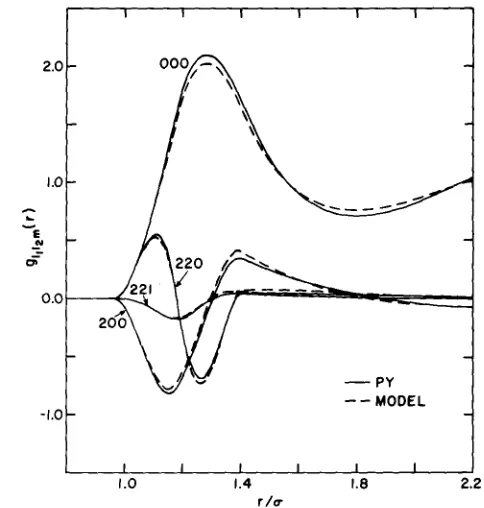
a n d q u a n t i t a t i v e l y in f a i r l y g o o d a g r e e m e n t w i t h t h e c o m p u t e d P Y f o r m s . F i n a l l y , figure 5 s h o w s t h a t t h e m o d e l l e d c o e f f i c i e n t s o f t h e p a i r d i s t r i b u t i o n f u n c t i o n g(12) o b t a i n e d u s i n g e q u a t i o n (6) are in r e m a r k a b l y g o o d a g r e e m e n t w i t h t h e c o r r e c t P Y r e s u l t s . ( I t will b e n o t e d t h a t h a v i n g o b t a i n e d q u a l i t a t i v e l y c o r r e c t f o r m s for S(12) a n d g(12), one m a y n o w p a t c h u p t h e o r i g i n a l s h o r t c o m i n g s o f e q u a t i o n (2) b y u s i n g
C(12) = g(12) - 1 - S ( 1 2 ) , (10)
if i n d e e d t h e c o e f f i c i e n t s C~,~2,,(r ) are t h e p r i m a r y o b j e c t s o f i n t e r e s t . )
T h e r m o d y n a m i c q u a n t i t i e s are o b t a i n e d in t h e u s u a l w a y [ 1 4 ] . I n t h e t a b l e , we s h o w t h e c o m p u t e d p r e s s u r e a n d c o m p r e s s i b i l i t y for t h r e e e l o n g a t i o n s l at
Reduced pressures and compressibilities for the hard dumbell fluid as obtained from the modelled solution (MOD), the Percus-Yevick equation (PY) and Monte Carlo simulation (MC).
0-2 0.4 0-6
pd 3 M O D PY M C M O D PY M C M O D PY M C
flp/p 2"51 2"51 2.59 2"59 2-59 2.64 2.73 2.72 2"78
0.4
PZ/fl 0.190 0.191 0.192 0"181 0"181 0-183 0.166 0.167 0.170
flp/p 7.16 7"13 8"02 7"58 7"52 8-42 8-38 8.20 9-23
0-8
PZ/fl 0.0324 0"0328 0"0354 0-0291 0"0302 0-0334 0.0242 0"0262 0'0300
412 F. L a d o
F i g u r e 4.
1.01 I I I I !
~. 0 . 0 ~ " / i - - - -
I/~'2/2,
--py
F .
.
,
""~ o.,
S p h e r i c a l h a r m o n i c coefficients of S(12) for h a r d d u m b e l l s o f e l o n g a t i o n 1 = 0'4~r at t h e d e n s i t y p d 3 = 0"8.
each of two densities. One sees again that equation (2) is surprisingly successful in mimicking the PY equation. For additional perspective, the correct values from c o m p u t e r simulations of hard dumbell fluids [19] are also included in the table.
It seems fair to conclude from this study that, in the absence of a more rigorously based formula, P y n n ' s simple model can play a useful role in the theory of molecular fluids. This should be particularly so in variational pertur- bation theories, where one basically needs merely a correct functional form for quantities like S(12).
F i g u r e 5.
2.0~
1 . 0 -
0.0
-I.0
I I ! 1 ! I
- OOC
/
2 2 ~ _-
- - p y
-- - M O D E L
( I I f I I I I
1.0 1.4 1.8 2.2
r / o -
S p h e r i c a l h a r m o n i c coefficients of g ( | 2 ) for h a r d d u m h e l l s of e l o n g a t i o n 1 = 0 ' 4 a at the d e n s i t y p d 3 = 0.8.
Analytical model for molecular fluids 413
REFERENCES
[1] HANSEN, J. P., and McDoxaLD, 1. R., 1976, Theory of Simple Liquids (Academic
Press).
[2] WERTHEI.Xl, M. S., 1963, Phys. Rev. Lett., 10, 321.
[3] TSIELE, E., 1963,07. chem. Phys., 39,474.
[4] ANDERSEN, H. C., 1975, A. Rev. phys. Chem., 26, 145.
[5] BARKER, J. A., and HENDERSON, D., 1976, Rev. rood. Phys., 48, 587.
[6] VERLET, L., and WEts, J. J., 1972, Phys. Rev. A, 5, 939. HENDERSON, D., and
GRUNI~KE, E. W., 1975,07. chem. Phys., 63, 601.
[7] LEBOWITZ, J. L., 1964, Phys. Rev. A, 133, 895. HmOIKE, K., 1969, J. phys. Soc.
07apan, 27, 1415.
[8] BAXTER, R. J., 1968,07. chem. Phys., 49, 2770.
[-9] PAL.XIER, R. G., and WEEKS, J. D., 1973,07. chem. Phys., 58, 4171.
[10] WAISMAN, E,, 1973, Molec. Phys., 25, 45.
[11] WERTrtEI.~I, M. S., 1971,07. chem. Phys., 55, 4291.
[12] BLU.Xl, L., 1972,07. chem. Phys., 57, 1862; 1973, Ibid., 58, 3295.
[13] PYNN, R., 1974, Solid St. Commun., 14, 29; 1974,07. chem. Phys., 60, 4579.
[14] LADO, F., 1982, Molec. Phys., 47,299.
[15] LADO, F., 1982, .'VIolec. Phys., 47, 283.
[16] SLUCKIN, T. J., and Srtt'KLA, P., 1983,o7. Phys. A, 16, 1539.
[17] LEBOWITZ, J. L., and PERCLS, J. K., 1983, 07- chem. Phys., 79, 443. SHAW, M. S.,
JOHNSON, J. D., and HOLIAN, B. L., 1983, Phys. Rev. Lett., 50, 1141.
[18] ONSAGER, L., 1949, Ann. N. Y. Acad. Sci., 51,627.
[19] TILDESLEY, D. J., and STEELE, W. A., 1980, Molec. Phys., 41, 85.