ISSN: 2319-8753
I
nternational
J
ournal of
I
nnovative
R
esearch in
S
cience,
E
ngineering and
T
echnology
(An ISO 3297: 2007 Certified Organization)
Vol. 3, Issue 11, November 2014
Analysis of SBI (Switched Boost Inverter)
Based On Nano Grid Applications Using
PWM Technique
M. Sailaja
1, K.Dayakar
2Dept. of Electrical And Electronics Engineering, Geethanjali Institute of Science and technology, Gangavaram, Andhra
Pradesh, India1
Associate Professor, Dept. of Electrical and Electronics Engineering, Geethanjali Institute of Science and technology,
Gangavaram, Andhra Pradesh, India2
ABSTRACT:In order to supply power from a solar panel or photo voltaic system at a low voltage to a grid at high voltage, a power electronic converter which is capable of voltage boosting and inversion is required. Newly introduced Switched Boost Inverter is capable of achieving both these objectives by a single stage. This paper presents a PWM control strategy based switched Boost Inverter (SBI) for DC nanogrid applications. Using Switched boost inverter (SBI), the system can produce an ac output voltage which is either greater or less than that of the dc input voltage. This also exhibits better Electro Magnetic Interference (EMI) noise immunity as compared to the VSI, which enables compact design of the power converter. It allows the shoot through switching state for boosting the input voltage and, compensates the dead time effect which causes the serious output voltage waveform distortion and avoids the risk of damaging the inverter switches. It can supply both ac and dc loads simultaneously from a single dc input source. These features cannot be obtained in the traditional inverters and they are more advantageous for DC nanogrid applications. The whole system is designed, modeled and, simulated in a MATLAB software.
KEYWORDS: DC nanogrid, Switched Boost Inverter (SBI), PWM control strategy, Steady state operation and simulation results
I INTRODUCTION
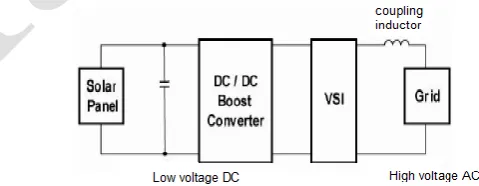
There is a greater increase in importance for the distributed power generation(DG) using renewable energy resources like wind turbines, photovoltaic generators, small hydro systems and fuel cells, because of the increasing global power demand. This produces a wide range of voltages due to fluctuation of energy resources and implies to the requirement of inverter topologies and control techniques. The conventional power electronic converter of grid connected renewable energy sources consists of two conversion stages. A dc/dc boost type converter transforms the low voltage variable dc into high voltage constant dc form. This high voltage dc is then converted into the required ac grid voltage by a conventional Voltage Source Inverter (VSI) as shown in fig.1.
ISSN: 2319-8753
I
nternational
J
ournal of
I
nnovative
R
esearch in
S
cience,
E
ngineering and
T
echnology
(An ISO 3297: 2007 Certified Organization)
Vol. 3, Issue 11, November 2014
This kind of topology, although simple may not be able to provide enough dc voltage gain when the input voltage is very low, even an extreme duty cycle of operation is employed. Also, large duty cycle operation may result in serious reverse-recovery problems and increase the ratings of switching devices. There is another problem with the added converter, i.e. it may deteriorate system efficiency and increase system size, weight, and cost. On the other hand, the upper and lower devices of the same phase leg cannot be gated on simultaneously in conventional voltage source inverter (VSI). Otherwise, shoot-through problems would occur and destroy the switching devices. In bridge type converters, Dead time is always used in case of shoot-through events, but it will cause waveform distortion. Though dead-time compensation technology has been developed, it increases complexity of control. So, it is desirable to have a single-stage high-gain boost inverter featuring no shoot through issues. So in this paper, we discuss the structure of the Switched Boost Inverter(SBI) based DC nanogrid and its advantages in comparison with the traditional one.
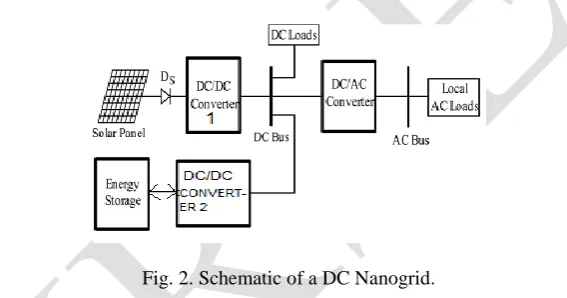
This paper introduces a Switched Boost Inverter based DC Nanogrid to supply both ac and dc loads simultaneously from a single dc input. DC NANOGRID is a low-power dc distribution system, which is suitable for residential power applications. In the DC nanogrid, the average load demand is generally met by the local renewable energy sources like solar, wind, etc. An energy storage unit is also associated with the nanogrid in order to ensure uninterruptible power supply to the critical loads and to maintain power balance in the grid. In this grid, there are three different power converter stages are used to interface the renewable energy source, energy storage unit, and the local ac loads in the system with the dc bus.
Fig. 2. Schematic of a DC Nanogrid.
Fig.2 shows the schematic of a dc nanogrid consisting of a solar panel as an energy source, a storage unit, and some dc and local ac loads. Here the solar panel was associated with a series blocking diode DS to prevent reverse power conduction.
Fig. 3.Structure of the proposed SBI-based dc nanogrid.
ISSN: 2319-8753
I
nternational
J
ournal of
I
nnovative
R
esearch in
S
cience,
E
ngineering and
T
echnology
(An ISO 3297: 2007 Certified Organization)
Vol. 3, Issue 11, November 2014
II. PROPOSED CIRCUIT
The proposed Switched Boost Inerter uses PWM control technique for the DC NANOGRID applications. This inverter has the following special features which are listed below.
SBI is a single or one stage power converter which converts dc voltage into ac voltage and supplies both ac and dc loads simultaneously from a single dc input (dc input is obtained from the solar panel).So it performs the functions of both dc to dc converter for solar panel and dc to ac converter in a single stage. Therefore it reduces the size and cost of overall system.
SBI can produce an ac output voltage, which is either greater or less than the available dc input and thereby it has an advantage of wide range of obtainable output voltage for a given dc input voltage
SBI has better Electro Magnetic Interference(EMI) noise immunity as compared to the traditional Voltage Source Inverter(VSI), because shoot-through event due to EMI noise will not damage the switches of SBI and there by it eliminates the requirement of converter protection circuits and helps in realization of compact design of the converter circuit.
As SBI allows shoot-through event, it does not has the requirement of dead time circuit and thereby it eliminates the complex dead time compensation technologies, which are required to minimise or compensate the waveform distortion caused by the dead time of VSI.
A .SCHEMATIC OF SBI:
The schematic of Switched Boost Inverter is shown in below fig.4.
Fig.4. Circuit diagram of SBI supplying both dc and ac loads.
This circuit consists of one active switch, one inductor (L), one capacitor(C) and, two diodes D1and D2 as shown in below. A low pass LC filter is connected across the output of the inverter bridge to filter the switching frequency components in the inverter output voltage. Here, the capacitor(c) connected between Vdc and ground acts as a dc bus for dc loads and, the capacitor (Cf) acts as an ac bus for ac local loads.
III.STEADY STATE OPERATION OF SWITCHED BOOST INVERTER (SBI)
The steady state operation of the Switched Boost Inverter (SBI) with its two modes of operation is explained below. It consists of two modes of operation and is capable of handling both positive and negative polarities by changing the switch operation.
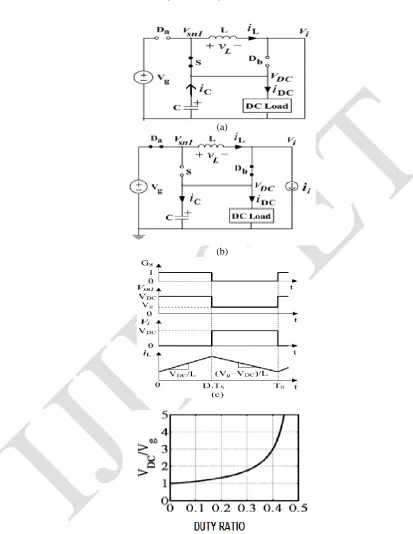
In the first mode, the inverter is in shoot-through zero state and switch S is turned ON. The diodes Da and Db are reverse biased as VDC > Vg. In this interval, capacitor C charges the inductor L through switch S and the inverter bridge. So, the inductor current equals the capacitor discharging current minus the dc load current.
In second mode, the inverter is in non-shoot through state and the switch S is turned OFF. The inverter bridge is represented by a current source in this interval as shown in the equivalent circuit of Fig 5. Now, the voltage source Vg and inductor L together supply power to the dc load, inverter, and the capacitor through diodes Da and Db. The inductor current in this interval equals the capacitor charging current added to the inverter input current and the dc load current. Note that the inductor current is assumed to be sufficient enough for the continuous conduction of the diodes Da , Db
ISSN: 2319-8753
I
nternational
J
ournal of
I
nnovative
R
esearch in
S
cience,
E
ngineering and
T
echnology
(An ISO 3297: 2007 Certified Organization)
Vol. 3, Issue 11, November 2014
(a)
(b)
Fig. 5. (a) Equivalent circuit of SBI in D·TS interval. (b) Equivalent circuit
ISSN: 2319-8753
I
nternational
J
ournal of
I
nnovative
R
esearch in
S
cience,
E
ngineering and
T
echnology
(An ISO 3297: 2007 Certified Organization)
Vol. 3, Issue 11, November 2014
IV. PWM CONTROL OF SBI
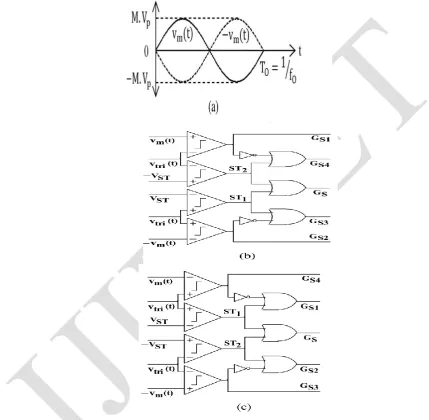
The PWM control of SBI is based on traditional sine-triangle PWM with unipolar voltage switching. This control technique has been illustrated in below fig.6, during positive and negative half cycles of sinusoidal modulating signal, which is shown in fig.6 (a).
ISSN: 2319-8753
I
nternational
J
ournal of
I
nnovative
R
esearch in
S
cience,
E
ngineering and
T
echnology
(An ISO 3297: 2007 Certified Organization)
Vol. 3, Issue 11, November 2014
V. RESULTS
A .SIMULATION OF THE PROPOSED SBI BASED DC NANOGRID
As shown in fig 7, simulation of the proposed model is performed using MATLAB.
Fig.7. Simulation Diagram of the Proposed closed loop SBI based DC nanogrid
Pulse width modulation is used to reduce the harmonics and improve the efficiency. The simulation results are shown in fig 7. The input dc voltage from the PV cell and the gating signals of five switches of SBI is shown in fig 8(a) and
8(b) respectively. Also the AC and DC output load voltages are shown in fig 8(c) and 8(d) respectively. The output voltage is boosted as compared with the input DC, with the help of the switched Boost Inverter configuration.
ISSN: 2319-8753
I
nternational
J
ournal of
I
nnovative
R
esearch in
S
cience,
E
ngineering and
T
echnology
(An ISO 3297: 2007 Certified Organization)
Vol. 3, Issue 11, November 2014
(b)
(c)
(d)
ISSN: 2319-8753
I
nternational
J
ournal of
I
nnovative
R
esearch in
S
cience,
E
ngineering and
T
echnology
(An ISO 3297: 2007 Certified Organization)
Vol. 3, Issue 11, November 2014
VI. CONCLUSION
Switched boost inverter (SBI) can produce an ac output voltage which is either greater or less than that of the dc input voltage. This also exhibits better Electro Magnetic Interference (EMI) noise immunity as compared to the VSI, which enables compact design of the power converter. It allows the shoot through switching state for boosting the input voltage and, compensates the dead time effect which causes the serious output voltage waveform distortion and avoids the risk of damaging the inverter switches. Therefore this circuit eliminates dead time circuit and complex dead time compensation technologies and thereby reduces the size and cost as compared to two stage DC to AC conversion system. It can supply both ac and dc loads simultaneously from a single dc input source. These features cannot be obtained in the traditional inverters and they are more advantageous for DC nanogrid applications.
REFERENCES
[1] R. C. Dugan and T. E. McDermott, “Distributed generation,” IEEE Ind. Appl. Mag., vol. 8, no. 2, pp. 19–25, Mar./Apr. 2002
[2] J.Wang, F. Z. Peng, J. Anderson, A. Joseph, andR.Buffenbarger, “Low cost fuel cell converter system for residential power generation,” IEEE
Trans. Power Electron., vol. 19, no. 5, pp. 1315–1322, Sep. 2004.
[3] J. Schonberger, R. Duke, and S. D. Round, “DC-bus signaling: A distributed control strategy for a hybrid renewable nanogrid,” IEEE Trans.Ind. Electron., vol. 53, no. 5, pp. 1453–1460, Oct. 2006.
[4] Y. Huang, M. Shen, F. Z. Peng, and J. Wang, “Z-source inverter for residential photovoltaic systems,” IEEE Trans. Power Electron., vol. 21, no. 6, pp. 1776–1782, Nov. 2006.
[5] L. Chen and F. Z. Peng, “Dead-time elimination for voltage Source inverters,” IEEE Trans. Power Electron., vol. 23, no. 2, pp. 574–580, Mar.2008.
[6] H. Kakigano, Y. Miura, and T. Ise, “Low-voltage bipolar-type DC micro grid for super high quality distribution,” IEEE Trans Power Electron.,vol. 25, no. 12, pp. 3066–3075, Dec. 2010.
[7] R. Adda, S. Mishra, and A. Joshi, “A PWM control strategy for switched boost inverter,” in Proc. 3rd IEEE Energy Covers. Congr. Expo., Phoenix, AZ, 2011, pp. 4208–4211.
[8] S. Mishra, R. Adda, and A. Joshi, “Inverse Watkins-Johnson
topology based inverter,” IEEE Trans. Power Electron., vol. 27, no. 3, pp. 1066–1070, Mar. 2012.
[9] Y. Zhou and W. Huang, “Single-stage boost inverter with coupled inductor,” IEEE Trans. Power Electron., vol. 27, no. 4, pp. 1066–1070, Apr.2012.
[10] Zhilei Yao and Lan Xiao, “Control of Single-Phase Grid-