ABSTRACT
FRAZEE, SHARON GLAVE. The Social Context of Inmate Misbehavior: A Contextual Analysis of Infractions in North Carolina Prisons. (Under the direction of Dr. William R. Smith.)
Inmate misbehavior is a relatively common phenomenon in correctional facilities throughout the United States. While many steps have been taken by correctional
THE SOCIAL CONTEXT OF INMATE MISBEHAVIOR: A CONTEXTUAL ANALYSIS OF INFRACTIONS IN NORTH CAROLINA PRISONS
by
SHARON GLAVE FRAZEE
A dissertation submitted to the Graduate Faculty of North Carolina State University
in partial fulfillment of the requirements for the Degree of
Doctor of Philosophy
DEPARTMENT OF SOCIOLOGY AND ANTHROPOLOGY
Raleigh 2003
APPROVED BY:
____________________________________ __________________________________
DEDICATION
PERSONAL BIOGRAPHY
Sharon Glave Frazee was born April 16, 1965 in Cortland, New York. She received her elementary and secondary education in Cortland, graduating with honors from Cortland High School. Following high school she served in the United States Army and then went on to earn her Bachelor of Science from Columbus College (now Columbus State
University), Columbus, Georgia, in 1987. She entered the graduate program at North Carolina State University in the spring of 1995, receiving a Master’s of Science in Sociology in May 1997, and a PhD in Sociology in May 2003. Presently, Ms. Frazee is employed in the health care research field as Manager of Analytic Services at Landacorp Inc. in Raleigh, NC.
ACKNOWLEDGMENTS
This doctoral project would not have been possible without the guidance, encouragement and patience of Dr. William R. Smith. He has served as my mentor, advisor and friend since my first year as a graduate student at NC State. I am also
indebted to Dr. Patricia L. McCall, Dr. Matthew T. Zingraff and Dr. Rodney L. Engen for their advice and encouragement on this project, as well as for serving on my committee.
Special thanks are extended to the many professors and graduate students at North Carolina State who have provided support and encouragement throughout my graduate career. In addition I would like to extend thanks to Joe Carter at SAS Institute for his suggestions on the analysis portion of this dissertation. He and the rest of the SAS staff have provided invaluable technical support both on this dissertation and in my
professional life. I would also like to thank my employers over the past four years for being flexible when I needed time to work on my dissertation or attend to other graduate school activities, and my many colleagues who have offered advice, encouragement, and a ready ear when I needed it.
TABLE OF CONTENTS
Page
LIST OF TABLES . . . viii
CHAPTER ONE: STATEMENT OF THE RESEARCH PROBLEM . . . 1
Introduction . . . 1
Background of the Problem . . . 1
Theoretical Explanations . . . 3
The Gap in Current Research . . . 6
Research Overview Hypotheses . . . 10
Overview of the Following Chapters . . . 11
CHAPTER TWO: THEORY AND LITERATURE REVIEW . . . 13
General Prison Information . . . 13
Prison Misbehavior . . . 17
Infraction Prevalence . . . 17
Theories of Prison Misbehavior . . . 19
Correlates of Misbehavior . . . 20
Demographic Correlates . . . 20
Age . . . 20
Gender . . . 22
Race . . . 22
Drug Use . . . 23
Other Demographic Correlates . . . 24
Criminal History Correlates . . . 27
Past Criminal and Institutional Behavior . . . 27
Sentence Length and Amount of Time Already Served . . . 28
Facility Correlates . . . 30
Jobs and Programs . . . 30
Prison Security Level and Size . . . 31
Prison Treatment or Custody Orientation . . . 33
Crowding and Transiency . . . 34
Racial Composition . . . 37
Problems with Correlates of Misbehavior . . . 38
The Importance of Context . . . 39
Contextual Effects . . . 41
CHAPTER THREE: DATA AND METHODS . . . 44
Introduction . . . 44
General Research Design . . . 45
The overall directional research hypothesis . . . 46
Study population and sample design . . . 48
Data . . . 48
TABLE OF CONTENTS
Page
Variable Selection and Operationalization of Major Concepts . . . 52
Dependent Variables . . . 52
Independent Predictor Variables . . . 53
Contextual Variables . . . 56
Bivariate Relationships Between Independent and Contextual Variables . . . 66
Analysis Procedures . . . 72
Multilevel Analysis . . . 72
OLS Regression . . . 72
Hierarchical Linear Models . . . 74
Limitations of Data and Methods . . . 77
CHAPTER FOUR: A TEST OF PRISONIZATION THEORY ON INMATE MISBEHAVIOR . . . 80
CHAPTER FIVE: A TEST OF IMPORTATION THEORY ON INMATE MISBEHAVIOR . . . 87
Comparison of Importation to the Prisonization Model . . . 92
CHAPTER SIX: A CONTEXTUAL MODEL OF INMATE MISBEHAVIOR . . 94
Combined Regression Model . . . 94
Hierarchical Linear Models . . . 98
Unconditional Means Models . . . 98
Models Including Effect of Level-2 Predictors . . . 100
Models Including Effect of Level-1 Predictors . . . 103
CHAPTER SEVEN: DISCUSSION AND CONCLUSIONS . . . 108
SOURCES AND REFERENCES . . . 123
APPENDICES . . . . Appendix A: Department of Correction Data Files . . . 146
Appendix B: Comparison of Male and Female Inmate Characteristics . . . 147
LIST OF TABLES
Page
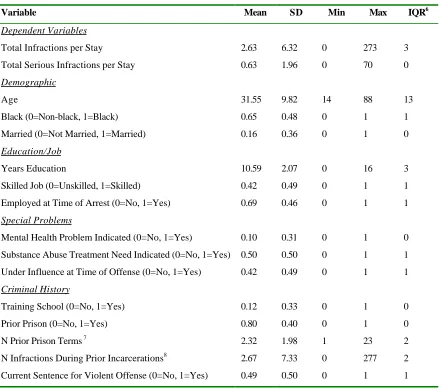
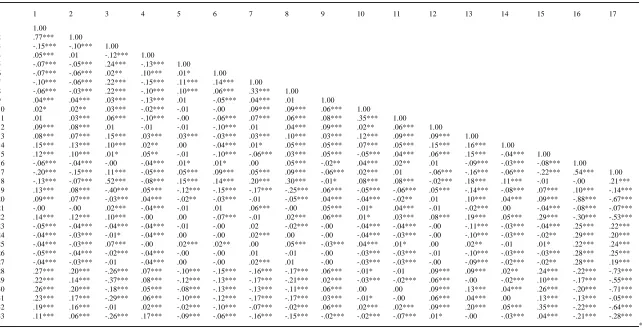
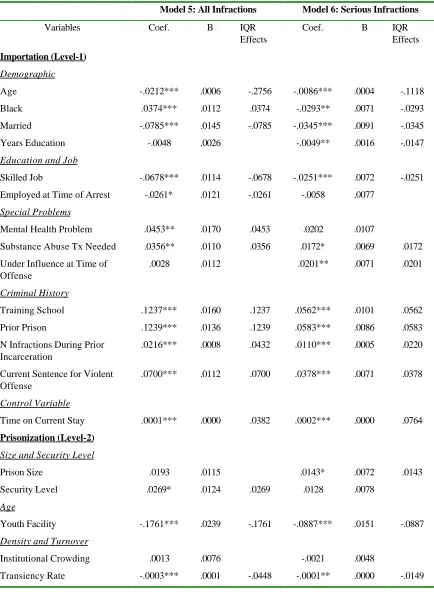
Table 1. Individual Level Variables . . . 56 Table 2. Characteristics of North Carolina Prisons . . . 60 Table 3. Correlation Coefficients of Independent Variables . . . 70 Table 4. Descriptive Statistics for Unlogged and Logged Dependent Variables . . 73 Table 5. OLS Regression: Effect of Prisonization Factors Predicting All
Infractions and Serious Infractions During current Prison Stay . . . 86 Table 6. OLS Regression: Effect of Importation Factors Predicting Any
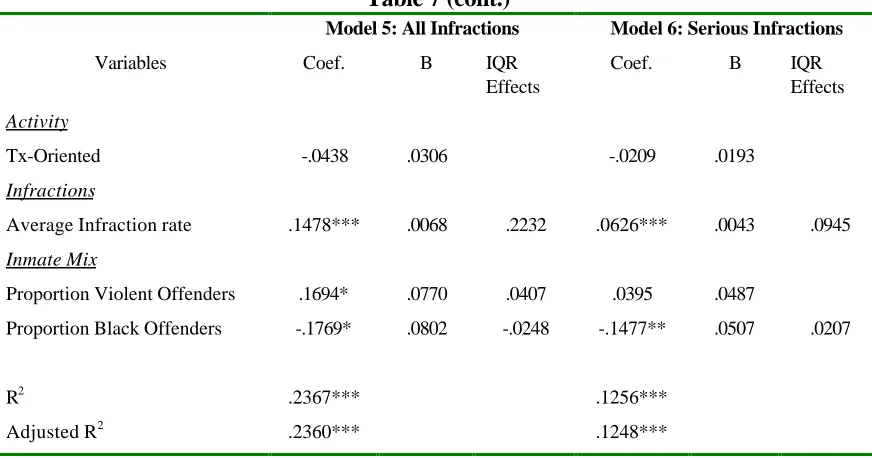
Infraction and Serious Infractions During current Prison Stay . . . 92 Table 7. OLS Regression: Effect of Importation and Prisonization Factors
Predicting Any Infraction and Serious Infractions during Current Prison Stay . . . 97 Table 8. Hierarchical Linear Models of Any Infraction and Serious Infractions
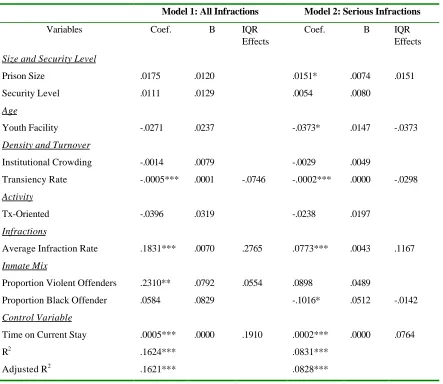
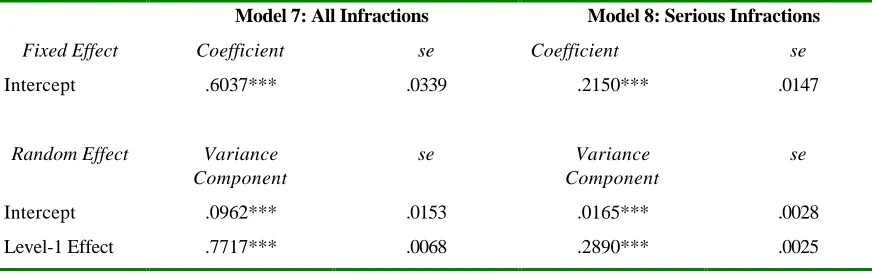
during Current Prison Stay: Unconditional Means . . . 100 Table 9. Effects of Prison Characteristics (Level-2) on All Infractions and
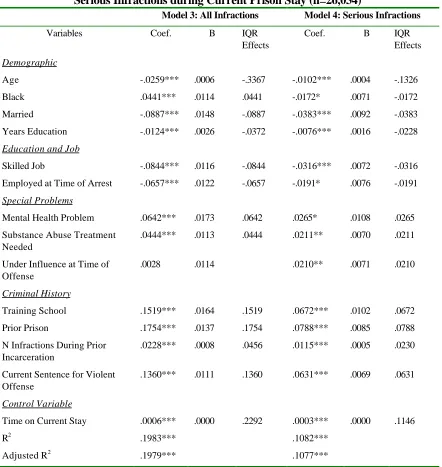
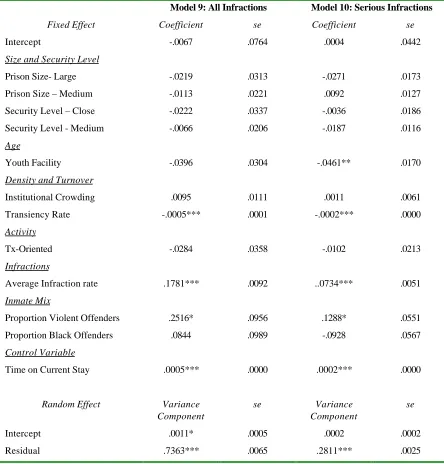
Serious Infractions . . . 102 Table 10. Hierarchical Linear Models of All Infractions and Serious Infractions
CHAPTER ONE
STATEMENT OF THE RESEARCH PROBLEM
Introduction
Sociologists have always been interested in why people conform or fail to conform to rules in society. This research looks at prison inmates and the context in which prison
misbehavior occurs. By definition prison inmates have already failed to conform to at least one societal rule, that of obeying the law. However, past research on human behavior tells us that one rule violation does not necessarily preclude obeying other rules. Just as most offenders obey most laws most of the time, the majority of inmates comply with most prison rules most of the time. With this in mind, the following study attempts to discover in what circumstances noncompliance does occur.
Background of the Problem
Flanagan and colleagues (1998) argue that prison can be seen as a unique form of society, with “its own distinctive set of social and cultural arrangements that include a dominant social structure, a special set of goals, norms and values, and a primitive yet serviceable economy” (Flanagan, Marquart and Adams 1998, p.91). However, the notion of prisons as unique societies is not a new one. For instance, in 1940 Clemmer published The Prison Community, which described how prisons are different from mainstream society. In this work, Clemmer portrayed the “inmate code” and coined the term “prisonization” to characterize the process of assimilation to that code, “the taking on in greater or less degree of the folkways, mores, customs and general culture of the penitentiary.” Several years later, Sykes (1958) characterized the “pains of imprisonment” suffered by inmates, viewing the deprivations of imprisonment as different from other types of suffering. Sykes and Messinger (1960) further developed this idea. They constructed a theory explaining the construction of the inmate social system as both a reflection of and accommodation for the deprivation and pains of prison life. Building on these works, Ohlin (1960) discussed how prisons are characterized by “goal conflict” stemming from the opposing mandates of treatment and custody, while Goffman (1961) described prisons as “total institutions,” a type of organization designed to transform people both socially and psychologically.
This interest in prison culture and behavior has led to the development of several
and importation.
Theoretical Explanations
Since the early 1960's, two major theoretical factions have dominated the field of explaining prison behavior: prisonization and importation. These theories differ primarily on the order of causation for inmate behavior: prisonization supposes that behavior is a result of the prison experience while importation posits that behaviors are in place prior to prison and are merely ‘imported’ into the prison setting.
Prisonization, or adaptation theories as they are often called, argues that behavior emerges as an adaptation to prison society (Clemmer 1940; Goffman 1961). Inmates learn through socialization, the rules and regulations of the prison as well as the informal values, rules and customs of the prison culture (Clemmer 1940). The process of prisonization begins with a transformation of the inmates’ status. They are given a number in lieu of their name and are made to wear uniforms, reminding inmates of their new status at the bottom of the institutional hierarchy. Prisoners must learn to operate under a new set of rules and even to understand a new language, prison slang. Clemmer argued that prisonization reinforces the inmates’ criminal status, further deepening their commitment to the inmate ideology.
Sykes (1958) expanded on Clemmer’s work by explaining the origin of the inmate subculture. Their reasoning was that inmate alienation and subsequent misbehavior are a reaction to the “pains of imprisonment”, such as loss of liberty, material possessions,
occasionally lead to inmates violating prison rules. The shared sense of suffering unifies inmate populations to some degree, creating an inmate subculture (Sykes and Messinger 1960).
While most early research on prisons is consistent with the idea of prisonization (e.g., Berk 1966; Garabedian 1963; Goffman 1961; Sykes 1958; Tittle 1969), prisonization theories have only received mixed empirical support more recently (Akers, Hayner, and Gruninger 1974; Ellis 1984; Leger 1978; Poole and Regoli 1983; Smith 1984; Thomas and Zingraff 1976; Wooldredge and Carboneau 1998). Beginning in the 1960s and 1970s, prisonization theories came under considerable criticism because of their disregard for the ways in which individual life experiences, such as criminal history, race, age, and socioeconomic status, affect inmate
behavior patterns. Researchers argued that inmates brought with them the code of the streets and applied this code to prison, thus importing values, behaviors and social structures into the prison environment (Carroll 1974; Irwin and Cressey 1962; Jacobs 1974, 1977). The models developed by these researchers are commonly referred to as “importation models.
Emerging from criticisms of the leading existing theory, one of the first tenets of
prisonization to be critically assessed was the assumption that prisonization is directly related to time spent in the prison (i.e., the longer one spends in the institution, the greater the expected level of prisonization). In his study designed to test the processes described by Clemmer, Wheeler (1961) found that rather than a direct linear relationship between time in prison and changes in inmate attitudes, a U-shaped pattern emerged. That is, inmates’ attitudes changed over time in a cyclical fashion, from socially conformist, to antisocial and then back to
1964).
Importation theories posit that inmate behavior has less to do with the deprivations experienced (i.e., prisonization) and more with the characteristics of inmates. That is, prisoners import their ideas, attitudes and behaviors from their outside lives as street criminals into the prison rather than learning new behavior as a result of the prison experience as suggested by prisonization. For example, Wheeler (1961) found prison adjustment to be dependent on the degree to which individuals adhered to “criminal values” prior to incarceration. This was supported by Wellford (1967), who concluded that the level of prisonization is “chiefly determined by the characteristics of the individual prior to his commitment, particularly with regard to his prior involvement in what is often referred to as the ‘criminalistic subculture’.” (p. 202). Rose Giallombardo (1966) concluded that the same phenomenon occurs for female inmates, with inmate patterns reflecting cultural definitions brought into the institution and which “determine the direction and focus of inmate cultural systems” (p. 187).
organizational roles and ideologies from the street into the prison. Similarly, Toch (1977) introduced the concept of prison “niches,” sub-environments with distinctive attributes. These niches are not unlike various cultural groups in free society. Importation models have also received some empirical support (Jacobs 1974; Poole and Regoli 1983; Schwartz 1971; Smith 1984; Tittle 1969).
However, an emerging group of researchers are proposing that neither prisonization nor importation alone is very useful in explaining the current dynamics of prison life. These
arguments seem to be the result of an increasing recognition of the complexity and diversity of inmates and prison settings. For instance, Hunt and colleagues argue that prison behavior cannot be attributed solely to forces emanating from inside the prison nor from those outside the prison (Hunt, Riegel, Morales, and Waldorf 1993). Even Clemmer (1940) recognized the interaction of pre-prison experiences with prison culture in determining the character of the prison subculture. Today, more than ever before, studying prison behavior is complex due to factors such as increased gang presence, changes in prison population demographics, higher levels of prison disorder, and new developments in prison policy (Hunt et al. 1993; Zamble and Porporino 1988).
The Gap in Current Research
theories provide a basis for identifying conditions in prisons that increase the rate of misbehavior, whereas importation theories establish a set of individual characteristics that
increase the risk of engaging in misbehavior. Inmates are neither solely driven to misbehavior by structural conditions and deprivations, nor are they only driven by imported norms and values. Discussing inmate misbehavior in either/or terms emphasizes structure at the expense of imported culture or vice versa, and we miss the dynamic, interactive process in which misbehavior emerges.
By combining importation and prisonization as an explanation for inmate misbehavior, we shift our attention to examining the contexts under which social action occurs. I define context here as the material and social conditions of one’s daily living environment. Both structural and cultural factors come into play within one’s social context. For instance, context is not limited to the physical locality within which inmates are imprisoned. Rather, context includes factors such as gender, race, and age, which simultaneously form a framework for organizing social relations. Context is an integral part of sociological theories in that social theories are premised on the assumption that social conditions (i.e., context) enable and constrain human activity. In this case, while individual factors influence adjustment to prison life, context has a direct impact on behavior independent of individual characteristics.
environment. Inmates bring with them a host of social, personal and cultural characteristics that influence their reaction to the prison environment. In what follows, a more comprehensive model of misbehavior that not only incorporates contextual factors, but also specifies how they are related to each other is developed. The result is a framework that depicts misbehavior as a function of social context.
The study of context has played an integral role in increasing our understanding of determinants of street crime victimization (e.g., Miethe and Meier 1994; Rountree, Land and Miethe 1994; Rountree and Land 1996). It seems likely that prison misbehavior occurs in a similar fashion. That is, structural conditions such as population heterogeneity and density, inmate mobility, and lack of job/program opportunities can be identified as ‘criminogenic’ forces because they increase culture conflict, decrease available resources, or hamper the development of effective mechanisms of social control (Bursik 1988; Kornhauser 1978; Sampson and Groves 1989). Social context may also increase opportunities to misbehave by increasing or decreasing the amount of supervision over persons and things in an area (Miethe and Meier 1994).
factors, while micro-level analysis is normally restricted to the experiential features of imprisonment. Because both macro and micro forces are at work simultaneously, many researchers (Ellis 1984; Gaes and McGuire 1985; Owen 1998; Poole and Regoli 1983; Smith 1984; Thomas and Zingraff 1976; Wooldredge and Carboneau 1998) have considered both in their research. However, methods used in the past have been generally restricted to types of analyses that are unable to fully show how individual-level characteristics vary as a function of aggregate-level characteristics. This may explain the often-inconclusive results in past research (Gaes and McGuire 1985; Poole and Regoli 1983; Thomas and Zingraff 1976). In an attempt to overcome some of the difficulties encountered by earlier research this study employs
hierarchical linear models.
Hierarchical linear models are one method used to perform contextual analyses. These types of models allow us to look at the interaction of individual and environmental
characteristics, thus presenting a clearer picture of which factors and in what combinations of factors, misbehavior occurs. Contextual analysis has been widely endorsed as a research tool to bridge this macro-micro gap (Blalock 1984; Bryk and Raudenbush 1992; Flanagan et al. 1998; Miethe and Meier 1994; Miethe and McDowall 1993; Myers and Talarico 1987;
Research Overview and Hypotheses
The overriding assumption of this research is that context is important to our understanding of inmate behavior. That is, we must take into account the interrelation of individual and environmental factors and how the outcomes of these interrelations create a situation where misbehavior is both possible and likely.
Two major theoretical traditions, prisonization and importation, are tested. First, each theory is analyzed singly, and then a contextual model looks at how factors supporting each of the theories interact and influence each other. This interaction seems particularly important to study because of today’s prison climate. It is expected that looking at individual-context interactions will shed some light on misbehavior. We might find, for example, that inmate behavior is dependant on the proportion of inmates with particular characteristics. For instance, someone with violent pre-prison characteristics may act differently in a prison with many other violent offenders than in a prison with very few violent offenders.
Thus, this research looks at the context in which inmate misbehavior occurs. Two key questions are addressed in the analysis: first, does prison context affect rates of inmate
misbehavior, and second, do these contexts affect the role inmate characteristics play in prison misbehavior? My hypothesis is that prison context interacts with individual correlates of
misconduct to have a significant effect on misconduct. In other words, true context is created by both the physical and the social factors; and determining contextual effects on an outcome requires the consideration of both. Where this hypothesis is supported and cross-level
tested using data provided by the North Carolina Department of Correction for prisoners incarcerated during 1997.
Studying inmate misconduct is important from both a theoretical and an applied
perspective. Discovering why inmates fail to comply, or perhaps more interesting, why they do comply, furthers our knowledge of human behavior. Sociologists have long known that rule conformity is necessary for the maintenance of the social system. The system (i.e., prison) is able to maintain its integrity only if the subsystems (i.e., prisoners) perform their designated roles and functions, thus promoting internal order. From this point of view, misconduct damages the effective operation of the correctional institution, detracting from its ability to provide the
intended services to the larger society (Goetting and Howsen 1986). In addition, controlling the behavior of inmates is a major concern in most federal, state and local correctional facilities. While behavioral problems are expected due to the norm-violating history of the typical inmate, correctional agencies spend a considerable proportion of their resources on minimizing inmate misbehavior as well as incurring costs directly related to individual incidents of misbehavior (Lovell and Jemelka 1996; Wright 1994).1
Overview of the Following Chapters
while Chapter Five tests the effects of importation on inmate misbehavior. Chapter Six then presents the contextual model of inmate misbehavior and the results of analysis of the effects of context on infractions. Chapter Seven provides the final discussion and conclusions.
CHAPTER TWO
THEORY AND LITERATURE REVIEW
General Prison Information
Prisons have served a variety of functions over time, from poorhouse to warehouse for criminals. Likewise, the purpose of imprisonment has also changed, generally alternating between retribution, incapacitation, deterrence and rehabilitation. Retribution is aimed at punishment, applied in proportion to the seriousness of the crime. Incapacitation is intended to prevent further criminal behavior by physically restraining the offender from engaging in further misconduct. Deterrence seeks to prevent the offender from committing further crimes by punishing them (specific deterrence) as well as deterring others from committing crime through the example being set (general deterrence). Rehabilitation takes the view that criminal behavior stems from social or psychological shortcomings and that the criminal justice system can work to correct these shortcomings. It is assumed that with effective treatment, offenders can be reformed into law-abiding citizens. In practice, correctional philosophy usually shows elements of all four functions, although one tends to dominate.
Regardless of the philosophy behind corrections, the most basic mandate of the prison is to contain and maintain offenders (Garland 1990). The growing numbers of Americans incarcerated in prisons makes this primary goal more difficult.
inmates being added to state prison systems each week (BJS 1998). The South has been particularly affected by recent population increases since this region contains nearly 50% of state correctional facilities and more than 40% of all state prisoners. Not surprisingly then, the South also has the highest per capita incarceration rate in the country. There are 437 prisoners per 100,000 state residents in the South, compared to the Northeast which has only has 293 prisoners per 100,000 residents (Stephan 1997).
Growth in prison populations is most frequently attributed to tougher crime legislation, especially for violent and drug offenses (Austin 1991; Austin and Irwin 1990; Irwin and Austin 1997; Josi and Sechrest 1998; Langan, Perkins and Chaiken 1994; Shichor and Sechrest 1996; Taggart and Winn 1993). However, the distributions of these offenders differ between the state and federal correctional systems. State facilities are more likely to house violent offenders while Federal prisons are more likely to contain drug offenders. Violent offenders account for fifty percent of the total growth in the number of state prison admissions since 1990 (BJS 1998) while the proportion of offenders in federal prisons convicted of drug crimes rose from 25% in 1980 to 61% in 1994 (Josi and Sechrest 1998). Using 1990 federal and state court data, Langan and colleagues (1994) found that drug crimes accounted for 32% of sentences to state prisons and 62% of federal prison sentences. Similarly, Skolnick (1995) found that 20% of federal inmates in 1994 were low-level drug offenders with no current or prior history of violence and no prior prison time.
actually served by inmates. This means that the inmates prisons are admitting today will be there longer than ever before. Evidence of this is already apparent with the average length of stay for first releases from prison increasing from 22 months in 1992 to 25 months in 1994 (Maguire and Pastore 1997).
Prison admissions come primarily in two forms: new court commitments and returnees, the latter usually are either probation or parole violators. Recently, an increase in the number of returnees has occurred. In 1980, 17% of admissions were parolee returnees compared to 29.5% in 1992 (Gilliard and Beck 1994). This accounts for more than one-third of prison population growth in state prisons during that period (Gilliard and Beck 1994).
to state and federal facilities.
Increases in the use of prison have not affected all segments of society equally. Two population groups have been especially affected: minorities and women. In 1992, African American males were incarcerated in prison at a rate of 2,678 per 100,000 black residents and African American females at a rate of 143 per 100,000 black residents, both more than seven times that of their white counterparts (Gilliard and Beck 1994). Apart from race, the number of women in prison has risen rapidly. In 1997, women comprised 21.6% of people arrested in the United States and 6.4% of the prison population, up from 19% of arrests and 5.4% of prison populations in 1991 (BJS 1998, 1994). Shifts in the proportion of minority and female offenders can at least partially be explained by the nationwide war on drugs. Since the 1980's, the war on drugs has targeted urban areas where minority representation is highest. In addition, females represent a disproportionate share of drug commitments, at least partially explaining the rise in female inmate populations (Maurer and Huling 1995; Steffensmeier 1992).
These changes are likely to affect the way prison is experienced by inmates. Prison construction has not been able to keep up with inmate population growth, leading to
overcrowding. This in turn, changes the quality of inmate life as well as the level of control that must be implemented by prison officials to keep burgeoning populations contained. Likewise, the offenses that inmates are incarcerated for affect prison life. The increase in drug offenders being sentenced to prison has immediate implications: more inmates with substance abuse problems, younger inmates, and longer sentences. This combination creates a more volatile
population than in the past.
Prison Misbehavior
Prison populations are diverse and complex. Inmates come not only with a variety of criminal sentences but also with a wide range of personal, social and psychological problems. This makes controlling inmates a challenge. While maintaining custody of prisoners and protecting the public is the primary responsibility of prison administrators, they must also provide an environment that protects prisoners from each other (Austin 1983). To accomplish these goals, inmates must be controlled and guidelines for appropriate behavior delineated.
Infraction Prevalence
Prisons are institutions geared to rules and regulations designed to control behavior in order to ensure their safe and orderly operation (Irwin 1980; Stephan 1989). Prison rules prohibit criminal offenses and other behaviors that are not criminal but rather tend to be disruptive or dangerous such as failing to obey an order or possessing a weapon. However, failing to obey prison rules is fairly common. A national survey of state prison inmates found that 53% of inmates had been charged with a rule violation, an average of 1.5 rule violations per inmate per year (Stephan 1989). While most rule violations are minor, such as disobeying an order, serious misbehavior is not uncommon. In 1995, approximately 5 percent of the nation’s state prison populations were assigned to some form of segregation, a common punishment for serious misbehavior (Criminal Justice Institute 1995).
observed by or reported to staff. Of those that are, not all are recorded. It has even been suggested that correctional officers often allow some misconduct, including violent behavior, in order to obtain inmate cooperation (Hewitt, Poole and Regoli 1984). It should be noted thought that when prison staff charge an inmate with violating prison rules, the inmate is quite likely to be disciplined in some way. Stephan (1989) found that more than 90% of inmates charged with violating prison rules were found guilty in prison administrative proceedings, regardless of race, age or gender.
We also know from previous research that misbehavior is not evenly distributed among inmates. Both individual and institutional factors have been shown to affect the incidence of misbehavior. Individual misconduct rates vary with type of crime, length and intensity of criminal careers (Bondeson 1989; Flanagan 1983; Stephan 1989; Zamble 1992) and history of drug use (Flanagan 1983; Stephan 1989). Gender (Craddock 1996; Stephan 1989) and age (Bondeson 1989; Carey, Garske and Ginsberg 1986; Cooper and Werner 1990; Flanagan 1983; Gaes and McGuire 1985; Hanson, Moss, Hosford and Johnson 1983; Porporino and Zamble 1984; Stephan 1989; Toch and Adams 1989; Wolf, Freinek and Shaffer 1966) are commonly cited as affecting misconduct rates. Other factors linked to misconduct include education level (Proctor 1994), family history of incarceration (Stephan 1989), and past institutional
misbehavior (Flanagan 1983; Hanson et al. 1983; Morris and Miller 1985). Institutional factors such as prison size and security (Flanagan 1983; Stephan 1989), the utilization of prison
Camp 1997; Dooley 1986; Megargee 1976; Walters 1998; Wooldredge 1989) have also been shown to affect levels of inmate misbehavior.
Theories of Prison Misbehavior
As discussed in the previous chapter, two major theories have been applied to prison misbehavior: importation and prisonization. The importation theory of prison social structure essentially posits that lower class offenders bring to prison a set of subcultural attitudes and meanings, including those related to the use of violence and opposition to authority (Irwin and Cressey 1962). Importation models have generally been applied only to individual-level misbehavior (McCorkle, Miethe and Drass 1995). Alternatively, prisonization theories suggest that inmate misbehavior is the product of the stressful and oppressive conditions within the prison itself, lending itself to macro-level analyses.
Prisonization theory lends itself to looking at the ways in which prison structures and processes influence inmate adaptation to incarceration. Institutions that emphasize custody, with stricter disciplinary rules and physically harsher environments, may contribute to increased inmate misbehavior (Berk 1966). Importation researchers however, point to behaviors in prison as a reflection of behaviors being exhibited outside the prison walls by the groups to which the prisoners once belonged. Increased gang activity, lack of respect for authority figures in schools and the community, and deviant activities are simply transferred to a new location, that of the prison.
While the theoretical debate is yet unresolved, past research has shown that not all inmates react to prison in the same manner. A variety of factors seem to affect adjustment to prison life and subsequent rates of misbehavior. These can be broadly broken into
demographic, criminal history and facility correlates of misbehavior. With the exception of facility correlates, predictors of institutional misconduct and general recidivism are very similar (Gendreau, Little and Goggin 1996).
Demographic Correlates
Individual or demographic correlates have been studied perhaps more frequently than the other factors. Key factors include age, gender, race, and drug use history.
Age
others than older inmates (Wright 1991). This relationship is consistent with the more general age-criminality literature (Ellis et al. 1974; Greenberg 1985; Hirschi and Gottfredson 1983).
Younger inmates pose several other risks. Inmates under the age of 30 are a much higher escape risk than their over thirty counterparts (Gaes and McGuire 1985). They are also more likely to be involved in organized security threat groups, or gangs, within the prison (Trout 1992). Membership in security threat groups is particularly attractive to younger inmates who may have a previous affiliation with national or regional groups prior to prison. These groups provide protection, status, and access to prison contraband and gambling rings (Gaes and McGuire 1985). Security threat groups pose significant problems for institutional security as illustrated by Federal Bureau of Prisons research that suggests security threat group members are five times more likely to be involved in serious institutional misbehavior than non-group members (Trout 1992).
The age-misconduct correlation has not been found in all research however. Unlike most other studies, MacKenzie (1987) failed to find a direct linear decline between age and aggressive behavior in prison. MacKenzie did find that younger inmates tend to respond to fear of victimization or the need to assert oneself in interactions with others in a manner that is more likely to lead to punishment by the institution. In essence, he found that all ages have
interpersonal conflicts but the types of conflicts engaged in by younger inmates tend to be those most visible to prison authorities. Similarly, Holland and Holt (1980) failed to find a relationship between age and disciplinary adjustment in a sample of minimum-security state prisoners.
While most research has focused primarily on male inmates, some studies have looked at differences between male and female inmates in their adjustment and subsequent misbehavior. Several studies have shown that women experience prison in a fundamentally different way than do men (Giallombardo 1966; Heffernan 1972; Owen 1998; Tittle 1969; Ward and Kassebaum 1965). Not surprisingly then, prison behavior differs by gender. Stephan’s (1989) study found that a higher percentage of male inmates (53%) had been charged with infractions than female inmates (47%) but women seemed to incur infractions at a higher annual rate than men. That is, women who misbehave in prison do so at a higher rate than men who misbehave. This accounts for the higher average annual infraction rate for female prisoners (2.0 versus 1.4 for men).
Race
Race is a variable that has been tested often, but with inconsistent results. While some studies find evidence of higher misbehavior rates for nonwhites (Bowker 1980; Harer and Steffensmeier 1996; Poole and Regoli 1980), most research fails to find significant race differences on infraction rates (Craddock 1996; Finn 1995; Flanagan 1983; Hewitt, Poole and Regoli 1984; Stephan 1989; Van Voorhis 1993). Even in studies that show Black inmates receive significantly more disciplinary reports than White inmates, it is unclear whether Black inmates actually violate more rules or if there is simply a greater willingness for official reports of misconduct to be made on non-Whites (Hewitt et al. 1984).
1974; Hewitt et al. 1984; Johnson 1966; Toch et al. 1987; Wolfgang 1961; Wolfgang and Ferracuti 1967). Therefore, prison misbehavior may simply demonstrate the influences of importing lower-class focal concerns such as toughness, physical integrity and manliness into the prison environment (Thomas 1973; Wellford 1967). It is suggested that variations in prior social experiences may differentially prepare inmates to resort to violent or other unacceptable behavior as a response to the problems posed by incarceration (Poole and Regoli 1983).
This does not mean that race doesn’t matter in prison life. Race is often a source of conflict in prisons. Even in early research such as Gresham Sykes’ (1958) classic study of prison life, Sykes observed “the inmate population is shot through with a variety of ethnic and social cleavages” that kept prisoners from acting in concert or maintaining a high degree of solidarity (p. 81). Today, racial and ethnic imbalances are more pronounced than ever and can lead to serious problems. Prisons communities are frequently split along racial and ethnic lines, with groups and gangs defined in terms of race and ethnicity (Carroll 1988; Jacobs 1977; McCall 1995).
Drug Use
have used cocaine or heroin in the month prior to the offense for which they were incarcerated occurred. They are also more likely to have been using these drugs daily, and are more likely to have been under the influence of major drugs at the time they committed the crime (Maguire, Pastore, and Flanagan 1993). This supports other research that indicates increasing female drug use in recent decades it is a factor in the increased involvement in criminal behavior by women (Merlo and Pollock 1995).
Several studies show that inmates who used drugs prior to admission to prison are more likely to violate prison rules than non-drug users (Flanagan 1983; Stephan 1989). In addition, those inmates with more extensive drug histories are the most likely to violate prison rules (Stephan 1989).
However, like many other factors believed to be related to prison misbehavior, drug use has not been validated as a correlate in all studies. In their study of federal prisoners, Morris and Miller (1987) did not find drug/alcohol abuse to be predictive of overall misconduct and prison violence. Similarly, research by Cooper and Werner (1990), Hanson et al. (1983), and Wooldredge and Carboneau (1998) failed to validate the effect of drug use on prison
adjustment and behavior.
Other Demographic Correlates
Other demographic correlates of misbehavior that have been mentioned in the literature include family factors, educational level, employment status, and mental health factors.
Sociologists have long recognized the effect of family experiences on individual
1991; Wilson 1978). While it is beyond the breadth of this study to discuss the general area of family and crime, several studies have looked at the influence family background has on
prisoners. For instance, Stephan (1989) found that many prison inmates have other family members who have served a prison or jail sentence. In his sample, nearly two-fifths of all inmates had an immediate relative (sibling, parent, spouse or child) who had served or was serving a term in jail or prison. Of these inmates approximately 58% had a rule violation compared to 49% of inmates from families with no other member ever in jail or prison (Stephan 1989). Marital and parental status has also been studied in conjunction with inmate behavior. Many researchers (Flanagan 1983; Johnson 1966; Jones 1986; Toch and Adams 1989; Wolfgang 1961; Wooldredge 1994; Wooldredge and Carboneau 1998) found married inmates have fewer disciplinary problems than unmarried inmates. Likewise, inmates who are childless have higher rates of misbehavior than those with children (Bondeson 1989).
Educational level and employment factors have been found to affect subsequent
seems to be important, with those engaged in skilled employment prior to incarceration being less likely to engage in misbehavior (MacKenzie 1987; Wooldredge and Carboneau 1998).
Some current research suggests that emotionally disturbed inmates are
disproportionately involved in prison infractions (Adams 1986; Lovell and Jemelka 1996; Toch and Adams 1986). One study found that inmates who had either been hospitalized or had received outpatient care for mental health problems had a 20% higher annual infraction rate than inmates who had not received mental health services (Toch and Adams 1986). Related to this, research shows that the degree to which an inmate fears being the victim of prison violence is the strongest predictor of his mental health (Maitland and Sluder 1996; McCorkle 1993). Mental health issues are of particular concern as the complexities of managing inmates effectively are amplified when offenders suffer from even minor mental health problems (Maitland and Sluder 1996). Prison staff is placed in the precarious position of trying to
balance their custodial duties (which demand disciplinary responses) with their mental health role (which suggests that referrals to treatment staff are in order). While both options can be
exercised, mentally ill inmates can be particularly disruptive, reducing staff enthusiasm for recognizing the relevance of mental health issues (Toch and Adams 1988).
Criminal History Correlates
One of the key principles of human behavior is that past behavior is highly predictive of future behavior. Thus, when trying to identify inmates who are likely to have difficulty
prior prison experience, as well as the length of an inmate’s prison sentence and the amount of time already served on that sentence.
Past Criminal and Institutional Behavior
One of the best-documented empirical regularities in criminology is the positive association between past and future criminal behavior (Akers 1985; Andrews 1983; Cook 1986; Cornish and Clarke 1975; Farrington and West 1990; Gottfredson and Hirschi 1990; Hill 1985; Hirschi 1969; Lemert 1972; Sutherland and Cressey 1974; Tittle 1980; Williams and Hawkins 1986). Thus, it can be supposed that inmates with longer criminal histories and prior incarcerations and those who have had problems in prison in the past will have higher rates of misbehavior than inmates with shorter criminal histories and no prior problems in prison. This has been validated by research showing that inmates serving their first prison sentence have a lower average annual rate of infractions than recidivists, regardless of the amount of time already served on their current sentence (Bondeson 1989; Flanagan 1983; Stephan 1989).
primarily to the fact that prison misconduct is the most extensively documented behavioral factor and that other, less often documented, factors may in fact, be accounting for this relationship.
Sentence Length and Amount of Time Already Served
The effect of sentence length also has had mixed results. In a study of federal prisoners, those with longer sentences had greater difficulty in adjusting to prison than inmates with shorter sentences (Morris and Miller 1985). This has been explained as a result of greater frustration and emotional stress for inmates with long sentences (Brown and Spevacek 1971; Ellis et al. 1974; Flanagan 1980; Jones 1986; McCorkle 1992; Proctor 1994; Van Voorhis 1993; Zink 1958) and by the decreased psychological threat of disciplinary action on inmates who face very long sentences (Leeke and Mohn 1986). However, another study by Cooper and Werner (1990) found that inmates with longer sentences actually had fewer adjustment problems than inmates with shorter sentences.
However, other research supports a nonlinear socialization process for inmates. For instance, Wheeler (1961) found that inmates incarcerated for six months or less, as well as those who had six months or less remaining prior to release from prison, expressed more pro-social attitudes than other inmates. This inverted U-shaped curve for prison misbehavior has garnered considerable support in the literature (Craddock 1996; Garabedian 1963; Glaser 1964; Tittle 1969; Tittle and Tittle 1964; Toch and Adams 1989; Toch, Adams and Grant 1989; Wellford 1967; Wheeler 1961; Zamble 1992). However, some research has supported neither a linear, nor a U-shaped pattern of misbehavior and antisocial attitudes over the course of incarceration. Flanagan’s (1980) study found similar rates of infractions throughout the course of a sentence and Garabedian’s (1963) study found the effects of time on prisonization depended upon the type of inmate. Garabedian found that professional street criminals (“square johns” or “right guys”) conform to Wheeler’s U-shaped curve, but different patterns emerge for other types of inmates.3 Of course, sentence length and time served do not occur in a vacuum. Inmates who have served more time tend to be older, thus a considerable portion of the time effect may be due to aging.
Facility Correlates
The correlates discussed thus far have focused on individual-level factors such as demographics and criminal history. These factors tend to be those that proponents of importation theories consider. However, other researchers have looked at how the prison
3
experience itself affects inmate behavior (Thomas and Zingraff 1976; Wooldredge and Carboneau 1998). Key factors in this type of research are the availability of jobs and
programs, prison security and size, treatment or custody orientation, crowding, transiency of the inmate population, and the racial mix of inmates.
Jobs and Programs
Prisons tend to be full-service institutions, providing a range of activities for inmates, many of which are comparable to those available in the larger society. Inmate activities serve multiple purposes including relief of boredom, rehabilitation, incentives for good behavior, and, in the case of inmate jobs, defraying some of the costs of housing inmates by having inmates provide some of the labor necessary for the day-to-day operation of the prison. Perhaps most importantly, prison jobs and programs reduce idleness and provide structure. Since idleness is a major cause of prison disorder, prison administrators use prison jobs and programs to keep inmates occupied (Gaes and McGuire 1985; McCorkle et al. 1995). This is supported by research that shows institutions with a greater percentage of inmates involved in educational, vocational and industrial programs experience lower rates of assaults on inmates and on staff (McCorkle et al. 1995). There is also empirical support for the proposition that involvement in prison work programs is related to a reduction in overall inmate misconduct (Flanagan et al. 1988; Petersilia and Honig 1980; U.S. Department of Justice 1991). When looking at participation in work versus non-work programs however, Rhodes and colleagues (2001) found that inmates participating in non-work activities such as vocational training and
rehabilitative programs had higher rates of misconduct than those who participate in work activities. While at face value, it appears that all activities are not equal in their ability to reduce misbehavior; the relationship between work and non-work programs to misconduct is perhaps due more to the type of inmates assigned to work versus non-work programs. Many prison systems place inmates in non-work programs such as GED, drug treatment or rehabilitative programs prior to inmates being eligible for work programs.
Prison Security Level and Size
Differences in security level affect the level of supervision over inmate behavior. Inmates in more secure facilities are offered fewer opportunities for clandestine misbehavior than those in less secure facilities (Bidna 1975; Kratcoski 1988; Toch 1977). Thus, it is not surprising that more misbehavior is reported for inmates in maximum-security facilities (an average of 1.9 infractions per inmate) than prisoners in either medium (1.4) or minimum (1.2) (Stephan 1989).
minimum-security facilities and access to programs tends to be more limited. Maximum-security prisons are characterized by many stringent rules and restrictions and inmates are more likely to be isolated from one another for long periods in single-cell accommodations (Farmer 1994). Frequently, maximum-security institutions are strictly custodial and make little or no effort to rehabilitate inmates (Van Voorhis 1997).
Facility size also has been correlated with inmate misbehavior. Stephan (1989) found that small prisons of 500 or fewer inmates contained a smaller percentage of inmates charged with infractions (47%) than did either medium-size prisons of 500-999 inmates (56%) or large institutions of 1,000 or more (55%).This may be due to other factors such as the security level of smaller prisons. Smaller facilities tend to house lower-risk inmates than larger ‘warehouse’ type prisons.
However, others have discussed the need to look further than just the size and security level of a prison. Prisons of the same security level and size can vary in structure, includingthe number, clarity and consistency of rules; the degree to which one is able to control these rules; and the amount and type of support provided by the structuring agent (Miller 1981; Reitsma-Street and Leschied 1988). While we can speculate that more secure and larger prisons will, on the whole, provide more structure than smaller and less secure facilities, we rarely measure these factors directly. Rather, we tend to use size and security level as a measure of
environmental structure, a situation that is less than ideal (Reitsma-Street and Leschied 1988).
Prison Treatment or Custody Orientation
important in inmate behavioral outcomes. When comparing inmate organization in three types of prison settings, Berk (1966) found support for prisonization theory. Inmates in the most
treatment-oriented facilities displayed the most positive attitudes toward staff, the prison itself and the treatment program while inmates in the most custody-oriented facilities, displayed the most negative attitudes. Street, Vinter, and Perrow (1966) also found similar findings for juveniles in their research. A study of federal inmates incarcerated in treatment-oriented prisons showed an inverse relationship between the length of imprisonment and prisonization and misbehavior (Atchley and McCabe 1968). That is, attitudes and behavior improved over time for inmates in treatment-oriented facilities. While differences in behavior seem to be clear in these early studies, we should not assume that all treatment-oriented prisons would have lower infraction rates. Street and colleagues (1966) caution us to temper assumptions that inmate social systems operate equally in all institutional contexts. What they seem to be stressing is the necessity for looking at the prison holistically rather than focusing on one factor or another.
Crowding and Transiency
Population crowding is yet another possible aggregate-level influence. Prison overcrowding has become quite commonplace in state and federal facilities and has created problems for inmates and prison staff (BJS 1998; Camp and Camp 1993, 1997, 1999; Furniss 1996; Ruback and Carr 1993; Vaughn 1993). Researchers have noted that levels of prison violence have risen rapidly in years when overcrowding has increased (Maitland and Sluder 1996; Ruback and Carr 1993; Wooldredge 1989).
Overcrowding increases psychological and emotional strain for both inmates and staff (Cox, Paulus and McCain 1984; Klofas, Stojkovic, and Kalinich 1992). Crowding makes it more difficult for staff to supervise inmates effectively (Cobb 1985; Ellis et al. 1974; Gaes 1985; Gaes and McGuire 1985; Paulus and Dzindolet 1993). It may also influence inmate misbehavior and aggression as inmates are unable to control or avoid unwanted interaction or stimulation, increasing inmate fears for their personal safety, and reducing the means to maintain personal identity (Dooley 1986; Megargee 1976). A strong relationship between crowding and inmate rule violations has been supported in the literature (American Correctional Association 1981; Clayton and Carr 1984; Cox et al. 1984; Eckland-Olson et al. 1983; Ellis 1984; Farrington and Nuttall 1980; Gaes 1985; Gaes and McGuire 1985; Jan 1980; Jayewardene, McKay and McKay 1976; Kratcoski 1988; Leger 1988; Martin and Zimmerman 1990; Nacci, Teitelbaum, and Prather 1977; Paulus, McCain and Cox 1981; South Carolina Department of Corrections 1973; Toch and Adams 1986). Like most possible correlates however, not all research has supported a positive relationship between crowding and misbehavior (Walters 1998).
communicate with inmates and overall morale, all of which have been found to significantly impact behavior. Unfortunately, data to measure these factors are rarely available (Cooke 1992; Davies and Burgess 1988a, 1988b). Experienced staff tends to take a different approach to prisoners than inexperienced staff and they are usually better able to judge the mood of prisoners (Davies and Burgess 1988b). This leads to better communication and fewer problems with inmates. Some have also suggested that poor staff morale may increase
aggressive inmate behavior (Cooke 1991; Kingdon and Bakewell 1988; Lion, Madden and Christopher 1976). Implications of this finding are exacerbated by research that shows that the job of the prison guard is often alienating (Johnson 1996) and that approximately two-thirds of prison guards would rather be in a different job (Cullen, Link, Cullen and Wolf 1989; Toch and Grant 1982).
For this and several other probable reasons, research on prison overcrowding and its relationship to inmate violence, health, stress, prison disciplinary problems, and recidivism are not conclusive. Other possible confounding factors are the difficulty in finding comparable control groups and problems involved with comparing one inmate population with another based simply on population density. For instance, while Gaes and McGuire (1985) found higher rates of inmate violence in overcrowded state prisons, they were unable to replicate these findings in federal prisons.
(Eckland-Olsen et al. 1983; Jan 1980; Nacci et al. 1977). However, other research has found the opposite effect: that crowding has a significant impact on the misbehavior of older inmates but not for younger ones (Gaes and McGuire 1985).
Other researchers contend that it is not crowding per se that fuels inmate behavioral problems, but rather the rate of turnover, or transiency, of the prison population (Ellis 1984; Gendreau and Keyes 2001; Porporino 1986). They contend that rapidly changing prison populations hamper the development of normal prison social structures, leading to a greater number of challenges to prisoner hierarchy and increased wariness by inmates and staff alike. In fact, Porporino’s (1986) study found that the most crowded prisons were the least violence-prone because they had the lowest transiency rate. Ellis (1984) also suggests the relationship between crowding and behavioral problems are mediated by several factors other than transiency including age, institutional size, level of institutional violence and scarcity of institutional resources. Today’s prison populations are more transient than ever before, with prisoners often moving from one prison to another every few months (Perkins, Stephan and Berk 1995).
Kruttschnitt, and Gartner 1998; Quay 1983). Inmates in need of treatment for a variety of problems may also be unable to receive such treatment in a timely manner because of lack of resources (Van Voorhis 1994). Overcrowding places additional strain on the ability of prisons to offer adequate work, recreational and educational programs as well as basic services such as health care and food service. All of these factors may fuel behavior problems in inmates. Because of this, overcrowding and transiency are best seen as having an interactive yet indirect association with inmate misbehavior.
Racial Composition
Problems with Correlates of Misbehavior
It is clear that there is no overall consensus as to exactly what factors impact inmate misbehavior. There are several possible reasons for this, including lack of adequate data, improperly specified models, differences in operationalizing key concepts, and confounding factors yet unmeasured such as those mentioned in the previous sections (e.g., the actual structure of prisons, staff behavior).
One of the limitations often cited in prediction literature is the general exclusion of environmental factors from predictive efforts (see Gabor 1986; Monahan 1981, 1984). Even with comprehensive data on individual characteristics of inmates, we have only been able to explain misbehavior in a limited way. For instance, even those inmates presumed to be the most problematic to prison officials may or may not actually misbehave in various contexts.
With this in mind, several researchers have looked at how context affects inmate behavior. Context has been operationalized in many different ways including factors such as time of day, temperature, inmate activity structure level, prison crowding level, institutional size, and whether the facility leaned more toward treatment or control (Dietz and Rada 1983; Gaes and McGuire 1985; Harris and Varney 1986; Henderson 1986; Kratcoski 1988; Steinke 1991; Thomas and Zingraff 1976). Most research that examines prison context has concluded similarly to Harris and Varney (1986) that inmate behavior is “due to the interaction of
that lead to charging an inmate with a disciplinary infraction are situational in nature--involving a complex interplay between inmate, officer, and the setting in which the interaction occurs” (p. 37).
The Importance of Context
Context allows us to see prisons not as inert institutions, but rather, as dynamic environments, which condition the role that individual characteristics play in determining behavior (Miller et al. 1998). Currently, the variables used in predicting prison adjustment or incidents of violence have been heavily weighed in the direction of background variables such as race, age, and commitment offense (Austin 1993). Researchers are still unable to identify which inmates perceive prison as stressful and act out accordingly, and which environmental conditions support this behavior (Bonta and Gendreau 1990; Gendreau and Keyes 2001). The usefulness of studies that focus primarily on inmate characteristics has been questioned on a number of grounds (Henderson 1986; Shawver, Clanon, Kurdys and Friedman 1985; Solomon and Camp 1993).
Therefore, we should make explicit the assumption that misbehavior and its predictors vary by characteristics of the wider social context. These contextual effects can take various forms. Being assigned to a facility that has excessively high rates of infractions may be especially harmful because of ones proximity to a large number of misbehavers. Likewise, an individual with all the characteristics generally thought of as putting them at risk for increased misbehavior may not misbehave when put in an environment that does not support such behavior. As mentioned earlier, prisonization (macro-level) theories can provide a basis for identifying conditions in prisons that increase the rate of infractions, whereas importation (micro-level) theories of inmate behavior can establish a set of individual characteristics that increase the risk of misbehavior. When we integrate these in a multi-level analysis several types of contextual effects are possible.
There are several reasons why it is important to include both measures of individual predictors and contextual variables in studies of prison misbehavior. First, a major premise of sociological theory is that social conditions enable and constrain human activity. Although not denying those individual predictors influence adjustment to prison life, most sociological theories assume that the community context has a direct impact on risk independent of individual
be assigned to prisons with more mobile populations, lower structural control, and less access to meaningful work. Under these conditions, failing to include measures of the prison context would mis-specify the true relationship between individuals’ characteristics and infraction risk.
Contextual Effects
Context takes into account individual differences, the effect of the environment, and interactions between individuals and their environment. Therefore, three kinds of effects are expected: individual-level effects; main-level effects at the prison level; and cross-level interaction effects. A brief discussion of each type of effect follows below.
Individual-level, or Level-1 (L1), effects are the effects of individual differences on the outcome variable independent of the aggregate-level effects. These effects are thought to be indicative of importation processes.
Prison-level effects are those main effects of Level-2 (L2), the prison, on individual’s risks of misbehavior net of their personal characteristics. For example, we might discover that inmates placed in a highly transient, violent prison population might react to the context of being in a group of very violent inmates by behaving in a violent fashion. Effects of this type exemplify the prisonization hypothesis.
Two types of cross-level effects are possible, depending upon whether the interaction has a positive or negative effect. Positive effects are seen when individual effects (the L1 slope) become more pronounced (i.e., the slope becomes steeper) under certain prison-level (L2) conditions such as transiency or overcrowding. The second type of cross-level effect is a negative or leveling effect, and it is consistent with a general prisonization hypothesis: individual-level propensity for violence has a weak effect where violence is prevalent (or a strong effect where violence is less prevalent). The L1 slope of past and future violence would be flattened under violent prison conditions.4 That is, it is the institutional context that dominates rather than individual propensity toward violence as importation theory suggests. An intuitive example of this is when many inmates with high levels of prior violence are placed in a prison together; there may be a leveling effect on individual violence: no one of them can dominate, so violence is minimized.
Chapter 3 discusses the data and methods used to measure the effect of context on inmate misbehavior, including a discussion of how context will be measured.
4
CHAPTER THREE
DATA AND METHODS
Introduction
This study addresses two key questions: first does prison context affect rates of inmate misbehavior, and second, do these contexts affect the role inmate characteristics play in prison misbehavior? Past research has shown that context does indeed have an effect on inmate responses to imprisonment (Ellis 1984; Gaes and McGuire 1985; Owen 1998; Poole and Regoli 1983; Thomas and Zingraff 1976; Wooldredge and Carboneau 1998). However, the types of analysis and data available have limited past research. This study attempts to correct for some of these problems through the use of hierarchical linear modeling on a statewide prison sample.
As mentioned in the first chapter, contextual analysis has played an integral role in increasing our understanding of determinants of street crime victimization (e.g., Miethe and Meier 1994; Rountree et al. 1994; Rountree and Land 1996). Researchers interested in inmate behavior have suggested that context plays an essential role in inmate behavior. Structural conditions provide the framework within which individual characteristics are maximized or minimized. In addition, individual characteristics condition the structure of the prison itself.
inmates each bring with them a unique package of individual characteristics, any single characteristic is probably insufficient to explain behavior, even when present in the same environment.
In this chapter, I describe the data used to answer these questions. I also present measures of individual and contextual variables. The chapter concludes with a discussion of analytic procedures and strategy.
General Research Design
Social systems typically have a hierarchical organization in which ‘units’ at one ‘level’ are grouped within units at the next higher level (Bryk and Raudenbush 1992). Thus, human beings (Level-1 units) live in groups (Level-2 units), and usually work within well-structured hierarchies (units at Level-2 and higher). This hierarchical arrangement can be applied to inmate structures within prisons where individual inmates (Level-1) live in groups of inmates, usually at the prison level (Level-2), depending upon the particular prison. Inmates can also be grouped into units to reflect work, program, and/or other assignments.
all higher order unit effects.
In order to address the problem of aggregation bias and the influence of micro-level variables on inmate misbehavior, I use hierarchical linear models. This type of analysis combines previously distinct lines of individual- and aggregate-level analyses in social research into
comprehensive analytic models. In a two-level hierarchical analysis, it is possible to decompose the variation in the dependent variable into within- and between-prison components, thus obtaining intra-variable correlations that are estimates of the proportion of total variance in the outcome variable that lies between and within prisons. The relative percentage of variance between and within prisons can then be used as the initial diagnostic information about the extent to which causal processes in a model predicting aggregate outcomes can be assumed to be operating at various analytical levels (Bryk and Raudenbush 1992).
In the analysis there are two levels of analysis: Level-1, individual inmates, and Level-2, the prison. Analyses estimate the amount of variation in the dependent variable, individual-level prison misbehavior between and within prisons; incorporate individual inmate level demographic variables into the explanation of misbehavior; and model the interactions between individual-and macro-level factors in the explanation of prison misbehavior.
The overall directional research hypothesis
hypothesized that the effects of prisonization will vary with the variables measured at the prison (L-2) level while the effect of importation on misbehavior will vary with the variables measured at the individual (L-1) level. For instance, we would expect larger, more crowded prisons to provide for closer contact between inmates, increasing adaptation into prison culture
(prisonization). Likewise, younger, violent inmates with a history of substance abuse are expected to bring with them cultural values in opposition to prison administration, increasing the likelihood of misbehavior (importation). It should be noted however that in reality the delineation between importation and prisonization is not as clear-cut as this. Environment is partially formed by the characteristics of the offenders, not something that exists as a static entity. Culture can be imported into the prison (e.g. male or female culture, black culture, gang culture) and as the mix of inmates and non-prison culture changes this is reflected in the culture of the prison itself. For instance, during times of racial unrest in society in general, tensions between racial groups in prison are acerbated. This study focuses more on how variation in misbehavior is affected by L-1 and L-2 factors than in drawing parameters around which factors affect prisonization or importation alone. Thus, where context affects individuals it is assumed that prisonization is the major cause.
will be able to better explain misbehavior than with individual- or prison-level variables alone. Alternatively, we can then look at context and its effect on prison misbehavior. It is expected that the environment in which the inmates find themself will condition individual propensities for misbehavior. For instance, in prisons with higher than average infraction rates, inmates who are at relatively low risk for misbehavior based on individual characteristics will misbehave more than expected. Conversely, the misbehavior of high-risk inmates in low infraction rate prisons will flatten out (i.e., high-risk inmates will misbehave less than expected). In either of these situations we can assume that the cross-level interactions of individual- and prison-level factors affect prisonization. Support for this hypothesis would suggest the need for theory integration.
Study Population and Sample Design
Data
Data for my analysis were derived from North Carolina Department of Correction (NCDOC) inmate computer records. These data are collected by the state of North Carolina and accessed through the Offender Population Unified System (OPUS), a management information system. These data contain a wealth of information about persons under the supervision of the NCDOC, their movements and activities while being supervised, and the institutions that house them.
The NCDOC data were obtained through an agreement between the Office of
format and were then converted into SAS data files prior to processing the data. These files came in two basic types: event files and non-event files. A list of the files used is contained in Appendix A. Considerable data processing was required to prepare the data for analysis, especially for the event files. Data processing was further complicated by the fact that many of these files are extremely large. For instance, the Custody Classification file had 503,633
observations prior to processing the data and was over 217MB in size. The other event files are similarly large as each inmate has multiple observations.
Data from the various files were linked by the offender identification number (CIDORNUM). All persons supervised by the North Carolina Department of Corrections have a unique identification number assigned to them. This number is retained throughout the course of one’s life so an inmate who enters prison (or any other type of correctional
calendar year data available at the time of the data request.
The NCDOC data offer quite a rich source of both demographic information and correctional experience for individual inmates. Demographic information includes age, race, height, weight, educational level, and marital status. Correctional experience include the number of times incarcerated, the number of times on probation, length of current sentence, and offense classification.
Appendix B
North Carolina Prisoners
This study looks at North Carolina prison inmates. Like other prison systems in the United States, incarceration rates in North Carolina are on the rise. In 1997 the incarceration rate was 370 per 100,000 state residents, an increase from 267 a decade earlier and from 234 per 100,000 in 1977 (BJS 1998). Even though North Carolina has built new prisons to
accommodate this rapidly growing population, at the end of 1997 the average prison was being operated at 117% of capacity (BJS 1998).