Teaching-Learning Based Optimization for
Economic Emission Dispatch
P. Aravindhababu
Professor, Department of Electrical Engineering, Annamalai University, Annamalainagar, Tamilnadu, India
ABSTRACT: Economic Emission Dispatch (EED) is a computational process of allocating generations to various generation plants so as to simultaneously minimize both fuel cost and emissions subject to load and operational constraints. This paper proposes a method involving teaching-learning based optimization (TLO), for solving EED to overcome the drawbacks of classical methods. TLO is inspired from the behavior of the students in improving their performance through gaining the knowledge from the teacher and interacting with other students. The learner in the proposed method is modeled to denote the real power generations, and the performance function is tailored involving the objective function along with power balance constraint. The simulation results of a test system with 40 generating plants are presented to exhibit the superior performance of the proposed method.
KEYWORDS: economic load dispatch; emission dispatch; teaching-learning based optimization
I. INTRODUCTION
Today's power systems have the requirement of operating the system in an economical and reliable manner under changing load conditions. Economic dispatch (ELD), an opt methodology in operating the system economically, is a computational process whereby the total required generation is distributed among the generating units in operation so as to lower the total generation cost, subject to load and operational constraints. Recently, operating at minimum fuel cost is not the only criterion for dispatching electric power, as the public are more concerned about environmental pollutions. Besides the enactment of the ‘Clean Air Act Amendment of 1990’ force the utilities to change their operating methodologies to meet environmental standards. The power plants using coal, oil and gas, releases pollutions such as sulphur oxides (SOx), nitrogen oxides (NOx) and carbon dioxide into the atmosphere. In the light of the fact that the ELD leads a large fuel cost savings, it causes large emissions. One of the simplest methodology in reducing the pollutions is the Economic Emission Dispatch (EED), which simultaneously minimises both fuel cost and emissions [1].
In recent years, several classical methods such as lambda iteration, gradient search, linear programming, dynamic programming, quadratic programming and so on [2] were outlined in the literature for solving the EED problems. A few of these methods have drawbacks involving natural complexity and convergence issues. For example, the classical lambda-iteration method has convergence problems which depends on the initial choice of lambda values, leading to oscillatory issues and larger computation time. Another family of algorithms, called bio-inspired optimization algorithms, such as have been suggested for solving genetic algorithms (GA) [3], particle swarm optimization (PSO) [4], evolutionary programming (EP) [5], differential evolution (DE) [6], ant colony optimization (ACO) [7] etc. were applied for solving EED problems. These algorithms differ from one another only by the way of representing the problem variables, formation of fitness/cost functions and the mechanism adapted for creating new off-springs. These algorithms have been considered as a robust method, as they do not require derivatives of the functions.
Recently, teaching learning based optimization (TLO), inspired from teaching-learning process in class rooms, was suggested for solving optimization problems by Rao et al. [8,9]. It mimics the behaviour of the students in improving their performance through gaining the knowledge from the teacher and interacting with other students. This paper proposes a method involving TLO for solving EED problem to overcome the drawbacks of classical methods.
II. PROBLEM FORMULATION
ng
i
i G i i i i G i i G i
i G Gi i i ng
i
i Gi i Gi i G
P P
P w
P P e d c P b P a w P
1 2
min
1 2
) exp( )
1 (
) (
sin )
(
(1)
Subject to
0
1
ng
i
L D
Gi P P
P (2)
max min
Gi Gi
Gi P P
P i1,2,,ng (3)
Where
oo ng
i
Gi oi ng
i ng
j
Gj ij Gi
L P B P B P B
P
1 1 1
(4)
i i ib c
a represent fuel cost coefficients of the th
i generator
i i
, ,i, i and i are the emission cost coefficients.
oo oB
B
B indicates loss coefficients
PG denotes net fuel cost and emissions
ng represents number of generators
D
P
denotes the total power demand L
P indicates the net transmission loss
Gi
P represents real power generation at ithgenerator
w indicates the weight factor
III.PROPOSED METHOD
The proposed method (PM) employs TLO for solving EED problem. In this approach, each student represents a solution point and his performance is analogous to fitness value of the problem. The best student in the population is considered as the teacher. A group of students comprising a teacher forms the population and the solution process is governed by two basic operations, namely teaching and learning phases. The procedure involves representation of problem variables and the formation of a performance function (B). Each student (S) in the TLO is defined to indicate the real power generations of all generating plants as
] , , , ,
[PG1 PG2 PG3 PGng
S (5)
k j teacher
S is the grade point of the j-th subject of the teacher at k-th iteration
f
t is the teaching factor
The new grade point of the j-th subject of the i-th student, as a result of teaching, is mathematically modeled by j
k j i k j
i S S
S 1
(9) The grade points of all the students at the teachers phase are further improved by the learner phase.
In the learning phase, the students enrich their knowledge by interaction among themselves for improving their performances. The influence on the grade points due to the interaction of p-th student with q-th student may be mathematically expressed as follows:
otherwise S
S rand S
F F if S S rand S
S
k j p k j q k
j p
q p k j q k j p k
j p k j p
1
(10) Where Fp and Fq is the performance, indicating the fitness, of the p-th and q-th student respectively.
An initial population of students is obtained by generating random values within their respective limits to every individual in the population. The fitness F is calculated by considering the grade points of each student; and the teaching and learning phases are performed for all the students in the population with a view of maximizing their performances. The iterative procedure is continued until the number of iterations reaches the specified maximum number of iterations. The real power generations obtained from best student in the population is EED solutuion.
IV.SIMULATION RESULTS
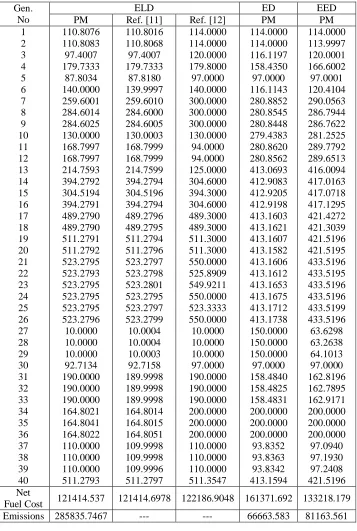
Table 1 Comparison of ELD, ED and EED solutions for a demand of 10500 MW
Gen. No
ELD ED EED
PM Ref. [11] Ref. [12] PM PM
while the existing methods leads to 121414.6978 $/h and 122186.9048 $/h, thereby exhibiting that the proposed method is robust in obtaining the global best solution. The results comprising real power generations, the fuel cost and emissions for ED, obtained by setting w as zero, are also included in the same table. It is seen that the emissions are lower value of 66663.583 kg/h and fuel cost is much higher value of 161371.692 $/h in this case. The table also includes the results of EED solution, obtained by setting w as 0.5. It is seen from the results of EED that the EED solution lies in between the best fuel cost and best emissions. The PM attempts to lower the fuel cost, minimizes emissions and extracts satisfactory results in relation to those obtained by ELD and ED.
V. CONCLUSION AND FUTURE WORK
EED is a computational process of economically allocating generations to various generation plants subject to load and operational constraints. A TLO based method for solving EED problem was proposed in this paper. The firefly was represented to denote the real power generations and the brightness function was built comprising objective function and power balance constraint. The method has been run for 100 iterations and the obtained results were compared with those of existing methods for a system with 13 generating units. The results have illustrated the effectiveness of the algorithm in finding the global best solution.. The proposed method involving TLO will culminate itself as a powerful tool in solving EED problem at energy control centers. The objective function can be modified to include emissions and the method can be extended to obtain a compromised solution.
REFERENCES
1. J.W. Lamont and E.V. Obessis, 'Emission dispatch models and algorithms for the 1990’s', IEEE Trans. on Power Systems, Vol. 10, No.2, pp. 941- 946, 1995.
2. B.H. Chowdhury and S. Rahman, A review of recent advances in economic dispatch, IEEE Trans. on Power Systems, Vol. 5, No. 4, pp. 1248-1259, 1990.
3. Tahir Nadeem Malika, Azzam ul Asarb, Mudasser F. Wynec and, Shakil Akhtar, 'A new hybrid approach for the solution of nonconvex economic dispatch problem with valve-point effects', Electric Power Systems Research, Vol. 80, pp. 1128–1136, 2010.
4. Taher Niknan, Hassan Doagou Mojarrad and Majid Nayeripour, 'A new fuzzy adaptive particle swarm optimization for non-smooth economic dispatch', Energy, Vol. 35, pp. 1764-1778, 2010.
5. K.P. Wong, J. Yuryevich, 'Evolutionary-programming-based algorithm for environmentally-constrained economic dispatch', IEEE Trans. on Power Systems, Vol. 13, pp. 301-306, 1998.
6. J.-. Chiou, 'A Variable Scaling Hybrid Differential Evolution for Solving Large-Scale Power Dispatch Problems', Generation, Transmission & Distribution, IET, Vol. 3, No. 2, pp. 154-163, 2009.
7. Saravuth Pothiya, Issarachai Ngamroo and Wree Kongprawechnon, 'Ant colony optimization for economic dispatch problem with non-smooth cost functions', Electrical Power and Energy Systems, Vol. 32, No. 5, pp.478-487, 2010.
8. Rao, R.V., Savsani, V.J. and Vakharia, D.P, 'Teaching-learning-based optimization: A novel optimization method for continuous non-linear large scale problems', Information Sciences, Vol. 183, No. 1, pp. 1-15, 2012.
9. Rao, R.V., Savsani, V.J. and Vakharia, D.P, 'Teaching-learning-based optimization: A novel method for constrained mechanical design optimization problems', Computer-Aided Design, Vol. 43, No. 3, pp.303-315, 2011.
10. S. Hemamalini and Sishaj P Simon, 'Emission constrained economic dispatch with valve-point effect using particle swarm optimization', IEEE Technical Conference, 18-21 Nov, TENCON-2008.
11. Leandro dos Santos Coelho and Viviana Cocco Mariani. An efficient cultural self-organizing migrating strategy for economic dispatch optimization with valve-point effect, Energy Conversion and Management, Vol. 51, pp.2580-2587, 2010.