Abstr defec this p which techn issue proce regul softw comp Keyw Mod grow adop quali indu quali appli is ca [1]. that quali been softw bug defec revie analy cost-Thes the diffe comp level purp perfo techn softw phas using techn featu Featu
SOFTW
Associa PE ract: Software ct prediction, id process, previouh identifies the niques and mach e, in this work w ess for feature s larization schem ware defect data
pared with state
words: Software
dern software wing rapidly. pted in real-tim
ity and reliab ustries and the
ity of softwa ications are co aused due to c
In order to de early predictio ity of the soft n carried out f ware defect pr
prediction, ctive area in ewers to alloc yzing complet -effective proc se techniques software met erent levels ponent-level, l and method-pose. Further ormed by usi niques, artific ware defect p ses: feature ex
g machine niques are ba ure extraction
ures can be M
Interna
WARE DEF
L1
Manju
ate Professor, ESIT- BSC, K
defect predictio dentifies the bug us archives of s e faults in soft hine learning te we have present
subspace reduc me resulting in
abase. An exten e-of-the-art soft
e Metrics, Softw
1. INTR
modules and Software ba me & daily li bility is a cr e growth of i are application
omplex and fa code defect/bu eal with this i on of bugs or tware applicat for early bug p
rediction [2]. classifiers ar n the code w cate their effor te code. This cess of softwa
of software d trics which of the sof process-leve -level, which r, software ing statistical cial intelligenc prediction te xtraction and c
learning alg ased on the de n technique f McCabe featur
Volu
ational Jou
Av
FECT PR
1-REGUL
ula C MCA Depart Karnataka,Indiaon is considere g during autom software module ftware modules
echniques but a ted a new appro tion and deep b better learning nsive experime ware defect pre
ware Quality, S
ODUCTION
d development ased applicati
fe scenarios. ritical issue i industry also ns. Generally, failure –prone ugs during co issue, research
code defects tion. Various prediction wh According to re built whi which can he rt for defected process is con are quality ma
defect predicti can be comp ftware such el, class-leve
are used for defect pred l methods, m ce techniques
chnique cont classifier mod gorithm. Fea
evelopment o for better de res, Halstead f
ume 9, No.
urnal of Ad
RESE
vailable On
REDICTI
LARIZAT
tment, aed as most inter mated testing pr es are considere . Several techn achieving desire oach deep lear belief network f g process by red ental study is ca ediction techniq
oftware Defect
N
t techniques a ions are wide Maintaining t in the softwa
depends on t , huge softwa in nature whi ode developme
hers have fou can improve t researches ha hich is known o this process ich predict t elp to the co d part instead nsidered as mo anagement.
ion are based puted from t as: file-lev el, quantitati software testi diction can machine learni etc. In gener tains two ma del developme ature extracti of discriminati efect predictio features and C
1, January
dvanced Re
EARCH PA
nline at ww
ION USIN
TION BA
resting area for rocess which pr ed for analyzin niques have be ed accuracy in p rning for softwa
for pattern learn ducing the over arried out whic ques.
t Prediction, De
are ely the are the are ich ent und the ave as of the ode of ost on the vel, ive ing be ing ral, ain ent ion ive on. CK fe m M (D de te pe de pr cl re fo ba pr bu ge So de m te co al cl ac te an w H de In da an N co
y-February
esearch in C
APER
ww.ijarcs.in
NG DEEP
ASED OPT
Ad
r researchers in revents the dev g the quality ba een presented f performance is are defect predi
ning. Deep beli rfitting error. T ch shows that p
eep Belief Netw
eatures for ob machine learnin Machine) [3],
Decision Tree eveloped for s echniques suff erformance a egraded perf rediction. U lassification te esearchers. In ocused on the ased on the m resented softw ug prediction enetic algori oftware defe efective ide misclassificatio echnique is us ost sensitive l l. [6] also i lassifiers Near chieving local echniques pos nd validation which may lead Hence, a gene efect predictio
n order to dev ata mining te nalysis, open NASA softwar ontains variou
y 2018
Computer
nfo
P BELIEF
TIMIZAT
Lilly Professor, M diyamman Col Tamil Nthe field of so velopment of fau
ased on data mi for software de
a challenging t ction by combi ief networks ar This combined proposed approa
work, Genetic A
bject-oriented ng algorithms ANN (Artifi e) [4] and software defec fer from multi and dataset tr formance an Unfortunately echniques stil n order to ov
development machine learni ware defect pr n where part thm are us ct prediction entities and on rate. For be
sed where in learning are i introduced a rest –Neighbo l and global se various ch of sophisticat d to improper eral and effi on is required.
velop the sof chniques hav source softw e defect datas us metrics valu
Science
ISSN No
F NETWO
TION
Florence
MCA Departme llege of Engin Nadu,India
ftware enginee ulty software m ining and mach
efect prediction task for researc ning genetic alg re further impro
model is imple ach achieves h
Algorithm, L1-re
programs. M s such as SVM icial Neural N Naïve Bayes ct prediction. iple issues suc raining error nalysis for y, performa
ll remain unad vercome this,
of new sophi ing. Recently rediction tech ticle swarm ed for optim n identifies d
attempts etter performa
feature select ncorporated.
hybrid appr or and Naïve B
information o hallenges such ted techniques r identification icient framew ftware defect ve been adopt ware defect re sets [8] are us ues such as LO
o. 0976‐5697
ORK WIT
ent, neering,
ring. This proc module. Accord ine leaning con n using data m chers. To addres gorithm optimi oved by applyin
emented on SPI igher accuracy
eguralization
Meanwhile, va M (Support V Network) [3] s etc. have
However, exi ch as classific . resulting in software d ance of ddressed issue , researchers sticated techn y, Mussa et a hnique for soft optimization mization pro defective or to reduce ance, sophisti tion and Similarly, R roach where Bayes are use of the data. T h as configur s, optimization n of software work for soft
prediction m ted widely an epositories suc
program length and number of blank lines etc. Based on these attributes, a machine learning approach is implemented which learns the complete pattern and returns a trained datasets which is further used for testing purpose. By considering data mining technique as base, Arar et al. [9] developed a new approach for software defect prediction using Naïve Bayes classification scheme. To improve the analysis, feature dependent naïve Bayes classifier model is developed where features are computed based on the dependency on the other features.
For software defect prediction artificial intelligence also plays important role. Quah et al. [10] discussed about the software quality assessment using neural network modeling by focusing on software maintenance and reliability. To achieve this objective, ward neural network and general regression neural network are presented. Similarly, Kanmani et al. [11] also presented neural network based approach for software defect prediction where two neural network models are used along with object-oriented metrics. This study shows that neural networks achieve better performance in terms of defect prediction accuracy. Further, performance of neural network can be enhanced by applying deep neural network techniques. However, deep neural network models are considered as prone to the overfitting error which may lead to the inaccurate performance of software defect prediction. These studies show that considerable amount of research work has been carried out in this field of software defect prediction but still prediction accuracy remains a challenging task along with the development of general framework for software defect prediction.
In order to overcome these issues, here we present an improved technique of software defect prediction. As discussed before neural network gives better performance which can be further improved by using Deep Neural Network (DNN) or Deep Belief Networks (DBN) due to its significant learning scheme. However, DBN suffers from the issue of overfitting. Hence, to deal with this issue, we present L1-reguralization scheme. First we present a classification study using DBN. Next, Genetic algorithm is applied for feature optimization. The optimized features are further processed through DBN using L1-regularization scheme.
Rest of the article is organized as follows: Section 2describes recent studies in the field of software defect prediction, proposed model is presented in section 3, experimental analysis is demonstrated in section 4and finally concluding remarks are given in section 5.
2. LITERATURE REVIEW
In this section we review the studies based on the software defect prediction techniques. The problem of software defect prediction can be considered as learning problem in software engineering. Several researches have been reported on this topic. He et al. [2] discussed about the software defect prediction techniques. Generally, software defect prediction techniques utilize the historical data for further software bug prediction but due to insufficient dataset the desired performance cannot be achieved. This issue can be addressed using metric set based evaluation for training and testing dataset. First of all, authors created
predictor model based on the six classifiers which are later validated using Top-k metrics using statistical measurement. A general framework is needed for software defect prediction which can be used as benchmark for SDP. Lessmann et al. [12] discussed about this issue and presented an experimental study using 22 classifiers which are tested for 10 publicly available databases. This technique of software defect prediction depends on the feature extraction techniques. Along with feature extraction, feature selection and optimization plays important role. Several studies have been presented on feature selection and optimization techniques. In [13], Chen et al. presented a combined model for software defect prediction where feature selection and optimization are performed. Optimal feature selection is considered as most challenging task. Hence authors presented search based feature selection techniques. Further, optimization process is carried out by formulating a multi-objective optimization problem. Similarly, Hosseini et al. [14] also focused on the feature selection process for improving the Optimization. In this work, nearest neighbor filtering scheme is implemented along with genetic algorithm which helps to generate the accurate validation sets. These sets can be considered for training and testing dataset.
However, various techniques have been discussed for software defect prediction but time and complexity remains challenging and unaddressed issues. Sabharwal et al. [15] presented a low complex technique for feature selection for long search space. For this purpose, feature ranking based scheme is implemented which performs search space reduction and selection of feature subset. This process performs both the tasks simultaneously which reduces the computation time. Maua et al. [16] discussed about feature optimization scheme using multi-population genetic algorithm. In this process, multi-level selection algorithms are involved which require additional optimization process. To overcome this, authors presented multi-level genetic algorithm for SDP by using different stages of selection. In this process, colonization and migration operators are considered along with multi-objective evolutionary algorithm. Afzal et al. [17] focused on benchmarking the feature extraction technique and reviewed feature subset selection techniques. In this work, defect prediction experiments are conducted by using information gain attribute ranking (IG); Relief (RLF); principal component analysis (PCA); correlation-based feature selection (CFS); consistency-based subset evaluation (CNS); wrapper subset evaluation (WRP); and an evolutionary computation method, genetic programming (GP) for PROMISE dataset where C4.5 and naïve Bayes (NB) classifiers are used for measuring the classification performance.
prediction also depends on the historical dataset and software structure pattern analysis. Sometimes, software datasets suffer from class imbalance problem where learning becomes a very complex task. This issue is addressed by using multiple kernel learning algorithm which helps to map the historical defect data into a higher dimensional feature space and express better and later ensemble learning can be implemented which uses series of weak classifiers to reduce the majority class and helps to achieve better prediction performance. In [20], authors presented metric learning based model for software defect prediction. Tomar et al. [21] studied about software defect prediction and found that efficient software defect predictor model is needed for improving the software defect prediction which can identify the bugs in the software modules without affecting the overall performance and working of the software module. As discussed before, learning becomes a crucial step where data distribution is random and imbalanced in nature.
Computational complexity and implementation cost is a challenging task for researchers. Conventional techniques require more time and human effort for software testing. Hryszkoet al. [22] discussed about complexity issues in software defect prediction in industries and presented a comprehensive study on cost effectiveness for software defect prediction. An extensive experimental study is carried out for defect prediction and cost effectiveness is analyzed. Study shows that early prediction can avoid the degraded software development and can reduce the implementation cost for software defect prediction model.
Above discussed studies are mainly focused on the feature extraction, feature selection, optimization and learning techniques. Feature extraction process includes the analysis of all metrics for pattern learning. Feature extraction and selection schemes are discussed which shows improvement in software defect prediction by selecting optimal features during computation. Finally, machine learning schemes are discussed which are used for pattern learning and classification. Various techniques have been presented in the literature to improve the software defect prediction performance, but, development of techniques with significant accuracy, performance, less-complexity still remain as challenging task. There is a need to develop an efficient model to deal with these issues. Next section discusses an approach proposed by the authors for addressing these issues.
3. PROPOSED MODEL
This section presents details about the proposed model for software defect prediction. From the previous section it is clear that artificial intelligence is a promising technique for software bug prediction. Hence, we focus on an improved artificial intelligence model known as Deep Belief Neural network (DBN).The process of DBN suffers from the overfitting issue which may lead to improper classification. To overcome this, we use L1-regularization scheme which helps to reduce the overfitting error. Moreover, proposed model also includes genetic algorithm optimization process. The complete proposed approach can be categorized as: (a) Genetic algorithm optimization (b) DBN implementation (c) L1- regularization modeling in DBN. .
3.1 Genetic Algorithm:
First of all, we study about genetic algorithm and its implementation for software defect dataset. Genetic algorithm is widely adopted for various optimization and feature selection problems.
Fig..1 Genetic algorithm
Genetic algorithm is described as heuristic search and optimization approach which is inspired by nature. Development of genetic algorithm contains various stages. In this section we briefly describe various stages of genetic algorithm. This technique is evolutionary optimization technique which initiates with the initial population and tends to achieve global optimal solution for the given problem and stops when the desired optimal criteria parameters are achieved.
A basic architecture model of genetic algorithm is depicted in Fig 1. GA contains multiple stages to achieve the optimal solution which are as follows: (a) initialization (b) fitness assignment (c) selection (d) crossover (e) mutation.
(a) Initialization:
This is the first step of genetic algorithm where individuals are initialized and an initial population is generated. At these stage, all initial individual and randomly generated and considered as initial population which is used for further analysis.
(b) Fitness assignment
After generating the initial population, next task is to assign fitness value to each individual. In order to perform this, we apply rank based method for fitness computation which helps to sort the selection error. This sorting process is useful for identifying the lowest selection error and its corresponding individual. Fitness assignment can be denoted as:
. 1,2,3, … . . (1)
Here denotes selective pressure whose values are fixed between 1 to 2. Generally, greater value will result in fittest solution and denotes the rank of individuals.
(c) Selection
combined and used for next generation formulation. According to this process, individuals which are have good fitness values, are considered to survive as they are more fitted to the environment. Hence, this section is made based on the individual’s fitness level. Here, half of the population is selected for further operation.
(d) Crossover
In previous stage, half of the population is selected which is used in this process where crossover is performed. Crossover operator recombines the best selected population and generates new population. In this process, randomly two individuals are considered and combinedto generate four off-springs for new population. This process continues until the size of new population is equal to the old one.
(e) Mutation
Crossover generates offspring which may be very similar to the parents. This may result in low diversity in the process of mutation. Mutation operator randomly changes some feature parameters of offspring to avoid the diversity issues.
These steps are performed until the best optimal solution is achieved for given problem. In this work we have considered, software metrics as input parameter. These metrics are processed through the above mentioned process and optimal solution is obtained. Here, it is assumed that a priori information of potential areas of the given feature set is already known based on the assumption initial population can be generated such that it shall cover all points and areas of given input set. At this stage, our main aim is to reduce the search space during computation. The process of search space reduction is divided into two main categories: (a) initial solution generation and (b) reduced feature subset generation. In order to improve the performance, initial solutions are generated using filtering techniques as information gain, Gini index, correlation and gain ratio. This process of filtering and feature subset reduction is presented in Fig 2.
Fig.2 Filtering and Feature Subset Reduction
3.2 Deep belief network for learning
After feature selection and dimension reduction, we apply Deep Belief Network (DBN) for pattern learning. In this section, we discuss about DBN along with Restricted Boltzmann Machines (RBMs).
3.2.1 Restricted Boltzmann Machines
RBM are considered as a part of neural networks which is composed by two neuron layers as visible and hidden layer. In these layers, learning phase is conducted by using unsupervised learning. In RBM, connections between neurons and same layer are not allowed unlike classical Boltzmann Machine. The architecture of RBM contains a visible layer with units and a hidden layer with number of units. The input data matrix is which models the weight between hidden and visible layer where denotes the weights between layers and , where it is assumed that hidden layers are denoted by and visible layers denoted by . For this machine, energy function can be given as:
,
(2)
Where and denotes biases for visible and hidden layers. The probability of visible and hidden layer is computed as:
,
,
∑ ,
,
(3)
With the help of this modeling, deep belief network learning is presented. RBM parameters can be optimized by applying gradient scaling on the training pattern’s log-likelihood data. Let us consider that a training sample is given in the form of visible unit, it probability can be computed as follows:
∑ ,
∑ ,
,
(4)
Weights and biases varies for each iteration, hence it is necessary to compute the updated weights and biases with the help of following derivatives:
(5)
Where . Denotes the expectation operations, . denotes data driven probability and . denotes reconstructed data driven probability. In general,
can be computed as:
| (6)
sigmoid function . Similarly, testing data can be denoted as 1| ∑ . Various studies show that DBN suffer from overfitting error which may lead to faulty prediction during classification. In order to deal with this issue, here we include L1-regularization model to improve the learning by reducing overfitting error. Let us consider that a learning task is given with training sequences whose training instances are , ,
1, … . , where denotes the dimensional
feature vector and 0,1 denotes class label. For these feature vectors and classes, logistic regression model can be expressed as:
1| ; 1
1 exp (7)
denotes the l1 regularized regression model parameters and . denotes sigmoid function. Furthermore, maximum a posteriori (MAP) estimate of the parameters of can be given as:
; (8)
This optimization problem can be referred as L1 regularization which can be further solved by using following L1 regularization solution:
;
(9) The above given optimization problem provides the minimal
error in training by reducing overfitting error. The complete proposed model can be used for better classification performance which can be obtained by using genetic algorithm for dimensionality reduction, DBN and L1 regularization for better learning and reduced error.
Input: total number of attributes, number of hidden layer, Boltzmann machine configuration parameters
Output: optimal weights, learned attribute set, probability model and logistic regression optimal function set.
Step 1: input the visible and hidden layer units with initial weights corresponding to the hidden and visible layer unit. Step 2: Construct an initial energy function using Bernoulli’s RBM given in (2)
Step 3: Based on this energy function, find the probability of hidden and visible layers which can be used for weight estimation given in (3)
Step 4: Initiate the learning process by for given input samples by computing the probability function of hidden units.
Step 5: apply weight update computation by applying logarithmic derivative computation for hidden layer and visible layer units
Step 6: establish the logistic regression model using sigmoid function as (7)
Step 7: maximum a posteriori (MAP) computation for best probability function
Step 8: construct the optimization problem as (8) and iterate until the desired value is obtained
4. EXPERIMENTAL STUDY
In this section we present complete experimental study for software defect prediction using proposed approach. In order to perform this operation, we have considered dataset obtained from SEIP Lab [23] where eclipse dataset is provided with subsequent release of the data. These two datasets are named as (a) Eclipse JDT (release 2.0,2.1,3.0,3.1 and 3.2) and Eclipse PDE (release 2.0, 2.1, 3.0, 3.1, 3.2) b) Private Dataset ABC.
4.1 Dataset description
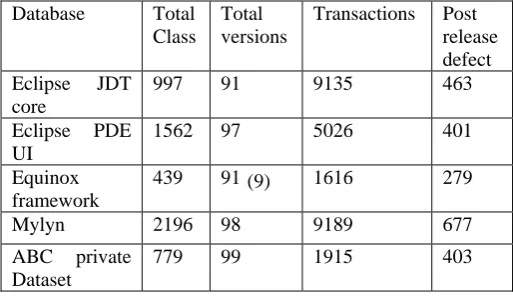
These datasets are obtained in .csv format with comma and points as decimal mark. First row of the csv data file contains the description of metrics: column 1 denotes file path and columns 2-49 denotes the independent software metrics variable which are given with the software metric abbreviations and final column number 50 denotes the total number of defects. A brief description about these datasets [24] is provided in the Table 1given below.
Table.1. Database Description
4.2 Performance measurement
[image:5.595.314.571.361.509.2]Performance of proposed approach is measured in terms of classification accuracy which can be computed by using confusion matrix. Table 2 shows a sample representation of confusion matrix.
Table 2. Confusion Matrix
Actual class
Predicted class
Non defective Defective Non Defective False negative
(FN)
True Positive (TP)
Defective True Negative (TN)
False Positive (FP)
With the help of this, accuracy of the proposed model is computed and compared with other state of art models. Moreover, first experiment is conduced only using DBN, next experiment contains DBN and genetic algorithm and
Database Total Class
Total versions
Transactions Post release defect Eclipse JDT
core
997 91 9135 463
Eclipse PDE UI
1562 97 5026 401
Equinox framework
439 91 1616 279
Mylyn 2196 98 9189 677
ABC private Dataset
finally, DBN, genetic algorithm and L1 regularization scheme is also incorporated.
4.3 Comparative analysis
Based on this approach, we present a comparative analysis where various parameters such as precision, recall, false
positive rate, F-measure and AUC (Area under curve) have been computed and compared.
4.3 Comparative Analysis
Measurement Parameter
Approaches Eclipse JDT core Equinox framework
Eclipse PDE UI Mylyn ABC Private Dataset
Precision DBN 0.47 0.63 0.28 0.21 0.21
GA+DBN 0.8 0.89 0.62 0.75 0.66
GA+DBN+L1 0.86 0.93 0.78 0.83 0.77
False Positive rate DBN 0.17 0.24 0.2 0.17 0.13
GA+DBN 0.69 0.88 0.83 0.89 0.81
GA+DBN+L1 0.76 0.87 0.91 0.93 0.85
F-Measure DBN 0.52 0.62 0.35 0.34 0.26
GA+DBN 0.91 0.9 0.77 0.81 0.85
GA+DBN+L1 0.93 0.92 0.81 0.83 0.92
AUC DBN 0.76 0.78 0.7 0.68 0.69
GA+DBN 0.91 0.86 0.88 0.94 0.81
GA+DBN+L1 0.94 0.92 0.9 0.94 0.85
This comparative analysis is presented in Table 3 where existing system performance are compared with proposed approach. This comparative analysis shows that proposed approach achieves better performance when compared with conventional software defect technique.
5 ACKNOWLEDGEMENT
I would like to thank the organization who has provided me the ABC private data set for my research work.
6 CONCLUSION
In this work, we have focused on software defect prediction techniques using deep learning technique and presented a novel approach for early bug prediction. In order to perform this task, we have considered deep learning techniques along with feature selection and overfitting error reduction in deep belief networks. First of all, genetic algorithm is implemented for dimensionality reduction from considered feature subset. In next stage, deep belief network is applied for pattern learning which is further improved by solving an optimization problem using L1-regularization model. Performance study of the proposed model is carried out using SPIE lab dataset repository and private dataset ABC. Proposed approach performance is compared with existing models in terms of classification accuracy. This experimental analysis shows that proposed approach is capable of achieving enhanced classification performance.
REFERENCES
[1] Hryszko, Jaroslaw, and Lech Madeyski. "Assessment of the Software Defect Prediction Cost Effectiveness in an Industrial Project." In Software Engineering: Challenges and Solutions, pp. 77-90. Springer International Publishing, 2017.
[2]
[3] He, P., Li, B., Liu, X., Chen, J. and Ma, Y., 2015. An empirical study on software defect prediction with a simplified metric set. Information and Software Technology, 59, pp.170-190.
[4] Arora, I. and Saha, A., 2018. Software Defect Prediction: A Comparison Between Artificial Neural Network and Support Vector Machine. In Advanced Computing and Communication Technologies (pp. 51-61). Springer, Singapore.
[5] Mohanty, R. and Ravi, V., 2017. Machine Learning Techniques to Predict Software Defect. In Artificial Intelligence: Concepts, Methodologies, Tools, and Applications (pp. 1473-1487). IGI Global.
[6] Moussa, R. and Azar, D., 2017. A PSO-GA approach targeting fault-prone software modules. Journal of Systems and Software, 132, pp.41-49.
[7] Liu, M., Miao, L. and Zhang, D., 2014. Two-stage cost-sensitive learning for software defect prediction. IEEE Transactions on Reliability, 63(2), pp.676-686.
[8] Ryu, D., Jang, J.I. and Baik, J., 2015. A hybrid instance selection using nearest-neighbor for cross-project defect prediction. Journal of Computer Science and Technology, 30(5), pp.969-980.
[9] Shepperd, M., Song, Q., Sun, Z. and Mair, C., 2013. Data quality: Some comments on the nasa software defect datasets. IEEE Transactions on Software Engineering, 39(9), pp.1208-1215.
Software Defect Prediction Problem. Applied Soft Computing.
[11] Quah, T.S. and Thwin, M.M.T., 2003, September. Application of neural networks for software quality prediction using object-oriented metrics. In Software Maintenance, 2003. ICSM 2003. Proceedings. International Conference on (pp. 116-125). IEEE.
[12] Kanmani, S., Uthariaraj, V.R., Sankaranarayanan, V. and Thambidurai, P., 2007. Object-oriented software fault prediction using neural networks. Information and software technology, 49(5), pp.483-492.
[13] S. Lessmann, B. Baesens, C. Mues and S. Pietsch, "Benchmarking Classification Models for Software Defect Prediction: A Proposed Framework and Novel Findings," in IEEE Transactions on Software Engineering, vol. 34, no. 4, pp. 485-496, July-Aug. 2008. [14] Chen, X., Shen, Y., Cui, Z. and Ju, X., 2017, July.
Applying Feature Selection to Software Defect Prediction Using Multi-objective Optimization. In Computer Software and Applications Conference (COMPSAC), 2017 IEEE 41st Annual (Vol. 2, pp. 54-59). IEEE.
[15] Hosseini, S., Turhan, B. and Mäntylä, M., 2017. A benchmark study on the effectiveness of search-based data selection and feature selection for cross project defect prediction. Information and Software Technology. [16] Sabharwal, S., Nagpal, S., Malhotra, N., Singh, P. and
Seth, K., 2018. Analysis of Feature Ranking Techniques for Defect Prediction in Software Systems. In Quality, IT and Business Operations (pp. 45-56). Springer, Singapore.
[17] Maua, G. and Galinac Grbac, T., 2017. Co-evolutionary multi-population genetic programming for classification in software defect prediction. Applied Soft Computing, 55(C), pp.331-351.
[18] Afzal, W. and Torkar, R., 2016. Towards benchmarking feature subset selection methods for software fault prediction. In Computational Intelligence and Quantitative Software Engineering (pp. 33-58). Springer International Publishing.
[19] Li, J., He, P., Zhu, J. and Lyu, M.R., 2017, July. Software Defect Prediction via Convolutional Neural Network. In Software Quality, Reliability and Security (QRS), 2017 IEEE International Conference on (pp. 318-328). IEEE.
[20] Wang, T., Zhang, Z., Jing, X. and Zhang, L., 2016. Multiple kernel ensemble learning for software defect prediction. Automated Software Engineering, 23(4), pp.569-590.
[21] Wang, S., Ping, H. and Zelin, L., 2016. An enhanced software defect prediction model with multiple metrics and learners. International Journal of Industrial and Systems Engineering, 22(3), pp.358-371.
[22] Tomar, D. and Agarwal, S., 2016. Prediction of defective software modules using class imbalance learning. Applied Computational Intelligence and Soft Computing, 2016, p.6.
[23] Hryszko, J. and Madeyski, L., 2017. Assessment of the Software Defect Prediction Cost Effectiveness in an Industrial Project. In Software Engineering: Challenges and Solutions (pp. 77-90). Springer International Publishing.
[24] http://www.seiplab.riteh.uniri.hr/?page_id=834
[25] D'Ambros, M., Lanza, M. and Robbes, R., 2010, May. An extensive comparison of bug prediction approaches. In Mining Software Repositories (MSR), 2010 7th IEEE Working Conference on (pp. 31-41). IEEE.