Volume 3, No. 3, May-June 2012
International Journal of Advanced Research in Computer Science
RESEARCH PAPER
Available Online at www.ijarcs.info
832
ISSN No. 0976-5697
Recent Research Trends in Active Real-time Database Systems
Sunil R. Gupta
Department Computer Science & Engineering P.R.M.I.T& R, Badnera.
Badnera-Amravati, India [email protected]
Dr. M.S.Ali Principal
P.R.M.C.E.A.M, Badnera Badnera-Amravati, India
Abstract: This paper presents an overview of research trends in Active Real-time Database Systems. Active real-time databases have emerged as a research area in which concepts of active databases and real-time databases are combined into a real-time database with reactive behaviour. This paper addresses active real-time database system, as well as projects which have done research on active real-time database systems.
Keywords: active real-time database, real-time database, transaction scheduling, transaction model, trigger.
I. INTRODUCTION
In general, applications that require automatic situation monitoring of their environments and need to react to events with respect to timing constraints, requires an active real-time database system (ARTDBS). Both active and real-time databases are considered as important technologies for supporting non-traditional applications such as process control, network database services, network management, air traffic control, cooperative navigation systems and computer integrated manufacturing (CIM) [1,2,3]. Generally active database systems support ECA (Event-Condition-Action) rules, which are triggered and executed within the context of database transactions. Applications that require execution of transactions with respect to time constraints require a real-time database system.
Before presenting description of the ARTDBS, we give a brief introduction to active databases and real-time databases. The building block of an active database system is the event-condition-action (ECA) rule. The semantics of the ECA rule is that, if the specified event occurs and if the condition is true, then the specified action is to be executed. A condition is usually a predicate on the database state [4]. An action is the transaction that is executed in reaction to a specific situation, which is a combination of events and conditions. The transaction that fires the rules is called the triggering transaction, and the action that is executed because of the rule firing is called the triggered transaction. We refer to the transactions that trigger other transactions as active transactions or parent transactions. An active transaction has a set of triggered transactions that are executed either as part of the active transaction or separately, depending on the type of the coupling mode between the parent and the triggered transactions [5]. There are three types of coupling modes: immediate, deferred and detached (independent). The transactions triggered in those modes are referred to as immediate, deferred and detached transactions, respectively. Due to the rule firings, an active transaction dynamically generates additional work.
Active database systems support different mechanisms for triggering of transactions to react to the critical events occurred in the external environment [6]. The newly created transaction is called triggered transaction. However, active database systems are lacking mechanisms to guarantee that the triggered transactions can be completed before their deadlines. Their processing is “passive” even though their generations are “active”. It is unpredictable and completely dependent on how the system schedules them. A real-time database system (RTDBS) can be viewed as a system, which inherits mechanisms of both traditional database systems and real-time systems. It is a transaction processing system that is designed to handle workloads where transactions have completion deadlines. The objective of such system is to meet these deadlines, that is, to complete processing transactions before their deadlines expire. On the other hand, RTDBS supplements the deficiencies of the unpredictability in active database systems by using different scheduling algorithms to minimize the number of deadline missing.
The integration of real-time database systems with active databases creates new scheduling problems. Triggering of transactions represent the generations of actions (in the form of triggered transactions) to respond to the occurrences of critical events in the external environment. It is important to commit these transactions. If the critical events are beneficial, missing the deadline of a triggered transaction means the loss of a good opportunity. If the occurred events are harmful, missing the deadline may result in disasters. Triggering of transactions decreases the predictability of the system as the triggered transactions increase the system workload and the probability of data conflicts suddenly [7].
II. ACTIVE REAL-TIME DATABASE SYSTEM MODEL
An active real-time database system (ARTDBS) has to provide capabilities for timely trigger of time-constrained transactions and at the same time to process them, concurrently with others transactions, in a real-time manner.
Mostly, triggered transactions are critical transactions. The newly created transaction is called triggered transaction.
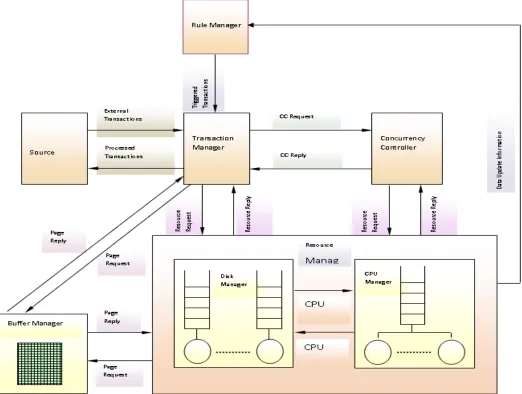
[image:2.612.48.570.135.529.2]An ARTDB system model given below (figure 1) uses a queuing model of a single-site shared-memory multiprocessor database system. This model is similar to those presented in other simulation studies e.g., [8,9].
Figure 1. `An Active Real-time Database System Model.
In this section, an ARTDBS system model is presented as shown in figure 1 is referred from [10]. The figure 1 shows that model of ATRDBS consists of six components: include six active components, namely, Source (transaction generator), transaction manager, concurrency control manager, memory manager, resource manager, rule manager, and one passive component, namely, the database.
A Source also known as transaction generator that generate the non-triggered, or external workload of the system. A Transaction Manager (TM) that models the execution details of the transactions. It handles the various stages of transaction execution, such as begin, commit and abort. A Concurrency Controller that implements the (e.g. OPT-BC) protocol for managing concurrency. A Resource Manager that consist of
the CPU Manger and the Disk Manager, that manage the system's CPUs, disks and the associated queues by using scheduling policy such as Earliest Deadline (ED) protocol, and a Rule Manager which implements the active functionality. Rules are triggered when a specified event occurs. When the event notification arrives at the rule manager, all rules triggered by this event must be retrieved from the rule base and be prepared for execution.
834 can be made off-line, and thereby run-time overhead can be
kept low. If a rule base can be made static, that is, no rules are added, deleted or altered at run-time, the rules can be analysed, optimised and compiled into the rule manager, thereby improving efficiency. Buffer Manager is associated with the use of main memory during reading and writing data from and to the disk. When the main memory has a plenty of space, the database is preferred to reside in the main memory (“memory resident database system”) to enable fast and predictable access [12,13].
The transaction manager interacts closely with the concurrency controller, memory manager and the resource manager. The TM first interacts with the concurrency control manager to seek permission for data access or to see if marked for restart/abort. The rule manager manages the active workload of ARTDB. This module simulates a rule base in which a transaction triggers other transactions when a condition becomes true. The concurrency module simulates concurrency control mechanism to maintain database consistency [10].
III. RELATED WORK
Initial research work on active databases and time constraint data management was carried out in HiPAC project [13]. HiPAC was the first large project that addressed active real-time databases, although no complete system emerged from that project. We will elaborate here on active real-time database systems that been built or that currently under development. Today there are mainly the following research prototypes.
HiPAC (High Performance ACtive database system) project is investigating active, time-constrained database management. HiPAC has proposed Event-Condition-Action (ECA) rules as formalism for active database capabilities [2,6].
DeeDS (Distributed activE real-timE Database System) is a main-memory fully replicated database with support for a mix of hard and soft deadlines, multipurpose event monitoring and ECA-rules. A dedicated deadline-driven transaction scheduler guarantees that discarding soft and firm deadlines and switching to contingency actions meet all hard deadlines [14].
REACH (REal-time ACtive and Heterogeneous mediator system) [15,16] in-corporate reactive mechanisms with temporal constraints in a heterogeneous environment.
BeeHive [17,18] is a global database, which is designed for applications where properties such as real-time guarantees, quality of service and dependability are desirable, for example in multimedia applications over the Next Generation Internet. The ECA paradigm is a core component, where rules are used to ensure freshness of data, to change modes of operation, to issue contingency actions in case of overload, etc.
RADEx (Real-time Active Database Experimental system) is a simulator for the purpose of experimental evaluation. RADEx is a real-time, active, temporal database simulator. It supports research on time cognizant concurrency control protocols, real-time transaction scheduling, and real-time logging and recovery [19].
KRAFT [20] An Active Real-Time DBMS for Signal Streams. KRAFT is an extension of traditional DBMS. The
KRAFT has distinguished features such as scheduler-level thread control mechanism for continual event monitoring, similar sequence retrieval for signal processing, UPS write ahead logging for predictable timely processing of transaction.
An Agilor [21] is active real-time database system having active object model to incorporate timing and active features into object-oriented data model. Agilor architecture consists of some kernel modules and critical services. An important building block of the Agilor is ECA rule.
IV. CURRENT RESEARCH TRENDS IN ARTDBS
Current research trends in active real-time database system are given below. Recently active real-time databases are being studying and used with some different aspect.
In [22] an architecture for reactive systems using an active real-time database with standardized components are explored. In [23] present a communication architecture that uses a distributed active real-time database system as its communication medium. In [24] distributed active real-time database functionality in information-fusion infrastructures with real-time requirements is described. In [25] time-triggered communication approach in the time-time-triggered architecture (TTA) which offers deterministic, fault-tolerant communication services. Avionic case study is used to explain model based design aspect of time-triggered architecture.
In [26], Electronic brokerage design also explains about new form/way of ECA definition using RTL language. Active real-time functionalities for Electronic brokerage application are explored in [27] where supports for timeliness requirements and allow users to express complex preferences using ECA rule model. In [28] approach for developing active application is presented. The aim is to verify transformations between timed automaton specification and ECA rules.
of micro-kernel in the real-time database system is proposed and design the trigger model base on the active mechanism.
V. CONCLUSION
The area of ARTDBS has received much attention in recent times because of its vast application in network management, manufacturing process control, program trading also different categories of applications are work flow management systems, co-ordination infrastructure for distributed object systems, stream-oriented systems and multimedia systems (synchronization). A novel application of ARTDB in electronic brokerages in financial markets is developed. These emerging applications have similar characteristics and involve accessing and manipulating large amounts of data, and taking actions under time constraints. Data in these applications have short temporal validity and the value of actions taken diminishes rapidly with elapsed time.
From above related work and current research trends it is identified that there is need of ARTDBS, which will be generalised to accommodate the need of all type of applications that requires reactive and timeliness behaviour. To achieve this goal there is need to investigate in some aspects of ARTDBS such as new transaction scheduling technique, overload management module. Also one important aspect is generalised transaction model, which is a fruitful aspect for a new generalise ARTDBS.
VI. REFERENCES
[1]. M. Berndtsson and J. Hansson, “Issues in Active Real-Time Databases”, in Proceedings First International Workshop on Active Real-Time Database Systems, (ARTDB-95), Skovde, Sweden, Workshops in Computing. Springer Verlag (London), pp. 142-157, June 1995.
[2]. Joakim Eriksson, “Real-Time and Active Databases: A Survey”, in Proceedings Second International Workshop on Active, Real-Time, and Temporal Database Systems, (ARTDB-97), Como, Italy, Springer-Verlag (London), pp. 01-23, 08-09 September 1997.
[3]. Jorgen Hansson and Mikael Berndtsson, “Active Real-Time Database Systems”, in Active Rules in Database Systems, Editor Norman W. Paton: Springer, 1999, pp. 405-426.
[4]. Thomas Heimrich and Gunther Specht, “Enhancing ECA Rules for Distributed Active Database Systems”, in Proceedings the Node 2002 Web and Database-Related Workshops on Web, Web-Services, and Database Systems, Erfurt, Germany, pp. 199-205, 07-10 October 2002.
[5]. Umeshwar Dayal, Meichun Hsu and Rivka Ladin, “Organizing Long-Running Activities with Triggers and Transactions”, ACM SIGMOD Record, volume 19, issue 02, pp. 204-214, June 1990.
[6]. U. Dayal, B. Blaustein, A. Buchmann, U. Chakravarthy, M. Hsu, R. Ledin, D. McCarthy, A. Rosenthal, S. Sarin, M. J. Carey, M. Livny and R. Jauhari, “The HiPAC Project: Combining Active Databases and Timing Constraints”, ACM
SIGMOD Record, volume 17, issue 01, pp. 51-70, March 1988.
[7]. Kam-yiu Lam, Tony S.H. Lee and Sang H. Son, “READS: A Prototyping Environment for Real-Time Active Applications”, in Proceedings Eight International Workshop on Database and Expert Systems Applications, Toulouse, pp. 265-270, 01-02 September 1997.
[8]. J. Lee and S. H. Son, “Using Dynamic Adjustment of Serialization Order for Real-Time Database Systems”, in Proceedings of IEEE Real-Time Systems Symposium, Raleigh Durham, NC, USA, pp. 66-75, 01-03 December 1993.
[9]. Prabhudev Konana and Sudha Ram, “Transaction Management Mechanisms for Active and Real-Time Databases: A Comprehensive Protocol and a Performance Study”, Elsevier Journal of Systems and Software, volume 42, issue 03, pp. 205-225, September 1998.
[10]. Anindya Datta, Sarit Mukherjee, Igor R. Viguier, “Buffer Management in Active Real-Time Database Systems”, Department of Management Information Systems, University of Arizon, Arizona, Tucson, 21 January 1996.
[11]. Mohamad Ridha, Active Database Implementation For Real-Time Computing, E-Learning Free Computer Science Community, Kuliah Umum IlmuKomputer.Com, Indonesia, pp. 01-12, March 2005.
[12]. H. Kawashima, “KRAFT: A Real-Time Active DBMS for Signal Streams”, in Proceedings of Fourth International Conference on Networked Sensing Systems (INSS 2007), Braunschweig, pp. 163-166, 06-08 June 2007.
[13]. S. Chakravarthy, B. Blaustein, A. Buchmann, M. Carey, U. Dayal, D. Goldhirsch, M. Hsu, R. Jauhari, R. Ladin, M. Livny, D. McCarthy, R. McKee and A. Rosenthal, “HiPAC: A Research Project in Active Time-Constrained Database Management”', Final Technical Report, XAIT-89-02, XAIT Reference Number 187, Xerox Advanced Information Technology, Cambridge, July 1989.
[14]. S. F. Andler, J. Hansson, J. Eriksson, J. Mellin, M. Berndtsson and B. Eftring, “DeeDS Towards a Distributed and Active Real-Time Database System”, ACM SIGMOD Record, volume 25, number 01, pp. 38-51, March 1996.
[15]. Holger Branding, Alexander Buchmann, Thomas Kudrass and Jurgen Zimmermann, “Rule in an Open System: The REACH Rule Systems”, in Norman W. Paton and M. Howard Williams, editors, Rules in Database System, Edinburgh, pp. 111-126, Springer-Verlag, 1993.
[16]. J. Zimmermann, H. Branding, A. P. Buchmann, A. Deutsch and A. Geppert, “Design, Implementation and Management of Rules in an Active Database System”, in Proceedings of the 7th International Conference on Database and Expert Systems Applications, Lecture Notes in Computer Science, Springer-Verlag, volume 1134, pp. 422-435, 1996.
836
Workshop, ARTDB97, Lecture Notes in Computer Science, volume 1553, pp. 51–69, Springer, 1997.
[18]. Suhee Kim, Sang H. Son and John A. Stankovic, “Performance Evaluation on a Real-Time Database”, in Proceedings of the Eighth IEEE Real-Time and Embedded Technology and Applications Symposium (RTAS'02), pp. 253-265, September 2002.
[19]. R. Sivasankaran, “Design of RADEx: Real-Time Active Database Experimental System”, Technical Report, University of Massachusetts, 1994.
[20]. H. Kawashima, “KRAFT: A Real-Time Active DBMS for Signal Streams”, in Proceedings of Fourth International Conference on Networked Sensing Systems (INSS 2007), Braunschweig, pp. 163-166, 06-08 June 2007.
[21]. Xinjie Lu, Xin Li, Tian Yang, Zaifei Liao, Wei Liu and Hongan Wang, “QoS-Aware Publish-Subscribe Service for Real-Time Data Acquisition”, in Proceedings of Business Intelligence for the Real-Time Enterprise, Lecture Notes in Business Information Processing, volume 27, pp. 29-44, Springer, 2009.
[22]. Munnich, M. Birkhold, G. Farber and P. Woitschach, “Towards an Architecture for Reactive Systems Using an Active Real-Time Database and Standardized Components”, in Proceedings of the International Symposium on Database Engineering & Applications, Montreal, Que., Canada, pp. 351-359, 02-04 August 1999.
[23]. Marcus Brohede and Sten F. Andler, “Distributed Simulation Communication through an Active Real-Time Database”, in Proceedings of 27th Annual NASA Goddard Software Engineering Workshop (SEW-27'02), Greenbelt, Maryland, pp. 147-155, 05-06 December 2002.
[24]. Marcus Brohede and Sten F. Andler, “Using Distributed Active Real-Time Database Functionality in Information-Fusion Infrastructures”, in Proceedings of Real-Time in Sweden 2005 (RTiS2005), Skovde, Sweden, 16-17 August 2005.
[25]. Hauke Fuhrmann, Reinhard von Hanxleden, Christian-Albrechts, Jorn Rennhack, Jens Koch, Airbus Deutschland GmbH, “Model-Based System Design of Time-Triggered Architectures - Avionics Case Study”, in Proceedings of
IEEE/AIAA 25th Digital Avionics Systems Conference, Portland, OR, pp. 01-12, 15-19 October 2006.
[26]. Aloysius K. Mok, Prabhudev Konana, Guangtian Liu, Chan-Gun Lee and Honguk Woo, “Specifying Timing Constraints and Composite Events: An Application in the Design of Electronic Brokerages”, IEEE Transactions on Software Engineering, volume 30, issue 12, pp. 841-858, December 2004.
[27]. M. Beck, Prabhudev Konana, Guangtian Liu, Yanbin Liu and Aloysius K. Mok, “Active and Real-time Functionalities for Electronic Brokerage Design”, in Proceedings of the International Workshop on Advance Issues of E-Commerce and Web-Based Information Systems, Santa Clara, California, pp. 30-35, 08-09 April 1999.
[28]. AnnMarie Ericsson, “Verifying transformations between timed automata specifications and ECA rules”, Master’s Thesis, University of Skovde, Sweden, September 2003.
[29]. Ying Qiao, Kang Zhong, HongAn Wang and Xiang Li, “Developing Event-Condition-Action rules in Real-time Active Database”, in Proceedings of the 2007 ACM symposium on Applied computing, Seoul, Korea, pp. 511-516, 2007.
[30]. Ying Qiao, Xiang Li, Hongan Wang and Kang Zhong, “Real-Time Reasoning Based on Event-Condition-Action Rules”, in Proceedings of the OTM Confederated International Workshops and Posters on, On the Move to Meaningful Internet Systems, OTM 2008 Workshops, Lecture Notes in Computer Science, volume 5333, pp. 01-02, Springer, 2008.
[31]. Ying Du, “Active Behavior in a Configurable Real -Time Database for Embedded Systems”, Master's Thesis, Department of Computer Science, Linkoping University, Sweden, April 2006.
[32]. Aindya Datta and Sang H. Son, “A Study of Concurrency Control in Real-Time, Active Database Systems”, IEEE Transactions on Knowledge and Data Engineering, volume 14, issue 03, pp. 465-484, May-June 2002.
[33]. Chenggang Zhen and Baoqiang Ren, “The Realization of