Page 1 of 5 Original Article
Analysis of major programs in the field of health science funded
by the National Natural Science Foundation of China between the
years 2010 and 2018
Rong Lei
1, Quan Liu
1, Yan Wang
1, Hao Wang
2, Yaxing Shen
21The National Natural Science Foundation of China, Beijing 100085, China; 2Department of Thoracic Surgery, Zhongshan Hospital, Fudan University, Shanghai 200032, China
Contributions: (I) Conception and design: R Lei, H Wang; (II) Administrative support: Q Liu, Y Wang; (III) Provision of study materials or patients: R Lei, H Wang; (IV) Collection and assembly of data: Q Liu, Y Wang; (V) Data analysis and interpretation: R Lei, H Wang, Y Shen; (VI) Manuscript writing: All authors; (VII) Final approval of manuscript: All authors.
Correspondence to: Hao Wang, MD; Yaxing Shen, MD. Department of Thoracic Surgery, Zhongshan Hospital, Fudan University, 180 Fenglin Road, Shanghai 200032, China. Email: [email protected]; [email protected].
Background: The National Natural Science Foundation of China (NSFC) plays an important role in supporting scientific research. The Major Program is one of the most important types as it improves the capability of indigenous innovation in China’s basic research efforts. Thus, numerous scientists and researchers are concerned about its application and funding aspects.
Methods: The information and data of the Major Program were collected from guide books and annual reports released between the years 2010 to 2018 via the NSFC official website. We conducted further analysis to discover any regularities and tendencies.
Results: From 2010 to 2018, a total of 21 areas in the field of health science were funded by the NSFC and eventually 87 projects were approved, totaling 32.8 million CNY. The applicants funded were from 43 host institutions, 70 were males and 17 were females, and the applicants were aged between of 35 and 77 years. Of all the applicants funded, 86 had senior title while only 1 had deputy senior title. The collaboration of institutions was common in the applications.
Conclusions: Several characteristics of the Major Program could be found based on the analysis, which may be beneficial for the applicants in the future.
Keywords: Major program; health science; funded; National Natural Science Foundation of China (NSFC)
Submitted May 04, 2019. Accepted for publication May 16, 2019. doi: 10.21037/atm.2019.05.66
View this article at: http://dx.doi.org/10.21037/atm.2019.05.66
Introduction
The National Natural Science Foundation of China
(NSFC) is an institution tasked with the administration
of the National Natural Science Fund from the Central
Government. Since its establishment in 1986, the NSFC
has comprehensively implemented a rigorous and objective
merit-review system to fulfill its mission of supporting basic
research and promoting socioeconomic development (1).
Among the diverse project types maintained by the
NSFC, the Major Program serves the primary needs of the
scientific frontier, national economy, and social development
initiatives. By conducting multidisciplinary research, it
plays both a supporting and guiding role in improving the
capability of domestic innovation in China’s core research
efforts.
science funded by NSFC between the years 2010 and 2018.
Methods
The information and data of the Major Program were
collected from editions of guide books (2) and annual
reports (3) released between the years 2010 and 2018 via
the NSFC official website. Further analysis was made to
discover any regularities and tendencies.
Results
Overall condition
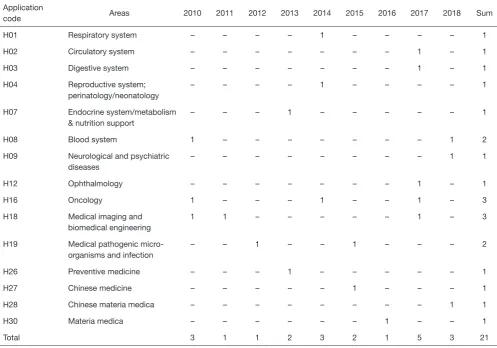
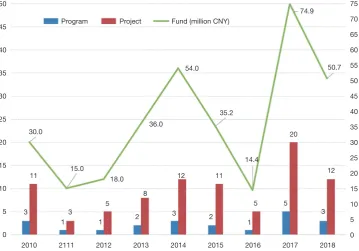
From 2010 to 2018, a total of 21 programs in the field of
health science were funded by the NSFC Major Program,
totaling 32.8 million CNY. The detailed information is
shown in
Table 1
and
Figure 1
.
Applicants’ host institutions
The applicants funded were from 43 host institutions. The
top ten institutions ranked are shown in
Figure 2
.
Regional distribution of applicants funded
The applicants funded were from 12 provinces and
municipalities which are shown in
Figure 3
.
Gender of applicants funded
[image:2.595.48.546.97.445.2]Of the applicants funded, 70 were males and 17 were
Table 1 Detailed information of areas in the field of health science funded by the NSFC Major Program between 2010 and 2018 Application
code Areas 2010 2011 2012 2013 2014 2015 2016 2017 2018 Sum
H01 Respiratory system – – – – 1 – – – – 1
H02 Circulatory system – – – – – – – 1 – 1
H03 Digestive system – – – – – – – 1 – 1
H04 Reproductive system; perinatology/neonatology
– – – – 1 – – – – 1
H07 Endocrine system/metabolism & nutrition support
– – – 1 – – – – – 1
H08 Blood system 1 – – – – – – – 1 2
H09 Neurological and psychiatric diseases
– – – – – – – – 1 1
H12 Ophthalmology – – – – – – – 1 – 1
H16 Oncology 1 – – – 1 – – 1 – 3
H18 Medical imaging and biomedical engineering
1 1 – – – – – 1 – 3
H19 Medical pathogenic micro-organisms and infection
– – 1 – – 1 – – – 2
H26 Preventive medicine – – – 1 – – – – – 1
H27 Chinese medicine – – – – – 1 – – – 1
H28 Chinese materia medica – – – – – – – – 1 1
H30 Materia medica – – – – – – 1 – – 1
Total 3 1 1 2 3 2 1 5 3 21
Age of applicants funded
The ages of applicants funded were between 35 and
77 years, with the age group between 46 and 60 being the
most common (
Figure 4
).
Professional qualifications of applicants
Of all the applicants funded, 86 had senior title (including
professor, researcher, and chief physician) while only 1 had
deputy senior title (associate chief physician).
Collaboration of institutions
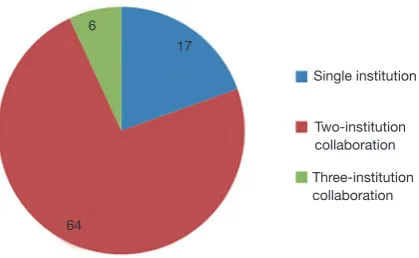
Collaboration was commonly found in the applications.
Of all the applicants funded, 64 cases had cooperation
between 2 institutions, and 6 cases had cooperation between
50 45 40 35 30 25 20 15 10 5 0 75 70 65 60 55 50 45 40 35 30 25 20 15 10 5 0 Program Project Fund (million CNY)2010 2111 2012 2013 2014 2015 2016 2017 2018 30.0
11 12 11 12
1 1 1
3 3 3 3
5 5 5
[image:3.595.117.477.85.336.2]8 2 2 36.0 54.0 35.2 14.4 18.0 15.0 74.9 50.7 20
Figure 1 Number of programs and projects with corresponding fund amount in the field of health science funded by the NSFC Major Program between 2010 and 2018. NSFC, National Natural Science Foundation of China.
3 4 4 4 4 7 8 8 3 3 Beijing University Fudan University Shanghai Jiaotong University Zhejiang University Sun Yat-sen University Sichuan University Capital Medical University Huazhong University of Science and Technology Air Force Medical University Academy of Military Medical University 10 8 6 4 2 0
[image:3.595.113.485.395.518.2]3 institutions (
Figure 5
).
Discussion
Several prominent characteristics of the Major Programs
could be gleaned based on our above analysis which may be
beneficial for the applicants in the future.
Major Programs cover nearly all health research areas.
Among them, blood system, oncology, medical imaging,
biomedical engineering, medical pathogenic micro-organisms
and infection account for the majority part of the funding.
Universities and institutes of Chinese academy of
sciences show great strength on the ability of medical
scientific research. And they successfully dominate the
number of the NSFC Major Program projects funded.
Geographically, the host institutions funded appear to be
concentrated in Beijing and Shanghai. At the same time,
collaboration of institutions seems to be advantageous.
The principle investigators of Major Programs are
mostly with the age of 50, although the number of PIs in
their 40s are growing.
[image:4.595.119.490.78.242.2]Generally, the eligible applicants should have excellent
academic accomplishments, with considerable influence
and team ability. Meanwhile, applicants should follow the
guidelines when writing proposals, focus on key scientific
issues with strategic and fundamental significance, concentrate
on interdisciplinary scientific targets, and pay attention to
coordination and links with other national scientific programs.
The research team should have an adequately prepared pilot
study, sufficient supporting conditions, innovative ability, and a
Figure 3 The regional distribution of applicants in the field of health science funded by the NSFC Major Program between 2010 and 2018. NSFC, National Natural Science Foundation of China.
0 5 10 15 20 25 30 35
Anhui Fujian Jiangsu Chongqing Shaanxi Tianjin Zhejiang Hubei Guangdong Sichuan Shanghai Beijing
1 1
2 2
3 3
4 5
7 7
20
32
30
25
20
15
10
5
0
[image:4.595.55.276.300.432.2]≤35 35–40 41–45 46–50 51–55 56–60 61–65 66–70 71–75 >75
Figure 4 The ages of applicants in the field of health science funded by the NSFC Major Program between 2010 and 2018. NSFC, National Natural Science Foundation of China.
6
64
Single institution
Two-institution collaboration
Three-institution collaboration 17
[image:4.595.58.268.518.647.2]Acknowledgments
None.
Footnote
Conflicts of Interest:
The authors have no conflicts of interest
to declare.
References
1. Zhu Z. Basic research must come first. An interview with
Zuoyan Zhu, Vice President of the National Natural Science Foundation of China and member of the Chinese Academy of Sciences. Interviewed by Holger Breithaupt and Caroline Hadley. EMBO Rep 2004;5:442-5.
2. NSFC Annual Guidance Books in 2010, 2011, 2012, 2013, 2014, 2015, 2016, 2017, 2018. Available online: http:// www.nsfc.gov.cn/english/site_1/funding/E1/2018/07-09/112.html
3. NSFC Annual Report in 2010, 2011, 2012, 2013, 2014, 2015, 2016, 2017, 2018. Available online: http://www.nsfc. gov.cn/english/site_1/report/C1/2018/10-18/130.html