Automatic Code Assignment to Medical Text
Koby Crammer and Mark Dredze and Kuzman Ganchev and Partha Pratim Talukdar Department of Computer and Information Science, University of Pennsylvania, Philadelphia, PA
{crammer|mdredze|kuzman|partha}@seas.upenn.edu
Steven Carroll
Division of Oncology, The Children’s Hospital of Philadelphia, Philadelphia, PA
Abstract
Code assignment is important for handling large amounts of electronic medical data in the modern hospital. However, only expert annotators with extensive training can as-sign codes. We present a system for the assignment of ICD-9-CM clinical codes to free text radiology reports. Our system as-signs a code configuration, predicting one or more codes for each document. We com-bine three coding systems into a single learn-ing system for higher accuracy. We compare our system on a real world medical dataset with both human annotators and other auto-mated systems, achieving nearly the maxi-mum score on the Computational Medicine Center’s challenge.
1 Introduction
The modern hospital generates tremendous amounts of data: medical records, lab reports, doctor notes, and numerous other sources of information. As hos-pitals move towards fully electronic record keeping, the volume of this data only increases. While many medical systems encourage the use of structured in-formation, including assigning standardized codes, most medical data, and often times the most impor-tant information, is stored as unstructured text.
This daunting amount of medical text creates exciting opportunities for applications of learning methods, such as search, document classification, data mining, information extraction, and relation ex-traction (Shortliffe and Cimino, 2006). These
ap-plications have the potential for considerable bene-fit to the medical community as they can leverage information collected by hospitals and provide in-centives for electronic record storage. Much of the data generated by medical personnel is unused past the clinical visit, often times because there is no way to simply and quickly apply the wealth of informa-tion. Medical NLP holds the promise of both greater care for individual patients and enhanced knowledge about health care.
In this work we explore the assignment of ICD-9-CM codes to clinical reports. We focus on this prac-tical problem since it is representative of the type of task faced by medical personnel on a daily ba-sis. Many hospitals organize and code documents for later retrieval using different coding standards. Often times, these standards are extremely complex and only trained expert coders can properly perform the task, making the process of coding documents both expensive and unreliable since a coder must se-lect from thousands of codes a small number for a given report. An accurate automated system would reduce costs, simplify the task for coders, and create a greater consensus and standardization of hospital data.
This paper addresses some of the challenges asso-ciated with ICD-9-CM code assignment to clinical free text, as well as general issues facing applica-tions of NLP to medical text. We present our auto-mated system for code assignment developed for the Computational Medicine Center’s challenge. Our approach uses several classification systems, each with the goal of predicting the exact code configu-ration for a medical report. We then use a learning
system to combine our predictions for superior per-formance.
This paper is organized as follows. First, we ex-plain our task and difficulties in detail. Next we de-scribe our three automated systems and features. We combine the three approaches to create a single su-perior system. We evaluate our system on clinical reports and show accuracy approaching human per-formance and the challenge’s best score.
2 Task Overview
The health care system employs a large number of categorization and classification systems to assist data management for a variety of tasks, including patient care, record storage and retrieval, statistical analysis, insurance, and billing. One of these sys-tems is the International Classification of Diseases, Ninth Revision, Clinical Modification (ICD-9-CM) which is the official system of assigning codes to di-agnoses and procedures associated with hospital uti-lization in the United States.1 The coding system is based on World Health Organization guidelines. An ICD-9-CM code indicates a classification of a disease, symptom, procedure, injury, or information from the personal history. Codes are organized hier-archically, where top level entries are general group-ings (e.g. “diseases of the respiratory system”) and bottom level codes indicate specific symptoms or diseases and their location (e.g. “pneumonia in as-pergillosis”). Each specific, low-level code consists of 4 or 5 digits, with a decimal after the third. Higher level codes typically include only 3 digits. Overall, there are thousands of codes that cover a broad range of medical conditions.
Codes are assigned to medical reports by doc-tors, nurses and other trained experts based on com-plex coding guidelines (National Center for Health Statistics, 2006). A particular medical report can be assigned any number of relevant codes. For exam-ple, if a patient exhibits a cough, fever and wheez-ing, all three codes should be assigned. In addi-tion to finding appropriate codes for each condiaddi-tion, complex rules guide code assignment. For exam-ple, a diagnosis code should always be assigned if a diagnosis is reached, a diagnosis code should never
1http://www.cdc.gov/nchs/about/otheract/ icd9/abticd9.htm
be assigned when the diagnosis is unclear, a symp-tom should never be assigned when a diagnosis is present, and the most specific code is preferred. This means that codes that seem appropriate to a report should be omitted in specific cases. For example, a patient with hallucinations should be coded 780.1 (hallucinations) but for visual hallucinations, the correct code is 368.16. The large number of codes and complexity of assignment rules make this a diffi-cult problem for humans (inter-annotator agreement is low). Therefore, an automated system that sug-gested or assigned codes could make medical data more consistent.
These complexities make the problem difficult for NLP systems. Consider the task as multi-class, multi-label. For a given document, many codes may seem appropriate but it may not be clear to the algo-rithm how many to assign. Furthermore, the codes are not independent and different labels can inter-act to either increase or decrease the likelihood of the other. Consider a report that says, “patient re-ports cough and fever.” The presence of the words cough and fever indicate codes 786.2 (cough) and 780.6 (fever). However, if the report continues to state that “patient has pneumonia” then these codes are dropped in favor of 486 (pneumonia). Further-more, if the report then says “verify clinically”, then the diagnosis is uncertain and only codes 786.2 and 780.6 apply. Clearly, this is a challenging problem, especially for an automated system.
2.1 Corpus
We built and evaluated our system in accordance with the Computational Medicine Center’s (CMC) 2007 Medical Natural Language Processing Chal-lenge.2 Since release of medical data must strictly follow HIPAA standards, the challenge corpus un-derwent extensive treatment for disambiguation, anonymization, and careful scrubbing. A detailed description of data preparation is found in Compu-tational Medicine Center (2007). We describe the corpus here to provide context for our task.
The training corpus is comprised of 978 radiolog-ical reports taken from real medradiolog-ical records. A test corpus contains 976 unlabeled documents. Radiol-ogy reports have two text fields, clinical history and
impression. The physician ordering the x-ray writes the clinical history, which contains patient informa-tion for the radiologist, including history and current symptoms. Sometimes a guess as to the diagnosis appears (“evaluate for asthma”). The descriptions are sometimes whole sentences and other times sin-gle words (“cough”). The radiologist writes the im-pression to summarize his or her findings. It con-tains a short analysis and often times a best guess as to the diagnosis. At times this field is terse, (“pneu-monia” or “normal kidneys”) and at others it con-tains an entire paragraph of text. Together, these two fields are used to assign ICD-9-CM codes, which justify a certain procedure, possibly for reimburse-ment by the insurance company.
Only a small percentage of ICD-9-CM codes ap-pear in the challenge. In total, the reports include 45 different codes arranged in 94 configurations (com-binations). Some of these codes appear frequently, while others are rare, appearing only a single time. The test set is restricted so that each configuration appears at least once in the training set, although there is no further guarantee as to the test set’s distri-bution over codes. Therefore, in addition to a large number of codes, there is variability in the amount of data for each code. Four codes have over 100 examples each and 24 codes have 10 or fewer doc-uments, with 10 of these codes having only a single document.
Since code annotation is a difficult task, each doc-ument in the corpus was evaluated by three expert annotators. A gold annotation was created by tak-ing the majority of the annotators; if two of the three annotators provided a code, that code is used in the gold configuration. This approach means that a doc-ument’s configuration may be a construction of mul-tiple annotators and may not match any of the three annotators exactly. Both the individual and the ma-jority annotations are included with the training cor-pus.
While others have attempted ICD-9 code classi-fication, our task differs in two respects (Section 7 provides an overview of previous work). First, pre-vious work has used discharge reports, which are typically longer with more text fields. Second, while most systems are evaluated as a recommendation system, offering the top k codes and then scoring recall atk, our task is to provide theexact
configu-ration. The CMC challenge evaluated systems using an F1 score, so we are penalized if we suggest any label that does not appear in the majority annotation. To estimate task difficulty we measured the inter-annotator score for the training set using the three annotations provided. We scored two annotations with the micro average F1, which weighs each code assignment equally (see Section 5 for details on evaluation metrics). If an annotator omitted a code and included an extra code, he or she is penalized with a false positive (omitting a code) and a false negative (adding an extra code). We measured anno-tators against each other; the average f-measure was 74.85 (standard deviation of .06). These scores were low since annotators chose from an unrestricted set of codes, many of which were not included in the fi-nal majority annotation. However, these scores still indicate the human accuracy for this task using an unrestricted label set.3
3 Code Assignment System
We developed three automated systems guided by our above analysis. First, we designed a learning system that used natural language features from the official code descriptions and the text of each re-port. It is general purpose and labels all 45 codes and 94 configurations (labels). Second, we built a rule based system that assigned codes based on the overlap between the reports and code descriptions, similar to how an annotator may search code de-scriptions for appropriate labels. Finally, a special-ized system aimed at the most common codes imple-mented a policy that mimics the guidelines a medical staffer would use to assign these codes.
3.1 Learning System
We begin with some notational definitions. In what follows,x denotes the generic input document (ra-diology report),Y denotes the set of possible label-ings (code configurations) ofx, and y∗(x) the cor-rect labeling of x. For each pair of document x
and labeling y ∈ Y, we compute a vector-valued feature representation f(x, y). A linear model is
3
given by a weight vectorw. Given this weight vec-torw, the scorew·f(x, y)ranks possible labelings of x, and we denote by Yk,w(x) the set of k top
scoring labelings for x. For some structured prob-lems, a factorization off(x, y)is required to enable a dynamic program for inference. For our problem, we know all the possible configurations in advance (there are 94 of them) so we can pick the highest scoring y ∈ Y by trying them all. For each docu-mentxand possible labelingy, we compute a score usingwand the feature representationf(x, y). The top scoringyis output as the correct label. Section 3.1.1 describes our feature function f(x, y) while Section 3.1.2 describes how we find a good weight vectorw.
3.1.1 Features
Problem representation is one of the most impor-tant aspects of a learning system. In our case, this is defined by the set of featuresf(x, y). Ideally we would like a linear combination of our features to ex-actly specify the true labeling of all the instances, but we want to have a small total number of features so that we can accurately estimate their values. We sep-arate our features into two classes: label specific fea-tures and transfer feafea-tures. For simplicity, we index features by their name. Label specific features are only present for a single label. For example, a simple class of label specific features is the conjunction of a word in the document with an ICD-9-CM code in the label. Thus, for each word we create 94 features, i.e. the word conjoined with every label. These features tend to be very powerful, since weights for them can encode very specific information about the way doc-tors talk about a disease, such as the feature “con-tains word pneumonia and label con“con-tains code 486”. Unfortunately, the cost of this power is that there are a large number of these features, making parameter estimation difficult for rare labels. In contrast, trans-fer features can be present in multiple labels. An example of a transfer feature might be “the impres-sion contains all the words in the code descriptions of the codes in this label”. Transfer features allow us to generalize from one label to another by learning things like “if all the words of the label description occur in the impression, then this label is likely” but have the drawback that we cannot learn specific de-tails about common labels. For example, we cannot
learn that the word “pneumonia” in the impression is negatively correlated with the code cough. The inclusion of both label specific and transfer features allows us to learn specificity where we have a large number of examples and generality for rare codes.
Before feature extraction we normalized the re-ports’ text by converting it to lower case and by replacing all numbers (and digit sequences) with a single token hNUMi. We also prepared a synonym dictionary for a subset of the tokens and n-grams present in the training data. The synonym dictionary was based on MeSH4, the Medical Subject Headings vocabulary, in which synonyms are listed as terms under the same concept. All ngrams and tokens in the training data which had mappings defined in the synonym dictionary were then replaced by their normalized token; e.g. all mentions of “nocturnal enuresis” or “nighttime urinary incontinence” were replaced by the token “bedwetting”. Additionally, we constructed descriptions for each code automati-cally from the official ICD-9-CM code descriptions in National Center for Health Statistics (2006). We also created a mapping between code and code type (diagnosis or symptom) using the guidelines.
Our system used the following features. The de-scriptions of particular features are in quotes, while schemes for constructing features are not.
• “this configuration contains a disease code”, “this configuration contains a symptom code”, “this configuration contains an ambiguous code” and “this configuration contains both dis-ease and symptom codes”.5
• With the exception of stop-words, all words of the impression and history conjoined with each label in the configuration; pairs of words con-joined with each label; words concon-joined with pairs of labels. For example, “the impression contains ‘pneumonia’ and the label contains codes 786.2 and 780.6”.
• A feature indicating when the history or im-pression contains a complete code description
4www.nlm.nih.gov/mesh 5
for the label; one for a word in common with the code description for one of the codes in the label; a common word conjoined with the pres-ence of a negation word nearby (“no”, “not”, etc.); a word in common with a code descrip-tion not present in the label. We applied similar features using negative words associated with each code.
• A feature indicating when a soft negation word appears in the text (“probable”, “possible”, “suspected”, etc.) conjoined with words that follow; the token length of a text field (“im-pression length=3”); a conjunction of a feature indicating a short text field with the words in the field (“impression length=1 and ‘pneumo-nia’ ”)
• A feature indicating each n-gram sequence that appears in both the impression and clinical his-tory; the conjunction of certain terms where one appears in the history and the other in the impression (e.g. “cough in history and pneu-monia in impression”).
3.1.2 Learning Technique
Using these feature representations, we now learn a weight vector wthat scores the correct labelings of the data higher than incorrect labelings. We used ak-best version of the MIRA algorithm (Crammer, 2004; McDonald et al., 2005). MIRA is an online learning algorithm that for each training document
xupdates the weight vectorwaccording to the rule:
wnew = arg min
w kw−woldk
s.t. ∀y ∈Yk,wold(x) :
w·f(x, y∗(x))−w·f(x, y)≥L(y∗(x), y)
whereL(y∗(x), y)is a measure of the loss of label-ingywith respect to the correct labelingy∗(x). For our experiments, we setkto 30 and iterated over the training data 10 times. Two standard modifications to this approach also helped. First, rather than using just the final weight vector, we average all weight vectors. This has a smoothing effect that improves performance on most problems. The second
modifi-cation is the introduction of slack variables:
wnew = arg min
w kw−woldk+γ
X
i
ξi
s.t. ∀y∈Yk,wold(x) :
w·f(x, y∗(x))−w·f(x, y)≥L(y∗(x), y)−ξi
∀i∈ {1. . . k}: ξi≥0.
We used aγof10−3in our experiments.
The most straightforward loss function is the 0/1 loss, which is one ifydoes not equaly∗(x)and zero otherwise. Since we are evaluated based on the num-ber of false negative and false positive ICD-9-CM codes assigned to all the documents, we used a loss that is the sum of the number of false positive and the number of false negative labels thaty assigns with respect toy∗(x).
Finally, we only used features that were possi-ble for some labeling of the test data by using only the test data to construct our feature alphabet. This forced the learner to focus on hypotheses that could be used at test time and resulted in a 1% increase in F-measure in our final system on the test data.
3.2 Rule Based System
we may predict a code configuration that does not appear in our training data. Adding this restriction improved precision but hurt recall, leading to a slight decrease in F1 score. We therefore omitted the re-striction from our system.
3.3 Automatic Coding Policies
As we described in Section 2, enforcing coding guidelines can be a complex task. While a learning system may have trouble coding a document, a hu-man may be able to define a simple policy for cod-ing. Since some of the most frequent codes in our dataset have this property, we decided to implement such an automatic coding policy. We selected two related sets of codes to target with a rule based sys-tem, a set of codes found in pneumonia reports and a set for urinary tract infection/reflux reports.
Reports related to pneumonia are the most com-mon in our dataset and include codes for pneumo-nia, asthma, fever, cough and wheezing; we handle them with a single policy. Our policy is as follows:
• Search for a small set of keywords (e.g. “cough”, “fever”) to determine if a code should be applied.
• If “pneumonia” appears unnegated in the im-pression and the imim-pression is short, or if it oc-curs in the clinical history and is not preceded by phrases such as “evaluate for” or “history of”, apply pneumonia code and stop.
• Use the same rule to code asthma by looking for “asthma” or “reactive airway disease”.
• If no diagnosis is found, code all non-negated symptoms (cough, fever, wheezing).
We selected 80% of the training set to evaluate in the construction of our rules. We then ran the finished system on both this training set and the held out 20% of the data. The system achieved F1 scores of 87% on the training set and 84% on the held out data for these five codes. The comparable scores indicates that we did not over-fit the training data.
We designed a similar policy for two other related codes, urinary tract infection and vesicoureteral re-flux. We found these codes to be more complex as they included a wide range of kidney disorders. On these two codes, our system achieved 78% on the
train set and 76% on the held out data. Overall, au-tomatically applying our two policies yielded high confidence predictions for a significant subset of the corpus.
4 Combined System
Since our three systems take complimentary ap-proaches to the problem, we combined them to im-prove performance. First, we took our automatic policy and rule based systems and cascaded them; if the automatic policy system does not apply a code, the rule based system classifies the report. We used a cascaded approach since the automatic policy sys-tem was very accurate when it was able to assign a code. Therefore, the rule based system defers to the policy system when it is triggered. Next, we in-cluded the prediction of the cascaded system as a feature for our learning system. We used two fea-ture rules: “cascaded-system predicted exactly this label” and “cascaded-system predicted one of the codes in this label”. As we show, this yielded our most accurate system. While we could have used a meta-classifier to combine the three systems, includ-ing the rule based systems as features to the learninclud-ing system allowed it to learn the appropriate weights for the rule based predictions.
5 Evaluation Metric
System Precision Recall F1
BL 61.86 72.58 66.79
RULE 81.9 82.0 82.0
CASCADE 86.04 84.56 85.3
LEARN 85.5 83.6 84.6
[image:7.612.341.514.53.126.2]CASCADE+LEARN 87.1 85.9 86.5
Table 1: Performance of our systems on the provided labeled training data (F1 score). The learning sys-tems (CASCADE+LEARNandLEARN) were eval-uated on ten random split of the data while RULE
was evaluated on all of the training data. We include a simple rule based system (BL) as a baseline.
6 Results
We evaluated our systems on the labeled training data of 978 radiology reports. For each report, each system predicted an exact configuration of codes (i.e. one of 94 possible labels). We score each sys-tem using a micro-averaged F1 score. Since we only had labels for the training data, we divided the data using an 80/20 training test split and averaged results over 10 runs for our learning systems. We evaluated the following systems:
• RULE: The rule based system based on ICD-9-CM code descriptions (Section 3.2).
• CASCADE: The automatic code policy system (Section 3.3) cascaded withRULE(Section 4).
• LEARN: The learning system with both label specific and transfer features (Section 3.1).
• CASCADE+LEARN : Our combined system that incorporates CASCADE predictions as a feature toLEARN(Section 4).
For a baseline, we built a simple system that ap-plies the official ICD-9-CM code descriptions to find the correct labels (BL ). For each code in the train-ing set, the system generates text-segments related to it. During testing, for each new document, the sys-tem checks if any text-segment (as discovered dur-ing traindur-ing) appears in the document. If so, the cor-responding code is predicted. The results from our four systems and baseline are shown in Table 1.
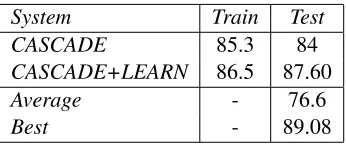
System Train Test
CASCADE 85.3 84
CASCADE+LEARN 86.5 87.60
Average - 76.6
Best - 89.08
Table 2: Performance of two systems on the train and test data. Results obtained from the web sub-mission interface were rounded. Average andBest
are the average and best f-measures of the 44 sub-mitted systems (standard deviation 13.40).
Each of our systems easily beats the baseline, and the average inter-annotator score for this task. Ad-ditionally, we were able to evaluate two of our sys-tems on the test data using a web interface as pro-vided by the competition. The test set contains 976 documents (about the same as the training set) and is drawn the from same distribution as the training data. Our test results were comparable to perfor-mance on the training data, showing that we did not over-fit to the training data (Table 2). Addi-tionally, our combined system (CASCADE+LEARN
) achieved a score of 87.60%, beating our training data performance and exceeding the average inter-annotator score. Out of 44 submitted systems, the average score on test data was 76.7% (standard devi-ation of 13.40) and the maximum score was 89.08%. Our system scored 4th overall and was less than 1.5% behind the best system. Overall, in comparison with our baselines and over 40 systems, we perform very well on this task.
7 Related Work
[image:7.612.69.303.55.137.2]inde-pendence. Similar to our approach, they tag items as negated and try to identify diagnosis and symp-tom terms. Additionally, their final system combines all three models. A direct comparison is not possi-ble due to the difference in data and evaluation met-rics; they use average precision and recall atk. On a comparable metric, “principal code is top candi-date”, their best system achieves 59.9% accuracy. de Lima et al. (1998) rely on the hierarchical nature of medical codes to design a hierarchical classification scheme. This approach is likely to help on our task as well but we were unable to test this since the lim-ited number of codes removes any hierarchy. Other approaches have used a variety of NLP techniques (Satomura and Amaral, 1992).
Others have used natural language systems for the analysis of medical records (Zweigenbaum, 1994). Chapman and Haug (1999) studied radiology re-ports looking for cases of pneumonia, a goal sim-ilar to that of our automatic coding policy system. Meystre and Haug (2005) processed medical records to harvest potential entries for a medical problem list, an important part of electronic medical records. Chuang et al. (2002) studied Charlson comorbidi-ties derived from processing discharge reports and chest x-ray reports and compared them with admin-istrative data. Additionally, Friedman et al. (1994) applies NLP techniques to radiology reports.
8 Conclusion
We have presented a learning system that processes radiology reports and assigns ICD-9-CM codes. Each of our systems achieves results comparable with an inter-annotator baseline for our training data. A combined system improves over each individ-ual system. Finally, we show that on test data un-available during system development, our final sys-tem continues to perform well, exceeding the inter-annotator baseline and achieving the 4th best score out of 44 systems entered in the CMC challenge.
9 Acknowledgements
We thank Andrew Lippa for his extensive medical wisdom. Dredze is supported by an NDSEG fel-lowship; Ganchev and Talukdar by NSF ITR EIA-0205448; and Crammer by DARPA under Contract No. NBCHD03001. Any opinions, findings, and
conclusions or recommendations expressed in this material are those of the author(s) and do not nec-essarily reflect the views of the DARPA or the De-partment of Interior-National Business Center (DOI-NBC).
References
W.W. Chapman and P.J. Haug. 1999. Comparing expert sys-tems for identifying chest x-ray reports that support pneu-monia. InAMIA Symposium, pages 216–20.
JH Chuang, C Friedman, and G Hripcsak. 2002. A com-parison of the charlson comorbidities derived from medical language processing and administrative data. AMIA Sympo-sium, pages 160–4.
Computational Medicine Center. 2007. The computational medicine center’s 2007 med-ical natural language processing challenge. http://computationalmedicine.org/challenge/index.php. Koby Crammer. 2004.Online Learning of Complex Categorial
Problems. Ph.D. thesis, Hebrew Univeristy of Jerusalem. Luciano R. S. de Lima, Alberto H. F. Laender, and Berthier A.
Ribeiro-Neto. 1998. A hierarchical approach to the auto-matic categorization of medical documents. InCIKM. C Friedman, PO Alderson, JH Austin, JJ Cimino, and SB
John-son. 1994. A general natural-language text processor for clinical radiology. Journal of the American Medical Infor-matics Association, 1:161–74.
Leah S. Larkey and W. Bruce Croft. 1995. Automatic assign-ment of icd9 codes to discharge summaries. Technical re-port, University of Massachusetts at Amherst, Amherst, MA. YA Lussier, C Friedman, L Shagina, and P Eng. 2000. Au-tomating icd-9-cm encoding using medical language pro-cessing: A feasibility study.
Ryan McDonald, Koby Crammer, and Fernando Pereira. 2005. Flexible text segmentation with structured multilabel classi-fication. InHLT/EMNLP.
Stephane Meystre and Peter J Haug. 2005. Automation of a problem list using natural language processing.BMC Medi-cal Informatics and Decision Making.
National Center for Health Statistics. 2006. Icd-9-cm official guidelines for coding and reporting. http://www.cdc.gov/nchs/datawh/ftpserv/ftpicd9/ftpicd9.htm. Y Satomura and MB Amaral. 1992. Automated diagnostic
in-dexing by natural language processing. Medical Informat-ics, 17:149–163.
Edward H. Shortliffe and James J. Cimino, editors. 2006.
Biomedical Informatics: Computer Applications in Health Care and Biomedicine. Springer.