Bridging the Gaps:
Interoperability for GrAF, GATE, and UIMA
Nancy Ide
Department of Computer Science Vassar College
Poughkeepsie, New York USA
Keith Suderman
Department of Computer Science Vassar College
Poughkeepsie, New York USA
Abstract
This paper explores interoperability for data represented using the Graph Anno-tation Framework (GrAF) (Ide and Sud-erman, 2007) and the data formats uti-lized by two general-purpose annotation systems: the General Architecture for Text Engineering (GATE) (Cunningham, 2002) and the Unstructured Information Man-agement Architecture (UIMA). GrAF is intended to serve as a “pivot” to enable interoperability among different formats, and both GATE and UIMA are at least im-plicitly designed with an eye toward inter-operability with other formats and tools. We describe the steps required to per-form a round-trip rendering from GrAF to GATE and GrAF to UIMA CAS and back again, and outline the commonalities as well as the differences and gaps that came to light in the process.
1 Introduction
The creation of language data and linguistic anno-tations remains a fundamental activity in the field of language technology, in order to develop in-creasingly sophisticated understanding and gener-ation capabilities for the world’s languages. Sub-stantial effort has been devoted to the creation of resources for major languages, and new projects are developing similar resources for less widely-used languages; the cost and effort of resource cre-ation, as well as the possibilities for linking multi-lingual and multi-modal language data, demands that resources and tools are reusable as well as compatible in terms of their representation. Var-ious representation standards and annotation tools have emerged over the past decade and have con-tributed to some convergence in practice, but at the same time, there has been growing recognition that
interoperability among formats and tools, rather than universal use of a single representation for-mat, is more suited to the needs of the community and language technology research in general.
This paper explores interoperability for data represented using the Graph Annotation Frame-work (GrAF) (Ide and Suderman, 2007) and the data formats utilized by two general-purpose an-notation systems: the General Architecture for Text Engineering (GATE) (Cunningham, 2002) and the Unstructured Information Management Architecture (UIMA)1. UIMA and GATE are
sim-ilar in design and purpose: both represent docu-ments as text plus annotations and allow users to define pipelines of processes that manipulate the document. However, there are some differences in implementation and representation format that prohibit direct exchange of data and annotations between the two.
The Graph Annotation Framework (GrAF) (Ide and Suderman, 2007) is intended to serve as a “pivot” to enable interoperability among different formats for data and linguistics annotations and the systems that create and exploit them. In this paper, we describe the steps required to perform a round-trip rendering from GrAF to GATE and GrAF to UIMA CAS and back again, and outline the commonalities as well as the differences and gaps that came to light in the process. In doing so, we hope to shed some light on the design and implementation choices that either contribute to or impede progress toward interoperability, which can feed future development.
2 Background
A handful of formats for linguistic data and annotations have been proposed as standards over the past ten years, including Annotation Graphs (AG) (Bird and Liberman, 2001), and,
1http://www.oasis-open.org/committees/uima/
most recently, the Graph Annotation Framework (GrAF) (Ide and Suderman, 2007). UIMA’s Common Analysis System (CAS) also provides a ”common” way to represent annotations so that they can be shared and reused among UIMA an-notator components.
Annotation Graphs were introduced primarily as a means to handle time-stamped speech data, in large part to overcome the problem of overlapping annotations that violate the strict tree structure of XML-based schemes. However, AGs are limited by the inability to represent hierarchical relations among annotations (as, for instance, in a syntax tree). AGs are used in GATE to represent standoff annotations.
GrAF has been developed by the International Standards Organization (ISO)’s TC37 SC4, as a part of the Linguistic Annotation Framework (In-ternational Standards Organization, 2008). GrAF provides an XML serialization of an abstract data model for annotations that is intended to serve as a ”pivot” for transducing among user-defined and tool input annotation formats. GrAF is intended to function in much the same way as aninterlingua in machine translation: a common, abstract con-ceptual representation into and out of which user-and tool-specific formats are transduced, so that a transduction of any specific format into and out of GrAF accomplishes the transduction between it and any number of other GrAF-conformant for-mats. GrAF is currently an ISO Candidate Draft.
The UIMA framework is a data management system that supports pipelined applications over unstructured data. UIMA was originally de-veloped by IBM and is currently under further development by an OASIS technical commit-tee2. Apache UIMA3is an Apache-licensed open
source implementation of the UIMA specification being developed as an Apache incubator project. UIMA’s Common Analysis System (CAS) is used to describe typed objects (annotations) associated with a given text or other media, upon which pro-cessing modules (”annotators”) operate.
2.1 Annotation models
Each of the formats described above is based on some model of annotations and their relation to the data they describe. The AG model consists of sets of arcs defined over nodes corresponding to
2http://www.oasis-open.org/committees/uima/ 3http://incubator.apache.org/uima/index.html
timestamps in primary data, each of which is la-beled with an arbitrary linguistic description that applies to that region. Multiple annotations over the data produce multiple arcs; there is no provi-sion for arcs associating annotations.
GrAF defines theregionsto be annotated in pri-mary data as the area bounded by two or more an-chors. The definition of anchor and the number of anchors needed to define a region depends on the medium being annotated. The only assumption that GrAF makes is that anchors have a natural or-dering. For textual data GrAF uses character off-sets for anchors, and two anchors bound each re-gion. Regions serve as the leaf nodes of a directed acyclic graph. Annotations in the form of feature structures are associated with nodes in the graph, including nodes associated with both regions and other annotations, via edges in the graph. GrAF can represent common annotation types such as hierarchical syntax trees by allowing, for exam-ple, a sentence annotation to have edges to con-stituent annotations such as NP, VP, etc. As op-posed to AGs, annotations typically label nodes rather than edges in GrAF, although labeled edges are allowed, and the information comprising the annotations is represented using feature structures rather than simple labels.
3 GrAF→UIMA→GrAF
Conversion of a GrAF data structure into UIMA involves generating (1) a UIMA data structure (a CAS), (2) a UIMAtype system, and a specification oftype priorities.
The CAS consists of asubject of analysis(sofa), which is the data (in our examples here, a text) it-self, together with its annotations. The CAS XML representation of the annotations is very similar to the GrAF XML representation: each annotation is identified by its start and end location in the data expressed in terms of virtual nodes between each character in the data, where the position before the first character is node 0. The conversion of GrAF anchors to UIMA indexes is therefore trivial.
3.1 UIMA Type Systems
A UIMA type system specifies the type of data that can be manipulated by annotator components. A type system defines two kinds of objects; types and features. The type defines the kinds of data that can be manipulated in a CAS, arranged in an inheritance hierarchy. A feature defines a field, or slot, within a type. Each CAS type specifies a single supertype and a list of features that may be associated with that type. A type inherits all of the features from its supertype, so the features that can be associated with a type is the union of all features defined by all supertypes in the inher-itance tree. A feature is a name/value pair where the value can be one of UIMA’s built in primitive types (boolean, char, int, etc.) or a reference to another UIMA object. UIMA also allows feature values to be arrays of either primitive types or ar-rays of references to other objects.
UIMA defines a top level type uima.cas.TOP which contains no features and serves as the root of the UIMA type system inheritance tree. The root type uima.cas.TOP is the supertype of uima.cas.AnnotationBase, which is the super-type of uima.tcas.Annotation, which in turn is the supertype for org.xces.graf.uima.Annotation. All UIMA annotations generated by GrAF use org.xces.graf.uima.Annotationas their supertype. Note that the UIMA type hierarchy is strictly an is-ahierarchy; for example, there may be an annota-tion typeposwith subtypes penn pos,claws pos, etc., indicating that each of these annotations are a kind of part of speech annotation. The hierar-chy does not reflect other kinds of relations such as the relation between a ”lemma” annotation and
a ”pos” annotation (i.e., a lemma and a pos are typically companion parts of a morpho-syntactic description, but neither oneisa morpho-syntactic description), or constituency relations in syntactic annotation schemes.
The GrAF Java API provides a Java class that generates a valid UIMA type system given one or more GrAF objects. The type system is generated by iterating over all the nodes in the graph and cre-ating a new type for each kind of annotation en-countered (e.g., token, sentence, POS, etc.). Fea-ture descriptions are generated for each type at the same time.
One drawback of deriving a type system auto-matically is that some of the power of UIMA type systems is lost in the conversion. For example, in the process of conversion, all feature values are assumed to be strings, even though UIMA allows specification of the type of a feature value. Since in GrAF, feature values have been serialized from the contents of an XML attribute, all feature values are represented internally as strings; to convert a feature value to any other representation would re-quire that GrAF have some external knowledge of the annotation format being deserialized. There-fore, any type checking capability for feature value types in UIMA is lost after automatic generation of the type system. Similarly, it is not possible to determine a supertype for an annotation if it is more specific than org.xces.graf.uima.Annotation from the information in the GrAF representation alone, so in effect, it is not possible to derive any meaningful type hierarchy without additional knowledge. For example, it is not possible to in-clude the information in the type system descrip-tion thatpenn pos andclaws posare subtypes of possince this information is not represented in the graph. Even in cases where this kind of informa-tion is represented in the graph, it is not retriev-able; for example, FrameNet annotation includes agrammaticalFunctionannotation whose children are elements such as subject, object, etc. However, there is no way to determine what the parent-child relation is between nodes without a prioriknowledge of the annotation scheme.
used when generating the type system. The XML schema can specify the type hierarchy, data types and restricted ranges for feature values, etc. (see, for example, the XCES (Ideet al., 2000) schema is used for the data and annotations in the American National Corpus (ANC)4.)
3.2 UIMA Views and Indexes
A UIMA CAS object may contain more than one view of the artifact being annotated; for example, a CAS may contain an audio stream as one view and the transcribed text as another. Each view contains a copy of the artifact, referred to as thesubject of analysis(sofa), and a set of indexes that UIMA an-notators (processing modules) use to access data in the CAS. Each index is associated with one CAS type and indexes that type by its features–that is, the features are the keys for the index.
The indexes are the only way for UIMA annota-tors to access annotations in the CAS. It is neces-sary to generate these indexes, which are not pro-vided automatically within UIMA. The GrAF Java API provides a module that generates the indexes at the same time the it generates the type system description. Since we do not know, and make no assumptions about, which annotations might be required by other annotators, all annotations are indexed by all of their features.
3.3 Type Priorities
Type priorities in UIMA are used to determine nesting relations when iterating over collections of annotations. That is, if two annotations have the same start and end offsets, then the order in which they will be presented by an iterator is determined by their type priority; the annotation with the high-est priority will be presented first. Type priorities are specified by an ordered listing of annotation types, where order determines priority. In GrAF, annotation nesting is implicit in the graph itself.
To generate an explicit type priority specifica-tion for UIMA we must first obtain a list of all annotation types that appear in the graph and then sort the list based on the order they are encoun-tered during a a depth first traversal of the graph. During the depth first traversal aN x N precedence matrixis constructed whereNis the number of an-notation types in the graph. Ifprecedes[A,B] == true then A was encountered as an ancestor of B in the depth first traversal. If precedes[A,B] ==
4http://www.anc.org
precedes[B,A] ==truethen it is assumed that the annotation types have the same priority. Once the list of annotation types has been collected and the precedence matrix constructed, the matrix can be used to to sort the annotation types:
int compare(Annotation A, Annotation B, PrecedenceMatrix m)
{
boolean AB = m.precedes(A,B); boolean BA = m.precedes(B,A); if (AB && BA)
{
return 0; // equal
}
else if (AB)
{
return -1; // A first.
}
else if (BA)
{
return 1; // B first.
}
// Neither AB or BA means A and // B are not in connected // components.
return 0;
}
Not all nodes in the graph may be reachable in a depth first traversal, particularly if multiple annotations formats have been merged together. Therefore, after the initial traversal has been com-pleted each node is checked to determine if it has been visited. If not, then another traversal is started from that node. This is repeated until all nodes/annotations in the graph have been visited at least once.
We have found that UIMA type priorities im-pose some limitations because they cannot repre-sent context sensitive annotation orderings. For example, given
<!ELEMENT E1 (A,B)> <!ELEMENT E2 (B,A)>
The order ofAandBdiffers depending on whether the parent annotation isE1orE2. This type of re-lationship cannot be expressed by a simple order-ing of annotations.
3.4 Naming Conflicts
gen-<as type="POS"> <a label="token">
<fsr:fs type="PENN">
<fsr:f name="msd" fVal="NN"/> </fsr:fs>
<fsr:fs type="CLAWS5">
<fsr:f name="msd" fVal="NN"/> </fsr:fs>
</a> </as>
Figure 1: GrAF representation of alternative POS annotations
erated UIMA type name consists of a concatena-tion of the nested annotaconcatena-tion set names with the annotation label appended. For example, multiple part of speech annotations may be represented in different annotation sets, as shown in Figure 1.5
For the above example, two types will be generated: POS token PENN and
POS token CLAWS5. However, GrAF places
no restrictions on the names used for annotation set names, annotation labels, or feature structure types. Therefore, it is possible that the derived type name is not a valid UIMA identifier, which are required to follow Java naming conventions. For example,Part-Of-Speechis a valid name for an annotation label in GrAF, but because of the hyphen it is not a valid Java identifier and therefore not valid in UIMA.
To avoid the naming problem, a derived name is converted into a valid UIMA identifier before creating the UIMA type description. To permit round trip engineering, that is, ensuring a GrAF→ UIMA→GrAF transformation results in the same GrAF representation as the original, a NameMap file is produced that maps a generated name to the compatible UIMA name. NameMaps can be used in a UIMA→GrAF conversion to ensure the GrAF annotations and annotation sets created are given the same names as they had in the original GrAF representation.
3.5 Preserving the Graph Structure
While UIMA does not have any graph-specific functionality, the value of a UIMA feature can be an array of annotations, or more specifically, an array of references to other annotations. In 5The use of the fValattribute in this example is sub-ject to change according to revisions of ISO/DIS 24610-1 Language Resource Management - Feature Structures - Part 1: Feature Structure Representation(International Standards Organization, 2005), to which the representation of feature structures in GrAF adheres.
this way, annotations can effectively ”point” to other annotations in UIMA. We exploit this ca-pability to preserve the structure of the original graph in the UIMA representation, by adding two features to each annotation: graf children
andgraf ancestors. This information can be
used to recreate the GrAF representation, should that ever be desired. It can also be used by UIMA annotators that have been designed to use and/or manipulate this information.
Although rarely used, GrAF permits edges in the graph to be annotated in the same way that nodes are. For UIMA conversion, if a graph con-tains labeled edges it must be converted into an equivalent graph without labeled edges. A graph with labeled edges can be converted into an equiv-alent graph without labeled edges, where a node replaces the original edge. To preserve the origi-nal graph structure, an attribute indicating that the node is represented as a a labeled edge in GrAF is included.
4 GrAF→GATE→GrAF
The conversion to/from GATE is much simpler than conversion to UIMA, since GATE is type-less and does not require the overhead of gener-ating a type system or type priorities list. While GATE does support annotation schemas, they are optional, and annotations and features can be cre-ated at will. GATE is also much more lenient on annotation and feature names; names automat-ically generated by GrAF are typautomat-ically valid in GATE.
Representing the graph structure in GATE is not as straightforward as it is in UIMA. We have de-veloped a plugin to GATE that loads GrAF stand-off annotations into GATE, and a parallel plugin that generates GrAF from GATE’s internal format. As noted above, GATE uses annotation graphs to represent annotations, However, because annota-tion graphs do not provide for annotaannota-tions of an-notations, to transduce from GrAF to the GATE in-ternal format it is necessary to ”flatten” the graph so that nodes with edges to other nodes are mod-ified to contain edges directly into the primary data. GATE assigns a unique id value to every an-notation, so it is possible to link annotations by creating a special feature and referencing the par-ent/child annotations by their GATE id values.
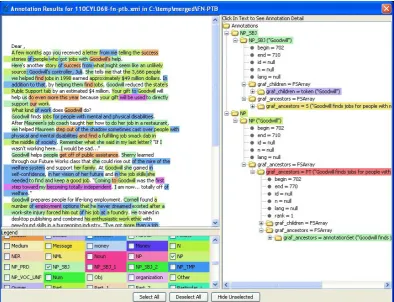
Figure 2: UIMA rendering of GrAF annotations
annotation is expected to have a start and end off-set. In GrAF, a node may have multiple edges to other nodes that cover disjoint regions of text. For example, the FrameNet6annotation for a given
verb typically includes edges to the associated role fillers (e.g., agent, theme, instrument, etc.), which are rarely contiguous in the text itself. Our current solution to this problem is to give a start and end offset that covers the smallest region of the text covering the regions associated with all descen-dants of the annotation, and recording the infor-mation concerning the original graph structure in attributes to enable reconversion into the original GrAF representation.
5 Exploiting Interoperability
GrAF is intended to serve as thelingua francafor data and annotations used in processing systems such as GATE and UIMA. As such, it provides a way for users to take advantage of each frame-work’s strengths, e.g., UIMAs capabilities for de-ploying analysis engines as services that can be run remotely, and GATE’s wide array of process-ing resources and capabilities for definprocess-ing
regu-6http://framenet.icsi.berkeley.edu/
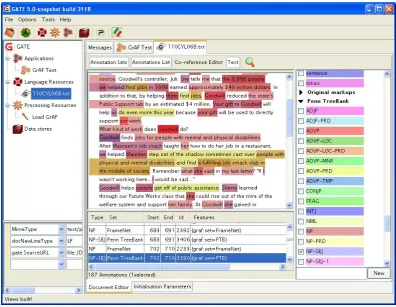
Figure 3: GATE rendering of GrAF annotations
for use in UIMA. The same data is shown ren-dered in GATE in Figure 3. The two ”views” of the data consisting of overlaid annotations for each annotation type are visible in each render-ing. There are multiple possibilities for exploiting and exploring merged annotations representing a range of annotation types within these two frame-works. For example, a UIMA analysis engine could be developed to identify regions annotated by both schemes, or all FrameNet elements that are annotated as agentand also annotated with Penn Treebank NP-OBJ, etc. In GATE, JAPE rules could locate patterns in annotations obtained from different sources, or named entity recogni-tion rules could be enhanced with annotarecogni-tion in-formation from data annotated in other formats. It would also be possible to compare multiple an-notations of the same type, such as different tok-enizations, different POS taggings , etc.
As a final note, we point out that in addi-tion to conversion to UIMA and GATE, annota-tions from different sources (singly or merged in any combination) can also be converted to sev-eral other formats by using the GrAF Java API. The API allows the user to select from among
ex-isting annotations and specify an output format for their merged representation. Currently, in ad-dition to GrAF, the following output formats are supported: XML documents with inline annota-tions; formats compatible with Monoconc Pro7
and Wordsmith Tools8; NLTK9; CONLL (B-I-E)
format; and UIMA CAS.10 So, for example, it is
possible to load a collection of standoff annota-tion files and convert to XML, and then present them to XML-aware applications as XML files with inline annotations. As a result, we are be-ginning to see possibilities for true interoperabil-ity among not only major frameworks like UIMA and GATE, but also applications with more limited functionalities as well as in-house formats. This, in turn, opens up the potential to mix and match among tools for various kinds of processing as ap-propriate to a given task. In general, the trans-duction of ”legacy schemes” such as Penn Tree-bank into GrAF greatly facilitates their use in ma-jor systems such as UIMA and GATE, as well as
7http://www.athel.com/mono.html 8http://www.lexically.net/wordsmith/ 9http://www.nltk.org/
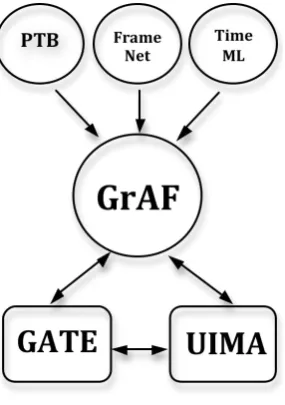
Figure 4: Conversion capabilities
other applications and systems. Figure 4 shows the conversion capabilities among a few annota-tions schemes, GrAF, and UIMA and GATE.
All of our conversion tools and GATE plugins are freely available for download with no restric-tions at http://www.anc.org. The UIMA project has received support to develop a UIMA→GrAF conversion module, which should be available in the near future.
6 Conclusion
Consideration of the transduction from a generic, relatively abstract representation scheme such as GrAF into the formats required for widely adopted frameworks for creating and analyzing linguisti-cally annotated data has several ramifications for interoperability. First, it brings to light the kinds of implementation choices that either contribute to or impede progress toward interoperability, which can feed future development. Second, our work on converting GrAF to the formats supported by UIMA and GATE shows that while minor differ-ences exist, the underlying data models used by the two frameworks are essentially the same, as well as being very similar to the data model under-lying GrAF. This is good news for interoperability, since it means that there is at least implicit conver-gence on the data model best suited for data and annotations; the differences lie primarily in the ways in which the model is serialized internally and as output by different tools. It also means that transduction among the various formats is possible without loss of information.
We have shown that a UIMA→GrAF or GATE →GrAF conversion is fairly straightforward; the expressive power of GrAF can easily represent the data models used by UIMA and GATE. On the other hand, GrAF → UIMA or GrAF → GATE transformations are less straightforward. Both frameworks can represent graphs, but neither pro-vides a standard representation that other compo-nents are guaranteed to understand. Given that powerful analysis algorithms for data in graphs are well-established, there may be considerable ad-vantage to using the graph as a general-purpose format for use within various modules and ana-lytic engines. In any case, the generality and flexi-bility of the GrAF representation has already been shown to be an effective means to exchange lin-guistic data and annotations that exist in different formats, as well as a model for development of an-notation schemes in the future.
Acknowledgments
This work was supported by an IBM UIMA In-novation Award and National Science Foundation grant INT-0753069.
References
Steven Bird and Mark Liberman. 2001. A Formal Framework for Linguistic Annotation. Speech Com-munication, 33:1-2, 23-60.
Nancy Ide and Keith Suderman. 2007. GrAF: A Graph-based Format for Linguistic Annotations.
Proceedings of the First Linguistic Annotation Workshop, Prague, Czech Republic, June 28-29, 1-8.
International Standards Organization. 2008. Lan-guage Resource Management - Linguistic Annota-tion Framework. ISO Document WD 24611.
International Standards Organization. 2005. Language Resource Management - Feature Structures - Part 1: Feature Structure Representation. ISO Document ISO/DIS 24610-1.
Nancy Ide, Patrice Bonhomme, and Laurent Ro-mary. 2000. XCES: An XML-based Standard for Linguistic Corpora. Proceedings of the Sec-ond Language Resources and Evaluation Confer-ence(LREC), Athens, Greece, 825-30.