KTimeML:
Specification of Temporal and Event Expressions in Korean Text
Seohyun Im Dept. of Computer Science
Brandeis University Waltham, MA, USA [email protected]
Hyunjo You, Hayun Jang, Seungho Nam, Hyopil Shin Dept. of Linguistics
Seoul National University Seoul, Korea
youhyunjo, hyan05, nam, [email protected]
Abstract
TimeML, TimeBank, and TTK (TARSQI Project) have been playing an important role in enhancement of IE, QA, and other NLP applications. TimeML is a specification lan-guage for events and temporal expressions in text. This paper presents the problems and so-lutions for porting TimeML to Korean as a part of the Korean TARSQI Project. We also introduce the KTTK which is an automatic markup tool of temporal and event-denoting expressions in Korean text.
1 Introduction
The TARSQI (Temporal Awareness and Reason-ing systems for QA) Project1 aims to develop
technology for annotation, extraction, and rea-soning of temporal information in natural lan-guage text. The main result of the TARSQI Pro-ject consists of TimeML (Pustejovsky et. al., 2003), TimeBank (Pustejovsky et. al., 2006), and
TARSQI Toolkit (TTK, Verhagen and Puste-jovsky, 2008). TimeML is a specification lan-guage for events and temporal expressions in text. TimeBank is an annotated corpus which was made as a proof of the TimeML specification.
TTK is an automatic system to extract events and time expressions, creating temporal links be-tween them2.
TimeML is an ISO standard of a temporal markup language and has been being extended to other languages such as Italian, Spanish, Chinese,
1 R
efer to www.timeml.org for details on the TARSQI. 2
TTK contains GUTime (TIMEX3 tagging, Mani and Wil-son, 2000), Evita (event extraction, Saurí et. al., 2005), Slinket (modal parsing, Saurí et. al., 2006b), S2T, Blinker, Classifier, Sputlink, Link Merger, etc.
etc. (ISO/DIS 24617-1: 2008). TempEval-2, a task for the Semeval-2010 competition, has been proposed (Pustejovsky et. al. 2008). The task for the TempEval-2 is evaluating events, time ex-pressions, and temporal relations. Data sets will be provided for English, Italian, Spanish, Chi-nese, and Korean.
The necessity of temporal and event expres-sions markup for any robust performance such as
QA (for Korean QA system, refer to Han et. al., 2004), IE, or summarization is applied to Korean
NLP applications as well. Recently, there have been TimeML-related studies for Korean: Jang et. al (2004) show an automatic annotation system of temporal expressions with Timex2 in Korean text. Lee (2008) argues about the semantics of Korean TimeML, specially the EVENT tag. Im and Saurí (2008) focus on the problems of Ti-meML application to Korean caused by typo-logical difference between English and Korean. Motivated by them, the Korean TARSQI Project3
started with the purpose of making TimeML, TimeBank and TTK for Korean text4.
Porting TimeML to other languages can be challenging because of typological difference between languages. In this paper, we present the problems for TimeML application to Korean. Our solution is to change TimeML markup phi-losophy: a change from word-based in-line anno-tation to morpheme-based stand-off annoanno-tation. Based on the changed annotation philosophy, we decide how to annotate temporal and event-denoting expressions in Korean text. More spe-cifically, it is challenging to decide whether we use LINK tags or attributes to annotate some
3 See http://word.snu.ac.kr/k-tarsqi/doku.php for more
in-formation about the KTARSQI Project. 4
temporal or event-denoting expressions (see ex-amples in 3.2). In section 4, we describe the specification of Korean TimeML (KTimeML). Section 5 introduces Korean TTK (KTTK). Be-fore discussing the issues of Korean TimeML, we briefly introduce TimeML.
2 The Basics of TimeML
TimeML features four major data structures:
EVENT, TIMEX3, SIGNAL, and LINK. The
EVENT tag encodes event-denoting expressions.
The TIMEX3 tag annotates temporal expressions
of different sorts: fully specified dates, times, and durations, or just partially specified dates, times, and durations. The SIGNAL tag annotates
elements that indicate how temporal objects are related among them (e.g., subordinating connec-tors such as when or after).
The LINK tag splits into three main types: (a)
TLINK, which encodes temporal relations among
EVENTs and TIMEX3s; (b) ALINK, representing
aspectual information as expressed between an aspectual predicate and its embedded event; and (c) SLINK, encoding subordination relations
conveying evidentiality (e.g. Mary said [she bought some wine]), factivity (John regretted
[Mary bought wine]), or intensionality (Kate
thought [Mary bought beer]).
Information relevant to each tag is character-ized by means of attribute-value pairs (refer to Pustejovsky et. al. 2003 about specific attributes-value pairs). (1) illustrates an annotated sentence with the TimeML specification:
(1)John saide1 that Mary begane2 to worke3 John
<EVENT id=”e1” class=”REPORTING” tense=”PAST” aspect=”NONE” polar-ity=”POS”>
said </EVENT>
that Mary
<EVENT id=”e2” class=”ASPECTUAL” tense=”PAST” aspect=”NONE” polar-ity=”POS”>
began </EVENT>
to
<EVENT id=”e3” class=”OCCURRENCE” tense=”NONE” aspect=”NONE” polar-ity=”POS”>
work </EVENT>
<TLINK eventID=”e1” relatedToEvent=”e2” relType=”AFTER”/>
<SLINK eventID=”e1” subordinatedEvent=”e2” relType=”EVIDENTIAL”/>
<ALINK eventID=”e2” relatedToEvent=”e3” relType=”INITIATES”/>
Sentence (1) presents three EVENT expressions (said,began, and work). SLINK conveys an evi-dential relation between e1 (said) and e2 (began).
TLINK represents a temporal relation –
AFTER-between the two same events. ALINK encodes an aspectual relation –initiates– between e2 ( be-gan) and e3 (work). Due to space limitations, some EVENT attributes are obviated.
3 Porting TimeML to Korean
3.1 The Characteristics of Korean
Korean is an agglutinative language whose words are formed by joining morphemes to-gether, where an affix typically represents one unit of meaning and bound morphemes are ex-pressed by affixes. For example, the sentence John-i emeni-kkeyse o-si-ess-ta-te-ra ‘John-Nom mother-Nom come-Hon-Past-Quo-Ret-Dec 5 ’
means that (I heard) (John said) that his mother came. Each morpheme has its own functional meaning or content.
As shown above, consideration of morphemes is important for TimeML markup of Korean text. Here, we summarize TimeML-related character-istics of Korean:
(i) In Korean, functional markers (tense, aspect, mood, modality, etc.) are represented morphologically. English as an isolating language uses periphrastic conjugation to represent functional categories. (e.g. ‘-keyss-’is a conjectural modal morpheme in pi-ka o-keyss-ta ‘it will rain’. While, ‘will’ is an auxil-iary verb in it will rain.)
(ii) Some subordination is realized morphologically via morpheme contraction.
(e.g. ‘-ta-n-ta’ is a morphological contraction which
denotes quotation in the sentence John-i nayil o-n-ta-n-ta ‘John-Nom tomorrow
come-Pres-Dec.Quo-Pres-Dec’. Its English counterpart is represented by subor-dination: John said that he will come tomorrow)
(iii) Some connectives in English correspond to mor-phemes in Korean.
(e.g. Korean counterpart of the English connective ‘and’ in I ate milk and went to sleep is the morpheme
‘-ko’ in the sentence na-nun wuyu-rul masi-ko ca-re ka-ss-ta ‘I-Top milk-Acc drink-and sleep-ending
go-Past-Dec’)
(iv) The sentence type of English is represented by word order but that of Korean by ending morphemes (e.g. Declarative: pi-ka o-n-ta ‘it is raining’
interroga-tive: pi-ka o-ni? ‘Is it raining?’)
These properties of Korean make the porting of TimeML to Korean challenging. In the next sec-tion, we discuss the basic issues of KTimeML.
3.2 Basic Issues of Korean TimeML
3.2.1 Morpheme-based standoff annotation TimeML employs word-based in-line annotation. It poses a challenge at the representation level, since it encodes information mainly based on the structure of the target language, and thus content equivalences among different languages are hard to establish. For example, indirect quotation in Korean offers an example of the mismatch of linguistic devices employed in different lan-guages to express the same meaning. Quotation constructions in English use two predicates, the reporting and the reported, which TimeML marks up as independent EVENTs:
(2) John saide1 he boughte2 a pen.
<SLINK eventID=”e1” subordinatedE-vent=”e2”relType=”EVIDENTIAL”/>
TimeML uses a subordination link (SLINK) in order to convey the evidentiality feature that the reporting predicate projects to the event ex-pressed by its subordinated argument.
On the other hand, a Korean quotative con-struction, as in (3), has only one verb stem, which corresponds to the subordinated predicate in English. Note that there is no reporting predi-cate such as say in English. Nevertheless, the sentence has a reporting interpretation.
(3) John-i ku-ka wine-ul sa-ss-ta-n-ta J-Nom he-Nom wine-Acc buy-Past-Quo-Pres-Dec
‘John said that he bought some wine’
The quotative expression –ta-n-ta above is a con-tracted form of –ta-ko malha-n-ta ‘Dec-Quo say-Pres-Dec’. Although (3) is a simple sentence in-volving no subordination at the syntactic level, the two tense markers, ‘-ss-’ and ‘-n-’, are evi-dence of the existence of an implicit reporting event. Specifically, the past tense marker ‘-ss-’ applies to the main event here (sa-ss ‘buy-past’), while the present tense marker ‘-n-’ is under-stood as applying to the implicit reporting event (ta-n-ta ‘report-pres-Dec)6.
Constructions presented above show a prob-lem for the standard TimeML treatment of a Ko-rean quotative sentence. The relationship be-tween reporting and reported events is expressed morphologically, and thus the SLINK mechanism
6 Tense markers of the construction can change: sa-ss
-tay-ss-ta ‘buy-past-quo-past-dec: said_bought’; sa-n-ta-n-ta ‘buy-pres-quo-pres-dec: say_buy’, etc.
for word-based annotation is not adaptable here. Because Korean transfers meanings through morphological constructions, morpheme-based annotation is more effective than word-based for TimeML application to Korean7.
For morpheme-based tagging, we propose stand-off annotation for Korean because it needs two-level annotation: the MORPH tag8 and
Ti-meML tags. Standoff annotation separates mor-phologically-annotated data from primary data and saves it in a different file, and then TimeML annotation applies to the data. The following is the proposed morpheme-based stand-off annota-tion for (3).
(4) Morpheme-based stand-off annotation for (3)
<MORPH id=”m7” pos=”PV”/> <MORPH id=”m8” pos=”EFP”/> <MORPH id=”m9” pos=”EFP”/> <MORPH id=”m10” pos=”EFP”/> <MORPH id=”m11” pos=”EF”/>
<EVENT id=”e1” morph=”m7 m8” yaleRo-manization=”sa-ss” pred=”buy” class=”OCCURRENCE” tense=”PAST” sen-tenceMood=”DEC”/>
<EVENT id=”e2” morph=”m9 m10 m11” yaleRomanization=”ta-n-ta” pred=”say” class=”REPORTING” tense=”PRESENT” sen-tenceMood=”DEC”/>
<SLINK eventID=”e2” subordinatedE-vent=”e1” relType=”EVIDENTIAL”/> <TLINK eventID=”e1” relatedToEvent=”e2” relType=”BEFORE”/>
In (4), we show the example annotation of the
MORPH tag for (3) to help readers to understand our proposal. Standoff annotation makes it pos-sible to extract information about two events without using a non-text consuming EVENT tag. Moreover, each of the two tense morphemes is properly assigned to its related event. Our pro-posed TimeML annotation scheme is compro-posed of two levels – morphological analysis and Ti-meML annotation.
7 There can be several ways of annotating morphological
constructions: morpheme-based, morpho-syntactic unit-based (refer to MAF: Clément and Clergerie, 2005), charac-ter-based, and bunsetsu-based. At present, we adopt mor-pheme-based annotation because it seems to be enough to introduce the required units for KTimeML markup and we want to avoid the possible redundancy of bunsetsu-based or morpho-syntactic unit-based annotation. Moreover, the criterion for separation of a morphological construction is related with tags such as EVENT, TIMEX3, or attributes like tense, aspect, mood, or modality in KTimeML, not with syntactic or phonological information. Standoff annotation makes it easy to mark up the interval of morphemes. Never-theless, we consider the possible advantage of morpho-syntactic analysis positively for future work.
8
3.2.2 Surface-based annotation
KTimeML adopts the surface-based annotation philosophy of TimeML (Saurí et. al. 2006a), which does not encode the actual interpretation of the constructions it marks up, but their gram-matical features. For example, the leaving event in the sentence we are leaving tomorrow is not annotated as expressing a future tense, but as expressed by means of a present tense form. Several considerations motivate this surface-based approach. As an annotation language, it must guarantee the marking up of corpora in an efficient and consistent way, ensuring high inter-annotator agreement. As a representation scheme, it needs to be used for training and evaluating algorithms for both temporal informa-tion extracinforma-tion and temporal reasoning.
A surface-based approach is the suitable op-tion for meeting such requirements. Neverthe-less, it poses a challenge at the representation level. How to represent evidentiality in Korean and English shows the challenge.
(5) I sawe1 that John boughte2 some wine.
<SLINK lid=”sl1” eventID=”e1” subordinat-edEvent=”e2” relType=”EVIDENTIAL”/>
English, as an isolating language, expresses evi-dentiality in a periphrastic manner. Hence, the TimeML treatment of these constructions con-sists in marking the two involved predicates as
EVENTs, and introducing an SLINK between them. Korean has both periphrastic and morpho-logical ways for expressing evidentiality. Anno-tating the periphrastic version with the standard TimeML treatment poses no problem because it has two predicates denoting events like its Eng-lish counterpart. Morphological constructions however, are harder to handle, because the retro-spective mood morpheme ‘-te-’ brings about the implicit reference to a seeing event.
(6) Vietnam-un tep-te-ra Vietnam-Top hot-Ret-Dec ‘(as I saw) Vietnam was hot’
They are similar to quotative constructions in the sense that, although there is only one predicate expressed on the surface, the sentence refers to more than one event. Unlike quotative construc-tions, there is no morphological evidence of the implicit event; e.g. tense or sentence mood markers independent of those applied to the only verbal predicate in the sentence. The issue to consider is therefore whether to treat the eviden-tial constructions by introducing an EVENT tag for the retrospective mood marker as in (7) or to
handle them by specifying the evidential value of the main predicate at the MOOD attribute of its
EVENT tag, as illustrated in (8).
(7) SLINK tagging for (6)
<EVENT id=”e1” morph=”m3” yaleRomaniza-tion=”tep“ class=”STATE” pos=”ADJECTIVE” tense=”NONE”/>
<EVENT id=”e2” morph=”m4 m5” yaleRomaniza-tion=”te-ra” class=”PERCEPTION” pos=”NONE” tense=”NONE”/>
<SLINK lid=”sl1” eventID=”e2” subordinatedE-vent=”e1” relType=”EVIDENTIAL”/>
(8) Mood-attribute tagging for (6) <EVENT id=”e1” morph=”m3 m4 m5”
yaleRo-manization=”tep-te-ra” pred=”hot” class=”STATE” pos=”ADJECTIVE” tense=”NONE” mood=”RETROSPECTIVE”/>
As in (7), adding an EVENT tag for the retrospec-tive morpheme corresponds semantically to Eng-lish-based TimeML. However, it is not surface-based, because the perception event is an implicit event entailed by the retrospective morpheme. While, the annotation in (8) is a surface-based annotation of the evidential construction which uses the MOOD attribute for retrospective mood, thus respects the surface-based philosophy of TimeML. This is different from the English counterpart that presents two EVENTs related with a TLINK signaling their relative temporal order. KTimeML follows the surface-based an-notation philosophy of TimeML ((8) here).
3.2.3 Cancellation of the head-only rule TimeML employs the head-only markup policy in order to avoid problems derived from tagging discontinuous sequence (e.g. we are not fully prepared). If the event is expressed by a verbal phrase, the EVENT tag will be applied only to its head, which is marked in bold face in the exam-ples (e.g. has been scrambling, to buy, did not
disclose). However, Korean does not have the
discontinuity problem. See Korean examples:
(9) a.*na-nun cwunpitoy-e wanpyekhakey iss-ta I-Top prepared-e fully exist-Dec
‘we are fully prepared’
b. *John-un ca-ko anh-iss-ta J-Top sleep-ko Neg-exist-Dec ‘John is not sleeping’
verbal clusters (main verb + auxiliary verb con-struction: e.g. mek-ko iss-ta ‘eat-progressive-dec’). It makes the KTimeML more readable by showing the progressive aspect-denoting expres-sion -ko iss- in one unit of annotation.
4 Specification of the Korean TimeML
Based on the proposed annotation principles of KTimeML, we present the specification of the first version of KTimeML (KTimeML 1.1) with changed tags, attributes, and their values. We assume that the MORPH-tagged data are sepa-rately saved in a different file. KTimeML con-tains EVENT, TIMEX3, SIGNAL, and LINK tags. Some new attributes such as mood and sType
are added to the attributes of the EVENT tag. The other tags have no changes from the TimeML tags9.
KTimeML 1.1 adds the attributes of predi-cate_content (pred), mood, verb_form (vForm),
and sentence type (sType) to the attributes of EVENT in TimeML (For Korean grammar, refer to Sohn, 1999, Nam and Ko, 2005). The BNF of
EVENT is shown below:
attributes ::= id pred morph yaleRomanization class pos tense [aspect][mood] [sType][modality] vForm id ::= ID
{id ::= EventID
EventID ::= e<integer>} morph ::= IDREF
{morph ::= MorphID}
yaleRomanization ::= CDATA pred ::= CDATA
class ::= ‘OCCURRENCE’|‘ASPECTUAL’|‘STATE’| ‘PERCEPTION’|‘REPORTING’|‘I_STATE’| ‘I_ACTION’
pos ::= ‘ADJECTIVE’|‘NOUN’|‘VERB’|‘OTHER’ tense ::= ‘PAST’|‘NONE’
aspect ::= ‘PROGRESSIVE’|‘PERFECTIVE’| ‘DURATIVE’ | ‘NONE’
mood ::= ‘RETROSPECTIVE’ | ‘NONE’ {default, if absent, is ‘NONE’} sType ::= ‘DECLARATIVE’|‘INTERROGATIVE’| ‘IMPERATIVE’|‘PROPOSITIVE’| ‘NONE’ {default, if absent, is 'DECLARATIVE'} modality ::= ‘CONJECTUAL’|‘NONE’
{default, if absent, is 'NONE'} vForm ::= ‘S_FINAL’|‘CONNECTIVE’|‘NOMINALIZED’| ‘ADNOMINAL’
{default, if absent, is 'S_FINAL'} polarity ::= ‘NEG’|‘POS’
{default, if absent, is 'POS'}
KTimeML puts the semantic content of EVENT -tagged expressions for international communica-tion. Because mood is not an important gram-matical category for English, TimeML does not
9 Nevertheless, how to annotate various morphologi-cal constructions in the specific texts is not trivial. The annotation guideline, which will be published on the web, will handle the issues in detail.
markup a mood attribute, but KTimeML adds the mood attribute since there are morphemes that express mood like many other languages. Unlike English, different sentence ending morphemes represent sentence types in Korean. Hence, KTimeML adds sType to attributes of the EVENT tag. We put vForm to distinguish
be-tween different subordinated clauses10.
Event classes in KTimeML are the same as TimeML. Korean tense system does not have distinction between present and future unlike English, and thus the tense attribute has PAST
and NONE values. We add DURATIVE to aspect attribute values in KTimeML for the durative expression such as combination of stative verb + progressive aspect marker (e.g. al-ko iss-ta ‘know-durative-Dec’).
For mood, KTimeML 1.1 puts the retrospective
mood (‘-te-‘). The values of vForm attribute are S_FINAL, CONNECTIVE, and NOMINALIZED, and ADNOMINAL. The sentence types in Korean are DECLARATIVE, INTEROGGATIVE, IM-PERATIVE, and PROPOSITIVE (e.g. cip-ey ka-ca
‘Let’s go home’). KTimeML puts CONJEC-TURAL (e.g. nayil pi-ka o-keyss-ta ‘(I guess) It will rain tomorrow’) as a modality value and de-fault is NONE. The sentence in (10) is an inter-esting example that includes all attributes of an
EVENT tag for Korean TimeML except for as-pect.
(10)ecey Seoul-un pi-ka o-ass-keyss-te-ra yesterday Seoul-Top rain-Nom come-Past-Conj-Ret-Dec ‘(From that I saw), I guess that it rained in Seoul
yesterday’
<EVENT id=”e1” morph=”m6 m7 m8 m9 m10” yaleRomanization=”wa-ss-keyss-te-ra” pred=”come” pos=”VERB”
class=”OCCURRENCE” tense=”PAST” aspect=”NONE” mood=”RETROSPECTIVE” modality=”CONJECTURAL” vForm=”S_FINAL” sType=”DECLARATIVE” polarity=”POS”/>
Each of the morphemes above has its own func-tional meaning, which is represented as a value of an attribute in the EVENT tag.
The major types of TIMEX3 expressions are: (a) Specified Temporal Expressions, 2009-nyen 5-wol 1-il ‘2009-year 5-month 1-day’, (b)
Under-specified Temporal Expressions, wolyoil
‘Mon-day’, caknyen ‘last year’, ithul cen‘two days ago’;
(c) Durations, 2 kaywol ‘2 months’, 10 nyen‘ten
years’.
attributes ::= tid type [functionInDocument] [temporalFunction] morph yaleRomanization
(value|valueFromFunction)
[mod][anchorTimeID|anchorEventID]
10
tid ::= ID {tid ::= TimeID
TimeID ::= t<integer>} morph ::= IDREF {morph ::= MorphID} yaleRomanization ::= CDATA type ::= ‘DATE’|’TIME’|’DURATION’ functionInDocument ::= ‘CREATION_TIME’|
‘EXPIRATION_TIME’|’MODIFICATION_TIME’| ‘PUBLICATION_TIME’|’RELEASE_TIME’| ‘RECEPTION_TIME’|’NONE’
temporalFunction ::= ‘true’|’false’ {temporalFunction ::= boolean} value ::= CDATA
{value ::= duration|dateTime| time|date|gYearMonth|
gYear|gMonthDay| gDay|gMonth}
valueFromFunction ::= IDREF
{valueFromFunction ::= TemporalFunctionID TemporalFunctionID ::= tf<integer>} mod ::= ‘BEFORE’|’AFTER’|’ON_OR_BEFORE’| ‘ON_OR_AFTER’|’LESS_THAN’|’MORE_THAN’| ‘EQUAL_OR_LESS’|’EQUAL_OR_MORE’|’START| ‘MID’|’END’|’APPROX’
anchorTimeID ::= IDREF
{anchorTimeID ::= TimeID} comment ::= CDATA
Although the BNF of TIMEX3 in Korean Ti-meML is same as that of TiTi-meML, we point out that Korean time expressions also have the issue of how to treat morphological representations of temporal meaning. For example, pwuthe ‘from’
and kkaci ‘to’ in 3ilpwuthe 5ilkkaci ‘From 3rd to
5th’ both are the counterparts of prepositions in English (Jang et. al., 2004). We do not tag tem-poral morphemes as SIGNALs, in principle. In-stead, we mark up 3ilpwuthe ‘from 3rd’ with one
TIMEX3 tag. However, temporal connectives such as ttay ‘when’ in ku-ka o-ass-ul ttay young-hee-nun ttena-ss-ta ‘When he came, Younghee left’ are tagged as SIGNALs.
SIGNAL is used to annotate sections of text - typically function words - that indicate how tem-poral objects are to be related to each other. It includes temporal connectives (e.g. ttay ‘when’, tongan ‘during’), and temporal noun (e.g. hwu
‘after’, cen ‘before’). See the BNF of SIGNAL
below:
attributes ::= sid morph yaleRomanization sid ::= ID
{sid ::= SignalID SignalID ::= s<integer>} morph ::= IDREF
{morph ::= MorphID} yaleRomanization ::= CDATA
We show an annotated example which describes the difference of Korean TimeML markup from the English-based TimeML. The sentence below is a compound sentence.
(11) ku-nun hankwuk panghan-ul maci-n hwu,
Ku-Top Korea visit-Acc finish after
onul cwungkwuk-uro ttena-ss-ta today China-for leave-Past-Dec
‘He finished his visit to Korea and left for China today’
<Document time: March, 20, 2009>
<EVENT id=”e1” morph=”m4 m5” yaleRomaniza-tion=”pangmwun-ul”
pred=”visit” class=”OCCURRENCE”/> <EVENT id=”e2” morph=”m6 m7”
yaleRomaniza-tion=”machi-n” pred=”finish” class=”ASPECTUAL” pos=”VERB” tense=”NONE” vForm=”ADNOMINAL”/> <SIGNAL sid=”s1” morph=”m8”
yaleRomaniza-tion=”hwu”/>
<TIMEX3 tid=”t1” morph=”m9” yaleRomaniza-tion=”onul” type=”DATE” value=”2009-03-20” temporalFunction=”true”/>
<EVENT id=”e3” morph=”m14 m15 m16” yaleRo-manization=”ttena-ss-ta”
pred=”leave” class=”OCCURRENCE” tense=”PAST” sType=”DECLARATIVE” vForm=”S_FINAL”/>
LINK types splits into TLINK, SLINK, and
ALINK. The BNF of TLINK is as follows:
attributes ::= [lid] (eventID|timeID) [signalID] (relatedToEvent| relatedToTime) relType [comment] lid ::= ID
{lid ::= LinkID LinkID ::= l<integer>} eventID ::= IDREF {eventID ::= EventID} timeID ::= IDREF {timeID ::= TimeID} signalID ::= IDREF {signalID ::= SignalID} relatedToEvent ::= IDREF {relatedToEvent ::= EventID} relatedToTime ::= IDREF {relatedToTime ::= TimeID}
relType ::= ‘BEFORE’|’AFTER’|INCLUDES’| ’IS_INCLUDED’|’DURING’|
’SIMULTANEOUS’|’IAFTER’|’IBEFORE’| ’IDENTITY’|’BEGINS’|’ENDS’| ’BEGUN_BY’|’ENDED_BY’|’DURING_INV’ comment ::= CDATA
TLINK is a temporal link among EVENTs and
TIMEX3s. For example, three TLINKs are tagged between the events in (11). We show those to-gether with other LINKs in (12). Now, we show the BNF of SLINK.
attributes ::= [lid] eventID [signalID] subordinatedEvent relType [comment]
lid ::= ID {lid ::= LinkID LinkID ::= l<integer>} eventID ::= IDREF {eventID ::= EventID} subordinatedEvent ::= IDREF {subordinatedEvent ::= EventID} signalID ::= IDREF
relType ::= ‘INTENTIONAL’|’EVIDENTIAL’| ‘NEG_EVIDENTIAL’|’FACTIVE’| ‘COUNTER_FACTIVE’|’CONDITIONAL’ comment ::= CDATA
The subordination link is used for contexts in-volving modality, evidentials, and factives.
In Korean, various morphemes bring about subordination clauses. Nominal endings such as
-um/-ki make nominal clauses (e.g. na-nun John-i o-ass-um-ul al-ko iss-ta ‘I-Top John-Nom come-Past-Nominal ending-Acc know-Durative-Dec’; na-nun kongpwuha-ki-ka shilh-ta‘I-Top study-nominal ending-Nom hate-Dec’). Adnominal endings such as -n/-un/-nun make adnominal clauses (e.g. na-nun John-i kaci-e-o-n kwaca-rul mek-ess-ta ‘I-Top John-Nom bring-adnominal ending cookies-Acc eat-Past-Dec’). Conditional clauses are also triggered by morphemes (e.g. na-nun John-i o-myen ka-keyss-ta ‘I-Top John-Nom come-Conditional go-Conj-Dec’). All the above morphemes are not sepa-rately tagged as SIGNALs. The words with the morphemes – o-ass-um-ul, kongpwuha-ki-ka, kaci-e-o-n, and o-myen – are tagged as EVENTs.
ALINK is an aspectual link which indicates an aspectual connection between two events.
attributes ::= [lid] eventID [signalID] relatedToEvent relType [comment]
lid ::= ID {lid ::= LinkID LinkID ::= l<integer>} eventID ::= IDREF {eventID ::= EventID} relatedToEvent ::= IDREF {relatedToEvent ::= EventID} signalID ::= IDREF
{signalID ::= SignalID}
relType ::= ‘INITIATES’|’CULMINATES’| ‘TERMINATES’|’CONTINUES’| ‘REINITIATES’
comment ::= CDATA
Now we show the ALINK and TLINKs of the sen-tence in (11).
(12) LINKs between the events in (11)
<ALINK eventID=”e2” relatedToEvent=”e1” relType=”CULMINATES”/>
<TLINK eventID=”e3” relatedToEvent=”e2” relType=”AFTER”/>
<TLINK eventID=”e2” relatedToEvent=”e1” relType=”ENDS”/>
<TLINK eventID=”e3” relatedToEvent=”e1” relType=”AFTER”/>
That is, the visiting event and the finishing are related aspectually and its relation type is culmi-nating. The finishing event is related temporally with the leaving event by the signal ‘후’(‘after’).
Naturally, the relation type of the TLINK is
AF-TER. From ALINK, additional TLINKs are
de-rived between visiting, finishing, and leaving events.
5 Korean TARSQI ToolKit
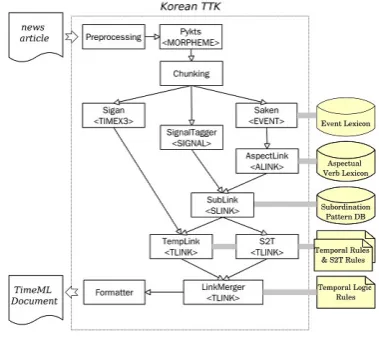
[image:7.595.312.502.194.363.2]Based on the specification of KTimeML, we started to develop KTTK11.
Figure 1. Korean TARSQI Architecture
At first, the normalization of the raw document is done in the preprocessor module. Here the raw text is separated into sentences, wide characters are substituted by regular characters, punctuation symbols are normalized (specially quotation marks), sino-korean characters (hanja) are transcribed in hangul, and, the encoding is also normalized to unicode.
The next module is called Pykts (Python Wrapper for KTS). Here, sentences are parsed in order to get their morphological components, which is achieved by means of a program called
KTS. With the exception of this morphological parser, which was programmed in C, all the other components of our project are being written in Python in order to achieve good results in less time. The output of Pykts is a Document object composed by a hyerarchical data structure of document, sentences, words and morphemes, which is passed to the Event Tagger.
The Event Tagger consists of three modules: a preprocessor where the chunking of Time Expressions is done; a module called Saken, which does the tagging of events; and, a module called Sigan for TIMEX3 tagging. Then, LINK
taggers add TLINK, ALINK, SLINK tags. A module S2T changes the annotated SLINKs and
ALINKs into TLINKs. In the final step, the LINK
Merger merges all TLINKs with temporal closure.
6 Conclusion and Future Work
Temporal and event information extraction is an important step for QA and other inference or temporal reasoning systems. Korean TARSQI
Project aims at (1) making KTimeML; (2) build-ing Korean TimeBank as a gold standard, and (3) developing KTTK as an automatic markup tool of temporal and event expressions in Korean text.
In this paper, we presented problems in port-ing TimeML to Korean and proposed changes of TimeML philosophy. Since consideration of morphological issues is a basic step for KTi-meML, we introduce a morpheme-based two-level stand-off annotation scheme. We adopt the surface-based annotation of TimeML, but do not follow the head-only annotation.
The tags of KTimeML are EVENT, TIMEX3,
TLINK, ALINK, and SLINKs. The morphological annotation is saved as separate data. The EVENT
tag has the attributes such as vForm, sType, mood, and modality in addition to the
attrib-utes of TimeML. We showed the architecture of
KTTK.
This work will be a help for QA, IE, and other robust performance for Korean. In addition, KTimeML will be, hopefully, a model for port-ing TimeML to other agglutinative languages such as Japanese.
Aknowledgements
The authors wish to thank Kiyong Lee (ISO-TimeML) and James Pustejovsky, a director of the TARSQI Project, for their help for the speci-fication of KTimeML.
References
Lionel Clément and Éric Villemonte de la Clergerie. 2005. MAF: a Morphosyntactic Annotation Framework. In
Proceedings of the Language and Technology Confer-ence, Poznan, Poland, pages 90-94.
Han, Kyoung-Soo, Hoojung Chung, Sang-Bum Kim, Young-In Song, Joo-Young Lee, and Hae-Chang Lim. 2004. TREC 2004 Question Answering System at Ko-rea University. In Proceedings of the 13rd Text RE-trieval Conference, Pages 446-455. Gettysburg, USA.
Im, Seohyun and Roser Saurí. 2008. TimeML Challenges for Morphological Lanuages: A Korean Case Study. In
Proceedings of CIL 18, Seoul, Korea.
ISO DIS 24617-1:2008. Language resources management – Semantic annotation framework (SemAF) – Part1: Time and events. ISO 2008. Unpublished.
Jang, Seok-Bae, Jennifer Baldwin, and Inderjeet Mani, 2004. Automatic TIMEX2 Tagging of Korean News. In Proceedings of ACM Transactions on Asian Lan-guage Information Processing. Vol. 3, No. 1, Pages
51-65.
Kim, Jae-Hoon and Seo, Jung-yeon. 1994. ms. A Korean Part-of-Speech Tag Set for Natural Language Process-ing Version 1.0. KAIST. Seoul, Korea.
Kiyong, Lee, 2008. Formal Semantics for Temporal An-notation, An invited plenary lecture for CIL 18. In Pro-ceedings of the 18th International Congress of Linguists,
CIL 18, Seoul, Korea.
Inderjeet Mani and George Wilson. 2000. Processing of News. In Proceedings of the 28th Annual Meeting of the Association for Computational Linguistics (ACL 2000),
Pages 69-76.
Nam, Ki-Shim and Yong-Kun Ko, 2005. Korean Gram-mar (phyojwun kwuke mwunpeplon). Top Publisher.
Seoul, Korea
Pustejovsky, J., M. Verhagen, X. Nianwen, R. Gaizauskas, M. Happle, F. Shilder, G. Katz, R. Saurí, E. Saquete, T. Caselli, N. Calzolari, K.-Y. Lee, and S.-H. Im. 2008.
TempEval2: Evaluating Events Time Expressions and Temporal Relations: SemEval Task Proposal.
James Pustejovsky, Jessica Littman, Roser Saurí, Marc Verhagen. 2006. TimeBank 1.2. Documentation.
James Pustejovsky, José Castaño, Robert Ingria, Roser Saurí, Robert Gaizauskas, Andrea Setzer, and Graham Katz. 2003. TimeML: Robust Specification of Event and Temporal Expressions in Text. IWCS-5. Fifth In-ternational Workshop on Computational Semantics.
Roser Saurí, Jessica Littman, Bob Knippen, Robert Gai-zauskas, Andrea Setzer, and James Pustejovsky. 2006a.
TimeML Annotation Guidelines Version 1.2.1.
Roser Saurí, Marc Verhagen, and James Pustejovsky. 2006b. SlinkET: A Partial Modal Parser for Events. In
Proceedings of LREC 2006. Genova, Italy.
Roser Saurí, Robert Knippen, Marc Verhagen and James Pustejovsky. 2005. Evita: A Robust Event Recognizer for QA Systems. In Proceedings of HLT/EMNLP 2005,
Pages 700-707.
Sohn, Ho-Min. 1999. The Korean Language. Cambridge
University Press.