Volume 6, No. 5, May - June 2015
International Journal of Advanced Research in Computer Science
RESEARCH PAPER
Available Online at www.ijarcs.info
Comparative Analysis of AODV and DSDV Protocols in Hybrid Wireless Mesh
Network
A.Mercy Rani
Assistant Professor, Sri.S.R.N.M College,
Sattur, India
V. Lakshmi Praba
Assistant Professor, Govt.Arts College for Women,
Sivaganga, India
Abstract: Wireless Mesh Network (WMN) is an emerging technology for the next-generation wireless world. WMN has the advanced features like easy deployment, self-healing, greater reliability, flexibility and last mile broadband internet access etc. Routing is a current research topic in wireless mesh network for providing the effective communication in the network. Routing protocols play a major role for discovering a route to transmit the packets from the source to the destination. They are categorized into Reactive(Table-Driven) and Proactive(On-Demand) routing protocols. This paper analyzes the comparison of reactive protocol Ad-hoc On-demand Distance Vector (AODV) and proactive protocol Destination Sequenced Distance Vector (DSDV) in WMN using the performance metrics Packet Delivery Ratio(PDR), Packet loss and Routing Overhead by varying the transmission rate.
Keywords: AODV, DSDV, Hybrid WMN, PDR and transmission rate.
I. INTRODUCTION
Wireless Mesh Networks (WMNs) are dynamically self-organized and self-configured and the nodes in the network automatically creating an ad-hoc network and maintaining the mesh connectivity [1]. WMN provides the advanced features such as low deployment cost, easy network maintenance, robustness, wide area coverage and self-healing. Due to these features, WMN is primarily used in various applications for instance, difficult to create wired network buildings or areas, disaster recovery, impenetrable areas, home automation, industrial plant monitoring, automated meter reading, defense and national security, healthcare, industries and office management etc [2].
Wireless Mesh Network consists of gateway, mesh routers and mesh clients. The gateways are used to connect WMN to the Internet. The mesh routers form a mesh backbone infrastructure and forward traffic between mesh clients and gateways. The mesh clients are mobile devices or stationary devices. The mesh clients may be cell phones, laptops, PDA or other wireless devices. The mesh topology in the mesh network is changed frequently due to the dynamic nature of mesh clients[3].
The architecture of WMN is categorized into Client WMN, Infrastructure WMN and Hybrid WMN [3]. Client WMN is also known as Mobile Ad-hoc Network(MANET) [3][4]. An important characteristic of this type of WMN is that the network consists entirely of mobile client devices without a wireless backbone. The Mesh Clients in a client WMN assume the responsibility of routers to route and forward packets from one client to another and expand the overall range of the network beyond the physical single-hop range of individual nodes.
[image:1.595.329.546.354.614.2]In Infrastructure WMN, the Mesh Routers (MR) provide an end-to-end connectivity to Mesh Clients (MC) and also forms a high bandwidth wireless multi-hop backbone. It consists of static Mesh Routers and the Mesh Clients can communicate with each other via the Mesh Routers.
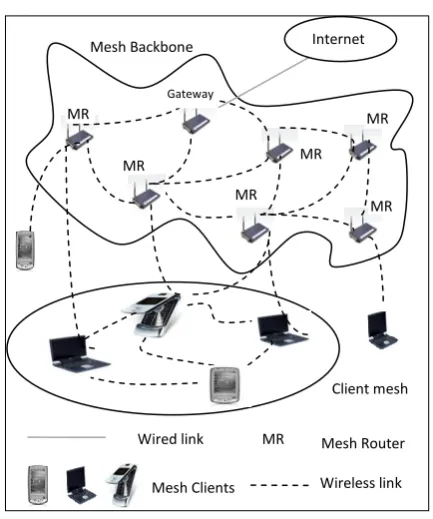
Figure 1. Hybrid Wireless Mesh Network
Hybrid WMN [5] is an attractive version of WMN. As the name indicates that is a combination of Infrastructure and Client WMN. Mesh Routers form a Mesh backbone while Mesh Clients involve in the routing and forwarding of packets. Different type of communications can be established in Hybrid WMN. The Mesh Clients within a client mesh can communicate directly and the mesh clients in one client mesh can communicate with mesh clients in another client mesh through the Mesh Routers. The Mesh Clients can communicate with the Mesh Routers by discovering the appropriate mesh router to gain access with infrastructure part of the network. The Gateway provides the
Mesh Backbone
Mesh Clients
Mesh Router Wired link
Wireless link MR MR
MR MR
MR MR
MR
Gateway
Internet
connection to the wired network such as an Internet. The architecture of Hybrid WMN is shown in Figure 1.
Routing protocols play a major role in transmission for sending packets from the source to the destination. They can be divided into two categories proactive and reactive. The proactive routing protocols also known as table-driven protocols which establish the path between all nodes in the network irrespective of its usage. For this purpose, each node maintains a routing table for storing this routing information. The main advantage of proactive routing protocols is that nodes can quickly get their routing information for the transmission from the routing table. The proactive routing protocols [6] are Destination-Sequenced Distance-Vector Routing (DSDV)[10], Optimized Link State Routing Protocol (OLSR)[11] and Scalable Routing using heat Protocols etc.
The reactive routing protocols establish the route only when it is needed. The route discovery process is initiated when the source requires a route to the destination node. The discovery procedure terminates when a route has been determined or no route available after examining all route permutation. The active routes may be disconnected due to node mobility. The reactive routing protocols [6] are Dynamic Source Routing (DSR)[7] protocol, Adhoc On Demand Distance Vector (AODV)[8] protocol and Temporally Ordered Routing Algorithm (TORA)[9] etc.
In this paper the performance analysis of AODV and DSDV routing protocols in the Hybrid WMN is evaluated by varying the transmission rate. The paper is organized as follows. Section 2 deals with an overview of AODV and DSDV protocols, section 3 presents the simulation analysis, section 4 shows the analysis results and section 5 concludes the paper.
II. OVERVIEWOFAODVANDDSDVPROTOCOLS
A. Ad-Hoc On-Demand Distance Vector (AODV):
Ad-hoc On Demand Distance Vector (AODV) [8] is an on-demand or a reactive routing protocol, it is capable for both unicast and multicast routing. The AODV protocol provides dynamic, self-starting and multihop routing between nodes which are wishing to establish communication in the network. It is reactive in nature and it constructs the routes only when source node wants to send information to the destination node. The nodes need not maintain routes for their destinations which are not in active communications. The link breakages and changes in network topology are automatically handled in AODV protocol. It uses sequence numbers to ensure the freshness of routes. AODV constructs route using a route request / route reply query cycle.
When a source node needs a route to a destination for which it does not already have a route, it broadcasts a route request(RREQ) packet to nodes which are its immediate neighbours. Nodes receiving this packet update their information for the source node and set up reverse pointers to the source node in the route tables. The RREQ packet contains source node's IP address, current sequence number, broadcast ID and also the most recent sequence number for the destination(destination sequence number) of the source node. Nodes maintain the RREQ's source IP address and broadcast ID. A node receiving the RREQ may send a route reply (RREP) packet to the source if it is either the
destination or if it has a route to the destination with the sequence number greater than or equal to that contained in the RREQ packet, otherwise, it rebroadcasts the RREQ. If they receive a RREQ packet which they have already processed then they discards the RREQ and do not forward it. When the RREP packet propagates back to the source, the nodes set up the forward pointers to the destination. Once the source node receives the RREP, it may begin to forward data packets to the destination. If the source receives a RREP packet containing a greater sequence number or contains the same sequence number with a minimum hop count then it updates its routing information for that destination in the routing table and begins to use the better route.
B. Destination Sequenced DistanceVector (DSDV):
DSDV [10], [11] is a table-driven or proactive routing scheme for ad-hoc mobile networks based on the Bellman-Ford algorithm. The main purpose of the algorithm was to solve the routing loop problem. Every node in this protocol maintains a routing table which contains next hop entry and number of hops needed for all reachable destinations from that node. Each route table entry is attached with a destination sequence number. If a link is present then the sequence numbers are even number otherwise it is an odd number. The emitter needs to send out the next update with this number. The updates are done periodically to maintain the consistency in the dynamic environment. The list entries may be changed frequently. The advertisement must be made at regular intervals to each of its current neighbour nodes. Routing information is distributed between nodes by sending full dumps occasionally and smaller incremental updates more regularly.
When a mobile node receives new routing information, either Full Dump or incremental, that information is compared with the information already available from previous routing information packets. The route with the recent sequence number is considered for next transmission of packets and routes with older sequence number is discarded. If more than one route having the same sequence number then the route with the best metric is considered for the next transmission of packets. Each update entry contains the destination node IP address, destination node sequence number and hop count. After the update is performed, each update is broadcasted in the network. In response to the topology changes, mobile nodes may cause broken links and these broken links may be detected by layer-2 protocol. DSDV is one of the early algorithms available. It is quite suitable for creating ad-hoc networks with small number of nodes. DSDV [10] guarantees for loop free path. DSDV requires a regular update of its routing tables, which uses up battery power and a small amount of bandwidth even when the network is idle.
III. SIMULATION ANALYSIS
A. Performance Metrics:
a. Packet Delivery Ratio (PDR):
The ratio between the numbers of packets successfully received at the destinations and the total number of packets sent by the sources.
PDR = received packets/sent packets * 100
b. Packet loss:
No. of packets dropped during transmission. Packet loss = sent packets - received packets
c. Routing Overhead:
Ratio of total number of control packets generated to the total number of data packets received during the simulation time.
Routing overhead = data packets received/ control packets generated
B. Scenario 1:
In Scenario 1, a Hybrid WMN with 6 Mesh Clients and 4 Mesh Routers has been created. The mesh routers are arranged in 2x2 grid topology. The simulation layout is shown in Figure 2. The mesh clients(violet color) and mesh routers(black color) are placed in an area of 500 x 500 meters. Mesh routers are placed statically so that it helps the mesh clients in establishing reliable connections to the network. CBR connections are established between mesh clients.
a. Simulation Process and Results:
The analysis is conducted in the simulation layout to analyze the performance of AODV and DSDV protocols in Hybrid WMN by varying transmission rate at 1.0 Mbps, 1.5 Mbps, 2.0 Mbps, 2.5 Mbps and 3.0 Mbps. The simulation parameters used for the evaluation are shown in Table 1. The simulation results are shown in the form of line graphs. Figure 2.1 to 2.3 show the graph for the metrics packet delivery ratio, packet loss and routing overhead.
[image:3.595.317.557.76.466.2]Figure 2. AODV & DSDV - Scenario 1: Simulation Layout
Table 1 Scenario 1: Simulation Parameters
Parameters Values
Simulation area 500 x 500m
Simulation time 200 sec
Mesh Routers 4
Mesh Clients 6
Packet Size 512 bytes
Transmission range 250 m
Bandwidth 9.0Mbps
Transmission rate (Mbps) 1.0, 1.5, 2.0, 2.5 and 3.0
Packet Delivery Ratio (PDR)
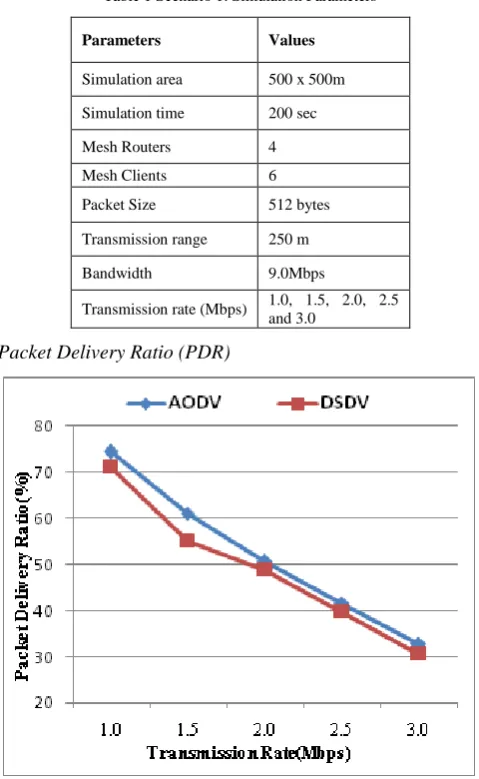
Figure 2.1 Packet Delivery Ratio Vs Transmission Rate
Figure 2.1 shows the performance of AODV and DSDV protocols on the basis of PDR by varying transmission rate. It is observed that the PDR value of AODV protocol increases than DSDV in all the considered transmission rates. Moreover, the maximum PDR value is provided by the AODV protocol at transmission rate 1.0Mbps.
Packets Loss
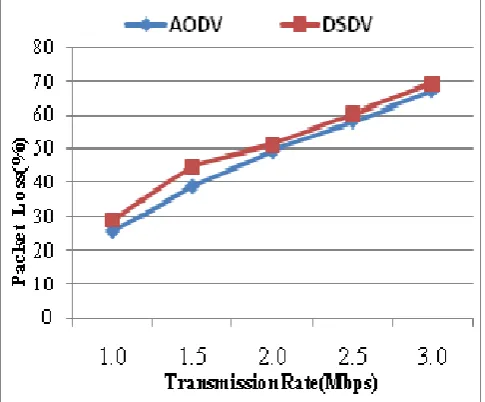
[image:3.595.37.281.496.691.2]Figure 2.2 Packet Loss Vs Transmission Rate
[image:4.595.37.281.91.498.2]Routing Overhead
[image:4.595.315.560.153.339.2]Figure 2.3 Routing Overhead Vs Transmission Rate
Figure 2.3 shows the performance of DSDV and AODV protocols on the basis of routing overhead by varying transmission rate. The routing overhead of AODV is low when compared to DSDV protocol in the considered transmission rates. Moreover, when the transmission rate increases, the routing overhead also increases. The better performance of AODV is achieved at transmission rate at 1 Mbps.
C. Scenario 2:
In Scenario 2, a Hybrid WMN with 25 Mesh Clients and 16 Mesh Routers has been created. The simulation layout is shown in Figure 3. The network scenario is constructed in an area of 600 x 600 meters. The mesh routers are placed statically in a 4x4 grid format with the distance of 100 meters. It assists the mesh clients for providing reliable connections within the entire network. Initially, the mesh clients are sited at the fixed position, and they connect it to the nearby routers. During simulation, the mesh clients move and connect them to different mesh routers automatically. The CBR connections are established between mesh clients to transmit the messages.
a. Simulation Process and Results:
The analysis is conducted in the simulation layout to assess the performance of AODV and DSDV protocols in Hybrid WMN by varying transmission rate at 1.0 Mbps, 1.5 Mbps, 2.0 Mbps, 2.5 Mbps and 3.0 Mbps. The simulation parameters used for the evaluation are shown in Table 2. Figure 3.1 to 3.3 show the graph for the metrics packet delivery ratio, packet loss and routing overhead.
Figure 3. AODV & DSDV - Scenario 2: Simulation Layout
Table 2 Scenario 2: Simulation Parameters
Parameter Value
Simulation area 600 x 600m
Simulation time 200 sec
Mesh Routers 16
Mesh Clients 25
Packet Size 512 bytes
Transmission range 250 m
Bandwidth 9.0Mbps
Transmission Rate(Mbps) 1.0,1.5, 2.0, 2.5 and 3.0
Traffic Type CBR
Packet Delivery Ratio (PDR)
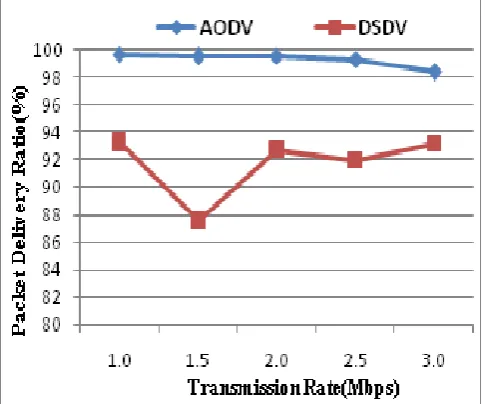
[image:4.595.39.282.296.499.2] [image:4.595.328.547.373.533.2]Figure 3.1 Packet Delivery Ratio Vs Transmission Rate
Packet Loss
[image:5.595.319.560.58.258.2]Figure 3.2 shows the comparison of AODV and DSDV protocols in terms of packet loss. It can clearly be seen that the percentage of packets loss in AODV is decreased when compared to DSDV.
Figure 3.2 Packet Loss Vs Transmission Rate
[image:5.595.40.281.352.553.2]Routing Overhead
Figure 3.3 shows the comparison of AODV and DSDV protocols on the basis of routing overhead. The objective of any routing protocol is to minimize the routing overhead. The obtained results show that the routing overhead of AODV protocol is lower than DSDV protocol except the transmission rate 2.0. However, the AODV protocol produces a minimum routing overhead at transmission rate 1.0 Mbps.
Figure 3.3 Routing Overhead Vs Transmission Rate
IV. CONCLUSION
In this paper, the performance comparison of AODV and DSDV protocols is evaluated in Hybrid Wireless Mesh Network by considering the performance metrics of packet delivery ratio, packet loss and routing overhead in terms of varying transmission rate. In scenario 1, the AODV protocol has a maximum of 74.41% in packet delivery ratio with the minimum routing overhead of 1.76 and with 25.59% of packet loss at the transmission rate 1Mbps. Similarly, the DSDV protocol has a maximum of 71.01% in packet delivery ratio with the minimum routing overhead of 1.81 and with 28.99% of packet loss at the transmission rate 1Mbps.
In Scenario 2, the AODV protocol has a maximum of 99.67% in packet delivery ratio with the minimum routing overhead of 1.53 and with 0.33% of packet loss in the transmission rate 1 Mbps. Likewise, the DSDV protocol has a maximum of 93.26% in packet delivery ratio with a minimum of 6.73% of packet loss at the transmission rate 1Mbps and the minimum routing overhead of 1.64 at transmission rate 2.0 Mbps. Table 3 and Table 4 show the summary of performance metrics results in both scenario 1 and scenario 2. The bolded entries in Table 3 and 4 indicate the better performance of the considered metrics in both protocols.
Table 3 Scenario 1: Summary of Performance Metrics
Metrics AODV DSDV
Maximum Minimum Maximum Minimum
Packet Delivery Ratio(%)
74.41 at 1.0Mbps
32.77 at 3.0Mbps
71.01 at 1.0Mbps
30.67 at 3.0Mbps
Packet Loss(%)
67.23 at 3.0Mbps
25.59 at 1.0Mbps
69.33 at 3.0Mbps
28.99 at 1.0Mbps
Routing Overhead
3.35 at 3.0Mbps
1.76 at 1.0Mbps
3.42 at 3.0Mbps
[image:5.595.318.559.603.699.2]Table 4 Scenario 2: Summary of Performance Metrics
Metrics AODV DSDV
Maximum Minimum Maximum Minimum
Packet Delivery Ratio(%)
99.67 at 1.0Mbps
98.41 at 3.0Mbps
93.26 at 1.0Mbps
87.61 at 1.5mbps
Packet Loss(%)
1.58 at 3.0Mbps
0.33 at 1.0Mbps
12.39 at 1.5Mbps
6.73 at 1.0Mbps
Routing Overhead
1.96 at 1.5Mbps
1.53 at 1.0Mbps
2.15 at 1.5Mbps
1.64 at 2.0Mbps
The advanced features hop-by-hop routing, node sequence numbers and on-demand route discovery made the AODV to perform well in the considered metrics than DSDV protocol. The AODV protocol shows better performance at transmission rate 1Mbps in both scenarios. Hence, the transmission rate of 1 Mbps may be considered in future for the analysis process.
V. REFERENCES
[1]. http://en.wikipedia.org/wiki/Wireless_mesh_ network
[2]. What‟s so good about Mesh Networks? http://backup.daintree.net/downloads/whitepapers/mesh-networking.pdf
[3]. I. F. Akyildiz and X. Wang, “A Survey On Wireless Mesh Networks”, IEEE Communications Magazine, Vol. 43, No. 9, pp. S23–S30, 2005.
[4]. A.A. Pirzada, C. McDonald, “Establishing trust in pure ad-hoc networks”,CRPIT ’04: Proceedings of the 27th Conference on Australasian Computer Science, Australian Computer Society Inc., pp. 47–54, 2004.
[5]. Peizhao Hu, Pirzada, A. A. and Portmann, M, “Experimental Evaluation of AODV in a Hybrid Wireless Mesh Network”, Proceedings of the 5th Workshop on the Internet, Telecommunications and Signal Processing (WITSP), pp. 1-6, 2006.
[6]. http://www.cse.wustl.edu/~jain/cis788-99/ftp/adhoc_routing/
[7]. David B. Johnson and David A. Maltz. "Dynamic source routing for ad hoc wireless networks". In Mobile Computing, edited by Tomasz Imielinski and Hank Korth, chapter 5, pages 153-181. Kluwer Academic Publishers, 1996.
[8]. C.E. Perkins and E.M. Royer, “Ad hoc on demand distance vector (AODV) routing (Internet-draft)”, Mobile Ad-hoc Network (MANET) Working Group, IETF, 1998.
[9]. Vincent D. Park and M. Scott Corson. "Temporally-Ordered Routing Algorithm (TORA) version 4: Functional specification". Internet-Draft, draft-ietfmanet-TORA-spec-04.txt, July 2001.
[10]. Charles E. Perkins and Praveen Bhagwat, “Highly dynamic destination-sequenced distance-vector routing (DSDV) for mobile computers”, in: Proceedings. of ACM SIGCOMM ’94 Symposium on Communication, Architectures and Protocols, pp. 234–244, 1994.
[11]. Destination-Sequenced Distance Vector routing,
http://en.wikipedia.org/wiki/Destination-Sequenced_Distance_Vector_routing
[12]. NS2, “The Network Simulator,” http://www.isi.edu/nsnam/ns/, 1989.