O R I G I N A L R E S E A R C H
Effects Of Triptolide On Tooth Movement And Root
Resorption In Rats
This article was published in the following Dove Press journal: Drug Design, Development and Therapy
Fan Yang1,2 Xu Xia Wang1,3 Dan Ma1,2 Qun Cui1,2 De Hua Zheng1,2 Xiao Can Liu1,2 Jun Zhang1,2
1Shandong Provincial Key Laboratory of
Oral Tissue Regeneration & Shandong Engineering Laboratory for Dental Materials and Oral Tissue Regeneration, School of Stomatology, Shandong University, Jinan, Shandong Province,
People’s Republic of China;2Department
of Orthodontics, School of Stomatology, Shandong University, Jinan, Shandong
Province, People’s Republic of China;
3Department of Oral and Maxillofacial
Surgery, School of Stomatology, Shandong University, Jinan, Shandong
Province, People’s Republic of China
Purpose: The aim of this study was to investigate the effects of triptolide on the tooth
movement and root resorption in rats during orthodontic treatment.
Material and methods:A total of 48 male Wistar rats were divided into three groups of 16
each. The right maxillary first molars of rats were drawn mesially by closed coil nickel– titanium spring with a force of 50 g. The two experimental groups received intraperitoneal injections of triptolide for 14 days at a dose of 15 µg/kg/day and 30 µg/kg/day, respectively. The control group received vehicle injections. After 14 days, the rats were humanely killed. The amount of tooth movement was measured. Eight rats from each group were randomly chosen for analysis of the percentage of root resorption area by scanning electron micro-scopy. For the remaining eight rats in each group, the H&E staining, tartrate-resistant acid phosphatase (TRAP) staining and immunohistochemistry analysis were performed.
Results: The amount of tooth movement and the ratio of root resorption area were
sig-nificantly decreased in the triptolide-treated rats. The number of TRAP-positive cells was significantly lower in triptolide-treated groups. Moreover, the expression of nuclear factor kappa B ligand (RANKL) was reduced. In contrast, the expression of osteoprotegerin was significantly up-regulated. In the tension side, the expressions of runt-related transcription factor 2 and osteocalcin were significantly enhanced by triptolide injection.
Conclusion: Triptolide injection could arrest orthodontic tooth movement and reduce root
resorption in rats via inhibition of osteoclastogenesis. In addition, triptolide may exert a positive effect on osteoblastogenesis.
Keywords: triptolide, osteoclast, scanning electron microscope, tooth movement, bone
formation
Introduction
Orthodontic tooth movement (OTM) is achieved by the remodeling of alveolar bone and periodontal ligament (PDL) with the application of sustained mechanical force exerted on teeth. During the orthodontic treatment, alveolar bone is resorbed at the pressure side while it is formed at the tension side. Bone resorption and bone formation are tightly coupled via the linkage between osteoclast and osteoblast. The force-induced strains alter the periodontal microenvironment releasing various
cytokines, chemokines and inflammatory factors such as nuclear factor
kappa B ligand (RANKL), osteoprotegerin (OPG), and tissue necrosis factor-α
(TNF-α).1,2 These molecules participate in the regulation of this complex bone
remodeling process. Several studies have been conducted to investigate the effect of
pharmacological agents on OTM.3A recent study found clodronate can arrest tooth
movement following the dose- and time-dependent manners.4Another study found
Correspondence: Jun Zhang
Department of Orthodontics, School of Stomatology, Shandong University, 44 Wenhua West Road, Jinan 250012,
People’s Republic of China
Tel +86 139 5310 9816 Fax +86-531-88565657 Email [email protected]
Drug Design, Development and Therapy
Dove
press
open access to scientific and medical research
Open Access Full Text Article
Drug Design, Development and Therapy downloaded from https://www.dovepress.com/ by 118.70.13.36 on 21-Aug-2020
parathyroid hormone could facilitate bone remodeling and
accelerate tooth movement.3
Orthodontically induced inflammatory root resorption
(OIRR) is one of the most common but unpredictable sequela of orthodontic treatment, which will lead to the permanent loss of tooth structure. Previous studies showed that approximately 90% of the patients who underwent orthodontic treatment presented a different extent of root resorption, and 3% of the patients had severe root
resorption.5,6 The etiology of OIRR is multifactorial,
including individual susceptibility, orthodontic force, type
of OTM, and duration of orthodontic treatment.7A recent
study also found vitamin D may be associated with the
pathology of root resorption.8Although the exact
mechan-ism of OIRR remains unclear, the process is considered as a part of hyaline elimination. During the removal of hya-linized tissues, the cementum and dentin are removed, resulting in root resorption.9,10The local sterile infl amma-tory process induced by mechanical force is essential for
OTM and it is also responsible for OIRR.2The methods to
predict and prevent root resorption are needed now. Triptolide, a diterpenoid trioxide isolated from the ancient
Chinese herb Tripterygium wilfordii Hook F (TWHF), has
been widely used to treat autoimmune and inflammatory
dis-eases in China.11,12As the most active and promising
compo-nent of TWHF, triptolide exhibits a wide range of biological and pharmacological activities, such as antitumor, antioxidant,
anti-inflammatory, and immunosuppressive properties.13–16
Researches have found triptolide could inhibit bone loss and
up-regulate the bone mineral density.17However, the
lying molecular and cellular mechanisms are not fully under-stood. Therefore, we hypothesized that triptolide may have
a potential efficacy on the bone remodeling and root resorption
in orthodontic treatment.
To the best of our knowledge, there is no study
demon-strating if triptolide exhibits possible benefits or side
effects on orthodontic treatment. Thus, in the present study, we investigated the effects of triptolide on tooth movement and root resorption during orthodontic treat-ment in rats and explored the underlying mechanisms.
Materials And Methods
Reagents
Triptolide was obtained from Solarbio Science &
Technology (Beijing, China). The polyclonal anti-rabbit RANKL, anti-rabbit runt-related transcription factor 2 (RUNX2), anti-rabbit osteocalcin (OCN) were purchased
from Proteintech (Wuhan, China). The polyclonal anti-rabbit OPG was obtained from Solarbio Science & Technology. The H&E staining kit and tartrate-resistant acid phosphatase (TRAP) staining kit were both purchased
from Solarbio Science & Technology. The Biotin–
Streptavidin HRP detection system is acquired from ZSGB-BIO (Beijing, China).
Ethical Statement
The animal experiments in this study were performed accord-ing to the Guide for the Care and Use of Laboratory Animals of the National Institutes of Health and approved by the Institutional Animal Care and Use Committee of Shandong University.
Experimental Animals And Groups
Forty-eight 6-week-old male Wistar rats (260–280 g) were
purchased from SPF Biotechnology (Beijing, China). The rats were pair-housed in standard plastic cages under
spe-cific pathogen-free conditions with controlled temperature
(22±1°C), humidity (55±10%) and a 12-h light/dark cycle. The interior noise was controlled below 60 dB. They were provided with a powder diet and water ad libitum. The general condition and weight of each animal in this study were monitored during the experiment. All the animals were acclimated for 1 week before the start of the experiment.
The animals were randomly divided into three groups of 16 rats each as follows: one control group and two triptolide-treated groups (high-dose and low-dose groups). Triptolide was solubilized in 0.05% dimethyl sulfoxide then diluted in saline. The rats in the high-dose group were administrated with triptolide at a dose of 30 µg/kg/day by intraperitoneal injection for 14 days. The rats in the low-dose group were administrated with triptolide at a dose of 15 µg/kg/day by intraperitoneal injection for 14 days. The control group received the same volume of saline according to the same protocol.
Animal Model Establishment
All the rats in three groups received orthodontic treatment. Induction of tooth movement was performed as described
previously.18The animals were anesthetized with 3%
pheno-barbital sodium at a dose of 35 mg/kg by intraperitoneal injection. After anaesthetization, the closed coil nickel– tita-nium spring (GRIMED Medical, Beijing, China) was inserted
between the right maxillary first molar and incisors.
A 0.5-mm-deep groove was prepared around the neck of the
maxillary incisors. The closed coil nickel–titanium spring was
Drug Design, Development and Therapy downloaded from https://www.dovepress.com/ by 118.70.13.36 on 21-Aug-2020
fixed with a 0.20 mm stainless wire around the neck of teeth and the stainless wire was embedded into the groove to pre-vent the orthodontic appliance detaching from the incisors. In addition, two maxillary incisors were bonded together as a whole by light-curing composite resin (Charisma, Heraeus Kulzer, Germany) to enhance the anchorage. The force of the coil spring after activation is approximately 50 g verified by an ergometer (Westlake Biomaterial, Hangzhou, China). The
right maxillaryfirst molar was drawn mesially with the two
incisors as anchorage and the anchorage loss was neglected.
Figure 1shows the orthodontic appliance used in this study. The monitoring of appliance breakage was performed daily.
Amount Of OTM
On the 14th day after orthodontic treatment, the distance
between first and second molars as the amount of tooth
movement was measured with a caliper (accuracy of 0.02 mm) (Measuring & Cutting Tool Works, Shanghai,
China) from the distal contact area of thefirst molar to the
mesial contact area of the second molar. All measurements were repeated three times by the same operator to ensure the consistency of our method.
Scanning Electron Microscope
The eight rats in each group were sacrificed under anesthesia
on the 14th day. For evaluating root resorption, the right max-illaryfirst molars were extracted in toto. The teeth were soaked in 1% hypochlorite solution for 15 mins. Then, the PDL was carefully removed. Both distobuccal and distopalatal roots were exposed completely. Then, the teeth were dried and scanned under a scanning electron microscope (SEM, SU8010, HITACHI, Tokyo, Japan) at the same orientation and distance. The data of mesial surfaces of distobuccal and distopalatal roots were obtained and saved as digital photo-graphs. The resorption areas on the two-thirds of the cervical side of both distobuccal and distopalatal roots were measured by ImageJ software. The resorption craters on the apical third region were ignored because the root apices of rats which covered by cellular cementum changed incessantly in shape and dimension by secondary cementum. We evaluated the root resorption by the percentage of the resorption area on the mesial side of distobuccal and distopalatal roots (Figure 2).
Tissue Preparation
The remaining eight rats of each group were generally anesthetized and perfused transcardially with 4% paraformal-dehyde (pH 7.2–7.6) forfixation. Then, the maxilla of each rat
Figure 1Model of orthodontic treatment.
Notes:(A) The sagittal diagram of orthodontic appliance. The arrow indicates the direction of mechanical force. (B) The horizontal diagram of orthodontic appliance. (C) The intraoral photograph of the orthodontic appliance. The closed coil nickel– titanium spring was inserted between the right maxillaryfirst molar and incisors to draw thefirst molar mesially.
Abbreviation:NiTi, nickel–titanium.
Figure 2Analysis of root resorption area.
Notes:(A) The representative scanning electron micrograph of the compression side of distopalatal root of maxillary rightfirst molar of rat. (B) Diagram indicating the root resorption area (black), compared with the total area of root surface (gray). The ratio of root resorption was calculated by dividing the resorption area by the total root surface area (the ratio of root resorption = black area/gray area).
Drug Design, Development and Therapy downloaded from https://www.dovepress.com/ by 118.70.13.36 on 21-Aug-2020
including thefirst and second molars was carefully dissected
andfixed in 10% buffered formalin (pH 7.2–7.6). Then, the
specimens were decalcified in 10% ethylene diamine
tetraace-tic acidat 4°C for 8 weeks. Afterward, the samples were dehydrated through the ethanol series, rendered transparent
by xylene, and embedded in paraffin wax. Serial sections
with a thickness of 5μm in a mesiodistal direction parallel to
the long axis of the distopalatal root were cut.
Histological Evaluation
The sections were routinely stained with H&E to examine the remodeling of periodontal tissues and root resorption. To identify the osteoclastogenesis, the TRAP staining was
performed according to the manufacturer’s instruction.
The sections were counterstained with hematoxylin. The region of interest was the distopalatal root and adjacent alveolar bone, as the structure of distopalatal root was stable. The multinucleated TRAP-positive cells located around the alveolar bone were considered as osteoclasts and those located on root surface were considered as
odontoclasts. Under high magnification (×200), the
TRAP-positive cells within the periodontal area in the mesial side of distopalatal root were counted. The process was
per-formed in five sections per animal, and the mean values
were calculated.
Immunohistochemistry
Sections were deparaffinized and treated with 3% hydrogen
peroxidase in methanol for 15 mins at room temperature to inhibit endogenous peroxidase activity. After washing in phosphate buffer solution (PBS), sections were preincu-bated in goat serum for 35 mins. Then, the sections were incubated with the polyclonal anti-rabbit RANKL (working dilution, 1:300), polyclonal anti-rabbit OPG (working tion, 1:50), polyclonal anti-rabbit RUNX2 (working dilu-tion, 1:400), and polyclonal anti-rabbit OCN (working dilution, 1:400) in a humid chamber for 16 hrs at 4°C.
Sections were rinsed in PBS and stained with Biotin–
Streptavidin HRP detection system according to the
manu-facturer’s instruction. All sections were counterstained with
hematoxylin. The negative control was submitted to the same procedure as described above but incubated with PBS instead of primary antibodies.
Statistical Analysis
Normality was assessed with Shapiro–Wilk test, and as data
were found to be normally distributed, they were expressed as mean±SD and parametric statistical tests were used. One-way
ANOVA followed by the Newman–Keuls' multiple
compar-ison test was performed to analyze the statistical differences in the amount of tooth movement, number of TRAP-positive cells, the ratio of root resorption, and the mean optical density (MOD) values of RANKL, OPG, OCN, RUNX2 among the control and triptolide-treated groups using the SPSS software
(22.0). The p value<0.05 was considered statistically
significant.
Results
General Condition
No animals died during the experiment. No differences were observed in the body weights among different groups at the end of the experiment.
Distance Of Tooth Movement
After 14 days, the amounts of tooth movement were 0.51 ±0.04 mm and 0.40±0.10 mm in the 15 µg/kg and 30 µg/kg
triptolide injection groups, respectively, which were signifi
-cantly lower than the control group (0.71±0.04 mm) (Figure 3).
The amount of tooth movement in the 30 µg/kg group was
decreased significantly, compared with the 15 µg/kg group.
Root Resorption Analysis Via SEM
The compression side of distobuccal and distopalatal
roots was observed under a SEM (Figure 4). The root
surface of the control group was smoother than that of
triptolide-treated groups (Figure 4A and B). There were
Figure 3Amount of tooth movement.
Notes:After 14-day orthodontic treatment, the tooth movement was significantly inhibited by triptolide injection. Data are expressed as mean±SD (**P<0.01).
Drug Design, Development and Therapy downloaded from https://www.dovepress.com/ by 118.70.13.36 on 21-Aug-2020
more resorption pits showed in the control group and the extent of root resorption was more severe in the control
group (Figure 4C). The percentage of resorption area was
calculated. The mean root resorption area ratios were statistically reduced in triptolide-treated groups compared
to the control group (Figure 5). The mean root resorption
area ratio of the 30 µg/kg group was slightly lower than
the 15 µg/kg group, but the difference was not significant
(Figure 5).
Histologic Examination By H&E Staining
After 14-day tooth movement, resorption craters were detected on the surface of root and alveolar bone among
different groups (Figure 6). The disorientation of PDL
fibers was observed in the pressure side. There were
more resorption pits detected on the root surface in the
control group (Figure 6E). And the extent of resorption
craters was decreased with increasing dose of triptolide (Figure 6B,D,F).
TRAP Staining Observation
In the control group, numerous TRAP-positive multinuc-lear cells were observed in the pressure side of root surface
and alveolar bone after 14 days of OTM (Figure 7). In the
triptolide-treated groups, the TRAP-positive multinuclear cells were sparsely located on the alveolar bone and
occa-sionally found on the root surface (Figure 7AandB).
The number of TRAP-positive cells within the
com-pression area was significantly lower in rats treated with
Figure 4Scanning electron microscope micrograph of the compression side of distal root of maxillaryfirst molar.
Notes:(A) The rats treated with triptolide at a dose of 30 µg/kg. (B) The rats treated with triptolide at a dose of 15 µg/kg. (C) The rats in the control group. The root surface of the control group was rougher than that of triptolide-treated groups. There were more resorption craters showed in the control group. And the extent of root resorption was greatly reduced in the rats treated with triptolide. The white arrows indicate the root
resorption craters. Figure 5Ratio of root resorption area.
Notes:The mean root resorption area ratio of the control group was statistically reduced in triptolide-treated groups compared to the control group. The mean root resorption area ratio of the 30 µg/kg group was slightly lower than the 15 µg/ kg group, but the difference was not significant. Data are expressed as mean±SD (**P<0.01).
Drug Design, Development and Therapy downloaded from https://www.dovepress.com/ by 118.70.13.36 on 21-Aug-2020
triptolide compared to the control group (Figure 8). Moreover, the number of TRAP-positive cells was statis-tically reduced in the 30 µg/kg group compared with the
15 µg/kg group (Figure 8).
Immunohistochemistry Analysis
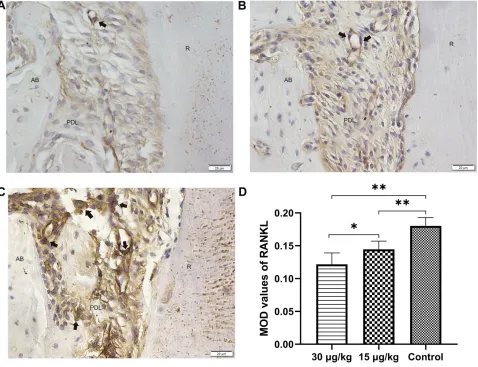
The immunoreactivity of RANKL was mainly observed within the compression side of periodontal area. The
expression of RANKL was significantly higher in the
Figure 6Histologic observation of the compression side of distopalatal root of the maxillaryfirst molar (H&E staining).
Notes:(A) The rats treated with triptolide at a dose of 30 µg/kg. (C) The rats treated with triptolide at a dose of 15 µg/kg. (E) The rats in the control group. The root surface of rats in the high-dose group showed less resorption craters than the low-dose group and control group (magnification, ×100). (B), (D) and (F) represent the high powerfield of root surface in (A), (C), and (E), respectively (magnification, ×200). The extent of root resorption was decreased with increasing dose of triptolide.
Abbreviations:AB, alveolar bone; PDL, periodontal ligament; R, root.
Drug Design, Development and Therapy downloaded from https://www.dovepress.com/ by 118.70.13.36 on 21-Aug-2020
control group than that of triptolide-treated groups (Figure
9). And the expression of RANKL in the 30 µg/kg group
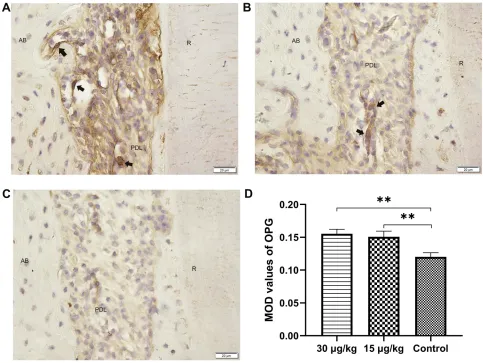
was statistically lower than that of the 15 µg/kg group (Figure 9D). Conversely, greater immunoreactivity of OPG was observed in the rats treated with triptolide (Figure 10). The MOD value of OPG was increased
sig-nificantly in the rats administrated with triptolide (Figure
10D). Moreover, the expression of OPG in the 30 µg/kg
group was higher than the 15 µg/kg group, but the
differ-ence was not significant (Figure 10D).
The immunoreactivities of RUNX2 and OCN were apparently observed in the PDL area and on the surface
of alveolar bone of the tension side (Figures 11 and12).
The expression of RUNX2 was remarkably higher in the triptolide-treated group compared to the control group (Figure 11). Besides, the expression of OCN was signifi
-cantly enhanced by the injection of triptolide (Figure 12).
The expressions of both RUNX2 and OCN were increased with increasing dose of triptolide, but the difference in the expression of OCN between the 15 µg/kg and 30 µg/kg
groups was not significant (Figures 11 and12).
Discussion
In the present study, Wistar rats were used to establish the orthodontic model, which are considered as an adequate model with translational potential and widely used in the
Figure 7TRAP staining of the compression side of distopalatal root of maxillary
first molar.
Notes:(A) The rats treated with triptolide at a dose of 30 µg/kg. (B) The rats treated with triptolide at a dose of 15 µg/kg. (C) The rats in the control group. In the control group, numerous TRAP-positive multinuclear cells were observed on the pressure side of root surface and alveolar bone after 14-day OTM. In the triptolide-treated groups, the TRAP-positive multinuclear cells were sparsely located on the alveolar bone and hardly found on the root surface. The number of TRAP-positive cells within the compression area was significantly lower in rats treated with triptolide. The arrows indicate the positive cells (magnification, ×200).
Abbreviations:AB, alveolar bone; PDL, periodontal ligament; R, root.
Figure 8Number of TRAP-positive cells.
Notes:The number of TRAP-positive cells was significantly lower in the rats treated with triptolide, compared with the control group. The number of TRAP-positive cells was decreased with increasing dose of triptolide. Data are expressed as mean±SD (**P<0.01).
Drug Design, Development and Therapy downloaded from https://www.dovepress.com/ by 118.70.13.36 on 21-Aug-2020
study of OTM and pharmacology.19–21In order to exclude
the influence of estrogen, only male rats were chosen. The
optimum force for the tooth movement of rats may be less
than 10 g as previously suggested.22And it is believed that
the heavy force would aggravate the root resorption.7 In
this study, 50 g force was applied to move thefirst molar
of rat mesially for 14 days to induce the tooth movement and root resorption.
The OTM results from the bone resorption at the compression side induced by osteoclast under mechanical stimuli. Osteoclast, the only cell with bone resorption function in vivo, plays a critical role in bone remodeling. Triptolide was found to exhibit a regulatory effect on bone turnover. A previous study showed triptolide had
a protective effect on age-related bone loss,23 and it was
demonstrated to attenuate titanium-induced osteolysis and
osteoclast formation.24 In the present study, the
TRAP-positive cells were observed on the surface of alveolar bone and the root of compression side after 14 days under orthodontic force. The number of TRAP-positive
cells including osteoclasts and odontoclasts was signifi
-cantly decreased in the triptolide-treated groups. In the triptolide-treated groups, the TRAP-positive cells were
hardly detected. Our findings provided further evidence
on the inhibitory effect of triptolide on osteoclast activity. As a result of that, the OTM of rats administrated with triptolide was arrested. This result could raise a clinical concern. As triptolide was widely used to treat a variety of diseases, the tooth movement would be hindered in patients who take triptolide.
Figure 9Expression of RANKL in the compression side of distopalatal root of maxillary molar.
Notes:(A) The rats treated with triptolide at a dose of 30 µg/kg. (B) The rats treated with triptolide at a dose of 15 µg/kg. (C) The rats in the control group. (D) Mean optical values of RANKL. The immunoreactivity of RANKL was mainly observed within the compression side of periodontal area. The expression of RANKL was significantly higher in the control group than that of triptolide-treated groups (magnification, ×400). The arrows indicate the positive cells. The MOD values of RANKL were significantly inhibited by triptolide injection. Data are expressed as mean±SD (*P<0.05, **P<0.01).
Abbreviations:AB, alveolar bone; PDL, periodontal ligament; R, root.
Drug Design, Development and Therapy downloaded from https://www.dovepress.com/ by 118.70.13.36 on 21-Aug-2020
In general, what both patient and orthodontist pursue is to accelerate OTM and diminish the duration of orthodon-tic treatment. Several studies had been performed on these
purposes.25–27Whereas the inhibition of tooth movement
may also imply its clinical use. The study showed stron-tium ranelate can improve tooth anchorage and inhibit root
resorption in the orthodontic treatment of rats.28 Another
study found that aspirin can inhibit tooth movement and
block orthodontic relapse.29 The present study was
per-formed as an explorative experiment. Our result indicated triptolide may have the potential to be used for these aims. The correlative studies would be performed in the future.
The mechanism of OIRR is similar to that of osteoclast-induced bone resorption. Several effector cells are
impli-cated in the root resorption process – specifically, the
odontoclast, the morphologic and functional characteristics
of which are extremely similar to those of the osteoclast.10
In order to evaluate the root resorption, the pressure sides of distobuccal and distopalatal roots were scanned by SEM. The clear micrographs of the surface of distobuccal and distopalatal roots were obtained. There were more resorp-tion pits located on the surface of distobuccal and distopa-latal roots in the control group. The amount of root
resorption area was significantly reduced in the
triptolide-treated groups. Our finding indicated triptolide injection
may be able to inhibit root resorption during orthodontic treatment.
RANKL is a crucial factor for osteoclast and odontoclast formation and activation. It exerts its effect by binding to the RANK receptor expressed on osteoclast lineage cells. This
Figure 10Expression of OPG in the compression side of distopalatal root of maxillary molar.
Notes:(A) The rats treated with triptolide at a dose of 30 µg/kg. (B) The rats treated with triptolide at a dose of 15 µg/kg. (C) The rats in the control group. (D) Mean optical values of OPG. Greater immunoreactivity of OPG was observed in the rats treated with triptolide (magnification, ×400). The arrows indicate the positive cells. The MOD values of OPG were increased significantly in the rat administrated with triptolide. Moreover, the expression of OPG in the 30 µg/kg group was higher than the 15 µg/ kg group, but the difference was not significant. Data are expressed as mean±SD (**P<0.01).
Abbreviations:AB, alveolar bone; PDL, periodontal ligament; R, root.
Drug Design, Development and Therapy downloaded from https://www.dovepress.com/ by 118.70.13.36 on 21-Aug-2020
binding initiates the rapid differentiation of hematopoietic osteoclast precursors to mature osteoclasts. OPG acts as the decoy receptor and competes with RANK for RANKL bind-ing, resulting in inhibition of terminal stages of osteoclast differentiation, suppression of activation of matrix osteoclasts, and induction of apoptosis. The multifunctional roles of RANK, OPG, and RANKL may provide an important link
between bone remodeling, OTM, and root resorption.30
Osteoclast and odontoclast differentiations in root resorption areas are critically regulated by RANKL, which is produced as a local factor by PDL cells in response to heavy orthodontic
force.31In addition, the deletion of RANKL in PDL and bone
lining cells greatly reduces osteoclastogenesis in response to
mechanical force.32Therefore, we examined the expression of
RANKL and OPG to further elucidate the underlying mechan-ism of inhibitory effect of triptolide on osteoclastgenesis. After
14-day tooth movement, the RANKL was observed in the compressive side of PDL around the alveolar bone and root.
The expression of RANKL was significantly decreased in rats
injected with triptolide. Thefinding was in agreement with the
previous study that demonstrated triptolide inhibited
osteoclas-togenesis by suppressing RANKL-induced NF-κB
activation.33 On the other hand, the OPG expression was
greatly up-regulated in the triptolide-treated groups, which could contribute to the inhibition of osteoclastogenesis. The suppression of tooth movement and root resorption in rats administrated with triptolide could result from the decreasing expression of RANKL and increasing expression of OPG. Furthermore, another in vitro study showed triptolide inhibited osteoclast differentiation by promoting the production of IL-10
and TGF-β.34The further study of the molecular mechanism of
triptolide on osteoclast is needed.
Figure 11Expression of RUNX2 in the tension side of distopalatal root of maxillary molar.
Notes:(A) The rats treated with triptolide at a dose of 30 µg/kg. (B) The rats treated with triptolide at a dose of 15 µg/kg. (C) The rats in the control group. (D) Mean optical values of RUNX2. The immunoreactivity of RUNX2 was detected in the tension side after 14-day OTM (magnification, ×400). The arrows indicate the positive cells. The expression of RUNX-2 was remarkably higher in the triptolide-treated group compared to the control group. Data are expressed as mean±SD (*P<0.05, **P<0.01).
Abbreviations:AB, alveolar bone; PDL, periodontal ligament; R, root.
Drug Design, Development and Therapy downloaded from https://www.dovepress.com/ by 118.70.13.36 on 21-Aug-2020
Bone formation results from complex events that involve differentiation of osteoblast precursor cells from primitive mesenchymal cells, maturation of osteoblasts, and matrix
formation, followed by its mineralization.1 With regard to
the effect of triptolide on osteoblastogenesis, literature has
emerged that offers contradictoryfindings. An in vitro study
demonstrated the suppressive effect of triptolide on
osteo-blast proliferation and mineralization.35 Nevertheless, in
another in vitro study, triptolide was found to be able to
reverse TNF-α-associated suppression of osteoblast
differentiation.36 The process of bone formation plays an
important role in OTM, which could sustain the structural integrity of alveolar bone. In the present study, the expres-sions of OCN and RUNX2, which are regarded as the late and early markers of osteoblastogenesis, respectively, were examined. The positive expressions of RUNX2 and OCN
were observed within the periodontal area in the tension side along the alveolar bone. The MOD values of both RUNX2
and OCN were significantly increased in the
triptolide-treated groups. Our result suggested that triptolide may exert a positive effect on osteoblastogenesis.
It is notable that the triptolide is reported to exhibit adverse reactions, involving hepatotoxicity, renal cytotoxi-city, and reproductive toxicity. A variety of studies showed
triptolide-induced toxicity depends on dosage and
administration.37And the minimal toxic does of triptolide
for Wistar rats was 150 µg/kg/day for 28 days.38 The
dosages we used were 15 µg/kg/day and 30 µg/kg/day for 14 days, which were much lower than the minimal toxic dose. Moreover, there was no difference observed in the body weight among the triptolide-treated groups and the control group. Meanwhile, no adverse reaction was
Figure 12Expression of OCN in the tension side of distopalatal root of maxillary molar.
Notes:(A) The rats treated with triptolide at a dose of 30 µg/kg. (B) The rats treated with triptolide at a dose of 15 µg/kg. (C) The rats in the control group. (D) Mean optical values of OCN. The positive cells were observed in the tension side along the alveolar bone (magnification, ×400). The arrows indicate the positive cells. The expression of OCN was significantly up-regulated by the injection of triptolide. Data are expressed as mean±SD (**P<0.01).
Abbreviations:AB, alveolar bone; PDL, periodontal ligament; R, root.
Drug Design, Development and Therapy downloaded from https://www.dovepress.com/ by 118.70.13.36 on 21-Aug-2020
observed during the experiment. Thus, the triptolide was well tolerated by rats in this study.
The limitation of this study was that we only examined the short-time effect of triptolide on orthodontic treatment in rats. But OTM refers to a complex process. The long-term effect of triptolide on orthodontic treatment should be evaluated in the future.
Conclusion
The present study demonstrated that triptolide could
sig-nificantly arrest OTM and reduce root resorption via
inhi-bition of osteoclastogenesis. In addition, triptolide may exert a positive effect on osteoblastogenesis.
Acknowledgments
This work was supported by the Shandong Province Natural Science Foundation (ZR2019MH113).
Disclosure
The authors report no conflicts of interest in this work.
References
1. Krishnan V, Davidovitch Z. Cellular, molecular, and tissue-level reactions to orthodontic force. Am J Orthod Dentofacial Orthop.
2006;129(4):469.e1–469.e32. doi:10.1016/j.ajodo.2005.10.007 2. Li Y, Jacox LA, Little SH, et al. Orthodontic tooth movement: the
biology and clinical implications. Kaohsiung J Med Sci. 2018;34 (4):207–214. doi:10.1016/j.kjms.2018.01.007
3. Thaleia K, Christos K, Stephan VG. The potential use of pharmaco-logical agents to modulate Orthodontic Tooth Movement (OTM).
Front Physiol.2017;8:67. doi:10.3389/fphys.2017.00067
4. NakašE, Lauc T, Tiro A, et al. Dose- and time-dependent effects of clodronate on orthodontic tooth movement.Bosn J Basic Med Sci.
2017;17(1):23–28. doi: 10.17305/bjbms.2017.1715
5. Kaley J, Phillips C. Factors related to root resorption in edgewise practice. Angle Orthod. 1991;61(2):125–132. doi:10.1043/0003-3219(1991)061<0125:FRTRRI>2.0.CO;2
6. Lupi JE, Handelman SC. Prevalence and severity of apical root resorption and alveolar bone loss in orthodontically treated adults.
Am J Orthod Dentofacial Orthop.1996;109(1):28–37. doi:10.1016/
S0889-5406(96)70160-9
7. Lopatiene K, Dumbravaite A. Risk factors of root resorption after orthodontic treatment.Stomatologija.2008;10(3):89–95.
8. Fontana ML, de Souza CM, Bernardino JF, et al. Association analysis of clinical aspects and vitamin D receptor gene polymorphism with external apical root resorption in orthodontic patients.Am J Orthod
Dentofacial Orthop.2012;142(3):339–347. doi:10.1016/j.ajodo.2012.
04.013
9. Feller L, Khammissa RA, Thomadakis G, et al. Apical external root resorption and repair in orthodontic tooth movement: biological events. Biomed Res Int. 2016;2016(2):1–7. doi:10.1155/2016/486 4195
10. Jager A, Kunert D, Friesen T, et al. Cellular and extracellular factors in early root resorption repair in the rat. Eur J Orthod. 2008;30 (4):336–345. doi:10.1093/ejo/cjn012
11. Chen SR, Dai Y, Zhao J, et al. A mechanistic overview of triptolide and celastrol, natural products fromTripterygium wilfordiiHook F.
Front Pharmacol.2018;9:104. doi:10.3389/fphar.2018.00104
12. Li W, Gong K, Ding Y, et al. <p>Effects of triptolide and methotrex-ate nanosuspensions on left ventricular remodeling in autoimmune myocarditis rats.Int J Nanomedicine.2019;14:851–863. doi:10.2147/ IJN
13. Zou Y, Hu W. Investigation of gene expression profiles in a rat adjuvant arthritis model suggests an effective role of triptolide via
PI3K-AKT signaling. Exp Ther Med. 2019;17(5):3999–4006.
doi:10.3892/etm.2019.7425
14. Ding YY, Li JM, Guo FJ, et al. Triptolide upregulates myocardial forkhead helix transcription factor p3 expression and attenuates car-diac hypertrophy.Front Pharmacol.2016;7:471. doi:10.3389/fphar. 2016.00471
15. Kim ST, Kim SY, Lee J, et al. Triptolide as a novel agent in pancreatic cancer: the validation using patient derived pancreatic tumor cell line. BMC Cancer. 2018;18(1):1103. doi:10.1186/s128 85-018-4995-0
16. Han Y, Huang W, Liu J, et al. Triptolide inhibits the AR signaling pathway to suppress the proliferation of enzalutamide resistant pros-tate cancer cells. Theranostics. 2017;7(7):1914–1927. doi:10.7150/ thno.17852
17. Fan D, Guo Q, Shen J, et al. The effect of triptolide in rheumatoid arthritis: from basic research towards clinical translation.Int J of Mol Sci.2018;19(2):376. doi:10.3390/ijms19020376
18. Li J, Wang X, Li N, et al. Short-term effects of nicotine on ortho-dontically induced root resorption in rats. Angle Orthod. 2016;86 (2):199–205. doi:10.2319/101014-727.1
19. Dolci GS, Ballarini A, Gameiro GH, et al. Atorvastatin inhibits osteoclastogenesis and arrests tooth movement. Am J Orthod and
Dentofacial Orthop.2018;153(6):872–882. doi:10.1016/j.ajodo.2017.
09.021
20. Li F, Li G, Hu H, et al. Effect of parathyroid hormone on experi-mental tooth movement in rats.Am J Orthod and Dentofacial Orthop.
2013;144(4):523–532. doi:10.1016/j.ajodo.2013.05.010
21. Arias OR, Marquez-Orozco MC. Aspirin, acetaminophen, and ibu-profen: their effects on orthodontic tooth movement.Am J Orthod
Dentofacial Orthop.2006;130(3):364–370. doi:10.1016/j.ajodo.2004.
12.027
22. Gonzales C, Hotokezaka H, Yoshimatsu M, et al. Force magnitude and duration effects on amount of tooth movement and root resorp-tion in the rat molar.Angle Orthod.2008;78(3):502–509. doi:10.231 9/052007-240.1
23. Luo D, Ren H, Zhang H, et al. The protective effects of triptolide on age-related bone loss in old male rats. Biomed Pharmacother.
2018;98:280–285. doi:10.1016/j.biopha.2017.12.072
24. Huang J, Zhou L, Wu H, et al. Triptolide inhibits osteoclast forma-tion, bone resorpforma-tion, RANKL-mediated NF-қB activation and
tita-nium particle-induced osteolysis in a mouse model. Mol Cell
Endocrinol.2015;399:346–353. doi:10.1016/j.mce.2014.10.016
25. Hashimoto F, Kobayashi Y, Mataki S, et al. Administration of osteo-calcin accelerates orthodontic tooth movement induced by a closed coil spring in rats.Eur J Orthod.2001;23(5):535–545. doi:10.1093/ ejo/23.5.535
26. Jing D, Xiao J, Li X, et al. The effectiveness of vibrational stimulus to accelerate orthodontic tooth movement: a systematic review.BMC
Oral Health.2017;17(1):143. doi:10.1186/s12903-017-0437-7
27. Yi J, Yan B, Li M, et al. Caffeine may enhance orthodontic tooth movement through increasing osteoclastogenesis induced by periodon-tal ligament cells under compression.Arch Oral Biol.2016;64:51–60. doi:10.1016/j.archoralbio.2015.12.009
28. Kirschneck C, Wolf M, Reicheneder C, et al. Strontium ranelate improved tooth anchorage and reduced root resorption in orthodontic treatment of rats.Eur J Pharmacol.2014;744:67–75. doi:10.1016/j. ejphar.2014.09.039
Drug Design, Development and Therapy downloaded from https://www.dovepress.com/ by 118.70.13.36 on 21-Aug-2020
29. Liu Y, Zhang T, Zhang C, et al. Aspirin blocks orthodontic relapse via inhibition of CD4(+) T lymphocytes. J Dent Res. 2017;96 (5):586–594. doi:10.1177/0022034516685527
30. Yamaguchi M. RANK ⁄ RANKL ⁄ OPG during orthodontic tooth
movement. Orthod Craniofac Res. 2009;12:113–119. doi:10.1111/ j.1601-6343.2009.01444.x
31. Nakano Y, Yamaguchi M, Fujita S, et al. Expressions of RANKL/RANK and M-CSF/c-fms in root resorption lacunae in rat molar by heavy orthodontic force.Eur J Orthod.2011;33(4):335–343. doi:10.1093/ejo/ cjq068
32. Yang CY, Jeon HH, Alshabab A, et al. RANKL deletion in periodontal ligament and bone lining cells blocks orthodontic tooth movement.Intl
J Oral Sci.2018;10(1):31–39. doi:10.1038/s41368-017-0004-8
33. Liu C, Zhang Y, Kong X, et al. Triptolide prevents bone destruction in the collagen-induced arthritis model of rheumatoid arthritis by
target-ing RANKL/RANK/OPG signal pathway.Evid Based Complementary
Alternat Med.2013;2013:1–12. doi:10.1155/2013/626038
34. Xu H, Zhao H, Lu C, et al. Triptolide inhibits osteoclast differentia-tion and bone resorpdifferentia-tion in vitro via enhancing the producdifferentia-tion of
IL-10 and TGF- β 1 by regulatory T cells. Mediators Inflamm.
2016;2016(4):1–10. doi:10.1155/2016/8048170
35. Ji W, Liu S, Zhao X, et al. Triptolide inhibits proliferation, differ-entiation and induces apoptosis of osteoblastic MC3T3-E1 cells.Mol
Med Rep.2017;16(5):7391–7397. doi:10.3892/mmr.2017.7568
36. Liu SP, Wang GD, Du XJ, et al. Triptolide inhibits the function of TNF-αin osteoblast differentiation by inhibiting the NF-κB signaling pathway.Exp and Ther Med. 2017;14(3):2235–2240. doi:10.3892/ etm.2017.4749
37. Li XJ, Jiang ZZ, Zhang LY. Triptolide: progress on research in pharmacodynamics and toxicology. J Ethnopharmacol. 2014;155 (1):67–79. doi:10.1016/j.jep.2014.06.006
38. Wang J, Jiang Z, Ji J, et al. Gene expression profiling and pathway analysis of hepatotoxicity induced by triptolide in Wistar rats.Food
and Chem Toxicol.2013;58:495–505. doi:10.1016/j.fct.2013.04.039
Drug Design, Development and Therapy
Dove
press
Publish your work in this journal
Drug Design, Development and Therapy is an international, peer-reviewed open-access journal that spans the spectrum of drug design and development through to clinical applications. Clinical outcomes, patient safety, and programs for the development and effective, safe, and sustained use of medicines are a feature of the journal, which has also
been accepted for indexing on PubMed Central. The manuscript management system is completely online and includes a very quick and fair peer-review system, which is all easy to use. Visit http://www. dovepress.com/testimonials.php to read real quotes from published authors.
Submit your manuscript here:https://www.dovepress.com/drug-design-development-and-therapy-journal
Drug Design, Development and Therapy downloaded from https://www.dovepress.com/ by 118.70.13.36 on 21-Aug-2020