Generalised Interaction Mining:
Probabilistic, Statistical and Vectorised
Methods in High Dimensional or
Uncertain Databases
Florian Verhein
Dr. rer. nat. Dissertation
Faculty of Mathematics, Informatics and Statistics Ludwig-Maximilians-Universität, Munich, Germany
Generalised Interaction Mining:
Probabilistic, Statistical and Vectorised
Methods in High Dimensional or
Uncertain Databases
Dissertation zum Erreichen des Doktorgrades an der Fakultät für Mathematik, Informatik und Statistik
der Ludwig-Maximilians-Universität München
vorgelegt von
Florian Verhein
Tag der Einreichung: 28.10.2010
Tag der mündlichen Prüfung: 15.12.2010 Berichterstatter:
Prof. Dr. Hans-Peter Kriegel, Ludwig-Maximilians-Universität München, Deutschland Prof. Dr. Jian Pei, Simon Fraser University, Burnaby, Canada.
c
Copyright 2010 Florian Verhein. http://www.florian.verhein.com
für Brigitte, Martin, Mundi & Michael
Abstract
Knowledge Discovery in Databases (KDD) is the non-trivial process of identifying valid, novel, useful and ultimately understandable patterns in data. The core step of the KDD process is the application of Data Mining (DM) algorithms to eciently nd interesting patterns in large databases. This thesis concerns itself with three inter-related themes: Generalised interaction and rule mining; the incorporation of statistics into novel data mining approaches; and probabilistic frequent pattern mining in uncertain databases.
An interaction describes an eect that variables have or appear to have on each other. Interaction mining is the process of mining structures on variables describing their interaction patterns usually represented as sets, graphs or rules. Interac-tions may be complex, represent both positive and negative relaInterac-tionships, and the presence of interactions can inuence another interaction or variable in interesting ways. Finding interactions is useful in domains ranging from social network analysis, marketing, the sciences, e-commerce, to statistics and nance. Many data mining tasks may be considered as mining interactions, such as clustering; frequent itemset mining; association rule mining; classication rules; graph mining; ock mining; etc. Interaction mining problems can have very dierent semantics, pattern denitions, interestingness measures and data types. Solving a wide range of interaction mining problems at the abstract level, and doing so eciently ideally more eciently than with specialised approaches, is a challenging problem.
This thesis introduces and solves the Generalised Interaction Mining (GIM) and Generalised Rule Mining (GRM) problems. GIM and GRM use an ecient and in-tuitive computational model based purely on vector valued functions. The semantics of the interactions, their interestingness measures and the type of data considered are exible components of vectorised frameworks. By separating the semantics of a problem from the algorithm used to mine it, the frameworks allow both to vary independently of each other. This makes it easier to develop new methods by fo-cusing purely on a problem's semantics and removing the burden of designing an
viii
ecient algorithm. By encoding interactions as vectors in the space (or a sub-space) of samples, they provide an intuitive geometric interpretation that inspires novel methods. By operating in time linear in the number of interesting interactions that need to be examined, the GIM and GRM algorithms are optimal. The use of GRM or GIM provides ecient solutions to a range of problems in this thesis, including graph mining, counting based methods, itemset mining, clique mining, a clustering problem, complex pattern mining, negative pattern mining, solving an optimisation problem, spatial data mining, probabilistic itemset mining, probabilistic association rule mining, feature selection and generation, classication and multiplication rule mining.
Data mining is a hypothesis generating endeavour, examining large databases for patterns suggesting novel and useful knowledge to the user. Since the database is a sample, the patterns found should describe hypotheses about the underlying process generating the data. In searching for these patterns, a DM algorithm makes addi-tional hypothesis when it prunes the search space. Natural questions to ask then, are: Does the algorithm nd patterns that are statistically signicant? and Did the algorithm make signicant decisions during its search?. Such questions address the quality of patterns found though data mining and the condence that a user can have in utilising them. Finally, statistics has a range of useful tools and measures that are applicable in data mining. In this context, this thesis incorporates statis-tical techniques in particular, non-parametric signicance tests and correlation directly into novel data mining approaches. This idea is applied to statistically signif-icant and relatively class correlated rule based classication of imbalanced data sets; signicant frequent itemset mining; mining complex correlation structures between variables for feature selection; mining correlated multiplication rules for interaction mining and feature generation; and conjunctive correlation rules for classication. The application of GIM or GRM to these problems lead to ecient and intuitive solutions.
ix
Zusammenfassung
Knowledge Discovery in Datenbanken (KDD) ist der nicht-triviale Prozess, gültiges, neues, potentiell nützliches und letztendlich verständliches Wissen aus groÿen Daten-sätzen zu extrahieren. Der wichtigste Schritt im KDD Prozess ist die Anwendung ezienter Data Mining (DM) Algorithmen um interessante Muster (Patterns) in Datensätzen zu nden. Diese Dissertation beschäftigt sich mit drei verwandten Themen: Generalised Interaction und Rule Mining, die Einbindung von statistis-chen Methoden in neue DM Algorithmen und Probabilistic Frequent Itemset Mining (PFIM) in unsicheren Daten.
Eine Interaktion (Interaction) beschreibt den Einuss, den Variablen aufeinander haben. Interaktionsmining ist der Prozess, Strukturen zwischen Variablen zu nden, die Interaktionsmuster beschreiben. Diese werden gewöhnlicherweise als Mengen, Graphen oder Regeln repräsentiert. Interaktionen können komplex sein und sowohl positive als auch negative Beziehungen repräsentieren. Auÿerdem kann das Vorhan-densein von Interaktionen andere Interaktionen oder Variablen beeinussen. Interak-tionen stellen in Bereichen wie Soziale Netzwerk Analyse, Marketing, Wissenschaft, E-commerce, Statistik und Finanz wertvolle Information dar. Viele DM Methoden können als Interaktionsmining betrachtet werden: Zum Beispiel Clustering, Frequent Itemset Mining, Assoziationsregeln, Klassikationsregeln, Graph Mining, Flock Min-ing, usw. Interaktionsmining-Probleme können sehr unterschiedliche Semantik, Mus-terdenitionen, Interessantheitsmaÿe und Datentypen erfordern. Interaktionsmining-Probleme auf breiter und abstrakter Basis ezient und im Idealfall ezienter als mit spezialisierten Methoden zu lösen, ist ein herausforderndes Problem.
Diese Dissertation führt das Generalised Interaction Mining (GIM) und das Gener-alised Rule Mining (GRM) Problem ein und beschreibt Lösungen für diese. GIM und GRM benutzen ein ezientes und intuitives Berechnungsmodell, das einzig und allein auf vektorbasierten Funktionen beruht. Die Semantik der Interaktionen, ihre Interessantheitsmaÿe und die Datenarten, sind Komponenten in vektorisierten Frameworks. Die Frameworks ermöglichen die Trennung der Problemsemantik vom
xii
Algorithmus, so dass beide unabhängig voneinander geändert werden können. Die Entwicklung neuer Methoden wird dadurch erleichtert, da man sich völlig auf die Problemsemantik fokussieren kann und sich nicht mit der Entwicklung problemspez-ischer Algorithmen befassen muss. Die Kodierung der Interaktionen als Vektoren im gesamten Raum (oder Teilraum) der Stichproben stellt eine intuitive geometrische Interpretation dar, die neuartige Methoden inspiriert. Die GRM- und GIM- Algo-rithmen haben lineare Laufzeit in der Anzahl der Interaktionen die geprüft werden müssen und sind somit optimal. Die Anwendung von GRM oder GIM in dieser Dissertation ermöglicht eziente Lösungen für eine Reihe von Problemen, wie zum Beispiel Graph Mining, Aufzählungsmethoden, Itemset Mining, Clique Mining, ein Clusteringproblem, das Finden von komplexen und negativen Mustern, die Lösung von Optimierungsproblemen, Spatial Data Mining, probabilistisches Itemset Min-ing, probabilistisches Mining von Assoziationsregel, Selektion und Erzeugung von Features, Mining von Klassikations- und Multiplikationsregel, u.v.m.
Data Mining ist ein Verfahren, das Hypothesen produziert, indem es in groÿen Datensätzen Muster ndet und damit für den Anwender neues und nützliches Wis-sen vorschlägt. Da die untersuchte Datenbank ein Resultat des datenerzeugenden Prozesses ist, sollten die gefundenen Muster Erkenntnisse über diesen Prozess liefern. Bei der Suche nach diesen Mustern macht ein DM Algorithmus zusätzliche Hypothe-sen, wenn Teile des Suchraums ausgeschlossen werden. Die folgenden Fragen sind dabei wichtig: Findet der Algorithmus statistisch signikante Muster? und Hat der Algorithmus während des Suchprozesses signikante Entscheidungen getroen?. Diese Fragen beeinussen die Qualität der Muster und die Sicherheit die der An-wender in ihrer Benutzung haben kann. Da die Statistik auch eine Reihe von nüt-zlichen Methoden bereitstellt, die für DM anwendbar sind, kombiniert diese Dis-sertation einige statistische Methoden mit neuen DM Algorithmen, insbesondere nicht-parametrische Signikanztests und Korrelation. Diese Idee wird für die folgen-den Probleme angewandt: Signikante und "relatively class correlated" regelbasierte Klassikation in unsymmetrischen Datensätzen, signikantes Frequent Itemset Min-ing, Mining von komplizierten Korrelationsstrukturen zwischen Variablen zum Zweck der Featureselektion, Mining von korrelierten Multiplikationsregeln zum Zwecke des Interaktionsminings und Featureerzeugung und konjunktive Korrelationsregeln für die Klassikation. Die Anwendung von GIM und GRM auf diese Probleme führt zu ezienten und intuitiven Lösungen.
xiii
Acknowledgments
I would like to acknowledge all the people who supported me during the development of this thesis. I can only mention some of them here, but my thanks go to all. First I would like to express my sincere gratitude to my supervisor and rst referee, Professor Hans-Peter Kriegel, for his encouragement and advice. He also has a special talent for creating an inspiring, supportive and productive environment within his database systems research group. I would also like to thank Professor Jian Pei for his enthusiastic willingness to be the second referee of this thesis.
This thesis beneted greatly from my colleagues at the database research group, who I thank not only for the great teamwork, advice, productive discussions and exchange of ideas, but also the fun we had. In no particular order then, my warmest thanks go to: Dr. Matthias Renz, Andreas Züe, Tobias Emrich, Thomas Bernecker, Dr. Peer Kröger, Dr. Matthias Schubert, Marisa Thoma, Franz Graf, Erich Schubert, Dr. Arthur Zimek, Dr. Irene Ntoutsi and Dr. Elke Achtert. I am also grateful to Susanne Grienberger and Franz Krojer for their organisational and technical support. Some of the research in this thesis was performed while at the University of Sydney, Australia. I would particularly like to thank my former colleagues Dr. Ghazi Al-Naymat and Dr. Bavani Arunasalam for fruitful discussions and input.
Last but denitely not least, I am very grateful for the support of my family and in particular my parents for their never ending encouragement.
Publications
Publications during the author's Doctoral and PhD candidatures are listed below. [18] and [19] were joint work with the team in Professor Hans-Peter Kriegel's database systems group in the Ludwig-Maximilians-Universität, Munich, Germany. [94] was joint work with Ghazi Al-Naymat at the University of Sydney.
Publications Contributing to this Thesis
The following publications contributed to this thesis, as will be described in sec-tion 1.2.
• [19] Thomas Bernecker, Hans-Peter Kriegel, Matthias Renz, Florian Verhein,
Andreas Züe: Probabilistic Frequent Pattern Growth for Itemset Mining in Uncertain Databases
Technical report, arXiv.org, arXiv:1008.2300v1, Fri, 13 Aug 2010.
• [93] Florian Verhein: Generalised Rule Mining
The 15th International Conference on Database Systems for Advanced Appli-cations (DASFAA'2010), 1 4 April 2010, Tsukuba, Japan. Lecture Notes in Computer Science, Volume 5981/2010, pp. 85-92, Springer, 2010.
• [18] Thomas Bernecker, Hans-Peter Kriegel, Matthias Renz, Florian Verhein,
Andreas Züe: Probabilistic Frequent Itemset Mining in Uncertain Databases The 15th ACM SIGKDD Conference on Knowledge Discovery and Data Mining (SIGKDD'2009). Paris, France, June 28 July 1 2009. pp. 119-128, ACM Press, 2009.
• [91] Florian Verhein: Mining Complete Complex Maximal Sets of Correlated
Variables with Applications to Feature Subset Selection
2008 SIAM International Conference on Data Mining (SDM'2008). April 24-26 2008, Atlanta, Georgia, USA. pp. 597-608, SIAM, 2008.
xviii
• [94] Florian Verhein, Ghazi Al-Naymat: Fast Mining of Complex Spatial
Co-location Patterns using GLIMIT
IEEE International Conference on Data Mining Workshops (ICDM-W'2007). 28 31 October 2007, Omaha NE, USA. pp. 679-684, IEEE Computer Society, 2007.
• [98] Florian Verhein, Sanjay Chawla: Using Signicant, Positively Associated
and Relatively Class Correlated Rules For Associative Classication of Imbal-anced Datasets
IEEE International Conference on Data Mining (ICDM'2007). 28 31 October 2007, Omaha NE, USA. pp. 679-684, IEEE Computer Society, 2007.
• [96] Florian Verhein, Sanjay Chawla: Geometrically Inspired Itemset Mining
IEEE International Conference on Data Mining (ICDM'2006). 18 22 Decem-ber 2006, Hong Kong. pp. 655-666, IEEE Computer Society, 2006.
Other Publications
The following publications constitute research performed by the author in spatio-temporal data mining. They contributed to the author's PhD in the Faculty of Engineering and Information Technology at The University of Sydney, Australia. The thesis was titled Mining Complex Spatio-Temporal Movement Patterns.
• [92] Florian Verhein. Mining Complex Spatio-Temporal Sequence Patterns.
2009 SIAM International Conference on Data Mining (SDM'2009). April 30 May 2 2009, Sparks, Nevada, USA. pp. 605-616, SIAM, 2009.
• [99] Florian Verhein, Sanjay Chawla. Mining Spatio-Temporal Patterns in
Ob-ject Mobility Databases
Data Mining and Knowledge Discovery Journal (DMKD), Volume 16, Number 1 / February, 2008 (online 2007). Springer.
• [90] Florian Verhein: k-STARs: Sequences of Spatio-Temporal Association
Rules
IEEE International Conference on Data Mining Workshops (ICDM-W'2006). 18 22 December 2006, Hong Kong. pp. 387-394, IEEE Computer Society, 2006.
• [97] Florian Verhein, Sanjay Chawla: Mining Spatio-temporal Association Rules,
xix
The 11th International Conference on Database Systems for Advanced Appli-cations (DASFAA'2006). 12 15 April 2006, Singapore. Lecture Notes in Computer Science, Volume 3882, pp. 187-201, Springer, 2006.
• [95] Florian Verhein, Sanjay Chawla. Mining Spatio-Temporal Association
Rules, Sources, Sinks, Stationary Regions and Thoroughfares in Object Mo-bility Databases
IEEE International Conference on Data Mining Workshops (ICDM-W'2005).
Publication Outlet Ranking
At the time of writing, the outlets for the publications listed above were ranked as follows:
Acronym Conference or Journal Name CORE'07 ERA'10 MSAS DATAMINE Data Mining and Knowledge Discovery
journal
A 3
SIGKDD ACM SIGKDD International Conference on Knowledge Discovery and Data Mining
A+ A 1
ICDM The IEEE International Conference on Data Mining
A+ A 3
DASFAA The International Conference on Database Systems for Advanced Application
A A 9
SDM SIAM (Society for Industrial and Applied Mathematics) International Conference on Data Mining
A A 5
CORE'07: Computing research and education association of australasia (CORE) Final 2007 Australian Ranking of ICT Conferences1. ICT Conferences were ranked in tiers
{A+, A, B, C}. Journals were not ranked.
ERA'10: Since late 2008, journals and conferences are ranked under the Excellence in Research for Australia (ERA) initiative2. Conferences were ranked in tiers {A, B, C} and
journals in tiers {A∗, B, C, D}. The A tier for conferences is equivalent to theA∗ and A
tiers for ranked journals.3.
MAS: Microsoft Academic Search. Data mining conference and journal ranks by number of in domain citations4. January 2011.
1Previously available fromhttp://www.core.edu.au/rankings/ConferenceRankingMain.html 2Available fromhttp://www.arc.gov.au/era/
Chapter Summary
Abstract vii
Zusammenfassung xi
Aknowledgements xv
Publications xvii
Chapter Summary xxii
Contents xxxii
List of Figures xxxvi
I Preliminaries xxxvii
1 Introduction 1
2 Background 13
II Generalised Interaction Mining 21
3 Generalised Interaction Mining 23
4 Geometrically Inspired Itemset Mining in the Transpose 65
5 Fast Mining of Complex Spatial Co-location Patterns 97
xxii CHAPTER SUMMARY
6 Generalised Rule Mining 113
7 Correlated Multiplication Rules with Applications 141
III Statistical Data Mining Methods 155
8 Classication of Imbalanced Databases using Signicant Rules 157
9 Mining Complex Correlation Structures 183
IV Mining Uncertain and Probabilistic Databases 207
10 Probabilistic Frequent Itemset Mining 209
11 Signicant Frequent Itemset Mining 235
12 Probabilistic Frequent Pattern Growth 251
13 Vectorised Probabilistic Frequent Itemset Mining 279
V Conclusions 291
14 Conclusions and Future Work 293
Contents
Abstract vii
Zusammenfassung xi
Aknowledgements xv
Publications xvii
Chapter Summary xxii
Contents xxxii
List of Figures xxxvi
I Preliminaries xxxvii
1 Introduction 1
1.1 Research Problems and Thesis Overview . . . 2
1.1.1 Generalised Interaction Mining . . . 2
1.1.2 Statistical Approaches in Interaction Mining . . . 5
1.1.3 Probabilistic Frequent Itemset Mining in Uncertain Databases 7
1.1.4 Summary of Data Mining Problems Addressed in this Thesis 9
1.2 Publications Contributing to Chapters of this Thesis . . . 9
xxiv CONTENTS
2 Background 13
2.1 Knowledge Discovery in Databases . . . 14
2.2 Data Mining. . . 17
II Generalised Interaction Mining 21
3 Generalised Interaction Mining 23
3.1 Introduction . . . 24
3.1.1 Relationship to other Chapters . . . 26
3.1.2 Contributions . . . 27
3.1.3 Organisation . . . 27
3.2 Generalised Interaction Mining Framework. . . 27
3.3 Generalised Interaction Mining Algorithm . . . 32
3.3.1 Prex Tree . . . 32
3.3.2 Algorithm . . . 34
3.3.3 Complexity . . . 36
3.4 Counting Based Approaches: The Simplest Example . . . 37
3.5 Mining Maximal Interactions . . . 38
3.6 Including Negative Patterns . . . 40
3.7 Solving Top-Down or Monotonic Problems with GIM . . . 42
3.8 Graph Mining: When the Input is an Adjacency or Distance Matrix 44
3.8.1 Clique Mining . . . 44
3.8.2 Mining Maximal Cliques . . . 47
3.8.3 Solving the Independent Set Problem. . . 48
3.9 Clustering . . . 49
3.10 Mining Uncertain or Probabilistic Databases. . . 50
3.11 Complex (Non-Trivial) Interestingness Measures . . . 52
3.11.1 Complexity . . . 53
CONTENTS xxv
3.12.1 Maximum Participation Index (maxPI) . . . 55
3.13 Forced Anti-monotonicity . . . 58
3.14 High Dimensional Data and Dimensionality Reduction . . . 59
3.15 Vector Representations and Subspace Projections . . . 59
3.15.1 Subspaces, Projections and Geometric Interaction Mining . . 60
3.16 Applications and Examples in Other Chapters . . . 61
3.16.1 Mining Complex, Maximal and Complete Sub-graphs and Sets of Correlated Variables . . . 61
3.16.2 Geometric Itemset Mining, Frequent Itemset Mining . . . 62
3.16.3 Mining Complex Spatial Co-location Patterns . . . 62
3.16.4 Probabilistic Itemset Mining in Uncertain Databases . . . 62
3.17 Conclusion. . . 62
4 Geometrically Inspired Itemset Mining in the Transpose 65
4.1 Introduction . . . 66
4.1.1 Contributions . . . 69
4.1.2 Organisation . . . 69
4.2 Some Challenges and Important Concepts . . . 69
4.2.1 The Transposed View . . . 70
4.2.2 Number of Item-vectors Used . . . 70
4.3 Related Work . . . 71
4.4 Item-vector Framework. . . 76
4.5 Algorithm . . . 80
4.5.1 Data Structures. . . 80
4.5.2 Important Facts and Properties . . . 81
4.5.3 Algorithm Example . . . 83
4.5.4 Algorithm Complexity . . . 83
4.5.5 Algorithm Details . . . 87
4.6 Mining Association Rules . . . 88
4.7 Experiments . . . 91
xxvi CONTENTS
5 Fast Mining of Complex Spatial Co-location Patterns 97
5.1 Introduction . . . 98
5.1.1 Problem Statement . . . 101
5.1.2 Contributions . . . 101
5.1.3 Organisation . . . 102
5.2 Complex Spatial Co-location Pattern Discovery Process . . . 102
5.3 Maximal Cliques . . . 103
5.4 Extracting Complex Relationships . . . 103
5.5 Mining Interesting Complex Relationships . . . 104
5.5.1 Mapping the Problem to GLIMIT . . . 105
5.6 Mapping the Problem to GIM . . . 106
5.7 Experiments. . . 106
5.8 Related Work . . . 109
5.9 Conclusion. . . 111
6 Generalised Rule Mining 113
6.1 Introduction . . . 114
6.1.1 Contributions . . . 115
6.1.2 Organisation . . . 116
6.2 Related Work . . . 116
6.3 Novel and Motivational Methods Solved Using GRM . . . 118
6.3.1 Probabilistic Association Rule Mining (PARM) . . . 118
6.3.2 Conjunctive Correlation Rules for Classication (CCRules) . 119
6.3.3 Directing the Search by Correlation Improvement . . . 121
6.3.3.1 CCRules for Classication. . . 122
6.4 Generalised Rule Mining (GRM) Framework. . . 123
6.5 Generalised Rule Mining Algorithm. . . 127
6.5.1 Mutual Exclusion Constraints . . . 127
CONTENTS xxvii
6.5.3 Generalized Rule Mining Algorithm . . . 129
6.5.4 Complexity . . . 131
6.6 Experiments . . . 133
6.6.1 Complexity Experiments. . . 134
6.6.2 CCRules for Classication . . . 136
6.7 Conclusion. . . 137
6.8 Appendix: Notes on using Pearson's Correlation for the Evaluation of Rules. . . 138
7 Correlated Multiplication Rules with Applications 141
7.1 Introduction . . . 142
7.1.1 Contributions . . . 142
7.1.2 Organisation . . . 143
7.2 Related Work . . . 143
7.2.1 Rule Mining. . . 143
7.2.2 Correlation Rules . . . 144
7.3 Correlated Multiplication Rules (CMRules) . . . 144
7.3.1 Directing the Search by Correlation Improvement . . . 146
7.4 CMRules for Feature Selection and Generation . . . 148
7.5 Mining CMRules . . . 148
7.6 Experiments . . . 151
7.6.1 Eectiveness . . . 151
7.6.2 Eciency . . . 152
7.7 Conclusion. . . 153
III Statistical Data Mining Methods 155
8 Classication of Imbalanced Databases using Signicant Rules 157
8.1 Introduction . . . 158
xxviii CONTENTS
8.1.2 Organisation . . . 159
8.2 Background: Associative Classication . . . 159
8.2.1 Association Rule Mining . . . 159
8.2.2 Associative Classication . . . 159
8.2.3 Associative Classication Rule Mining . . . 160
8.3 Signicance and Class Correlation Ratio for Rules. . . 160
8.3.1 Fisher's Exact Test . . . 160
8.3.2 Correlation (Interest Factor) . . . 161
8.3.3 Class Correlation Ratio . . . 162
8.4 Relative Correlation Bias of Condence (and Support) on Imbalanced Data sets . . . 163
8.5 SPARCCC. . . 166
8.5.1 Interestingness and Rule Ranking . . . 166
8.5.1.1 Interestingness . . . 166
8.5.1.2 Rule Ranking . . . 167
8.5.2 Search and Pruning Strategies. . . 168
8.5.3 Rule Selection Method . . . 170
8.5.4 Classication Method . . . 170
8.5.5 A Note on Interpreting the Rules . . . 171
8.6 Mining SPARCCC Rules using GRM . . . 172
8.7 Experiments. . . 174
8.7.1 Original (Balanced) Data sets . . . 174
8.7.2 Imbalanced Data sets . . . 177
8.8 Related Work . . . 179
8.9 Conclusion. . . 181
9 Mining Complex Correlation Structures 183
9.1 Introduction . . . 184
CONTENTS xxix
9.1.2 Contributions . . . 186
9.1.3 Organisation . . . 187
9.2 Complete, Complex Variable Sub-graphs, Sets and Correlation. . . . 187
9.2.1 Highly Correlated, Complex Variable Sets . . . 188
9.2.2 Uncorrelated Variable Sets. . . 191
9.3 Mining Complex Maximal Sets: Algorithm . . . 192
9.3.1 Algorithm . . . 192
9.3.2 Complex Sets . . . 193
9.3.3 Maximal Complex Sets . . . 194
9.3.4 Mining Uncorrelated Sets . . . 194
9.3.5 Complexity . . . 196
9.4 Mining the Patterns using GIM . . . 197
9.5 Selecting a Representative Set: an Application to Feature Subset Se-lection . . . 197
9.6 Experiments . . . 200
9.6.1 Run Time Performance . . . 200
9.6.2 Feature Selection Performance . . . 203
9.7 Related Work . . . 204
9.7.1 Clique and Set Mining . . . 204
9.7.2 Feature Subset Selection . . . 205
9.8 Conclusion. . . 206
IV Mining Uncertain and Probabilistic Databases 207
10 Probabilistic Frequent Itemset Mining 209
10.1 Introduction . . . 210
10.1.1 Uncertain Data Model . . . 211
10.1.2 Problem Denition . . . 214
xxx CONTENTS
10.1.4 Organisation . . . 215
10.2 Related Work . . . 215
10.3 Probabilistic Frequent Itemsets . . . 217
10.3.1 Probabilistic Support. . . 218
10.3.2 Frequentness Probability . . . 220
10.4 Ecient Computation of Probabilistic Frequent Itemsets . . . 221
10.4.1 Ecient Computation of Probabilistic Support . . . 221
10.4.1.1 Certainty Optimisation or 0-1-Optimisation . . . . 223
10.4.2 Probabilistic Filter Strategies . . . 224
10.4.2.1 Monotonicity Criteria . . . 224
10.4.2.2 Pruning Criterion . . . 225
10.5 Probabilistic Frequent Itemset Mining (PFIM) . . . 226
10.6 Incremental Probabilistic Frequent Itemset Mining (I-PFIM). . . 227
10.6.1 Incremental Probabilistic Frequent Itemset Mining Algorithm 227
10.6.2 Top-k Probabilistic Frequent Itemsets Query . . . 228
10.7 Experimental Evaluation . . . 229
10.7.1 Evaluation of the Frequentness Probability Calculations . . . 229
10.7.1.1 Scalability . . . 229
10.7.1.2 Eect of the Density . . . 231
10.7.1.3 Eect of minSup . . . 231
10.7.2 Evaluation of the Probabilistic Frequent Itemset Mining Algo-rithms . . . 231
10.8 Conclusion. . . 234
11 Signicant Frequent Itemset Mining 235
11.1 Introduction . . . 236
11.1.1 Problem Denition . . . 236
11.1.2 Contributions . . . 237
CONTENTS xxxi
11.2 Related Work . . . 238
11.3 Signicant Frequent Itemsets . . . 239
11.3.1 Discussion of the Independence Assumption . . . 240
11.3.2 Parametric Computation of the p-value . . . 241
11.3.3 Non-Parametric Calculation of the (Exact) p-value . . . 243
11.4 Incremental Signicant Frequent Itemset Mining . . . 244
11.5 Experimental Evaluation . . . 245
11.5.1 Expected vs. Signicant Frequent Itemsets . . . 245
11.5.2 Evaluation of the Parametric Test . . . 247
11.5.3 Evaluating the Independence Assumption . . . 249
11.6 Conclusion. . . 250
12 Probabilistic Frequent Pattern Growth 251
12.1 Introduction . . . 252
12.1.1 Problem Denition and Data Model . . . 253
12.1.2 Contributions . . . 254
12.1.3 Organisation . . . 254
12.2 Related Work . . . 254
12.3 Probabilistic Frequent-Pattern Tree (ProFP-Tree) . . . 255
12.3.1 ProFP-Tree Construction . . . 257
12.3.1.1 Example . . . 258
12.3.2 Complexity . . . 259
12.4 Extracting Certain and Uncertain Support Probabilities . . . 262
12.5 Ecient Computation of Probabilistic Frequent Itemsets . . . 263
12.5.1 Ecient Computation of Probabilistic Support . . . 264
12.5.1.1 Pruning using a Lower Bound . . . 266
12.5.1.2 Pruning using an Upper Bound . . . 267
12.5.1.3 Certainty Optimisation . . . 267
xxxii CONTENTS
12.6 Extracting Conditional ProFP-Trees . . . 269
12.7 ProFP-Growth Algorithm . . . 269
12.8 Experimental Evaluation . . . 272
12.8.1 Number of Transactions . . . 272
12.8.2 Number of Items . . . 274
12.8.3 Eect of Uncertainty and Certainty. . . 275
12.8.4 Eect of MinSup . . . 276
12.9 Conclusion. . . 277
13 Vectorised Probabilistic Frequent Itemset Mining 279
13.1 Introduction . . . 280
13.1.1 Research Problem and Data Model . . . 280
13.1.2 Contributions . . . 281
13.1.3 Organisation . . . 281
13.2 Related Work . . . 282
13.3 Solving PFIM with GIM . . . 282
13.4 Experiments. . . 284
13.4.1 Articial Data Sets . . . 284
13.4.2 Well Known and Real World Databases . . . 286
13.5 Conclusion. . . 290
V Conclusions 291
14 Conclusions and Future Work 293
List of Figures
1.1 A summary of problems addressed in this thesis. . . 10
2.1 The classic view of the Knowledge Discovery in Databases (KDD) process. . . 16
3.1 An interaction V0 visualised as a vector xV0 in the space X of (3) samples. . . 28
3.2 Prex tree examples. . . 34
3.3 The fringe of a prex tree. . . 41
3.4 Clique mining example. . . 45
4.1 Running item-vector example . . . 67
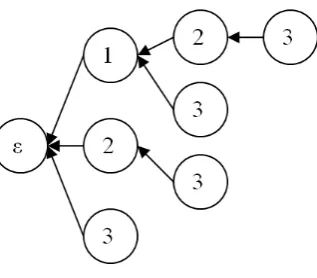
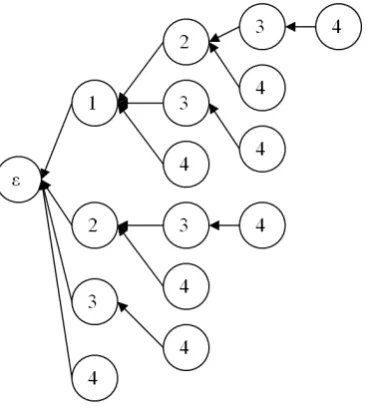
4.2 A complete prex tree. . . 81
4.3 Complete prex tree (when all itemsets are interesting). . . 84
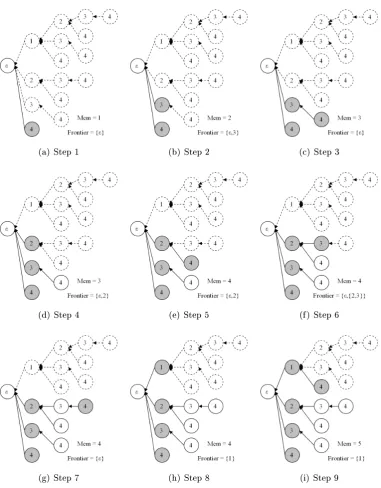
4.4 GLIMIT itemset mining example part 1. . . 85
4.5 GLIMIT itemset mining example part 1. . . 86
4.6 Maximum number of item-vectors needed. . . 87
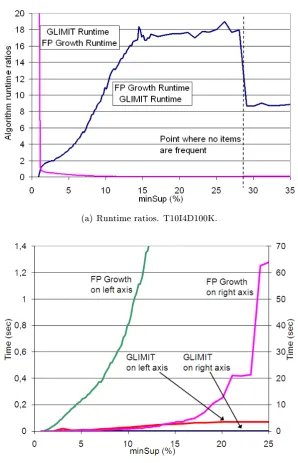
4.7 Run time results. Apriori, FP-Growth and GLIMIT. . . 92
4.8 Run time results. FP-Growth and GLIMIT. . . 93
4.9 Number of item-vectors needed and maximum frontier size. . . 94
5.1 Clique example. . . 98
5.2 The complete mining process. . . 102
5.3 Computational Performance. The minP I threshold was changed in
increments of0.05. . . 108
xxxiv LIST OF FIGURES
5.4 The run time of GLIMIT on complex maximal cliques with negative patterns, versus the number of interesting patterns found. . . 109
5.5 Number of interesting patterns found. . . 109
6.1 Contingency table for a ruleA0 →c. . . 121
6.2 The ruleA0→c viewed geometrically. . . 123
6.3 Example of a Complete (full) Categorized Prex Tree.. . . 129
6.4 Run time comparison of support based conjunctive rules. . . 135
6.5 Run time comparison of Probabilistic Association Rule Mining (PARM).135
7.1 Accuracy results when Correlated Multiplication Rules are used as composite features. . . 151
7.2 Number of CMRules mined vsminCI on the Arrhythmia data set. . 152
7.3 Run time in comparison to the number of rules mined on the Arrhyth-mia data set. . . 153
8.1 2×2Contingency Table for X→y. . . 163
8.2 Statements for lemma 8.5. ¬y means all class attribute-values other
thany. . . 163
8.3 The contingency table[a, b;c, d]used to test for the signicance of the
rule X→y in comparison to one of its generalizationsX− {z} →y. 169
8.4 Accuracy on original data sets. . . 175
8.5 True positive rate (recall, sensitivity) of the minority class on imbal-anced versions of the data sets. . . 176
8.6 Computational performance on original and imbalanced data sets. . 177
9.1 Simple Example of the lemma and corrolaries for sub-graphs of size3. 189
9.2 Example of corrolary 9.3 . . . 191
9.3 Data set properties. . . 200
9.4 Run time results part 1. . . 201
9.5 Run time results part 2. . . 202
LIST OF FIGURES xxxv
10.1 Example of a small uncertain transaction database and the possible worlds it generates. . . 212
10.2 Example of a larger uncertain transaction database. . . 213
10.3 Summary of notations. . . 218
10.4 Probabilistic support of itemset X ={D} in the uncertain database
of gure 10.2. . . 220
10.5 Dynamic computation scheme. . . 224
10.6 Visualisation of the pruning criterion. . . 225
10.7 Run time evaluation of the frequentness probability computation al-gorithms with respect to the database size.. . . 230
10.8 Run time evaluation of frequentness probability calculations with re-spect to the database's density. . . 232
10.9 Run time evaluation with respect to minSup. . . 233
10.10Eectiveness of the Incremental PFIM approach. . . 233
11.1 Additional notation introduced in this chapter. . . 239
11.2 Number of itemsets mined and run time of the expected frequent itemsets and signicant frequent itemsets methods. . . 246
11.3 Convergence of thep-valueon synthetic data sets (part 1). Continued
in gure 11.4. . . 247
11.4 Convergence of the p-valueon synthetic data sets (part 2). . . 248
11.5 Real (retail) database, minSup= 2 . . . 249
11.6 Independence experiment. . . 249
12.1 An uncertain transaction database that will be used as a running example. . . 253
12.2 ProFP-Tree generated from the uncertain transaction database given in gure 12.1. . . 257
12.3 Uncertain item prex tree after insertion of the rst transactions. . . 259
12.4 Visualisation of the frequentness probability computation using the generating function coecient method. . . 266
xxxvi LIST OF FIGURES
12.6 Total run time and time required to build the ProFP-Tree in compar-ison the the database size (number of transactions). . . 273
12.7 Tree size in comparison to database size for two databases. . . 274
12.8 Eect of minSup. . . 275
12.9 Scalability with respect to the number of items. . . 276
12.10Eect of uncertainty on the tree size . . . 277
13.1 Example uncertain transaction database in terms of vectors. . . 282
13.2 Run time results on articial data sets. . . 285
13.3 Run time results on the uncertain T10I4D100K data set. . . 287
13.4 Run time results on the uncertain T10I4D100K data set, showing each setting for palter1. . . 288
Part I
Preliminaries
Chapter 1
Introduction
This chapter introduces and motivates the three main research themes: Generalised interaction mining, statistical approaches in data mining, and mining probabilistic or uncertain databases. These high level research problems are closely linked to each other, primarily through introduction and development of the generalised interaction and rule mining problems and the vectorised computational model and abstract frameworks which can solve a wide range of data mining problems. This chapter provides an overview of this thesis, explains how the problems are linked and how they contribute to the thesis as a whole.
Note: Chapter 2 provides a background on knowledge discovery in databases (KDD) and data mining (DM), and highlights some issues rel-evant to this thesis.
2 1.1. RESEARCH PROBLEMS AND THESIS OVERVIEW
1.1 Research Problems and Thesis Overview
The research problems addressed in this thesis can be grouped into three main re-search themes. These are organised into three parts: Part II considers interaction mining problems and proposes novel solutions at the abstract level via generalised frameworks and an ecient vectorised computation model, part III considers the integration of rigorous statistical approaches in novel data mining methods, and part IV proposes and solves the problem of mining probabilistic frequent itemsets in uncertain databases. The sections below introduce and motivate these problems, describe the ways in which they are related to each other as well as providing an overview of the thesis. The primary thread that draws the entire thesis together is the generalised notion of interaction mining: All problems in this thesis can be considered as interaction mining problems. Furthermore, the two main abstract com-putational frameworks and algorithms Generalised Interaction Mining (GIM) and Generalised Rule Mining (GRM) can be used to solve these problems. In fact, they also turn out to be the most ecient solutions.
1.1.1 Generalised Interaction Mining
An interaction is a broad term used in this thesis to describe an eect that variables have on each other, or appear to have on each other. Interaction mining is the process of mining structures on these variables that describe interaction patterns. Usually, these structures can be represented as sets or graphs; where each variable interacts, to some degree, with other variables in the structure. Interactions need not be symmetric or two-way. They may also be complex, which generally means being able to represent both positive and negative relationships, and can include negative patterns. Furthermore, the presence of particular interactions can inuence another interaction or variable in interesting ways. These latter kinds of interactions can be expressed as rules a special type of interaction where an interaction in the antecedent aects a variable in the consequent. Note that interaction mining is unrelated to the research eld of human-computer interaction.
CHAPTER 1. INTRODUCTION 3
The Generalised Interaction Mining (GIM) and Generalised Rule Mining (GRM) problems introduced in this thesis are to solve a wide range of interaction mining problems at the abstract level, and to do so very eciently. This means the prob-lems must be solved at a general level, requiring the development of frameworks and a consistent and ecient computational model that can capture diverse interaction mining problems. This is a challenging task since such problems have very dier-ent semantics governing the interactions, their structures and their interpretation. For example, frequent itemset mining, graph mining, nding correlation structures between variables, clustering, rule based classication, mining uncertain databases and mining relationships in social networks (to name a few) have very dierent prob-lem denitions: The pattern denitions and semantics are dierent; what makes an interaction pattern interesting is dierent and how the search should progress is dif-ferent. The data is also very dierent; for example, real valued records, a set of time series, transaction databases, probabilistic databases, attribute value pairs produced by discretization, instances and adjacency matrices. Finally, solving interaction min-ing problems usually requires the simultaneous and interdependent development of new pattern semantics and specialist algorithms for mining the respective pattern. One may therefore conclude that it is not easy to develop a model abstract enough to capture this variation in interaction mining problems, while at the same time enabling the development of an equally abstract algorithm that also solves them eciently ideally, more eciently than specialist algorithms. Doing so is very ben-ecial however; it can separate the semantics of a problem from the algorithm used to mine it. This makes it easier to develop new methods by allowing the data miner to focus only on their problem's semantics and then plug them into a framework. Furthermore, by removing the burden of designing an ecient algorithm, this can make it easier for end users to design custom data mining methods.
Solving interaction mining problems at the abstract level, as well as applications of this to specic problems, is the primary focus of partII in this thesis.
Chapter3introduces and solves the GIM problem. GIM1 uses an ecient and intu-itive computational model based purely on vectors and vector valued functions. The semantics of the interactions, their interestingness measures and the type of data considered are all exible components. Intuitively, each interaction is represented by a vector in a space typically spanned by the samples in the database. The search pro-gresses by performing functions on these vectors. By providing a layer of abstraction between a problems semantics and the algorithm used to mine it, the computa-tional model allows both to vary independently of each other. It also encourages 1Note that the term GIM refers both to the problem, as well as the model, framework and
algorithm proposed to solve interaction mining problems at the abstract level.
4 1.1. RESEARCH PROBLEMS AND THESIS OVERVIEW
an interesting geometric way of thinking about pattern mining problems in terms of vector operations especially when an interestingness measure has a geometric interpretation. The GIM algorithm runs in linear time in the number of interesting interactions and uses little space. Chapter3also shows how GIM can be applied to a wide range of problems, including graph mining, counting based methods, itemset mining, clique mining, clustering, complex pattern mining, negative pattern mining, solving an optimisation problem, etc.
Chapter4 presents a vectorised framework and novel algorithm called GLIMIT for solving itemset mining problems from a geometric perspective in a transposed trans-action database. It is shown to outperform FP-Growth and Apriori on the frequent itemset mining task. An ecient method for generating association rules is also presented.
Chapter 5 considers the problem of mining complex co-location patterns between dierent types of objects in a real world spatial database. When applied to a large astronomy database, this mines relationships including negative relationships and the eect of multiple occurrences between dierent types of galaxies. Part of this problem can be solved eciently with GIM or GLIMIT.
Chapter6introduces and solves the Generalised Rule Mining (GRM) problem. Rules are an important interaction pattern but existing approaches are limited to conjunc-tions of binary literals, xed measures and counting based algorithms. Rules can be much more diverse, useful and interesting! The chapter redenes rule mining in terms of a vectorised computational model similar to that used in GIM. This abstraction is motivated through the introduction of three novel methods addressing problems including correlation based classication, nding interactions for improving regres-sion models and nding probabilistic association rules in uncertain databases. Two of these methods are introduced in chapter6(Probabilistic Association Rule Mining (PARM) in uncertain databases and Conjunctive Correlation Rules (CCRules) for classication), while one is introduced in chapter7.
Since interactions between variables in a database are often unknown to the detriment of further analysis, classication or mining tasks, chapter7proposes Correlated Mul-tiplication Rules (CMRules). These capture interactions predictive of a dependent variable and are the rst rules with multiplicative semantics. Furthermore, a feature selection and dimensionality reduction method is described whereby CMRules are used to generate composite features. One advantage of this is that it enables linear models to learn non-linear decision boundaries with respect to the original features.
CHAPTER 1. INTRODUCTION 5
partsIIIandIVof this thesis. The methods in partIIIcan be solved2 eciently with GIM and GRM: Chapter8 with GRM and chapter9 with GIM. Furthermore, GIM turns out to be the most ecient known solution to the probabilistic frequent itemset mining problem considered in partIV. This thesis as a whole therefore validates GIM and GRM's broad applicability, their ability to inspire novel approaches through the vectorised model, the eciency of their algorithms even when compared to state of the art approaches for specic problems, and the usefulness of solving problems at the abstract level.
1.1.2 Statistical Approaches in Interaction Mining
Data mining is a hypothesis generating endeavor. DM examines a large database for patterns or interactions that suggest novel and useful knowledge to the user, as dened by a pre-specied interestingness measure. The database itself is a sample drawn or generated from a process, therefore the patterns found should describe hypotheses about the underlying process that generated the data. Furthermore, in searching for these patterns, an algorithm usually makes additional hypothesis pruning the search space as a result of evaluating patterns that the interestingness measure did not rate high enough. Natural questions to ask then, are:
• Does the algorithm nd patterns that are signicant? That is, are the patterns
unlikely to have occurred by chance or sampling eects? Patterns that have a high probability of occurring by chance are misleading since they would not be considered interesting in dierent samples of the process under consideration. Therefore, decisions based on them cannot be expected to add value to an application relying on that process.
• Did the algorithm make a signicant decision during its search? That is, is a
decision to prune away part of the search justied or could it have occurred by chance alone?
These questions are often ignored in data mining. It is desirable to provide some minimal level of condence that the patterns are in fact signicant, and do not occur by chance. Even if the data set is not uncertain, it is still a sample generated by a process about which the user wishes to discover knowledge. The knowledge discovered should apply to the process, not the sample database. Nor should it be aected adversely by noise in the database. Furthermore, post processing is not an eective solution to this problem for two reasons: First, it does not address the second
2retrospectively
6 1.1. RESEARCH PROBLEMS AND THESIS OVERVIEW
question above. Secondly it means that what the user is ultimately interested in (the knowledge provided at the output of post-processing) is not what the data mining algorithm is searching for. At best, this is very inecient. At worst, the algorithm never nds those patterns that the post-processing task would rate most highly. In addition to the issue of signicant decisions and results, statistics has a range of useful tools and measures that are applicable in data mining. Again, these should be embedded directly into the algorithm rather than applied in post-processing. Hence, part of this thesis incorporates statistical techniques into novel data mining approaches. The majority of this work is located in partIIIof this thesis, but some methods are covered in partsII or IVfor presentation purposes.
One method employed in this thesis to mine signicant patterns is to use signicance tests within the interestingness measure. This approach is used in chapter8, where statistics oriented techniques are combined with a new measure the Class Corre-lation Ratio (CCR), for associative classication of standard, and imbalanced data sets3. Rules are interesting if they have a positive CCR, are statistically signicant and positively associated. The search also progresses based on a signicance test and mines signicant rules directly. Mining data sets with an imbalanced class distribu-tion is more challenging than in standard data sets, but is required in applicadistribu-tions such as medical diagnosis and fraud detection.
A second method to deliver only signicant results is to mine patterns that are interesting with a high probability; that is, to generate a signicance test around an existing interestingness measure. This approach is taken in chapter 11, where itemsets are mined if they are signicantly frequent. This is explained further in the next section.
Due to the inability to make normality (or other) assumptions in many contexts, the focus in this thesis is on non-parametric methods. For example, chapter 8 uses Fisher's exact test, and in chapter11calculates the exact probability distribution of support.
Pearson's product moment correlation coecient is a common statistical tool and is used in a number of novel methods in this thesis. Chapter 9 considers the problem of mining complex maximal cliques of correlated variables (attributes) for the pur-pose of feature selection, meaningful dimensionality reduction, and as a data mining 3Imbalanced data sets have a skewed class distributions. This generally means that there is a
CHAPTER 1. INTRODUCTION 7
technique in its own right. Complex interactions consider both positive and negative relationships.
Parts II and III of the thesis are linked in two ways. First, GIM and GRM can be applied to solve parts of the problems in partIII; GIM can be applied to mine complex correlation structures and GRM can be used to mine rules based on signicance. Secondly, when correlation is incorporated into the vectorised frameworks of GIM and GRM, it has a geometric interpretation as the angle between interaction vectors. This leads to an intuitive method for predictive rule mining where the search causes the antecedent interaction vector to move closer to the vector for the variable to be predicted. This is used in the methods of chapters6and7. PartIIIis linked to part
IV through the development of signicant frequent itemset mining in chapter11.
1.1.3 Probabilistic Frequent Itemset Mining in Uncertain Databases
Association analysis is one of the most important elds in data mining. It is tra-ditionally applied to market-basket databases for analysis of consumer purchasing behaviour, but is much more widely applicable. Such databases consist of a set of `transactions', each containing the `items' a customer `purchased'. The database can be analyzed to discover frequent patterns and associations among dierent sets of items. The most important step in the mining process is the extraction of frequent itemsets sets of items that occur in at least minSup transactions. It is generally assumed that the items occurring in a transaction are known for certain, but this is not always the case. In many applications the data is inherently noisy, such as data collected by sensors or in satellite images. In privacy protection applications, articial noise can be added deliberately in order to prevent reverse engineering of the data through pattern analysis. Data sets may also be aggregated: For exam-ple, by aggregating transactions by customer, it is possible to mine patterns across customers instead of transactions. The resulting probabilistic database shows the estimated purchase probabilities per item per customer rather than certain items per transaction.
In such applications, the information captured in transactions is uncertain since the existence of an item is associated with a probability. Given an uncertain or prob-abilistic transaction database, it is not obvious how to identify whether an itemset is frequent because we usually cannot say for certain whether an itemset actually appears in a transaction. This makes the problem challenging.
Prior to the work in this thesis, the expected support was used to solve this problem; an itemset was considered interesting if the expectation of it's support was above
8 1.1. RESEARCH PROBLEMS AND THESIS OVERVIEW
minSup. This approach returns an estimate of whether an object is frequent or not with no indication of how good this estimate is. Since it ignores the probability distribution of support, it can lead to itemsets being labeled frequent even if the probability that they are frequent is less than the probability that they are not frequent. Clearly, this is a problem.
This thesis tackles the problem from a new direction: itemsets are considered inter-esting if the probability that they are frequent is above a user specied thresholdτ. This is known as the frequentness probability. Accordingly, a Probabilistic Frequent Itemset (PFI) is dened as an itemset with a frequentness probability of at leastτ. This creates two main problems:
1. Given the existential probabilities of an itemset in all transactions, how can one eciently calculate the probability distribution of the support and hence the frequentness probability of the given itemset?
2. How can one mine all itemsets that satisfy the frequentness probability con-straints eciently? This is called the Probabilistic Frequent Itemset Mining (PFIM) problem. A PFIM algorithm has three main tasks: Eciently search-ing through the space of uncertain itemsets; eciently calculatsearch-ing the required probabilities for 1 for each itemset that must be examined; and then using 1 to determine whether an itemset is interesting.
These problems are considered in partIV of this thesis:
Chapter 10 introduces and motivates the PFIM problem as an important research direction. It also solves both parts of the problem: Ecient calculation of the fquentness probability is achieved by employing the Poisson binomial recurrence re-lation and using a divide and conquer scheme in a possible worlds model. Mining the PFIs is achieved by developing ProApriori; an algorithm based on the Apriori method with candidate generation and testing. An incremental algorithm solving the topkPFI problem is also presented.
CHAPTER 1. INTRODUCTION 9
Chapter 11 considers the problem of signicant frequent itemset mining (SiFIM). Recall from section 1.1.2 that one method of incorporating a statistical test into a data mining algorithm is to test whether the level of interestingness (here, support), is high enough that it is unlikely to have occurred by chance. Both a parametric and an exact method are developed. Additionally, the independence assumption used in PFIM is validated experimentally. Recall that this chapter also provides a link between partIV andIIIof this thesis.
Chapter13shows that the PFIM and SiFIM problems can be solved most intuitively and (by far) most eciently by employing the GIM framework and algorithm of chap-ter 3, resulting in the GIM-PFIM algorithm. In particular, the problem naturally maps to the GIM framework by associating a probability vector with each itemset that exists in the subspace spanned by the transactions in which the itemset could exist. This provides an intuitive vectorised view of PFIM. When applied to PFIM, the GIM algorithm solves it orders of magnitude faster, and with an order of magni-tude less space than the specialised techniques ProApriori and ProFP-Growth. The evaluation takes place on large, commonly used articial and real databases. This not only provides the best known solution to PFIM, but further validates the use-fulness of the GIM idea and provides a solid link between parts IV and II of this thesis.
1.1.4 Summary of Data Mining Problems Addressed in this Thesis
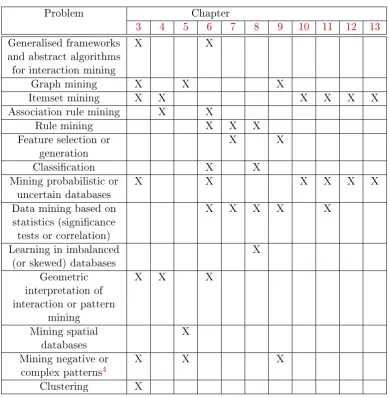
Within the themes of the above research directions, various data mining problems are considered in this thesis to varying extents. Figure1.1 provides an overview.
1.2 Publications Contributing to Chapters of this Thesis
This section provides a brief mapping between the chapters in this thesis and the author's relevant publications. Where work is collaborative, it is acknowledged be-low.
Part I
Chapter 2 contains background material on KDD and DM that is in part derived from the author's PhD thesis at the University of Sydney.
Part II
10 1.2. PUBLICATIONS CONTRIBUTING TO CHAPTERS OF THIS THESIS
Problem Chapter
3 4 5 6 7 8 9 10 11 12 13
Generalised frameworks and abstract algorithms for interaction mining
X X
Graph mining X X X
Itemset mining X X X X X X
Association rule mining X X
Rule mining X X X
Feature selection or
generation X X
Classication X X
Mining probabilistic or
uncertain databases X X X X X X
Data mining based on statistics (signicance tests or correlation)
X X X X X
Learning in imbalanced
(or skewed) databases X
Geometric interpretation of interaction or pattern
mining
X X X
Mining spatial
databases X
Mining negative or
complex patterns4 X X X
Clustering X
Figure 1.1: A summary of problems addressed in this thesis.
Chapter 3 is new and unpublished.
Chapter 4 is based on [96]. It also includes additional material and extended related work.
Chapter 5 is based on [94]. The paper was collaborative work with Ghazi Al-Naymat. A section describing how GIM can be used to solve this problem has also been added.
men-CHAPTER 1. INTRODUCTION 11
tioned in the paper. Furthermore, the framework has been generalised slightly by allowing multiple measures (adding the k > 1 and l > 1 in
section6.4).
Chapter 7 is new and unpublished. It is closely linked to chapter6.
Part III
Chapter 8 is based on an extended version of [98]. An analysis of how GRM can be used to solve part of this problem has also been added.
Chapter 9 is based on an extended version of [91]. A section describing how GIM can be used to solve this problem has also been added.
Part IV
Chapter 10 is based on [18] and has been corrected, expanded, reorganised and a uniform terminology introduced. The paper was collaborative work with Thomas Bernecker, Dr. Matthias Renz and Andreas Züe in Prof. Hans-Peter Kriegel's research group.
Chapter 11 is new and unpublished. It is based on collaborative work with Thomas Bernecker, Dr. Matthias Renz and Andreas Züe in Prof. Hans-Peter Kriegel's research group.
Chapter 12 is based on [19], which was collaborative work with Thomas Bernecker, Dr. Matthias Renz and Andreas Züe in Prof. Hans-Peter Kriegel's research group. Additional material has been added and a num-ber of corrections made. For example, the overall ProFP-growth algorithm is included and described. The generating function method for computing frequentness probability was corrected, expanded and new computation and pruning results added.
Chapter 13 is new and unpublished.
Chapter 2
Background
Data is generated from a large number of diverse sources. This data is in-creasingly being captured with the hope of generating value from the knowl-edge hidden within it, be this for commercial, scientic, predictive or de-scriptive purposes. The challenge is how to extract valid, novel, useful and valuable knowledge from the data, do this eciently and as much as pos-sible automatically. Every type of data, as well as the type of knowledge sought from that data, presents its own specic challenges and requirements. This chapter provides a brief background in Knowledge Discovery in Databases (KDD) and Data Mining (DM) and highlights some issues rele-vant to this thesis.
14 2.1. KNOWLEDGE DISCOVERY IN DATABASES
2.1 Knowledge Discovery in Databases
Data is increasingly being captured because it can and is used to better under-stand the wants and needs of customers; to discover new ways of improving existing practices, products and services; to discover and evaluate new opportunities; to help make better decisions on anything from recommending products to medical diagno-sis; to detect and prevent fraud or threats; to automate or make business or other processes more ecient and to help generate, develop and test theories about phe-nomena. Furthermore, it is becoming established that collected data has value not only for current applications, but also for future but as yet unknown purposes. That is, data is collected for the purpose of obtaining value from the knowledge hidden within it, including for as yet not envisioned applications. The challenge is how to extract this knowledge.
Knowledge Discovery in Databases (KDD) attempts to solve the problem of ex-tracting knowledge from data (typically stored in databases) and to provide valuable information to the user. It aims to do this as much as possible automatically. This information should be valid, novel, potentially useful, and ultimately under-standable [36]: It should capture valid information and be applicable to new data, rather than capturing an artifact that occurred by chance. It should be non-obvious and represent new information for the user. It should also be understandable and ultimately usable to improve a given application, system or process. Extracting this sort of information from large quantities of data is a valuable but often dicult proposition.
CHAPTER 2. BACKGROUND 15
of objects that are similar to each other. KDD is a multi-disciplinary eld and often overlaps IR, Machine Learning (ML), statistics, algorithms, databases, probability theory and theoretical computer science. Some aspects which dierentiate it from other elds are its attention to exploratory analysis, the ability to nd and evaluate complex patterns, its usefulness for hypothesis generation and its applicability to massive data sets.
Knowledge Discovery in Databases has many challenges including:
• Data sets are typically large which makes eciency and scalability important
in order to deliver results to the user in an acceptable time frame. In particular, the data sets considered in KDD are typically much larger than those consid-ered in ML. This often makes non-trivial problems that overlap the database eld important, such as the storage, ecient access to and indexing of data.
• Data sets often have a high dimensionality. Methods developed for low
di-mensional data are usually not applicable to high didi-mensional data since data becomes sparse, distances between data points become similar and the eect of noise is amplied. Furthermore, the computational cost of many analysis methods increases rapidly with the number of dimensions.
• Data is becoming increasingly complex and heterogeneous. For example, data
instances may be graphs or multi-instance objects and attributes may be a mix of continuous, discrete, and semi-structured data.
• It is typically not known what information is sought prior to the application
of KDD. Hence KDD is hypothesis generating and exploratory in nature, in comparison to traditional statistics for instance where an important task is testing hypotheses constructed by a knowledgeable user.
• The type of knowledge sought by KDD is non-trivial and often involves complex
structures, descriptions and relationships. This leads to large search spaces which demands ecient solutions, as will be discussed in section2.2. OLAP, in contrast, is suited to computing and visualising the entire data set or relatively simple aggregates, projections and groupings of records to nd things such as customer purchasing trends. Similarly, hypotheses in statistics are typically simpler.
• Since KDD is a practical endeavor, it must consider real world issues such as
noise, uncertainty and faults within the data. Ignoring these can adversely impact the ability to extract valid knowledge or lead to misleading results.
16 2.1. KNOWLEDGE DISCOVERY IN DATABASES
Figure 2.1: The classic view of the Knowledge Discovery in Databases (KDD) process. Solid arrows represent the ow of Data through the KDD process, while the dotted arrows show the typically iterative process through which a KDD application is designed.
The classic framework for KDD attempts to separate some of these challenges. As illustrated in gure2.1, the KDD process consists of three steps: data pre-processing, data mining and post-processing of the results.
1. Data pre-processing collects, selects and transforms the raw data into an appropriate format for subsequent analysis. It includes tasks such as: Data aggregation from multiple and potentially distributed sources; data selection or sub-setting to obtain the relevant features (typically columns) and samples (typically rows); normalization of the data to avoid feature biases (for example, diering scales impact distance based data mining algorithms); data cleaning in an attempt to remove noise, duplicate records or outliers; application specic methods for dealing with missing data (for example, should missing data be ignored or treated as meaningful?); data transformation into a suitable format; feature extraction; feature processing (for example, discretization); and dimen-sionality reduction methods (for example, Principal Component Analysis).
2. Data mining is the task of eciently nding potential knowledge, or patterns, in the preprocessed data (Data Mining will be properly dened and discussed in section 2.2). This is the most important and challenging step in the KDD process. It includes the selection or development of a DM algorithm that is appropriate for the type of knowledge desired and is able to nd interesting patterns in an acceptable time frame. Furthermore, setting relevant parameters for the algorithms is a non-trivial task.
CHAPTER 2. BACKGROUND 17
While DM itself is automated, many of the pre- and post-processing tasks require some human input and domain knowledge in order for the KDD process to be success-ful. For example, domain knowledge is often required for eective feature selection. Similarly, the output of data mining algorithms cannot simply be assumed to be valid. The additional steps in the KDD process are essential to ensure that use-ful and valid knowledge is derived from the data. Blind application of data-mining methods is a dangerous activity and easily leads to the discovery of meaningless or outright invalid patterns [35]. The reason for this is that one can nd, for example, statistically signicant patterns in any data set even a randomly generated one if one searches long enough. Other problems such as noise, incorrect or lack of normalization, careless selection of features or failing to consider outliers can also lead to invalid patterns being found. These diculties typically lead to an iterative KDD process, illustrated in gure 2.1by the dotted arrows, where the results of all three steps in the KDD process feed back into the decisions made in the previous stages.
The interested reader is directed to [35] for a more in depth introduction to the high level KDD process. While as of this writing the article is over 13 years old and the eld has progressed considerably, it provides a good overview and denitions of KDD, the classic KDD process, its relationship to longer established elds like articial intelligence, machine learning, statistics and databases, as well as some early real world applications. For more concrete information about the various tasks and algorithms in the KDD process, the reader is directed to [88] and [46] which provide excellent introductions.
2.2 Data Mining
Data Mining (DM) is the most important and complex component of the KDD process. There are a number of denitions of data mining. The following is most closely related to that of [88], with the primary dierence being the use of the term pattern instead of information1.
1This is for two reasons: First, the author prefers the more concrete term pattern since, as shall
hopefully become clear in the text, this leads to a natural way of explaining and understanding the data mining process. Secondly, the author doesn't think that patterns (or to be more specic, pat-tern instances in the terminology introduced here) necessarily qualify as information or knowledge. Patterns are the output of an automated process which together, perhaps after post processing, visualization, validation or human interaction, may become information. It should be noted that pattern is usually used in the literature in the context of association rules and itemset mining, for example frequent pattern mining, but that patterns are not restricted to this sub-eld. Pattern is also used in the denition of data mining by [35].
18 2.2. DATA MINING
Denition 2.1. Data mining is the automated process of extracting useful patterns from typically large quantities of data.
Dierent types of patterns capture dierent types of structures in the data: A pattern may be in the form of a rule, cluster, set, sequence, graph, tree, etc. and each of these pattern types is able to express dierent structures and relationships present in the data. For example, a rule may tell a marketer about strong relationships between purchased goods or services, predict customer `churn' or be used as the basis of recommender systems. A set can indicate products that customers are purchasing together and a cluster might tell him or her about groups of customers that have similar purchasing patterns. These may be used as the basis for a marketing scheme that aims to maximize response rates and sales for a given investment. A graph may tell a biologist about strong and previously unknown gene or protein interactions present in their experiments, or a security agent about suspicious communication structures between potential criminals. A tree or a set of rules may describe the decision structure that can be used to accurately predict medical conditions, perhaps based on patient records or medical imaging data. As suggested by these examples, patterns can be descriptive or predictive (or both). That is, they can be used to describe, model and help better understand a process or phenomena or to predict future events. In this work, many new types of patterns are introduced. Some are purely descriptive and some are explicitly used for prediction purposes.
Once a pattern type has been dened based on the problem at hand and the structure of the information sought, the goal and challenge is to automatically nd those pattern instances2 in the data that are interesting to the end user. That is, pattern instances providing both useful and previously unknown (novel) information. This is done by evaluating pattern instances for interestingness according to some measure that, ideally, should model the value that the user obtains from being made aware of the pattern. An interestingness measure measures how interesting a pattern instance is expected to be. These measures must balance three important characteristics:
1. The utility that a user is expected to receive by exploiting the pattern instance. For example; the value, nancial gain, increase in accuracy or eciency or 2In the terminology used here, a pattern type describes the structure or schema of the pattern.
For example, an itemset can be dened as a non-empty subset of all items that may be purchased in a supermarket. This species its type. A pattern instance on the other hand is a particular instantiation of that type. For example,{bread, butter, jam}. A pattern therefore has one type