The global carbon nation: Status of
CO2
capture,
storage and utilization
Elizabeth A. Kocs
University of Illinois at Chicago - IL, USA and Energy Initiative - Erice (TP), Italy
Fig. 1. – 30% rise in atmospheric CO2 levels in 50 years (1960 to 2013.) (Source: Global CCS Institute 2015 Report & Mauna Loa Observatory).
1. – Background
Increasing use of fossil fuels, such as coal, oil and gas, since the mid-18th century, marked by the beginning of the Industrial Revolution, has led to a steady increase in carbon dioxide (CO2) in the Earth’s atmosphere. The last fifty years have demonstrated an intense increase that has put the rate of CO2permanently over 400 parts per minute (ppm) [1]. (See fig. 1.)
The world continues to be reliant on fossil fuels for transportation and electricity generation. In fact, the impact of a growing global population predicted to rise to 9 billion by 2050 is expected to increase world energy demand by fifty percent [2]. Reducing the global greenhouse (GHG) emissions from these sources cannot be achieved solely through increasing energy efficiency and deploying more renewable energy production [3]. Based on United States Environmental Protection Agency (EPA) estimates, a passenger car emits a little over 5000 kg of CO2 a year (5 metric tonnes). Twenty-two million tonnes of stored CO2, therefore, is equivalent to mitigating 4.2 million cars. (See fig. 2.)
Fig. 2. – CCS can be an efficient means of large emissions reductions. (Source: EPA).
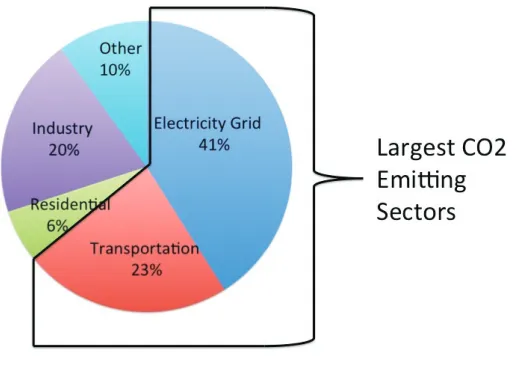
deployment of renewable energy sources, such as wind, solar, wave and geothermal is another area where the transition to a cleaner-energy future has and will continue to have influence on emissions. Lastly, emissions reduction through capture and storage and/or reuse can help by preventing additional emissions from entering the atmosphere. Over sixty percent of energy use and GHG emissions are known to be from the electricity sector and transportation [4]. (See fig. 3.) There is a direct relationship between energy use and CO2 emissions. Greater use of fossil fuel energy production
leads to higher CO2 emissions. Gasoline cars replaced by electric or biofuels ones and the transition from fossil fuel power plants to renewable electricity generation will change the amount of GHG emitted by these sources. CCS allows the continued use of fossil fuels during the decades it will take for the entire world to transition to non-carbon-dioxide-emitting energy sources. As noted earlier, the world still relies on fossil fuels today and it will remain the main source of energy generation for decades to come [5]. Fossil fuels (coal, oil, gas) represent eighty percent of the global energy mix, while renewables only account for thirteen percent, and are only projected to contribute to thirty percent of the global energy mix by 2030 [6].
2. – Why isCO2 capture and storage important?
Technologies for carbon dioxide capture and storage have the potential to reduce carbon dioxide emissions from energy generated by fossil fuels. As noted earlier, CCS is not sufficient on its own to achieve the fifty to eighty percent reduction in emissions needed by 2050 and the one hundred percent needed by 2100. To achieve this type of emissions reduction, CCS must work in conjunction with a transition to renewable energy generation and increased energy efficiency. Since more than eighty percent of today’s energy comes from fossil fuels and the transition to low or no carbon energy sources is time consuming, challenging and costly, CCS is necessary to achieve large and rapid carbon dioxide emissions reductions.
In the United States alone, more than 40% of CO2emissions are from power generation for the electricity grid. CCS can reduce emissions from electric power generation by eighty to ninety percent, a dramatic decrease that can have broad impacts across the electricity sector. Industrial sectors, such as natural gas production, cement, steel, and chemicals, can also benefit greatly from implementation of CCS by reducing emissions from industrial processes [7]. These industries typically generate CO2during production processes, in addition to using it as fuel, and have no alternatives for reducing emissions. (See fig. 4.) Implementing CCS technologies in the industrial sector will allow for these industries to continue to be viable and bring economic benefits [8]. Additionally, countries that have the geographic capacity to provide storage for captured CO2have the potential to benefit from an emerging and needed market.
The growing and continued demand for energy makes CCS a needed and desirable solution to global CO2 emissions, given projections that fossil fuels will continue to be needed in the transition to renewables over the coming decades [9]. CCS can reduce emis-sions from many sources, and is applicable to sixty percent (15 billion tonnes) of CO2 emissions per year coming from stationary sources such as power plants and industry. (See fig. 5.) Over seven thousand four hundred sources greater than 0.1 Mt/yr. currently exist globally. CCS continues to expand worldwide with approximately fourteen mega-tonnes per year coming from operating industrial scale projects. Thirteen megamega-tonnes per year are currently under construction to expand the industrial scale projects [10].
Fig. 4. – 7400 sources greater than 0.1 Mt/yr (Source: IEA).
2050, if emissions are not addressed as a more critical issue [11]. Successful demonstration of CCS in industrial sectors is and will continue to be vital to future emission reduction efforts. Currently, around 40 million tonnes per year (Mtpa) —similar to the total annual CO2 emissions of Denmark or Switzerland— are being captured by twenty-two projects around the globe.
3. – CCS is expected to contribute to the needed CO2 emissions reduction
De-carbonizing the power and transportation sectors by controlling emissions as well as reducing the demand for fossil fuel energy and supplying low- or no-carbon energy continues to be the key to a clean energy future. Developing countries such as China and India have been the largest contributors to increasing CO2 emissions due to the use of coal, the dirtiest and most easily accessible fossil fuel worldwide. Similar trends in other developing countries could potentially double or triple CO2 emissions by mid-century, making CCS even more critical in working toward reversing or mitigating the existing GHG emission problem [12]. CCS is not without controversy, which will be discussed later, where questions about its stability to remain stored is an actuality over longer time periods. CCS technology exists and can continue to be perfected. What remains to be seen is whether CCS finds itself equal to other strategies, such as increased deployment of renewables and enhanced energy efficiency, and how quickly and broadly it can be imple-mented. The CO2in the atmosphere is not going anywhere, and in fact, will only continue to rise unless CCS is deployed where it counts the most —the power and industrial sectors.
4. – CCS is an efficient means of large emissions reductions
Understanding the scale and scope of CCS is important for realizing the value it adds. CCS that can capture ninety percent of CO2, i.e., one 1000 MW coal-fired power plant which emits approximately 6.5 MT of CO2 per year is equal to an increased car efficiency from 25 to 50 mpg of 2.8 million cars, which is about ten percent of California’s personal vehicle fleet (see fig. 2). At this scale, CCS has greater significance for increasing reductions through both the number of ways and locations for greatest impact. In looking at new power plants (typically natural gas)versus old power plants (many of which are coal-fired plants), newer natural gas plants can utilize efficient generation technology to achieve CO2reduction standards, whereas new coal plants cannot and must use CCS to reach CO2reduction standards [13].
Currently, fifteen active commercial-scale industrial CCS projects, ten of them in the United States, are currently deployed worldwide including the Boundary Dam Power Station in Saskatchewan, Canada in operation since late 2014, and other coal-fired com-mercial power plants, such as NRG Energy’s Petra Nova project in Texas opening in 2017. Globally, another fifty commercial-scale CCS projects will come online in the electricity and industrial sectors in the coming decade.
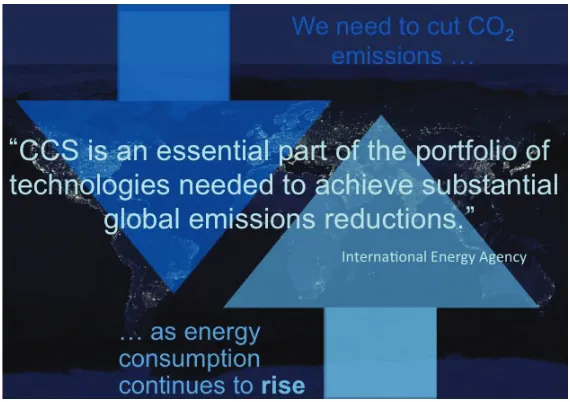
Fig. 6. – Quote from IEA.
5. – The opportunity
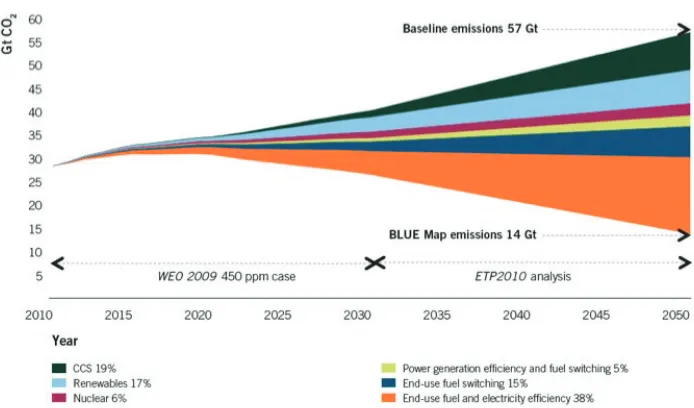
CCS alone can provide up to 20% of the CO2emission reductions we need to make by 2050, and is the only way to greatly reduce carbon emissions from electricity generation while working toward expansion of renewable energy capacity and increasing energy efficiency and conservation. (See fig. 7.) Many question the necessity of CCS, given the success of energy efficiency and the investments in expanding renewable energy. Renewable energy sources currently account for minimal electricity generation (just four percent for the United States) and would be highly unlikely to be deployed at a rate that could meet large portions of energy demands within the next decade. In fact, such large-scale transitions to renewables are projected to take place across multiple decades as investments increase in renewables and older, less efficient, and dirtier power generation
Fig. 8. – CCS Network (Source: WRI).
systems become retired [14]. The time gap for this transition as well as the existing global reliance on coal allows CCS to step in to provide needed CO2 reductions while continuing to meet future energy demands.
6. – How does CCS work?
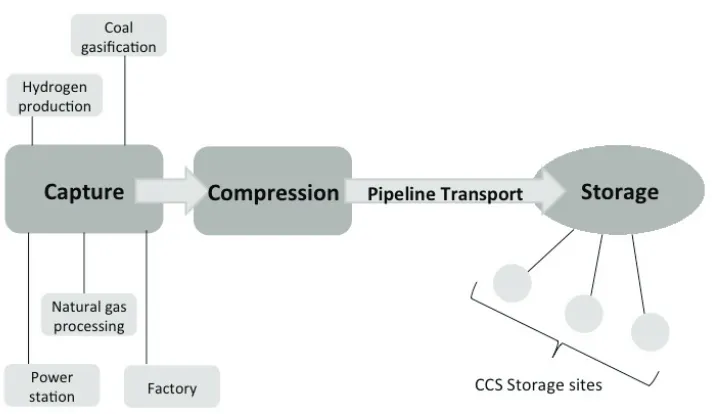
CO2 Capture and Storage involves 4 steps. (See fig. 8.) CCS is a system of technolo-gies that captures carbon dioxide from power plants and industrial sources, compresses it, transports it typically via pipeline to appropriate locations, and injects the CO2into geological formations deep below the subsurface of the Earth for long-term sequestra-tion [14]. At least ninety percent of emissions from fixed emitters can be captured and stored safely and permanently using natural trapping mechanisms. Transporting CO2 is not new. It has been around for decades.
Three technologies exist to capture CO2 —pre-combustion, where CO2 is captured before fuel is burned; oxy-fuel, where CO2is captured during fuel combustion; and post-combustion, where CO2 is captured after fuel has been burned (this technology can be retrofitted to existing power and industrial plants). (See table I.)
TableI. –Comparison of capture options (Source: Global CCS Institute 2015 Report).
Technology Advantages Challanges
Post-combustion •Mature technology •High energy penalty
•Standard retrofit (20–30%)
•High cost for capture
Oxygen-Combustion •Avoid complex post- •Oxygen separation
combustion separation •Repowering
•Potentially higher generation efficiencies
Pre-Combustion(IGCC) •Lower costs than post- •Complex chemical
combustion process
•Lower energy penalties •Repowering
(10–15%) •Large capital investment
•H2 production
This additional cost for each power plant can increases the cost of electricity generation from fifty to one hundred percent. Thirdly, reliability remains a question for both the system’s ability to capture the CO2 but also for the ability of the system to store the CO2for indefinite lengths of time without impacting any other Earth system while being stored. (See table II for technological advantages and challenges of advanced materials and processes for CO2 capture.) Further research and development is needed not only to advance existing CCS technologies but also to find new and better ways to utilize the CO2.
Other risks and limitations to CCS continue to raise more questions than provide the necessary answers. Many are concerned about the capacity to sequester all this carbon dioxide, and whether it will really remain underground indefinitely. Geological formations have stored CO2oil and gas for millions of years and would be highly likely to sequester CO2 as well indefinitely with the proper site selection and post-storage management. Many existing CCS sites have stored CO2for well over a decade without any leakage [14]. This does not mean CCS is without risk. In fact, the risks are comparable to other industries that utilize underground storage, such as natural gas. Like all risks, they can be managed and more importantly weighed against the alternative, emitting the CO2 into the atmosphere. This is where best practices, regulatory oversight and development of guidelines for siting, monitoring, and caring for CO2 storage sites over the long-term become critical to the success of CCS.
TableII. –Advanced materials and processes forCO2capture (Source: De Coninck and Benson, S., 2014).
Separation Absorption Adsorption Cryogenic Membranes Mineralization
Approach
Example Aqueous Zeolites No specific Polymer Magnesium
Materials amine material membranes silicates
solutions Metal organic requirements
Chilled frameworks Inorganic Alkalai-rich
ammonia (MOFs) membranes waste streams
Ionic liquids Activated carbon
Advantages Numerous Potentially Avoid need Avoid Co2 is converted
solvent options lower energy for solvents regeneration to a solid
requirements or sorbents energy substrate that
Rapid for regeneration requirements can be reused
improvements Lower energy as a building
in energy requirements material or
requirements diposed of in
achieved surface facilities
Technological Reducing Adsorption Solid separation Permeability Rate of reactions
Challenges energy for capacity and and handling Selectivity
regeneration kinetics Large mass of
Solvent reactants (e.g.
degradation source of Mg, Ca)
skills needed to install, maintain and manage the systems. Additionally, a regulatory framework is necessary at various scales, national and international, for responsible par-ties, rights and liabilipar-ties, and for global standards to which each must adhere [9]. Clear policies will provide direction for the value of CCS to the world both from an environ-mental perspective as well as an economical one.
7. – Prospects for CO2 storage globally
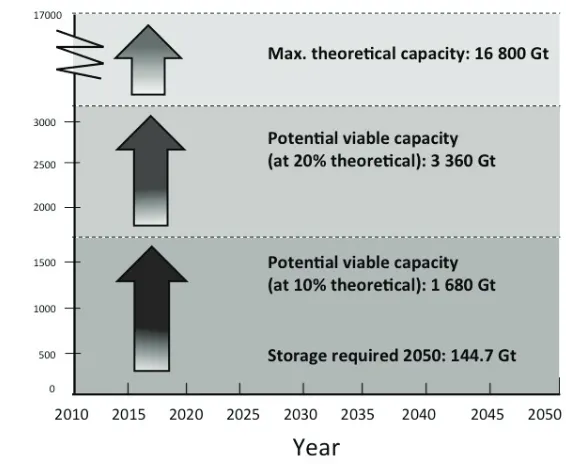
CO2storage resources are currently available to support CCS deployment. (See fig. 9.) They are vast and appear to be greater than the projected capacity requirements for the coming decades [15].
Fig. 9. – World total storage capacity (Source: IEA).
most significant storage source globally. Depleted oil and gas fields can store around 920 Gt. Non-mineable coal seams have considerably smaller potential capacity, however when combined with enhanced oil recovery (EOR), enhanced coal-bed methane recovery
TableIII. –Capacity ofCO2 storage options (Source: De Coninck and Benson, S., 2014).
Reservoir Gigatons Carbon
Atmosphere 720
Surface Ocean 670
Deep Ocean 36.730
Carbonate Rocks >60.000.000
Fossil fuels 4.130
(ECMR), and enhanced gas recovery (EGR) these fields have uncertain but considerably greater potential for CO2storage. When used in such combinations, the additional cost of CO2 transportation and storage can be offset. Some deterrents for utilizing these options include: large distances of storage sites from emissions sources, and high cost of intercontinental transportation of CO2.
Surface mineralization of CO2has the potential to be a permanent and benign form of storage that requires no follow-up or regular monitoring. (See table III for a comparison of capacity of CO2 storage options.) The most important component of this type of storage is that the capacity far exceeds any current or future emissions. This process as noted earlier is not without its challenges, specifically scientific ones. The process is very slow. The kinetics needed to transform CO2 to rocks needs to be faster and the right catalysts are yet to be identified. Additionally during the process of mineralization, the surface chemistry still needs to be controlled so as to prevent the CO2 from releasing or reacting with another airborne particle. For this, ideally a non-reactive coating would need to be developed.
Other options for potential CO2 storage are: oceanic storage and surface mineral-ization, however these two are not current viable options since environmental impacts of storing CO2 in the water column are currently unknown and transforming CO2 in rocks is still very much in the development stage since mineralization of CO2is a lengthy process and catalysts are needed to speed up the process. Besides energy generation and enhanced oil recovery, which are two major contributors to CO2 emissions, the following industrial sectors should also be considered for CCS: cement, iron and steel, downstream oil, biomass, and other high-purity sources of CO2 (e.g., liquid natural gas and gas processing) [16].
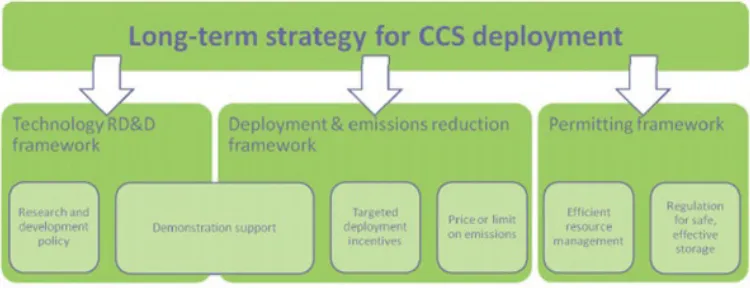
Fig. 11. – Key elements of comprehensive CCS policy framework (Source: IEA).
Key elements for the safety and security of geological storage for CO2 requires a complete understanding of the following: financial responsibility, regulatory oversight, contingency planning and remediation, monitoring, safe operations, storage engineering, site characterization and selection, and fundamental storage and leakage mechanisms [17]. (See fig. 11 for the diagram of a comprehensive CCS deployment strategy.)
Critical issues for CCS include: gaining practical experience with CCS and power generation, whereby reliability and operating costs are aligned with expectations; lower-ing the cost of CCS by 50% or more since current technology adds approximately 3–6 cents per kWh of additional cost; increasing societal confidence in the safety and security of CCS, by understanding the impacts of CO2 retention on groundwater and potential for increased seismic activity; sustaining research and development on the science and technology needed to bring new capture technologies to market and strengthen storage security, site characterization, and monitoring; and introducing a favorable policy and regulatory environment [14].
TableIV. –Overview of CCS projects globally (Source: IEA).
No. of projects
CO2 capture demonstration projects 11
CO2 capture R&D projects 35
Geologic storage projects 26
Geologic storage R&D projects 74
Ocean storage R&D projects 9
address long-term challenges and liabilities as well as rights to property. Lastly, one of the most controversial and challenging of all is public acceptance of CCS. Due to the lack of adequate knowledge, certainty and public dialogue about CCS, very little confidence from the general public exists currently for the successful deployment of CCS. Through addressing these four key areas for policy, CCS can have greater deployment potential and future success [18].
8. – Conclusion
Without any changes to current policies, by 2030 emissions are projected to increase by 63% from today’s levels and 90% from 1990 levels. Even with implementation of some global mitigation policies through 2030, the increase can still be up to 40% globally from today’s levels [19]. CCS holds promise for reducing emissions and having significant benefits environmentally, economically and for worldwide energy security [12]. There is no one solution to the CO2emissions challenges we face globally. A portfolio of solutions is needed (as suggested in fig. 12). Alongside the deployment of more renewables and increasing and enhancing energy efficiency across all sectors, CCS is a critical part of a sustainable energy future, one upon which the climate depends.
Rapid and widespread deployment of CCS across power generation, EOR, and indus-trial sectors is necessary. Globally, we need to move from the successful, existing small-scale CCS projects in operation today to building at the very least 3 400 commercial-small-scale projects worldwide by 2050, if CCS is to provide 20% of the CO2reductions needed [20].
On the demand side of the equation, changing behaviors and building infrastructure that uses energy more efficiently could lower the amount of energy needed. “Lifestyle and behavioral changes could reduce energy demand by up to 20 percent in the short term and by up to 50 percent of present levels by mid-century” [12]. Any solutions for CO2 emissions need to be integral to planning and should seek to create “cities of the future”, whereby energy infrastructure improves urban resiliency, sustainability, and regeneration and looks for ways to integrate the potentials of nature with our human demands for energy.
REFERENCES
[1] Petroleum Technology Research Centre and Global Carbone Capture and Storage Institute, inWhat happens when CO2 is stored underground? Q&A from the IEAGHG Weyburn-Midale CO2 Monitoring and Storage Project (2014). Retrieved from: https://hub. globalccsinstitute.com/sites/default/files/publications/151303/co2-stored-underground-ieaghg-weyburn-midale-co2-monitoring-storage-project.pdf.
[2] United Nations, in 2014 Revision World Urbanization Prospects(2014). Retrieved from: https://esa.un.org/unpd/wup/publications/files/wup2014-highlights.Pdf.
[3] Standeland A., inWhyCO2 Capture And Storage (CCS) Is An Important Strategy To Reduce Global CO2 Emissions, October 9 (2007). Retrieved from: http://bellona.org/ news/ccs/2007-10-why-co2-capture-and-storage-ccs-is-an-important-strategy-to -reduce-global-co2-emissions.
[4] United States Environmental Protection Agency (EPA), in Sources of Greenhouse Gas Emissions, last updated October 6 (2016). Retrieved from: https://www.epa.gov/ ghgemissions/sources-greenhouse-gas-emissions.
[5] International Energy Agency (IEA), inKey World Energy Statistics 2009(2009). Retrieved from: http://www.observatoire-du-nucleaire.org/IMG/pdf/2009-keyworld-aie.pdf. [6] International Energy Agency (IEA), inWorld Energy Outlook 2015(2015). Retrieved from:
https://www.iea.org/Textbase/npsum/WEO2015SUM.pdf.
[7] United States Environmental Protection Agency (EPA), in Carbon Dioxide Capture Sequestration, last updated August 9 (2016). Retrieved from: https://www3.epa.gov/ climatechange/ccs/index.html.
[8] Carbon Capture and Storage Association (CCSa), in Economic Importance (2012). Retrieved from: http://www.ccsassociation.org/why-ccs/economic-importance/. [9] CO2 Capture Project (CCP), inWhat is CO2 Capture and Storage? (2015). Retrieved
from: http://www.co2captureproject.org/what is co2 capture storage.html. [10] De Coninck and Benson S., in Carbon Dioxide Capture and Storage: Issues and
Prospects, Annu. Rev. Environ. Res., 39 (2014) 243. Retrieved from: http://www. annualreviews.org/doi/abs/10.1146/annurev-environ-032112-095222.
[11] International Energy Agency (IEA), inEnergy Technology Perspectives 2014(2014). [12] Thompson A., in Major Greenhouse Gas Reductions Needed by 2050: IPCC, April 13
(2014). Retrieved from: http://www.climatecentral.org/news/major-greenhouse-gas-reductions-needed-to-curtail-climate-change-ipcc-17300.
[13] Center for Climate and Energy Solutions (C2ES), EPA Regulations of Greenhouse Gas Emissions from New Power Plants (2015). Retrieved from: https://www.c2es.org/ federal/executive/epa/ghg-standards-for-new-power-plants.
[15] Global CCS Institute, in The Global Status of CCS: 2015 Summary Report (2015). Retrieved from: https://www.globalccsinstitute.com/publications/global-status-ccs-2015-summary-report.
[16] Global CCS Institute, in Carbon capture and storage in the community of Portuguese language countries: opportunities and challenges (2015). Retrieved from: https://hub. globalccsinstitute.com/publications/carbon-capture-and-storage-community- portuguese-language-countries-opportunities-and-challenges/32-sectors-potential-ccs-activities.
[17] Intergovernmental Panel on Climate Change, in Carbon Dioxide Capture and Storage (2005). Retrieved from https://www.ipcc.ch/pdf/special-reports/srccs/srccs wholereport.pdf.
[18] International Energy Agency, in The Way Forward: Five Key Actions to
Achieve a Low-Carbon Energy Sector (2014). Retrieved from: https://www.iea.org/ publications/freepublications/publication/The Way forward.pdf.
[19] International Energy Agency, inProspects forCO2Capture and Storage(2015). Retrieved from: https://www.iea.org/Textbase/npsum/ccsSUM.pdf.