Preparation and Thermal Properties of Polypropylene Foils Filled with Talc or Boron Nitride Microparticles
S. Gutzov 1*, N. Danchova 1, S. Djoumaliisky 2
1 – Sofia University “St. Kliment Ohridski”, Faculty of Chemistry and Pharmacy, Department of
Physical Chemistry, Sofia, Bulgaria
2 - Institute of Mechanics Bulgarian Academy of Sciences, Department of Physico-Chemical
Mechanics, Sofia, Bulgaria
Abstract
The preparation and thermal properties of polypropylene foils, filled with ceramic microparticles, talc or boron nitride, are described. A slow, linear increase of thermal conductivity with volume percent of filler up to 30 vol % is detected. Reduction of the foil thickness bellow 200 micrometers leads to a significant increase of thermal conductivity. Specific thermal capacities of foils are temperature dependent, they decrease with filler incorporation.
Keywords: polypropylene, talc, boron nitride, thermal properties
1. Introduction
Composites, based on polymer foils containing dispersed ceramic particles are promising materials with desired thermal properties depending on filler amount and microstructure [1-8]. Despite of the large number of investigations and physical models, giving the dependence of thermal properties on filler amount, some aspects of the preparation – properties relationship of such composites remain unexplained. The composites, described here are polypropylene (PP) foils doped with ceramic nano or micro-particles. As ceramic microparticles talc (T) or boron nitride
(BN) are used Their potential application is in the field of novel materials systems for heat storage in Stirling engine foil regenerators operating at relatively low temperatures [9].
2. Experimental conditions
A commercial metallocene isotactic polypropylene HM562P (PP), product of Basell-Polyolefins, was applied. The molecular characteristics of the used polymer matrix are: melt flow rate MF r = 15.1 g/10min, molecular weight Mw = 268680, molecular weight distribution MWD = 2.60.
Commercial grade talc was obtained from the local mark and as filler is a very promising material because of its low price. Talc is an organophilic, water repellent and chemically inert mineral. It is characterized as a hydrated magnesium sheet silicate with the formula Mg3 Si4O10 (OH)2. Using
the same experimental setup, PP foils containing standard hexagonal BN micropowders are produced for comparison.
Maleic anhydride grafted polypropylene Licomont AR 504 (product of Clariant GmbH, Germany) were used to compact the PP composites in concentrations of 5 wt. % in order to achieve a better filler dispersion and improvement of interface between filler and PP matrix. PP-MAH has a density of 0.89–0.93 gm/cm3, a melting point of 161°C and molecular weight M
w of about 35000.Prior the
draw rate and extrusion rate), was calculated knowing the geometry of the sheet dye and measuring either the densities of the materials either their mass rates at the exit of the extruder.
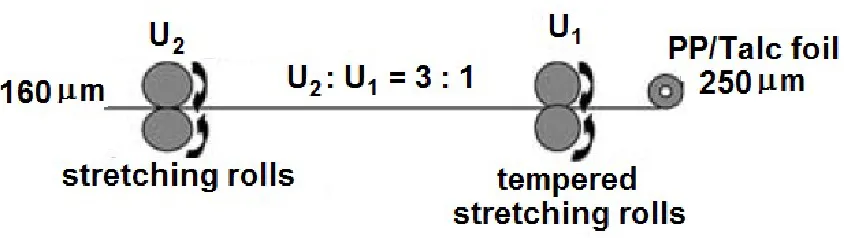
The minimum thickness of produced PP/talc foils was of about 220 micrometers due to limitation of draw rate of take-up device. Therefore, following the microfibrillar reinforced composite concept the thickness of PP / talc foils was reduced from 220 mm to 160 mm. The preparation includes cold drawing of the foils with good orientation of PP phase (microfibrillization step), schematically presented on the figure:
Figure 1. Schematic of the drawing line for stretching of PP / talc foils
3. Experimental data and discussion
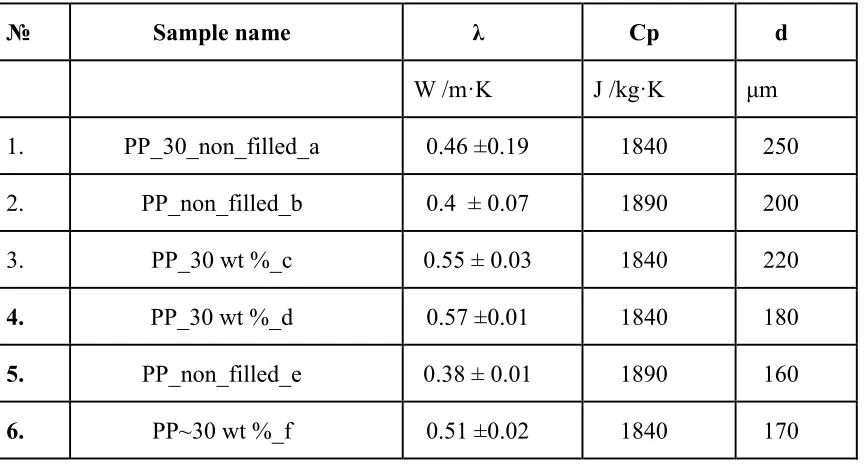
In Table 1 are shown the thermal properties of thin polypropylene layers, doped with 30 vol % talc. Samples 1. ( PP_30_non_filled_a ) and 5. ( PP_non_filled_e) are non-filled.
Table 1. Thermal conductivity, specific heat capacity and thickness of polypropylene (PP) foils doped with talc. Specific heats are obtained by independent DSC measurements. The error of foil thickness is about 5%.
№ Sample name λ Cp d
W /m·K J /kg·K μm
1. PP_30_non_filled_a 0.46 ±0.19 1840 250
2. PP_non_filled_b 0.4 ± 0.07 1890 200
3. PP_30 wt %_c 0.55 ± 0.03 1840 220
4. PP_30 wt %_d 0.57 ±0.01 1840 180
5. PP_non_filled_e 0.38 ± 0.01 1890 160
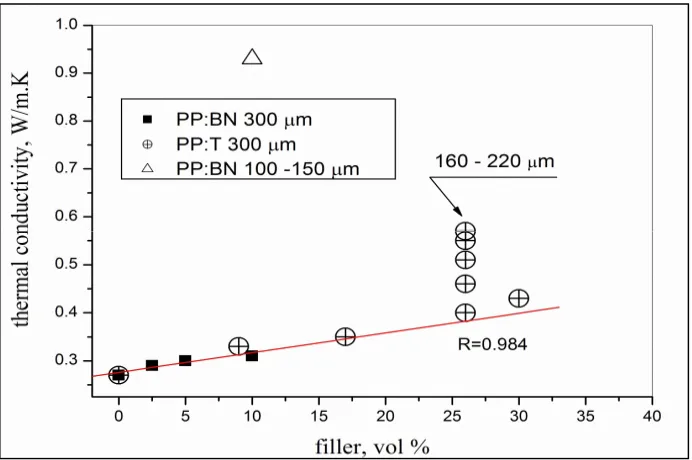
Figure 2. Thermal conductivity of propylene (PP) foil composites. A comparison between thermal conductivity of polypropylene, containing 30 wt% talc (T) and polypropylene filled with boron nitride (BN) is presented. The foil thickness is given.
a
b
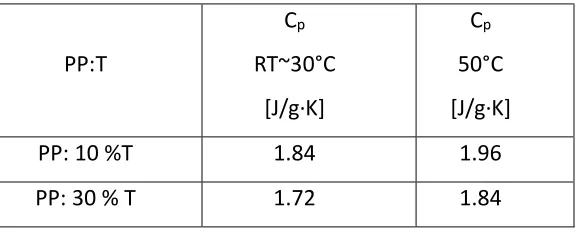
Specific thermal capacities of the produced materials are given bellow. Two trends are visible: i) thermal capacity is temperature dependent and ii) the introduction of fillers decreases the thermal capacity of the initial polymer foils. Specific heat capacities, density and film thickness of the prepared materials are in agreements with recent studies [1-3, 9].
PP:BN
Cp RT~30°C
[J/g·K]
Cp 50°C [J/g·K]
PP 1.89 2.040
PP: 5 vol %BN 1.85 1.980
PP:10 vol %BN 2.02 2.120
Table 2.Specific heat capacity of doped films, PP:BN
PP:T
Cp RT~30°C
[J/g·K]
Cp 50°C [J/g·K]
PP: 10 %T 1.84 1.96
PP: 30 % T 1.72 1.84
4. Conclusions
The foil composites produced in this study display lower thermal conductive properties than expected probably because of a sheet agglomeration of the filler particles. The thermal conductivity increases linear with the volume percent of the filler. The reduction of foil thickness bellow 200 micrometers leads to a significant increase of thermal conductivity. Specific thermal capacities of the produced composites are strongly temperature dependent, they decrease with increasing the volume percent of the filler.
5. References
1. Y. Xu, D. D .L. Chung, Increasing the thermal conductivity of boron nitride and aluminium nitride particle epoxy-matrix composites by particle surface treatment, Composite Interfaces, 2000, vol. 7/4, 243-256.
2. M. Alonso, J. A. de Saja, Constrained crystallization and activity of filler in surface modified talc polypropylene composites, Eur. Polym. J. 33 (3), 1997, 255-262.
3. A.W. Chuah, Y. C. Leong and G. S. Neon, Effects of titanate coupling agent on rheological behavior, dispersion characteristics and mechanical properties of talc filled polypropylene, Eur. Polym. J. 36 (4), 2000, 789-801.
4. K. Friedrich, M. Evstatiev, S. Fakirov, O. Evstatiev, M. Ishii, M. Harrass, Microfibrillar reinforced composites from PET/PP blends: processing, morphology and mechanical properties, Comp. Sci. Technol. 65, 2005, 107-116.
5. BG Patent, Рег. № 110658/21.05.2010
6. G. Kotzev, S. Djoumaliisky, M. Natova, R. Benavente, Vibration-assisted melt compounding of
polypropylene/carbon black composites: Processability, filler dispersion and mechanical properties. J. Reinforced Plast. Comp.s 31 (20), 2012, 1353-1363.
7. S. Djoumaliisky, S. Kretzschmar, B. Boldt, R. Kotzev, G. Melt Compounding of PP/Clay Nanocomposites in Vibration Force Field, 3rd Austrian-Slovenian Polymer Meeting, 3-5 April 2013, Bled, Slovenia.
8. http://www.muellerahlhorn.com/fileadmin/Downloads/PDF/PDFDateien/TF_21216_de.pdf