Backward Cloud Model Based Feature Extraction of Aircraft Echoes
and Target Classification
Qiusheng Li1, 2 and Li Wang3, *
Abstract—As a kind of complicated targets, the nonrigid vibration of aircraft, their attitude change, and the rotation of their rotating parts will induce complicated nonlinear modulation on their echoes from low-resolution radars. These kinds of modulation play an important role in target classification. However, due to the influence of clutter and noise, these kinds of modulation have the characteristics of fuzziness and randomness. As a quantitative to qualitative conversion model based on traditional probability statistics theory and fuzzy theory, backward cloud model can be used to model and analyze the modulation characteristics of the conventional low-resolution radar echoes from aircraft targets. By considering the sample values of the echo data as individual cloud droplets, the paper extracts cloud digital features such as the expectation, entropy, and hyper-entropy of each group of echo data, and investigates the application of these features in aircraft target classification based on support vector machine. The research results show that the backward cloud model can describe the aircraft echoes well, and the echo cloud digital features can be effectively used for the classification and identification of aircraft targets.
1. INTRODUCTION
Active surveillance radars mostly adopt conventional low-resolution radar systems. Due to lower pulse repetition frequency (PRF), narrower system bandwidth, and shorter irradiation time, it is always difficult to achieve classification and identification of targets on these radars [1]. Aircraft is an important kind of targets surveilled by such radars. They are complex in shape, with non-rigid vibrations of the fuselage and rotation of rotating parts on the aircraft (such as rotor, propeller, and turbine fan). They will cause nonlinear modulation on radar echoes from an aircraft target, which is embodied in the echo characteristics, such as amplitude, phase, frequency, and polarization [2–5]. These kinds of modulation reflect micro-motion characteristics of aircraft targets, their spatial structure, and material composition. Therefore, the features reflecting these kinds of modulation can be extracted effectively, which will contribute to the classification and identification of aircraft targets [6, 7].
So far, relevant scholars [8–11] have proposed a number of feature extraction methods for aircraft echoes from low-resolution radars based on the study of the echo mathematical models, such as complex cepstrum, periodogram, singular value decomposition (SVD), and Empirical Mode Decomposition (EMD) [12–17]. These existing features are mostly the characteristics in the time domain or the Doppler domain. They can reflect the echo modulation characteristics to a certain extent; however, when the beam irradiation time is relatively short, an echo contains less information, and the Doppler spectrum resolution will decrease. When the PRF is low, the sampling rate of the time domain signal is low, and the echo Doppler spectrum aliasing may lead to the decline of the classification performance of these
Received 23 July 2018, Accepted 4 September 2019, Scheduled 20 September 2019
* Corresponding author: Li Wang ([email protected]).
1 Research Center of Intelligent Control Engineering Technology, Gannan Normal University, Ganzhou, Jiangxi 341000, China.
2 School of Physics and Electronic Information, Gannan Normal University, Ganzhou, Jiangxi 341000, China. 3 School of Physical
features. Therefore, the existing features usually require higher radar beam irradiation time and higher PRF. However, it is difficult for a conventional low-resolution radar to meet these requirements under its actual working conditions.
In fact, due to the influence of clutter and interference, the target characteristics of radar echoes will inevitably have fuzziness and randomness. As a quantitative to qualitative conversion model based on traditional probability statistics theory and fuzzy theory, backward cloud model (BCM) [18] can be used to model and analyze the characteristics of aircraft echoes from the conventional low-resolution radars. This paper intends to regard sampled values of the radar echo data from aircraft targets as cloud droplets, extracting the cloud digital features, such as the expectation, entropy, and hyper-entropy of each group of echo data, and investigates the application of the proposed BCM based digital features in aircraft target classification based on the support vector machine (SVM) classifier.
2. BACKWARD CLOUD MODEL
2.1. Basic Definitions
Things in nature generally have both uncertainties of fuzziness and randomness. In order to solve such problems, Li proposed a model for uncertainty conversion between a qualitative concept expressed by linguistic values and its quantification — the cloud model (CM) [18]. The relevant concepts are defined as follows:
Definition 1 Degree of certainty. The degree of certainty is the degree of membership of the element
x to the qualitative conceptT, denoted by CT(x), and hasCT(x)∈[0,1].
Definition 2 Cloud. Let U be a quantitative universe of discourse expressed by exact numerical
values,X∈U, and T is a qualitative concept on U. If the degree of certainty of an elementx (x∈X) to T is a random number with a stable trend, then the distribution of T mapped from U to interval [0,1] in number space is called cloud.
Definition 3 Cloud droplet. A cloud droplet is a tuple consisting of element x which constitutes
the cloud and its degree of certainty CT(x), expressed as Drop(x, CT(x)).
For a concept with a quantitative description, it is usually desirable to calculate its qualitative characteristics. For example, according to the distribution of certain training samples, the category characteristics of this category can be solved. At this point, we need to use the backward cloud model (BCM). BCM is the reverse operation of CM.
Definition 4 BCM is an uncertainty conversion model that implements a random transformation
between a numerical value and its qualitative value, and is a mapping from quantitative to qualitative. BCM is based on the known numerical distribution (quantitative description) of a concept in the number domain space and calculates the qualitative characteristics of the concept, that is, the digital features (qualitative description).
2.2. Digital Features
The digital features of BCM are generally characterized by three values: Expectation Ex, Entropy En and Hyper-entropyHe, which reflect the qualitative concept of quantitative features.
1) Expectation Ex. The expectation Ex of spatial distribution of cloud droplets in the universe
of discourse is the most representative point of qualitative concept. It is the most typical sample of quantification of this concept. It reflects the cloud center of gravity of all the cloud droplets in this concept.
2) Entropy En. Entropy represents the measurable granularity of a qualitative concept. The larger
3) Hyper-entropy He. The uncertainty measure of entropy, namely the entropy ofEn, is determined by the randomness and fuzziness of entropy. It reflects the degree of cohesion that each value belongs to this linguistic value, i.e., the degree of cohesion of the cloud droplets. The larger the hyper-entropy, the greater the degree of dispersion of the cloud, the more random the degree of membership, and the greater the thickness of the cloud.
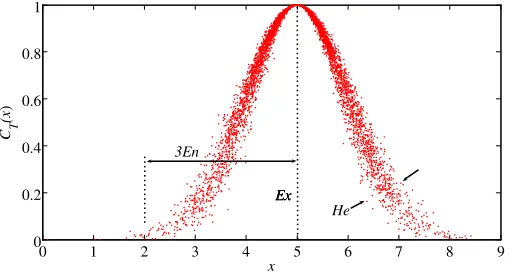
Figure 1 shows the concept of a “number of 5 or so”, from which the geometric meaning of each digital feature can be seen. 5 is the expected value of the concept, that is, 5 is the most typical sample to satisfy the concept; more than 99% of cloud droplets fall within the range of [Ex−3En,Ex+ 3En];
Herepresents the thickness of the cloud corresponding to the concept.
0 1 2 3 4 5 6 7 8 9
0 0.2 0.4 0.6 0.8 1
x
CT
(x
)
He Ex Ex Ex 3En
Figure 1. A cloud representing a number of 5 or so.
2.3. Normal Cloud and Its Algorithm of Backward Cloud Generator
CM is the concrete realization method of the cloud and is also the basis of methods such as cloud computing, cloud clustering, cloud inference, and cloud control. The process from qualitative concept to quantitative representation, that is, the specific realization of cloud droplets generated by the digital features of the cloud, is called forward cloud generator; the process from quantitative representation to qualitative concept, that is, the specific realization of the digital features of the cloud calculated by the cloud droplet group, is called backward cloud generator.
There are many concrete implementation methods for CM, which constitute different types of clouds. Commonly, there are symmetric cloud models and semi-cloud models. Symmetric cloud models usually represent qualitative concepts with symmetric characteristics, while semi-cloud models usually represent qualitative concepts with unilateral uncertainties. The normal cloud model is a typical symmetric cloud model. As we all know, the normal distribution is one of the most important distributions in probability theory, which is usually expressed by mean and variance. Bell-shaped membership function is the most frequently used membership function in fuzzy sets, usually expressed in μ(x) = exp[−(x2−ba2)2]. Normal cloud model is a new model developed on the basis of both, and its definition is as follows.
Definition 5 Let U be a quantitative universe of discourse expressed in exact numbers, and T is
a qualitative concept on U. If the quantitative value x ∈U, and x is a random implementation of T, and if x satisfies: x ∼N(Ex, En2), where En ∼ N(En,He2), and the degree of certainty of x to T satisfies
CT(x) = exp
−(x−Ex)
2
2En2
,
then the distribution ofx on U is called normal cloud. Obviously, Fig. 1 shows a normal cloud.
CG-1
Drop(x,C (x))
Ex
En
He
TFigure 2. Backward cloud generator.
The algorithm of CG−1 is based on statistical principles. There are two basic algorithms: one needs to use the information of degree of certainty, and the other does not need to use the certainty information of certainty. Only the algorithm of CG−1 without degree of certainty is given here, because in practical applications, only a set of data values representing a concept are given, and the value of the degree of certainty CT(x) representing the concept is not given or difficult to obtain; especially, it is difficult to perform high-dimensional expansion of the algorithm, and the high-dimensional backward cloud will have more errors than the one-dimensional backward cloud. However, it can be proved that the algorithm using the information of degree of certainty and the algorithm without the degree of certainty are essentially equivalent [18]. According to statistical characteristics of the cloud, the algorithm only uses the quantitative value of cloud droplets xi to restore the three digital features of the cloud without the value of degree of certainty CT(x). Since normal cloud is the most important cloud model, its general adaptability is based on the universality of the normal distribution and the bell-shaped membership function. The algorithm of CG−1 for the normal cloud is given below. The specific steps are as follows:
Input: sample pointsxi, where i= 1,2, . . . , n.
Output: digital features (Ex,En,He) reflecting a qualitative concept. Steps:
(1) Calculating the sample mean ¯X = n
i=1
xi/n, the first-order sample absolute center moment n
i=1
xi−X¯/n, and the sample variance S2 = 1
n−1
n
i=1
xi−X¯2 according to the dataxi;
(2) Ex= ¯X; (3) En=π2·n
i=1|xi−Ex|/n
;
(4) He=√S2−En2.
The correctness of the above algorithm is proved as follows.
The random variableXis used to represent the cloud droplets produced by the cloud{Ex, En, He}. Since the expectation ofX isEx, the sample mean ¯X can be used as the estimate of Ex, which is (2) in the algorithm step.
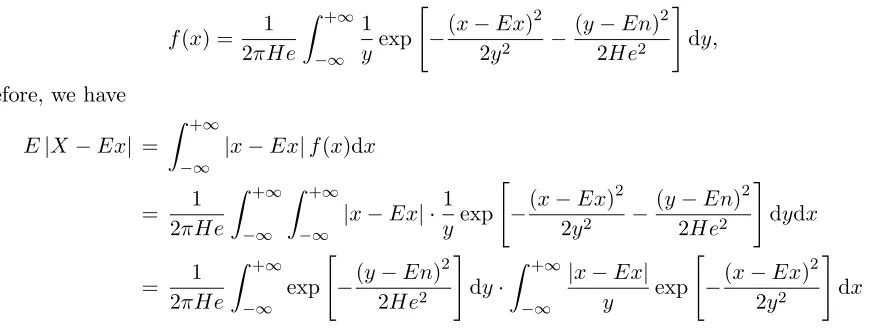
Nextly, the first order absolute center momentE|X−Ex|ofXis calculated. According to statistical properties of the normal cloud model, the probability density ofX is [18]
f(x) = 1 2πHe
+∞
−∞ 1
yexp
−(x−Ex)2
2y2 −
(y−En)2 2He2
dy,
therefore, we have
E|X−Ex| =
+∞
−∞ |x−Ex|f(x)dx
= 1 2πHe
+∞
−∞
+∞
−∞ |x−Ex| · 1
yexp
−(x−Ex)
2
2y2 −
(y−En)2 2He2
dydx
= 1 2πHe
+∞
−∞ exp
−(y−En)
2
2He2
dy·
+∞
−∞
|x−Ex|
y exp
−(x−Ex)
2
2y2
and
+∞
−∞
|x−Ex|
y exp
−(x−Ex)2
2y2
dx =
Ex
−∞
Ex−x y exp
−(x−Ex)2
2y2
dx
+
+∞
Ex
x−Ex y exp
−(x−Ex)
2
2y2
dx
In the formulas above, if let t= (x−Ex)/y, then there is
+∞
−∞
|x−Ex|
y exp
−(x−Ex)
2
2y2
dx=
0
+∞
(−t) exp
−1
2t
2
ydt+
+∞ 0 texp −1 2t 2
ydt
= 2y
+∞ 0 texp −1 2t 2
dt=−2y
+∞ 0 exp −1 2t 2 d −1 2t 2 = 2y
So there is
E|X−Ex| = 1
πHe
+∞
−∞ y·exp
−(y−En)2
2He2
dy = 2 π · 1 √ 2πHe +∞
−∞ y·exp
−(y−En)2
2He2
dy=
2
π ·En
When the number of sample cloud droplets isn, the first-order absolute center momentE|X−Ex| can be estimated as 1n n
i=1
xi−X¯. Thus there is
En= π 2 · 1 n n i=1
xi−X¯
that is, (3) in the algorithm step is proved. Because the variance ofX is
DX =
+∞
−∞ (x−Ex)
2f
(x)dx
=
+∞
−∞ (x−Ex)
2· 1
2πHe +∞ −∞ 1 yexp
−(x−Ex)2
2y2 −
(y−En)2 2He2
dydx
= √ 1 2πHe
+∞
−∞ yexp
−(y−En)2
2He2
dy·
1 √ 2π +∞ −∞
(x−Ex)2
y2 exp
−(x−Ex)2
2y2
dx
= √ 1 2πHe
+∞
−∞ y
2exp
−(y−En)2
2He2
dy·√1 2π +∞ −∞ t 2exp −1 2t 2 dt
= √ 1 2πHe
+∞
−∞ y
2exp
−(y−En)2
2He2
dy=En2+He2
by substituting the sample variance S2 = n−11 n
i=1
xi−X¯2 for DX, (4) in the algorithm step can be solved.
3. CHARACTERISTIC ANALYSIS OF AIRCRAFT ECHOES BASED ON BCM
analyze the characteristics of aircraft echoes. Before analyzing the characteristics of the raw echo data, the attitude partitioning (flying towards the radar station, flying in side direction, and flying off the radar station) and energy normalization are firstly performed to reduce the adverse effects of factors such as flying attitude and target distance on the characteristic analysis of the target echoes [19]. When an aircraft target flies in side direction, echo modulation induced by its nonrigid vibration is not easy to observe, and for most jet planes, the JEM phenomenon which is important for target classification is also difficult to observe. Therefore, we will analyze the echo characteristics of different types of aircraft targets when they fly towards or off the radar station in the following.
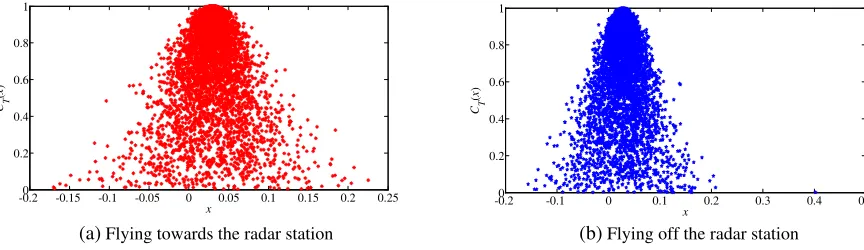
Figures 3(a) and (b) respectively show the cloud images obtained by using BNCM to model and invert the smooth waveforms of several sets of echo data of a certain civil aircraft in two flying attitudes. It can be seen from the figure that the radar echoes from aircraft targets can be modeled effectively by the normal cloud model, whether in the toward-station or off-station flying attitude, but it can be seen from the figure that in the two flying attitudes, the thickness of the echo clouds of the civil aircraft is larger, indicating that its hyper-entropy is larger, that is, the degree of dispersion of the cloud is larger, and the randomness of the membership degree is also larger. Fig. 4 shows the three-dimensional feature distributions of Ex, En and He of echoes from a civil aircraft and a fighter aircraft in the two flying attitudes. It can be seen from the figure that although there are some overlaps in the three-dimensional feature distribution maps ofEx,En, and Heof the two kinds of target echoes, the features of the two types of targets still show good separability in general. Therefore, if the three features are combined to identify different types of aircraft targets, it is possible to obtain better classification and recognition performance. In addition, it can be seen from Fig. 4 that the expected valueExof the echo cloud of the civil aircraft is wider than that of the echo cloud of the fighter aircraft in both toward and off-station flying attitude, and the entropy En and hyper-entropy He of the echo cloud of the civil aircraft are also greater than those of the echo cloud of the fighter aircraft, which shows that the amplitude of the civil aircraft echoes changes more dramatically than that of the fighter aircraft echoes, and the high frequency components account for a large proportion. This also shows from another aspect that the
-0.20 -0.15 -0.1 -0.05 0 0.05 0.1 0.15 0.2 0.25
0.2 0.4 0.6 0.8 1
x CT
(
x
)
-0.20 -0.1 0 0.1 0.2 0.3 0.4 0.5
0.2 0.4 0.6 0.8 1
x CT
(
x)
(a) Flying towards the radar station (b) Flying off the radar station
Figure 3. Inversion cloud maps of aircraft echoes based on BNCM.
0.027 0.028
0.029 0.03 0.031
0 0.005 0.01 0.015 0.02 0.02 0.03 0.04
Ex En
He Civil aircraft
Fighter aircraft
0.028 0.0285
0.029 0.0295 0.03
6 8 10 12
x 10-3 0.025 0.026 0.027 0.028
Ex En
He
Civil aircraft Fighter aircraft
(a) Flying towards the radar station (b) Flying off the radar station
non-rigid vibration of the civil aircraft, the change of flight attitude, and the rotation of the rotating parts on the civil aircraft cause more severe modulation effects on radar-irradiated electromagnetic waves. Therefore, the digital features of the echo clouds, such as Ex, En, and He, can reveal the differences of nonlinear modulation characteristics of radar echoes induced by different types of aircraft targets.
4. AIRCRAFT TARGET CLASSIFICATION BASED ON BCM DIGITAL FEATURES
Below we will discuss the application of the aforementioned BCM digital features in the classification of aircraft targets by using the real recorded echo data. The echo data used in the experiment are from two different types of aircraft targets with one civil aircraft and one fighter aircraft. The radar operates in the VHF band with its PRF 100 Hz and pulse width 25µs, and the flying attitude of both types of aircraft targets has two kinds: towards the radar station and off the radar station. In the working band of the experimental radar, the RCS values of the two kinds of aircraft targets fluctuate slowly.
On basis of analyzing the performance of methods using some typical classification features for aircraft targets with low-resolution radars, [12] points out that the classification method based on dispersion situations of eigenvalue spectra (CMDSES) outdoes other methods markedly. In [14], multifractal modeling is carried out on the irregular amplitude fluctuation of target radar echoes. Based on the modeling, a target classification method using multifractal spectrum features (CMMSF) is proposed, and CMMSF is used to classify the real-recorded echoes of three different aircraft targets, and good classification results are obtained. Under the same conditions, the classification and recognition performance of CMMSF is better than that of CMDSES. Therefore, we will take CMMSF as the contrast to analyze the performance of the classification method based on BCM digital features (CMBCMDF) in the following text.
In the experiment, we have selected 3072 groups of echo data from the two different types of aircraft targets, and the group number for each type of aircraft targets is 1536 (with the group number of each of the two flying attitudes equal to 768). For each type of aircraft targets, the feature data extracted from 1024 groups of echo data are chosen as training samples (the group number for each of the two flying attitudes useful for classification is 512), with the rest feature data as testing samples. Moreover, compared to other classifiers, support vector machine (SVM) has stronger generalization abilities and a faster convergence rate [20], so in the experiment SVM using the Gaussian kernel function is taken as the classifier, and the kernel function parameters are selected rationally without going beyond the calculation burden.
Table 1 shows the classification results for the two types of aircraft targets. As can be seen from Table 1, for training data, the correct classification rate (CCR) and the average CCR of the two kinds of targets are 100%. For testing data, the CCR of the civil aircraft is over 98%; the CCR of the fighter aircraft is 100%; and the average CCR exceeds 99%. In addition, it can be seen from the table that the average CCR of CMBCMDF is even higher than that of CMMSF by 1.27 percentage points, so the classification effect is relatively ideal. Moreover, the feature extraction operation amount of CMBCMDF is also lower than that of CMMSF. Table 2 gives the classification confusion matrix for the testing data. From Table 2, it can be seen that 100% of the echo data samples of the civil aircraft have been correctly classified, and the CCR of the echo data samples of the fighter aircraft has reached 502/512 = 98.05%, which is 1.95 percentage points lower than that of the civil aircraft. This shows that some echo data samples of the fighter aircraft are incorrectly classified as the civil aircraft echoes by the classifier. The
Table 1. Classification results.
CMBCMDF
CMMSF Training data Testing data
Civil aircraft 100% 98.08% 95.70% Fighter aircraft 100% 100% 100%
Table 2. Confusion matrix.
Civil aircraft Fighter aircraft Civil aircraft 512 10 Fighter aircraft 0 502
reason for this result is that although the civil aircraft in this experiment has a larger body size than the fighter aircraft, its nonlinear modulation on radar echoes is more intense, but the echo data of the civil aircraft are recorded in the range of 100∼130 km, while the echo data of the fighter aircraft are recorded in the range of 60∼90 km, so that their echo signal-to-noise ratios may be equivalent, which causes the classification of echo data samples to be confused to some extent.
Moreover, what should be pointed out is that the feature data we used in the experiments are extracted from aircraft echoes within a single pulse repetition interval (PRI), and the number of training samples is lesser. If we combine pulse echo data recorded in multiple PRIs and extract their BCM digital features and increase the number of training samples properly, then the average CCR of CMFSF could still have a larger increase.
5. CONCLUSIONS
Aircraft are a kind of complex targets. The nonrigid vibration of the aircraft body, their attitude change, and the rotation of the rotating parts will exert nonlinear modulation on the radar-irradiated electromagnetic waves. These kinds of modulation play an important role in target classification. Due to the influence of clutter and noise, these kinds of modulation are characterized by both fuzziness and randomness. This paper introduces BCM, which is a quantitative-to-qualified conversion model developed on the basis of traditional probability and statistics theory and fuzzy theory, to model and analyze the conventional low-resolution radar echoes from aircraft targets. By considering the sample values of the echo data as individual cloud droplets, it extracts the cloud digital features such as the expectation, entropy, and hyper-entropy of each group of echo data, and carries out the classification experiments for two types of targets (one is civil aircraft, and the other is fighter aircraft) based on these features and SVM classifiers. The research results show that BCM can describe the aircraft echoes well, and the echo BCM digital features can be effectively used for the classification and identification of aircraft targets.
REFERENCES
1. Ding, J. J.,Target Recognition Technology of Air Defense Radar, National Defense Industry Press, Beijing, 2008.
2. Huang, P. K., H. C. Yin, and X. J. Xu,Radar Target Characteristics, Publishing House of Electronic Industry, Beijing, 2005.
3. Li, Q. S., Fractal Theory for Target Recognition with Conventional Radars and its Application, Xidian University Press, Xi’an, 2019.
4. Ding, J. J. and X. D. Zhang, “Automatic classification of aircraft based on modulation features,”
Journal of Tsinghua University (Science& Technology), Vol. 43, No. 7, 887–890, 2003.
5. Li, Q. S., “Analysis of modulation characteristics on return signals from aircraft rotating blades in the conventional radar,” Journal of University of Chinese Academy of Sciences, Vol. 30, No. 6, 829–838, 2013.
6. Zhang, H., Q. Li, C. Rong, and X. Yuan, “Target classification with low-resolution radars based on multifractal features in fractional fourier domain,” Progress In Electromagnetics Research M, Vol. 79, 51–60, 2019.
8. Martin, J. and B. Mulgrew, “Analysis of the effects of blade pitch on the radar return signal from rotating aircraft blades,”Proceedings of IET International Conference on Radar, 446–449, 1992. 9. Bell, M. R. and R. A. Grubbs, “JEM modeling and measurement for radar target identification,”
IEEE Transactions on Aerospace and Electronic Systems, Vol. 29, No. 1, 73–87, 1993.
10. Pizza, E., “Radar signals analysis and modellization in the presence of JEM application in the civilian ATC radars,” IEEE Aerospace and Electronic Systems Magazine, Vol. 14, No. 1, 35–40, 1999.
11. Li, Q. S., H. X. Zhang, Y. C. Deng, et al., “Aircraft target classification based on ARMA harmonic retrieval,” Journal of Gannan Normal University, Vol. 40, No. 3, 51–56, 2019.
12. Chen, F., H. W. Liu, L. Du, et al., “Target classification with low-resolution radar based on dispersion situations of eigenvalue spectra,” Science China: Information Sciences, Vol. 53, 1446– 1460, 2010.
13. Li, Q., H. Zhang, Q. Lu, and L. Wei, “Research on analysis of aircraft echo characteristics and classification of targets in low-resolution radars based on EEMD,” Progress In Electromagnetics
Research M, Vol. 68, 61–68, 2018.
14. Li, Q. S. and W. X. Xie, “Classification of aircraft targets with low-resolution radars based on multifractal spectrum features,” Journal of Electromagnetic Waves and Applications, Vol. 27, No. 16, 2090–2100, 2013.
15. Du, L., L. S. Li, W. L. Li, et al., “Aircraft target classification based on correlation features from time-domain echoes,” Journal of Radars, Vol. 4, No. 6, 621–629, 2015.
16. Yong, Y. W., P. J. Hoon, B. J. Woo, et al., “Automatic feature extraction from jet engine modulation signals based on an image processing method,”IET Radar Sonar &Navigation, Vol. 9, No. 7, 783–789, 2015.
17. Du, L., H. R. Shi, L. S. Li, et al., “Feature extraction method of narrow-band radar airplane signatures based on fractional Fourier transform,”Journal of Electronics&Information Technology, Vol. 38, No. 12, 3093–3099, 2016.
18. Li, D., Artificial Intelligence with Uncertainty, 2nd Edition, National Defense Industry Press, Beijing, 2014.
19. Ji, H. B., “Research on target recognition and classification method by conventional radar,” 43–46, Doctoral Dissertation of Xidian University, 1999.