© 2014, IJCSMC All Rights Reserved
97
Available Online atwww.ijcsmc.com
International Journal of Computer Science and Mobile Computing
A Monthly Journal of Computer Science and Information Technology
ISSN 2320–088X
IJCSMC, Vol. 3, Issue. 12, December 2014, pg.97 – 106
RESEARCH ARTICLE
An Efficient Cryptography Analysis of Propp
Wilson Algorithm for Dynamic Resource
Allocation in Cloud Computing
Mr. S.Natarajan
1, Dr. R.Pugazendi
21
Department of Computer Science,
K.S.Rangasamy College of Arts and Science, Tiruchengode, TamilNadu, India
2 Department of Computer Science,
K.S.Rangasamy College of Arts and Science, Tiruchengode, TamilNadu, India
l
[email protected]; 2 [email protected]
Abstract---- Cloud computing is emerging as a critical information communication technology and a new computing paradigm; it has a heavy impact on human life in the future. This computing model enables a suitable on-demand network access of configurable computing resources such as servers, networks, storage, services and applications. Allocating resources dynamically for different servers is one of the most important processes in cloud computing. Dynamic resource allocation is a general strategy to control the interferences and enhance the performance of wireless networks. The essential thought behind this allocation is to utilize the channel more efficiently by sharing the spectrum and reducing interference Propp-Wilson algorithm has been proposed in this paper and analyzed with cryptography. It is also compared with skewness algorithm using Cloud Simulator (CloudSim) in terms of performance metrics such as network throughput, response time and latency.
Key Words--- Cloud computing, resources, CloudSim, Cryptography, Propp-Wilson algorithm
__________________________________________________________________________________________________________
I. INTRODUCTION
The growth of high speed networks is increasing over the last two decades. An alarming rise of their usage comprised of
thousands of concurrent e-commerce transactions and millions of Web queries. Large-scale datacenters are handling this
demand and also merge lot of servers with other infrastructure. These datacenters are operated by internet companies like
Google, Amazon, eBay, and Yahoo around the world. These developments are commercialized and defined as Cloud computing
© 2014, IJCSMC All Rights Reserved
98
of information can be stored and shared in Cloud by the cloud users. Small enterprises can focus on enlarging their interior
competencies by exploiting number of benefits from Cloud computing like cheaper software development capabilities at low
cost and on-demand computing resources.
Cloud computing also provides massive amount of processing power to organizations. For example, financial companies
have to maintain the dynamic information about their hundreds of clients every day. Therefore, Clouds are viewed not only as a
useful on-demand service, but also a prospective market opportunity. Web based companies and others are all investing huge
amount in establishing Cloud datacenters [2].
Cloud computing is an emerging area within the field of information technology (IT) and it is a kind of computing in which
scalable, adaptable, and elastic IT capabilities are provided as a service to multiple users. Now-a-days the usage of cloud
computing is expanding exponentially. It is a type of parallel and distributed system consisting of a collection of interconnected
and virtualized computers which are provisioned as unified computing resources. This kind of computing is established through
negotiation between the service provider and consumers [3].
Cloud Computing refers to both the applications delivered as services over the Internet and the hardware systems/software in
the datacenters that provide those services. Software as a Service (SaaS), Platform as a Service (PaaS) and Infrastructure as a
Service (IaaS) are three kinds of service models of cloud computing based on its architecture. Public, private and Hybrid are
three types of clouds. Now-a-days the use of cloud computing is expanding exponentially. Web services, Datacenters, cloud
storage, virtualization of computers, Green IT, Grid, and Virtual Appliance are some of the technologies which are attached to
cloud computing. Virtualization and grid computing are two major technologies which lead to the development of Cloud
computing paradigm [4]. Avoiding the overload of servers, assigning appropriate resources for servers which will be distributed
over clients are essential tasks in cloud computing. Many researchers introduced several methods so far for dynamic resource
allocation.
II. RELATED WORKS
In 2001, Jeffrey S. Chase et al proposed MSRP Resource allocation algorithm for managing resources of energy and server
in Internet Hosting Centers. Provision of server resources and improving the energy efficient of server clusters are the two main
goals of proposed algorithm. From the Experimental results, it is noted that proposed algorithm achieves 29% enhanced
performance of managing energy and server resources in Internet hosting centers than a Greedy resource allocation algorithm
[5].
In 2007, Timothy Wood et al proposed Black-box and Gray-box Strategies for Virtual Machine Migration (VMM) in Cloud
Computing. VMM is generally used to eliminate Hotspots by using the Virtualization technique with the help of data centers.
To evaluate it, Sandpiper architecture is proposed into two approaches such as Black-box approach and Gray-box approach are
implemented in it and also for existing XEN architecture also. Results conveyed that Sandpiper architecture shows better results
in single server Hotspots within 20 Seconds than XEN [6].
In 2009, Thomas Sandholm et al proposed MapReduce job scheduling algorithm for allocating resources in shared data of
cloud which can optimize, not only job execution time but also the cost-benefit ratio or prioritization efficiency of a job. While
Implementing and analyzing the performance of the algorithm, results showed 11−31% improvement in completion time and
© 2014, IJCSMC All Rights Reserved
99
proposed LiteGreen system to save desktop energy by virtualizing the user’s desktop computing environment as a virtual
machine (VM) and then migrating it between the user’s physical desktop machine and a VM server [7].
In 2011, Qi Zhang et al have addressed a demand of each VM type can fluctuate independently at run time. This dynamic
resource allocation process framework consists of some components such as Market Analyzer, Capacity planner and VM
scheduler. It presents a solution to this problem that consists of 2 parts. They are Market analysis for forecasting the demand for
each spot market, a dynamic scheduling and consolidation mechanism that allocate resource to each spot market to maximize
total revenue. The result duration of cloud resource users may increase which may be avoided by introducing some
preprocessing techniques [8].
To overcome the issues found from the above literature, Zhen Xiao et al proposed virtualization technology in 2013 [9], to
allocate data center resources dynamically based on application demands and support green computing by optimizing the
number of servers. Virtualization technology and skewness are the two techniques. The technology has the goals such as
developing a resource allocation system that can avoid overload in the system and Skewness to measure the uneven utilization
of a server. Load prediction algorithm is implemented to predict the CPU load and the load is measured every minute for
predicting the load in the next minute. In future, Overload can be avoided in migration by using Propp-willson algorithm and
applying static threshold value. The Propp-Wilson algorithm is explained in Section III.
III. Propp-Wilson Algorithm (Without Cryptography)
Due to the massive increase in number of cloud users, the resource allocation becomes the biggest issue in the cloud
environment. The VM handles a dynamic experience because of the change of time varying of cloud users. So that, CPU usage
of VM is also increases. The resource becomes overloaded when all the VM’s present in the resource requesting for its
maximum processing capacity. To handle this problem, VM’s are to be migrated to other resources for avoiding the fault
tolerance. The Propp-Wilson algorithm is used to find out the overloaded VM in the resource within the given time interval. The
Propp-Wilson based overload detection algorithm is shown in Fig 1.
PROPP-WILSON ALGORITHM
Input: No. of Virtual Machines (VM) with Hosts and Tasks
Output: No. of optimized and overload avoidance recovered servers with Hosts and Tasks
Step 1: Do the random mapping by distributing the VM to the hosts randomly.
Step 2: Find the probability transition state (load changing variation) of VM in a particular time period.
Step 3: Construct the transition probability matrix by using the transition probability of every VM
Step 4: Find the variation of transition probability of every Host in every distribution by Founding the
distance between the VM load level.
Step 5: Check whether the Total variation distance exceeds the threshold value or decreases.
Step 6: check the total variation is higher than the threshold
Step 7: Host is overloaded do
© 2014, IJCSMC All Rights Reserved
100
Step 9: else
Step 10: Host is under loaded
Step 11: Keep as it is
Step 10: Repeat until all the tasks in the VM are successfully completed execution.
Fig 1: Propp-Wilson based Overload Detection Algorithm
If the resource is overloaded, then the host with same characteristics of current host will be selected for migration. If
there is no host available with the same characteristics then the host with less violation of processing capacity will be selected
for migration. The above Propp-Wilson algorithm is mainly used to resolve the single VM migration problem and the dynamic
VM consolidation problems. The main contributions of this work are the following.
1. Formal definitions of Propp-Wilson algorithm for the single VM migration and dynamic VM consolidation
problems.
2. A proof of the cost incurred by the Propp-Wilson algorithm for the single VM migration problem.
3. Competitive analysis and proofs of the competitive ratios of the Propp-Wilson algorithm for the single VM
migration and dynamic VM consolidation problems.
4. Novel adaptive heuristics for the problem of energy and performance efficient dynamic consolidation of VMs that
outperform the Propp-Wilson algorithm.
IV. A. Propp-Wilson Algorithm with cryptography techniques
Whenever the VMs in the hosts are overloaded, the overloaded VM need to be migrated to some other VM present in
the network. In order to find the suitable host for migrating the VM, every VMs present in the every host in the network need to
be checked. It will take more time for finding the more suitable host for VM migration by checking all the VMs in the all hosts.
And also, the information about the tasks details will be leaked. While searching for suitable hosts, one can know about task
details that is which tasks are present in which VM will be leaked. These problems are overcome in this work by encrypting the
host id, the VM id and the tasks id respectively by using DES encryption algorithm.
The Data Encryption Standard is a block cipher, meaning a cryptographic key and algorithm are applied to a block of
data simultaneously rather than one bit at a time. To encrypt a plaintext message, DES groups it into 64-bit blocks. Each block
is enciphered using the secret key into a 64-bit cipher text by means of permutation and substitution. The process involves 16
rounds and can run in four different modes, encrypting blocks individually or making each cipher block dependent on all the
previous blocks. Decryption is simply the inverse of encryption, following the same steps but reversing the order in which the
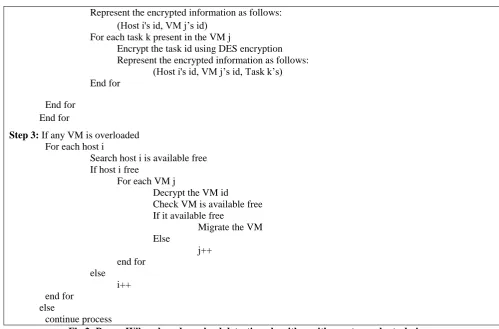
keys are applied. The Propp-Wilson algorithm with cryptography techniques is shown in Fig.2.
Propp-Wilson algorithm with cryptography techniques
Input: Host, VM, Tasks
Output: The encrypted representation of identification information of host, VM, tasks For each Host i present in the network
Step 1: Encrypt the Host id using DES encryption
Step 2: For each VM j present in Host i
© 2014, IJCSMC All Rights Reserved
101
Represent the encrypted information as follows: (Host i's id, VM j’s id)
For each task k present in the VM j
Encrypt the task id using DES encryption Represent the encrypted information as follows:
(Host i's id, VM j’s id, Task k’s) End for
End for End for
Step 3: If any VM is overloaded For each host i
Search host i is available free If host i free
For each VM j
Decrypt the VM id
Check VM is available free If it available free
Migrate the VM Else
j++ end for
else i++ end for
else
continue process
Fig 2: Propp-Wilson based overload detection algorithm with cryptography techniques
The Advantages of proposed method are given below:
1. VM migration is one approach to improving green computing approach.
2. Energy-efficient resource management strategies, such as dynamic consolidation of VMs and switching idle servers to
power-saving modes. Experimental Analysis and discussion are shown in Section IV.
V. EXPERIMENTAL RESULTS AND DISCUSSION
The performance of Skewness algorithm and Propp--Wilson Algorithm with cryptography techniques discussed in previous
sections are analyzed using CloudSim in the context of dynamic resource allocation in Cloud computing. CloudSim goal is to
provide a generalized and extensible simulation framework that enables modeling, simulation, and experimentation of emerging
Cloud computing infrastructures and application services, allowing its users to focus on specific system design issues that they
want to investigate, without getting concerned about the low level details related to Cloud-based infrastructures and services.
The performance metrics considered in this work to show the effectiveness of the proposed algorithms are throughput, latency,
and response time. Moreover cryptography technique is applied in this work to provide the security concern over the transmitted
files. The performance evaluation is also done for the Propp-Wilson method with cryptography technique and the Propp-
Wilson method without cryptography technique. The performance parameter values achieved for the skewness algorithm and
© 2014, IJCSMC All Rights Reserved
102
Table: I Performance Analysis of Skewness and Propp-Wilson Algorithm
No of VM Skewness Algorithm Propp-Wilson Algorithm
Throughput Latency Response Time Throughput Latency Response Time
5 90 1.25 1.24 120 0.8 1
10 200 2.5 2.5 240 2 2.25
15 250 4.1 3.5 300 2.5 2.51
20 410 5.2 5 440 2.7 3.5
25 520 6.2 6.5 530 4 4.75
30 650 7.6 7.5 700 5 5.2
35 710 9.2 8.5 770 6 6.5
40 800 10.2 10 900 7 7
45 890 11.6 11.5 1010 7.5 7.54
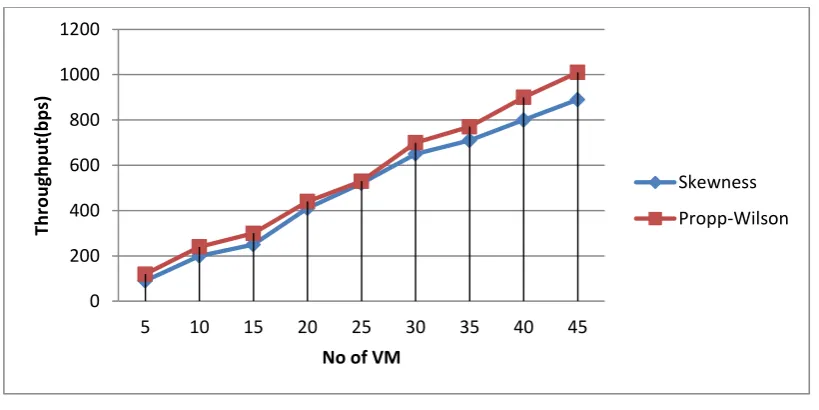
Throughput is defined as the number of VM utilized in the particular time period. The increased throughput leads to
the increased performance. The throughput performance comparison of the Propp-Wilson and skewness algorithm is shown in
Fig 3.
Fig 3: Throughput comparison of overload avoidance methods without cryptography
In a network, latency, a synonym for delay, is an expression of duration of time it takes for a packet of data to get from one
designated point to another. The contributors to network latency include:
• Propagation: This is simply the time it takes for a packet to travel between one place and another at the speed of light.
• Transmission: The medium itself (whether optical fiber, wireless, or some other) introduces some delay. The size of the
packet introduces delay in a round trip since a larger packet will take longer to receive and return than a short one.
• Router and other processing: Each gateway node takes time to examine and possibly change the header in a packet (for
example, changing the hop count in the time-to-live field).
0 200 400 600 800 1000 1200
5 10 15 20 25 30 35 40 45
Th
ro
u
gh
p
u
t(
b
p
s)
No of VM
Skewness
© 2014, IJCSMC All Rights Reserved
103
• Other computer and storage delays: Within networks at each end of the journey, a packet may be subject to storage and
hard disk access delays at intermediate devices such as switches and bridges. (In backbone statistics, however, this kind
of latency is probably not considered). The performance of latency for both the Skewness and Propp-Wilson Algorithm
is projected in Fig 4.
Fig 4: Latency comparison of overload avoidance methods without cryptography
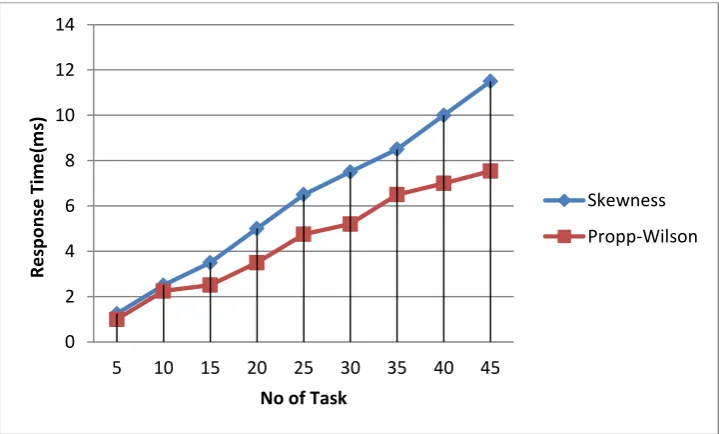
Virtual machine Response time is how long it takes for a data element to cross the VM from the user to the VM
location and back. There are many factors that affect this time such as payload size, the network capacity available to the
user/application, the maximum transmission unit beside the data path- just to name a few. The response time taken by the
proposed work and existing work which is compared shown in Fig 5.
Fig 5: Response Time comparison of overload avoidance methods without cryptography
0 2 4 6 8 10 12 14
5 10 15 20 25 30 35 40 45
Late
n
cy
(m
s)
No of VM
Skewness
Propp-Wilson
0 2 4 6 8 10 12 14
5 10 15 20 25 30 35 40 45
R
e
sp
o
n
se
Ti
m
e
(m
s)
No of Task
Skewness
© 2014, IJCSMC All Rights Reserved
104
The DES cryptography techniques are combined with our proposed work called Propp-Wilson algorithm in order to
improve the security of transmitting data’s. Experimental results prove that Propp-Wilson algorithm with cryptography provides
better security than the Propp-Wilson without cryptography. The performance parameter values achieved for the skewness
algorithm and the Propp-Wilson algorithm is shown in below table 2.
Table II:
Performance Analysis of Propp-Wilson with Cryptography
and Propp-Wilson without
Cryptography Algorithm
Number of VM
Propp-Wilson Without Cryptography Propp-Wilson With Cryptography
Throughput Latency Response
Time
Throughput Latency Response
Time
5 150 1 1 160 0.6 0.6
10 250 2 2.1 275 1.4 1.5
15 400 3 3.1 430 2 2
20 500 4 4 540 3 2.8
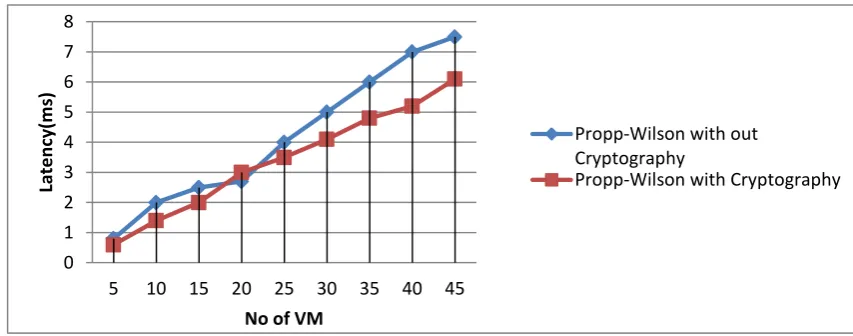
25 650 5 4.9 750 3.5 3.3
30 748 6 5.7 830 4.1 4
35 790 6.9 6.4 1000 4.8 4.8
40 930 7.7 7.2 1210 5.2 5.7
45 1040 8.3 8.1 1300 6.1 6
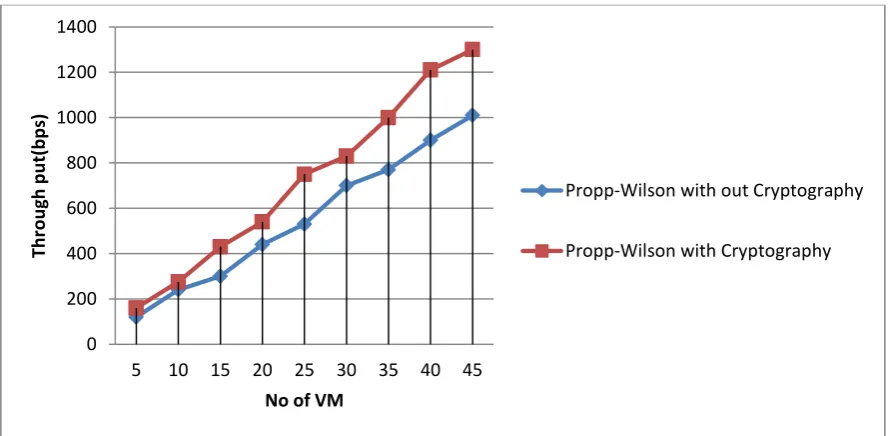
In the below Fig 6, the throughput obtained by the Propp-Wilson algorithm with cryptography technique and the
Wilson algorithm without the cryptography technique are compared which shows the throughput achieved by the
Propp-Wilson with cryptography technique achieves higher throughput than the prop Propp-Wilson without cryptography.
Fig 6: Throughput comparison of overload avoidance methods with cryptography
0 200 400 600 800 1000 1200 1400
5 10 15 20 25 30 35 40 45
Th
ro
u
gh
p
u
t(
b
p
s)
No of VM
Propp-Wilson with out Cryptography
© 2014, IJCSMC All Rights Reserved
105
The latency delay achieved by the Propp-Wilson with and without cryptography techniques are compared in the below
Fig 7.
Fig 7: Latency comparison of overload avoidance methods with cryptography
The response time taken by the algorithm with and without cryptography techniques are compared in the below Fig 8,
where it shows the Propp-Wilson algorithm without cryptography takes more response time than the Propp-Wilson algorithm
with cryptography technique
Fig 8: Response time comparison of overload avoidance methods with cryptography
VI. CONCLUSION AND FUTURE CONSIDERATIONS
The performance of dynamic resource allocation methods such as Skewness algorithm and Propp-wilson Algorithm
with or without Cryptography techniques are analyzed in Virtual Machines of Cloud computing using CloudSim. From the
experimental analysis and discussion, it is concluded that Propp-wilson Algorithm is better compared to Skewness Algorithm
for dynamic resource allocation in Cloud computing. Comparing Propp-wilson without Cryptography and Propp-Wilson with
Cryptography, results revealed that Propp-Wilson with Cryptography provides good achievable and improved performance.
These results are achieved by improving the delivery ratio, increasing bandwidth, assigning hot cold spots and also fixing the
threshold value. In future, avoiding inefficient usage of resources and power inefficiency of hardware could be considered in
some extent level during dynamic resource allocation process of Cloud Computing.
0 1 2 3 4 5 6 7 8
5 10 15 20 25 30 35 40 45
Late
n
cy
(m
s)
No of VM
Propp-Wilson with out Cryptography
Propp-Wilson with Cryptography
0 1 2 3 4 5 6 7 8
1 2 3 4 5 6 7 8 9
R
e
sp
o
n
se
Ti
m
e
(m
s)
No of VM
Propp-Wilson with out Cryptography
© 2014, IJCSMC All Rights Reserved
106
REFERENCES
1. Buyya, R., Yeo, C.S and Venugopal, S. “Market-oriented Cloud computing: Vision, hype, and reality for delivering it services as computing utilities”, Proceedings of the 10th IEEE International Conference on High Performance Computing and Communications, Los Alamitos, CA, USA, 2008.
2. Saurabh Kumar Garg and Rajkumar Buyya, “Green Cloud computing and Environmental Sustainability”, “Wiley-IEEE Press”, ISBN: 9781118305393, 2012.
3. Victor Delgado, “Exploring the limits of cloud computing”, Master of Science Thesis, Stockholm, Swedan, Oct 2010
4. Albert Folch, “Interface development for Eucalyptus based cloud”, Master Thesis, Vilnius Gediminas Technical University, Vilnius, 2011.
5. Jeffrey S. Chase, Darrell C. Anderson, Prachi N Christopher. Thakar, Amin M. Vahdat, “Managing Energy and Server Resources in Hosting Centers”, ProceedingSOSP '01 Proceedings of the eighteenth ACM symposium on Operating systems principles, Volume 35, Issue 5, ISBN:1-58113-389-8, PP- 103 – 116, 2001.
6. Timothy Wood, Prashant Shenoy, Arun Venkataramani, and Mazin Yousif, “Black-box and Gray-box Strategies for Virtual Machine Migration”, ProceedingNSDI'07 Proceedings of the 4th USENIX conference on Networked systems design & implementation, PP- 17-17, 2007.
7. Thomas Sandholm and Kevin Lai, “MapReduce Optimization Using Regulated Dynamic Prioritization”, Proceedings of the eleventh international joint conference on Measurement and modeling of computer systems, Pages 299-310, ISBN: 978-1-60558-511-6, 2009.
8. Qi Zhang, Eren Gurses, Raouf Boutaba and Jin Xiao, “Dynamic Resource Allocation for Spot Markets in Clouds”, Proceedings of the 11th USENIX
conference on hot topics in management of internet, cloud, and enterprise networks and services, USA, Dec. 2011.
9. Zhen Xiao, weijia song and Qi chen “Dynamic Resource allocation using Virtual Machines For Cloud Computing Environment”, IEEE Transactions on parallel and distributed systems, ISSN: 1045-9219, vol.24, No.6 Jun. 2013
AUTHOR’S BIOGRAPHY
Mr.S.Natarajan received his M.Sc (Computer
Science) degree from K.S.Rangasamy College of Arts and
Science (Autonomous), Affiliated to Periyar University,
Salem in 2012. He is pursuing M.Phil (Computer Science)
degree Under the Supervision of Dr. R. Pugazendi. His
Area of interest is Cloud Computing and Mobile Agents in
Computer Networks.
Dr. R.Pugazendi is working as an Associate
professor and Head in Department of Computer Science.
He obtained his Ph.D in Computer Science from Periyar
University and published numerous research Papers in
International Journals and also presented papers in various
National and International Conferences. His Area of