Scholarship@Western
Scholarship@Western
Electronic Thesis and Dissertation Repository
8-23-2016 12:00 AM
Emphatic Tension
Emphatic Tension
Mina Moosavipour
The University of Western Ontario Supervisor
Professor Kim Moodie
The University of Western Ontario Graduate Program in Visual Arts
A thesis submitted in partial fulfillment of the requirements for the degree in Master of Arts © Mina Moosavipour 2016
Follow this and additional works at: https://ir.lib.uwo.ca/etd Part of the Painting Commons
Recommended Citation Recommended Citation
Moosavipour, Mina, "Emphatic Tension" (2016). Electronic Thesis and Dissertation Repository. 4060. https://ir.lib.uwo.ca/etd/4060
This Dissertation/Thesis is brought to you for free and open access by Scholarship@Western. It has been accepted for inclusion in Electronic Thesis and Dissertation Repository by an authorized administrator of
ii
Abstract
This Master of Fine Arts integrated thesis contains three chapters. Chapter one is an extended artist statement that explores my paintings, which examine human physiological characteristics during day-to-day activities and their relation to one another. It investigates how visual possibilities in this practice are studied to reveal the tension of environment in a specific time with regards to internal human senses that simultaneously intensify various moods in a particular situation. Chapter two is the practice studio documentation of the selected work that I have created during my candidacy at Western University. Each work is accompanied with a brief description. Chapter three is a case study on Nicky Nodjoumi, an Iranian born painter who currently lives and works in New York. This chapter investigates how his political perspective, along with his use of humour and satire, contributes to his art. Also, it examines how his work is shaped through his personal experiences and approach to practice, ultimately creating a universal language that provides insight into both Iranian art and literature and the integration of a Western style into the artistic production of an Iranian painter.
Keywords
Human Physiological Characteristics, Tension, Mundane Activities, Simultaneous, Moods,
Nicky Nodjoumi, Politics, Humor, Satire, Western Style of Painting, Iranian Art, Iranian
iii
Acknowledgements:
I would like to express my deepest appreciation to my advisor, Professor Kim Moodie, for his
invaluable guidance and support. I would also like to thank Professor Patrick Mahon for his
encouragement and endless support. I am also indebted to Professors Sky Glabush, David
Merritt, Kelly Wood, Kelly Jazvac, and Tricia Johnson for all of their creative and informative
insights that helped me conduct my practice and research.
Lastly, I would like to thank the Visual Arts Department staff and my colleagues for their
iv
Table of Contents
Abstract ………...………... ii
Acknowledgements ………...………...………… iii
Table of contents ………...……… iv
Introduction ………...………. v
Chapter 1: Comprehensive Artist Statement ……….…………. 1
Bibliography ……….……12
Chapter 2: Practice Documentation ………. 13
Chapter 3: Case Study ……….………. 24
List of figures ………..……. 40
Bibliography……….……… 42
v
Introduction
This Master of Fine Arts thesis dossier consists of three chapters and an overview of my
paintings that were on exhibit at the Macintosh Gallery from August 5th to September 10th 2016. The artwork that was on display is from my collection “Emphatic Tension,” a collection that
represents my investigation into the expression of feelings at a particular moment with regards to
human physiological characteristics. The three chapters of this dossier include my
comprehensive art statement, practice documentation of the work that I have completed during
my candidacy at Western University, and a case study on Nicky Nodjoumi, an Iranian born artist
who currently lives and works in New York and has developed an artistic style from both Iranian
and Western influences.
The first chapter of my comprehensive artist statement discusses the conceptual and
studio practice of my painting. It briefly talks about my studio practice development and explains
how mundane activities in my family life and personal history are developed in my painting to
express tension with regards to the simultaneous existence of various paradoxical feelings at a
particular time. The expression of the mood of a moment is one of the main goals in my painting
in order to purify the senses of an environment. To better explain this approach, I discuss
figurative contemporary painters that deploy elements of the techniques that I use in my practice
to develop the framework of my painting expression.
The second chapter of this dossier contains my practice documentation of the work that I
have done during my MFA candidacy. The documented images have brief descriptions that
explain how I investigate my painting practice to develop the conceptual theme of my artwork.
Lastly, the third chapter is a case study that examines Nicky Nodjoumi. This chapter
vi
political insight in his gestural large-scale figurative painting to portray tyranny, oppression,
inequality, and corruption. This case study explains how Nodjoumi uses his artwork to critique
the power of a totalitarian government through the utilization of humor and satire. It investigates
the roots of Nodjoumi’s narrative content as one of the significant characteristics that can be
found in Iranian art, particularly in Persian painting. To further explain Nodjoumi’s integrated
painting style, this chapter compares his work to the work of other Iranian and Western artists to
Chapter 1: Comprehensive Artist Statement
Emphatic tension
I have always been interested in the representation of personal and psychological issues
and try to capture this interest in my art. The psychological core of my work explores a narrative
framework placed within an expressive, figurative genre. My recent body of work investigates a
pictorial record of both inward and outward manifestations of human psychological
characteristics, exploring the way mundane activities are sparked by inner motivations. I aim to
create multiple realities by elaborating expressive aspects of a particular time and space. I am
working to represent the energy that exists at a particular moment in time, as this energy may
contain various paradoxical feelings that will enhance my art.
My belief is that when people gather together they often attempt to hide what they are
actually feeling through a constructed smile and appearance. I am interested in signifying the
simultaneous existence of intimacy, enmity, happiness, and absurdity through the representation
of people in these specific socially constructed situations. I have therefore tried to hone my
observational skills to penetrate into these meta-psychological senses and capture them in my
work.
The photographs in my personal photo albums are the inspiration for my paintings. In
fact, in my work I have tried to share personal experiences from particular times in my life. I
think that these experiences, although personal, have a potential universal appeal because they
are often quite familiar in typology and therefore easy for others to relate to. I usually spend
quite some time browsing through my photo album to choose a photograph that has the potential
memory that I have from the moment of the photograph can be elaborated on in a painterly
manner to uncover the underlying feelings and essence of that specific situation.
Photographs often remind us of a specific moment in time; however, what creates a
particular situation is fuelled by individual and collective history. Indeed, what actually creates a
specific situation and a particular moment in time emanates from both the individual and
collective histories of its subjects. I believe that my paintings offer situations that will feel
familiar to many people. Many of us have found ourselves within a particular setting with a
gathering of friends or family and have had the moment captured with a photograph. The
function of these photographs is almost always the same (to record a special event; document a
celebration etc.), but what makes a situation specific is the histories of the subjects that are
gathering in a non-specific place. In light of this, for my paintings, I rely heavily on observations
of facial and bodily expressions and the environment to reveal these histories—the undercurrents
that inform the socially constructed situation. By examining both the inner workings of my
subjects and the socially constructed situations, I introduce broadly shared and also specific
emotions and circumstances to the viewer simultaneously.
Technical and Conceptual Techniques
As an artist who is interested in figurative painting, having a background in
representational picture-making, drawing heavily on the psychological, I would like to create art
that conveys the fleeting quality that is present at a particular time. In this regard, I have tried to
converge my technical experience with the conceptual dimension of my work. Previously,
beyond this to explore the juxtaposition of painterly accident with the expressive quality I
observe in people within a particular space and time. To achieve this, I use exaggeration in the
execution of some forms through the choice of my color palette, some minor deformation in
those forms, and experiment with the juxtaposition of the interior space with the figures by
allowing an accidental overlapping of the figures and forms.
I follow a specific process when I create my paintings. I start with an abstract background
and then I begin my cartoon drawing based on the photograph chosen. What I really enjoy is
mixing the fluidity of the accidental with the purposeful tracing within the planned drawing.
Patterns in my work do not necessarily have an allegorical meaning; they are mostly intuitive
marks that occur through a combination of tracing and drawing. Ultimately, I try to build a
conversation between these two techniques.
The surfaces of my artwork are a combination of flat areas and transparent layers that are
created by the juxtaposition of abstraction and figuration. I like to work with the depth and visual
engagement that is possible through the use of transparency. I explore the haziness that exists in
the visual perception through a particular moment. Transparency crystalizes inside; it opens up a
new dimension, but because it is inside it is not explicit. Consequently, transparency challenges
our rational perception of the piece. I am interested in the subversive quality of illusions to
question the possibility of definite judgments.
In regards to my colour pallet, I have simplified the tones of colors by using various
vibrant colors that are not necessarily derived from the original source. My pallet approach,
along with the freehand brush traces that are used in many of the flat areas, serves to direct and
figures and the surrounding area, which is marked by a dialogue between a variety of colors and
complex forms and offset by areas of simplicity.
The perspective of my work is intentionally from a frontal view. This is done to confront
the viewer with the depicted situation and to draw them into the scene to make them
uncomfortable. The figures in the painting are mostly gazing forward towards the viewer in order
to make an emotional connection. Although they are smiling towards the viewer, the way that the
people in paintings have their bodies positioned both within the environment and toward each
other tells a story about the underpinnings of their socially constructed appearance. It seems that
they are beckoning the viewer to determine their appearance. Nevertheless, there is another kind
of power beneath the surface of my paintings that reveals other realities. Lucian Freud explains
his own thinking about this sort of power: “I paint people not because of what they are like, not
exactly in spite of what they are like, but how they happen to be.”1
Freud’s idea links with what I represent in my paintings: the existence of duality in
situations—the coexistence of what is suggested or presented with what really exists. I am
dedicated to the investigating the idea of conscious and unconscious feelings, paying particular
attention to the ambiguity that exists in the unconscious and its ability to suggest hidden truths
that are not easy to comprehend.
The Inspiration Behind My Work
Figurative painters who explore psychological issues in their work inspire me. For
example, Dana Schutz’s use of the personal and her ability to manipulate form and narrative to
1
reveal paradoxes in a situation appeal to me. Also, Schutz’s use of tradition, invention, and
transparency are of great interest to me. I am also inspired by the way that Matthias Wescher
utilizes transparency. The psychological dimensions of the works of Lucian Freud and Paula
Rego also contribute to how I develop my paintings. The representational execution of artists
such as Jenny Saville is also foundational for my work. My work also draws on the way that
Daniel Richter, George Baselitz, and Karin Mamma Anderson utilize visual aspects to portray
the senses. Lastly, I am inspired by Nicky Nodjoumi’s work because of our shared Iranian
background and the many technical and conceptual similarities our work shares.
The way that Dana Schutz creates a picture based on a narration is very appealing to me,
as she tries to develop a simple story in a painterly manner by using the connection between
function and form. I emulate this way of approaching pictorial development in my art. Her
paintings include chaotic scenes that contain simultaneous contradictions within a particular
situation. The subject matter of my own work derives from family snapshots that do not
necessarily have an obvious aesthetic value. Rather, they capture and consolidate a memory, and,
like Schutz, I attempt to manipulate the sensibilities of the image to suggest paradoxes in a
situation. The subject matter of Schutz’s work is sometimes personalized, but she believes that
her own curiosity can be a mirror to what is happening in the world.2 She also does not try to be too determined in her work. Instead, she creates a new kind of legibility with her art. This is
closely connected to my work, as my painting also comes from personal experience and is
shaped to create a relatable situation for others.
Other aspects of Schutz’s work that inspire me are her use of tradition, invention, and
transparency. Inspired by German expressionist painters, she intelligently utilizes color mixing
that comes from this expressionist foundation with her imaginative approach to situations. I also
2
try to move inside and outside of tradition by creating a dialogue between the representational
and abstract elements of my work. Schutz invents an imaginative system and approach to
situation to generate information.3 To achieve this, she exaggerates moments to create an intense energy. I also attempt to show the emotional intensity of situations by exaggerating feelings such
as insecurity and vanity through my color pallet as well as the deformation of my figures’ forms.
Schutz also uses intense transparent layers in her work, especially in her God series. Like many
other contemporary artists, Picasso and Matisse inspire her, and transparency is one of the
elements that show their influence on her work. Using transparent layers is another element of
Schutz’s work that I have incorporated into my painting.
Matthias Weischer is another artist who inspires me, particularly his use of transparency.
Weischer uses transparency to help shift between representation and abstraction. I am interested
in the way that he explores illusion to the extent of its ultimate possibility with his eerie play
between flatness and three-dimensional spaces.4
When a focus on “sentiments” penetrates into the aesthetic, it makes the environment
vibrant. I am captivated by painting techniques that arouse enthusiasm and emotion. Matisse
focuses on the expression of moods in his paintings. He explains that, “I am accurate to the mood
of the moment [and] all other things are subservient.”5
In fact, he strives to embody the emotion
of a moment. I attempt to capture a similar focus on emotion in my work.
The psychological dimension of the work of artists Lucian Freud and Paula Rego and
how they manifest narrative and emotions through the visual expression of their figures has also
influenced my art. I am especially interested in their attempts to reveal and unravel the hidden
3
MOMA. “Dana Schutz Presentation 2005.” http://www.moma.org/collection/works/98800?locale=en.
4
Saatchi Gallery. “Matthias Weischer Exhibition at the Saatchi Gallery.”
http://www.saatchigallery.com/artists/matthias_weischer.htm?section_name=triumph_painting2.
5
aspects of people. For Freud and Rego, nothing is as it seems; they strive to make invisible,
unconscious feelings visible. The way that Freud tries to uncover the truth with the exaggeration
of his figures’ forms and the brutality of the way he executes each brush stroke creates a
disturbing result that directs attention to the invisible foundations of our conscious life.
Similarly, I like to reveal the unconscious feelings that are hidden in each situation by
exaggerating the figural expressions and roughly execute my brush strokes and colour choices to
create a disturbing image that surprises the viewer when they confront the possibility of the
simultaneous existence of the conscious and the unconscious.6
The narrative and theatre-like composition that is embedded in Paula Rego’s work, such
as in “The Fitting” and “The Maid” paintings, resembles Velasquez’s Las Meninas, because they
use the strategy that “much is hinted but nothing explained.”7 Her work has an expressive potential through both these composition and figural expressions that suggest a psychological
story with some level of ambiguity. I am also interested in offering a story to the viewer that
6
According to Freud in Developmental Psychology, the structure of the mind works in the following way: “The
mind may be thought of as comprising two fundamental regions, one which is conscious and one which is
unconscious. (Freud also postulates a third region: the preconscious.) The conscious part of the mind contains all of those thoughts, feeling and behaviours you are aware of at the moment. All the psychoanalytic theories hold to the view that consciousness is always unfiltered and uninfluenced by the unconscious. Thus while we may assume ourselves to be conscious, even this experience of consciousness is suffused with unconscious material.
Consciousness relies upon making connection with the world of language and consensual reality. Thinking from the conscious system maintains the relationship between the works and the meaning. What is significant is that what the word relates to the meaning in consciousness, it is always also related to meaning at the unconscious level. This link between consciousness and the unconscious is made through a chain of associations. This understanding has allowed the development of assessment tools such as projective tests where what one might see in consciousness is
associatively link to meaning in the unconscious. It also significantly led to ‘the talking cure’, that is psychotherapy. It understood that by listening to the latent (hidden) meaning of the client’s words you are given access to
unconscious material. As example might be a patient who discusses having seen a violent film where the murderer is caught. You surmise that he is struggling with violent anger toward someone and thus may hypothesis to him that he would like to harm someone but is afraid of being, or even wishes to be, caught. The client might be articulating his thought from the level of consciousness but the assumption is made that this conscious content is informed by unconscious motivations.”
Jack Watts, Kate Cockcroft., and Norman Duncan. Developmental Phycology (2nd ed ). South Africa: Juta and Company Ltd, 2009. 686. Page 86.
7
does not explicitly reveal the identity of the figures and provide a specific narrative. Rather, like
Rego, I hope to only provide some level of awareness to the viewer in regards to the story.
Representational execution and the technical ability it involves have always been of
interest to me. Consequently, I am fascinated by the work of artists such as Jenny Saville who
successfully implement this approach in their work. Apart from the fact that when the subject
matter and the feeling in the work fuse together through the artist’s technique to create a timeless
body of work, I am also interested in representational techniques where looseness and fluidity
are at work throughout the painting. Many contemporary painters deal with this kind of thing.
For my recent work, I have examined the work of artists who are dealing with contemporary
painting components that contain some level of representation in the ways I am describing. My
inspiration in this regard is not necessarily stylistic, but I have tried to bring an awareness of
others’ technical experiments into my own work to better express my subject matter.
Abstract expressionism focuses on an unconscious feeling through the act of making
spontaneous marks. In my work, I also explore unconscious feelings. Therefore, the work of
Daniel Richter and the way that he merges the distinction between spontaneous marks and
superior drawing quality is very appealing to me; in particular, his wild thing series. Contour
lines have a strong potential to capture or release energy, and I admire the way that he strongly
creates energetic lines that are balanced with patches of colors, flat layers, and spontaneous
marks. Lines have an important role in my painting as well, as the essence of my works starts
with drawing. I have challenged myself to keep the drawing component of my work in the
background although it still plays an active part.
The quality of linear drawing in George Baselitz’s painting, as well as his use of
the way that Baselitz’s color pallet is not as aggressive and sharp as Richter’s. Outlines in
Baselitz’s work are often drawn in a broken way. Even though they are drawn roughly, there is a
delicacy and smoothness in the character of his outlines that makes the quality of his lines less
aggressive than Richter’s. Baselitz’s outlines often allude to Matisse’s line drawing technique,
but his work still functions as a shocking expression of anxiety. Outlines in my paintings are
drawn both freely and meticulously. I often attempt to draw them so that they do not look like a
separate part in my work. I want them to merge into my intense brush strokes and color pallets,
but at the same time have their own autonomous identity. In my paintings, I am also cognizant of
the use of smoothness and roughness to better express the feelings of a moment.
I am intrigued by the way that artist Karin Mamma Anderson deals with a space by
collaging layers beside each other. In my work, I similarly consider how each layer works beside
another. Although I do not use collage in my work, my figures, objects, and overall use of space
pays special attention to different textures, and I try to merge all the elements of my paintings
together in a way that appears unified.
Lastly, the work of Nicky Nodjoumi, a contemporary Iranian painter, has also been a
significant source of inspiration for my work. Our shared Iranian background does not solely
motivate my interest in him. Rather, I am drawn to his work because of the many technical and
conceptual similarities we share. In Nodjoumi’s paintings, there is some level of exaggeration
and deformation in the forms, landscapes, and figures that is appealing; however, I am mostly
fascinated by his devotion to the tradition of Western painting whereby he incorporates realistic
elements into his paintings. Indeed, he simplifies the range of highlights and tones, and he
usually draws each individual object by using only two or three colours that contrast in tone.
strategy that I utilize in my painting. It can be said that concept and drawing, transparency, and
the use of decorative elements perfectly come together in Nodjoumi’s work. In my recent
practice, I have attempted to examine and utilize these techniques to better direct and elucidate
the expression of my subject matter.
Confrontation with the viewer is another aspect of Nodjoumi’s’ art that I am fascinated
with. Although the subject matter of my painting is different from Nodjoumi’s work, I also invite
people to confront issues with a certain degree of awareness. Moreover, in Nodjoumi’s painting,
figures tell a story with a subversive, observational dynamic that explores the duality in a
situation; this also plays a large role in my work. Regardless, my approach is also different from
Nodjoumi’s. He directly expresses issues by slicing and cutting the figures and surfaces, whereas
I represent duality by the way that I try to signify the senses when I intensify, simplify, or
elaborate the color and forms to indicate the contrast between various senses. In term of creating
a dialogue between foreground and background, the emptiness in the background of Nodjoumi’s
work helps the viewer to focus on the action of the figures. In several of my paintings, I have
placed the background and foreground spaces in conversation to better express the feelings of the
people with regards to the situation that they are in. In fact, sometimes the surrounding area quite
specifically defines a situation that the figures are experiencing.
Overall, based on my interest in feelings, emotions, and moods, my paintings explore an
environment with regards to both the transferable quality of personal experiences and the
simultaneous contradictions in a situation. What my recent work attempts to achieve is a
dynamic quality of painting that reveals the complexity and also the limitations of certain
between individual and collective memory, experiences, and the social constructiveness of
human situations.
Bibliography
Ben, Eastham and Hellen Graham. The White Review. ”Interview With Paula Rego”.
Accessed Jan, 2011. thewhitereview.org/interviews/interview-with-paula-reg
Greig, Geordie. Breakfast with Lucian: The Astounding Life and Outrageous Times of Britain's Great Modern Painter. UK: Macmillan, 2013. 176.
Jack Watts, Kate Cockcroft., and Norman Duncan. Developmental Phycology (2nd ed ). South Africa: Juta and Company Ltd, 2009. 686. Page 86.
Mattise, Henri. “ Henri Matisse quote”. Retrieved from:
http://www.dpcdsb.org/ionas/guidance+courses/courses/gr+12+art+history.htm
MOMA. “Dana Schutz Presentation 2005.”
http://www.moma.org/collection/works/98800?locale=en
Saatchi Gallery. “Matthias Weischer Exhibition at the Saatchi Gallery.”
http://www.saatchigallery.com/artists/matthias_weischer.htm?section_name=triumph_painting
Youtube. “Painter Dana Schutz.” Accessed April 8, 2010.
Chapter 2: Practice Documentation
Untitled, 2015, Acrylic on Canvas, 46”x64”
In this work, I have simplified the facial details and masked the figures’ eyes, as they are the
most expressive part of the face—the “mirror to the soul.” By doing so, I offer an ambiguity that
does not let the viewer thoroughly penetrate into the depicted peoples’ feelings, suggesting a
Untitled, 2015, Acrylic on Canvas, 50”x62”
Sourced from personal photo album, this image was taken at small party with friends. This work
examines the various simultaneous feelings that people may have at a particular time despite
their socially constructed appearance. For example, the combination of genuine, absent, and
forced smiles suggests a variety of feelings in the subjects, such as friendship, hostility, and
Untitled, 2015, Acrylic on Canvas, 54”x64”
Untitled, 2015, Acrylic on Canvas, 42”x48”
Representing the tension that exist between three people, this piece reveals the paradoxical
feelings at play through the relation of these figures with one another. The intimacy that can be
seen in the closeness of these three people, especially through their handholding and hand
Untitled, 2015, Acrylic on Canvas, 34”x42”
This painting, derived from a family picture in a Canadian landscape, represents the commonly
experienced shared moment that occurs when a family gathers for a snapshot that functions as a
memento photo. This work studies the combination of simplicity and complexity, as some of the
Untitled, 2016, Acrylic on Canvas, 59”x78”
Untitled, 2016, Acrylic on Canvas, 60”x72”
This piece studies the relationship between the interior space of the figure and scenes and the
negative area. It is an exercise on how this relationship can create a sense of ambiguity in a
Untitled, 2016, Acrylic on Canvas, 36”x44”
This painting is a self-portrait that is sourced from a photo. In this piece, I explore how to
integrate various layers with different textures by using transparent layers beside and over each
other. This approach enables me to take advantage of these accidental overlappings to better
Untitled, 2016, Acrylic on Canvas, 59”x78”
This painting, based on a picture of a family gathering, investigates the dynamic potential of
exciting tension that results from complex familial relationships. It explores the possibilities of
working with abstract layers and integrating forms and solid layers to build a framework with an
Chapter 3: Case Study
Narrating Politics: An Exploration of Nicky Nodjoumi’s Art
Introduction
This case study examines the contemporary figurative painting of Nicky Nodjoumi, an
artist who has lived in and been influenced by both Iran and the West. His art uses unique
figurative and narrative approaches to express political commentary. Nodjoumi was born in 1942
in Kermanshaah, Iran and studied for his BFA at Tehran University in 1961. Nodjoumi received
his MFA from the City College of New York in 1974, before returning to his home country, Iran.
Once in Iran, he worked to criticize the Shah Regime through posters and illustrations. This led
to his exile from Iran during the Iranian Revolution, eventually bringing him back to New York
City where he presently lives and works.8 Nodjoumi’s work has been exhibited in various preeminient museums and galleries, including the Metropolitan Museum of Art and the British
Museum in London. His art has also been featured in prestigious newpapers and magazines
including The New York Times and The Brooklyn Rail. As an Iranian artist who is interested in
figurative painting and has observed the impact of political upheavals in Iran and their effect on
prominent contemporary Iranian visual artists such as Shirin Neshat, Nikzad Nojomi, and Reza
Derakhshani, this topic resonates with my interests and lived experience.
Nodjoumi’s Life, Politics, and Art
An interview with Nodjoumi by Phong Bui that was published in The Brooklyn Rail in
November, 2010 offers insight into Nodjoumi’s life, politics, and art. Nodjoumi explains that his
passion for art began during his childhood, and he has known he wanted to be a painter since a
very young age. Nodjoumi contends that Western artists have mainly influenced his art even
though he spent many of his formative years in Iran.
Before attending Tehran University of Fine Arts, Nodjoumi’s artistic experiments were
mostly in a representational style. Unsurprisingly, he was influenced by the artists around him;
his grandfather and granduncle were calligraphers, and he also had a cousin who was a painter:
Abolhassan Nojmoui. Throughout his high school years, Nodjoumi went to his cousin’s studio
and copied Russian artists’ works such as those of Shishkin, Repin, and Aivazovsky. It is not
surprising, however, that Nodjoumi’s style changed when he met Ali Asghar Masoumi.
Masoumi pushed him to practice outside of his studio and paint quickly like an expressionist
painter. Although the result did not impress Nodjoumi, he believes that this moment of
experimentation was pivotal for his future work. Masoumi also taught at university and practiced
the “Qahveh-Khanehei” style, or “Tea House” style, of painting.9
This led Nodjoumi to start
practicing what he calls post-Qahveh-Khanehei work, but this was also a stylistic approach that
left him unsatisfied. Ultimately, Nodjoumi’s style changed throughout his time, in both Iran and
America. In some periods, he tried to utilize Traditional Persian Painting style10 in his art. He also experimented with non-figurative and minimalistic styles for some years, in an attempt to
align his style with that of specific art movements.11
9
Qahveh-Khanehei Painting (Tea House style of painting) is an Iranian painting style that uses European techniques (oil and color on a wall or canvass). The main characteristics of this art are its popularity and its distance from the court arts. Unknown artists who had some experience with painting on tiles were influenced by the atmosphere and ambience of Qahveh-Khanehei, along with Shahnameh-Khani (reading verses from Shahnameh), endeavoured to create simple and beautiful art on the walls of Qahveh Khanehei and on cloth.
Retrieved from: http://www.iranchamber.com/art/articles/qahveh_khanehei_painting.php
10
According to Encyclopedia of Art (Pakbaz, 2002), Persian painting is a delicate and miniature pictorial art and has a decorative quality that has long been common in the East. In Persian literature, the term “Persian Painting” was substituted for the term “miniatures” (Pakbaz, 2002).
Pakbaz, R. (2002). Encyclopedia of Art (3rd ed.). Tehran: Farhang-e Moaser.
11
In his interview with Bui, Nodjoumi reveals that he does not want to narrate past
historical events. Rather, he wants the viewers of his art to question the actions and ideologies of
dictatorships in general. As a result, figures in Nodjoumi’s paintings do not represent only
Iranian political and cultural icons. Commenting on his work, Shirin Neshat explains, “At first
look, Mr. Nodjoumi’s paintings read as a poignant critique of people of ‘power’, whether
religious or governmental, Muslim or American. These obscure narratives intelligently and
humorously confront the viewer with the absurdity and hypocrisy behind those characters that
control our lives.”12
Not concentrating on subjects from one particular country enables
Nodjoumi’s artwork to illustrate various political figures as icons in order to question ideas of
power, violence, conspiracy, and corruption in a broader context. The political context of
Nodjoumi’s work stems from his interest in political activities around the world and has been
reinforced through his own experience with and engagement in political issues. Nevertheless, his
political perspective has not been specifically restricted to his painting. He has made political
posters and has been active in other political causes during his time in Iran and also afterwards
when he lived in New York.
Nodjoumi held an exhibition at the Museum of Contemporary Art in Tehran after the
revolution of 1979 during which he displayed the works that he had completed during his time in
New York. Included in this show was a series that illustrated Ayatollah Khomeini leading a
group of clerical people against a background that represented a traditional Iranian landscape
style. However, after the show opened, Kayhan, a popular conservative newspaper in Iran,
published an article that called Nodjoumi’s artwork “anti-Revolution, anti-Islam and
12
leadership-of-Islam”.13 Shortly thereafter, the Museum of Contemporary Art took down his paintings. Unfortunately, the museum did not tell Nodjoumi what happened to his artwork after it
was removed from the exhibit, and to this day the works remain lost.14
When questioned about the current political driving force behind work, Nodjoumi
responds: “I follow current events, especially in Iran, almost religiously. Aside from world
events, however, I have other preoccupations. Naturally, when I start to work, the political events
of the day occupy part of my mind, but imagination is also a part of the function of the mind.
Inspirations that shape my work come from a lot of different places.”15
For Nodjoumi, art is the
result of both political influence and artistic imagination.
Stylistic Features
To better understand this marriage of political influence and artistic imagination and the
resulting stylistic features in Nodjoumi’s work, a consideration of the similarities between his
work, other Iranian artists, and also Western artists, is necessary. One of the Iranian artists that
Nodjoumi’s work shares some similarity with is Ardeshir Mohasses. Mohasses was a notable
illustrator and cartoonist. His brother, Bahman Mohasses, was a famous painter as well. Ardeshir
Mohasses was born in 1938 to a wealthy family in Rasht, a city in northern Iran. He completed a
bachelors degree in Political Science at Tehran University. He left Iran in 1976 to stay in New
York for a short time, but after the Iranian revolution he decided not to return to Iran during
13
The head clerk of the newspaper was Mir-Hossein Mousavi. Mousavi studied architecture at the National University of Tehran (now Shahid Beheshti University) at the same time as Nodjoumi and they knew each other. Mousavi was prime minster during the Khomeini regime for a year. However, after years of working in powerful positions in Iran during both the Khomeini and Khamenei eras, he became the leader of the Green Movement in Iran that rose in opposition during the 2009 Iran election.
14
Ibid. 4
15
Ayatollah Khomeini’s government. He resided in New York until his death in 2008 due to a
heart attack at the age of seventy.16
Like Nodjoumi, his cartoons’ subject matter is political and mostly depicts hypocrisy,
selfishness, and tyranny. In some of his work, he replaces the head of a figure with an animal
head to address the inherent identity of political figures (Figure 1). This is the same approach
that Nodjoumi uses in his painting. Also, Nodjoumi sometimes uses animal features to assert an
allegorical expression. Nodjoumi explains that one of the most important characteristics that he
learned from Mohasses is the use of humor and satire in art works.17
Figure 1
Using an animal as a symbol to address a particular characteristic of a person has a long
history in literature and the arts. In particular, Iranian poetry and literature often uses animals to
express human characteristics and explore human issues, as seen in works such as “Conference
of Birds”18 and “Mouse and Cat.”19 Indeed, similar to George Orwell’s Animal Farm, Bijan
16
New York Times. ” Ardeshir Mohassess, Iranian Cartoonist, Is Dead at 70”. Accessed Oct. 20, 2008. http://www.nytimes.com/2008/10/20/arts/design/20mohassess.html?_r=0
17
Ibid. 4
18
“Conference of the Birds” is based on a poem in Persian by the 12th century poet, Farid ud-Din Attar. The poem contains approximately 4500 lines. The poem uses a journey by a group of 30 birds, led by a hoopoe as an
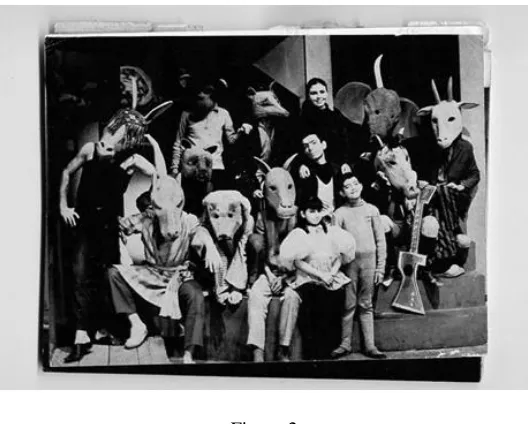
Mofid’s screenplay Shahre Ghese (Figure 2) examines politics through the use of animals.
Shahre Ghese, or City of Story, is set in Iran before the revolution, and the story criticizes Iranian
government policy and traditional beliefs. The characters are mostly animals, and in both
theaterical and film versions actors typically adorn their heads to represent themselves as
particular types of animal. Drawing on Mofid’s screenplay, Shahre Ghese, in some of
Nodjoumi’s paintings the heads of politicians are replaced with that of an ass, conveying a
simultaneous sense of wisdom and absurdity. However, Nodjoumi states that he does not want to
suggest a symbolical expression and declares that he is interested in the absurdity of the
situation, of being funny in a bitter manner.
Figure 2
Drawing on the influence of the above two artists, Nodjoumi also includes other
decorative elements in his work that surprises his audience and interrupts the seriousness of the
subject matter. He contends that he adds these elements to surprise the viewer and to evoke a
Retrieved from: https://birdsconf.wordpress.com/synopsis-of-the-poem/
19
“Mouse and Cat” has been written around 1370 by the persian writer 'Obayd-e Zakani. The story highlights the moral dilemma of the 'supressed' who faces the problem of his own powerlessness. The mice who fight against the domination of the cats, don't simply fail because of their weakness, smallness or fear, they lose because of the cats' 'superiority' in brutality. For the mice no alternative exists.
sense of absurdity. Moreover, Nodjoumi occasionally places characters in his paintings that do
not have any relationship with the other characters in the work or with the situation at hand, in
hopes of creating an interesting image and to surprise the viewer.
Nodjoumi also surprises the viewers of his art by slicing off and/or replacing the top or
bottom of the figures represented in his paintings. He suggests that this distortion of bodies is a
gesture towards the idea of a dual reality. He mentions that, “For many years I had been working
with imagery that dealt with two opposing views in the same painting.”20
This revelation of a
dual reality both surprises his audience and draws attention to the fact that rarely are things as
they first appear or as one might expect them to be. An example of this distortion of bodies can
be seen in his series, “Two View”, that was created to represent the horrors of the American/Iraq
war. In this series, depicted figures are divided into two parts. Each part of the divided figures
represents a different reality and points to the dismemberment of body parts that occurred during
the war. In his paintings, he only cut off the figures vertically or horizontally rather than using a
diagonal division. He explains that he is “looking for ways that would refer to violence, and
dividing the body seems to work as a pictorial motif best (when shown) on vertical and
horizontal planes”. For Nodjoumi, the figures in his paintings are used to surprise his audience
and reveal a previously hidden truth, or duality, that is difficult for the viewer to notice, unless it
is properly dissected. (Figure3 to 4)
20
Figure 3. Nicky Nodjoumi, “Two View”, 2003 Figure 4. Nicky Nojoumi, “Expanded Rules”, 2010
Political Content
The first defiant and critical artistic movement in Iran began before the revolution and
emerged in literature and painting, later manifesting itself through music. The various
movements involved were developed from Communist thought. Many artists consciously or
unconsciously were influenced by the thoughts of the masses. Indeed, many contemporary artists
assumed an active role in the production of political posters, inspired by the French student
movement of 1968 in Paris, France. Iranian contemporary artists also often protested by defacing
public monuments that were built by the Pahlavi regime as a symbol of its authority and
grandeur.21
One of the main ways that contemporary Iranian painters became politically active
leading up to and during the time of the revolution was through the use of symbolism in their art.
Nodjoumi’s work was not exempt from participation in this political art movement that was
fighting through the use of symbolism. Even now that Nodjoumi is seventy-five-years old, he
still remains conscious of the political message that symbols carry in his work and he tries to be
21
Gray Online. “ Iranian Revolutionary Posters”.
conscious of new art movements, techniques, and visual ways of expression. In fact, in contrast
to his use of the symbol, Nodjoumi’s paintings sometimes experiment with direct expression,
which to some degree must stem from his experience as an illustrator and designer of political
posters. For example, Nodjoumi’s paintings that consider how the Iranian government tried to
take advantage of the religious beliefs of its citizens through the use of sacred personas shows
the influence of his previous work in poster design and as a cartoonist.
The symbolic and defiant graffiti painting that took place at the time of the Iranian
revolution also influenced Nodjoumi’s work. Many Iranian graffiti artists used monotone colours
and simple figures that quickly conveyed meaning, inspiring artists such as Nodjoumi.
Propaganda and explicit ways of expression also play a part in Nodjoumi’s interest in graffiti.
Indeed, the background texture of many of Nodjoumi’s paintings (Figure 4) is reminiscent of the
texture of the walls one would encounter walking down a city street, leaving the viewer feeling
as through the painting itself could be a graffiti image on a wall. Moreover, the way that he
combines monotone color and simple images to tell a story functions in the same quick manner
as the graffiti that could be found upon Iran’s city walls. Seemingly, Nodjoumi intends to create
artwork that conveys defiant and politicized meanings both silently and symbolically, and also
loudly and directly.
Narration
One of the many ways that Nodjoumi’s artwork represents his Iranian identity and culture
is through an implementation of narrative in his paintings in a manner that relies heavily on
ancient Iranian texts. Literature is one of the main pillars of visual art history in Iran.
Historically, most Persian painting was done by the order of kings to demonstrate their power
Most of these paintings were based on illustrations and stories found in Iranian ancient texts such
as Shahnameh Books ( Book of Kings), Conference of Birds and Pang Gang (Persian: Five
Jeweles) of Nizami. Even though Iranian painters have slowly begun to shape an autonomous
artistic identity that is free from the state and Iran’s history, the essence of narration still
influences Iranian visual arts. For example, the backgrounds of many of Nodjoumi’s paintings
are adapted from scenes straight out of ancient Iranian storybooks. The paintings below show
historical battle scenes between sacred people, and political representations from the past as main
features of the background. Apparently, Nodjoumi used this combination in an attempt to
illustrate the historical roots of these protests. These backgrounds are portrayed as dreamlike
states existing behind the action, both representing and speaking to the collective memory of
Iranians.22 Nodjoumi achieves this by portraying the icons in a way that seems as though the main personas of the paintings are not aware of them, mirroring the way that collective memory
functions (Figure 5 to 6).
22
Figure 5 Figure 6
In contrast, some of Nodjoumi’s other paintings offer the audience an empty background and
still implement the use of full size figures. This emptiness helps the viewer to engage in the
depth of the image and foregrounds the action of the figures. For Nodjoumi, sometimes the most
productive way to portray a message is to let the main characters of the painting tell the story. He
believes that in some cases using a full size figure against a sparse background creates a sense of
monumentality, and opens up a dialogue between a specific time and place and a nonspecific
reality, all in hopes of drawing his audience into the story he is trying to tell.
As well as Iran’s narrative literary tradition, there was a tradition called “Pardeh Khani,”
a traditional and historical style of Iranian theatre during which stories were told that were based
on pictures that were painted on a curtain (Figure 7). These stories were mostly religious and
historical and often represented the social issues that the government of Iran continually
struggled to address. As such, it is not surprising that various Nodjoumi’s paintings, depict the
political themes and narrative qualities that would be found upon a curtain designed for Pardeh
Khani (see Figure 5). Without doubt, Nodjoumi’s use of Iranian narration throughout his work
Figure 7
Western Influence
Even though Nodjoumi’s work clearly draws on a variety of Iranian narrative artistic
approaches, Nodjoumi believes that he is more greatly influenced by the work of Western artists
than by his ties to his homeland or the education he received in either Iran or America. Chances
are that he is right, as it is easy to find similarities between Nodjoumi’s works and that of
Western figurative painters. Many critics and fans of his art suggest that he is the student of
Mohsen Vaziri Moghadam; however, he primarily considers himself a student of Javad
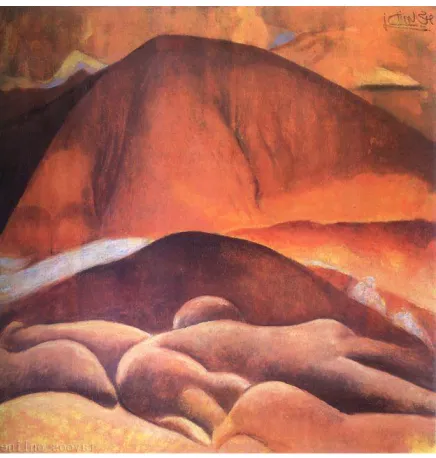
Hamidi.23 For example, his method of cutting and simplifying surfaces and monotone way of depicting individuals is similar to Hamidi’s methods. Even his signature deformation of his
figures can be traced back to Hamidi’s impact (Figure 8). Nodjoumi composition of surfaces
resembles the simplicity that exists in Hamidi’s compositions. Importantly, Hamidi, an Iranian
painter and poet, studied for his graduate degree in Paris, where he was the student of Matisse.24 Consequently, the impact of Matisse’s Western approach that appears prominent in Hamidi’s
work can be seen as flowing from Hamidi and into Nodjoumi’s art.
23
Ibid. 4
24
Figure 8. Javad Hamidi,”The hills”
As well being influenced by Matisse through Hamidi, Nodjoumi also believes that the
West shapes his work through his admiration of Picasso. Nodjoumi’s interest in Picasso’s art, in
particular his rose period, explains the use of decorative elements such as the use of colorful
diamond texture in Nodjoumi’s painting. Moreover, the way that Nodjoumi placed the vertical
gestures of figures in the composition of his work, and his choice of color pallet – a combination
of grayish color with sharp color – resembles Picasso’s rose-period painting. (Figure 9 to 10)
Critics have also found similaries between Nodjoumi’s art and the work of Western
painters Neo Rauch.25 For example, Rauch’s and Nodjoumi’s works are both large in scale and utilze a collage approach to develop composition. In terms of similatirites between the work of
Nodjoumi and the other western artists, as an example, Leon Gulob and Nodjoumi both explore
the dynamics of power with subversive observations. Both artists use color and surfaces to reveal
a paradox of simplicity and complexity, and utilize a simple background to accentuate figures in
the foreground and thus confront the viewer directly with their subject matter. Additionally, they
both paint perspectives from the front view and the composition of their works make the viewer
feel as though they are watching the scene on a street. In comparison, the free representation seen
in Nodjoumi’s work is also similar to that of Kentridge’s. Both of them are inspired by graffiti,
and the sketch-like form of their representations creates a free sense of execution that resembles
drawing. All of these connections between Nodjoumi’s work and Western painters suggest that
even though he makes use of the narrative Iranian approach to tell a story with his paintings, a
strong Western influence cannot be ignored.
In addition, this approach in Nodjoumi’s painting is also something that can be seen in
emerging Iranian artists. The influence of Western styles of art expression and the integration of
oriental and other cultural elements resonate through the work of many emerging Iranian artists
that are working out of Iran such as Shirin Fakhim, Behdad Lahouti, Shadi Ghadirian, Arman
Estefanian, and Rokni Herizadeh. For example, Rokni Haerizadeh is an Iranian artist born in
1978 who currently lives and works in Dubai. His direct way of expression led him abandon Iran
in his early career.26 Although he never talks about inspiration from artists such as Nodjoumi, there is seemingly an inherent Iranian identity that runs throughout his work. This is
25
Ibid.4
26
understandable, as the impact of war and politics can affect an artist’s life and their work in a
variety of long-lasting ways. Because of Nodjoumi’s interest in political issues, he always
follows current events, and even uses the images of newspapers as a reference in his painting.27 Haerizadeh says that he is “re-appropriating the tradition of Orientalism”28
with his way of
“extrinsic idealization.”29
In the Fictionville (Figure 11) series by Haerizadeh, he also uses
newspaper images as the basis of his art. In this series, like Nodjoumi, he uses hybrid human
animals for his narration to refer to the “violence in media without being judgmental of offering
a moral lesson.”30
The flavor of his art is rife with humor, and is similar to Nodjoumi’s work in
that it draws attention to propaganda and the effects of the news. This indicates that even though
Haerizadeh, as a new generation of Iranian artist, has a different lived experience than Nodjoumi,
he also tends to express what they have experienced through contemporary art with a vivid sense
of humor.
Figure11. Rokni Haerizadeh, Fictionville series, 2013
27
Ibid. 4
28
Saatchi Gallery. “Rokni Haerizadeh: Exhibited at the Saatchi Gallery”. http://www.saatchigallery.com/artists/rokni_haerizadeh_articles.htm
29
Ibid.21
30
Nodjoumi explains that “Humor and satire play a fundamental role in my painting in
order to be more effective in portraying violence, brutality and displacement; I use humor as an
instrument of my visual and conceptual vocabulary.”31
He states that “political art is not
necessarily beautiful. Its goal is not to be beautiful but to create a trigger. This trigger must be
instant, steady, and different from normal beauty.”32
The satirical language of Nodjoumi’s
painting, as a Middle Eastern artist who has been engaged in upheavals in various decades during
his life, marries politics with aesthetics and offers a sophisticated framework with a critical point
of view, embodying a particular imagination that is generated by his personal experiences and
political consciousness and offers some level of awareness regarding current world events.
Hamid Dabashi,33 during an interview with Nodjoumi, suggests that “insurgence against tyranny and social outcries are formed in the mind of artist before they take hold in politics and society,”
and that “street protest can be controlled with oppressive force but a creative mind can never be
oppressed or silenced”.34
31
Huffingtonpost. “Iranian Artist Nicky Nodjoumi Talks Revolutions, Secret Police And The Vietnam War”. Accessed on Sep 4, 2013. http://www.huffingtonpost.com/2013/09/04/nicky-nodjoumi_n_3861591.html?utm_hp_ref=arts
32
Youtube. “Week in Green - Episode 30: Interview with Nicky Nodjoumi”. Accessed on Sep 3, 2010. https://www.youtube.com/watch?v=yH3-3zYBE2k
33
Hamid Dabashi is the Hagop Kevorkian Professor of Iranian Studies and Comparative Literature at Columbia University. He received a dual Ph.D. in Sociology of Culture and Islamic Studies from the University of Pennsylvania in 1984, followed by a postdoctoral fellowship at Harvard University. Professor Dabashi has written eighteen books, edited four, and contributed chapters to many more. He is also the author of over 100 essays, articles, and book reviews on subjects ranging from Iranian Studies, medieval and modern Islam, and comparative literature to world cinema and the philosophy of art (trans-aesthetics). His books and articles have been translated into numerous languages, including Japanese, German, French, Spanish, Danish, Russian, Hebrew, Italian, Arabic, Korean, Persian, Portuguese, Polish, Turkish, Urdu, and Catalan.
Retrieved from: http://www.columbia.edu/cu/mesaas/faculty/directory/dabashi.html
34
List of Figures
Figure1. Mohassess, Ardeshir. “Photo tour through the exhibition in paris”. Retrieved from:
http://universes-in-universe.org/eng/nafas/articles/2014/unedited_history_iran/photo_tour/modernisation_1960_197
8/ardeshir_mohassess_2
Figure 2. Cabinet Magazin. “ Screening Shahre-e Ghese”. Accessed Feb. 26, 2010.
http://www.cabinetmagazine.org/events/shahr-e.php
Figure 3. Artnet. “ Artist Nicky Nodjoumi: Two View series”. Retrived from:
http://www.artnet.com/artists/nicky-nodjoumi/two-views-series-an-iranian-woman-Qjg-qbHSchTSnsKGZwVzug2
Figure 4. The Brooklyn Rail. “In conversation: Nicky Nojoumi with Phong Bui”. Accessed Nov.
5, 2010. http://www.brooklynrail.org/2010/11/art/nicky-nodjoumi-with-phong-bui
Figure 5. Tymour Grahne Gallery. “ Artist Nicky Nodjoumi”. Retrieved from:
http://www.taymourgrahne.com/artists/nicky-nodjoumi
Figure 6. Miller, Kristine. “Art in Exile: Artist Nicky Nodjoumi from Tehran to Brooklyn”.
Accessed Oct. 12, 2012. http://www.pbs.org/newshour/slideshow/multimedia-nodjoumi/
Figure 7. Matboatfars News. “ghahveh khaneh paintings’ exhibition “. Accessed Aug. 1, 2016.
http://www.matboatfars.com/newsThread.aspx?ID=1147
Fifure 8. Youtube. “Javad Hamidi By Farivar Hamzeyi”. Accessed April 23, 2011.
https://www.youtube.com/watch?v=YOWkEuxXBuI
Figure 9. Pablo Picasso Organization. “ Pablo Picasso’s Rose Period- 1904 to 1906”. Retrieved
from: http://www.pablopicasso.org/rose-period.jsp
Figure 10. Curator. “study for Walk at the Margin, 2014 by Nicky Nodjoumi”. Accessed Nov.
Figure 10. Carnegie Museum of art. “Fictionville: Artist Rokni Haerizadeh”. Retrieved from:
Bibliography
Aljazeera. “Politics on canvas: Nicky Nodjoumi and the New York enclave”. Accessed
Oct. 24, 2013.
http://www.aljazeera.com/indepth/opinion/2013/10/politics-canvas-nicky-nodjoumi-new-york-enclave-2013102061833355112.html
Columbia University. “Middle Eastern, South Asian, African Studies (Hamid Dabashi)”.
http://www.columbia.edu/cu/mesaas/faculty/directory/dabashi.html
Huffingtonpost. “Iranian Artist Nicky Nodjoumi Talks Revolutions, Secret Police And The Vietnam War”. Accessed on Sep 4, 2013.
http://www.huffingtonpost.com/2013/09/04/nicky-nodjoumi_n_3861591.html?utm_hp_ref=arts
Iran Chamber Society. “Qahveh Khanehei Painting (Tea house Style of Painting). Accessed
Aug. 2, 2016. http://www.iranchamber.com/art/articles/qahveh_khanehei_painting.php
Gray Online. “ Iranian Revolutionary Posters”.
http://www.nyu.edu/pages/greyart/exhibits/iran/imageposters/index.html
Moosh-o- gorbeh. “About Mice and Cat”. Retrieved from:
http://moosh-o-gorbeh.farangis.de/
Naomi Lev, “Rokni Haerizadeh”. Artforum, Aug.25, 2014.
http://artforum.com/words/id=48045
New York Times. ” Ardeshir Mohassess, Iranian Cartoonist, Is Dead at 70”. Accessed Oct.
20, 2008. http://www.nytimes.com/2008/10/20/arts/design/20mohassess.html?_r=0
The Brooklyn Rail. “In conversation: Nicky Nojoumi with Phong Bui”. Accessed Nov. 5,
2010. http://www.brooklynrail.org/2010/11/art/nicky-nodjoumi-with-phong-bui
Taymour Garahne Gallery. “Artist Nicky Nodjoumi”.
Taymour Grahne Gallery. “Artist Nicky Nodjoumi’s profile”.
http://www.taymourgrahne.com/artists/nicky-nodjoumi
Pakbaz, R. (2002). Encyclopedia of Art (3rd ed.). Tehran: Farhang-e Moaser.
Saatchi Gallery. “Rokni Haerizadeh: Exhibited at the Saatchi Gallery”.
http://www.saatchigallery.com/artists/rokni_haerizadeh_articles.htm
Stefan Stux Gallery. “ Shirin Neshat: Nicky Nodjoumi Paintings”.
www.stuxgallery.com/attachment/en/.../566aeefd4bd750386e89eed2
Youtube. “Week in Green - Episode 30: Interview with Nicky Nodjoumi”. Accessed on
Curriculum Vitae
Mina Moosavipour
Education
2014-2016 MFA in Visual Arts, University of Western Ontario, London, Canada
2005-2008 M.A in Illustration, Tehran University of Art, Tehran, Iran
2000-2004 B.A in Painting, Sooreh University, Tehran, Iran
Solo Exhibitions
2013 Momentum, Atbin Art Gallery, Tehran, Iran
2006 Music Player, Hoor Art Gallery, Tehran, Iran
Group Exhibition
2015 Selected group print work Exhibition, Art project Gallery, London, ON,
Canada
2010 Selected group illustration exhibition, Khial Art Gallery, Tehran, Iran
2008 Second International Exhibition of Monotheistic Religions (Illustration), Emam
Ali Museum, Tehran, Iran
2007 Dream and Wishes, Meridian International Center- Cafritz Gallery, Washington DC, USA
2004 Selected group painting exhibition, Tarahan Azad Gallery, Tehran, Iran
Honors and Awards
2014-2015 University of Western Ontario Dean’s Entrance Scholarship
2008 Runner up in the Second International Award of Monotheistic Religions (Illustration), Tehran, Iran
Collections
Tehran Municipal Organization of Art and Culture
Publications and Contributions
2007 Catalogue of Artists’ Statements for Dream and Wishes exhibition, Meridian International Center
Published Books
2010 Illustrating “Paradise” children’s book, Tehran, Iran
Graduate Course Work
Thesis
Mina Moosavipour, MA Thesis, Supervisor: Dr. Mostafa Naderloo “Contemporary children’s book Illustration of South Korea”.
Teaching experiences
A. Teaching
2008-2011 Teaching Painting and Sculpturing, Derakhshan kindergarten, Tehran, Iran
2007-2009 Teaching Painting, Drawing and Art History, Zohreh vocational public school, Tehran, Iran
B. Teaching Assistant
2015-2016 Teaching Assistantship, Foundation Art, Professor Johnson, Department of Visual Arts, Western University